AI for Back Office: Transform CRE Operations in 2026
AI for Back Office: Transform CRE Operations in 2026
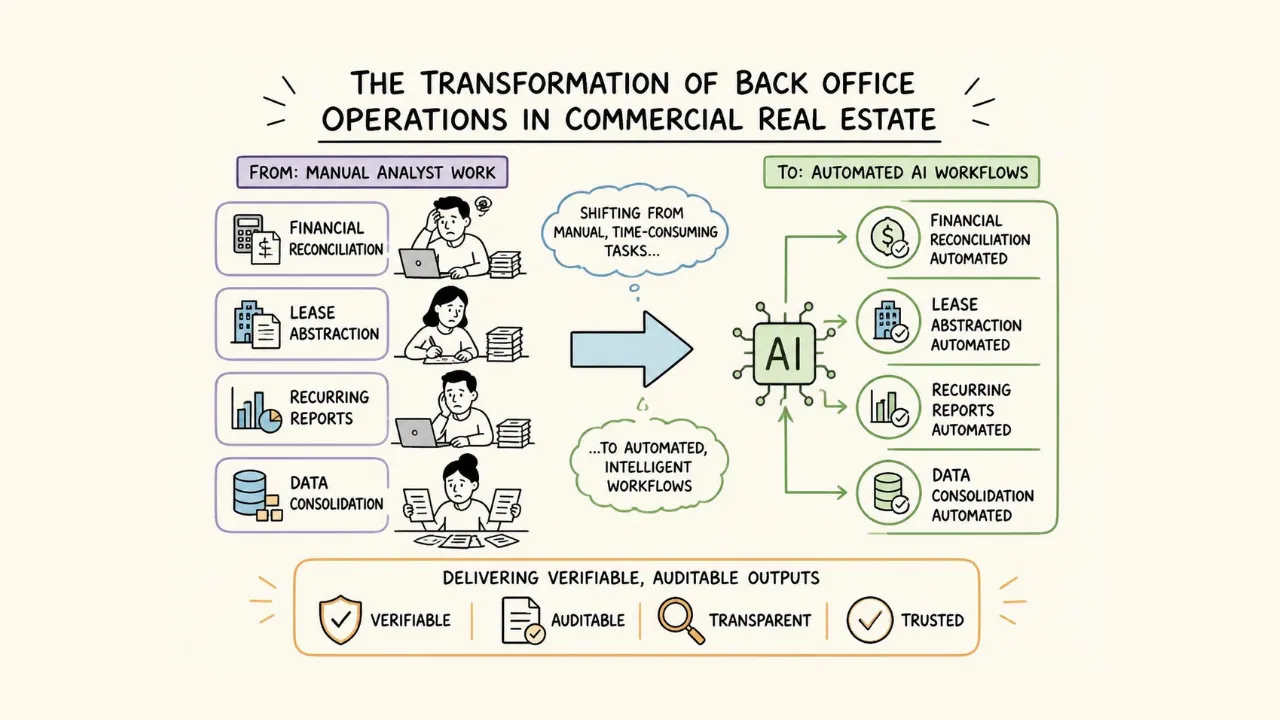
The back office is where commercial real estate deals slow to a crawl. Asset managers, acquisitions teams, and portfolio operators spend countless hours on financial reconciliation, lease abstraction, recurring investor reports, and data consolidation across disconnected systems. These tasks consume analyst time while delivering minimal strategic value, yet they're essential for accurate decision-making. The emergence of AI for back office functions promises to fundamentally change this equation, but only when the technology delivers verifiable, auditable outputs that financial professionals can trust.
Understanding the Back Office Burden in Commercial Real Estate
The back office represents the operational foundation of any commercial real estate firm. Every property acquisition, asset management decision, and portfolio optimization depends on accurate data flowing through these functions.
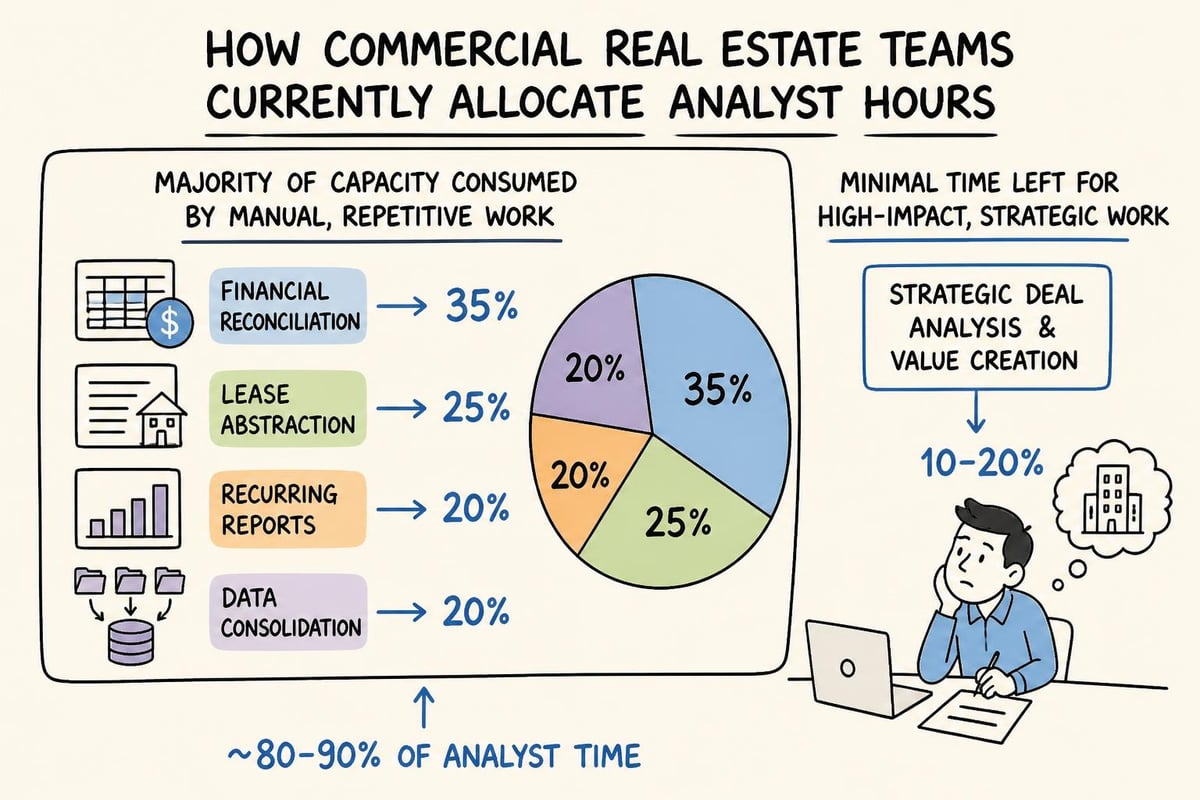
Where Analyst Hours Disappear
Financial reconciliation alone consumes 15-25 hours per property per month for most asset management teams. Analysts manually compare rent rolls against general ledgers, validate vendor invoices against budgets, and reconcile property management system outputs with accounting records. A single discrepancy can trigger hours of investigation across multiple data sources.
Lease abstraction presents an even more time-intensive challenge. Extracting key terms from a 50-page commercial lease requires 2-4 hours of focused work from an experienced analyst. Multiply that across a 30-property portfolio with 200+ tenants, and you're looking at hundreds of analyst hours quarterly just to maintain current lease data.
The cost in time is only part of the story. Manual processes introduce error risk at every step:
Transcription errors when moving data between systems
Missed escalations or renewal options buried in lease language
Calculation mistakes in multi-step financial reconciliations
Version control issues when multiple analysts touch the same file
According to research on how AI is transforming finance back-office operations, these manual processes create bottlenecks that delay strategic decision-making and increase operational risk.
The Strategic Cost of Back Office Inefficiency
When back office functions consume analyst capacity, firms face a hidden strategic tax. Your highest-value team members spend their time on data validation rather than deal analysis.
Time Allocation Reality
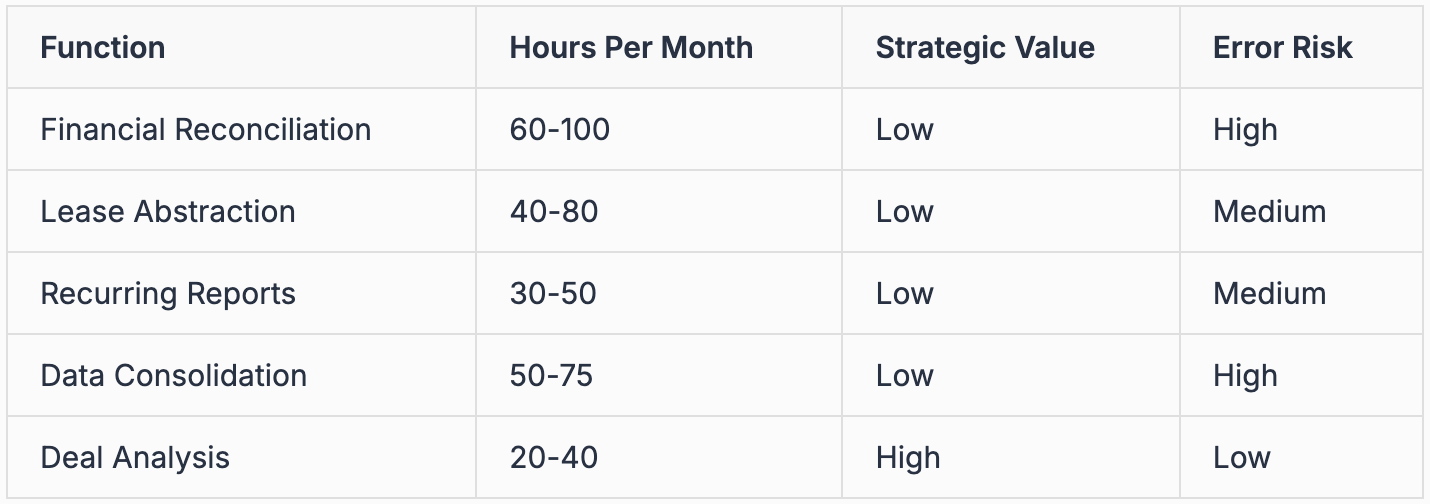
The numbers tell a clear story. Back office tasks consume 180-305 hours monthly while deal analysis, the highest-value activity, gets only 20-40 hours. This inverted time allocation means firms are optimizing for operational maintenance rather than growth.
Recurring investor updates exemplify this problem. Every quarter, teams spend 30-50 hours pulling data from property management systems, formatting presentations, validating metrics, and creating commentary. The work is essential but repetitive. The analyst doing it could be underwriting the next acquisition instead.
How AI for Back Office Operations Changes the Equation
The promise of AI for back office automation has been discussed for years, but 2026 marks a turning point. Purpose-built systems now deliver the accuracy and verifiability that financial operations demand.
Beyond Generic AI Models
Generic large language models create as many problems as they solve in back office applications. They generate plausible-sounding outputs that don't tie out when you check the numbers. An AI that extracts lease data with 85% accuracy means your team still needs to validate every field, eliminating the time savings.
BullshitBench, an industry benchmark for AI accuracy in financial tasks, reveals the gap. Most general-purpose models score between 60-75%. They hallucinate numbers, miss critical clauses, and produce outputs that require extensive manual verification.
The back office demands a different standard. When you're reconciling actual cash flows, preparing investor reports, or extracting critical data from lease documents, 85% accuracy isn't acceptable. You need outputs you can audit and verify.
What Accurate Back Office AI Looks Like
Direct source linking: Every extracted data point traces back to its source document with page and paragraph references
System integration: Native connections to property management platforms like Yardi, RealPage, and Entrata eliminate manual data transfer
Multi-step task execution: The AI completes entire workflows autonomously rather than requiring human handoffs
Verifiable calculations: All financial outputs show their work with formula transparency
Audit trails: Every automated action logs for compliance and review
These capabilities separate AI tools that truly automate back office functions from those that simply add another step to your workflow. As Deloitte's research on uncovering hidden value through back-office AI demonstrates, the key is choosing systems built for financial accuracy rather than general-purpose assistance.
Transforming Core Back Office Functions
Each major back office function requires a different approach to AI automation. The technology must handle the specific complexities that make these tasks time-consuming in the first place.
Financial Reconciliation Automation
AI for back office financial reconciliation eliminates the manual comparison work that consumes analyst hours. The system pulls data directly from your property management platform, cross-references it against general ledger entries, identifies discrepancies automatically, and flags issues for review.
The process runs continuously rather than monthly. Instead of discovering a three-month-old billing error during quarterly reconciliation, the AI catches it within days. This real-time reconciliation transforms back office operations from reactive cleanup to proactive monitoring.
Key automation capabilities:
Automated variance detection across rent rolls and GL
Invoice matching against approved budgets and contracts
CAM reconciliation with tenant-specific formulas
Bank statement reconciliation with automated categorization
The time savings compound quickly. What took 60-100 analyst hours monthly now requires 5-10 hours of exception review. More importantly, the continuous monitoring catches errors before they cascade through financial statements.
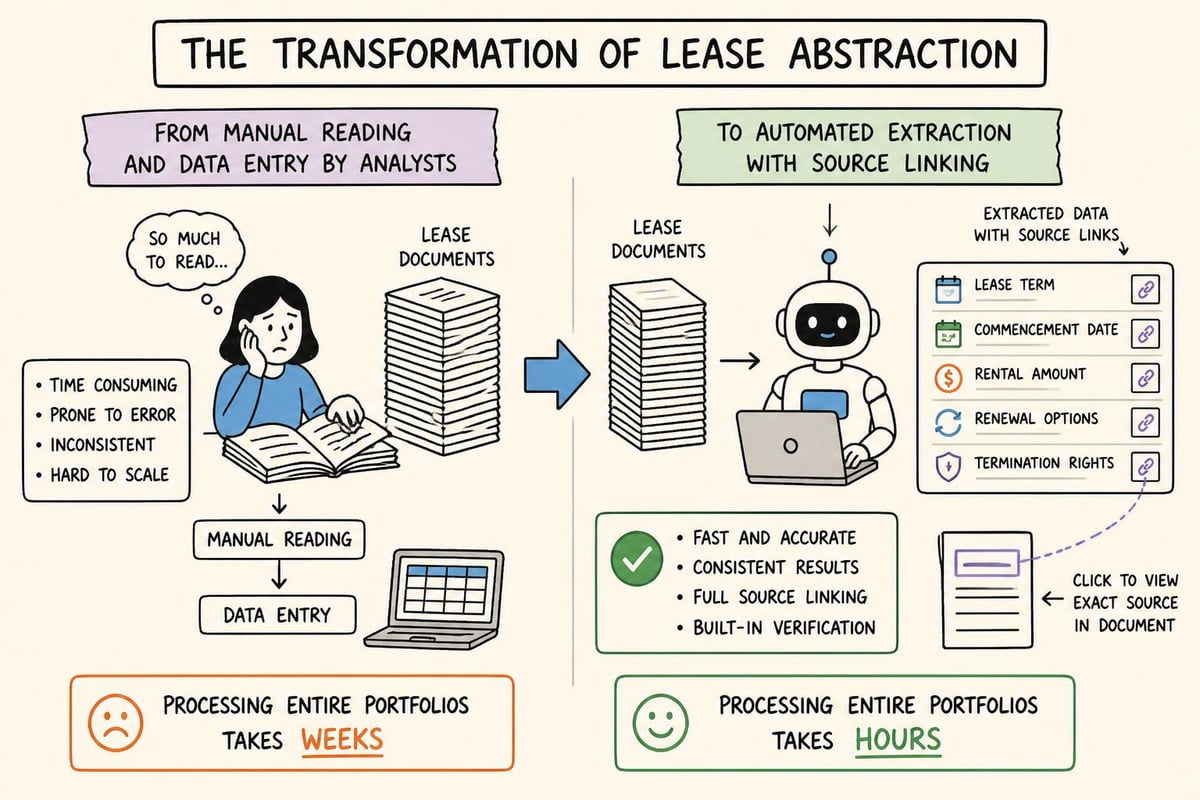
Lease Abstraction at Scale
Manual lease abstraction creates a permanent bottleneck in portfolio operations. Every lease amendment, every new tenant, every renewal requires analyst time to extract and validate key terms.
AI designed for lease abstraction processes entire documents in minutes. It identifies base rent, escalations, renewal options, termination clauses, tenant improvement allowances, and hundreds of other data points. Most critically, it links every extracted value back to the source clause so teams can verify accuracy without re-reading the entire document.
For lease data automation in multifamily properties, where portfolios may include thousands of leases, this capability transforms operations. Teams can analyze portfolio-wide renewal exposure, model rent growth scenarios, and identify optimization opportunities that were previously buried in individual lease files.
Recurring Reports That Write Themselves
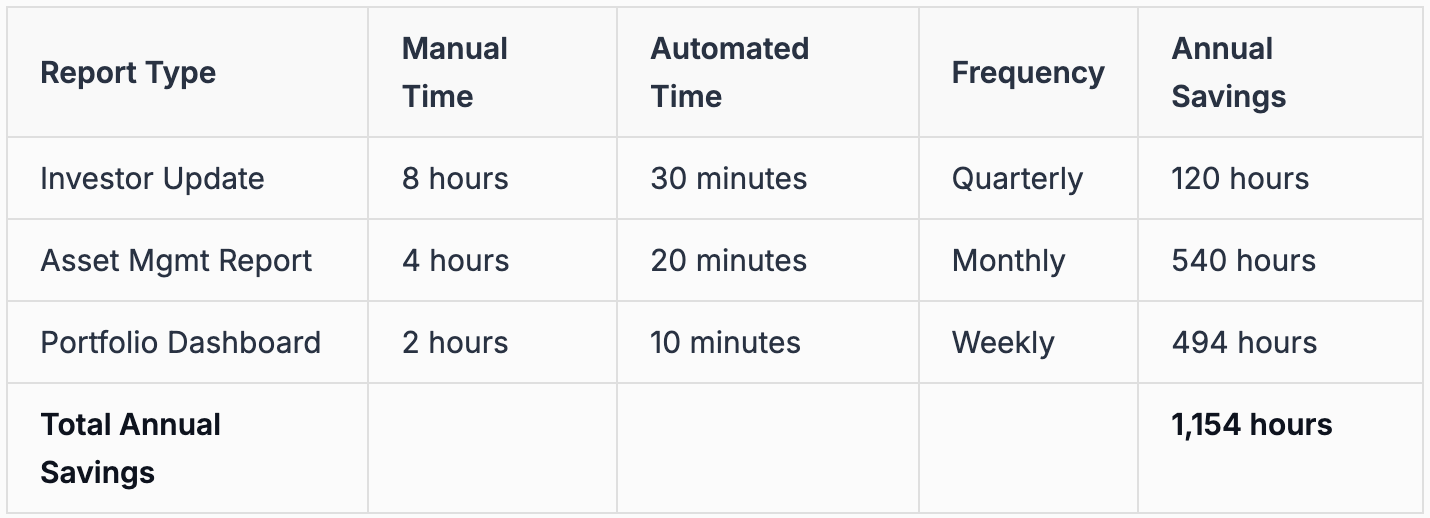
Quarterly investor updates, monthly asset management reports, and weekly portfolio dashboards all follow predictable formats. The content changes, but the structure remains constant. This makes them ideal candidates for AI automation.
AI for back office reporting pulls current data from connected systems, applies your established templates and formatting, generates commentary based on metric changes, and produces complete reports ready for review. The analyst role shifts from data gathering and formatting to strategic review and enhancement.
The efficiency gains scale with portfolio size. A team managing 50 properties might produce 200+ recurring reports annually. Automating this workload frees thousands of analyst hours for higher-value activities like market research and strategic planning.
Data Consolidation Across Systems
Commercial real estate firms operate across fragmented technology ecosystems. Property management data lives in Yardi or RealPage. Financial data sits in accounting software. Market data comes from third-party providers. Deal documents exist in shared drives.
Consolidating this data for analysis traditionally requires extensive manual export, import, and transformation work. An analyst preparing a portfolio review might spend 15-20 hours just gathering and standardizing data from these disconnected sources.
AI for back office data consolidation connects directly to these systems through APIs and automated integrations. It pulls current data on demand, standardizes formats automatically, and maintains a unified data model that updates continuously. When you need portfolio analytics, the data is already consolidated and current.
This capability proves especially valuable for financial modeling and underwriting, where analysts need to combine historical property performance, current market conditions, and forward-looking assumptions into integrated models.
The Accuracy Imperative in Back Office AI
Automation without accuracy creates more problems than it solves. A back office AI that produces outputs requiring extensive validation hasn't truly automated anything. It has simply changed which manual tasks consume analyst time.
Why Most AI Falls Short
Generic AI models trained on broad datasets lack the domain expertise and precision required for financial operations. They might understand general language patterns, but they don't understand commercial real estate lease structures, accounting reconciliation logic, or investment analysis frameworks.
The result is outputs that look correct on the surface but contain subtle errors. A base rent calculation that's off by $500 monthly. An escalation clause that's misinterpreted. A renewal option that's missed entirely. These errors compound through financial models, investor reports, and strategic decisions.
Industry benchmarks reveal the gap. On BullshitBench, which tests AI systems on financial accuracy and hallucination avoidance, most general-purpose models score 60-75%. Purpose-built systems designed for financial operations score above 95%. That 20-30 point difference determines whether the AI truly automates work or simply creates a new validation burden.
The Verifiability Standard
Back office operations in commercial real estate require auditable outputs. When you present numbers to investors, lenders, or investment committees, you need to show your work. AI outputs must meet this same standard.
Verifiable AI provides:
Direct links to source documents for every extracted data point
Transparent calculation formulas showing how numbers were derived
Audit trails documenting every automated action and decision
Version control tracking changes over time
This verifiability transforms AI from a black box into a transparent analyst that shows its work. Teams can spot-check outputs, understand reasoning, and maintain the same level of control they had with manual processes while gaining massive efficiency improvements.
SOC 2 Type 2 certification provides additional assurance that the AI platform meets enterprise security and compliance standards. For firms handling sensitive financial data across large portfolios, this certification is non-negotiable.
Implementing AI for Back Office Operations
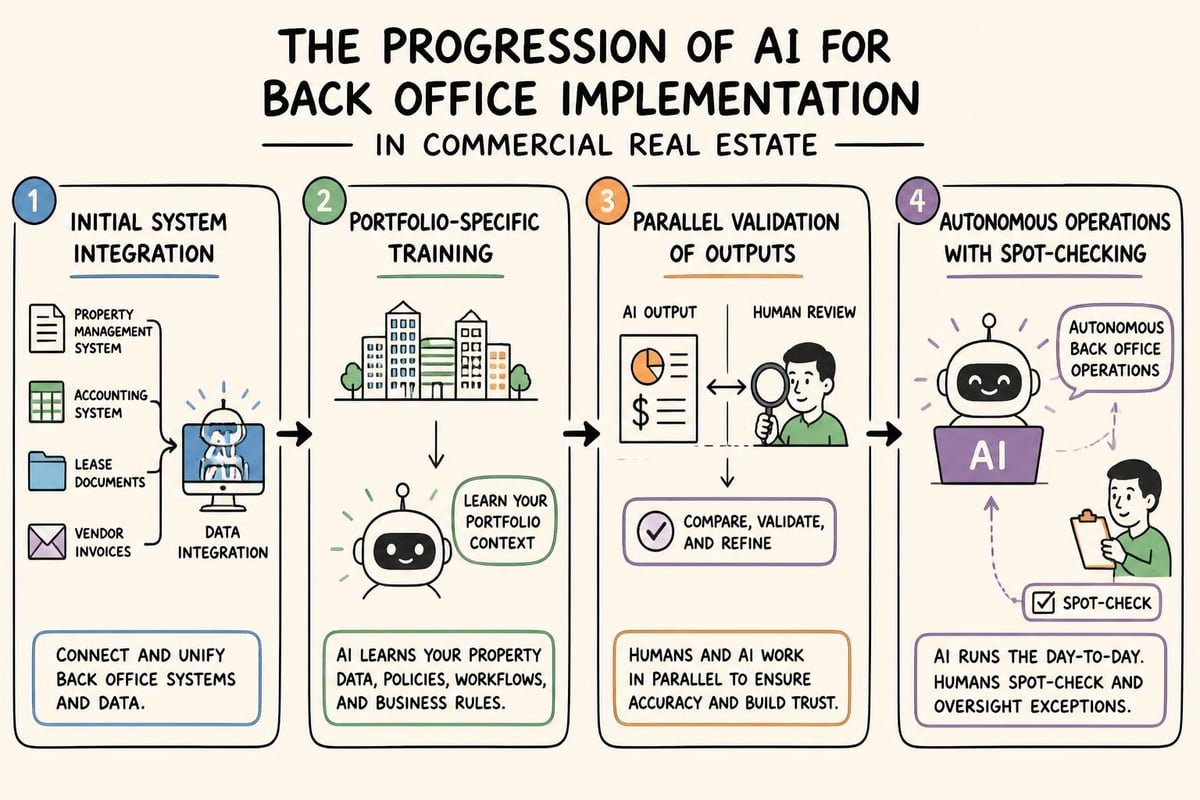
Moving from manual back office processes to AI automation requires a structured implementation approach. The technology needs to integrate with existing systems, learn your specific workflows, and deliver value quickly.
Integration with Existing Systems
The first step is establishing connections between your AI platform and core data sources. For commercial real estate operations, this typically includes:
Property management systems (Yardi, RealPage, Entrata) for rent rolls, lease data, and operational metrics
Accounting platforms for general ledger data and financial statements
Document repositories for leases, operating memoranda, and deal files
Market data providers for comparable property information and market research
Native integrations through APIs deliver better results than file-based imports. The AI can pull current data on demand rather than working from static exports that become outdated.
Training on Your Portfolio
AI for back office operations becomes more accurate as it ingests more data. The system learns your specific lease structures, property types, accounting conventions, and reporting formats.
Initial training involves:
Processing historical leases to understand your portfolio's lease structures
Analyzing past financial reports to learn your formatting and commentary standards
Reviewing existing property management data to establish baseline metrics
Studying investment memos and presentations to understand your analytical approach
This training creates a foundation of domain knowledge specific to your operations. The AI doesn't just understand commercial real estate generally. It understands your commercial real estate portfolio specifically.
Validating Outputs Initially
Even with high accuracy rates, teams should validate AI outputs during initial implementation. This validation serves two purposes: it confirms the AI is performing correctly, and it builds team confidence in the automated outputs.
Recommended validation approach:
Start with a small subset of properties or tasks
Compare AI outputs against manual processes in parallel
Document any discrepancies and understand root causes
Expand scope as validation confirms accuracy
Transition to spot-checking rather than full validation after 30-60 days
This measured rollout minimizes risk while accelerating time to value. Teams often discover the AI is more accurate than manual processes during this validation phase, particularly for high-volume, repetitive tasks where human attention naturally wanes.
Measuring Back Office AI Impact
The value of AI for back office automation extends beyond simple time savings. Firms experience improvements across multiple operational dimensions.
Quantifiable Efficiency Gains
Track these metrics to measure AI impact on back office operations:
Hours saved per analyst per week on reconciliation, abstraction, and reporting tasks
Time to complete recurring reports comparing manual versus automated processes
Data consolidation time for portfolio-wide analysis and investment committee materials
Error rates in financial reconciliation and lease data accuracy
Cycle time from data request to deliverable completion
Most firms implementing accurate back office AI see 60-70% time reduction on automated tasks within the first quarter. This translates to hundreds of hours monthly that redeploy to strategic work.
Strategic Capacity Creation
The more important metric is what teams do with reclaimed capacity. When analysts spend less time on back office tasks, they have more capacity for:
Additional deal analysis and underwriting
Deeper market research and competitive intelligence
Portfolio optimization and value-add strategies
Investor relationship building and communication
Strategic planning and business development
This shift from operational maintenance to strategic value creation compounds over time. Firms don't just operate more efficiently. They make better investment decisions because their best people focus on analysis rather than data wrangling.
Risk Reduction Benefits
Automated back office processes also reduce operational risk. Manual data entry creates transcription errors. Rushed reconciliation work misses discrepancies. Spreadsheet formulas break when file structures change.
AI for back office operations eliminates these error vectors. The system processes data consistently, applies logic uniformly, and maintains audit trails automatically. When errors do occur, they're systematic and fixable rather than random and recurring.
For firms managing institutional capital, this risk reduction directly impacts fiduciary responsibilities and regulatory compliance. Investor reports with verifiable data sources, reconciliations with complete audit trails, and lease abstractions with source document links all strengthen operational integrity.
The Future of Back Office Operations
Looking ahead, the back office will become increasingly autonomous. Firms will shift from asking "Can AI handle this task?" to "Which tasks still require human judgment?"
When Grunt Work Runs Itself
Imagine a back office where financial reconciliation happens continuously in the background. Discrepancies generate alerts rather than consuming analyst hours. Lease abstractions complete automatically as new documents arrive. Recurring reports generate themselves based on current data and distribute on schedule.
This automated back office environment enables:
Real-time portfolio visibility instead of monthly reporting cycles
Immediate access to consolidated data across all systems and properties
Instant responses to investor questions with verifiable source links
Proactive identification of optimization opportunities buried in operational data
Complete analyst focus on strategic analysis and decision support
The transformation parallels how other industries have automated transactional work. Just as ATMs didn't eliminate banking but freed bankers to focus on relationship management and advisory services, AI for back office operations doesn't eliminate analyst roles. It elevates them to strategic contributors rather than data processors.
Continuous Improvement Through Data
AI systems improve as they ingest more data. Each processed lease teaches the system more about your portfolio's lease structures. Each completed reconciliation refines understanding of your accounting conventions. Each generated report better aligns with your communication preferences.
This continuous learning creates a compounding advantage. The AI becomes more accurate and more aligned with your specific operations over time. Teams using purpose-built platforms for commercial real estate analytics benefit from this accumulating expertise across all back office functions.
Industry-Wide Transformation
As more firms adopt AI for back office operations, industry expectations will shift. Investors will expect real-time portfolio reporting. Lenders will require instant access to verifiable financial data. Investment committees will demand faster turnaround on deal analysis.
Firms still relying on manual back office processes will find themselves at a competitive disadvantage. The teams that embrace accurate, verifiable back office AI now will set the operational standard for the industry going forward.
Research from Banking Dive on how CFOs are leveraging AI for back-office tasks shows this transformation is already underway across financial services. Commercial real estate firms that delay implementation risk falling behind in operational efficiency and analytical capability.
Choosing the Right Back Office AI Platform
Not all AI platforms deliver the accuracy and verifiability that back office operations require. Selecting the right technology determines whether you achieve true automation or simply add another tool that requires extensive oversight.
Critical Evaluation Criteria
Accuracy benchmarks: Demand transparency on performance metrics. How does the platform score on independent benchmarks like BullshitBench? What accuracy rates can you expect for lease abstraction, financial reconciliation, and data extraction?
Source verifiability: Can you trace every output back to its source? Do extracted data points link directly to source documents? Are calculations transparent with visible formulas?
System integrations: Does the platform connect natively to your property management system, accounting software, and document repositories? Or does it require manual file exports and imports?
Domain specialization: Is this a general-purpose AI adapted for real estate, or a purpose-built platform designed specifically for commercial real estate operations?
Security and compliance: Is the platform SOC 2 Type 2 certified? Does it meet enterprise security standards for handling sensitive financial data?
Purpose-Built Versus General-Purpose
General-purpose AI platforms offer broad capabilities across many use cases. Purpose-built platforms specialize in specific domains and deliver higher accuracy in those areas.
For back office operations in commercial real estate, domain specialization matters enormously. A platform that understands lease structures, property management workflows, and investment analysis conventions will outperform a general tool adapted to these tasks.
The difference shows most clearly in accuracy rates and the need for manual verification. General-purpose platforms might automate the initial pass at a task but still require extensive human review. Purpose-built platforms deliver outputs teams can trust and use directly.
Implementation and Support
Consider the implementation timeline and ongoing support model. How long does integration take? What training does the vendor provide? How does the platform improve over time as it learns your portfolio?
The best AI for back office operations becomes more valuable with use. The system learns from every lease processed, every reconciliation completed, every report generated. This continuous improvement separates platforms that deliver static automation from those that become increasingly sophisticated analytical partners.
The back office has been commercial real estate's persistent efficiency bottleneck, consuming analyst capacity on essential but low-value tasks like reconciliation, abstraction, and reporting. AI for back office operations finally solves this problem, but only when the technology delivers the accuracy and verifiability that financial operations demand. Leni represents this new standard: purpose-built for commercial real estate with 98% accuracy on BullshitBench, SOC 2 Type 2 certification, and verifiable outputs with direct source links. When your back office runs itself, your team focuses on what actually drives portfolio value.

Johanna Gruber
Johanna has spent the last 8 years helping marketing teams connect with audiences through content. Specializing in B2B SaaS and real estate.

Curious About AI?
Join the largest AI community for real estate online. Get bite-sized, real-world use case videos, plus practical tips and proven strategies from top industry experts on adopting AI effectively.
MEET LENI
AI SuperAgent Purpose Built for Investors and Operators.
Experience how professionals and teams in your domain are getting the edge using AI.