AI for Property Managers: A 2026 Implementation Guide

AI for Property Managers: A 2026 Implementation Guide
Property managers spend an estimated 15-20 hours per week on manual reporting tasks. Between consolidating data from multiple property management systems, chasing down maintenance records, extracting critical numbers from lease documents, and assembling monthly owner reports, the administrative burden leaves little time for strategic portfolio optimization. The repetitive nature of these tasks makes them perfect candidates for automation, yet many property managers remain uncertain about where artificial intelligence delivers genuine value versus empty promises. This guide walks through the specific workflows where ai for property managers creates measurable impact in 2026.
Understanding Where AI Creates Real Value in Property Management
The distinction between useful AI and vaporware comes down to specificity. General-purpose chatbots might answer questions, but they cannot autonomously pull rent roll data from Yardi, cross-reference it against lease expiration schedules, and generate formatted owner reports with variance analysis. Purpose-built AI platforms designed for commercial real estate workflows understand the data structures, terminology, and output requirements unique to property management.
The highest-impact applications share three characteristics:
Data consolidation across systems: Connecting multiple property management platforms to create unified reporting
Document intelligence: Extracting structured data from unstructured sources like PDFs and scanned documents
Threshold-based monitoring: Proactive alerts when portfolio metrics deviate from expected ranges
Property management software has evolved significantly, with leading platforms now offering API integrations that enable sophisticated AI tools to access real-time property data. The challenge for property managers is identifying which AI capabilities translate into fewer hours spent on manual work.
The Cost of Manual Reporting
Consider the typical monthly reporting cycle for a property manager overseeing a 500-unit multifamily portfolio across three properties. Data lives in Yardi Voyager for accounting and rent rolls, RealPage for maintenance work orders, and various Excel spreadsheets tracking capital improvements. Assembling a comprehensive owner report requires:
Exporting financial statements from the property management system
Downloading occupancy and leasing data for each property
Pulling maintenance metrics and calculating average resolution times
Manually comparing current month performance against budget
Creating variance explanations for metrics outside acceptable ranges
Formatting everything into presentation-ready deliverables
This process repeats monthly, consuming 6-8 hours of a property manager's time per portfolio. Multiply this across multiple portfolios, and the opportunity cost becomes substantial.
Automated Portfolio Reporting That Eliminates Data Prep
The first workflow where ai for property managers delivers immediate ROI is automated portfolio reporting. Rather than manually exporting data from property management systems, AI platforms with direct integrations can query these systems programmatically, apply business logic, and generate finished reports without human intervention.
Key capabilities to prioritize:
Direct API connections to property management platforms (not just CSV imports)
Automated variance analysis with configurable thresholds
Source-linked outputs where every number traces back to its origin document
Scheduled report delivery to stakeholders without manual triggering
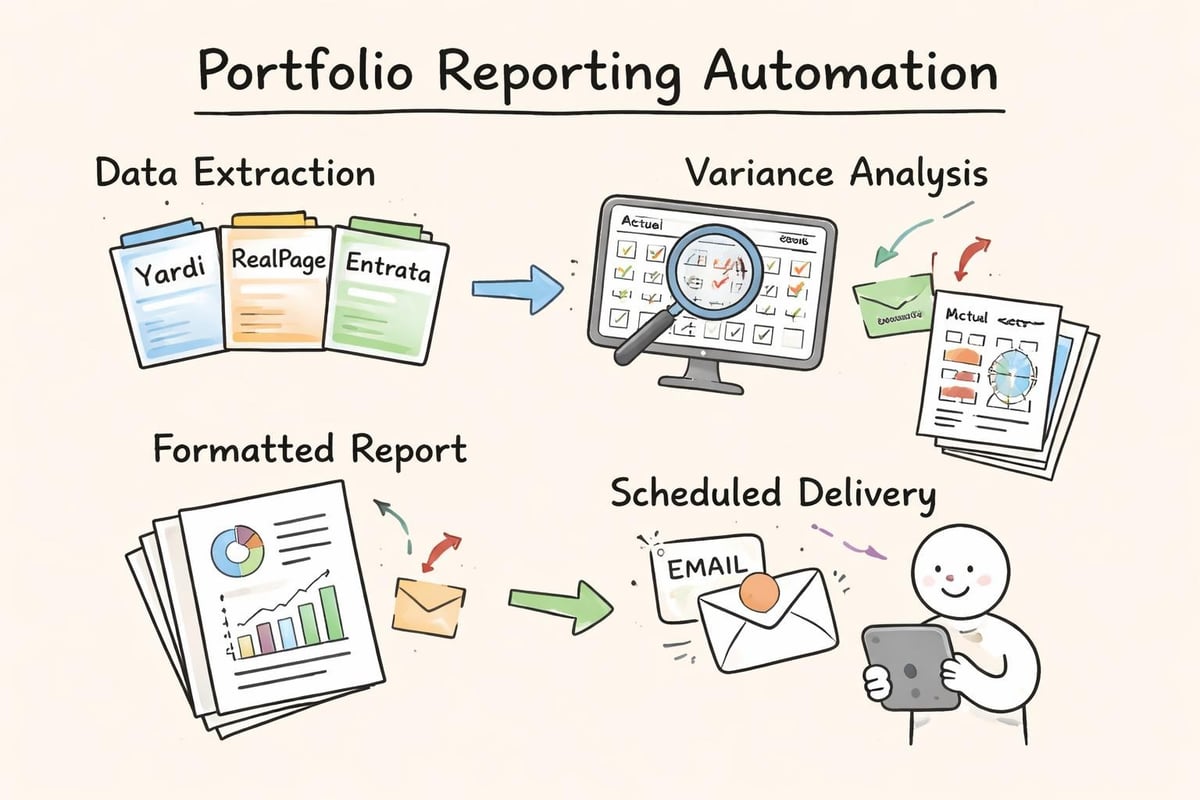
The transformation happens when reporting tools for property managers operate autonomously. Instead of blocking calendar time for report assembly, property managers review finished outputs and focus energy on addressing the exceptions and opportunities the data reveals.
Manual ReportingAI-Automated Reporting6-8 hours per portfolio monthly30 minutes review timeData exported from 3-5 systemsSingle integrated data pullManual variance calculationsAutomatic threshold monitoringStatic point-in-time snapshotsContinuous real-time monitoring
Platform integration depth matters significantly. Solutions that merely import CSV files require property managers to maintain the same export routines they are trying to eliminate. Platforms that connect directly to Yardi, RealPage, Entrata, AppFolio, ResMan, and MRI Software eliminate the export step entirely.
Building Trust Through Source Verification
One legitimate concern property managers raise about AI-generated reports centers on accuracy. When presenting financial performance to asset owners, every number must be defensible. This is where source-linked outputs become non-negotiable.
Purpose-built platforms maintain direct links from every reported metric back to the source transaction in the property management system. Click on a reported occupancy percentage, and you should see the exact rent roll extract with date stamp and system identifier. This verification layer transforms AI from a black box into an auditable analytical partner.
Document Extraction From Leases and Operating Statements
Property managers handle hundreds of documents monthly: lease agreements, vendor contracts, operating statements, insurance certificates, and maintenance records. Critical data points buried in these PDFs drive operational decisions, yet extracting them manually is tedious and error-prone.
Document extraction powered by AI converts unstructured documents into structured, queryable data. Instead of reading through a 40-page lease to find renewal options, escalation clauses, and tenant improvement allowances, AI extracts these provisions automatically and populates them into your data model.
High-value document types for extraction:
Lease agreements (existing and prospective)
Offering memorandums for acquisition analysis
Monthly operating statements from third-party managers
Capital project bids and proposals
Tenant estoppel certificates
The workflow improvement is substantial. When evaluating a potential acquisition, property managers traditionally spend hours manually building rent rolls from existing lease documents. AI document extraction completes this task in minutes, enabling faster deal evaluation and more time spent on strategic due diligence questions.
Accuracy Requirements for Legal Documents
Lease extraction demands precision beyond simple OCR. A misread escalation percentage or incorrectly identified option date creates legal and financial exposure. The best ai for property managers includes:
Clause-specific extraction models trained on real estate document structures
Confidence scoring that flags uncertain extractions for human review
Structured output formats that map directly to property management system fields
Version control tracking document amendments and modifications
Understanding how AI handles complex real estate documentation helps property managers set appropriate expectations. While AI dramatically accelerates extraction, critical provisions should still undergo human verification before execution.
KPI Monitoring With Proactive Alerts
Reactive management means discovering problems after they impact financial performance. A property trending toward higher-than-budgeted maintenance costs should trigger investigation before quarter-end, not during monthly reporting. This shift from reactive to proactive management defines the next frontier for ai for property managers.
Threshold-based monitoring systems continuously evaluate portfolio metrics against configurable ranges. When a metric crosses a threshold, the system generates an alert with context and suggested actions. Instead of discovering variance during monthly reporting, property managers receive alerts the moment data trends become concerning.
Common monitoring thresholds include:
Occupancy drops below 93% for more than one week
Average work order resolution time exceeds 72 hours
Collections percentage falls below 97%
Property-level NOI variance exceeds 5% from budget
Lease expiration concentration exceeds 15% in any single quarter
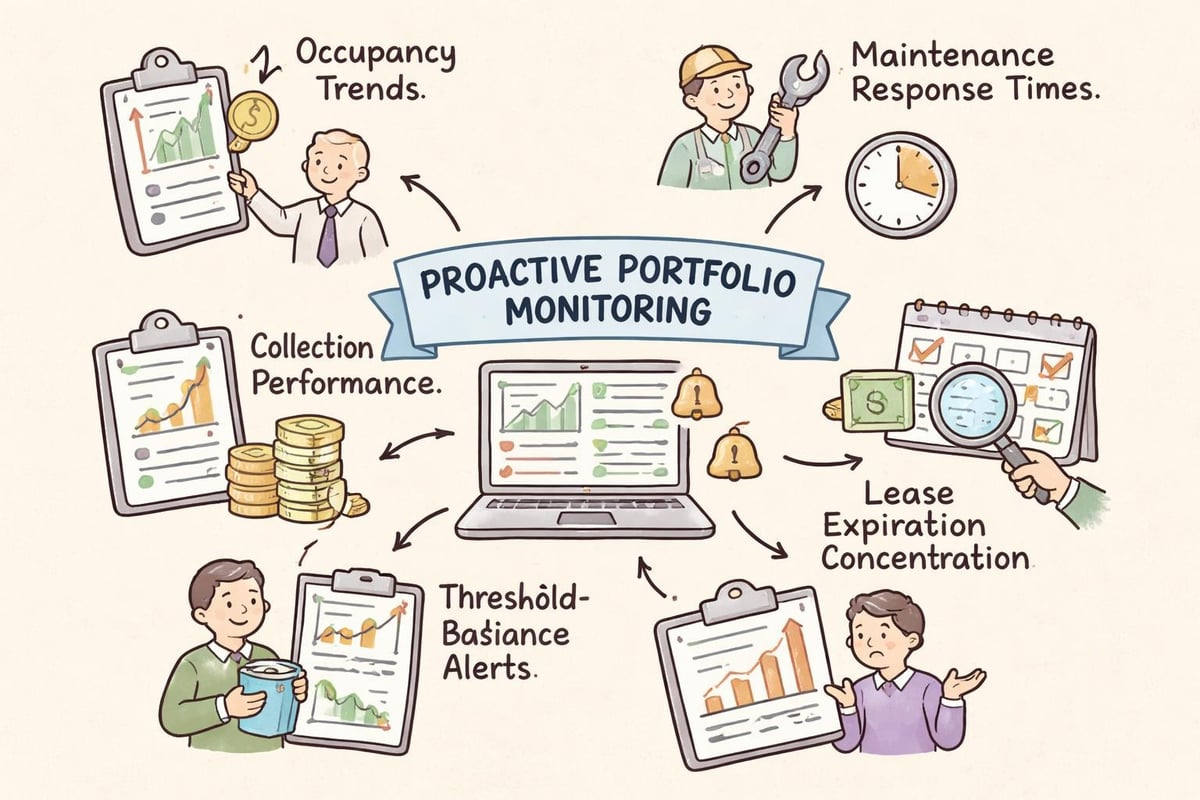
The power lies in the combination of continuous monitoring and intelligent alerting. Property managers define what matters for their specific portfolios, and the system watches these metrics 24/7. This approach aligns with best practices in asset management metrics tracking, ensuring nothing slips through the cracks between reporting periods.
Configuring Intelligent Alert Parameters
Alert fatigue undermines monitoring systems. Too many notifications and property managers start ignoring them. Effective threshold configuration requires understanding normal variance patterns for your portfolio.
Start with three alert tiers:
Critical alerts: Immediate action required (occupancy drop exceeding 5%, maintenance emergency)
Warning alerts: Investigation warranted (trending toward threshold, unusual pattern detected)
Informational alerts: Context for upcoming decisions (lease expirations in next 90 days, seasonal variance expected)
Predictive analytics in real estate takes monitoring further by forecasting metric trajectories. Rather than alerting only when thresholds are crossed, predictive systems warn when current trends will likely result in threshold breaches within the next 30-60 days.
Recurring Report Delivery Without Manual Triggering
Monthly, quarterly, and annual reporting follows predictable patterns. Asset owners expect consistent formatting, specific metrics, and timely delivery. Yet property managers spend hours each period recreating the same reports with updated data. This repetitive process is precisely where automation creates leverage.
Scheduled autonomous report generation works like this:
Define report template with required sections, metrics, and formatting
Configure data sources and update frequency
Set delivery schedule and recipient list
System runs complete report generation process automatically
Finished reports delivered to stakeholders without manual intervention
The property manager's role shifts from report assembly to report review and insight generation. This change frees substantial time for higher-value activities like tenant relationship management, property inspections, and strategic portfolio planning.
Report TypeTraditional TimeAutomated TimeTime SavingsMonthly owner report4-6 hours20 minutes review85% reductionQuarterly portfolio summary8-10 hours45 minutes review90% reductionAnnual budget variance12-15 hours90 minutes review90% reductionWeekly KPI dashboard2-3 hours10 minutes review95% reduction
Integration with communication platforms enables sophisticated delivery options. Reports can be automatically distributed via email, uploaded to shared drives, or posted to investor portals based on stakeholder preferences.
Maintaining the Human Element in Stakeholder Communication
Industry experts caution that while AI excels at data processing and report generation, property management remains a relationship-driven business. Automated reports should free property managers to spend more time on phone calls with asset owners, not replace that communication entirely.
The optimal approach pairs automated baseline reporting with proactive narrative communication. Let AI handle the standard monthly financial package, while property managers focus their energy on explaining the strategic implications of performance trends and discussing tactical adjustments.
System Integration Architecture for Maximum Impact
The effectiveness of ai for property managers depends entirely on integration depth with existing systems. Shallow integrations requiring manual data exports or CSV imports eliminate much of the efficiency gain. Deep integrations with direct API access to property management platforms unlock true automation.
Critical integration points:
Property management systems: Yardi Voyager, RealPage, Entrata, AppFolio, ResMan, MRI Software
Accounting platforms: Bill.com, QuickBooks, Sage Intacct
Maintenance management: ServiceChannel, FacilityDude
Leasing platforms: Funnel, Knock, LeaseLabs
Document storage: Box, Dropbox, SharePoint
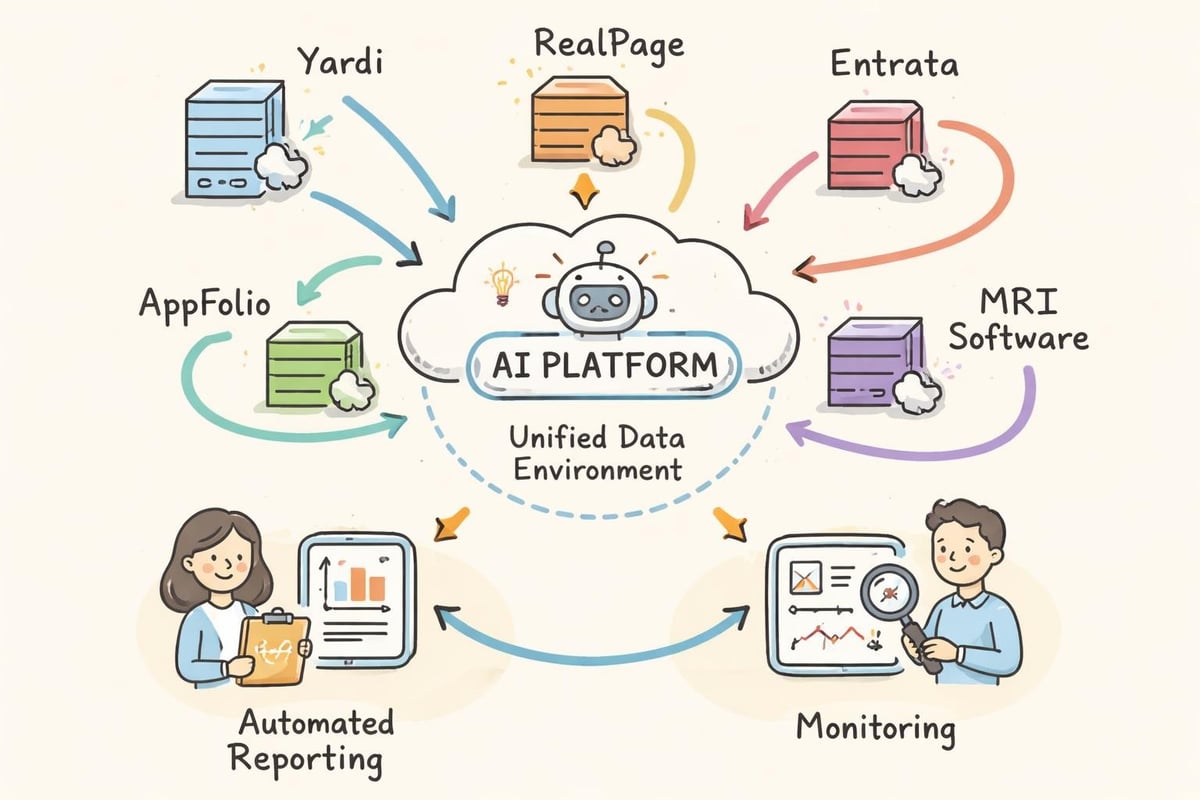
How AI in property management evolves in 2026 shows a clear trend toward ecosystem thinking. Rather than standalone point solutions, property managers benefit most from platforms that serve as a unified analytical layer across their entire technology stack.
Data Security and Compliance Requirements
Property management data includes sensitive tenant information, financial records, and proprietary operational metrics. Any AI platform accessing this data must meet stringent security standards.
Essential security certifications and practices:
SOC 2 Type 2 certification for data handling and security controls
Encryption in transit and at rest for all data
Role-based access controls aligned with organizational structure
Regular security audits and penetration testing
Clear data retention and deletion policies
Property managers should verify that AI vendors maintain compliance with Fair Housing regulations and data privacy laws applicable to their jurisdictions. The operational control and risk reduction benefits of AI implementation can be undermined by inadequate security practices.
Training Data Quality and Platform Accuracy
AI platforms become more accurate over time through exposure to property-specific data patterns. A platform trained exclusively on residential data will struggle with commercial lease structures. Similarly, systems unfamiliar with your specific property management software's data schema will require extensive configuration.
Questions to ask potential AI vendors:
What property types and management structures was the platform trained on?
How many property management system integrations have been deployed?
What is the accuracy rate for document extraction on lease agreements?
How does the platform handle custom fields and non-standard data structures?
What is the typical ramp-up period before outputs reach production quality?
Platforms purpose-built for commercial real estate bring pre-trained models that understand CRE-specific terminology, document structures, and analytical frameworks. This domain expertise accelerates implementation and improves accuracy from day one.
The Learning Curve Advantage
The more data an AI platform processes from your specific portfolio, the more accurate its outputs become. This creates a compounding advantage over time. Initial implementation may require human review and correction of outputs, but each correction teaches the system your specific preferences and standards.
Financial modeling and underwriting capabilities improve through this feedback loop. The platform learns your assumption ranges, preferred sensitivity scenarios, and output formatting preferences. After processing dozens of your deals, the platform generates models that closely match your manual approach but in fraction of the time.
Workflow Automation Beyond Reporting
While reporting represents the highest-impact initial use case, ai for property managers extends to numerous operational workflows. Each automation compounds time savings and reduces error rates.
Additional automation opportunities:
Lease abstract creation and updates
Tenant communication templates personalized at scale
Maintenance workflow routing based on request classification
Budget variance investigation report generation
Market research compilation for investment committees
Capital project tracking and cost variance analysis
The key is identifying repetitive, rules-based tasks that consume significant time but require minimal creative judgment. These workflows become candidates for AI automation, freeing property managers to focus on exception handling and strategic decision-making.
Balancing Automation With Tenant Relationships
Research on AI implementation in property management emphasizes maintaining authentic human connection with tenants. Automated responses to routine maintenance requests work well, but complex tenant issues require empathetic human engagement.
The framework: automate transactions, personalize relationships. Use AI to handle:
Routine maintenance request acknowledgment and tracking
Lease renewal timeline notifications
Payment confirmation and receipts
Document request fulfillment
Reserve human attention for:
Conflict resolution and complaint handling
Lease negotiation and terms discussion
Property tour experiences and community building
Strategic tenant retention conversations
Implementation Strategy for Property Managers
Adopting AI successfully requires thoughtful implementation planning. The most common pitfall is attempting to automate everything simultaneously, creating change management challenges and integration complexity.
Recommended phased approach:
Phase 1: Automated Portfolio Reporting (Months 1-2)
Start with the highest-impact, lowest-risk workflow. Configure automated monthly reporting for one or two portfolios. Validate output accuracy against your manual reports. Build trust in the platform before expanding scope.
Success metrics for Phase 1:
Report generation time reduced by 70%+
Accuracy matching manual reports within 1%
Stakeholder satisfaction with report format and delivery
Phase 2: Document Extraction (Months 3-4)
Once reporting runs reliably, add document extraction capabilities. Begin with new lease agreements and operating statements. Build your extracted data library while maintaining existing manual processes as backup.
Success metrics for Phase 2:
Extraction accuracy exceeding 95% for standard lease provisions
Time-to-rent-roll creation reduced by 80%
Reduction in manual data entry errors
Phase 3: Proactive Monitoring and Alerts (Months 5-6)
With clean data flowing from reporting and extraction, configure threshold-based monitoring. Start conservatively with obvious thresholds and expand as you refine what matters for your portfolio.
Success metrics for Phase 3:
Issue identification happening 2-3 weeks earlier than manual review cycle
Reduction in negative variances discovered during monthly reporting
Increased proactive outreach to asset owners about emerging trends
Phase 4: Workflow Automation Expansion (Month 7+)
Identify additional repetitive workflows consuming property manager time. Prioritize based on time savings potential and implementation complexity. Add automation incrementally, validating each new capability before proceeding.
This phased approach builds organizational confidence, allows teams to adapt gradually, and creates early wins that fund continued investment in AI capabilities.
Measuring ROI and Performance Impact
Quantifying the return on ai for property managers investment requires tracking both time savings and quality improvements. Establish baseline metrics before implementation to demonstrate impact.
Key performance indicators:
Metric CategoryBefore AIAfter AI TargetMeasurement MethodReport preparation time6-8 hrs/month30 min/monthTime tracking logsDocument processing speed4 hrs/lease15 min/leaseTimestamp comparisonError rate in reports2-3%<0.5%Audit findingsTime to issue identification15-30 days1-3 daysAlert timestamp vs. occurrenceProperty manager capacity4-5 portfolios6-8 portfoliosPortfolio assignments
The capacity expansion metric often provides the clearest ROI demonstration. When property managers can effectively oversee 50% more portfolios without sacrificing quality, the platform pays for itself through avoided hiring costs.
Soft Benefits Beyond Time Savings
Quantitative metrics capture direct efficiency gains, but AI's impact on property management extends to less tangible improvements:
Reduced stress: Elimination of manual reporting deadlines
Improved decision quality: Earlier issue identification enables more strategic responses
Enhanced credibility: Consistent, professional reporting strengthens asset owner relationships
Career development: Time freed from administrative tasks enables professional growth activities
Talent retention: Modern tools make property management roles more attractive
These qualitative benefits compound over time, creating organizational advantages beyond simple cost reduction.
Where to Start With AI Adoption
The path forward for property managers begins with honest assessment of current pain points. Which manual processes consume the most time? Where do errors occur most frequently? What reporting requirements create recurring bottlenecks?
For most property management teams, the answer points to portfolio reporting and data consolidation. This is where platforms built specifically for commercial real estate create immediate value. Unlike general-purpose AI tools that require extensive customization and training, purpose-built solutions understand property management workflows from day one.
The critical evaluation criteria: direct integration with your property management systems, autonomous execution of multi-step analytical tasks, verifiable outputs with source linking, and proven accuracy with CRE-specific documents and data structures. Solutions meeting these requirements transform property management from reactive fire-fighting to proactive portfolio optimization.
Start small, prove value on high-impact workflows, then expand systematically. The property managers achieving the greatest benefit from ai for property managers in 2026 are those who view it as an analytical partner that handles data-intensive work autonomously, freeing human expertise for strategic decisions and relationship building.
The future of property management belongs to teams that leverage AI for operational excellence while maintaining the human touch that defines exceptional service. Property managers who adopt purpose-built AI platforms gain the capacity to oversee larger portfolios more effectively, identify optimization opportunities earlier, and deliver insights that drive superior investment performance. Leni connects directly to your property management systems, automates portfolio reporting and analysis, extracts critical data from documents, and monitors your portfolio with intelligent alerts. Purpose-built for commercial real estate and trusted by leading asset management teams, Leni handles the analytical work so you can focus on what matters most.

Johanna Gruber
Johanna has spent the last 8 years helping marketing teams connect with audiences through content. Specializing in B2B SaaS and real estate.
Curious About AI?
Join the largest AI community for real estate online. Get bite-sized, real-world use case videos, plus practical tips and proven strategies from top industry experts on adopting AI effectively.
MEET LENI
AI SuperAgent Purpose Built for Investors and Operators.
Experience how professionals and teams in your domain are getting the edge using AI.
