AI Investment Management: Purpose-Built vs Generic Tools

AI Investment Management: Purpose-Built vs Generic Tools
The commercial real estate investment management industry faces a fundamental architectural problem. Most workflows still separate the data layer from the analytical layer, which means someone manually bridges the two. Property management systems hold operational data, financial models live in spreadsheets, market research sits in PDFs, and lease documents remain buried in shared drives. An analyst pulls data from each system, reconciles inconsistencies, builds models, generates reports, and delivers insights. This manual bridge represents thousands of hours annually and introduces errors at every handoff. The emergence of ai investment management platforms promises to eliminate this gap, but the difference between generic AI tools and purpose-built solutions determines whether teams gain efficiency or simply add another system to manage.
Generic AI Tools Break Down at the Data Layer
ChatGPT, Claude, and other large language models excel at generating text, answering questions, and producing initial drafts. Investment managers have experimented with these tools for summarizing documents, drafting emails, and brainstorming analysis approaches. These applications work because the tasks are self-contained and the cost of minor errors is low.
The breakdown occurs when investment teams attempt to use generic AI for core analytical work. These models lack domain-specific reasoning about commercial real estate metrics, financial conventions, and market dynamics. Ask a generic model to calculate debt service coverage ratio from a rent roll and operating statement, and it may produce a number, but the methodology behind that calculation often contains errors. The model doesn't understand that certain income line items should be excluded, that expense timing matters, or that debt service includes both principal and interest components.
The Reconciliation Problem
Generic ai investment management approaches create a secondary workflow: validating and fixing AI outputs. An analyst requests a financial model, receives a spreadsheet with formulas, then spends hours checking assumptions, tracing calculations, and correcting mistakes. The AI saved time on initial setup but created work on the backend.
This reconciliation burden exists because generic models:
Lack persistent memory of property-specific details across conversations
Cannot verify outputs against source documents automatically
Don't maintain data lineage from raw inputs to final calculations
Generate formulas without understanding industry-standard methodologies
The result is outputs that look professional but don't reconcile. Numbers appear in reports without clear derivation. Metrics shift between analyses without explanation. Investment committees receive materials they cannot fully trust because the analytical chain of custody is broken.
Purpose-Built AI Investment Management Architecture
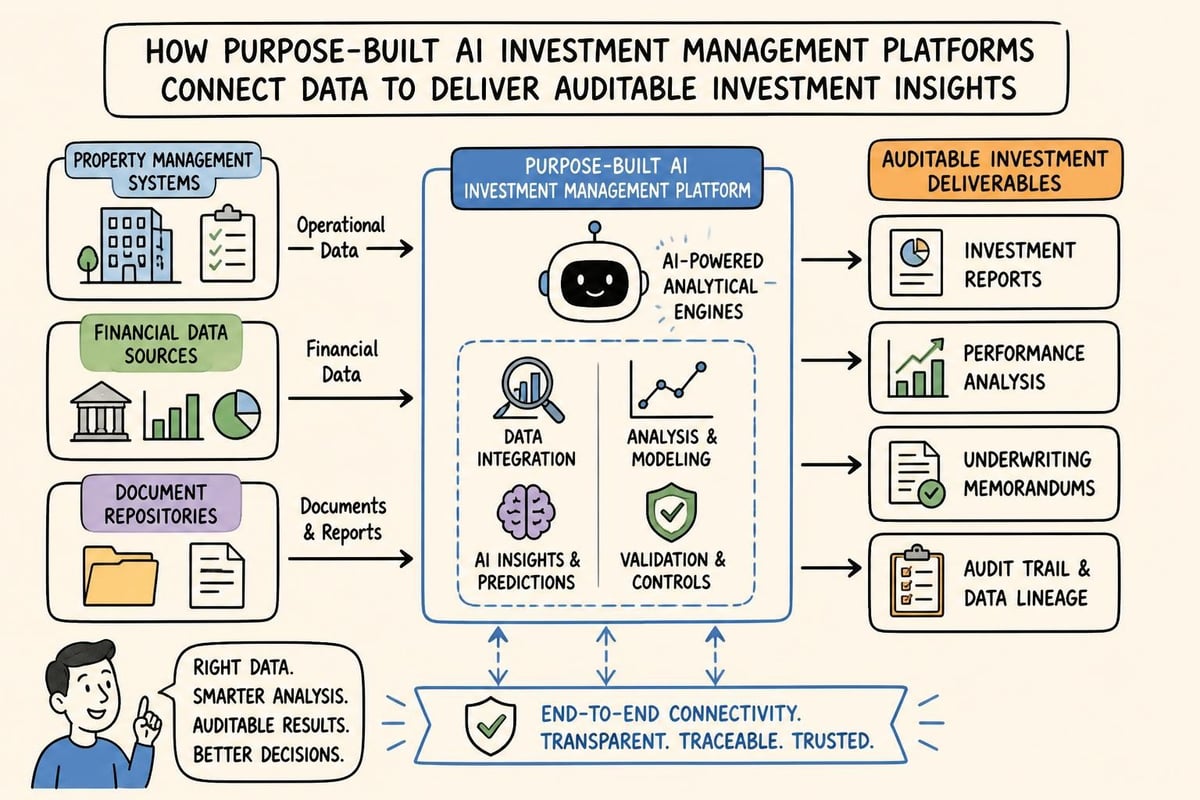
Domain-specific platforms solve the reconciliation problem by integrating the data and analytical layers into a single autonomous system. Rather than generating isolated outputs that require manual validation, these platforms ingest data directly from source systems, apply domain-specific logic, and return finished deliverables with full auditability.
The architectural difference is fundamental. Generic AI operates as a conversational assistant that requires constant direction and validation. Purpose-built ai investment management platforms function as autonomous analysts that execute complete workflows independently. This distinction matters when the deliverable is an investment committee memo, a quarterly LP report, or an acquisition underwriting model where accuracy is non-negotiable.
Domain Reasoning and Accuracy
AI-powered investing algorithms have transformed how institutional investors approach portfolio construction, but accuracy determines whether AI becomes a productivity tool or a liability. Purpose-built platforms achieve higher accuracy through domain-specific training data, validation logic, and output structures designed for investment workflows.
Consider NOI variance analysis. A generic AI tool might identify that actual NOI differs from budget, but a purpose-built system knows to drill into specific variance categories: occupancy changes, rental rate adjustments, expense overruns by category, capital expenditure timing, and recoveries. The platform applies real estate analytics methodologies automatically rather than requiring an analyst to prompt for each analysis layer.
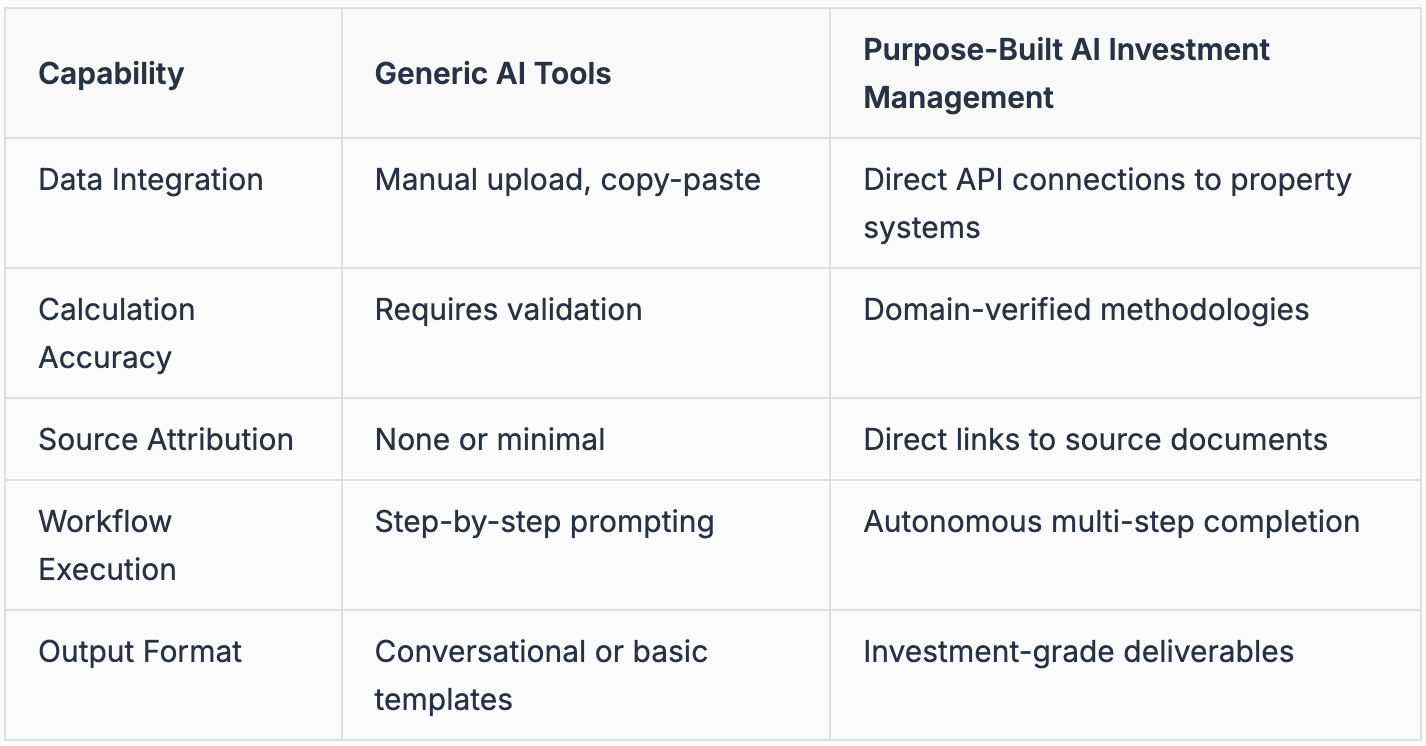
Platforms built specifically for investment management incorporate industry-standard formulas, understand regional market nuances, and recognize data quality issues automatically. When a rent roll contains inconsistencies, the system flags them and applies appropriate handling logic rather than proceeding with flawed inputs.
Core Investment Management Use Cases
The value of ai investment management becomes concrete when examined through specific workflows that consume analyst time today. Each represents a manual bridge between data systems and analytical outputs.
Portfolio Monitoring and Performance Analysis
Asset managers track dozens or hundreds of properties simultaneously, monitoring performance against budget, identifying trends, and spotting issues before they escalate. This process traditionally requires pulling data from property management systems, building comparison tables, calculating variances, researching causes, and summarizing findings for executive teams.
Purpose-built platforms automate this entire workflow:
Connect directly to property management systems like Yardi, RealPage, and Entrata
Extract current period financials automatically
Compare against budgets, forecasts, and prior periods
Calculate variance metrics across properties and portfolios
Generate executive summaries with drill-down capabilities
Flag outliers and potential data quality issues
The analyst receives a complete portfolio performance report rather than raw data requiring hours of manipulation. More importantly, the report updates automatically as new data flows into source systems, transforming portfolio monitoring from a monthly project into a continuous capability.
NOI Variance and Operational Analysis
Understanding how to increase NOI requires dissecting operational performance at the property level. When actual NOI deviates from projections, investment managers need to understand drivers: rental rate achievement, occupancy changes, operating expense efficiency, capital expenditure timing, and revenue optimization opportunities.
Generic AI can describe what NOI means and suggest analysis approaches. Purpose-built ai investment management platforms execute the analysis automatically, comparing line-item actuals against budgets, identifying the largest variance contributors, contextualizing changes against historical patterns, and generating actionable recommendations based on comparable property performance.
The difference is execution depth. A purpose-built system doesn't just identify that maintenance expenses exceed budget by 15%. It breaks down maintenance by category, compares unit costs to portfolio averages, flags unusual items, and connects findings to specific work orders in the property management system. Every insight traces back to source data with verifiable links.
LP Reporting and Investment Committee Materials
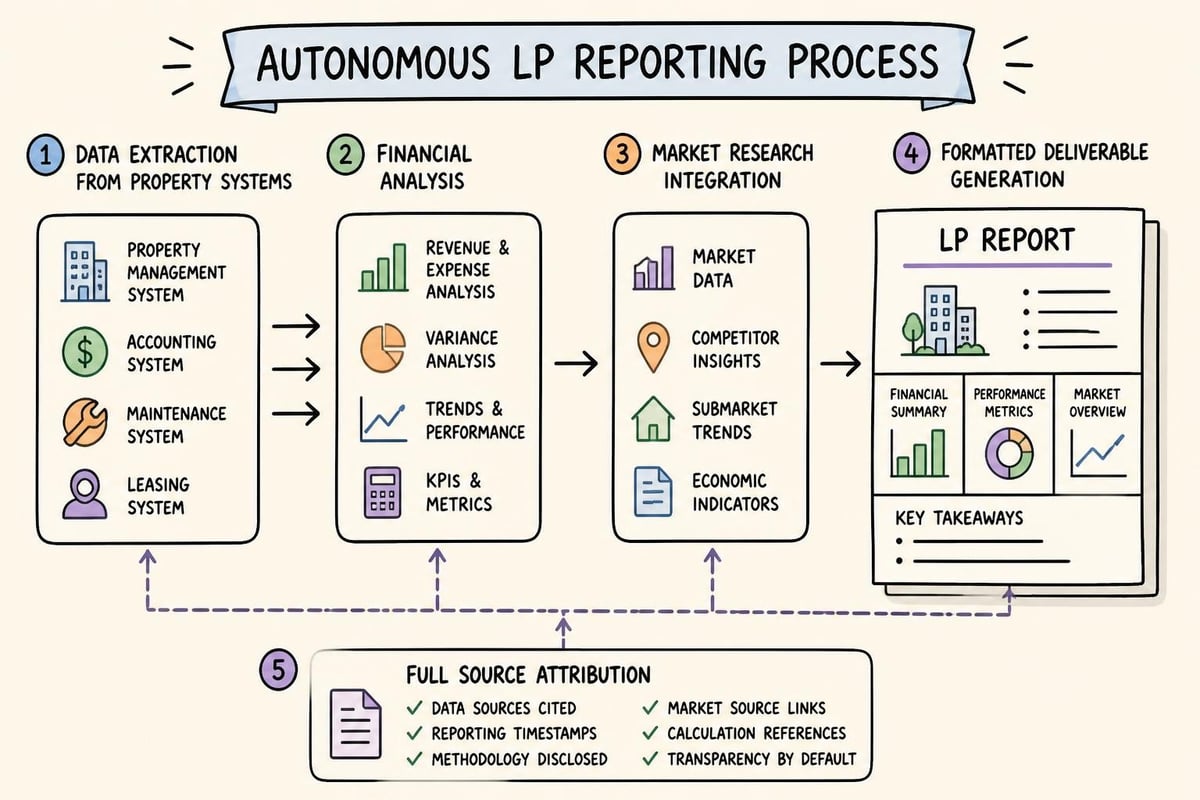
Limited partner reporting and IC memo creation represent high-stakes deliverables where accuracy and professionalism are non-negotiable. These documents synthesize property performance, market conditions, strategic decisions, and forward projections into formatted presentations that stakeholders use to make capital allocation decisions.
The traditional process involves:
Gathering data from multiple systems and teams
Building financial summaries and performance metrics
Researching market conditions and comparable transactions
Writing narrative sections that contextualize quantitative findings
Creating charts, tables, and visualizations
Formatting materials to brand standards
Reviewing and revising through multiple rounds
Purpose-built platforms compress this timeline from weeks to hours by executing each step autonomously. The platform extracts financial data, performs required calculations, researches market context through integrated data sources, generates narrative sections, creates visualizations, and outputs formatted documents. Critically, every statement in the document links to supporting data, enabling reviewers to audit any claim instantly.
Market Research and Competitive Intelligence
Investment decisions require understanding market dynamics, rental trends, supply pipeline, demographic shifts, and competitive positioning. Analysts traditionally spend hours searching databases, reading reports, compiling data points, and synthesizing findings into actionable intelligence.
AI-powered market research accelerates this process, but the quality difference between generic and purpose-built tools is substantial. Generic models can summarize articles and answer general questions about markets. Purpose-built platforms connect to proprietary databases, extract specific data points, verify information across multiple sources, and generate research memos formatted for investment decision-making.
The research is also live-sourced, meaning every fact includes direct attribution to the underlying source. Investment committees can click through to verify claims rather than accepting AI-generated summaries on faith. This auditability transforms AI from a convenience tool into a trusted analytical resource.
Acquisition Underwriting and Financial Modeling
AI underwriting for real estate represents one of the most complex and high-value applications of purpose-built platforms. Underwriting requires extracting data from offering memoranda, building detailed financial models, stress-testing assumptions, comparing returns across capital structures, and producing investment committee packages that justify acquisition decisions.
Generic AI struggles with this workflow because underwriting demands precision across interconnected calculations. A single error in rent roll interpretation cascades through vacancy assumptions, revenue projections, expense forecasting, debt sizing, and return calculations. The models must also conform to firm-specific standards for formatting, assumption documentation, and sensitivity analysis.
Purpose-built ai investment management platforms execute underwriting as an autonomous workflow:
Extract property details, rent rolls, and financials from offering memoranda using document AI
Build financial models using firm-standard templates and assumptions
Size debt based on lender parameters and property cash flows
Calculate return metrics across multiple hold periods and exit scenarios
Generate sensitivity tables for key assumptions
Produce formatted investment memos with executive summaries
Provide source links for every extracted data point and calculation
The platform returns a complete underwriting package rather than a rough draft requiring extensive revision. Teams review and refine rather than build from scratch, compressing underwriting timelines and enabling higher deal volume without proportional headcount increases.
Auditability and Accuracy Standards
The distinction between ai investment management tools ultimately comes down to trust. Investment professionals cannot rely on systems that produce unverifiable outputs, no matter how quickly those outputs arrive. Purpose-built platforms address this through two mechanisms: comprehensive source attribution and domain-specific accuracy benchmarks.
Source Attribution and Data Lineage
Every number, metric, and statement in an AI-generated deliverable should trace to a specific source document or data field. Purpose-built platforms maintain this lineage automatically, embedding links that enable reviewers to verify any claim with a single click. An LP report states that Q4 NOI increased 8% year-over-year at a specific property. Clicking that figure opens the property's financial statements with the relevant line items highlighted.
This capability transforms how investment teams work with AI outputs. Rather than validating every calculation manually, reviewers focus on confirming that the platform extracted correct source data and applied appropriate methodologies. The analytical work happened correctly; the review confirms inputs and logic rather than recalculating results.
Accuracy Benchmarks and Validation
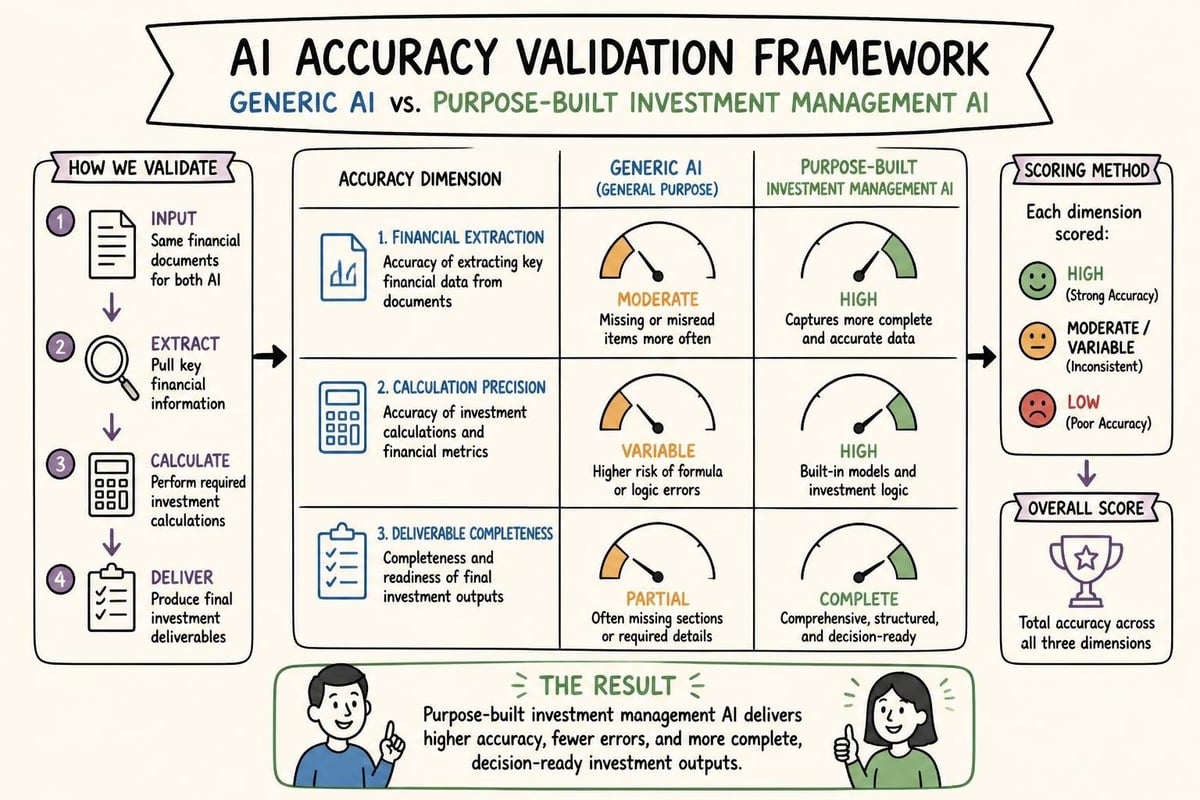
Generic models produce outputs that sound authoritative but contain factual errors, fabricated sources, and logical inconsistencies. Investment applications cannot tolerate this "hallucination" problem. Purpose-built platforms address accuracy through domain-specific training, validation layers, and transparent benchmarking.
Platforms designed for investment management achieve measurably higher accuracy on domain-specific tasks. Independent testing shows performance gaps between general-purpose models and specialized systems, with purpose-built platforms reaching accuracy rates above 98% on tasks like financial statement extraction and calculation verification. This level of precision makes the difference between AI as a drafting tool and AI as an autonomous analyst.
Security, Compliance, and Enterprise Requirements
Investment data represents some of the most sensitive information organizations handle. Property financials, acquisition strategies, LP relationships, and portfolio plans cannot be processed through consumer AI tools that lack enterprise security controls.
Purpose-built ai investment management platforms meet institutional requirements through:
SOC 2 Type 2 certification demonstrating security, availability, and confidentiality controls
Data encryption at rest and in transit using industry-standard protocols
Role-based access control ensuring users see only authorized information
Audit logging tracking every data access and action for compliance purposes
On-premise or private cloud deployment for firms with strict data residency requirements
These capabilities aren't add-ons; they're foundational architecture requirements for any platform handling investment data. Generic AI tools lack these controls because they weren't built for enterprise workflows where data governance is non-negotiable.
The compliance dimension extends to output accuracy as well. Investment decisions based on AI analysis create audit trails that regulators and investors may scrutinize. Deliverables must demonstrate that analysis followed sound methodologies and relied on verified data. Real estate software for investors must provide this level of accountability to serve institutional use cases.
What Investment Management Looks Like When the Analytical Layer Runs Itself
The future of ai investment management is not about analysts prompting AI tools to perform discrete tasks. It's about analytical workflows executing autonomously from data ingestion to finished deliverable. Teams focus on strategic decision-making, relationship management, and creative problem-solving while platforms handle the mechanical work of data extraction, calculation, research, and documentation.
This transformation requires platforms that understand investment workflows deeply enough to execute them independently. The platform knows that portfolio monitoring means comparing current performance against budgets and forecasts, calculating variances, identifying outliers, researching causes, and summarizing findings. It executes all steps without human intervention and delivers results meeting institutional quality standards.
Several architectural elements enable this autonomous operation:
Direct integration with property management, accounting, and market data systems eliminates manual data handling
Domain-specific reasoning applies investment industry methodologies automatically without requiring prompts
Multi-step workflow execution completes complex tasks from start to finish rather than requiring step-by-step guidance
Quality validation checks outputs against accuracy standards before delivery
Source attribution provides auditability for every data point and calculation
When these capabilities converge in a single platform, investment teams experience a fundamental shift in productivity. Underwriting that previously required two weeks occurs in hours. Portfolio monitoring becomes continuous rather than monthly. Market research that consumed days of analyst time updates automatically. Investment management workflows restructure around insights and decisions rather than data manipulation.
The Learning Effect
Purpose-built platforms improve over time as they process more data. Each new property analyzed, every lease extracted, and all underwriting completed expands the platform's understanding of an organization's specific standards, preferences, and patterns. The system learns firm-specific assumption conventions, typical cap rates for different property types, preferred formatting for deliverables, and common data quality issues in source systems.
This learning effect creates compound advantages. The platform becomes more accurate, generates outputs requiring fewer revisions, handles edge cases more gracefully, and anticipates user needs more effectively. Teams experience accelerating productivity gains rather than one-time efficiency improvements.
The evolution of AI in the investment industry has moved from experimental applications to production systems that handle core analytical workflows. Organizations evaluating ai investment management platforms must distinguish between tools that assist analysts and platforms that function as autonomous analysts. The former reduce some manual work while introducing new validation burdens. The latter eliminate entire categories of repetitive analytical tasks and enable teams to operate at previously impossible scales.
Selecting an AI Investment Management Platform
Investment organizations face decisions about which AI capabilities to adopt and how to integrate them into existing workflows. The choice between generic AI tools and purpose-built platforms depends on use case requirements, accuracy tolerance, and integration complexity.
Generic tools work well for:
Drafting initial versions of written content
Brainstorming analysis approaches
Answering general questions about concepts
Summarizing documents for preliminary review
Generating ideas during early-stage research
These applications share common characteristics: outputs require human review and refinement, minor errors create minimal risk, and the tasks are self-contained rather than part of multi-step workflows.
Purpose-built ai investment management platforms become essential for:
Financial modeling and underwriting requiring precision
Portfolio monitoring and performance reporting at scale
LP reporting and investment committee materials
Market research integrated with proprietary data sources
Automated workflows connecting multiple systems and data sources
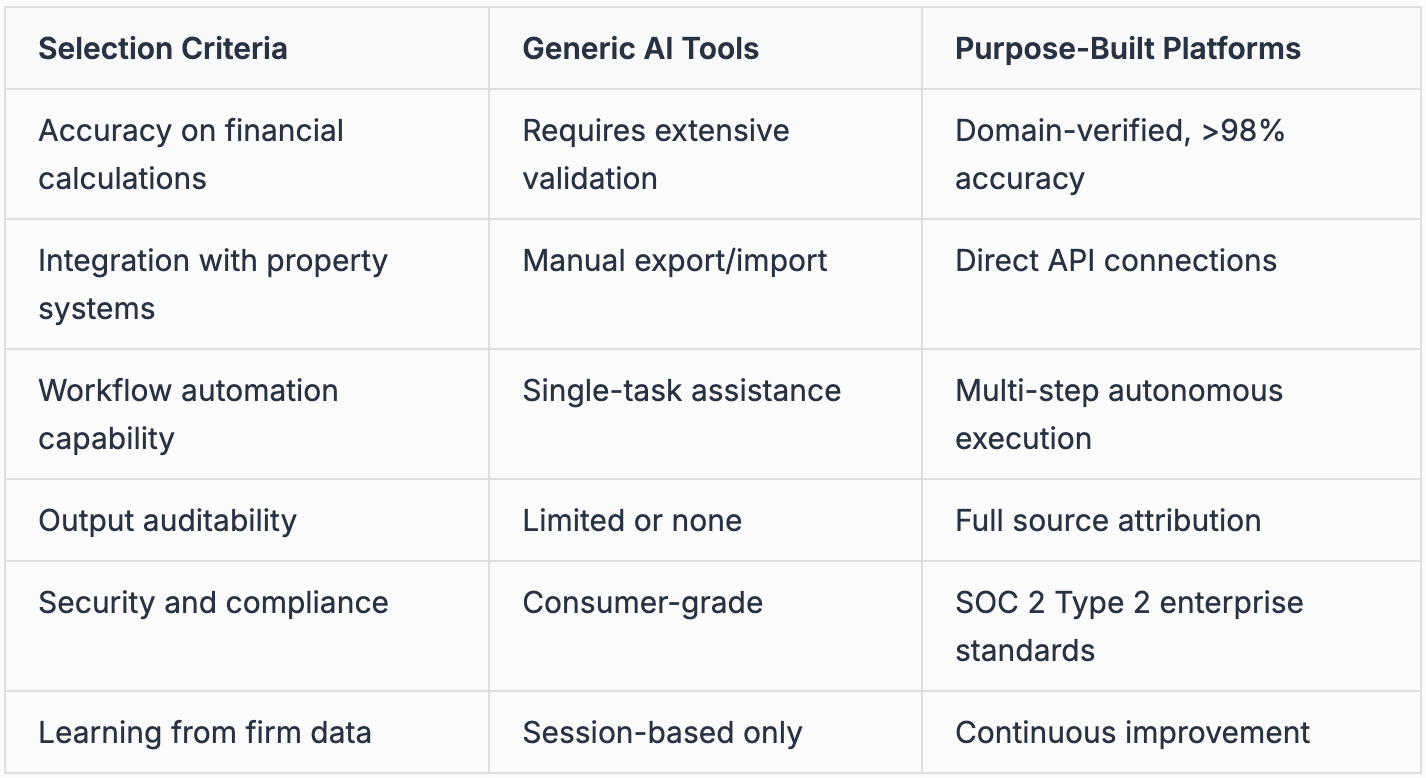
Organizations successfully deploying ai investment management typically start with high-volume, repeatable workflows where accuracy requirements are well-defined and current processes are documented. Portfolio monitoring, lease abstraction, and market research represent ideal initial applications. Success in these areas builds confidence for expansion into higher-stakes workflows like acquisition underwriting and strategic planning.
The integration approach also matters. Platforms that connect directly to existing property management and data systems deliver value faster than those requiring significant data migration or manual uploads. Commercial real estate portfolio management depends on current, accurate data, making system integration a critical platform capability.
Implementation and Change Management
Deploying AI investment management platforms successfully requires more than technology selection. Teams must adapt workflows, establish governance policies, and build trust in AI-generated outputs. Organizations achieve best results through phased implementation that demonstrates value quickly while building organizational capability progressively.
Initial phases focus on:
Connecting data sources and validating extraction accuracy
Running AI analysis in parallel with manual processes to verify outputs
Training teams on platform capabilities and verification procedures
Establishing accuracy thresholds and review protocols
Documenting firm-specific preferences and standards
This parallel operation period builds confidence that the platform produces reliable results before teams rely on it for production deliverables. Research on AI-oriented investment platforms demonstrates that organizations achieve higher adoption rates when teams verify platform accuracy on familiar analyses before trusting it for new applications.
As confidence builds, workflows shift from parallel validation to spot-checking, then to autonomous operation with periodic audits. Teams spend less time recreating AI work and more time applying judgment to insights, recommendations, and strategic decisions.
The separation between data and analytical layers has constrained investment management productivity for decades, requiring analysts to spend vast amounts of time bridging systems manually. Purpose-built ai investment management platforms eliminate this gap through autonomous workflows that deliver accurate, auditable results without constant human intervention. Leni brings this capability specifically to commercial real estate, connecting directly to property systems, executing complete analytical workflows independently, and returning investment-grade deliverables with full source attribution. With 98% accuracy on domain-specific tasks and SOC 2 Type 2 certification, Leni enables asset managers and acquisitions teams to operate at scale while maintaining the precision institutional investment requires.

Johanna Gruber
Johanna has spent the last 8 years helping marketing teams connect with audiences through content. Specializing in B2B SaaS and real estate.

Curious About AI?
Join the largest AI community for real estate online. Get bite-sized, real-world use case videos, plus practical tips and proven strategies from top industry experts on adopting AI effectively.
MEET LENI
AI SuperAgent Purpose Built for Investors and Operators.
Experience how professionals and teams in your domain are getting the edge using AI.
