AI Market Research Commercial Real Estate in 2026

AI Market Research Commercial Real Estate in 2026
Commercial real estate investment teams face an escalating research challenge: markets move faster, data sources multiply, and competitive intelligence demands deeper context than ever before. Traditional research methods struggle to keep pace with the volume of information required to evaluate submarkets, track demand drivers, monitor supply pipelines, analyze rent trends, pull comparable transactions, assess policy changes, understand capital markets dynamics, decode tenant behavior patterns, and position assets competitively. The promise of ai market research commercial real estate lies not in replacing human judgment but in systematically collecting, verifying, and synthesizing the scattered intelligence that forms the foundation of every investment thesis.
The Expanding Scope of CRE Market Research
Market research in commercial real estate has evolved from basic demographic studies and rent surveys into multidimensional intelligence work. Investment committees demand comprehensive narratives that connect macroeconomic trends to micro-level property performance.
Today's research workflows require teams to simultaneously track multiple analytical dimensions. Market-level analysis includes population migration patterns, employment growth by sector, household formation rates, and infrastructure investment plans. Submarket research drills into neighborhood-specific dynamics such as zoning changes, transit accessibility, school district quality, and retail clustering patterns.
Why Traditional Research Methods Fall Short
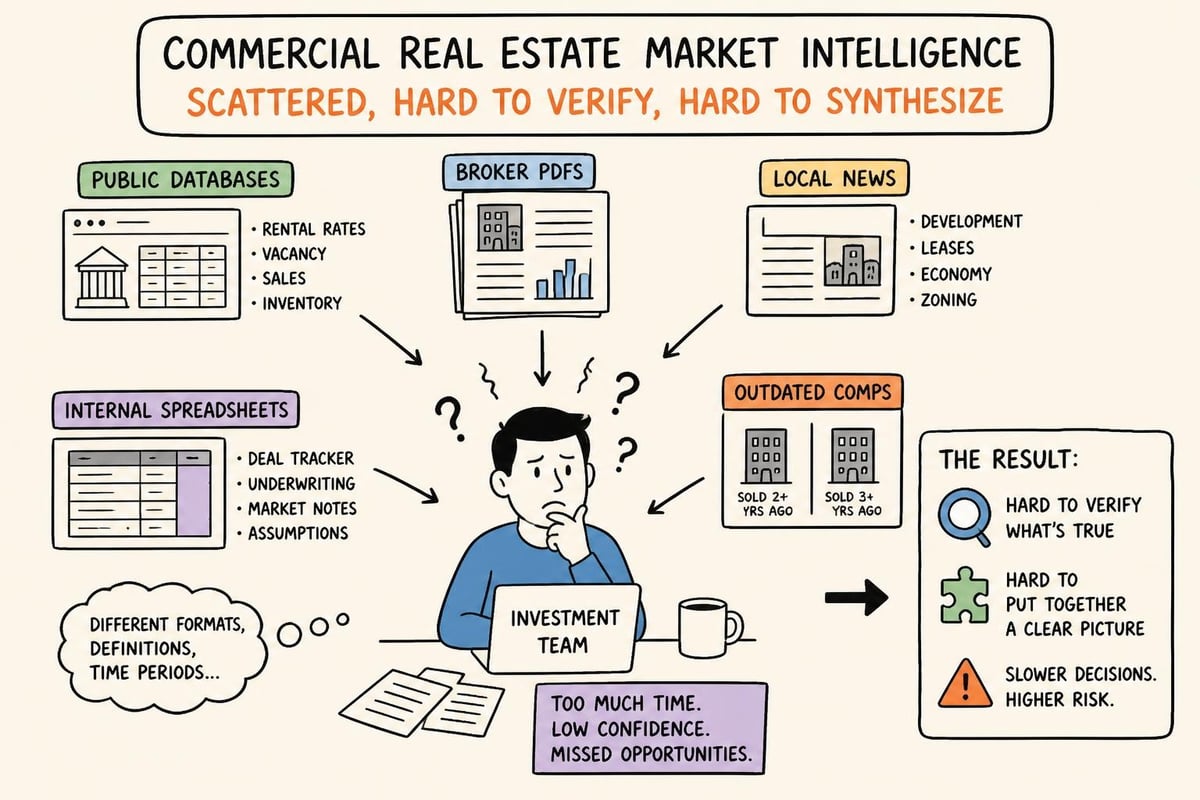
The fundamental challenge isn't data scarcity but data fragmentation. Critical intelligence exists across incompatible formats and disconnected sources.
Public databases provide census information, permit data, and transaction records, but each agency structures data differently. Broker reports offer market commentary and comp sets, yet they arrive as PDFs with inconsistent methodologies. Local news outlets break stories about development approvals, tenant relocations, and political shifts that materially impact valuations. Internal assumptions accumulated over years live in spreadsheets, email threads, and institutional memory.
This fragmentation creates several operational problems:
Time waste: Analysts spend 60-70% of research time hunting for data rather than analyzing it
Verification gaps: No systematic way to confirm when information was collected or which version is current
Source amnesia: Teams cannot trace where specific assumptions originated
Update lag: Markets shift while teams rely on quarterly reports published weeks after period close
AI adoption in commercial real estate shows that organizations recognize these challenges, with research and analysis emerging as primary use cases for artificial intelligence implementation.
Critical Research Dimensions in Modern CRE Analysis
Demand Drivers and Economic Fundamentals
Understanding demand requires synthesizing economic indicators across multiple timeframes and geographic scales. National employment trends matter, but submarket job growth in target industries matters more. Population growth provides context, but household formation rates within specific income bands determine multifamily absorption.
Investment teams evaluate office demand through detailed employment projections by sector, remote work adoption rates, and space utilization trends. Industrial research focuses on e-commerce penetration, port activity, logistics network evolution, and manufacturing reshoring patterns. Retail analysis tracks consumer spending by category, omnichannel strategies, experiential concepts, and demographic shifts.
The analytical challenge lies in connecting macro drivers to property-level implications. Generic economic forecasts don't answer whether a specific office building will maintain occupancy or which industrial submarkets will see rent growth.
Supply Pipeline Intelligence
Supply-side research determines whether demand translates into performance. Teams track projects across multiple stages: planned developments in entitlement, permitted projects under construction, recently delivered space seeking tenants, and rumored projects in pre-development.
Critical questions include:
How much competing space will deliver in the next 24 months?
Which projects pose the greatest leasing threat based on location, quality, and ownership?
Are permit trends accelerating or decelerating relative to historical patterns?
How does the development pipeline compare to absorption forecasts?
This intelligence exists across building department databases, broker reports, local news coverage, and conversations with market participants. No single source provides complete visibility, and information quality varies significantly by market.
Rent Analysis and Comparable Transactions
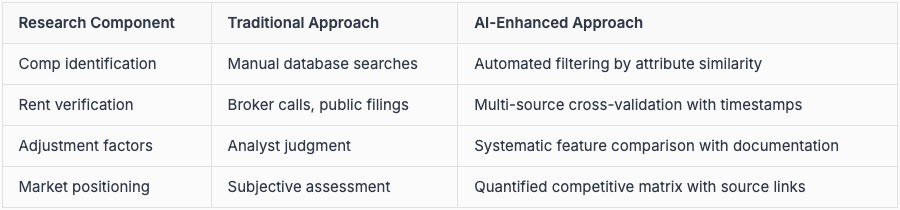
Real estate data analysts understand that comp analysis represents both an art and a science. Published rent surveys provide directional guidance, but investment-grade analysis requires property-level detail.
The difference between asking rent and effective rent can exceed 20% in certain markets, yet many research processes rely on incomplete information. Lease terms, tenant improvement allowances, free rent periods, and concession packages materially impact economics but rarely appear in standardized formats.
Policy and Regulatory Intelligence
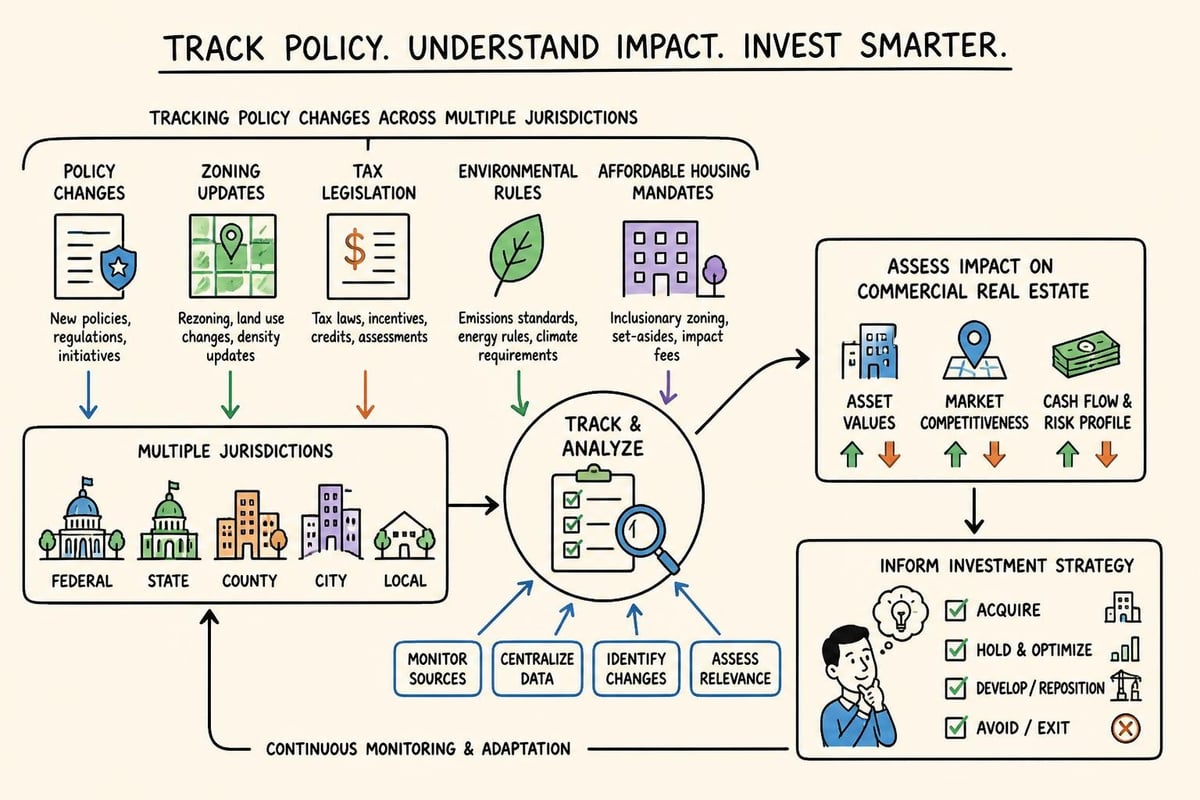
Zoning changes, tax policy shifts, environmental regulations, and affordable housing mandates reshape market dynamics faster than most research processes can track. A city council vote approving increased density can unlock development potential. A state legislature passing rent control legislation can compress cap rates overnight.
Commercial real estate portfolio management requires continuous monitoring of regulatory developments across all markets where assets sit or acquisitions are considered. This means tracking city planning department agendas, state legislative sessions, federal agency rule-making, and judicial decisions affecting property rights.
The challenge multiplies for firms operating across multiple jurisdictions. What's relevant in Austin differs from what matters in Boston, and generalist news aggregators miss local developments that investment committees need to know.
Capital Markets Context and Transaction Activity
Investment decisions require understanding where capital flows, which property types attract investor interest, what debt terms are available, and how transaction volume trends relative to historical patterns.
Capital markets research encompasses cap rate surveys, debt market conditions, equity fundraising activity, REIT performance, cross-border investment flows, and distressed transaction volume. Teams need to know whether recent sales represent market pricing or special situations.
Understanding Buyer and Seller Motivations
Transaction comparables provide limited value without context. A portfolio sale motivated by fund liquidation needs carries different weight than a competitive bidding process. An all-cash acquisition signals different market sentiment than a heavily leveraged purchase.
According to Deloitte's commercial real estate outlook, AI implementation in financial planning and risk management enables more sophisticated capital markets analysis, though many organizations remain in early adoption stages.
Tenant Behavior and Occupier Trends
Understanding how tenants make space decisions informs acquisition criteria, repositioning strategies, and leasing assumptions. Office tenant preferences shifted dramatically following remote work adoption. Industrial occupiers increasingly value last-mile proximity over raw warehouse costs. Retail tenants prioritize experiential elements and omnichannel integration.
Research must track lease expiration schedules, tenant credit quality, expansion and contraction patterns, and space utilization efficiency. This intelligence comes from tenant interviews, broker intelligence, corporate real estate announcements, and observation of market activity.
Competitive Positioning and Asset Strategy
Every investment thesis includes assumptions about competitive positioning. Teams must answer whether an asset offers superior location, better amenities, stronger sponsorship, or more efficient operations than alternatives.
Best asset management software provides tools to track performance metrics, but competitive intelligence requires external market context. How does occupancy compare to direct competitors? Does rent growth track with the submarket average or outperform? Are operating expenses in line with peer assets?
Competitive analysis demands systematic monitoring of comparable properties across operational and financial dimensions. Changes in ownership, management, capital improvements, leasing activity, and tenant mix all signal competitive threats or opportunities.
The Accuracy Imperative in AI Market Research Commercial Real Estate
The statistical reality of ai market research commercial real estate implementation shows a concerning gap between adoption and impact. Research from JLL reveals that only 5% of companies piloting AI have achieved all their goals, highlighting the difficulty of moving from experimentation to business impact.
The core issue centers on accuracy and verifiability. Generic AI models trained on broad datasets can produce plausible-sounding market summaries that lack the precision required for investment decisions. An IC memo stating "office demand is improving" without specific employment data, absorption figures, and source citations provides no decision-making value.
What Verifiable Research Requires
Investment-grade research demands specific attributes that many AI implementations fail to deliver:
Source documentation: Every claim must trace back to a specific data source with collection date
Observation timestamps: Teams need to know when information was current, not just when it was accessed
Methodology transparency: Understanding how conclusions were reached enables proper weight assignment
Contradiction flagging: When sources conflict, both perspectives require presentation with context
Verifiable AI outputs in real estate separate useful intelligence from generic summaries that add limited decision-making value.
Practical Applications Across the Investment Workflow
On-Demand Market Studies
Rather than commissioning expensive third-party reports that take weeks to deliver, ai market research commercial real estate enables teams to run focused studies addressing specific questions. An acquisition team evaluating a suburban office property can instantly generate a demand analysis covering employment trends in target industries, commute pattern analysis, competing building inventory, and rent trajectory over the past 36 months.
The AI layer collects relevant data from appropriate sources, synthesizes findings into coherent narratives, and documents where each data point originated. This approach delivers timely intelligence without sacrificing rigor.
Investment Committee Memo Support
Investment memo software for real estate streamlines document creation, but content quality depends on underlying research. Teams use AI to generate market overview sections, competitive analysis summaries, and risk factor discussions that incorporate current data rather than outdated templates.
The workflow involves specifying the property type, location, and key analytical questions, then allowing AI to pull relevant intelligence from vetted sources, structure findings logically, and present conclusions with supporting evidence. Analysts review output, adjust emphasis, add proprietary insights, and finalize documents for committee review.
Comp Scan Automation
Comparable transaction analysis requires identifying similar properties, collecting transaction details, making adjustment factors, and presenting findings clearly. This process traditionally consumed days of analyst time per acquisition.
AI-powered approaches automate comp identification based on property attributes, collect transaction information from multiple databases, flag data gaps requiring human follow-up, and structure comparisons systematically. The result delivers faster turnaround without compromising analytical rigor.
Continuous Market Monitoring
Rather than conducting research only when acquisitions arise, leading teams implement continuous monitoring across target markets. AI systems track relevant news sources, update key metrics, flag material developments, and alert teams to changes requiring strategic response.
This approach shifts research from reactive to proactive. Investment committees receive regular market intelligence updates highlighting what changed since last review, why it matters for portfolio strategy, and which assumptions require reconsideration.
The Human-AI Collaboration Model
Effective ai market research commercial real estate implementation recognizes that AI serves as an analytical layer supporting human decision-making rather than replacing judgment. Investment decisions incorporate qualitative factors, relationship intelligence, strategic considerations, and risk tolerance that no algorithm can replicate.
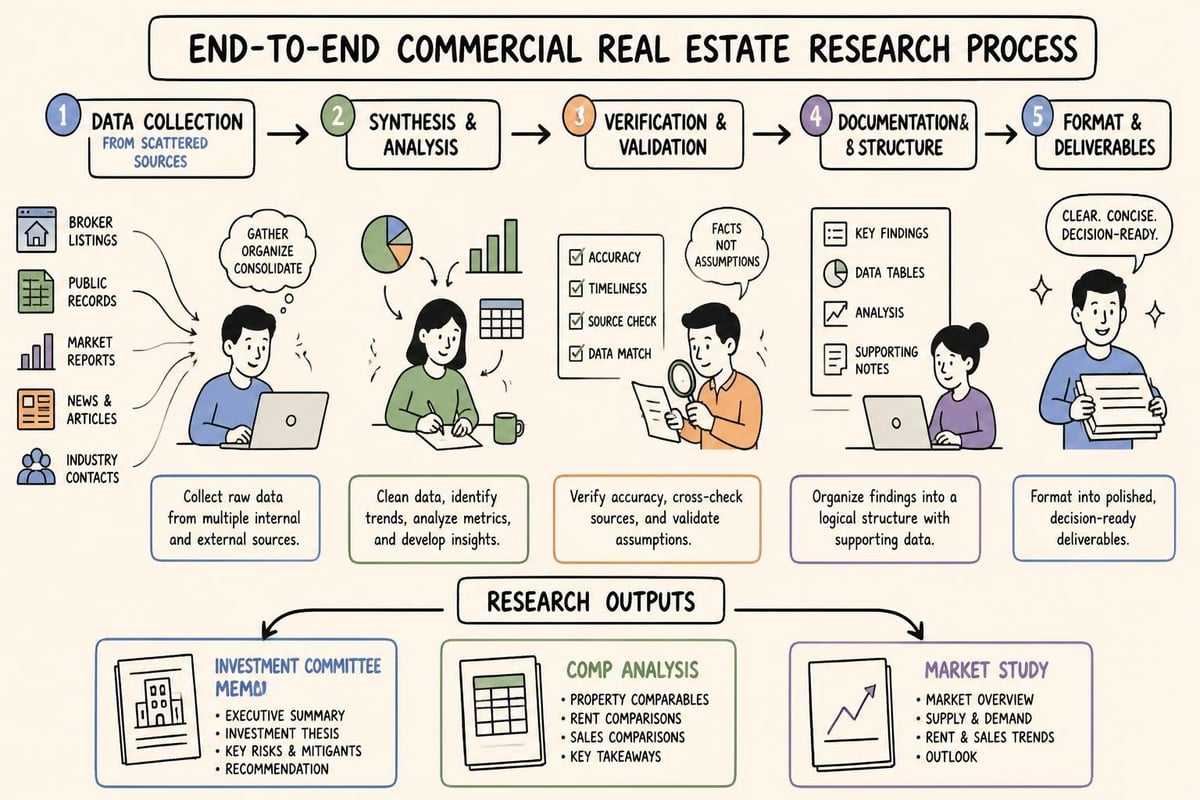
The optimal workflow positions AI handling systematic data collection, source documentation, synthesis of findings across multiple inputs, and production of structured research deliverables. Human experts provide strategy direction, evaluate synthesized intelligence, add market knowledge that exists outside documented sources, and make final recommendations incorporating both data and experience.
According to statistics on AI in commercial real estate, the market for AI applications in CRE is projected to grow substantially, with efficiency gains and decision-making improvements driving adoption across investment, asset management, and transaction workflows.
Implementation Challenges and Success Factors
Data Integration Complexity
Organizations implementing ai market research commercial real estate face technical challenges connecting disparate data sources. Public databases require different API approaches. PDF reports need parsing logic. Internal spreadsheets exist in various formats. News sources publish in inconsistent structures.
Success requires systematic data integration infrastructure that normalizes inputs, maintains update schedules, validates information quality, and flags when sources become unavailable. This foundational work enables AI to access comprehensive information sets rather than partial datasets.
Training AI on Real Estate Context
Generic language models lack the domain expertise required for investment-grade analysis. Understanding that "class A" means different things across markets, recognizing material versus immaterial lease clauses, and knowing which economic indicators predict specific property type performance requires specialized training.
Real estate AI tools designed specifically for investment workflows incorporate industry context, property type nuances, and market-specific knowledge that general-purpose AI lacks. This specialization determines whether output requires extensive editing or delivers immediate value.
Building Trust Through Transparency
Investment teams adopt AI when they understand how conclusions were reached. Black-box systems that produce answers without explanation create liability concerns rather than efficiency gains. Transparency around data sources, analytical methods, and confidence levels enables proper evaluation of AI-generated research.
Successful implementations provide drill-down capabilities allowing users to examine underlying data, view source documents, check collection timestamps, and understand adjustment factors. This transparency builds confidence that AI serves as a research assistant rather than an unaccountable decision-maker.
Sector-Specific Research Requirements
Office Market Intelligence
Office research requires tracking return-to-office policies, space utilization rates, amenity preferences, flight-to-quality dynamics, and obsolescence risk. Teams monitor corporate real estate announcements, workplace surveys, commute pattern data, and technology adoption trends.
Submarket analysis examines transit connectivity, talent pool access, amenity infrastructure, parking availability, and neighboring building quality. These factors determine competitive positioning more than general market trends.
Industrial and Logistics Analysis
Industrial research focuses on supply chain geography, e-commerce fulfillment requirements, last-mile delivery economics, port and airport proximity, labor market depth, and transportation infrastructure quality. Teams track manufacturing trends, nearshoring activity, inventory management practices, and logistics technology adoption.
Market-level analysis examines land availability for development, entitlement timelines, environmental considerations, and competing submarkets. Understanding why tenants choose specific industrial locations requires synthesizing economic data, transportation analysis, and operational requirements.
Retail Property Research
Retail market intelligence combines consumer spending analysis, demographic profiling, traffic pattern studies, competitive retail mapping, and experiential concept evaluation. Teams monitor retailer expansion and contraction announcements, omnichannel strategy shifts, consumer preference trends, and local economic conditions.
Site-level analysis examines visibility, accessibility, parking, co-tenancy, trade area demographics, and nearby demand generators. These micro-market factors often matter more than MSA-level retail statistics.
Multifamily Fundamentals
Multifamily research tracks household formation, employment growth, wage trends, homeownership affordability, and migration patterns. Teams analyze supply pipelines, rent growth trajectories, concession levels, and occupancy trends across rent tiers.
Submarket analysis evaluates school districts, crime statistics, transit access, walkability scores, competing properties, and neighborhood trajectory. Understanding why renters choose specific locations requires combining quantitative data with qualitative community assessment.
Future Evolution of AI Market Research Commercial Real Estate
The trajectory of ai market research commercial real estate points toward increasingly sophisticated intelligence capabilities. Natural language interfaces will enable investment professionals to ask complex questions and receive comprehensive answers with full source documentation. Predictive models will identify emerging trends before they appear in traditional data sources. Real-time monitoring will alert teams to material developments within minutes rather than days.
The competitive advantage will belong to organizations that combine comprehensive data access, sophisticated AI capabilities, domain-specific training, and transparent methodologies. Generic AI tools will provide commodity-level analysis, while specialized platforms deliver the precision and verifiability that investment decisions require.
As CRE asset management software evolves, integration between market intelligence, asset performance tracking, and portfolio strategy becomes seamless. Research insights directly inform hold-sell decisions, capital allocation, and value-add initiatives rather than existing as separate analytical exercises.
Building an AI-Enhanced Research Practice
Organizations implementing effective ai market research commercial real estate follow systematic approaches that balance technology capabilities with human expertise. The foundation starts with defining research questions that matter for investment decisions, identifying data sources that provide reliable information, establishing verification standards that ensure accuracy, and creating workflows that enable rapid iteration.
Investment teams benefit from AI handling the systematic collection of market data, the organization of information from scattered sources, the synthesis of findings into coherent narratives, and the documentation of assumptions with source citations. This automation frees senior professionals to focus on strategic analysis, relationship intelligence, deal negotiation, and portfolio optimization where human judgment creates the most value.
The result transforms research from a bottleneck limiting deal flow into a competitive advantage enabling faster decisions with greater confidence. Teams evaluate more opportunities, conduct deeper diligence, identify risks earlier, and position assets more effectively because comprehensive market intelligence becomes accessible on-demand rather than requiring weeks of manual effort.
The commercial real estate industry's shift toward ai market research commercial real estate represents a fundamental change in how investment teams gather intelligence, evaluate opportunities, and support decision-making. Organizations that implement purpose-built AI platforms designed specifically for investment-grade research gain decisive advantages over competitors relying on manual processes or generic tools. Leni delivers the accuracy, verifiability, and real estate expertise that enterprise investment teams require, transforming scattered market data into actionable intelligence that supports confident investment decisions. Our platform addresses the systematic research challenges facing CRE professionals, enabling faster diligence, deeper market understanding, and more efficient workflows across your entire investment process.

Johanna Gruber
Johanna has spent the last 8 years helping marketing teams connect with audiences through content. Specializing in B2B SaaS and real estate.

Curious About AI?
Join the largest AI community for real estate online. Get bite-sized, real-world use case videos, plus practical tips and proven strategies from top industry experts on adopting AI effectively.
MEET LENI
AI SuperAgent Purpose Built for Investors and Operators.
Experience how professionals and teams in your domain are getting the edge using AI.
