AI Replacing Back Office Outsourcing in CRE

AI Replacing Back Office Outsourcing in CRE
Commercial real estate firms have relied on back office outsourcing for years to manage repetitive data tasks: assembling portfolio reports, reconciling general ledgers, consolidating rent rolls, and preparing investor packages. This dependency emerged because property management systems, accounting platforms, and market data sources rarely talk to each other. When data lives in silos across Yardi, RealPage, Entrata, and AppFolio, someone has to manually extract, transform, and assemble it into usable formats. Third-party providers filled that gap. But AI replacing back office outsourcing is changing this equation by addressing the root problem: fragmented data that requires human assembly. Modern AI systems connect directly to these platforms, automate recurring workflows, and deliver decision-ready outputs without manual intervention.
Understanding What CRE Back Office Work Actually Involves
Back office operations in commercial real estate encompass specific, recurring tasks that consume significant time and resources. These aren't strategic functions, they're essential data assembly processes that keep properties, portfolios, and investor relationships running smoothly.
Core Back Office Functions in CRE
Portfolio reporting requires pulling property-level performance data from multiple systems and consolidating it into executive dashboards. A typical institutional portfolio might track 50-200 properties across different asset classes, each with its own lease structure, operating expenses, and capital improvement schedule.
General ledger reconciliation involves matching transactions across property management software, bank statements, and accounting systems. Month-end close processes often require reconciling thousands of line items to ensure accurate financial statements.
Rent roll assembly means extracting current lease data, tenant information, and payment status from property management systems. For portfolios with hundreds of tenants, this becomes a significant monthly task requiring validation and formatting.
Budget versus actuals analysis compares planned operating expenses and revenue against real performance. This work demands pulling data from budgeting tools, reconciling with actual expenses, and identifying variances that need explanation.
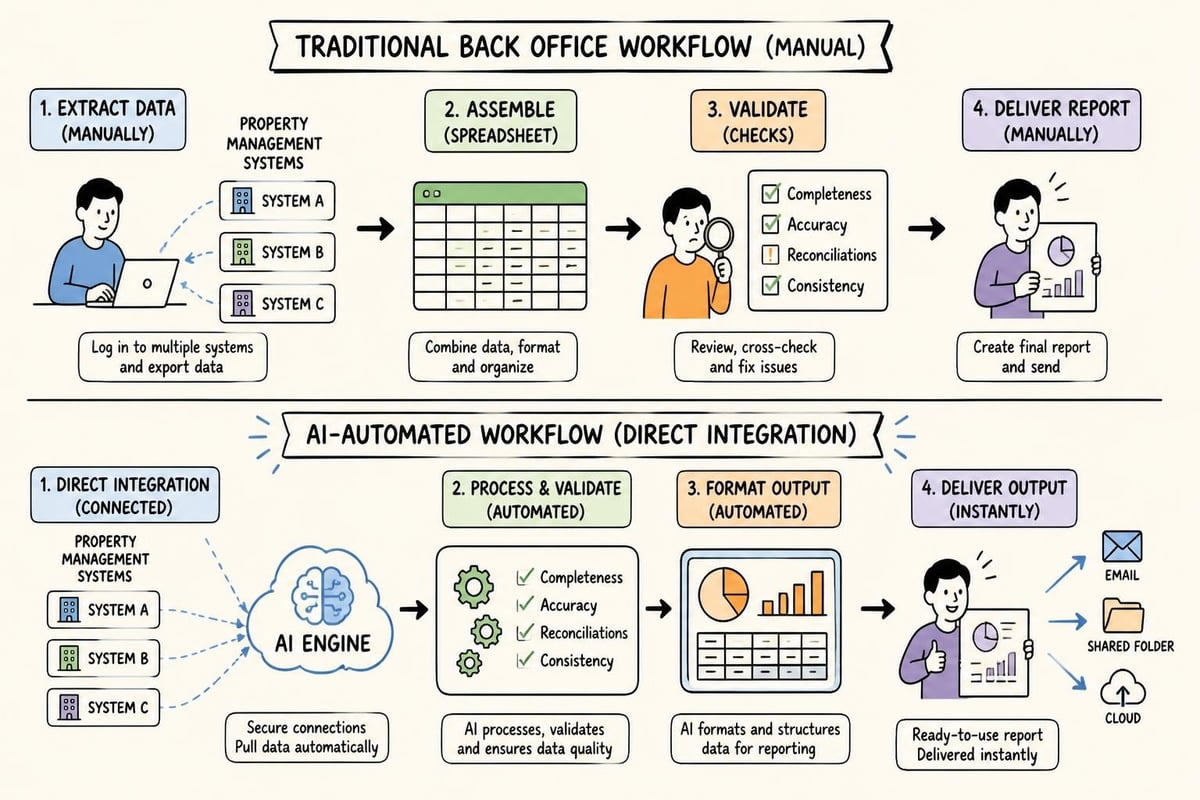
Investor package preparation combines all these elements into quarterly or monthly reports for limited partners. These packages include financial statements, property performance metrics, market commentary, and variance explanations, often requiring 40-80 hours of assembly time per reporting cycle.
Why Back Office Outsourcing Became the Default Solution
The rise of back office outsourcing in commercial real estate wasn't about strategic choice. It addressed a practical problem: enterprises needed these tasks completed but couldn't justify expanding internal headcount for data assembly work.
Third-party providers emerged as a cost-effective solution. Focus Services and similar BPO providers offered scalable teams trained in real estate accounting and reporting processes. They could handle volume fluctuations, cover for staff turnover, and operate at lower labor costs than in-house teams.
The Economics That Made Outsourcing Attractive
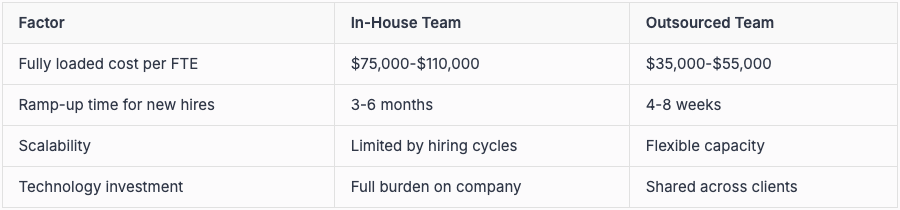
But outsourcing introduced its own friction. Communication delays, quality control issues, and the ongoing management overhead of coordinating with external teams created hidden costs. More importantly, outsourcing didn't solve the underlying problem-it just moved manual data assembly to a different location.
The fundamental issue remained: fragmented systems that don't communicate, requiring human intervention to bridge the gaps. This is precisely where AI-powered automation in real estate demonstrates its value by eliminating the need for that human bridge entirely.
How AI Replacing Back Office Outsourcing Actually Works
Modern AI systems don't just replicate what outsourced teams do faster. They fundamentally restructure the workflow by connecting directly to source systems and automating data transformation at the point of origin.
Step 1: Direct System Integration
AI platforms integrate with property management and accounting systems through secure API connections. Instead of exporting CSV files and manually reformatting data, the AI layer reads directly from Yardi Voyager, RealPage OneSite, Entrata, or AppFolio databases.
This integration happens at the data model level. The AI understands that "unit 4B rent payment" in one system corresponds to "lease revenue account 4100" in the general ledger. It maps these relationships automatically and maintains them as systems update.
For firms evaluating tools for real estate investors, this direct integration capability separates enterprise-grade solutions from simple reporting tools.
Step 2: Automated Data Assembly and Validation
Once connected, AI systems execute recurring workflows without manual triggers. On the first business day of each month, the system automatically pulls rent roll data, validates tenant payment status, flags exceptions, and generates standardized reports.
Validation happens through rule-based checks and pattern recognition:
Completeness checks: Ensuring all expected properties report data
Consistency validation: Confirming totals match across systems
Exception flagging: Identifying outliers or unusual variances
Historical comparison: Detecting changes that fall outside normal ranges
These validation steps catch 85-90% of data quality issues that would otherwise require manual review. The remaining 10-15% requiring human judgment are automatically escalated with context and supporting data.
Step 3: Output Generation for Specific Use Cases
AI platforms deliver formatted, decision-ready outputs tailored to specific business needs. Rather than dumping raw data into spreadsheets, they generate structured documents that match existing reporting templates and workflows.
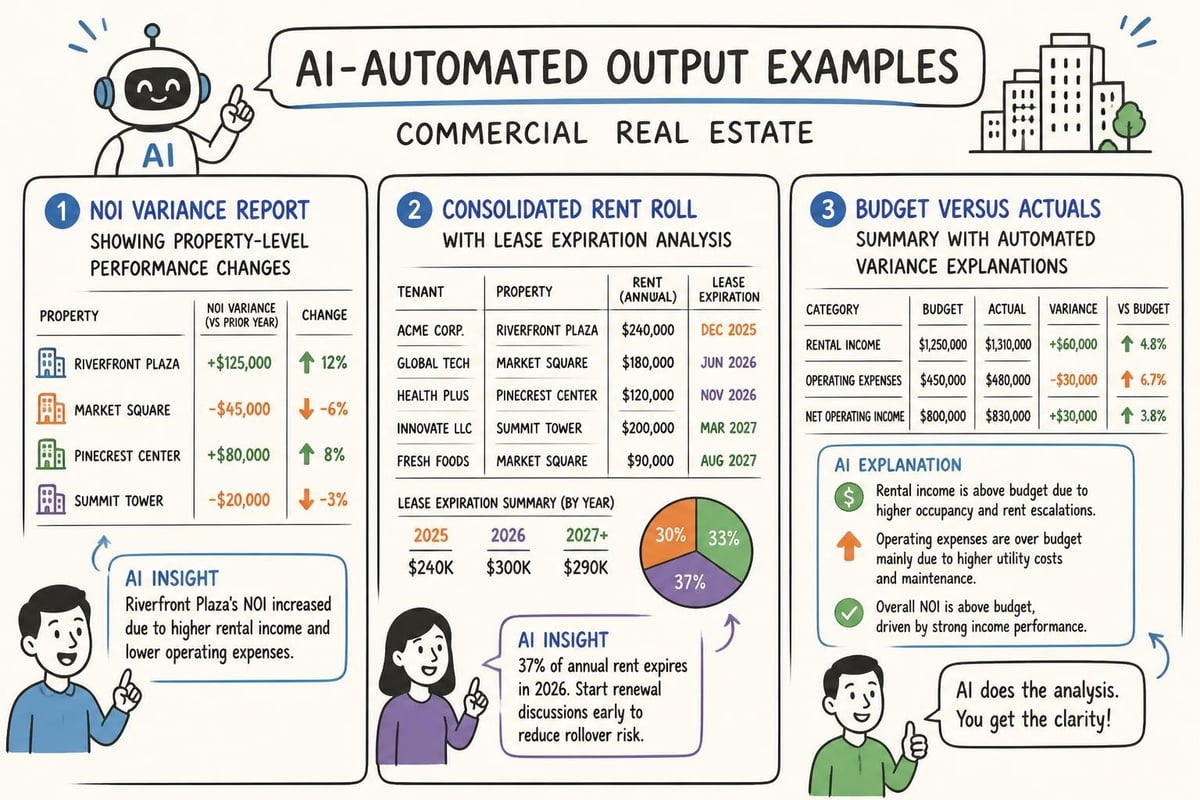
NOI Reporting Example: The system pulls revenue and operating expense data by property, calculates net operating income, compares to prior periods, and generates a formatted report showing period-over-period changes with percentage variances. Properties showing significant changes are flagged for review.
Rent Roll Assembly: Current tenant data, lease terms, payment status, and upcoming expirations are extracted and formatted into standardized rent rolls. The output includes occupancy percentages, weighted average lease terms, and renewal risk analysis.
Budget Variance Analysis: Planned versus actual expenses are compared at the property and portfolio level. The system identifies material variances, categorizes them by expense type, and drafts preliminary explanations based on historical patterns and known events.
Investor Package Preparation: Financial statements, property performance summaries, market updates, and variance explanations are compiled into formatted packages. Supporting schedules and exhibits are automatically attached based on investor preferences.
Mapping Traditional Outsourced Tasks to AI Workflows
Understanding how AI replacing back office outsourcing translates in practice requires mapping specific outsourced functions to their AI-automated equivalents.
Portfolio Performance Reporting
Traditional Process: Outsourced team receives monthly data exports from property managers. Team members manually consolidate data into Excel templates, validate totals, create charts, and format reports. Timeline: 5-7 business days per reporting cycle.
AI-Automated Workflow: System connects to property management platforms on the first of each month, pulls performance data, validates against prior periods, generates formatted reports, and delivers to stakeholder distribution list. Timeline: Same business day, available by 9 AM.
The time compression isn't the only benefit. Consistency improves because the same logic applies every cycle. Version control issues disappear because there's one source producing one output. And the audit trail is complete because every data point traces back to its system of record.
General Ledger Reconciliation
Traditional Process: Outsourced accountants download transaction files from property management systems and general ledger platforms. They manually match transactions, identify discrepancies, create adjustment entries, and document reconciliation evidence. Monthly cycle requires 40-60 hours across multiple properties.
AI-Automated Workflow: System continuously monitors transactions in both systems, matches based on date, amount, and property identifiers, flags unmatched items with potential matches, and generates reconciliation reports showing matched items, exceptions, and recommended adjustments.
According to Deloitte's analysis of back-office AI integration, organizations implementing AI-powered reconciliation reduce time spent by 60-75% while improving accuracy rates.
For firms managing diverse portfolios, understanding data analytics in asset management provides context for how these automated reconciliation workflows fit into broader analytical processes.
Rent Roll and Lease Administration
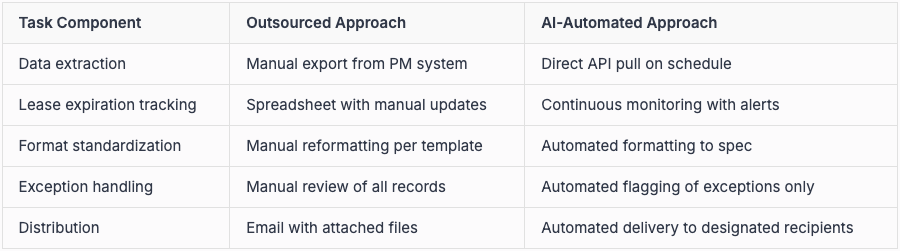
Budget Variance Analysis and Explanations
Budget variance work represents one of the highest-value targets for AI automation. Traditional outsourced teams spend substantial time calculating variances, categorizing them, and drafting explanatory narratives for material differences.
AI systems automate the calculation and categorization instantly. More importantly, they draft preliminary variance explanations by analyzing historical patterns, known events (like scheduled maintenance or lease renewals), and correlation with external factors (weather, market conditions).
A senior asset manager still reviews and approves these explanations, but starting from an 80% complete draft rather than a blank page changes the time equation dramatically. What previously required 10-15 hours of outsourced analyst time now needs 1-2 hours of internal expert review.
Introducing Leni's Approach to Back Office Automation
Leni operates as the connective layer between fragmented property, market, financial, and portfolio data systems. Rather than requiring manual data exports or outsourced assembly teams, Leni integrates directly with Yardi, RealPage, Entrata, and AppFolio to automate recurring back office workflows.
How Leni Connects to Your Existing Systems
The platform establishes secure connections to property management and accounting systems through authenticated APIs and data connectors. This isn't screen scraping or manual file uploads. It's direct database access with enterprise-grade security and audit logging.
Once connected, Leni maps your specific data structure, chart of accounts, property hierarchy, and reporting requirements. The system learns how your organization categorizes expenses, names properties, structures portfolios, and formats outputs.
This customization happens during implementation but doesn't require ongoing technical maintenance. As your property management system updates or you add new properties, Leni adapts automatically.
Specific Outputs Leni Delivers Without Manual Assembly
NOI Reports by Property and Portfolio: Leni pulls revenue and operating expense data, calculates net operating income at property and portfolio levels, compares to budget and prior periods, and generates formatted reports showing variances and trends. Reports are delivered on schedule without manual intervention.
Consolidated Rent Rolls: The platform extracts current tenant data, lease terms, payment status, and upcoming expirations from property management systems. It consolidates this information across properties, calculates portfolio-level metrics (occupancy, WALT, renewal risk), and outputs standardized rent rolls formatted to your specifications.
Budget Versus Actuals Summaries: Leni compares planned operating budgets against actual performance, identifies material variances by property and expense category, calculates percentage differences, and drafts preliminary variance explanations based on historical patterns and scheduled events.
Investor Package Components: The system generates complete financial statements, property performance summaries, portfolio dashboards, and supporting schedules. These components assemble into investor packages ready for review and distribution, reducing package preparation time from days to hours.
For teams evaluating comprehensive solutions, exploring best AI for real estate private equity provides additional context on enterprise-grade capabilities.
The Honest Truth About What AI Handles Versus What Humans Own
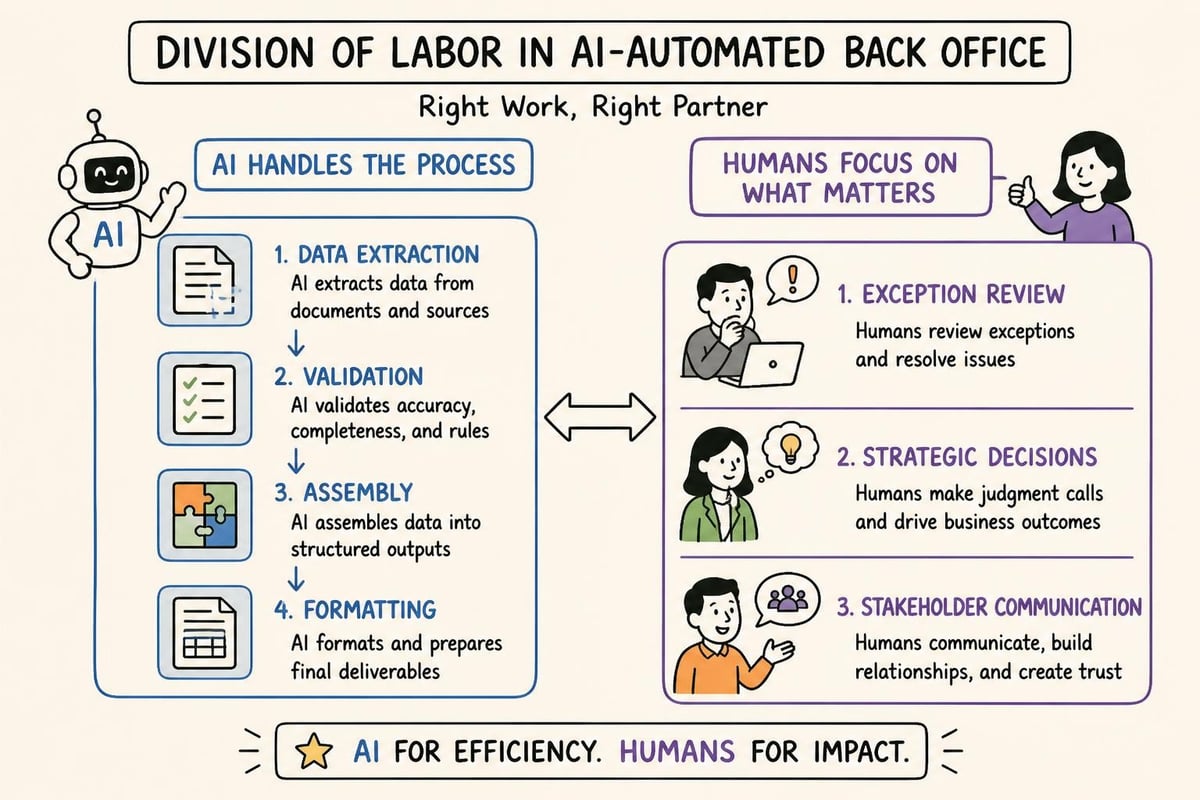
The narrative around AI replacing back office outsourcing shouldn't suggest humans become irrelevant. The relationship changes, with AI handling volume and consistency while human judgment remains central to decisions and exceptions.
Where AI Excels: Volume, Consistency, and Speed
AI systems process large volumes of repetitive tasks without fatigue or quality degradation. The thousandth transaction receives the same attention as the first. Rules apply consistently across all properties, all periods, and all scenarios.
Speed advantages compound over time. What takes an outsourced team five days to assemble takes AI systems minutes. This time compression enables more frequent reporting, faster month-end closes, and quicker response to investor inquiries.
According to research on how AI agents transform back-office operations, organizations report 70-80% reduction in processing time for recurring analytical tasks while maintaining or improving accuracy.
Where Human Judgment Remains Essential
Exceptional situations require context, experience, and judgment that AI systems don't possess. When a property shows unusual variance, a human needs to determine whether it reflects a data error, operational issue, or market shift requiring strategic response.
Strategic decisions about portfolio positioning, capital allocation, and disposition timing depend on nuanced judgment about market conditions, competitive dynamics, and organizational objectives. AI provides data and analysis to inform these decisions but doesn't make them.
Stakeholder communication, especially with investors and joint venture partners, requires empathy, relationship management, and the ability to address concerns beyond what data shows. These remain fundamentally human activities.
Key Distinction: AI replaces the assembly work that back office outsourcing handled. It doesn't replace the expertise that senior asset managers, controllers, and portfolio strategists provide.
Workflow Example Showing the Division
Consider monthly investor reporting for a value-add multifamily portfolio:
AI handles: Data extraction from Yardi, consolidation across 15 properties, NOI calculation, variance identification, preliminary variance explanations, report formatting
Human reviews: Flagged exceptions, material variances requiring context, strategic commentary on market conditions, disposition updates, capital allocation decisions
AI assembles: Final investor package incorporating human inputs, distributes to LP distribution list, archives for compliance
This division means a portfolio manager spends 2-3 hours on strategic review and commentary instead of 20-30 hours on data assembly. The work becomes more valuable because time shifts from manual processing to analytical judgment.
Understanding agentic AI for real estate helps clarify how these systems maintain human oversight while automating routine tasks.
What to Evaluate Before Reducing Back Office Outsourcing with AI
Transitioning from outsourced back office services to AI-powered automation requires systematic evaluation and planning. This isn't simply canceling a vendor contract and turning on software.
Step 1: Audit Your Current Back Office Workflow
Document exactly what your outsourced team does, how long tasks take, and what outputs they produce. Create a comprehensive list that includes:
Recurring tasks: Monthly, quarterly, and annual deliverables with timing and recipients
Data sources: Every system that requires manual data extraction
Output formats: Templates, formats, and customization requirements
Exception handling: How unusual situations are identified and escalated
Quality control: Current validation and review processes
This audit reveals which tasks are standardized and automatable versus which require specialized expertise or judgment. Generally, 60-75% of outsourced back office work in commercial real estate involves standardized data assembly suitable for AI automation.
Step 2: Map Data Integration Requirements
Identify every system that needs to connect to your AI platform. For most CRE firms, this includes:
Property management systems (Yardi, RealPage, Entrata, AppFolio)
General ledger and accounting platforms
Banking and treasury management systems
Market data providers
Document management systems
Confirm that your chosen AI solution offers native integrations or can develop custom connectors. Ask specific questions about authentication methods, data refresh frequency, and historical data access.
While some providers discuss limitations of AI in replacing back-office functions, these concerns primarily apply to systems lacking proper integration capabilities or attempting to automate judgment-based work rather than data assembly.
Step 3: Define Success Metrics and Transition Timeline
Establish clear metrics for evaluating AI implementation success:
Efficiency Metrics:
Time from period close to report delivery
Hours spent on data assembly versus analysis
Month-end close cycle time
Investor package preparation time
Quality Metrics:
Data accuracy rates (reconciliation match rates)
Exception identification rate
Stakeholder satisfaction scores
Audit finding frequency
Cost Metrics:
Total back office cost per property
Cost per report produced
Internal labor hours required for review
Technology costs versus outsourcing fees
Set a realistic transition timeline. Most organizations implement AI-powered back office automation in phases over 3-6 months rather than attempting immediate wholesale replacement.
Step 4: Plan for Change Management and Training
Your internal team needs to understand how their roles evolve. Portfolio managers and asset managers shift from data assembly supervision to analytical work. Controllers and accounting managers move from transaction processing oversight to exception management and strategic financial analysis.
Provide specific training on:
How to review AI-generated outputs and validate accuracy
When and how to override automated processes
How to customize report parameters and formatting
How to interpret exception flags and make decisions
Change management also affects relationships with current outsourcing providers. Consider maintaining limited back office outsourcing capacity during transition for backup coverage and complex exception handling.
Step 5: Evaluate Vendor Capabilities and Track Record
Not all AI platforms deliver equivalent capabilities. Evaluate vendors based on:
Integration Depth: Do they offer pre-built connectors to your specific property management and accounting systems? Can they access the specific data fields and modules you use?
Real Estate Expertise: Does the platform understand CRE-specific concepts like rent rolls, CAM reconciliation, lease accounting, and portfolio reporting? Generic AI automation tools require extensive customization for commercial real estate workflows.
Enterprise Security: Does the solution meet enterprise security standards with SOC 2 compliance, encryption, role-based access controls, and comprehensive audit logging?
Customization Flexibility: Can the platform adapt to your specific reporting templates, calculation methodologies, and output requirements without requiring complete workflow redesign?
Support and Implementation: What level of implementation support, training, and ongoing technical assistance does the vendor provide?
For firms evaluating comprehensive platforms, reviewing options for CRE asset management software provides useful comparison frameworks.
Addressing Common Concerns About AI Replacing Back Office Outsourcing
Organizations considering this transition typically raise specific concerns that deserve direct answers.
"Our workflows are too customized for AI to handle"
Most "customization" in back office workflows involves formatting preferences and calculation sequences rather than truly unique logic. AI platforms accommodate custom templates, specific calculation methodologies, and organization-specific report structures through configuration rather than custom coding.
The question isn't whether your workflows are too customized, but whether they're documented well enough to replicate. If your outsourced team can execute them, an AI system can automate them.
"What happens when the AI makes mistakes?"
AI systems make different types of errors than humans. They don't get tired, distracted, or sloppy. But they can misinterpret unusual data patterns or apply rules inappropriately in edge cases.
Effective implementation includes multiple validation layers: automated consistency checks, threshold-based alerts for unusual values, and human review of exceptions. The error rate for standardized data assembly tasks typically falls below 2-3% with proper implementation, compared to 5-8% for manual processing according to research on AI automation in back-office outsourcing.
"We'll lose institutional knowledge from our outsourcing partner"
This concern confuses two distinct types of knowledge. Data assembly procedures and formatting preferences aren't institutional knowledge-they're documented processes that AI can replicate. True institutional knowledge about market conditions, property histories, and relationship context remains with your internal team and actually becomes more accessible when they're not buried in manual data work.
"The technology costs seem high compared to outsourcing fees"
Compare total costs, not just invoice amounts. Outsourcing fees represent direct labor but don't include:
Internal management time coordinating with outsourced teams
Quality control and correction work
Communication delays extending decision timelines
Limited scalability requiring additional vendor capacity
Knowledge transfer costs from staff turnover
When calculated comprehensively, AI automation typically delivers 30-50% total cost reduction compared to outsourcing while improving speed and consistency. Forbes analysis of AI's impact on back-office work suggests even larger savings for organizations with significant data assembly requirements.
Practical Implementation: A Phased Approach
Successful implementation of AI replacing back office outsourcing follows a methodical progression rather than attempting complete transformation overnight.
Phase 1: Pilot with High-Volume, Standardized Tasks (Weeks 1-8)
Begin with one or two recurring workflows that involve significant manual effort but follow consistent patterns. Rent roll assembly and monthly portfolio performance reporting represent ideal starting points.
During this phase:
Configure system integrations to property management and accounting platforms
Map data fields to output requirements
Set up automated validation rules
Establish human review checkpoints
Run parallel processes (AI and outsourced) to validate accuracy
Success in Phase 1 builds confidence and identifies integration or configuration issues before expanding scope.
Phase 2: Expand to Financial Reporting and Reconciliation (Weeks 9-16)
Once basic reporting workflows function reliably, extend automation to financial processes. Budget versus actuals analysis, general ledger reconciliation, and variance reporting require more complex logic but follow predictable patterns.
This phase typically requires closer collaboration between technology teams and accounting staff to ensure proper mapping of chart of accounts, cost centers, and reporting hierarchies.
Phase 3: Implement Investor Reporting and Complex Packages (Weeks 17-24)
The final expansion phase automates complete investor packages, quarterly reporting packages, and other complex outputs that combine multiple data sources and require formatted assembly.
These workflows often include both automated components (financial statements, property performance summaries) and human-authored components (market commentary, strategic updates). The AI platform assembles both into final formatted packages.
By Phase 3 conclusion, most organizations reduce outsourced back office dependence by 60-80% while maintaining backup capacity for exceptions and surge periods.
Understanding how real estate data analysts use these automated outputs helps clarify how AI-generated reports feed into broader analytical workflows.
What the Future Looks Like: Beyond Replacement to Enhancement
AI replacing back office outsourcing represents the first step in a broader transformation of how investment and asset management teams operate. The ultimate goal isn't just doing the same work faster-it's fundamentally upgrading what's possible.
From Periodic Reporting to Continuous Intelligence
When data assembly happens automatically, reporting frequency becomes limited only by decision-making capacity rather than processing capacity. Organizations move from monthly snapshots to continuous monitoring with real-time alerts for material changes.
Portfolio managers receive immediate notification when a property's operating performance diverges from expectations, when a tenant payment pattern changes, or when market conditions shift enough to affect valuation assumptions. This continuous intelligence enables proactive management rather than reactive response.
From Standardized Outputs to Customized Analytics
AI platforms that understand your data can generate custom analyses on demand rather than just reproducing monthly templates. Ask for lease expiration concentration analysis, tenant credit quality trends, or expense ratio comparisons across property types, and receive formatted answers in minutes.
This capability transforms how teams approach strategic questions. Instead of planning analysis projects that require weeks of data assembly, leaders ask questions and receive data-driven answers immediately.
From Back Office Support to Strategic Partnership
As AI handles mechanical data work, the remaining human expertise shifts entirely to strategic value. Asset managers spend time on market analysis, disposition strategy, capital planning, and investor relationships rather than coordinating data assembly.
This evolution represents the core promise of AI replacing back office outsourcing: not reducing headcount but upgrading how talented professionals spend their time.
The shift from outsourced back office teams to AI-powered automation addresses the fundamental problem that made outsourcing necessary: fragmented data requiring manual assembly. Modern AI platforms eliminate that requirement by connecting directly to source systems and automating recurring workflows that previously consumed significant time and resources.
For commercial real estate, investment, and asset management teams ready to move beyond manual data assembly, Leni provides the enterprise-grade platform that connects property, market, financial, and portfolio data to deliver decision-ready outputs faster-built with the security, accuracy, and industry context that serious institutional work demands.

Johanna Gruber
Johanna has spent the last 8 years helping marketing teams connect with audiences through content. Specializing in B2B SaaS and real estate.

Curious About AI?
Join the largest AI community for real estate online. Get bite-sized, real-world use case videos, plus practical tips and proven strategies from top industry experts on adopting AI effectively.
MEET LENI
AI SuperAgent Purpose Built for Investors and Operators.
Experience how professionals and teams in your domain are getting the edge using AI.
