AI Reporting for Property Managers: Automation Guide 2026

AI Reporting for Property Managers: Automation Guide 2026
Property managers spend an average of 15-20 hours per week on reporting activities that deliver minimal strategic value. You pull occupancy data from one system, financial performance from another, maintenance metrics from a third platform, then manually consolidate everything into spreadsheets that are outdated before stakeholders even open them. This reporting burden doesn't just consume time. It delays critical decisions, creates version control chaos, and distances your team from the strategic work that actually improves portfolio performance.
AI reporting for property managers eliminates this inefficiency by automating the entire reporting workflow from data extraction to stakeholder delivery. The right platform connects directly to your property management systems, consolidates data autonomously, generates reports on recurring schedules, and monitors key performance indicators with proactive alerts that notify you the moment metrics exceed established thresholds.
What AI Reporting Actually Means for Property Managers
AI reporting transforms how property management teams interact with their operational data. Traditional reporting requires manual intervention at every step: logging into multiple systems, exporting data, reconciling inconsistencies, formatting spreadsheets, and distributing outputs. AI reporting for property managers automates this entire chain through direct system integrations and intelligent data processing.
The technology works through three core capabilities:
Automated data consolidation that pulls information from property management platforms without manual exports
Intelligent report generation that formats outputs according to stakeholder requirements and portfolio standards
Proactive monitoring that tracks metrics continuously and alerts teams when thresholds are exceeded
Unlike generic business intelligence tools that require extensive configuration and data engineering support, purpose-built solutions like AI property reporting software understand the specific data structures and reporting requirements inherent to property management.
Direct Integration with Property Management Systems
The foundation of effective AI reporting for property managers is seamless integration with existing property management systems. Your PMS platforms contain the operational data that drives every portfolio decision: lease terms, rent rolls, maintenance requests, occupancy trends, and financial performance.
Manual data extraction from these systems creates multiple failure points. Exports may exclude critical fields, formatting inconsistencies corrupt data integrity, and human error introduces inaccuracies that cascade through every subsequent analysis. Direct API integrations eliminate these risks by accessing data programmatically with perfect consistency.
Compatible Property Management Systems:
PlatformIntegration TypeData AccessibleYardiDirect APIFinancials, leases, rent rolls, AR/APRealPageDirect APIOccupancy, pricing, operations, financialsEntrataDirect APIResident data, maintenance, leasing metricsAppFolioDirect APIPortfolio financials, tenant communicationsResManDirect APIProperty operations, financial reportingMRI SoftwareDirect APIAccounting, leasing, maintenance tracking
Platforms that support document extraction can also process leases, operating memorandums, and financial statements to enrich reporting with details not captured in structured PMS databases.
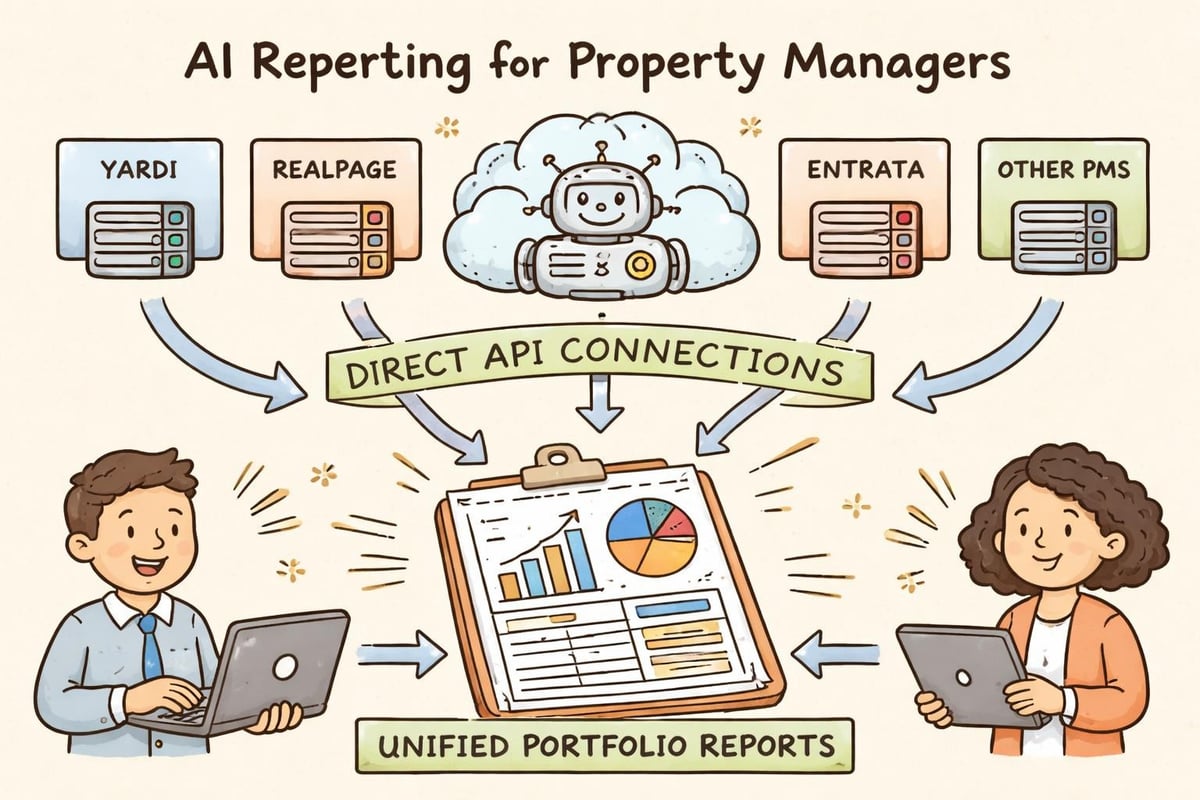
Automating Recurring Portfolio Reports
Property management teams produce the same reports on predictable schedules: weekly occupancy summaries, monthly financial statements, quarterly portfolio performance reviews, and annual budget variance analyses. These recurring reports consume disproportionate time precisely because they're repetitive.
AI reporting for property managers converts these manual processes into automated workflows that execute on schedule without human intervention.
Setting Up Automated Report Workflows
Define report templates that specify which metrics, properties, and time periods to include
Establish recurring schedules based on stakeholder requirements (daily, weekly, monthly, quarterly)
Configure distribution rules that automatically deliver reports to specific recipients
Set data refresh parameters to ensure reports always reflect current system data
Implement version control so teams can track report evolution over time
The most sophisticated platforms enable conditional logic within reports. If occupancy drops below 90% at a specific property, the automated report flags that asset and includes additional detail on lease expirations and marketing performance. This contextual intelligence transforms reports from static data summaries into actionable business intelligence.
Common Automated Reports for Property Managers:
Monthly financial performance by property and portfolio
Weekly occupancy and leasing velocity metrics
Rent roll summaries with lease expiration schedules
Maintenance request volume and resolution time tracking
Budget variance analysis with category-level detail
Collections performance and accounts receivable aging
Teams using reporting tools for property managers that automate these workflows reclaim 12-18 hours per week that previously went to manual report production.
Source-Linked Outputs for Verification
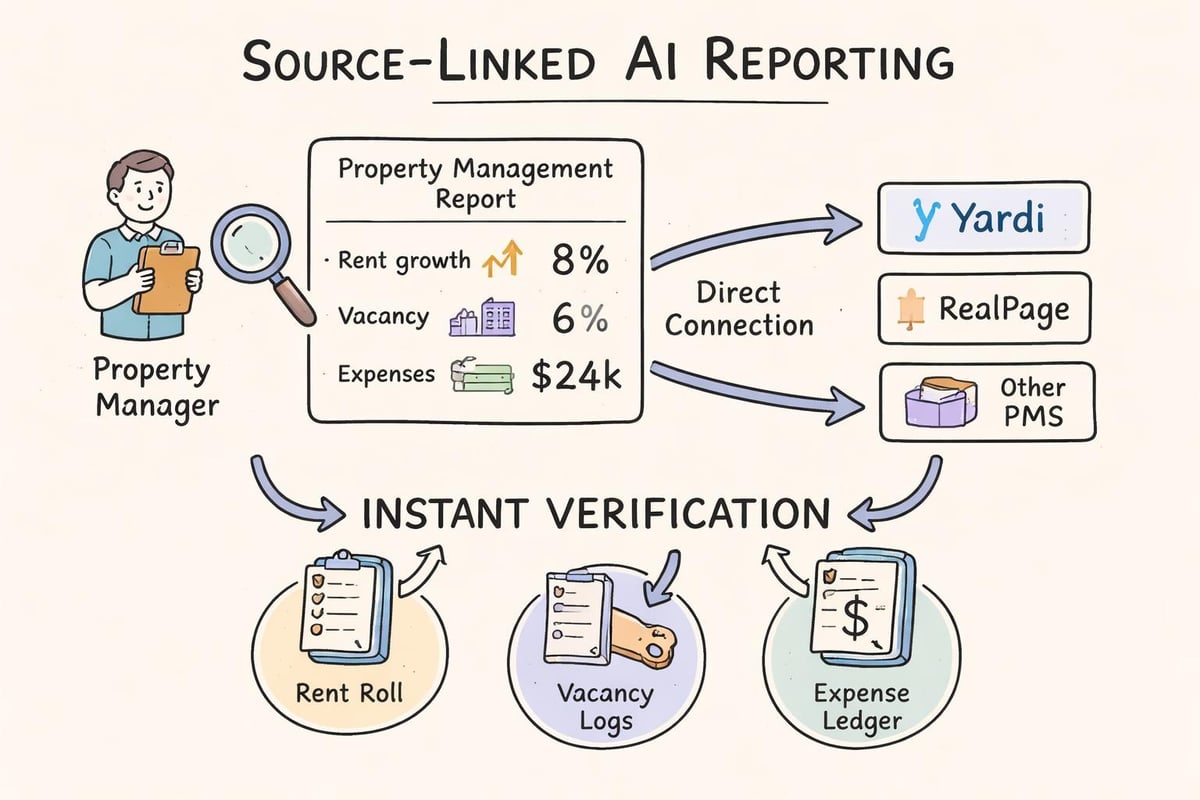
One critical challenge with automated reporting is trust. Stakeholders need confidence that reported figures accurately reflect underlying data. The solution is source-linked outputs that connect every data point in a report directly back to its origin in the property management system.
When a monthly financial report shows that Property A generated $127,450 in rental income, stakeholders can click that figure and view the specific rent roll entries, payment transactions, and system records that produced that number. This transparency eliminates the verification work that typically follows report distribution and reduces questions about data accuracy.
Real-Time KPI Monitoring and Proactive Alerts
Monthly reports provide retrospective visibility, but property management decisions require real-time awareness of performance trends. AI reporting for property managers extends beyond scheduled report generation to continuous monitoring of key asset management metrics with threshold-based alerting.
Configuring Pulse Alerts for Portfolio Metrics
Pulse alerts monitor specific KPIs continuously and notify teams the moment values exceed established thresholds. Rather than discovering an occupancy drop when you review next month's report, you receive an immediate notification when occupancy at any property falls below your defined acceptable range.
Critical KPIs for Property Management Pulse Alerts:
Metric CategoryAlert Trigger ExamplesBusiness ImpactOccupancyDrops below 92% at any propertyImmediate leasing intervention neededCollectionsDelinquency exceeds 5% of rent rollCash flow risk, collection action requiredMaintenanceAverage resolution time over 48 hoursResident satisfaction risk, operational reviewLeasing VelocityNew leases below 15 per monthMarketing adjustment, pricing reviewExpense VarianceCategory spend exceeds budget by 15%Budget management, vendor review
The most effective implementations don't just notify teams when thresholds are crossed. They include contextual data that accelerates response. An occupancy alert includes current lease expiration schedules, pending applications, and recent market rate adjustments so the receiving team member has immediate context for decision-making.
Comparing Static Reporting vs. Proactive Monitoring
Traditional reporting models create decision lag. You conduct operations throughout the month, compile a report at month-end, distribute it to stakeholders, and only then do they become aware of performance issues that emerged weeks earlier. By the time decisions are made and implemented, additional weeks have passed.
Proactive monitoring with AI-driven analytics and reporting collapses this timeline. Issues are identified immediately, relevant stakeholders are notified with complete context, and teams can respond while the situation is still developing rather than after it's already impacted financial performance.
Issue emerges (occupancy dips, expense spikes, maintenance backlog grows)
System detects threshold violation in real-time
Alert delivers notification with contextual data and source links
Team responds with immediate intervention
System tracks resolution and updates reporting automatically
This shift from reactive to proactive management fundamentally changes how property management teams operate, enabling intervention before small issues become major problems.
Customizing Reports for Different Stakeholders
Different stakeholders require different reporting formats and levels of detail. Asset managers need comprehensive portfolio analytics with property-level drill-down capabilities. Executive teams want high-level performance summaries focused on returns and variance from projections. Investors require transparency into financial performance with comparison to underwriting assumptions.
AI reporting for property managers handles this complexity through stakeholder-specific report configurations that automatically format the same underlying data according to recipient requirements.
Building Stakeholder-Specific Report Templates
Rather than maintaining separate reporting workflows for each audience, you create templates that filter and format data appropriately:
Asset Manager Reports:
Property-level financial statements with budget variance
Detailed occupancy trends with lease expiration schedules
Maintenance metrics including request volume and category analysis
Capital project tracking with budget and timeline status
Rent roll detail with unit-level performance
Executive Dashboard Reports:
Portfolio-level NOI and cash flow summaries
Occupancy across all properties with trend visualization
High-level budget variance by major category
Strategic initiative progress tracking
Market position relative to competitive set
Investor Update Reports:
Returns compared to underwriting projections
Distribution calculations and payment schedules
Portfolio valuation with comparable market data
Major events (acquisitions, dispositions, refinancings)
Forward-looking projections based on current performance
Platforms designed for reporting and asset management enable you to define these templates once and have the system automatically generate appropriately formatted reports for each stakeholder group on their required schedule.
Integrating Market Research into Portfolio Reports
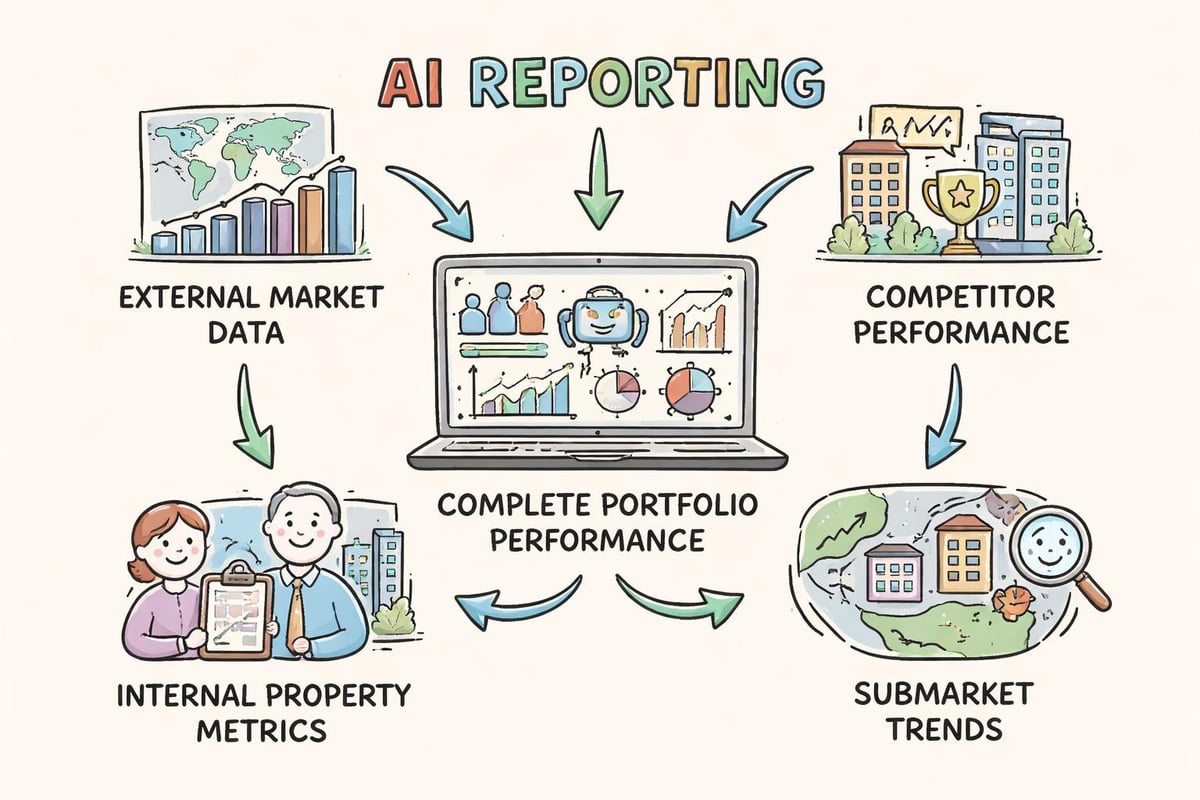
Property performance doesn't exist in isolation. Occupancy trends must be evaluated against market conditions. Rent growth should be compared to submarket performance. Your AI reporting for property managers should contextually integrate external market data with internal operational metrics.
The most sophisticated platforms automatically pull current market research into portfolio reports: comparable property performance, submarket occupancy rates, rental rate trends, and economic indicators that affect property performance. This integration transforms internal reports from simple data summaries into comprehensive market position assessments.
For example, a monthly occupancy report that shows 94% occupancy at Property A becomes significantly more valuable when it also shows that the submarket average is 91% and your primary competitors average 92%. This context immediately informs strategic decisions about pricing, marketing spend, and concession strategies.
Teams using market research capabilities within their reporting platforms make more informed decisions because they evaluate performance within appropriate competitive context rather than in isolation.
Choosing the Right AI Reporting Platform
Not all AI reporting solutions deliver equal value for property management teams. Generic business intelligence platforms require extensive configuration and don't understand property management workflows. Consumer-grade AI tools can't handle the data volumes or security requirements commercial real estate demands.
Essential Capabilities Checklist
When evaluating AI reporting for property managers, assess platforms against these critical requirements:
Integration and Data Access:
Direct API connections to your property management systems (Yardi, RealPage, Entrata, AppFolio, ResMan, MRI)
Automated data synchronization without manual exports
Support for both structured PMS data and unstructured documents
Historical data access for trend analysis
Report Generation and Automation:
Customizable templates for different stakeholder groups
Recurring schedule configuration for automated delivery
Source-linked outputs with verification capabilities
Multi-format export (PDF, Excel, PowerPoint, web dashboards)
Monitoring and Alerting:
Real-time KPI tracking across portfolio
Threshold-based alert configuration
Contextual data in notifications
Alert routing to appropriate team members
Security and Compliance:
SOC 2 Type 2 certification minimum
Role-based access controls
Data encryption in transit and at rest
Audit logging for all system activities
Accuracy and Reliability:
Verifiable outputs with direct source links
Continuous learning from ingested data
Reconciliation capabilities against source systems
Version control and change tracking
Platforms purpose-built for commercial real estate, like those supporting financial modeling and underwriting, understand the specific calculations, metrics, and reporting requirements property management teams need.
Implementation Process and Timeline
Deploying AI reporting for property managers requires structured implementation to ensure successful adoption and immediate value delivery. The process typically follows a phased approach that starts with core integrations and progressively expands capabilities.
Phase 1: System Integration and Data Connection (Weeks 1-2)
Begin by establishing connections to your property management systems. This phase involves:
Providing API credentials for PMS platforms
Mapping data fields between systems and reporting platform
Configuring data synchronization schedules
Validating data accuracy through reconciliation testing
Establishing security protocols and access controls
The goal is ensuring clean, accurate data flow from source systems into the reporting platform before building any reports.
Phase 2: Template Development and Report Automation (Weeks 3-4)
With data flowing reliably, create report templates and automation workflows:
Define standard reports required by different stakeholder groups
Build templates with appropriate metrics, formatting, and branding
Configure recurring schedules aligned with stakeholder needs
Set up distribution rules and delivery mechanisms
Test output quality and stakeholder feedback
Phase 3: Monitoring Configuration and Alert Setup (Weeks 5-6)
Implement proactive monitoring capabilities that extend reporting beyond scheduled outputs:
Identify critical KPIs requiring continuous monitoring
Establish appropriate threshold values for alerts
Configure alert routing to responsible team members
Define escalation protocols for unresolved issues
Test alert accuracy and reduce false positives
Phase 4: Training and Optimization (Ongoing)
Successful implementation requires team adoption and continuous refinement:
Training Focus Areas:
How to access and interpret automated reports
Responding to threshold alerts effectively
Customizing existing templates for ad-hoc analysis
Verifying data accuracy through source links
Requesting new reports or monitoring configurations
As teams use the platform, the system learns from interaction patterns and data ingestion. Solutions that improve accuracy with increased data exposure become progressively more valuable over time.
Measuring ROI from AI Reporting Implementation
Property management firms implementing AI reporting for property managers typically measure return on investment through both time savings and decision quality improvements.
Quantifiable Time Savings
Track the hours previously spent on manual reporting activities against time required after automation:
Reporting ActivityManual Hours/MonthAutomated Hours/MonthTime SavedData extraction from PMS12012 hoursData consolidation and reconciliation16115 hoursReport formatting and production20218 hoursReport distribution and versioning606 hoursStakeholder questions and verification1028 hoursTotal Monthly64559 hours
For a property management team, reclaiming 59 hours per month represents approximately 1.5 full-time employees worth of capacity that can be redirected to strategic activities like lease negotiations, asset optimization, and portfolio growth.
Decision Quality Improvements
Beyond time savings, measure improvements in decision speed and accuracy:
Reduced decision lag: Time from issue emergence to intervention
Improved forecast accuracy: Variance between projections and actuals
Faster occupancy recovery: Time to resolve occupancy dips
Enhanced budget compliance: Reduction in expense category overruns
Organizations using AI in property management report that faster access to accurate data improves decision quality by enabling intervention before small issues escalate into major problems.
Advanced Capabilities: Workflow Automation Beyond Reporting
The most sophisticated AI reporting for property managers extends beyond data visualization into workflow automation that acts on reporting insights. When a threshold alert identifies an issue, the system can automatically initiate corrective workflows.
For example, when collections performance exceeds acceptable delinquency thresholds, the platform can automatically:
Generate a detailed delinquency report by property and unit
Create resident communication templates for collection notices
Flag accounts requiring legal review based on defined criteria
Update cash flow projections to reflect collection risk
Notify relevant team members with assigned action items
This progression from reporting to action represents the next evolution in property management technology. Rather than simply informing teams about issues, the system actively participates in resolution workflows.
Platforms offering comprehensive workflow automation capabilities transform how property management teams operate by handling not just the analytical work but also the operational responses that analysis triggers.
Data Security and Compliance Considerations
Property management data includes sensitive financial information, resident personal data, and proprietary business intelligence that requires enterprise-grade security. When evaluating AI reporting for property managers, security and compliance capabilities are non-negotiable requirements.
Critical Security Requirements:
SOC 2 Type 2 certification demonstrating continuous security control effectiveness
Data encryption both in transit and at rest using industry-standard protocols
Role-based access controls ensuring team members only access appropriate data
Audit logging that tracks all system activity for compliance and investigation
Regular security assessments including penetration testing and vulnerability scanning
Additionally, ensure the platform maintains compliance with relevant regulations including Fair Housing Act requirements, state-specific privacy laws, and any industry-specific compliance frameworks applicable to your portfolio.
Solutions like AI property management software that prioritize security from initial design deliver more robust protection than platforms that treat security as an afterthought.
Evaluation Checklist: What to Look for When Choosing AI Reporting
As you evaluate AI reporting for property managers, use this comprehensive checklist to ensure the platform meets your requirements:
Integration Capabilities:
Direct API connections to your specific PMS platforms
Automated data synchronization without manual intervention
Support for both structured and unstructured data sources
Historical data access for trend analysis
Reporting Features:
Customizable templates for different stakeholder groups
Recurring automation with flexible scheduling
Source-linked outputs for verification
Multi-format export capabilities
Monitoring and Alerts:
Real-time KPI tracking across entire portfolio
Configurable threshold-based alerting
Contextual data included in notifications
Smart routing to appropriate team members
Accuracy and Reliability:
Verifiable outputs with direct source links
System learns and improves from data ingestion
Reconciliation capabilities against source systems
Version control and change tracking
Security and Compliance:
SOC 2 Type 2 certification minimum
Comprehensive data encryption
Role-based access controls
Complete audit logging
Scalability:
Performance maintained as portfolio grows
Support for multi-property and multi-market portfolios
Concurrent user support for team collaboration
Enterprise-grade uptime guarantees
Implementation and Support:
Structured onboarding process
Comprehensive training resources
Responsive technical support
Regular platform updates and improvements
Platforms purpose-built for commercial real estate understand these requirements inherently. They're designed specifically for asset managers, acquisitions teams, and portfolio operators rather than adapted from generic business intelligence tools.
AI reporting for property managers transforms the most time-consuming aspect of portfolio management into an automated, proactive capability that improves both efficiency and decision quality. By consolidating data from multiple systems, generating reports autonomously, and monitoring KPIs with threshold-based alerts, the right platform reclaims dozens of hours per month while simultaneously improving the speed and accuracy of critical portfolio decisions. Leni delivers this transformation through purpose-built capabilities that connect directly to Yardi, RealPage, Entrata, and other property management systems, automate recurring portfolio reports, and monitor metrics with Pulse alerts that notify teams the moment performance thresholds are exceeded. Discover how Leni can transform your property management reporting by visiting Leni today.

Johanna Gruber
Johanna has spent the last 8 years helping marketing teams connect with audiences through content. Specializing in B2B SaaS and real estate.
Curious About AI?
Join the largest AI community for real estate online. Get bite-sized, real-world use case videos, plus practical tips and proven strategies from top industry experts on adopting AI effectively.
MEET LENI
AI SuperAgent Purpose Built for Investors and Operators.
Experience how professionals and teams in your domain are getting the edge using AI.
