AI Tools for Financial Modeling: Accuracy vs. Speed

AI Tools for Financial Modeling: Accuracy vs. Speed
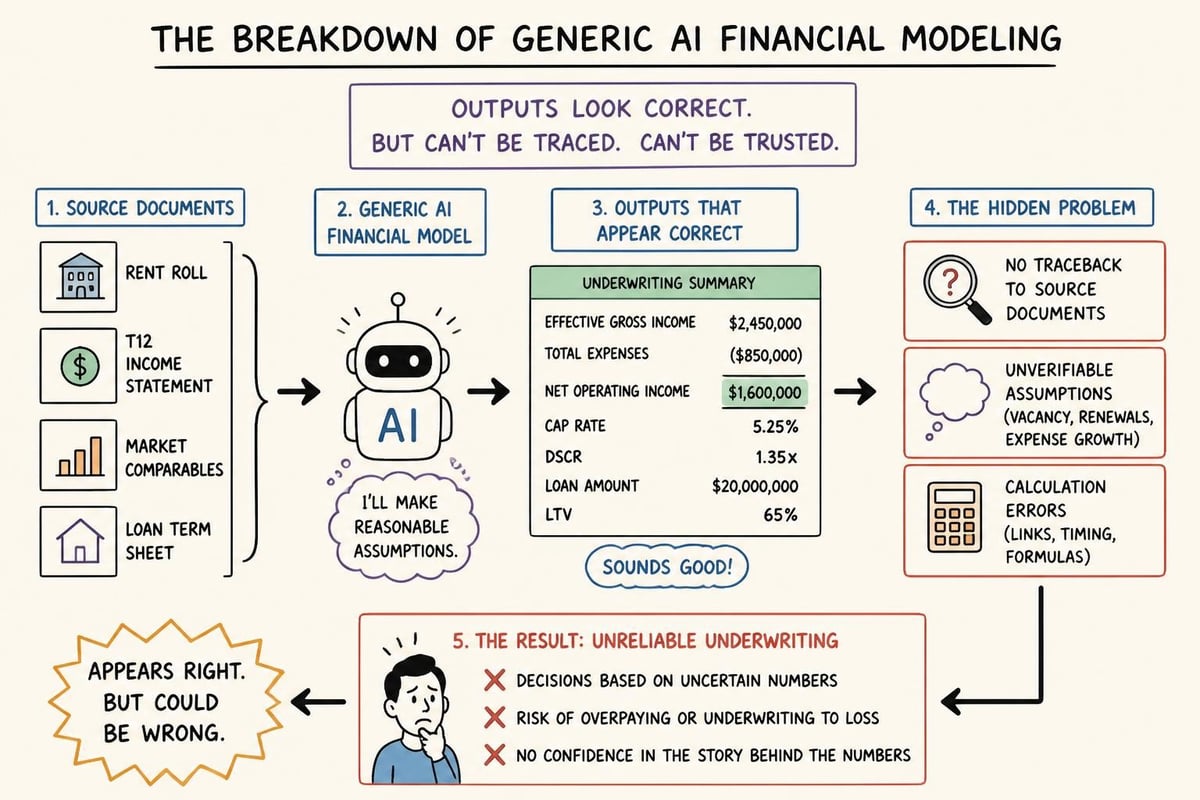
The gap between what looks right and what actually ties out defines the current state of ai tools for financial modeling. General-purpose AI platforms can draft a pro forma in seconds, complete with formatted tables and color-coded assumptions. The model arrives beautifully packaged, seemingly ready for your investment committee. But when you trace the numbers back to their source, the connections dissolve. An NOI figure references a rent roll that doesn't exist. Cap rates appear accurate but draw from outdated market comps. Sensitivity tables calculate perfectly while using assumptions that contradict the actual lease terms sitting in your data room.
The Generic AI Approach to Financial Modeling
ChatGPT, Claude, and Gemini represent the first wave of accessible ai tools for financial modeling. These platforms excel at pattern recognition and can produce financial statements that appear professional at first glance.
What Generic AI Does Well
These tools bring genuine value for certain financial tasks:
Draft creation: Rapid generation of initial model structures and frameworks
Formula assistance: Quick solutions for Excel calculations and financial formulas
Template generation: Building standardized formats for recurring analyses
Concept explanation: Breaking down complex financial concepts for team training
Generic AI shines when accuracy requirements allow for human review and correction. A preliminary budget forecast, an internal planning document, or a rough order-of-magnitude analysis all benefit from the speed these tools provide.
Where General-Purpose Models Break Down
The limitations surface immediately in production financial work. AI is reshaping the finance industry, but governance concerns persist precisely because generic tools lack financial rigor.
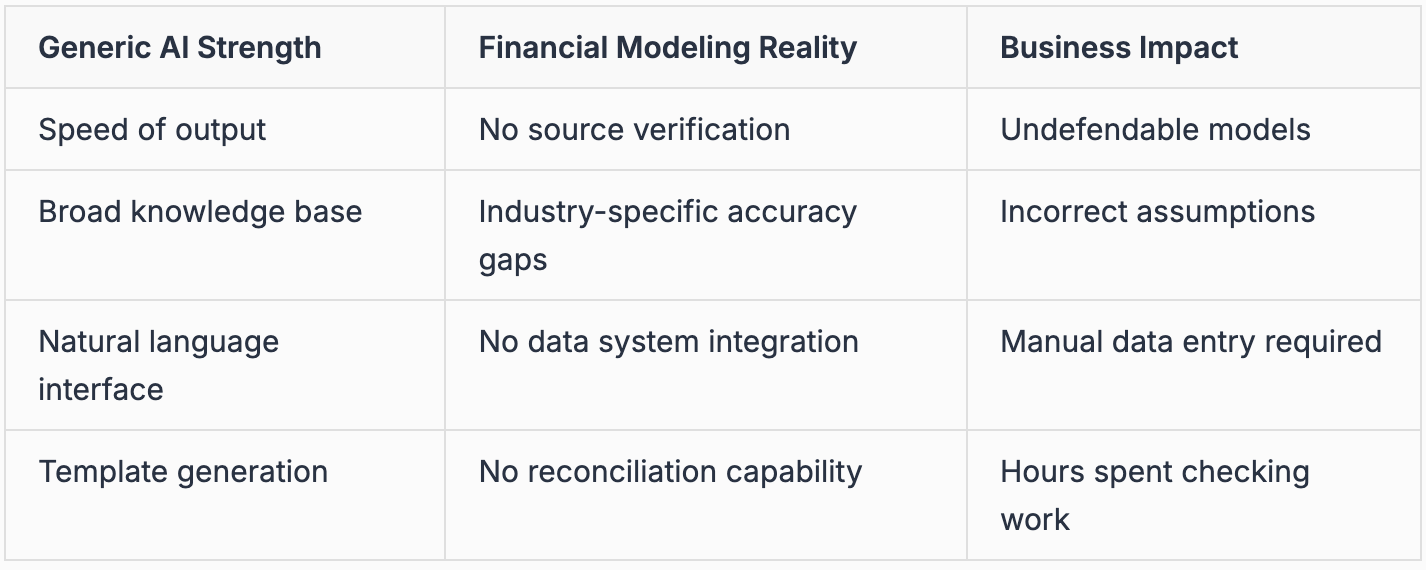
The reconciliation problem: Generic AI generates outputs without maintaining audit trails. You receive a 10-year cash flow projection with no path to verify which data points informed each calculation. When your CFO questions a specific assumption, you cannot trace it back to source documentation.
The hallucination risk: Large language models trained on broad datasets will confidently present incorrect financial data. A market rent assumption might reflect Seattle office rates when your asset sits in Phoenix. Expense ratios could average across property types that share no operational similarities with your asset.
The formula integrity gap: Calculations frequently contain subtle errors that compound across projection periods. A discount rate might apply incorrectly to a specific cash flow line. Debt service coverage ratios could use inconsistent denominators. These errors hide beneath professional formatting.
Purpose-Built Financial Modeling AI
A different category of ai tools for financial modeling emerged specifically to solve the verifiability problem. These platforms understand that financial models serve as decision-making instruments where accuracy determines investment outcomes.
Architecture Designed for Finance
Purpose-built systems approach modeling differently from their general-purpose counterparts. They connect directly to source data systems rather than relying on uploaded files or manual inputs. When building a pro forma, these tools pull lease abstracts from property management platforms, extract market data from verified sources, and maintain links between every output cell and its originating document.
AI underwriting in real estate requires this level of integration. An acquisition team cannot present a $50 million deal based on a model that "looks about right." Investment committees demand source-linked assumptions and reconcilable calculations.
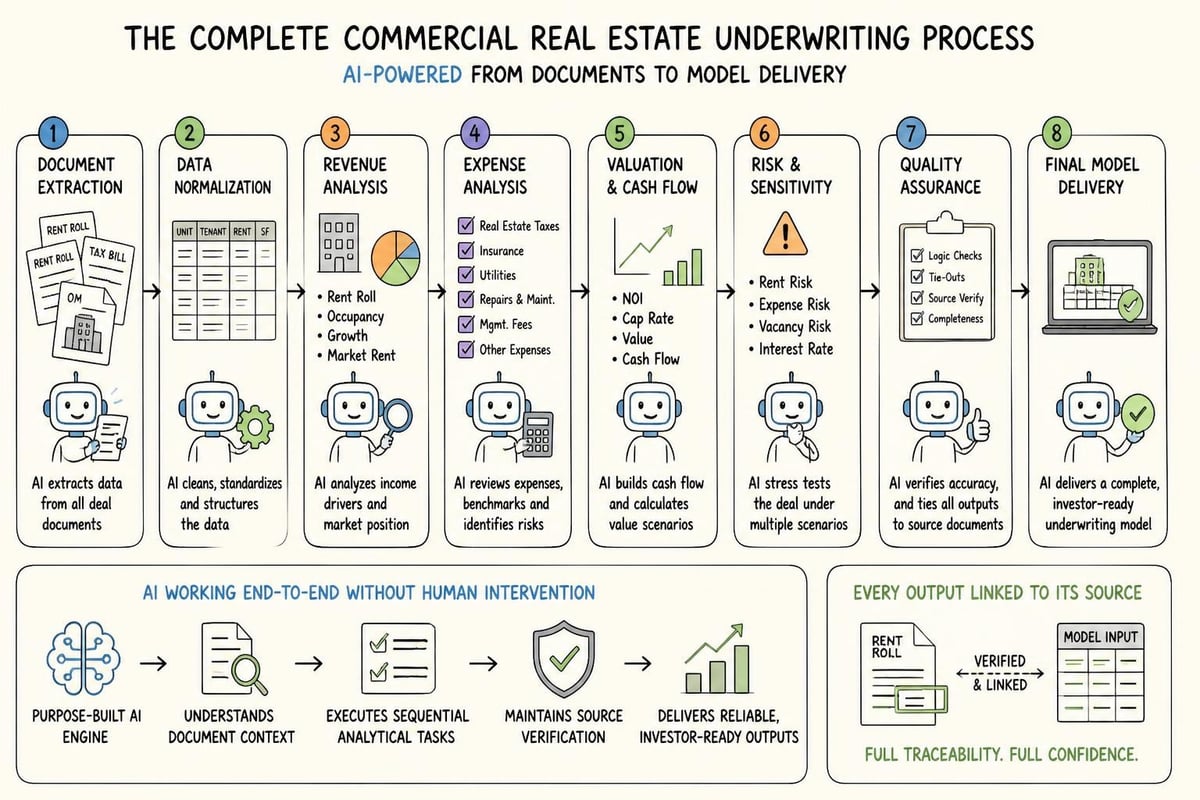
The autonomous execution capability distinguishes these tools further. Rather than generating a quick draft that requires extensive cleanup, purpose-built ai tools for financial modeling run complete workflows. They ingest lease documents, extract relevant terms, apply market context, build multi-scenario projections, and deliver finished models that include assumption documentation and sensitivity analyses.
The Verifiability Standard
BullshitBench rankings provide objective measurement of financial accuracy across AI platforms. The benchmark tests models against ground truth financial data, measuring how often outputs match verified calculations. Generic AI platforms typically score between 60% and 75%. Purpose-built financial modeling AI reaches 98% accuracy, ranking first among 142 evaluated systems.
This difference matters enormously in commercial real estate. A 75% accuracy rate means one in four calculations contains an error. In a typical acquisition model with hundreds of interconnected formulas, that error rate guarantees material misstatements.
Multi-Step Task Execution
Commercial real estate deal analysis involves sequential analytical tasks that build upon each other. A complete underwriting workflow includes:
Document ingestion from operating statements and rent rolls
Lease term extraction and normalization
Market research for comparable properties and trends
Pro forma construction with multiple hold period scenarios
Sensitivity table generation across key variables
Investment committee memo preparation with supporting exhibits
Generic AI handles individual components but cannot chain these tasks together autonomously. Each step requires human intervention, output review, and manual transfer to the next phase. Purpose-built platforms execute the entire sequence, typically completing the workflow in 15 to 60 minutes.
Financial Modeling Use Cases: Comparative Performance
Different modeling scenarios reveal distinct performance gaps between generic and specialized ai tools for financial modeling.
Pro Forma Development
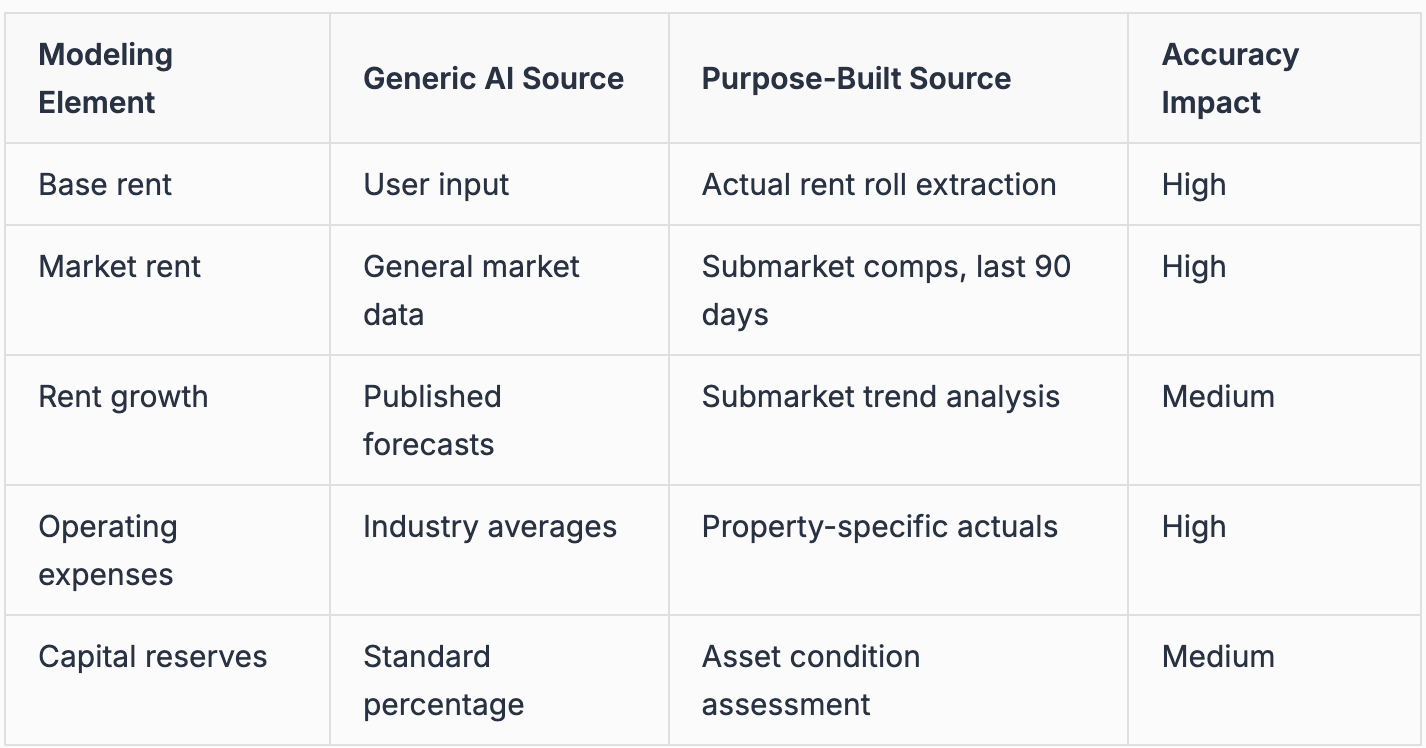
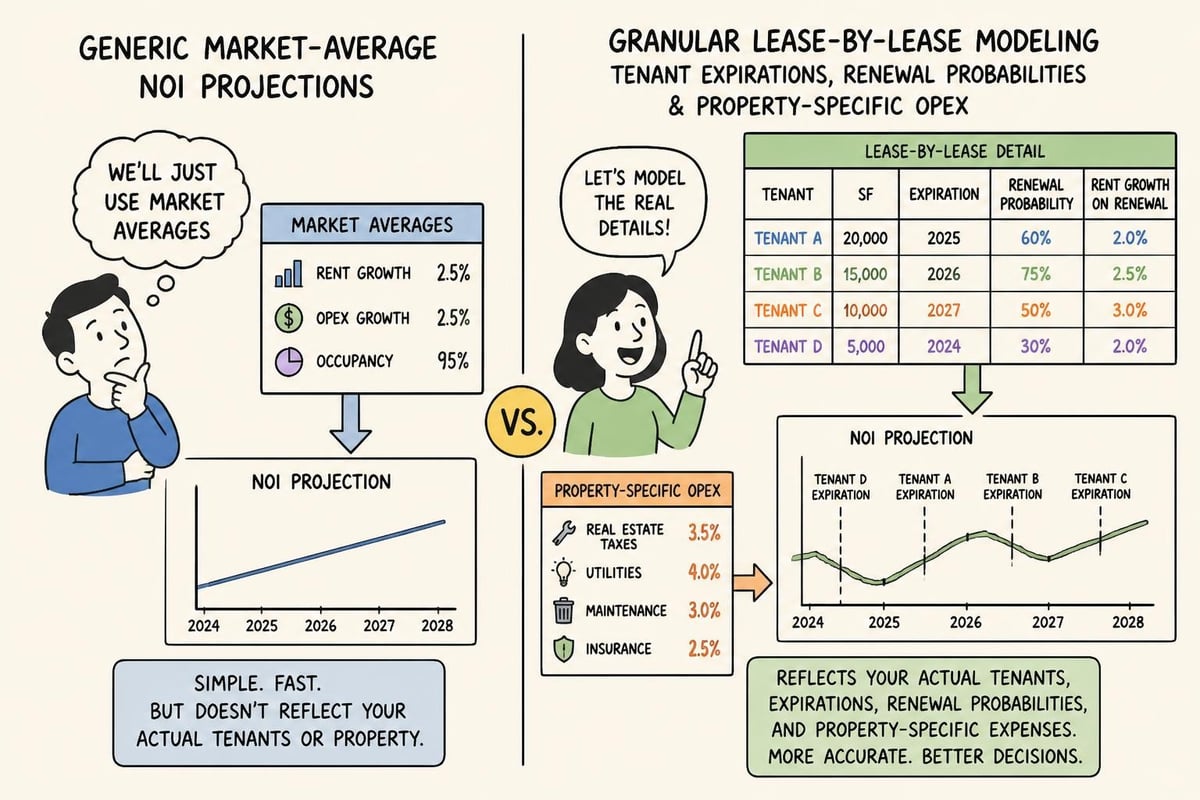
Generic AI approach: Accepts basic property information and generates a standard pro forma format. Rent growth typically defaults to market averages. Operating expenses reflect broad industry benchmarks. The model calculates correctly given its assumptions but lacks property-specific accuracy.
Purpose-built approach: Extracts actual in-place rents from current rent rolls, identifies upcoming lease expirations, applies market rents based on comparable recent transactions in the specific submarket, and adjusts operating expense projections based on historical actuals from the property management system. Every assumption links directly to supporting documentation.
Sensitivity Analysis
Sensitivity tables test how changing key variables affects investment returns. These analyses guide decision-making by revealing which assumptions matter most and how much margin for error exists.
Generic platforms build sensitivity tables mechanically. They vary exit cap rates or rental growth assumptions across predetermined ranges and calculate resulting IRRs. The mathematics work correctly, but the ranges themselves often lack market grounding.
Purpose-built ai tools for financial modeling anchor sensitivity ranges in actual market behavior. Exit cap rate bands reflect historical spreads in the specific property type and market. Rental growth scenarios incorporate economic forecasts tailored to the local employment base and supply pipeline. Real estate investment analysis software demonstrates how market-informed parameters produce actionable insights rather than mathematical exercises.
NOI Projections
Net operating income projections form the foundation of commercial real estate valuation. Even small errors in NOI forecasting cascade through to significant valuation misstatements.
The revenue side: Generic AI estimates rental income using broad occupancy assumptions and market rent averages. Purpose-built systems model lease-by-lease cash flows, accounting for specific expiration dates, tenant credit quality, renewal probabilities, and downtime between tenants.
The expense side: Operating expense projections require understanding property-specific cost structures. A 1985 office building carries different HVAC costs than a 2020 construction. Generic tools apply standardized expense ratios. Specialized platforms analyze historical operating statements and adjust for known upcoming changes like contract renewals or deferred maintenance needs.
Underwriting Workbooks
Complete acquisition underwriting requires assembling multiple analytical components into a coherent package. The workbook typically includes executive summary, market overview, property operations history, detailed pro forma, returns analysis, sensitivity scenarios, and risk assessment.
This represents exactly where generic ai tools for financial modeling fail most completely. Tools like ChatGPT are useful for drafting, but they cannot maintain analytical consistency across a multi-tab workbook. The market overview might reference Q3 2025 data while the pro forma uses Q1 2026 assumptions. Risk factors could identify supply concerns that the pro forma rental growth rates don't reflect.
Purpose-built platforms maintain analytical coherence because they treat the underwriting workbook as a single integrated output rather than disconnected sections. When market research identifies declining office demand, that insight automatically influences occupancy assumptions, rental growth projections, and risk factor discussions.
Integration Capabilities: The Data Connection Advantage
The most significant architectural difference between generic and specialized ai tools for financial modeling lies in their relationship with source data systems.
Property Management System Integration
Commercial real estate operates on data from Yardi, RealPage, Entrata, and similar platforms. These systems contain the ground truth for property operations: actual collected rents, real operating expenses, precise lease terms, tenant payment history, and capital expenditure records.
Generic AI cannot access this data directly. Users must export reports, convert formats, and upload files. Each data refresh requires repeating the manual process. Data analytics tools that connect natively to property management systems eliminate this friction while ensuring models always reflect current information.
Purpose-built platforms establish direct API connections. When you request an updated pro forma, the system pulls fresh data automatically. Month-end actual expenses flow directly into variance analyses. New lease execution updates occupancy projections without manual intervention.
Document Intelligence
Financial modeling requires extracting structured data from unstructured documents. Offering memorandums, lease agreements, operating statements, and environmental reports all contain information critical to accurate underwriting.
Generic extraction: Large language models can summarize documents and pull out requested information. They work one document at a time and require prompting for each data point. The extraction accuracy varies significantly based on document formatting and terminology.
Specialized extraction: Purpose-built systems understand commercial real estate document types. They know where to find CAM reconciliation clauses in leases, how to interpret T-12 operating statements across different formats, and which sections of offering memorandums contain verified versus projected data. AI in real estate applications demonstrate how domain-specific training dramatically improves extraction accuracy and completeness.
The Verifiable Output Requirement
Investment committee presentations demand defendable analysis. When questioned on any assumption, analysts must provide immediate source citation. This requirement eliminates generic ai tools for financial modeling from consideration for production work.
Source Linking Architecture
Every cell in a financial model derives from either a document, a system record, or a calculated formula. Purpose-built platforms maintain these connections explicitly:
A base rent figure links directly to the specific lease page containing that rental rate
An expense projection connects to historical actuals from the property management system
A market rent assumption references the comparable transaction database query that produced it
A cap rate ties to the market research report and date it was published
When reviewing the model, clicking any assumption reveals its supporting documentation. This transparency enables rapid review, builds confidence in outputs, and survives audit scrutiny.
The Reconciliation Test
A simple test separates useful ai tools for financial modeling from unreliable ones. Take any output number and attempt to reconcile it back to source. If you can trace the calculation path and verify each component within two minutes, the tool meets production standards. If the reconciliation requires detective work or the source remains unclear, the tool belongs in the drafting category only.
Real estate analytics platforms that pass this test become integral to investment processes. Those that fail remain supplementary aids for preliminary work.
Decision Framework: Choosing Financial Modeling AI
Selecting appropriate ai tools for financial modeling requires matching tool capabilities to use case requirements.
For Preliminary Analysis and Learning
Use generic AI when:
Exploring initial investment concepts before data gathering
Learning financial modeling techniques and formulas
Creating internal planning documents without external presentation
Generating templates and frameworks for manual completion
Explaining financial concepts to junior team members
These applications tolerate approximation and benefit from speed. AI tools for business analysts in training scenarios accelerate learning without risking material decision errors.
For Investment-Grade Deliverables
Require purpose-built AI when:
Presenting to investment committees or external stakeholders
Making acquisition or disposition decisions
Securing financing or engaging lenders
Reporting to investors or partners
Conducting portfolio valuations for financial reporting
The margin for error in these contexts approaches zero. An unverified assumption can derail a transaction, trigger covenant violations, or expose the firm to liability.
Evaluation Criteria
When assessing ai tools for financial modeling for production use, apply these standards:
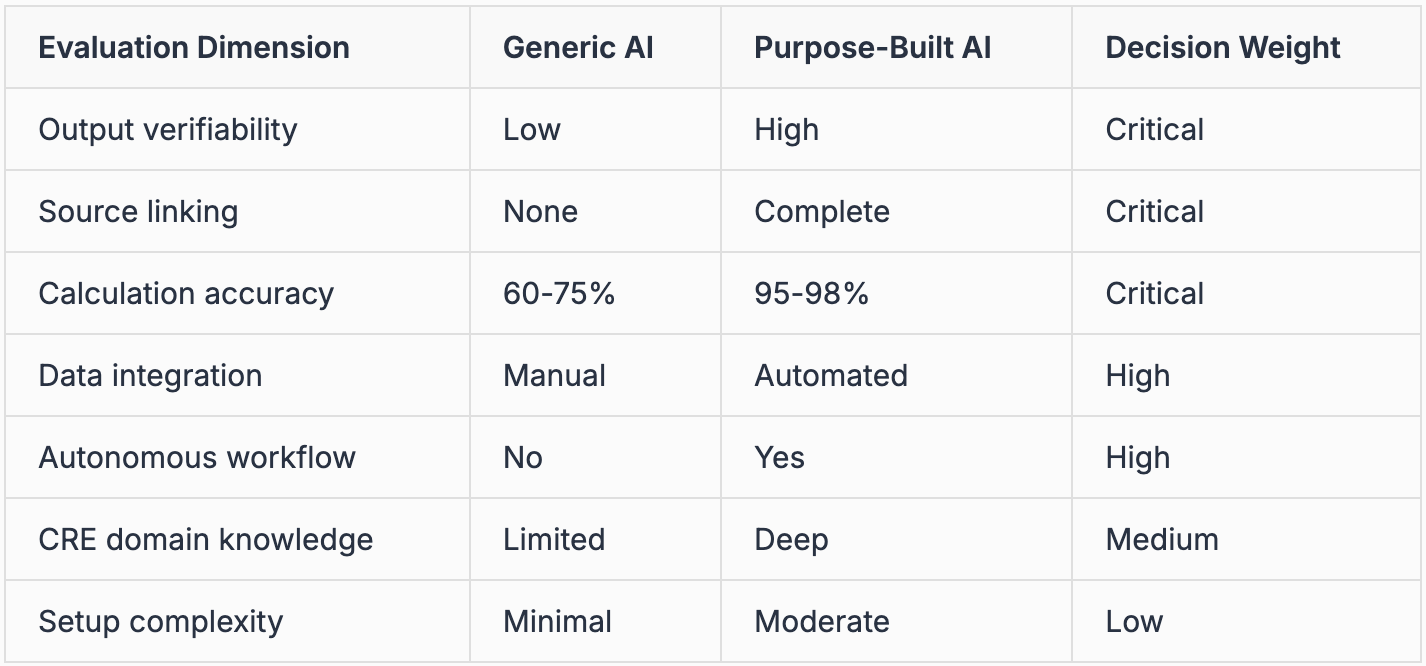
Output verifiability: Can every assumption be traced to supporting documentation within two minutes? Does the platform maintain source links throughout the analysis?
Calculation reconciliation: Do formulas tie out when checked manually? Can you rebuild any part of the model from source data and reach identical results?
Data integration: Does the tool connect directly to your property management systems and data sources, or require manual file handling?
Autonomous execution: Can the platform complete multi-step workflows independently, or does it require human intervention at each phase?
Accuracy benchmarking: How does the tool perform on objective financial accuracy tests like BullshitBench? What percentile ranking does it achieve?
Domain specialization: Was the platform built specifically for commercial real estate financial analysis, or adapted from general-purpose AI?
The Hybrid Approach
Many successful teams deploy both categories strategically. Generic AI accelerates early-stage thinking and internal communication. Purpose-built platforms handle all client-facing deliverables and investment decisions.
This division recognizes that different analytical tasks carry different consequence levels. Research platforms like Claude for Financial Services serve valuable roles in preliminary analysis while specialized tools deliver final outputs.
The critical error occurs when teams use generic ai tools for financial modeling in high-stakes contexts simply because they're faster or more familiar. Speed without accuracy creates risk rather than efficiency.
Implementation Considerations
Deploying purpose-built financial modeling AI requires different change management than adopting generic tools.
Team Training Requirements
Generic AI needs minimal training. Team members already familiar with ChatGPT or similar tools adapt quickly. The learning curve focuses on prompt engineering and output review.
Purpose-built platforms require understanding their specific workflows and capabilities. Teams learn how to structure data inputs, configure integration with existing systems, and interpret verifiable outputs. The training investment pays returns in output quality and review efficiency.
Quality Control Processes
With generic AI: Extensive manual checking represents the primary quality control. Analysts verify calculations, cross-reference assumptions against source documents, and rebuild portions of models to confirm accuracy. This checking often consumes more time than building the model manually would have required.
With specialized AI: Quality control shifts from calculation verification to assumption review. Because outputs link to sources and calculations reconcile automatically, reviewers focus on whether the right data sources were used and if analytical judgments (like comparable property selection) align with firm standards.
Cost-Benefit Analysis
Generic ai tools for financial modeling typically cost $20 to $30 per user monthly. Purpose-built platforms range from hundreds to thousands monthly depending on usage volume and integration requirements.
The cost comparison becomes meaningful only when measuring total analytical cost, not just software subscription fees. If generic AI requires three hours of analyst checking for every one hour of drafting, the loaded cost exceeds the subscription price by orders of magnitude. If purpose-built AI delivers finished, verifiable models autonomously, the per-model cost drops dramatically even with higher software fees.
Commercial real estate portfolio management at scale requires tools that reduce total analytical cost per asset, not merely software expenses.
The Accuracy Imperative
Financial modeling differs fundamentally from content creation or coding assistance where errors carry limited consequence. A 5% miscalculation in NOI projections creates millions in valuation error on institutional assets. Unverified assumptions expose acquisition teams to deal failure and reputational damage.
This accuracy imperative drives the distinction between ai tools for financial modeling that assist analysis versus those that actually perform it. Generic platforms assist by accelerating drafting and suggesting formulas. Purpose-built platforms perform analysis by executing complete workflows with verifiable outputs.
The question facing commercial real estate professionals is not whether to use AI in financial modeling. That decision has been made by competitive pressure and efficiency requirements. The real question is which category of tools to trust with production work and which to limit to preliminary exploration.
How AI is reshaping spreadsheets in accounting provides broader context for this transformation across financial disciplines, but real estate brings unique requirements around property-specific data, market research integration, and multi-decade projection horizons.
The platforms winning adoption in commercial real estate combine autonomous execution, source-linked outputs, property management system integration, and verifiable calculations. These capabilities define the threshold for production use in environments where models drive investment decisions.
Teams that select ai tools for financial modeling based on capability matching rather than familiarity or speed alone position themselves to leverage AI as a genuine analytical advantage rather than just another drafting assistant.
Most AI can generate a financial model quickly, but few deliver outputs you can defend in front of an investment committee. The difference between looking right and tying out determines whether AI truly accelerates your analytical workflow or simply creates more review work. For asset managers and acquisitions teams in commercial real estate where margin for error approaches zero, verifiable outputs with direct source links represent the minimum standard. Leni was purpose-built for exactly this requirement, delivering SOC 2 certified financial modeling and underwriting that runs autonomously and returns finished, reconcilable deliverables in 15 to 60 minutes.

Johanna Gruber
Johanna has spent the last 8 years helping marketing teams connect with audiences through content. Specializing in B2B SaaS and real estate.

Curious About AI?
Join the largest AI community for real estate online. Get bite-sized, real-world use case videos, plus practical tips and proven strategies from top industry experts on adopting AI effectively.
MEET LENI
AI SuperAgent Purpose Built for Investors and Operators.
Experience how professionals and teams in your domain are getting the edge using AI.
