5 Best Commercial Real Estate Databases
4.webp&w=1920&q=75)
5 Best Commercial Real Estate Databases
A commercial real estate (CRE) database organizes information about properties, ownership, leases, transactions and operating performance so your team can find and compare it. The right choice depends on the question you need to answer: where to invest, who owns a property, or how your own portfolio is performing.
Those are different jobs. A market-research database helps you investigate opportunities; your property-management system holds day-to-day operating records. Before comparing platforms, decide which information you need, where it comes from and how you will check it.
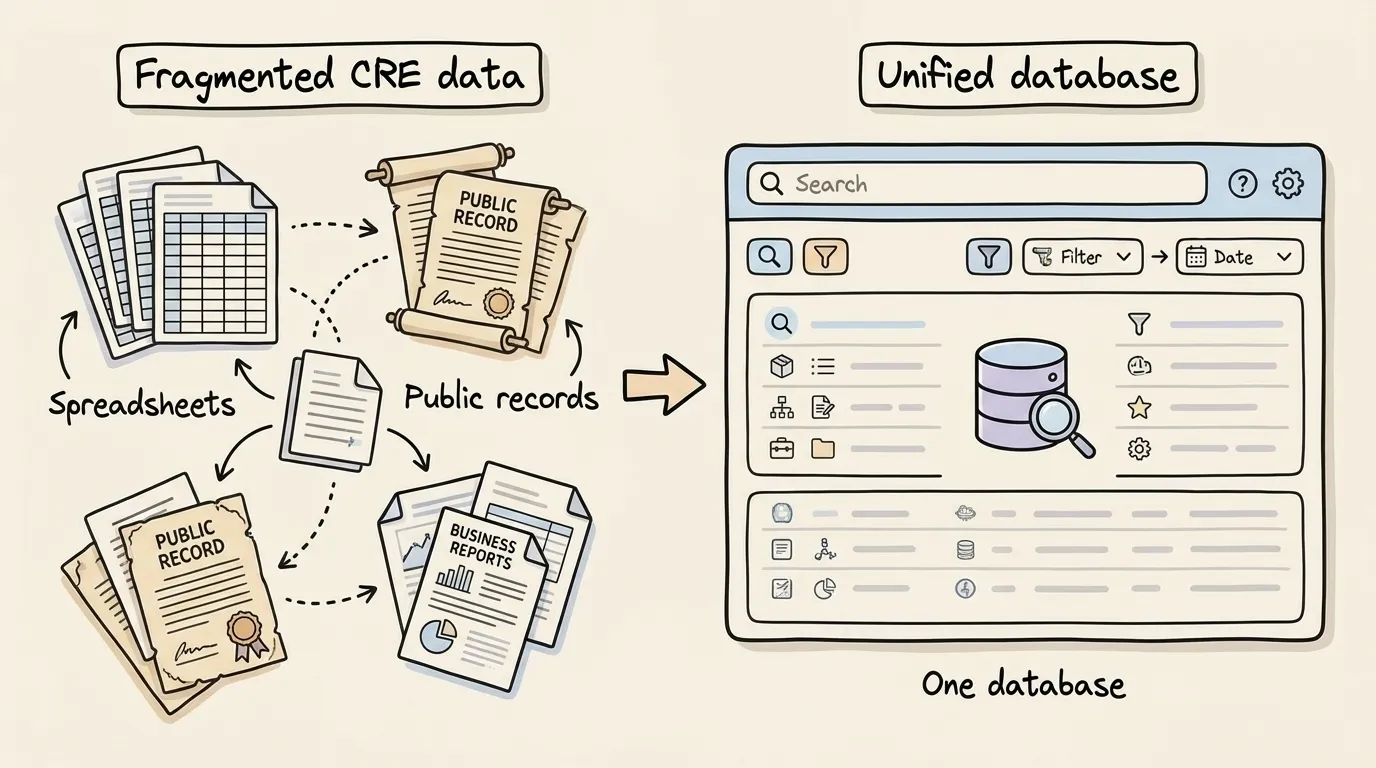
The solution is a powerful, all-in-one commercial real estate database. These databases are more than a home to a bunch of numbers. They're a central hub for all the information you need to analyze smarter and make decisions faster.
In this guide, we're breaking down what CRE databases are, the leading platforms today, and how to choose the right one for your team.
If you're evaluating platforms, here are a few "must-have" capabilities to look for based on what actually drives outcomes for CRE teams:
Real estate-native workflows (underwriting, comps, asset management reporting), not generic data storage.
Verifiable outputs (direct source links for market/comps research, plus what was observed and when).
Long-running, end-to-end analysis (run deeper work and return to a finished deliverable).
Automation after integrations (recurring reports only work once your systems are connected and the output format is defined).
Watch AI Build a Portfolio Forecast From Messy Files
In this AI in Real Estate episode, Marcio turns scattered spreadsheets into a 5-year, monthly forecast—showing how teams can move faster from setup to decisions.

What Is a Commercial Real Estate Database?
A commercial real estate database is a centralized system that stores and organizes critical information, like ownership structures, transaction history, valuation data, tenant rosters, and operating metrics.
Think of it as the difference between rifling through dozens of file folders and opening one well-organized archive. A commercial property database turns scattered data into something you can actually search, compare, and act on.
Key functions of a CRE database include:
Property and parcel search
Verified commercial property owner records
Market comps and transaction tracking
Rent rolls and operating performance
Historical benchmarks for underwriting and forecasting
Whether you manage assets, develop projects, or invest in them, the benefit of a CRE database is the same: clarity. Instead of relying on outdated reports or anecdotal information, a good database helps you verify ownership, confirm pricing, and make your next move confidently.
Why CRE Teams Rely on Databases
CRE teams today can't afford to rely on manual research alone. We shudder to think of the time wasted!
A commercial real estate database offers three primary advantages:
Faster insights Compiling tax records, chasing operators for updates, and searching through gigantic spreadsheets is super time consuming. What once took weeks can now be done in minutes.
Accuracy and transparency A commercial property owners database gives clarity into who holds the deed, how ownership is structured, and what transactions have occurred.
Competitive advantage Faster deal sourcing, cleaner risk assessment, and better investor reporting.
Some real-world use cases that highlight the value of a CRE database:
Asset managers benchmarking NOI across portfolios in real time.
Developers sourcing opportunities using a commercial building database to identify underutilized parcels.
Investors conducting a commercial property owner search to uncover acquisition targets before competitors.
Types of Commercial Real Estate Databases
Not all databases are built for the same purpose.
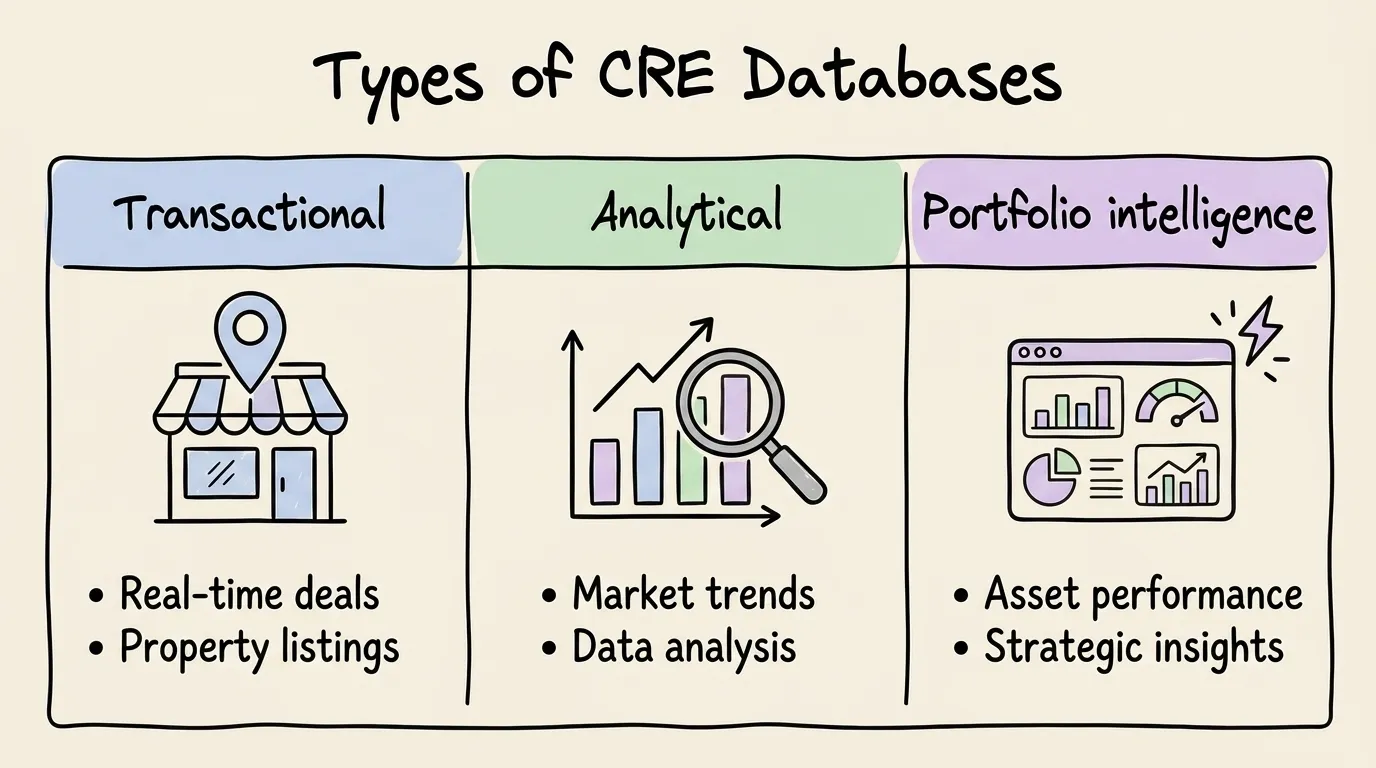
CRE databases fall into three categories:
Transactional platforms Marketplaces like Loopnet and Zillow serve as listing engines. They help buyers and sellers connect but provide limited analytical depth.
Analytical platforms Tools like CoStar and Crexi focus on verified data, comps, and analytics. These are paid tools for professionals.
Automation and intelligence layers Platforms like Leni help teams work across CoStar, PMS tools, spreadsheets, and reporting workflows, turning existing data into verifiable analysis they can use for decisions.
There are also distinctions between free and paid systems. A free commercial real estate database can be useful for surface-level research, but serious teams often find they fall short on depth and integrations compared to paid systems.
The 5 Best Commercial Real Estate Databases
We looked at the platforms CRE teams actually use day to day. Here's where each one stands out:
- Loopnet
Loopnet is probably the CRE listing platform most people have used at least once. Loopnet makes it easy to browse commercial real estate for sale and lease. Its strength lies in accessibility, but professionals often find data depth limited. Good for high-level deal sourcing, less so for analytics.
Top features:
Large, searchable marketplace of listings
Intuitive interface with map-based search
Accessible to both professionals and smaller investors
Use cases:
Quick property scans during early deal sourcing
Marketing listings to a wide audience
Comparing asking rents and sale prices in target markets
- Crexi
Crexi blends a listings marketplace with deal management tools, which works well for brokers and mid-market investors managing active deal flow. It offers auction capabilities, marketing tools, and transaction management features that go beyond a simple listing site.
Top features:
Marketplace covering sales and leasing, with auction capability built in
CRM and deal management functionality
Analytics and marketing tools for brokers
Use cases:
Running property auctions online
Managing leads and buyer communication in one place
Brokers marketing assets directly to a large network
- CoStar
CoStar is the industry heavyweight. Known for its breadth and depth, CoStar offers verified property records and deep market analytics at scale. It's also one of the most expensive platforms, making it best suited for institutional teams.
Top features:
National database of properties and transactions
Verified comps and ownership details
Market analytics and research reports
Use cases:
Institutional acquisition underwriting
Competitive benchmarking and market entry studies
Conducting a CoStar property search for comprehensive ownership and transaction data
- Zillow
Zillow is best known for residential real estate but also features a commercial property database. While it's consumer-oriented and limited in depth, it offers an easy entry point for smaller investors or local brokers exploring properties.
Top features:
Familiar Zillow interface
Listings for smaller commercial properties
Free access for basic property research
Use cases:
Small investors searching for local deals
Brokers testing exposure on a consumer-friendly platform
Early-stage research before diving into professional tools
- PropertyRadar
PropertyRadar focuses on ownership and demographic data, useful when you're digging into who actually owns a property. Its coverage is strongest at the regional level, so it tends to fit localized strategies best.
Top features:
Detailed ownership records
Demographic and market overlays
Advanced search and filter tools
Use cases:
Identifying property owners for off-market outreach
Layering demographic data into acquisition strategies
Local brokers and investors targeting niche geographies
Beyond Databases: When You Need More Than Data Storage
The platforms above are built to store, organize, and surface CRE data. But some teams need a layer on top of that, something that takes the data and actually does the analysis.
That's where Leni fits. Leni is an automation layer that works with the data you already have, whether that lives in CoStar, your PMS, Excel, or a mix of all three. Instead of replacing databases, it uses specialized models and connected workflows to turn fragmented data into finished, source-linked work products at a lower manual cost.
Top features:
Integrates across systems (Yardi, RealPage, Excel)
AI-powered analysis and anomaly detection
Real-time reporting with context, not just raw numbers
Use cases:
Asset managers benchmarking NOI across portfolios instantly
LPs receiving digestible, transparent reporting
Teams that want to adopt a more proactive approach
Where a database tells you what the numbers are, Leni helps complete the work those numbers feed: analysis, reporting, anomaly review, and decision support.
What to Consider Before Choosing a CRE Database
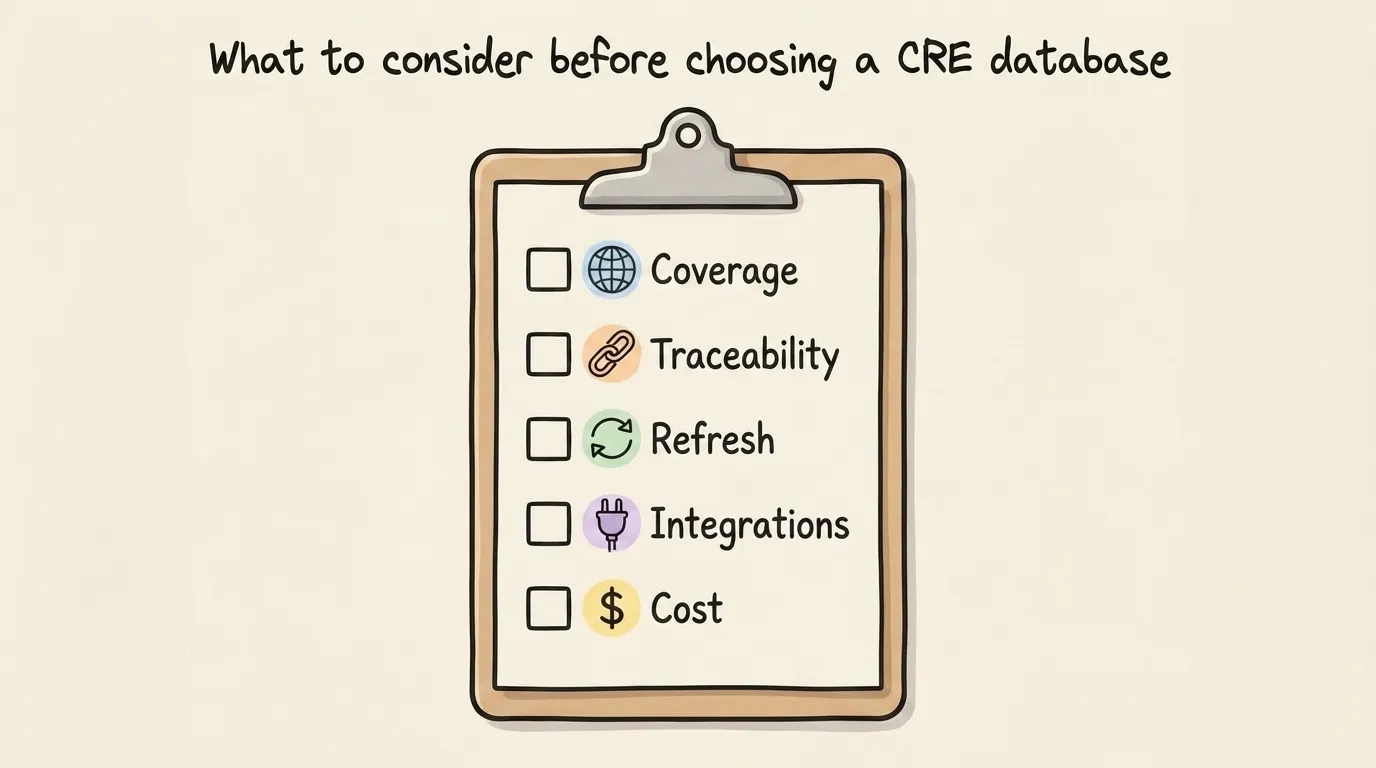
Coverage depth vs. breadth
Coverage depth vs. breadth
Some platforms offer wide national coverage, while others specialize in local markets with more granular detail.
If you're an institutional investor, broad reach may be essential. But for developers or operators focused on specific metros, accuracy at the parcel level is more important than having a nationwide view.
Source traceability (can you verify what you’re seeing?)
If a platform claims a rent comp, cap rate, or market statistic, you should be able to quickly verify where it came from. Look for tools that provide direct links to sources (or clearly documented data provenance) so your team can validate results before relying on them in underwriting or investor reporting.
Questions to ask before you buy
What are your primary data sources for ownership and transaction history, and how often are they refreshed?
For any market research or comps outputs, can you provide source links (and observation dates) for verification?
Can the system support long-running analysis tasks (not just quick lookups), and what deliverables can it produce?
Which integrations are available today (PMS, spreadsheets, BI tools), and what does setup typically require?
Can it automate recurring reporting once connected (weekly/monthly "Monday morning" style reporting), and how customizable is the output?
Data accuracy and refresh rates
CRE moves quickly, and outdated data can be a death sentence to a potential deal.
Ask how often the database is updated and what sources it relies on. Verified ownership records and transaction comps that refresh frequently will give you more confidence in underwriting and reporting.
System integrations
The best CRE databases connect seamlessly with your existing PMS software and BI tools, surfacing everything through real estate dashboards so your team isn't stuck copy+pasting data between systems.
Cost and licensing
Free databases can be useful for early-stage research, but they rarely deliver the depth you'll need. Paid platforms range from modest subscriptions to enterprise-grade contracts with hefty price tags. Think about the scale of your portfolio and the ROI of better, faster decisions when weighing cost.
Ease of use
A good database should serve everyone on the team, from the analysts who want to drill into NOI to the executives who need quick takeaways before a board call. Look for platforms that deliver detail without complexity, pairing analyst-friendly functionality with clean, executive-ready reporting.
The Future of Commercial Real Estate Databases
The next generation of commercial real estate databases is going beyond storing data to actually interpreting it.
We're seeing shifts from static spreadsheets and directories to living systems powered by AI that actively surface what matters most.
Instead of relying on a commercial property database that lists ownership records or comps, modern platforms are evolving into decision engines and automation layers that can complete recurring back-office workflows.
For teams across asset management, development, investing, this shift means less time spent "data digging" and more time shaping strategy. The future is about platforms that think alongside you, spotting risk before it escalates, explaining performance shifts as they happen, and ensuring your portfolio decisions stay one step ahead.
Questions teams ask about CRE data and AI
Do I need a market database or better access to the data I already have?
Start with the task. Finding comparable sales or researching an unfamiliar market calls for external data. Explaining a change in your own collections or occupancy starts with your operating records. Some workflows need both, but buying another dataset will not resolve inconsistent definitions across your existing systems.
Can I use AI with my existing property data?
Yes, once the relevant data is available through an authorized connection. With Leni, compatible MCP clients can discover the portfolio models available to your account and run bounded, read-only queries. Connecting an assistant does not automatically connect a new property-management system or give it access to every record.
What does Leni add beyond storing the records?
We help your team analyze authorized data using Leni’s runtime and your organization’s Context. Your developers can use the HTTP API for an application, while compatible AI assistants can connect through MCP. These are different interfaces; the analysis API should not be mistaken for a universal database-records API.
What should I check before trusting an AI-generated answer?
Confirm the property, reporting period, metric definition and data freshness. Compare a small result with the source report before extending the workflow. If the model or field you need is unavailable, resolve that access or coverage gap first instead of treating a plausible answer as proof.
Can Leni help reduce my real estate database spend?
Before adding another database subscription, check whether the information you need is already public. Our agents can look up websites and public real estate data on demand and return source links so you can check the findings. Where those sources cover your research needs, Leni can help reduce spending on overlapping tools. You may still need a licensed database for proprietary records, broader coverage or specific freshness requirements.
Final Thoughts
Different CRE data platforms excel at different things. Some are built for broad deal sourcing, others for granular ownership research, and others for portfolio intelligence. The key is choosing the system that matches your goals, scale, and workflow.
For teams that want to go beyond static data and into real-time, verifiable work outputs, Leni offers the automation layer above the database. It turns raw records into finished analysis and recurring back-office deliverables, helping CRE teams make sharper, faster, and more confident decisions without adding more manual analyst hours.
Building AI on top of your existing property data? Explore Leni’s universal data model for consistent records across supported sources, the context layer for your team’s definitions and reporting practices, and the runtime, APIs and MCP guide for connecting those capabilities to your own applications or compatible AI assistants.

Johanna Gruber
Johanna has spent the last 8 years helping marketing teams connect with audiences through content. Specializing in B2B SaaS and real estate.

Curious About AI?
Join the largest AI community for real estate online. Get bite-sized, real-world use case videos, plus practical tips and proven strategies from top industry experts on adopting AI effectively.
MEET LENI
AI SuperAgent Purpose Built for Investors and Operators.
Experience how professionals and teams in your domain are getting the edge using AI.
