Fri July 24, 2026
What’s a Company Brain? Does Your Organization Need One?

What’s a Company Brain? Does Your Organization Need One?
Imagine you’re stuck finalizing a report because one key number doesn’t match, and you can’t figure out which source is right. Your company probably knows the answer….but finding it is harder than it should be.
The information you’re looking for could be buried in a shared Google drive, an old email thread, your CRM, or a spreadsheet someone saved with a completely unhinged file name. Instead of driving yourself crazy digging through all that data, you’ll probably take the faster route and ask a coworker who might know the answer.
Your coworker has the answer you were looking for, thank God. But what happens when they leave the company in a few months? That knowledge suddenly leaves with them.
This is why organizations today are investing in a company brain. Company brains connect scattered information with the context needed to use it.
Today, we’re diving into:
What a company brain is
How it works
The value it creates
How to decide whether your organization needs one
What Is a Company Brain?
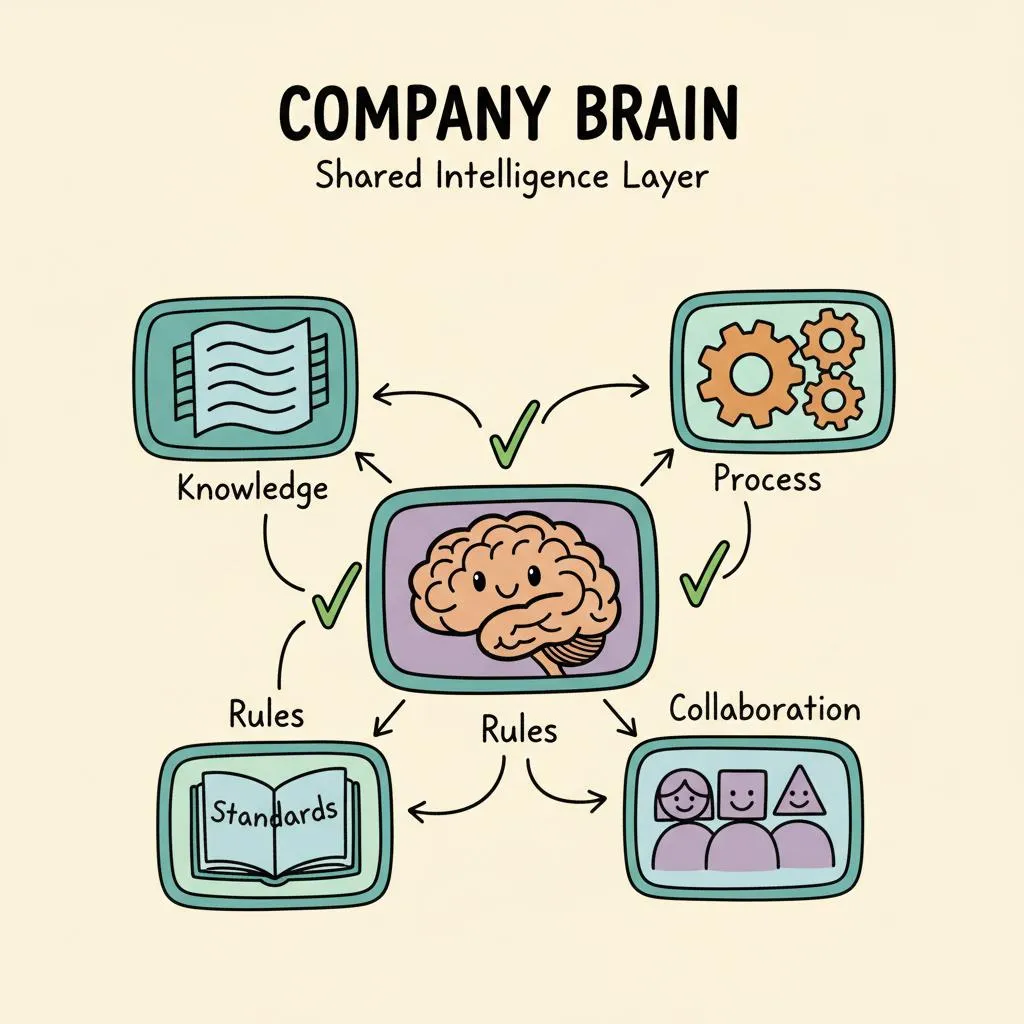
A company brain is a shared intelligence layer that connects your organization’s information, workflows, standards, and decision history. This allows people and AI to use that knowledge consistently.
A company brain is more than just a knowledge base that stores documents. It does more than help employees search for files or ask a chatbot a question. Those tools could contribute to a company brain, but they don’t equate to one on their own.
The key difference is context. A company brain understands how information relates to the company’s work. It knows who can access that information, which rules apply, and how the information should shape an output or decision.
Why Most Companies Have Data but No Memory
It’s probably safe to say that your company has tons of internal data. In fact, you’re probably swimming in it.
Having data isn’t the problem, but having memory is.
Here are some examples to illustrate what we mean by that:
You have a report in your company’s shared drive, but the reasoning behind that report’s recommendations is missing.
Your team creates new work based on a template, but only the senior leader who created the template knows what a strong version looks like.
Leadership makes a key decision, but the assumptions that shaped that decision aren’t actually documented anywhere.
Your team repeats the same workflows every month without capturing what they learned the last time. Someone corrects a calculation or adjusts a reporting rule, but then the next employee starts from the same outdated instructions.
If these sound like only a minor inconvenience, think again. The consequences add up:
Your team ends up redoing work that has already been done
New employees rely on a few experienced colleagues who don’t have ample free time to help
Different people produce inconsistent work from the same information
Your company’s AI tools return generic outputs because they don’t understand how you work
A company brain does the work of preserving information and the context surrounding it. That includes the standards, decisions, corrections, and working knowledge that usually gets stuck in people’s heads.
How Does a Company Brain Work?
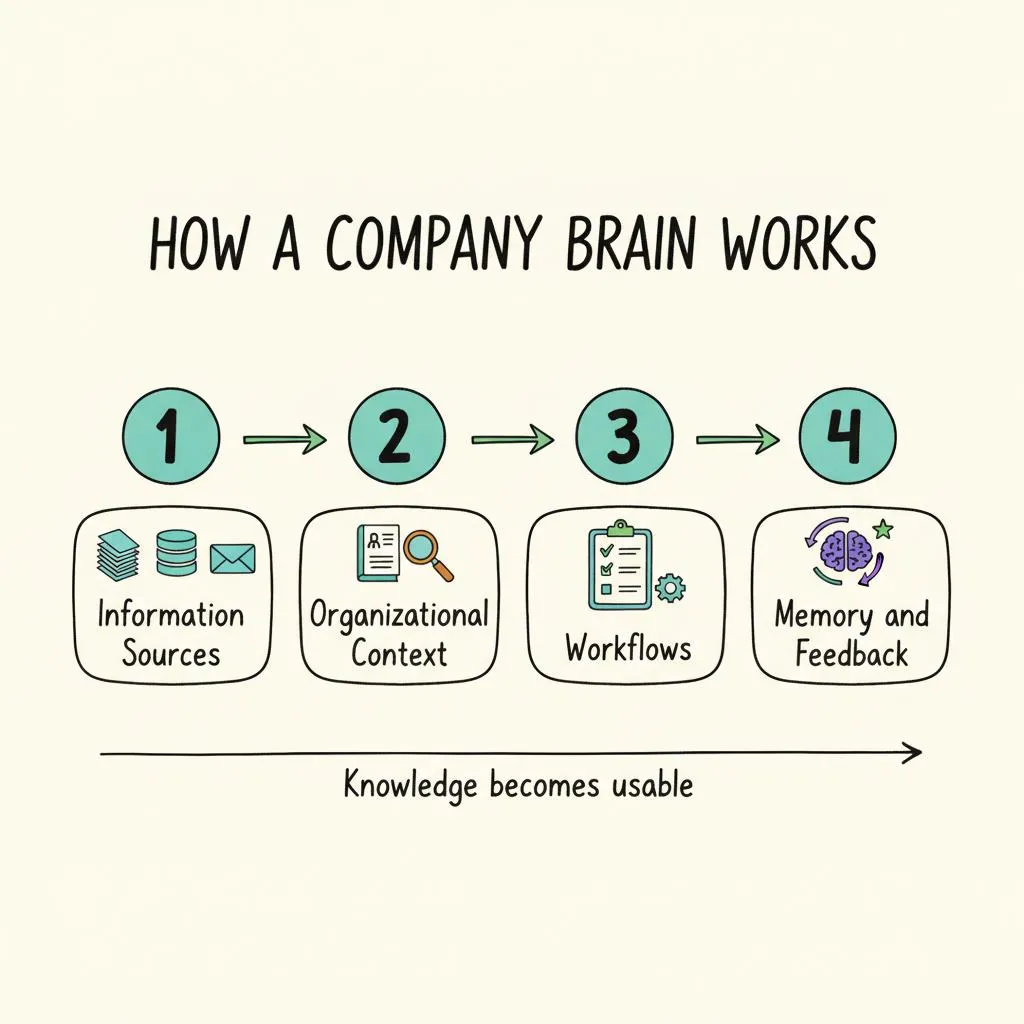
A company brain consists of four connected layers:
1. Information Sources
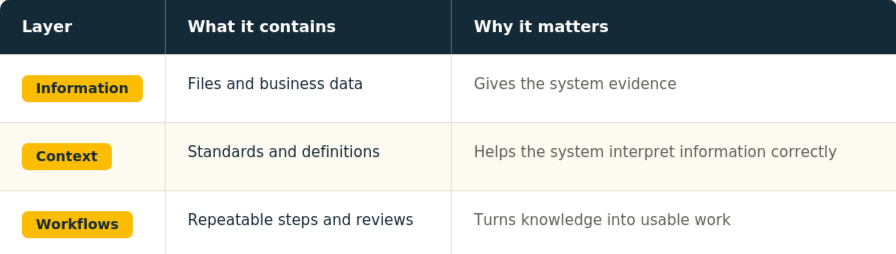
The first layer is all your sources of information, or the places where company knowledge already lives.
For most organizations, that includes:
Documents
Databases
Reports
Shared drives
Email
You need to connect these sources of information to the company brain so that people and AI are all working from the same, up-to-date information instead of disconnected systems or outdated copies.
But connecting all your information is only the starting point. The company brain still needs to understand what that information means.
2. Organizational Context
Connecting all your information is only the starting point. The company brain still needs to understand what that information means. Organizational context provides that meaning.
Examples of organizational context:
Definitions and business rules
Reporting standards
Review criteria
Access permissions
Preferred templates
Team-specific terminology
Consider how two companies can define one metric in completely different ways. A company brain needs to understand the definition your organization uses in order to work properly.
3. Workflows
A company brain needs to understand how your team uses information to do recurring work, like reviewing investment opportunities or building monthly reports.
The workflow layer connects knowledge to action. It captures the steps employees follow, the questions they ask, and the checks they make before completing the work.
4. Memory and Feedback
The last layer retains approved instructions, past decisions, corrections, and preferred outputs. This ensures that all work in the future starts from the same, strong baseline.
This memory should remain transparent, because people need to see which sources were used and correct the system when something is wrong.
What Does a Company Brain Look Like in Practice?
Let’s make this all a bit more concrete with a solid example.
Example: Preparing a Monthly Portfolio Review
Let’s say you’re a new analyst at a firm, and you’ve been tasked with preparing the monthly portfolio performance report for leadership.
You’ll probably start by seeking past examples and templates to make sure you’re on the right track.
Without a company brain, you might find yourself hunting down reports in multiple systems and digging through Google Drive files for the latest reporting template. Maybe you ask a senior employee which variances matter.
At the end of the day, in order to do this work effectively, you need more than access to data. You need to know where to look, what to question, and how to present your findings.
Now let’s say you’re leaning on AI to help with this project.
With a company brain, your AI tool already knows where to look and how your firm reviews the work. It can pull the right files, use your company’s definitions, and alert you to anything that looks off. It can also explain why a certain issue matters, create the report in the format your team expects, and use your feedback to improve the next one.
As a result, you work faster and get a report that reflects how your company actually thinks and works.
What Is the Value of a Company Brain?
A company brain turns institutional knowledge into context that people and AI can reuse over and over.
With a company brain, your organization gets:
More Consistent Work
Having a company brain means everyone on your team works from the same definitions and standards instead of everyone interpreting things on their own. As a result, your company maintains consistent work quality.
Preserve Knowledge When People Leave
Without a company brain, the employees who leave your organization take their knowledge and experience with them. By having a company brain in place, your company isn’t at risk of losing that valuable knowledge and context.
Faster Onboarding
New employees can get up to speed quickly because they have access to established processes and don't have to learn everything through trial and error.
More Useful AI
AI tools produce better work when they understand your organization’s context, preferred outputs, and decision criteria. And when AI outputs are better, your team spends less time rebuilding large prompts or explaining the same background before every task.
Knowledge Compounds
Every time someone improves a process, fixes a mistake, or makes a decision, that lesson gets carried into the next project. Over time, your company gets better at using what it’s already learned instead of starting from scratch.
Does My Organization Need a Company Brain?
We think it’s a good idea! If you notice that critical knowledge is spread across several systems and your team repeatedly asks the same questions, you probably would benefit from a company brain.
Consider investing in a company brain if:
Important work relies on knowledge that hasn’t been written down
Employees get different results from the same information.
Senior employees spend too much time reviewing basic work.
AI usage is growing, but everyone creates their own prompts and processes.
New employees take months to learn how things are done.
The value of a company brain grows as your company grows. More employees and workflows create more places for knowledge to hide. Increasing AI adoption also raises the stakes because AI can’t apply organizational standards that haven’t ever been captured.
How to Start Building a Company Brain
It’s usually best to start small and build gradually. Start with one recurring, high-value workflow.
Start by looking at how people handle this task today. Ask experienced employees to walk you through the decisions they make and what they double-check. Make note of what good results look like and who needs to approve it.
Let the people who actually do the work test the process. Pay attention to what they change or add, then save those changes so the next attempt starts from a better place.
Don’t try to connect every file and system at once. Starting with one real task makes it easier to prove value and pinpoint what information the company brain actually needs.
Build Memory Around the Work
A company brain’s primary purpose is to help your company leverage data and knowledge it already has.
Leni helps companies build shared intelligence around complex business and financial workflows. It preserves the context behind how work is reviewed, completed, and improved. The result is less knowledge lost, less work repeated, and a stronger starting point for whatever comes next.

Johanna Gruber
Johanna has spent the last 8 years helping marketing teams connect with audiences through content. Specializing in B2B SaaS and real estate.

Curious About AI?
Join the largest AI community for real estate online. Get bite-sized, real-world use case videos, plus practical tips and proven strategies from top industry experts on adopting AI effectively.
MEET LENI
AI SuperAgent Purpose Built for Investors and Operators.
Experience how professionals and teams in your domain are getting the edge using AI.
