CRE Investment Analysis Software: What Actually Matters

CRE Investment Analysis Software: What Actually Matters
Your acquisitions team just killed a deal because the underwriting took three weeks instead of three days. The GP pushed forward with incomplete data. The investment committee received a 60-slide deck that buried the critical assumptions on slide 47. This isn't a capability problem-your analysts are exceptional. It's an infrastructure problem. The cre investment analysis software most firms use was built for a different era, when deals moved slower and portfolio sizes were manageable without automation.
The Real Cost of Inadequate Analysis Infrastructure
Commercial real estate investment analysis generates massive opportunity costs that never appear on a P&L. Every hour spent reformatting Excel models is an hour not spent evaluating additional opportunities. Every deal that slips because underwriting bottlenecks your pipeline represents capital sitting idle.
The math is straightforward. A typical acquisitions analyst at an institutional firm handles 40-60 preliminary evaluations per quarter. Each requires financial modeling, market research, rent roll analysis, and comparable property underwriting. Traditional cre investment analysis software handles one piece of this workflow-usually the financial model-leaving analysts to manually integrate data from property management systems, market research databases, and third-party reports.
What Modern Teams Actually Need
Asset managers and portfolio operators require fundamentally different capabilities than what legacy platforms deliver:
Autonomous multi-step workflows that run from data extraction through final deliverable creation
Direct connectivity to operational systems like Yardi, RealPage, and Entrata for real-time portfolio data
Source-linked outputs that trace every assumption back to its origin document
Verifiable accuracy with audit trails for compliance and investment committee scrutiny
The shift from manual analysis to automated commercial real estate analytics isn't about replacing analyst judgment. It's about eliminating the mechanical work that prevents analysts from applying that judgment to higher-value decisions.
Architecture That Matters: Integration vs. Islands
Most commercial real estate firms operate with fragmented analysis infrastructure. Financial models live in Excel. Property data sits in the PMS. Market research comes from three different vendors. Lease abstractions exist in PDF folders. Each deal requires manually stitching these sources together.
This fragmentation creates three critical failures:
Data staleness. By the time an analyst pulls data from the PMS, formats it for the model, and incorporates market research, the underlying portfolio performance has already changed. Monthly reporting becomes a historical exercise rather than forward-looking analysis.
Version control chaos. Investment committee materials go through multiple iterations. Each version references different assumption sets. Six months later, when the deal closes and performance diverges from projections, no one can reconstruct which market rent assumptions drove the original underwriting.
Irrecoverable context. Junior analysts spend weeks becoming fluent in a portfolio's operational nuances. When they leave, that institutional knowledge evaporates. The next analyst starts from zero.
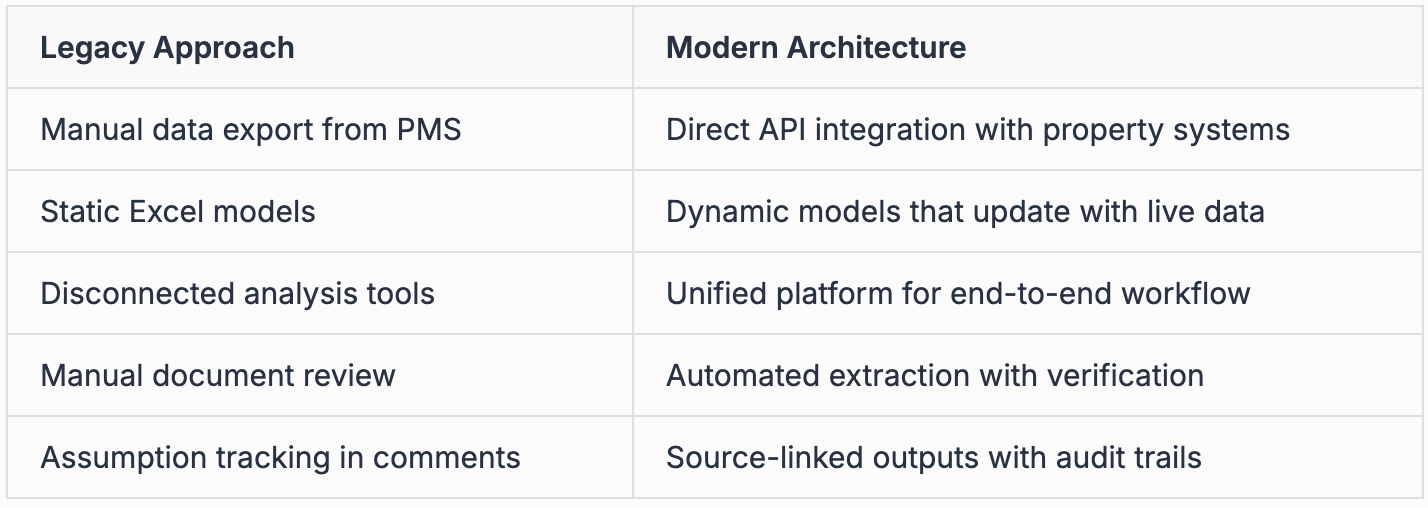
Purpose-built cre investment analysis software addresses these failures through architectural decisions, not feature additions. Document extraction workflows that automatically pull lease data, operating statements, and offering memoranda into structured formats eliminate the manual data entry that consumes analyst time.
The Investment Committee Deliverable Problem
Investment committees make billion-dollar allocation decisions based on materials prepared in PowerPoint and Excel. The quality of these deliverables directly impacts approval rates, but creating them remains stubbornly manual.
A comprehensive IC package includes:
Executive summary with deal highlights and risk factors
Market analysis with demographic trends and competitive landscape
Financial model with 10-year projections and sensitivity scenarios
Comparable property analysis
Operating assumptions and supporting documentation
Exit strategy and value creation plan
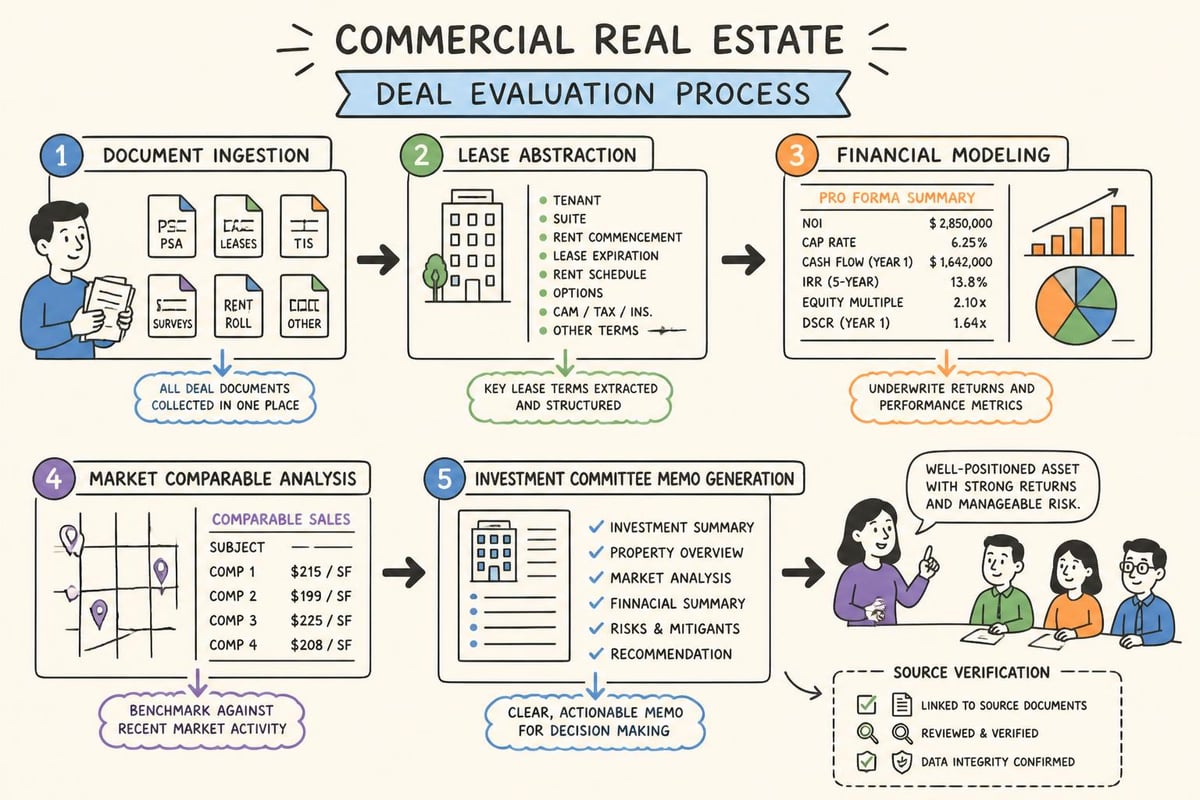
Assembling this package typically requires 40-60 hours of analyst time per deal. The work isn't intellectually challenging-it's mechanical aggregation and formatting. Yet it creates a hard limit on deal volume.
Automation That Preserves Judgment
The solution isn't removing human oversight from investment decisions. It's eliminating the mechanical steps between data gathering and strategic analysis. Investment memo and presentation creation platforms that automatically generate IC materials from underlying data allow senior team members to focus review time on assumptions and strategy rather than formatting and data accuracy.
Modern cre investment analysis software generates these deliverables by:
Extracting relevant data from source documents automatically
Populating financial models with verified property information
Generating market research summaries with citations
Creating formatted presentations that match firm templates
Maintaining source links for every data point and assumption
This approach reduces IC package preparation from days to hours while improving accuracy through automated verification.
Financial Modeling at Portfolio Scale
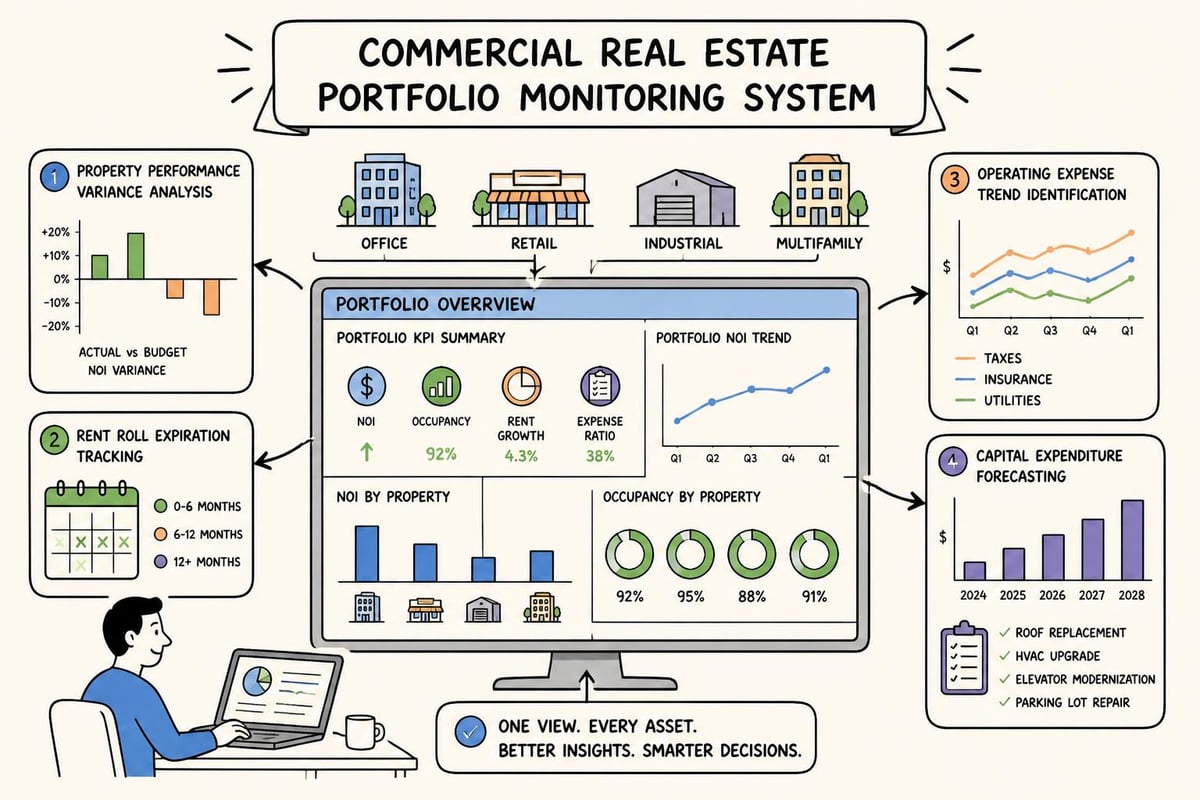
Individual deal underwriting represents one analytical challenge. Portfolio-level financial modeling presents another entirely. Asset managers monitoring 50+ properties need to track performance against original underwriting, identify variance drivers, and forecast portfolio-level returns.
Traditional approaches rely on aggregating individual property models. This works until you need to answer questions like:
Which properties are underperforming market rent assumptions by more than 5%?
How does our portfolio perform under different interest rate scenarios?
What's our exposure to lease rollover in the next 24 months across all assets?
Which operating expense categories are trending above underwriting across the portfolio?
Answering these questions with conventional tools requires manual data aggregation, custom analysis, and substantial analyst time. The financial modeling and underwriting capabilities built into modern platforms allow portfolio operators to run these analyses continuously rather than quarterly.
Market Research That Connects to Decisions
Investment decisions require current market intelligence: comparable sales, rent trends, demographic shifts, new development pipeline, employment growth, and competitive supply. Traditional market research arrives in static reports that quickly become outdated.
The challenge isn't accessing market data-multiple vendors provide comprehensive information. The challenge is integrating that research into investment analysis at the moment decisions are made. Live source-linked market research embedded directly in underwriting workflows allows analysts to validate assumptions against current market conditions without leaving the analysis platform.
Effective market research integration includes:
Automated comparable property identification based on property type, market, and size criteria
Real-time rent and occupancy data for competitive properties
Demographic and employment trend analysis for target markets
Development pipeline tracking to assess future supply risk
Citation links to original data sources for verification
This integration eliminates the common failure mode where analysts complete financial models with placeholder assumptions, then discover during market research that those assumptions don't align with current conditions.
The Data Accuracy Imperative
Investment analysis software that produces inaccurate outputs is worse than no software at all. Garbage in, garbage out isn't just an aphorism-it's a career-ending mistake when applied to $50M+ acquisitions.
Several comprehensive reviews of commercial real estate investment analysis software emphasize accuracy verification as a distinguishing feature among platforms. The difference between capable and inadequate systems comes down to how they handle data extraction and validation.
Verification Mechanisms That Work
Modern platforms implement multiple accuracy checkpoints:
Source document preservation with direct links from every data point to originating documents
Automated validation rules that flag inconsistencies and outliers
Cross-reference verification between related data points
Manual review workflows for critical assumptions
Audit trails that track every change and its author
These mechanisms don't just catch errors-they create confidence. Investment committees can drill into any assumption and trace it back to source documentation. Asset managers can verify that portfolio reports reflect actual property performance, not stale data.
The comparison across 200+ commercial real estate tools reveals significant variation in how platforms approach data accuracy. Purpose-built systems designed for institutional investment analysis prioritize verification mechanisms. General-purpose tools treat accuracy as the user's responsibility.
Workflow Automation Beyond Spreadsheets
Excel remains the default tool for commercial real estate analysis because it's flexible and familiar. But flexibility comes with costs. Every analyst builds models differently. Formulas break when ranges change. Version control happens through file names like "Acme_Apartments_v7_final_revised.xlsx."
Workflow automation in cre investment analysis software doesn't mean replacing Excel entirely. It means eliminating the repetitive tasks that consume analyst time without adding analytical value.
High-impact automation includes:
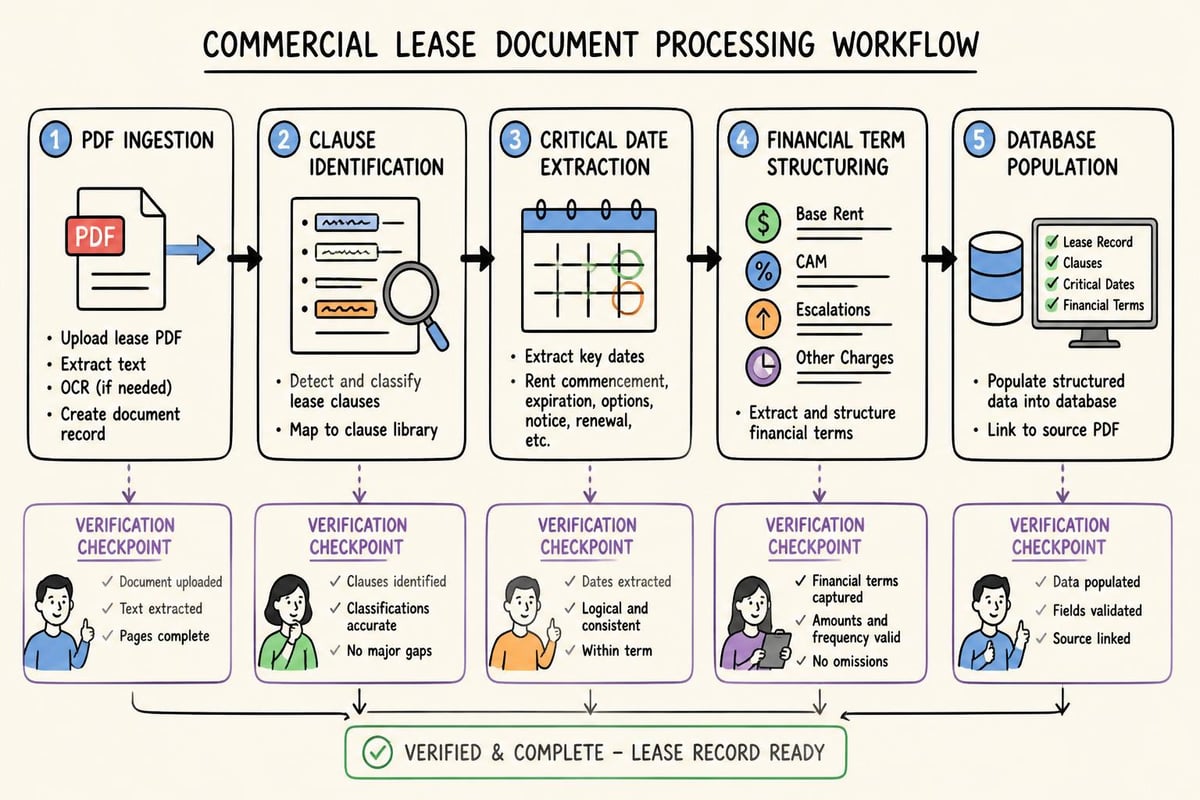
Lease data extraction from PDF rent rolls into structured databases
Operating statement normalization across different property management system formats
Comparable property research with automated filtering and selection
Report generation that updates automatically when underlying data changes
Portfolio monitoring dashboards that alert teams to variance conditions
For multifamily operators specifically, lease data automation workflows that extract unit-level information from property management systems eliminate weeks of manual data entry for large portfolios.
Integration Architecture for Enterprise Portfolios
Enterprise commercial real estate operations run on interconnected systems: property management platforms, accounting software, market research databases, document management systems, and investment analysis tools. The value of cre investment analysis software increases dramatically when it integrates with existing infrastructure rather than requiring duplicate data entry.
Critical integration points include:
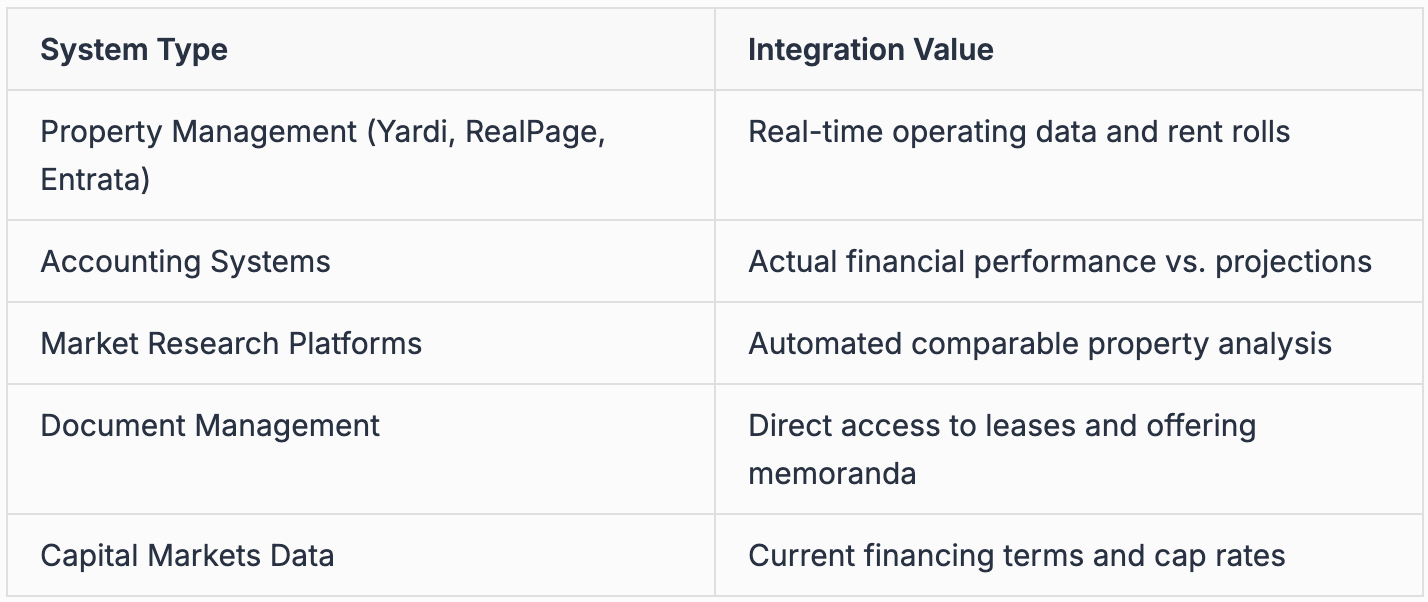
Direct API connectivity eliminates manual data transfers and ensures analysis uses current information. When portfolio performance data flows automatically from the PMS to analysis models, asset managers can identify operational opportunities to increase NOI based on real-time variance analysis rather than month-old reports.
Selection Criteria for Institutional Teams
Evaluating cre investment analysis software requires moving beyond feature checklists to operational impact assessment. The right platform should measurably reduce time from deal sourcing to investment committee presentation while improving analytical accuracy.
Key evaluation criteria:
Workflow coverage. Does the platform handle the complete analysis process, or does it solve one piece while creating integration challenges?
Data accuracy mechanisms. How does the system verify extracted data and maintain source links?
Learning curve vs. ongoing productivity. Some platforms require extensive training but deliver massive efficiency gains. Others are intuitive but limited in capability.
Enterprise integration. Can the platform connect to your existing property management, accounting, and research systems, or does it require manual data transfers?
Scalability. Does performance degrade with portfolio size, or is the architecture designed for institutional-scale operations?
Security and compliance. For firms handling sensitive investment data, SOC 2 Type 2 certification and robust access controls aren't optional features-they're requirements.
Reviews of real estate investment analysis software platforms reveal significant capability gaps between tools designed for individual investors and those built for institutional operations. The latter category prioritizes accuracy, audit trails, and enterprise integration over ease of use for ad-hoc analysis.
The AI Analyst Paradigm Shift
Artificial intelligence applications in commercial real estate have progressed beyond chatbots and basic automation. Purpose-built AI analyst platforms now handle complex, multi-step analytical workflows that previously required senior analyst involvement.
The distinction between AI-assisted tools and AI infrastructure matters. AI-assisted tools use machine learning to enhance specific tasks-extracting data from documents, suggesting comparable properties, or formatting reports. Purpose-built AI infrastructure executes complete workflows autonomously, from ingesting source documents through generating investment committee deliverables.
This architectural difference creates different value propositions:
AI-assisted tools reduce time per task while requiring human orchestration across workflow steps
AI infrastructure layers complete entire workflows without manual intervention, freeing analysts for strategic work and lowering the cost of producing verified outputs
For acquisitions teams evaluating 60+ opportunities per quarter, the ability to run commercial real estate deal analysis autonomously on preliminary opportunities allows human analysts to focus on high-probability deals rather than mechanical screening work.
Advanced Capabilities Becoming Standard
The commercial real estate technology landscape evolves rapidly. Capabilities that distinguished premium platforms in 2024 have become baseline expectations in 2026. Teams evaluating cre investment analysis software should understand which features represent genuine competitive advantages versus table stakes.
Now standard:
Cloud-based access with mobile compatibility
Basic financial modeling templates
PDF data extraction for offering memoranda
Comparable property databases
Report generation and export
Competitive differentiators:
Autonomous multi-step workflow execution
Direct property management system integration
Source-linked outputs with verification
Live market research with automatic updates
Custom model creation without coding
Portfolio-level scenario analysis
Automated variance reporting against underwriting
Advanced data analytics tools for real estate now incorporate predictive modeling, automated market opportunity identification, and proactive variance alerts that notify asset managers when portfolio performance diverges from projections.
Implementation Considerations for Large Organizations
Enterprise deployment of new cre investment analysis software involves more than technology selection. Successful implementations require change management, data migration planning, and workflow redesign.
Critical Implementation Steps
Data migration strategy. Determine which historical deals and portfolio data require migration versus starting fresh.
Workflow standardization. Document current analysis processes to identify automation opportunities and required customizations.
Integration sequencing. Plan property management system connections, market research data feeds, and accounting system links in priority order.
Training program design. Develop role-specific training for acquisitions analysts, asset managers, and senior leadership.
Parallel operation period. Run new and legacy systems simultaneously for 30-60 days to validate output accuracy.
Performance benchmarking. Establish metrics for time savings, accuracy improvement, and deal volume increase.
Large asset management firms report 3-6 month implementation timelines for comprehensive platforms versus 2-4 weeks for simpler tools with limited scope. The extended timeline reflects integration complexity and change management requirements, not technical limitations.
Measuring Software ROI in Investment Operations
Commercial real estate technology investments require the same analytical rigor as property acquisitions. The ROI calculation for cre investment analysis software should account for both hard cost savings and opportunity value creation.
Hard cost savings:
Reduced analyst hours per deal evaluation
Lower headcount requirements for given deal volume
Decreased third-party research subscription costs
Eliminated manual data entry and reconciliation time
Opportunity value:
Increased deal volume with same team size
Faster response time to time-sensitive opportunities
Improved investment committee approval rates from better materials
Enhanced portfolio monitoring identifying value-add opportunities earlier
For a mid-size acquisitions team evaluating 100 deals annually, reducing analysis time from 40 hours to 15 hours per deal represents 2,500 analyst hours annually. At a fully-loaded cost of $100/hour, that's $250,000 in direct savings. The opportunity value-evaluating an additional 50 deals per year with the same team-represents far greater upside if it results in even one additional accretive acquisition.
Security and Compliance Requirements
Investment analysis platforms handle sensitive financial data, proprietary underwriting assumptions, and confidential property information. Enterprise-grade security isn't optional-it's a baseline requirement for institutional deployment.
Essential security features include:
SOC 2 Type 2 certification validating security controls and processes
Role-based access control limiting data visibility by user function
Audit logging tracking all data access and modifications
Data encryption both in transit and at rest
Multi-factor authentication for platform access
Regular penetration testing and vulnerability assessments
For firms subject to regulatory oversight or managing institutional capital, platform security directly impacts compliance posture. The assessment of AI real estate software options should include detailed security credential review, not just feature comparison.
Looking Forward: 2026 and Beyond
The commercial real estate investment analysis landscape continues rapid evolution. Platforms that seem advanced today will be baseline tomorrow. Several trends will reshape how acquisitions teams and asset managers work:
Predictive market intelligence. Beyond historical data analysis, platforms will forecast market movements using economic indicators, development pipeline data, and demographic trends. Academic research on frameworks for national real estate investment analysis demonstrates the sophistication possible when comprehensive datasets meet advanced analytical methods.
Autonomous competitive monitoring. Rather than periodic market research reports, systems will continuously track competing properties, identify comparable transactions, and alert teams to market shifts affecting portfolio strategy.
Integration depth. Current integrations mostly pull data from property management systems. Future platforms will push investment decisions back into operational systems, automatically updating budgets and business plans when market conditions change.
Collaborative intelligence. As platforms process more deals across multiple firms, pattern recognition will identify which underwriting assumptions most accurately predict performance, creating feedback loops that improve industry-wide analytical accuracy.
The sophistication of spatio-temporal frameworks for property valuation emerging from academic research will increasingly influence commercial software capabilities, bringing institutional-grade analytical rigor to routine deal evaluation.
Why This Is Really About Back-Office Infrastructure
CRE investment analysis software is often in the search category, but the deeper problem is back-office infrastructure. Financial modeling, document extraction, market research, IC memo creation, and portfolio monitoring are not isolated software tasks. They are repeatable back-office workflows that require connected systems, specialized models, source-linked outputs, and auditability. When those workflows stay manual, firms pay for the same analyst hours again and again. When they are automated, the cost of producing reliable investment work drops while the quality and consistency of outputs improve.
The gap between what commercial real estate investment teams need and what legacy analysis tools deliver continues widening. Acquisitions velocity, portfolio complexity, and competitive intensity demand platforms that eliminate mechanical work while preserving human judgment for strategic decisions. Leni is the infrastructure layer for this work: AI-powered workflows that handle financial modeling, document extraction, market research, and deliverable creation autonomously-all while maintaining source links and verification trails that institutional investors require. Purpose-built for asset managers and acquisitions teams, Leni connects directly to your property management systems and turns weeks of analytical work into hours of strategic decision-making at a lower manual cost.

Johanna Gruber
Johanna has spent the last 8 years helping marketing teams connect with audiences through content. Specializing in B2B SaaS and real estate.

Curious About AI?
Join the largest AI community for real estate online. Get bite-sized, real-world use case videos, plus practical tips and proven strategies from top industry experts on adopting AI effectively.
MEET LENI
AI SuperAgent Purpose Built for Investors and Operators.
Experience how professionals and teams in your domain are getting the edge using AI.
