Data Analysis AI for Commercial Real Estate in 2026

Data Analysis AI for Commercial Real Estate in 2026
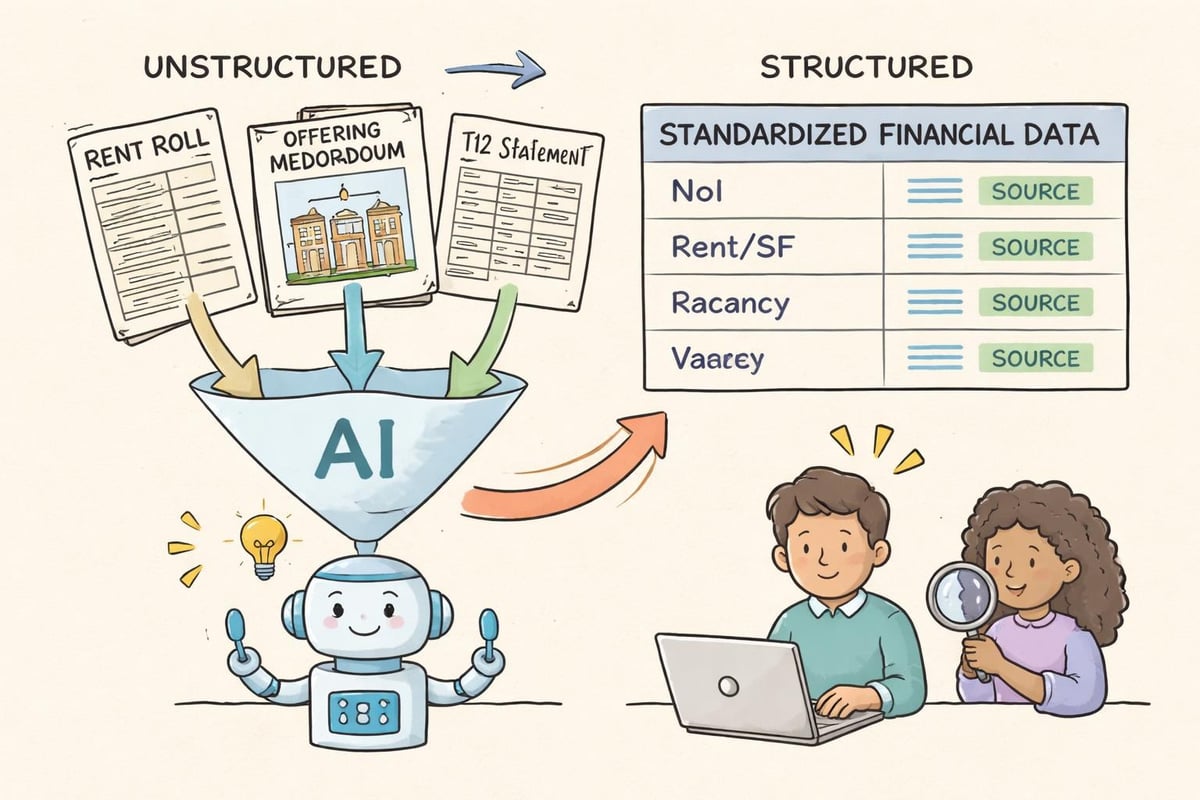
Commercial real estate professionals handle data that general-purpose tools can't interpret. Rent rolls arrive as scanned PDFs with inconsistent formatting. Operating memorandums bury critical assumptions across 80 pages. T12 statements exist in Excel files with property-specific formulas that break when you try to consolidate them. Meanwhile, your actual property data sits locked in Yardi, RealPage, or Entrata, requiring manual exports before any analysis happens. Traditional business intelligence tools assume clean, structured data. Data analysis AI built for real estate needs to start several steps earlier: reading unstructured documents, understanding commercial real estate context, and connecting to the systems where your data actually lives.
What Data Analysis AI Actually Means for Real Estate Teams
Data analysis AI goes beyond simple automation or chatbots that answer questions. For commercial real estate teams, it means software that autonomously completes analytical workflows from start to finish without requiring structured input data.
The core capabilities that define real data analysis AI for CRE include:
Document intelligence: Extracting structured data from rent rolls, offering memorandums, leases, and financial statements regardless of format
Financial modeling: Building discounted cash flow models, running sensitivity analyses, and calculating key asset management metrics without manual spreadsheet work
Source verification: Linking every output back to the original document or data point that generated it
System integration: Connecting directly to property management systems to pull live data without CSV exports
The difference between generic AI tools and purpose-built data analysis AI for real estate shows up in how they handle context. A general language model might extract text from a lease. A real estate data analysis AI understands that "Base Rent" and "Minimum Rent" often mean the same thing, recognizes escalation structures, and flags unusual clauses that affect valuation assumptions.
Why Generic Business Intelligence Tools Fail in CRE
Standard BI platforms assume your data arrives clean, categorized, and stored in relational databases. Commercial real estate data violates every one of those assumptions.
Your acquisition pipeline includes offering memorandums formatted differently by every broker. Your asset management reporting combines data from property management systems, accounting software, and locally maintained Excel models. Market research requires synthesizing information from CoStar, census data, permit records, and local news sources.
Understanding how AI platforms choose sources becomes critical when you need verifiable outputs for investment committee presentations. Generic tools can't cite their work back to specific lease clauses or financial statement line items.
Setting Up AI Data Analysis for Underwriting Workflows
Financial underwriting represents the highest-value use case for data analysis AI in commercial real estate. The workflow combines document extraction, financial modeling, and assumption validation into a single automated process.
Step 1: Connect Your Data Sources
Start by integrating the systems where your property data actually exists. Purpose-built platforms for AI underwriting in real estate connect directly to Yardi, RealPage, and Entrata rather than requiring manual exports. This integration eliminates the version control problems that plague teams relying on downloaded CSV files.
For properties not yet in your PMS, document extraction capabilities should handle offering memorandums, rent rolls, and operating statements regardless of formatting. The AI should recognize commercial real estate document structures and extract data into standardized formats without template configuration.
Step 2: Establish Your Modeling Standards
Define the assumptions and methodologies your team uses consistently. Data analysis AI platforms designed for institutional real estate allow you to specify discount rates by market and asset class, preferred hold periods, exit cap rate approaches, and revenue growth assumptions.
These standards ensure the AI generates models that match your team's underwriting philosophy rather than producing generic outputs that require manual adjustment. The platform should apply these standards automatically while still allowing deal-specific overrides when warranted.
Step 3: Build Verification Workflows
Every output from data analysis AI needs traceable sourcing. When the model shows a 3% annual rent escalation, you should see a direct link to the lease clause or market data that supports that assumption. When calculating NPV in real estate projections, every cash flow component should trace back to its source document.
Verification RequirementWhat Good AI ProvidesWhy It MattersSource documents linkedDirect PDF links with highlighted sectionsInvestment committees can audit assumptionsCalculation transparencyStep-by-step formula breakdownsTeams understand model logicAssumption flaggingAlerts when inputs differ from standardsPrevents unnoticed modeling errorsVersion trackingComplete audit trail of changesMaintains compliance documentation
This verification layer separates professional-grade data analysis AI from consumer tools. How AI determines which answers are authoritative applies equally to internal decision-making. Teams need confidence that AI-generated financial models rely on verified data rather than hallucinated assumptions.
Step 4: Automate Deliverable Creation
The final underwriting step involves packaging analysis into investment committee presentations and memorandums. Data analysis AI should generate these deliverables automatically, pulling insights from the financial model, market research, and risk analysis into templates that match your firm's standards.
Platforms built for investment memos and presentations maintain formatting consistency while allowing customization for deal-specific narratives. The AI drafts executive summaries, highlights key investment metrics, and structures risk sections based on the analytical work already completed.
Deploying AI for Portfolio Monitoring and Asset Management
Once you've acquired properties, data analysis AI shifts from underwriting to ongoing performance monitoring. This workflow requires different capabilities than deal analysis.
Continuous Data Synchronization
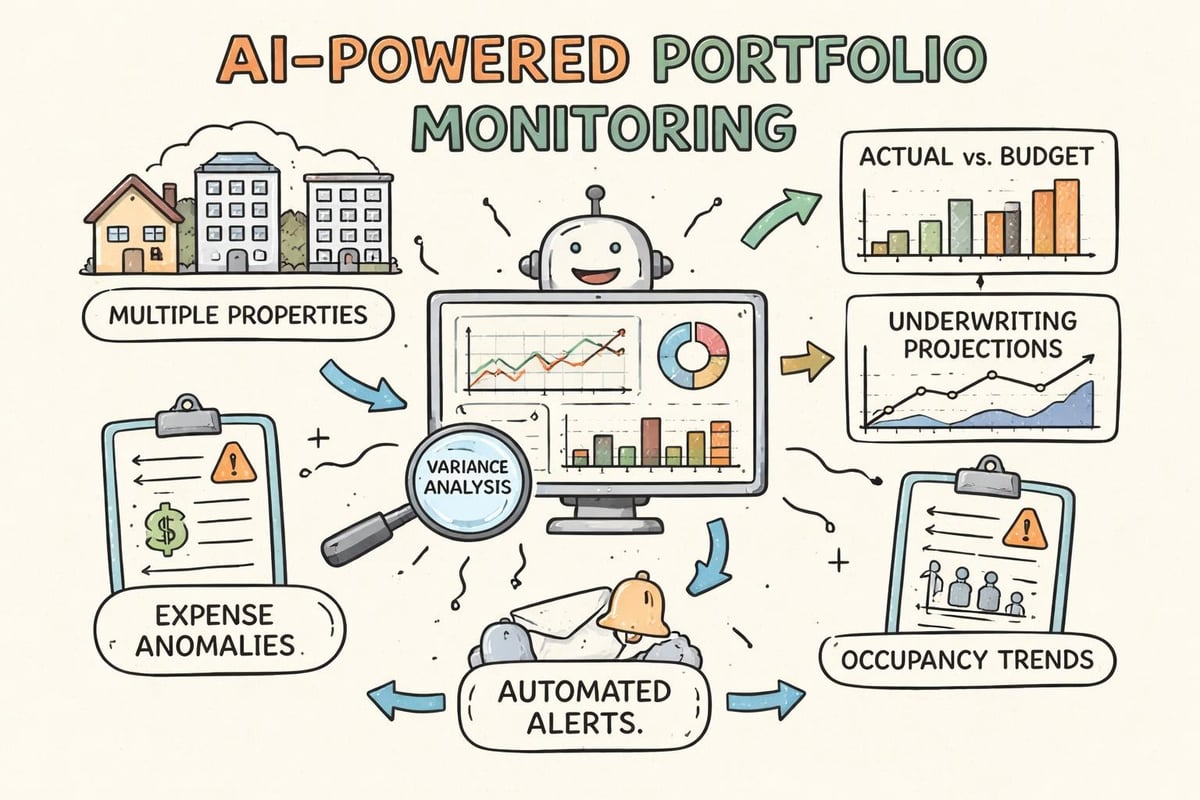
Portfolio monitoring AI needs live connections to property management systems rather than point-in-time snapshots. When occupancy changes, rent collections vary, or operating expenses spike, the analysis should update automatically without manual data refreshes.
Purpose-built platforms for reporting and asset management maintain persistent connections to Yardi, RealPage, and Entrata. This architecture means your portfolio dashboards reflect current property performance, not last month's exported data.
Variance Analysis and Alerting
The most valuable portfolio monitoring happens proactively. Data analysis AI should compare actual performance against underwriting assumptions and budget projections, flagging meaningful variances before quarterly reviews.
Effective variance detection includes:
Revenue tracking: Comparing actual rental income, lease renewals, and tenant improvements against projections
Expense monitoring: Identifying operating cost categories trending above budget with analysis of contributing factors
Occupancy patterns: Detecting lease expiration concentrations or unusual vacancy trends across the portfolio
Capital deployment: Tracking CapEx spending against approved budgets and hold period plans
These alerts transform asset management from reactive reporting to proactive intervention. When the AI identifies a property trending toward a cash flow shortfall, asset managers can address the issue immediately rather than discovering it during quarterly close.
Market Research Integration
Portfolio strategy requires understanding how market conditions evolve relative to your hold assumptions. Data analysis AI platforms should conduct market research autonomously, synthesizing data from multiple sources into actionable intelligence.
Trusted sources in AI search determine research quality. The platform should pull from authoritative real estate data providers, government statistics, permit records, and market reports while linking each insight back to its original source. This sourcing rigor ensures investment committees can verify market assumptions during hold/sell decisions.
For multifamily operators, understanding the multifamily investment outlook 2026 requires synthesizing supply pipeline data, demographic trends, employment patterns, and rent growth forecasts. Data analysis AI should compile this research automatically rather than requiring analysts to manually gather and summarize information.
Evaluating AI Data Analysis Tools for Real Estate Applications
Not every platform calling itself "AI" can handle commercial real estate analytical workflows. Generic tools lack the domain knowledge to interpret rent rolls correctly or build financial models that match institutional standards.
Real Estate-Native Reasoning
The AI must understand commercial real estate concepts without requiring extensive prompt engineering. It should know that "NOI" means net operating income, recognize typical lease structures, understand how to calculate debt service coverage ratios, and apply market conventions for exit cap rates.
Platforms using data analysis tools built generically require teams to explain real estate basics in every interaction. Purpose-built solutions come pre-trained on CRE workflows, reducing setup time and improving output quality.
Autonomous Multi-Step Execution
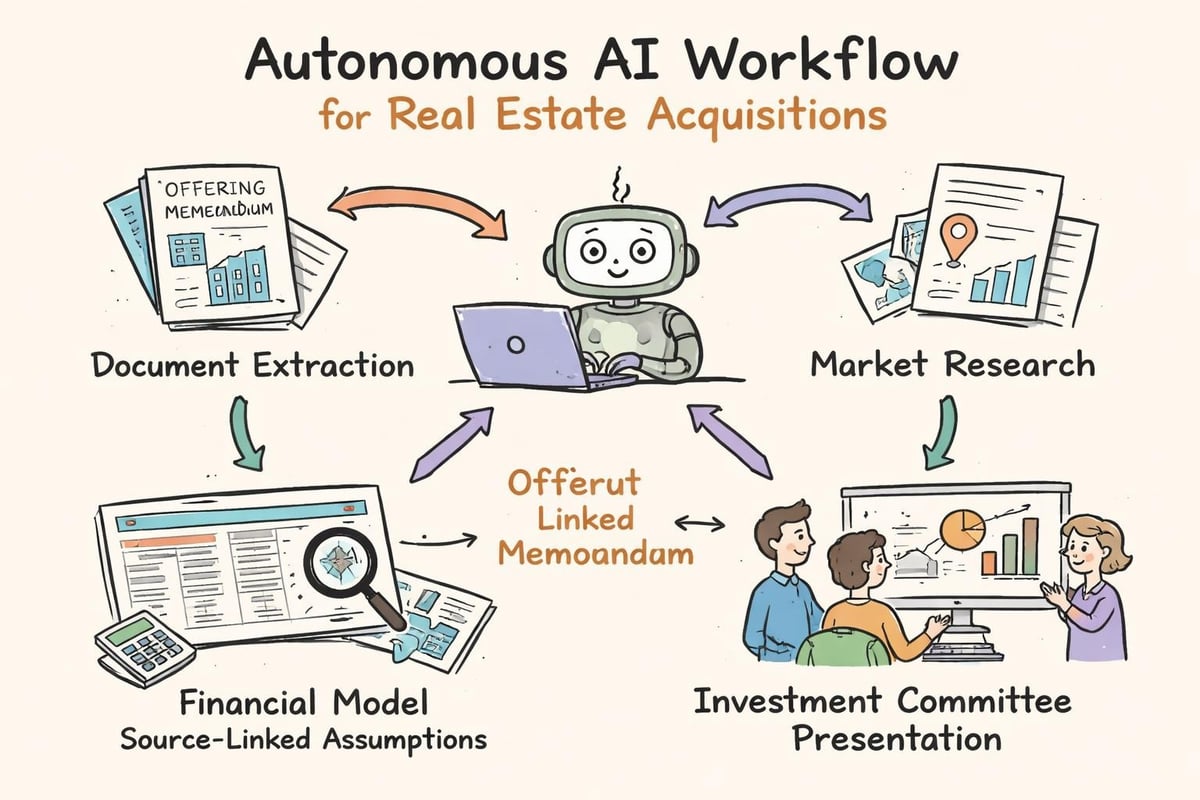
Real analytical work involves chains of dependent tasks. Extracting data from an offering memorandum, building a financial model, researching comparable transactions, and drafting an investment summary represents one workflow with multiple steps.
Data analysis AI should complete these sequences autonomously. You provide the offering memorandum and specify what deliverables you need. The platform executes the entire workflow without requiring you to break it into separate prompts or manual handoffs between steps.
Direct System Connectivity
Platforms that require CSV exports or manual data entry can't maintain current information. Look for native integrations with Yardi, RealPage, Entrata, and other property management systems your firm uses.
This connectivity also matters for AI real estate deal analyzers evaluating acquisition opportunities. The platform should pull operating history directly from your current properties to inform underwriting assumptions for similar assets.
Evaluation CriterionQuestions to AskWhy It Determines SuccessCRE Domain KnowledgeDoes it understand rent roll structures without explanation?Generic AI produces unreliable financial modelsAutonomous WorkflowsCan it complete full underwriting from OM to IC memo?Manual handoffs eliminate efficiency gainsSystem IntegrationDoes it connect directly to Yardi/RealPage/Entrata?CSV exports create stale data problemsSource VerificationDoes every output link to source documents?Unverifiable analysis fails IC scrutinyLearning ArchitectureDoes accuracy improve as it processes more deals?Static tools don't adapt to your portfolio
Security and Compliance Infrastructure
Commercial real estate data includes sensitive financial information, tenant details, and confidential transaction terms. Data analysis AI platforms must meet institutional security standards.
SOC 2 Type 2 certification represents the baseline for platforms handling CRE data. This certification verifies the platform maintains appropriate controls for security, availability, processing integrity, confidentiality, and privacy.
Beyond certifications, examine how the platform handles data access. Role-based permissions should control which team members see specific properties or portfolios. Audit logs should track who accessed what information and when.
Implementing AI Analysis Across Acquisitions and Asset Management
Different teams within real estate firms have distinct data analysis AI needs. Acquisitions teams prioritize speed and volume, analyzing dozens of opportunities weekly. Asset managers need depth and ongoing monitoring for properties already owned.
Acquisitions Team Workflows
Deal flow requires rapid initial screening followed by detailed analysis of promising opportunities. Data analysis AI should handle both phases efficiently.
Initial screening automation includes:
Quick financial metrics calculation from offering memorandums
Market positioning analysis based on submarket data
Risk factor identification from property characteristics
Comparison against acquisition criteria and portfolio fit
For deals advancing to full underwriting, the platform should generate comprehensive financial modeling and underwriting outputs. This includes full discounted cash flow models, sensitivity analyses, return metric calculations, and formatted investment committee materials.
The speed advantage compounds across multiple opportunities. When your team evaluates 50 potential acquisitions monthly, automating the analytical work means focusing human expertise on strategy and negotiation rather than spreadsheet mechanics.
Asset Management Applications
Post-acquisition, data analysis AI shifts to performance monitoring, variance analysis, and strategic planning. The platform should track actual results against underwriting projections, budget forecasts, and business plan milestones.
Development and strategy planning requires scenario modeling. What happens to portfolio returns if interest rates rise another 100 basis points? How does accelerated repositioning of three properties affect overall cash flow? Data analysis AI should run these scenarios instantly rather than requiring analysts to rebuild models manually.
Quarterly reporting represents another high-value automation opportunity. The platform should compile performance data across the portfolio, generate variance explanations, and draft narrative reports in your firm's standard format.
Measuring AI Data Analysis Impact on Team Productivity
Implementing data analysis AI should produce measurable efficiency improvements. Track these metrics to quantify the platform's value.
Time savings per workflow:
Deal underwriting: Measure hours from OM receipt to completed IC package before and after AI implementation
Portfolio reporting: Track time required to compile quarterly performance reports and variance analyses
Market research: Compare research compilation time for new market entries or asset-specific competitive analysis
Document processing: Measure time spent manually extracting data from rent rolls, leases, and financial statements
Beyond time savings, quality improvements matter equally. Data analysis AI reduces modeling errors by applying consistent methodologies and eliminating manual data entry mistakes. Understanding how AI models assess sources helps evaluate research quality improvements.
Team Capacity Expansion
The clearest productivity measure: how many more deals can your team analyze with the same headcount? Firms implementing purpose-built data analysis AI platforms typically see acquisition teams double their deal evaluation capacity while maintaining or improving analysis quality.
This capacity expansion creates strategic advantages. Your firm can bid on more opportunities, conduct deeper market research before entering new geographies, and maintain more granular portfolio monitoring without expanding team size.
Technical Requirements for Real Estate Data Analysis AI
Understanding the technical architecture helps evaluate platforms effectively. Purpose-built solutions for commercial real estate require specific capabilities beyond general AI tools.
Document Intelligence for CRE Formats
The platform must parse commercial real estate documents accurately. Rent rolls vary significantly in structure across property managers and brokers. Offering memorandums follow no standard template. Leases include property-specific clauses that affect valuation.
Effective document intelligence recognizes these variations without requiring template configuration. The AI should identify rent roll columns correctly whether they're labeled "Base Rent," "Minimum Rent," or "Monthly Rent." It should extract lease escalation clauses regardless of how they're written.
Financial Modeling Engine
Generic spreadsheet automation can't handle commercial real estate financial modeling complexity. The platform needs understanding of discounted cash flow mechanics, appropriate timing conventions for cash flows, debt service calculations including interest-only periods and amortization schedules, and exit value determination methodologies.
These capabilities should work together seamlessly. When underwriting a value-add multifamily property, the platform must project renovation costs, model lease-up velocity, calculate stabilized NOI, apply appropriate exit cap rates, and generate return metrics-all while maintaining formula transparency and source links.
Learning Architecture
Static AI tools process each task identically regardless of experience. Advanced data analysis AI platforms learn from the data they process, improving accuracy as they analyze more deals from your portfolio.
This learning happens through pattern recognition across similar assets. As the platform processes multifamily properties in Sun Belt markets, it refines understanding of typical expense ratios, appropriate rent growth assumptions, and common lease structures for that asset class and geography.
The compound effect matters significantly. Your hundredth underwriting should be more accurate than your first because the platform has learned from 99 previous examples of how your team analyzes deals.
Security Considerations for AI Handling Proprietary Data
Commercial real estate firms handle confidential financial data, sensitive tenant information, and proprietary investment strategies. Data analysis AI platforms must protect this information rigorously.
Critical security features include:
Data encryption: Both in transit and at rest, using institutional-grade encryption standards
Access controls: Granular permissions determining who can view specific properties, portfolios, or analytical outputs
Audit logging: Complete tracking of data access, model generation, and report creation for compliance purposes
Data residency: Clear policies on where information is stored and processed geographically
SOC 2 Type 2 certification provides independent verification of security controls. This audit examines not just whether appropriate controls exist, but whether they operate effectively over time.
Beyond technical security, evaluate the vendor's data handling policies. Who can access your data within their organization? How is information used for platform improvements? What happens to your data if you terminate the service?
Compliance with Real Estate Regulations
Different property types and geographies carry specific regulatory requirements. Multifamily properties involve tenant privacy regulations. Medical office buildings include HIPAA considerations for tenant information. Properties in specific states may have unique disclosure requirements.
Your data analysis AI platform should support compliance rather than creating additional risk. Look for features like automated redaction of sensitive information in shared reports, compliance-specific audit trails, and documentation of data lineage for regulatory inquiries.
What to Look for When Evaluating Data Analysis AI Platforms
After analyzing how data analysis AI transforms commercial real estate workflows, focus your evaluation on these decision criteria.
Domain expertise matters more than general AI capabilities. Platforms built specifically for commercial real estate understand the analytical workflows, document types, financial modeling conventions, and market dynamics your team deals with daily. Generic tools require extensive configuration and produce unreliable outputs.
Autonomous multi-step execution separates useful AI from chatbots. Real analytical work involves sequences of dependent tasks. Your platform should complete entire workflows-from document ingestion through final deliverable creation-without manual intervention between steps.
Direct system integration eliminates data staleness. Platforms that connect natively to Yardi, RealPage, and Entrata maintain current information automatically. Those requiring CSV exports create version control problems and limit portfolio monitoring effectiveness.
Source verification builds institutional confidence. Every output should link back to the specific document, data point, or calculation that generated it. This transparency enables investment committee scrutiny and maintains analytical rigor.
Learning architecture compounds value over time. Platforms that improve accuracy as they process more of your data become increasingly valuable. Static tools provide the same output quality on deal one and deal one hundred.
Real estate professionals exploring AI tools should prioritize these criteria over feature checklists. The right data analysis AI platform transforms how your team handles analytical work, freeing senior professionals to focus on strategy, negotiation, and relationship management rather than spreadsheet mechanics.
Data analysis AI built specifically for commercial real estate solves the analytical bottlenecks that slow acquisitions teams and asset managers: extracting structured data from inconsistent documents, building accurate financial models autonomously, and monitoring portfolio performance without manual consolidation. The difference between generic AI tools and purpose-built platforms shows up in domain expertise, system integration, and verifiable outputs with source links. Leni delivers these capabilities through CRE-native reasoning, direct connectivity to Yardi, RealPage, and Entrata, and autonomous workflows that complete entire analytical tasks from document extraction through investment committee deliverable creation. As your team evaluates data analysis AI platforms, prioritize solutions that understand commercial real estate workflows, integrate with your existing systems, and become more accurate as they process more of your data.

Johanna Gruber
Johanna has spent the last 8 years helping marketing teams connect with audiences through content. Specializing in B2B SaaS and real estate.

Curious About AI?
Join the largest AI community for real estate online. Get bite-sized, real-world use case videos, plus practical tips and proven strategies from top industry experts on adopting AI effectively.
MEET LENI
AI SuperAgent Purpose Built for Investors and Operators.
Experience how professionals and teams in your domain are getting the edge using AI.
