Growth Equity Investing in CRE: 2026 Data-Driven Guide

Growth Equity Investing in CRE: 2026 Data-Driven Guide
Growth equity investing has emerged as a critical strategy for general partners and institutional investors seeking to capture value in commercial real estate assets positioned for significant NOI expansion. Unlike traditional buyout strategies or early-stage venture bets, growth equity as defined by industry practitioners occupies a unique position in the capital stack, providing expansion capital to assets with proven fundamentals but unrealized potential. For CRE fund managers, this means deploying capital into stabilized or near-stabilized properties where operational improvements, market timing, or strategic repositioning can drive outsized returns. The challenge, however, lies not in identifying opportunities but in building the data infrastructure to underwrite them accurately and monitor performance throughout the hold period.
Understanding Growth Equity Investing in Commercial Real Estate
Growth equity investing in the CRE context differs fundamentally from both opportunistic value-add plays and core-plus acquisitions. This strategy targets properties with established cash flows, identifiable tenant bases, and clear pathways to operational improvement. The investment thesis centers on accelerating NOI growth through specific, measurable interventions rather than speculative repositioning or ground-up development.
Defining the Growth Equity Mandate
For institutional investors and fund managers, growth equity investments typically involve:
Minority or majority stakes in properties generating revenue but operating below market potential
Capital deployment focused on operational improvements, tenant amenities, or strategic lease-up
Hold periods of three to seven years aligned with value creation milestones
Exit strategies predicated on demonstrable NOI improvement and market timing
The structure and process of growth equity investments requires rigorous due diligence on both current performance and projected growth trajectories. Unlike core acquisitions where underwriting focuses on yield maintenance, growth equity demands forward-looking analysis of market rent expansion, lease rollover opportunities, and competitive positioning.
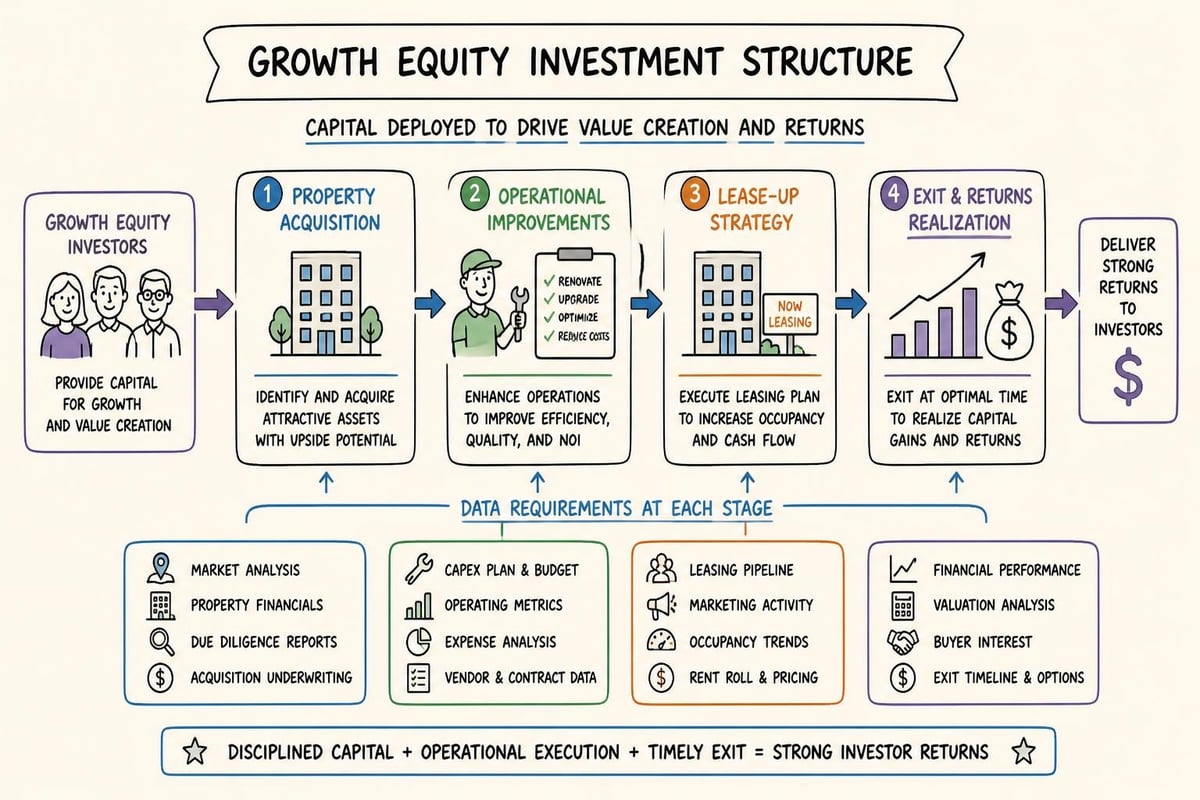
Where Growth Equity Creates Value in CRE
The value creation mechanisms in growth equity CRE investments cluster around several key drivers:
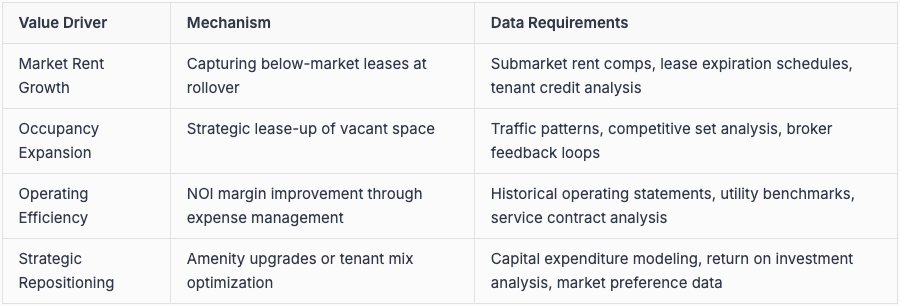
Each of these drivers requires different data inputs and analytical frameworks. Most fund managers assembling this information manually face weeks of aggregation work before the first underwriting model can be built with confidence.
Due Diligence Requirements for Growth Equity Investments
The diligence process for growth equity in commercial real estate extends far beyond traditional acquisition underwriting. Teams must validate both current operations and the feasibility of the growth thesis across multiple analytical dimensions.
Market Rent Growth Projections
Every growth equity investment thesis relies on assumptions about future rental rates. The quality of these projections determines whether the deal pencils at acquisition and whether the IRR targets hold through disposition.
Critical data points include:
Comparable lease transactions from the past 12-24 months with actual rental rates and concession packages
Submarket vacancy trends with granular asset class and quality tier segmentation
New supply pipeline analysis with delivery timelines and pre-leasing velocity
Tenant demand indicators including absorption rates and space requirements by industry
The challenge for investment teams lies in sourcing this data consistently and updating it throughout due diligence. Brokers provide selective comps. CoStar shows trends but lacks deal-level detail. Local market research firms deliver reports on inconsistent timelines. By the time teams assemble a complete picture, the opportunity may have moved to another bidder.
Modern AI tools for real estate private equity can aggregate this fragmented information and produce sourced market rent analyses in hours rather than weeks, maintaining data lineage so investment committees can verify every assumption.
Occupancy Trajectory Analysis
For properties with meaningful vacancy, the lease-up assumption drives the entire growth equity thesis. Underwriting must answer specific questions:
What is the realistic absorption timeline? Based on comparable lease-up velocity, current market conditions, and property-specific constraints
What concession packages will be required? Free rent, tenant improvement allowances, and leasing commissions that impact net effective rent
Which tenant profiles are most likely? Credit quality, space requirements, and lease term expectations that affect long-term NOI stability
Teams that rely on broker opinions or sponsor projections without independent verification consistently overestimate lease-up speed and underestimate capital requirements. Detailed real estate market analysis using actual transaction data provides the evidence base for realistic occupancy modeling.
NOI Expansion Thesis Validation
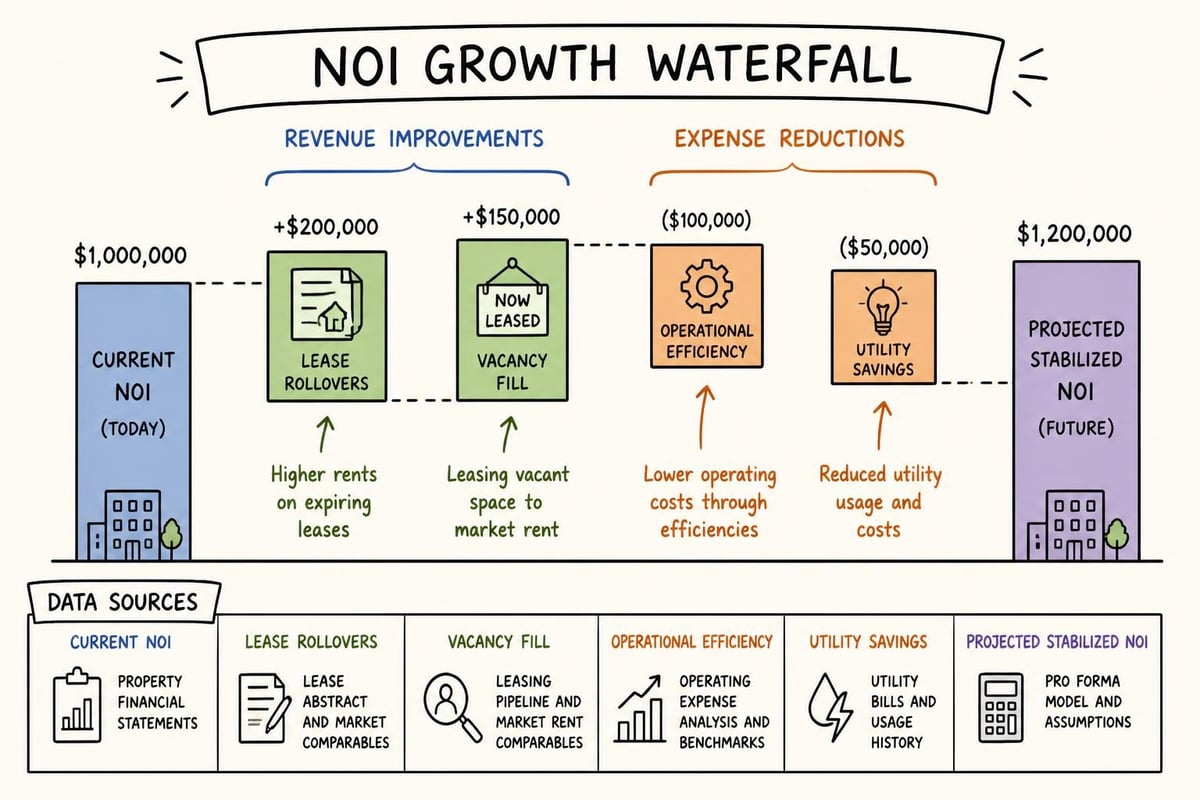
The heart of any growth equity investment is the NOI bridge from current performance to projected stabilization. This requires decomposing every revenue and expense line item:
Revenue Growth Components:
Base rent increases from lease rollovers
Occupancy gains from vacancy fill
Recoverable expense pass-throughs
Ancillary income opportunities (parking, amenities, services)
Expense Management Opportunities:
Operating expense ratio benchmarking against comparable assets
Service contract renegotiation potential
Utility efficiency improvements
Property management fee optimization
Investment committees want to see variance explanations for every material assumption. Where is the current rent roll relative to market? Why are operating expenses above peer benchmarks? What capital expenditures unlock which revenue opportunities? Assembling this analysis manually means extracting data from rent rolls, operating statements, and market reports, then building custom Excel models that become obsolete the moment assumptions change.
Exit Cap Assumptions and Comparable Transaction Analysis
Growth equity returns depend entirely on exit execution. Underwriting the terminal value requires modeling future market conditions and buyer expectations at disposition.
Building Defensible Exit Assumptions
The exit cap rate assumption carries more sensitivity than any other input in most growth equity models. A 25-basis-point variance can swing IRR by 200-400 basis points depending on leverage and hold period.
Exit cap analysis requires:
Historical cap rate trends for the asset class and submarket over full market cycles
Transaction comps from the past 18-24 months adjusted for asset quality and location
Forward interest rate assumptions and their correlation to cap rate movements
Institutional buyer appetite and capital availability projections
Teams must also model multiple exit scenarios: hold to full stabilization, early exit if value creation accelerates, or extended hold if markets deteriorate. Each scenario requires different cap rate assumptions and buyer profiles.
Understanding how growth equity positions differ from both value-add and core investments helps teams think through which buyers will be competing for the asset at disposition. A property underwritten as growth equity at acquisition should trade as core-plus or core at exit, attracting a different buyer pool with different return requirements.
Transaction Comparable Analysis
Reliable comp selection makes the difference between realistic exit modeling and wishful thinking. Fund managers need systematic frameworks for:
Identifying truly comparable transactions based on property type, vintage, location, tenant quality, and lease term profiles
Adjusting for transaction-specific factors including market timing, buyer motivation, and financing terms
Tracking disposition velocity to understand how long it takes to market and close similar assets
Monitoring buyer appetite across different institutional capital sources and investment strategies
Most teams track this information in spreadsheets that quickly become outdated. Commercial real estate databases provide some transaction history, but capturing the qualitative factors that explain price variance requires human judgment applied to structured data.
Data Gaps and Risk in Growth Equity Workflows
Every data gap in the growth equity workflow creates investment risk. Incomplete market information leads to aggressive rent assumptions. Missing operating expense detail hides value-creation obstacles. Outdated transaction comps produce unrealistic exit values.
Common Data Infrastructure Failures
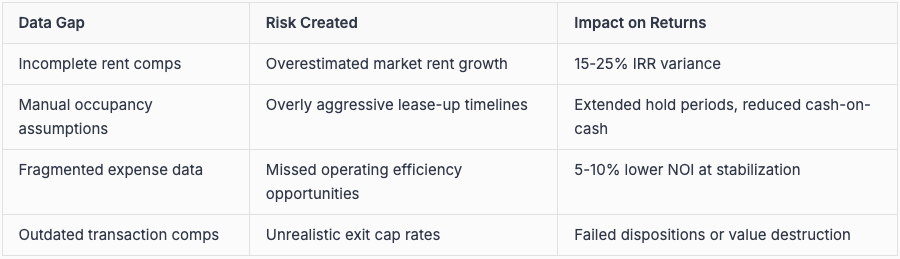
The downstream effects compound throughout the investment lifecycle. Aggressive underwriting wins deals but creates performance gaps. Portfolio monitoring relies on the same fragmented data sources, making it difficult to identify problems early. Investment committee reporting becomes an exercise in reconciling why actual performance diverges from projections.
Portfolio Monitoring After Deployment
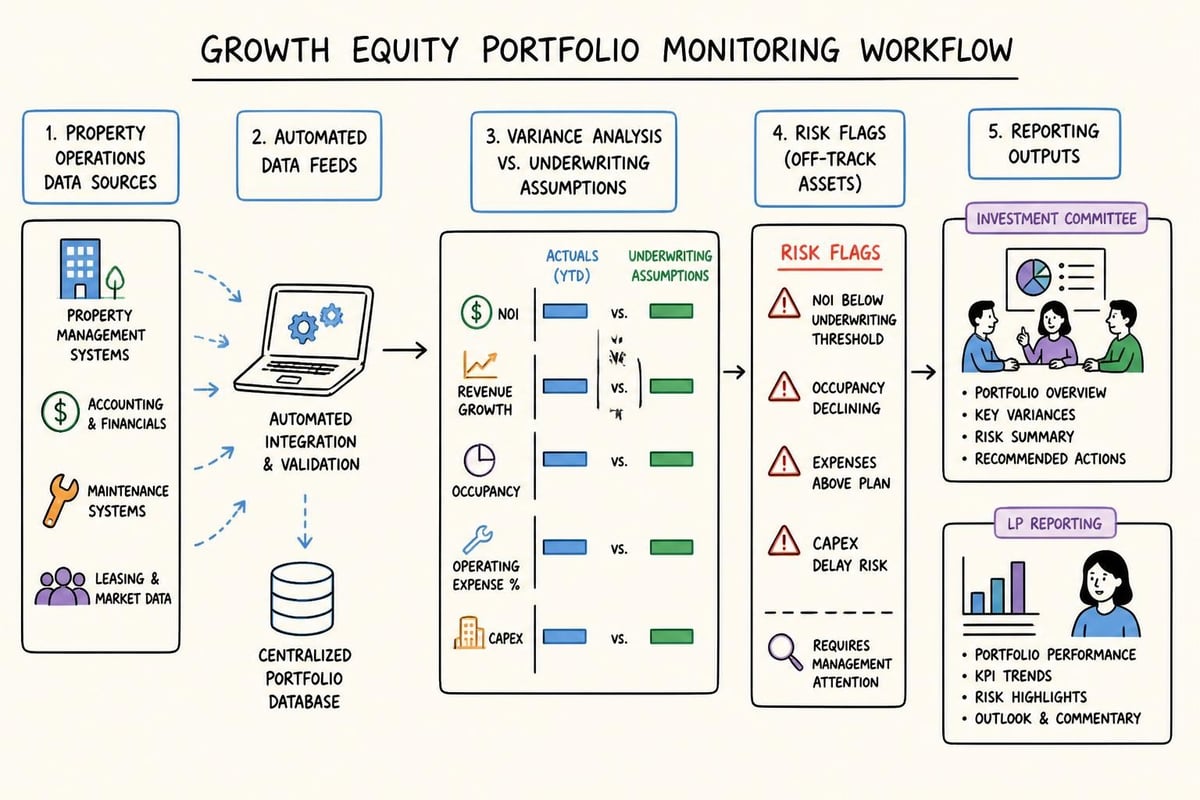
Once capital is deployed, the data infrastructure challenge shifts from underwriting to asset management. Growth equity investments require active monitoring of value creation milestones:
Monthly variance analysis comparing actual rent growth, occupancy, and operating expenses to underwriting assumptions
Quarterly portfolio reviews tracking NOI progression, capital deployment against budget, and market condition changes
Annual reforecasting updating hold period, exit timing, and return projections based on actual performance
Risk flagging identifying properties where the growth thesis is not materializing as expected
Teams using data analytics in asset management can automate much of this monitoring, freeing investment professionals to focus on strategic decisions rather than data aggregation.
Building Data Infrastructure for Growth Equity Performance
The institutional investors consistently outperforming in growth equity share a common characteristic: they treat data infrastructure as a competitive advantage. While other teams manually assemble market research and underwriting analyses, top performers have invested in systems that automate data aggregation, analysis, and reporting.
The AI Layer in Growth Equity Workflows
Modern AI platforms designed for real estate equity investment can support the entire growth equity lifecycle:
Pre-Acquisition Phase:
Automated market research with sourced rent comps, supply pipeline analysis, and demand indicators
Underwriting model generation from deal documents, rent rolls, and operating statements
Investment committee memo drafting with standardized analysis frameworks and data sourcing
Asset Management Phase:
Automated variance reporting comparing actual to underwritten performance
Risk flagging when key metrics deviate from projections
Portfolio-level dashboards tracking value creation progress across multiple assets
Disposition Phase:
Exit market analysis with current transaction comps and buyer appetite indicators
Updated valuation models reflecting actual performance and current market conditions
Marketing materials generation with data-driven value creation narratives
The teams deploying these capabilities gain speed advantages measured in weeks, not hours. More importantly, they make better decisions because analysis is based on complete, current, and verified data rather than whatever information could be assembled manually within deal timelines.
Integrating Technology into Investment Operations
For general partners and fund managers considering how to upgrade their data infrastructure, the question is not whether to integrate technology but how to do so without disrupting existing workflows.
Implementation Considerations
Successful technology integration in growth equity operations requires:
Clear workflow mapping identifying where data bottlenecks currently exist and which processes deliver the highest ROI when automated
Data quality standards ensuring that automated systems produce outputs that meet investment committee requirements for sourcing and verification
Human oversight frameworks maintaining professional judgment at critical decision points while delegating aggregation and analysis to AI systems
Security and compliance meeting enterprise-grade requirements for data handling, access controls, and audit trails
Leading growth equity firms have been early adopters of data infrastructure investments precisely because the strategy demands rigorous, data-intensive analysis. Teams that continue relying on manual processes face growing disadvantages as deal timelines compress and data volumes increase.
Measuring Data Infrastructure ROI
Investment in technology platforms should be evaluated using the same return frameworks applied to portfolio decisions:
Time Savings:
Hours saved per deal on market research, underwriting, and IC memo preparation
Reduced cycle time from LOI to closing
Faster portfolio monitoring and reporting cycles
Decision Quality:
Improved underwriting accuracy measured by actual vs. projected performance
Earlier identification of portfolio risks requiring intervention
Better exit timing based on current market data
Scalability:
Ability to evaluate more opportunities without proportional headcount increases
Consistent analysis quality across deal teams and geographies
Portfolio capacity expansion without operational complexity
The firms making these investments view data infrastructure as central to their competitive positioning, not as back-office cost centers.
Operational Excellence in Growth Equity Asset Management
Growth equity investing demands operational excellence throughout the hold period. The investment thesis assumes active value creation, not passive ownership. This requires systems that connect acquisition underwriting to asset-level operations and portfolio-wide performance tracking.
Connecting Underwriting to Operations
The disconnect between acquisitions teams and asset management creates performance gaps at most firms. Underwriting assumptions about rent growth, lease-up, and operating efficiency rarely translate into detailed operating plans with assigned accountability and milestone tracking.
Best practices include:
Value creation playbooks documenting the specific actions required to achieve underwritten NOI growth, with timelines and responsible parties
Monthly performance dashboards tracking actual results against underwriting assumptions with variance explanations
Quarterly strategy reviews evaluating whether the original thesis remains valid or requires adjustment based on market changes
Annual reunderwriting updating return projections and hold period recommendations based on accumulated performance data
This operational rigor separates the growth equity firms that consistently deliver projected returns from those that rely on market appreciation to compensate for execution shortfalls. Technology platforms that connect fragmented property, market, and financial data make this level of operational detail achievable without overwhelming investment teams.
Competitive Advantages Through Data Quality
The growth equity landscape has become intensely competitive, with major firms deploying billions in capital seeking similar opportunities. Winning deals requires more than financial firepower; it demands the ability to underwrite faster and more accurately than competitors.
Speed as Competitive Advantage
In competitive processes, the first credible offer often wins regardless of whether it is the highest price. Teams that can produce fully underwritten investment committee-ready analyses in days rather than weeks secure more opportunities and negotiate from positions of strength.
The speed advantage comes from:
Automated data extraction from offering memoranda, rent rolls, and operating statements
Instant market research pulling current comps and market conditions without manual broker outreach
Template-based analysis applying consistent frameworks while customizing for asset-specific factors
Parallel processing where multiple team members can work simultaneously on connected data rather than waiting for sequential handoffs
Firms implementing these capabilities report 40-60% reductions in time from initial opportunity review to investment committee presentation, allowing them to evaluate more deals and move decisively on the best opportunities.
Accuracy as Risk Management
Speed without accuracy creates different problems. The real competitive advantage comes from faster decisions based on better data. This requires systems that maintain data lineage, provide source attribution, and enable verification of every material assumption.
Enterprise-grade platforms designed for institutional investment operations provide this foundation, connecting market research to underwriting models to portfolio monitoring in auditable workflows that satisfy both investment committees and fiduciary requirements.
Growth equity investing in commercial real estate requires exceptional data infrastructure to underwrite accurately, monitor actively, and exit successfully. The firms that build systematic approaches to market research, underwriting analysis, and portfolio monitoring consistently outperform competitors relying on manual processes and fragmented information. For investment teams ready to upgrade their operational capabilities, Leni provides the AI layer that connects property, market, and financial data across the entire growth equity workflow, from initial market research through portfolio monitoring and exit execution. Purpose-built for enterprise CRE teams, Leni automates the data aggregation and analysis work that currently consumes weeks of professional time, allowing investment teams to focus on strategic decisions backed by complete, verified information.

Johanna Gruber
Johanna has spent the last 8 years helping marketing teams connect with audiences through content. Specializing in B2B SaaS and real estate.

Curious About AI?
Join the largest AI community for real estate online. Get bite-sized, real-world use case videos, plus practical tips and proven strategies from top industry experts on adopting AI effectively.
MEET LENI
AI SuperAgent Purpose Built for Investors and Operators.
Experience how professionals and teams in your domain are getting the edge using AI.
