Investment Memo Software Real Estate: IC-Ready Workflow

Investment Memo Software Real Estate: IC-Ready Workflow
Real estate investment committees demand more than polished presentation decks. They require defensible narratives built from verified data, supported assumptions, and transparent risk analysis. The challenge facing acquisitions teams isn't creating another template-based document. It's connecting dozens of disparate data sources into a coherent story that withstands scrutiny while maintaining the speed necessary for competitive deal execution. Investment memo software real estate firms deploy must bridge this gap between raw materials and decision-ready documentation.
The Journey from Deal Documents to Investment Committee Narrative
Creating an investment committee memo begins with scattered inputs: offering memoranda, historical financials, rent rolls, lease abstracts, title reports, market studies, and internal underwriting models. Each document contains critical information, but none speaks directly to the investment thesis.
The narrative must answer fundamental questions: Why this asset? Why this market? Why now? These questions demand synthesis across qualitative and quantitative inputs. Investment memo software real estate teams use should transform fragmented data into coherent analysis, not just organize files into folders.
Building the Investment Thesis from Source Materials
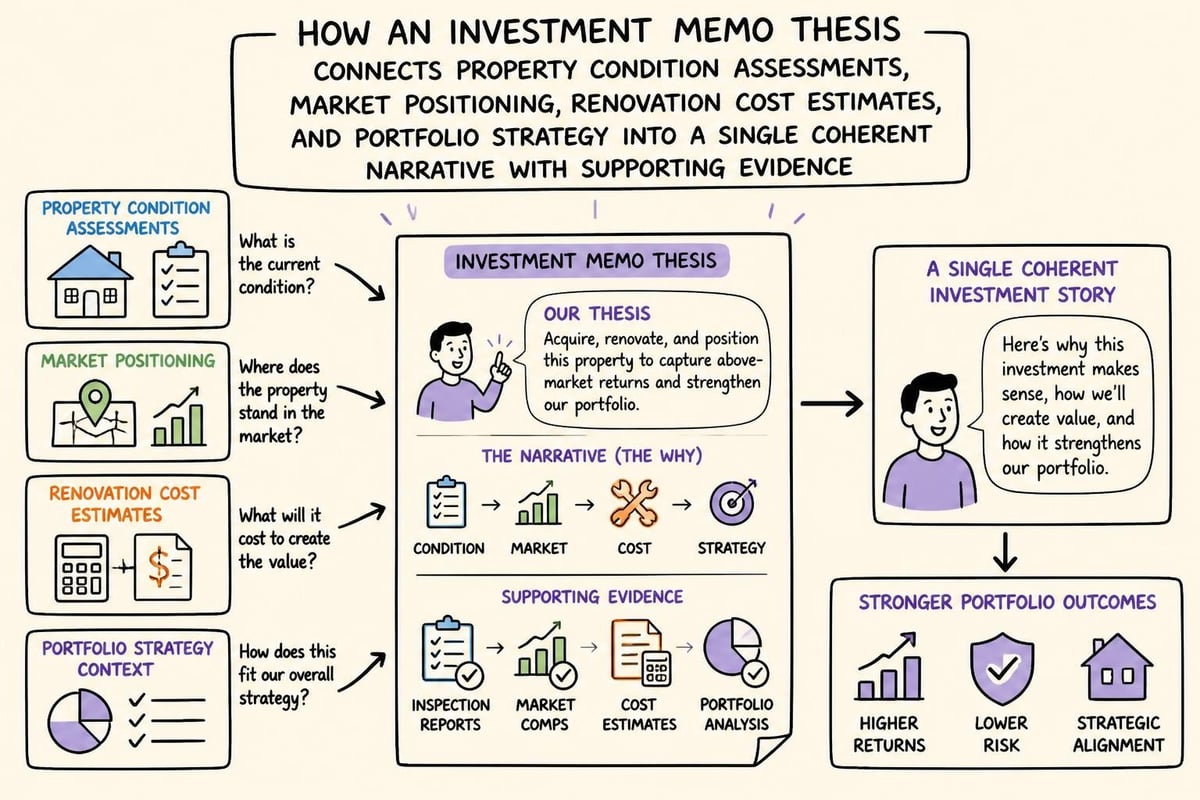
The thesis section requires connecting property-specific attributes to broader market dynamics and portfolio strategy. An acquisitions analyst might identify value-add potential in deferred maintenance, but the memo must link that observation to specific line items in the property condition report, capital expenditure estimates from contractors, and comparable renovation costs from similar assets.
Key thesis components include:
Asset positioning within submarket and competitive set
Specific value creation opportunities backed by quantified assumptions
Strategic fit with portfolio objectives and risk parameters
Market timing considerations supported by supply/demand data
This synthesis doesn't happen automatically. Teams spend hours cross-referencing documents, validating numbers, and ensuring every claim traces back to a verifiable source. The most sophisticated real estate AI tools now handle document reading and data extraction, allowing analysts to focus on interpretation rather than transcription.
Market Context: Beyond Surface-Level Demographics
Investment committees see dozens of memos claiming "strong fundamentals" and "favorable demographics." Differentiated memos demonstrate deep market understanding through specific, verifiable analysis.
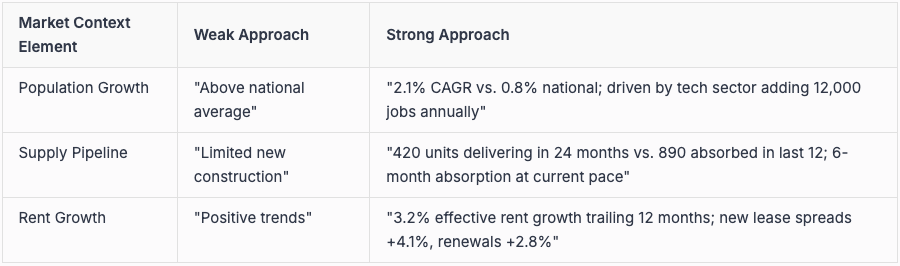
Platforms designed for CRE acquisitions help teams structure this context by integrating market data providers directly into the memo workflow. The challenge extends beyond data access to proper contextualization. A rent growth statistic means nothing without comparable periods, peer submarkets, and asset class specificity.
Rent Comparables and Competitive Positioning
Rent comps represent the foundation of revenue assumptions, yet teams often struggle with comparability adjustments. A four-year-old Class A property with structured parking cannot be directly compared to a ten-year-old Class B asset with surface lots, even in the same submarket.
Investment memo software real estate professionals rely on must support systematic comp adjustments:
Base rent per square foot normalized to property characteristics
Concession adjustments reflected in effective rent calculations
Amenity differences quantified through resident surveys or renewal patterns
Location premiums validated through absorption velocity differentials
The hard part isn't finding comparable properties. Services provide that data readily. The challenge lies in documenting why specific adjustments apply and how they affect underwriting assumptions. AI-powered real estate deal analyzers can flag inconsistencies between stated comps and actual underwriting inputs, reducing the risk of unsupported assumptions reaching the investment committee.
Financial Assumptions: Linking Inputs to Defensible Outputs
Every financial model contains dozens of assumptions. Investment committees don't need to review every cell, but they must understand which assumptions drive returns and how those assumptions connect to market evidence.
Revenue Assumptions and Occupancy Projections
The path from current occupancy to stabilized performance requires specific, staged assumptions. A value-add deal might project 85% occupancy at acquisition, 78% during renovation, and 94% at stabilization. Each figure needs support:
Current occupancy validated against rent roll and lease expiration schedule
Construction impact estimated from comparable renovation timelines
Stabilized occupancy benchmarked to competitive set's trailing performance
Platforms like Reef transform underwriting data into investment-ready documentation by maintaining links between model outputs and supporting evidence. When an IC member questions the stabilization timeline, the memo should reference specific comparable properties that achieved similar lease-up velocity.
Operating Expense Detail and Market Benchmarking
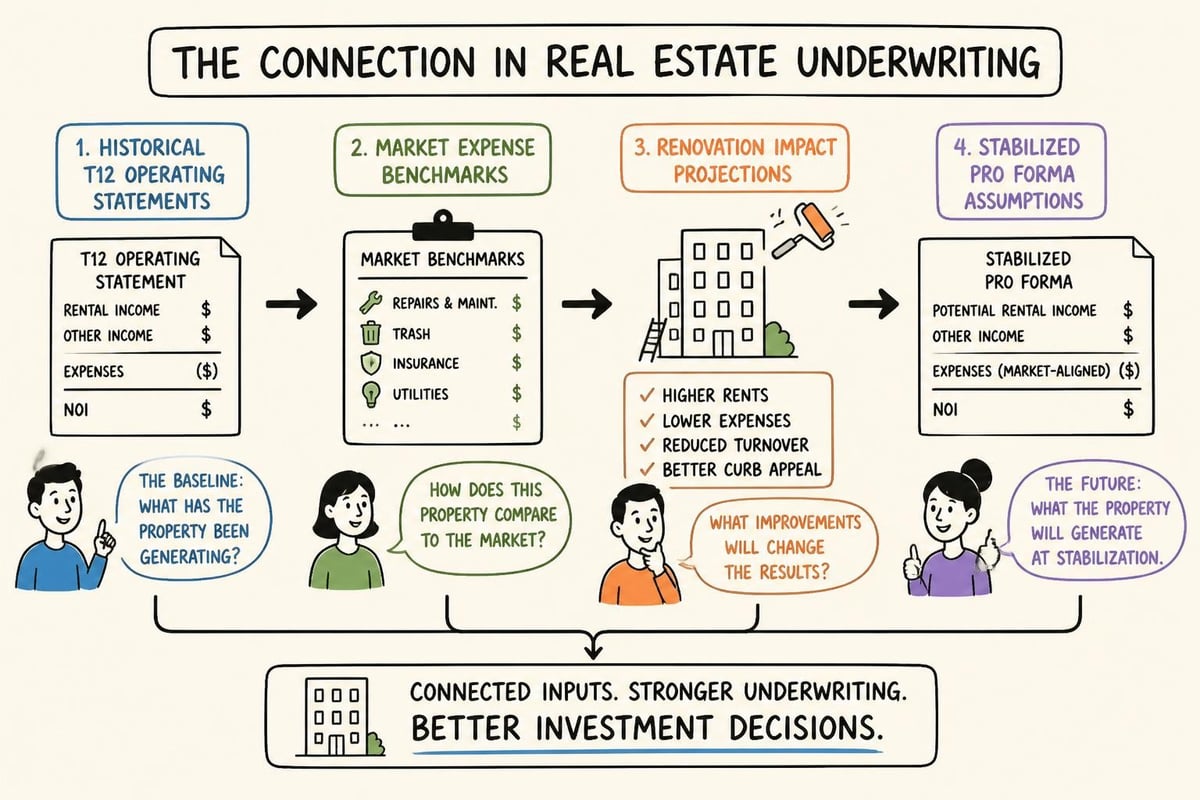
Expense assumptions often receive less scrutiny than revenue, yet they significantly impact cash flow projections. Investment memo software real estate teams deploy must facilitate systematic expense analysis across multiple dimensions.
Historical trending: How have expenses grown relative to revenue and inflation?
Peer comparison: Where does this asset sit within the expense distribution of comparable properties?
Category-specific drivers: What unit-level or per-square-foot metrics explain variance?
For properties requiring significant capital improvements, expense projections must account for the operational impact of renovations. Upgraded units command higher rents but may also carry higher turnover costs, increased insurance premiums, or elevated property tax assessments. Commercial real estate portfolio management requires tracking these relationships across assets to build defendable assumption sets.
Capital Structure and Sources and Uses
The sources and uses table represents more than accounting. It tells the story of how capital flows through the transaction and where value creation occurs.
Detailed Use of Funds Breakdown
Investment committees need granular visibility into capital deployment:
Purchase price components: Building allocation vs. land for tax purposes
Closing costs: Title, legal, transfer taxes, and financing fees
Immediate capital needs: Deferred maintenance, critical system replacements
Value-add capital: Unit renovations, amenity upgrades, common area improvements
Reserves: Operating deficit funding, TI/LC for leasing, contingency allocations
The sophistication of tools for real estate investors now extends to automatically generating sources and uses tables from underwriting models while maintaining audit trails to supporting documentation. When a line item like "exterior improvements" appears, the system should link to contractor bids, scope definitions, and comparable renovation costs.
Financing Terms and Cost of Capital
Debt terms significantly impact returns, but investment memos often reduce complex financing to simple metrics like LTV and interest rate. Complete analysis requires addressing:
Amortization impact on cash-on-cash returns vs. IRR
Prepayment penalties and exit flexibility
Rate cap costs and interest rate risk mitigation
Covenant requirements and operational constraints
Investment memo software real estate firms use should flag mismatches between financing assumptions and actual term sheets. A model assuming LIBOR-based pricing needs updating to reflect SOFR transitions. Financial modeling tools powered by AI can identify these inconsistencies before memos reach investment committees.
Risk Analysis: Beyond Generic Disclaimers
Every investment memo includes a risks section. Most list generic concerns: market downturn, lease-up challenges, construction delays, interest rate volatility. Differentiated memos quantify specific risks and present concrete mitigation strategies.
Deal-Specific Risk Identification
Effective risk analysis begins with property-level vulnerabilities. A suburban office property faces different risks than an urban multifamily asset. The analysis must reflect that specificity:
Multifamily value-add example risks:
Renovation timeline extends beyond 18-month assumption due to permitting delays
Rent growth assumptions prove too aggressive in softening market
Construction cost overruns from unforeseen structural issues
Resident retention during renovation lower than comparable properties
Office repositioning example risks:
Anchor tenant non-renewal during lease-up phase
TI costs exceed underwriting for credit tenants
Market absorption slows due to work-from-home trends
Asset becomes functionally obsolete before stabilization
Investment memo software real estate teams need must support systematic risk cataloging tied to specific deal attributes. Platforms focused on multifamily underwriting can reference historical patterns from similar deals to inform probability and impact assessments.
Quantified Sensitivity Analysis
Generic sensitivity tables showing returns across various cap rate and rent growth scenarios provide limited value. Targeted sensitivity analysis addresses the specific assumptions driving this deal's returns.

This level of specificity requires tight integration between underwriting models and memo generation. Solutions that automate investment memo creation maintain these connections, ensuring sensitivity outputs reflect current model assumptions rather than static estimates created weeks earlier.
The Hard Part: Integration, Not Formatting
Beautiful templates don't solve the core challenge investment memo software real estate firms face. The difficulty lies in connecting disparate information sources into a coherent, defensible narrative.
Document Reading and Data Extraction
An acquisitions team evaluating a property receives dozens of documents: 150-page offering memoranda, rent rolls with hundreds of rows, multi-tab operating statements, lease abstracts, environmental reports, property condition assessments, and market studies. Creating a memo requires extracting specific data points from each source.
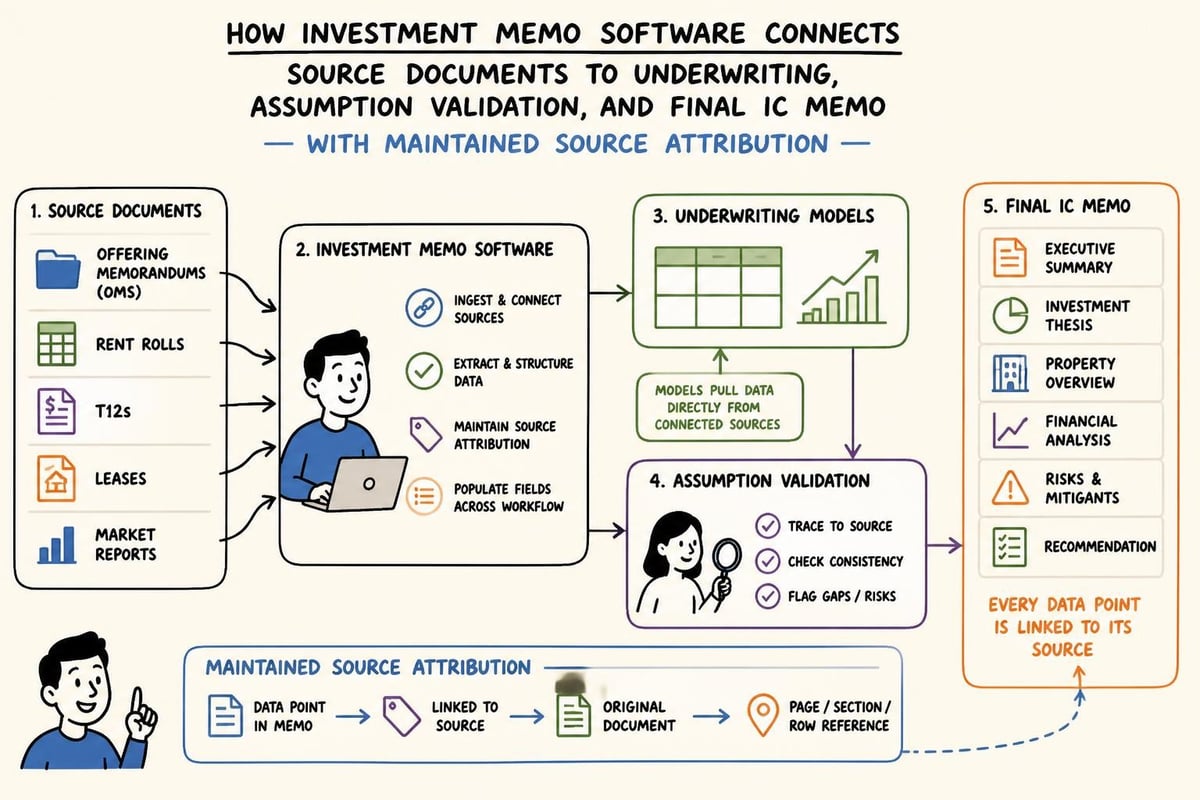
Manual extraction consumes hours of analyst time and introduces transcription errors. Advanced platforms like EQUIRE employ AI to read documents and extract structured data, populating underwriting models and memo sections automatically. The value isn't eliminating human review but redirecting attention from data entry to analysis.
Maintaining Source Links and Verifiability
Investment committees increasingly demand source documentation for key assumptions. When a memo states "12-month trailing occupancy averaged 91%," the supporting rent roll should be immediately accessible. When market rent assumptions cite specific comps, the underlying CoStar or Yardi Matrix reports should link directly.
This traceability serves multiple purposes:
Due diligence defense: External investors can verify claims during capital raising
Post-acquisition learning: Teams can assess assumption accuracy against actual performance
Institutional knowledge: Future deals benefit from documented decision rationale
Verifiable AI outputs in real estate represent a critical evolution beyond simple document generation. The platform should not only draft memo sections but also maintain audit trails showing exactly which source documents informed each statement.
Beyond Templates: Intelligence-Layer Requirements
Template-based systems offer consistency but limited intelligence. Investment memo software real estate organizations need in 2026 must provide active support throughout the memo development process.
Missing Input Detection and Assumption Flagging
A complete investment memo requires dozens of inputs across multiple categories. Even experienced teams occasionally overlook critical elements until late in the review process. Intelligent software should identify gaps proactively:
Missing market data: No absorption statistics for competitive properties
Incomplete financial analysis: Debt service coverage ratios not calculated for stress scenarios
Unsupported assumptions: Revenue growth exceeds market benchmarks without explanation
Document inconsistencies: Rent roll totals don't reconcile to trailing financials
Research on AI-assisted investment workflows demonstrates that systematic input validation significantly improves memo quality and reduces revision cycles. The goal isn't automating judgment but ensuring human decision-makers have complete information.
Internal Standards Compliance
Enterprise real estate firms maintain specific formatting requirements, assumption guidelines, and approval workflows. A memo created for one fund might require different sensitivity scenarios than a memo for another vehicle. Investment memo software real estate enterprises deploy must encode these institutional standards.
Compliance features include:
Template enforcement: Required sections, ordering, and content specifications
Assumption boundaries: Flagging when inputs fall outside policy parameters
Approval routing: Automatic distribution to appropriate stakeholders based on deal size and asset type
Historical benchmarking: Comparing current deal metrics to portfolio averages and outliers
The most sophisticated platforms, including solutions focused on CRE asset management, integrate memo creation with portfolio management systems, enabling real-time benchmarking against existing holdings.
Competitive Deal Execution Speed
Investment memo quality matters, but so does velocity. In competitive acquisition markets, the team that delivers credible IC memos fastest often wins allocations.
Parallel Workstream Management
Traditional memo creation follows a waterfall: acquire documents, extract data, build model, draft narrative, review, revise, finalize. This sequential approach consumes weeks.
Modern workflows enable parallelization:
Automated document processing begins immediately upon deal intake
Market research runs concurrently with financial modeling
Memo drafting starts from extracted data before full model completion
Stakeholder review occurs on progressive drafts rather than final versions
Platforms designed for governed acquisitions workflows structure these parallel streams while maintaining version control and audit trails. Speed without accuracy provides no value, but accuracy achieved slowly loses competitive opportunities.
Presentation Layer Efficiency
Investment committees consume information in multiple formats: detailed written memos, executive summaries, presentation decks, and sometimes interactive dashboards. Creating each format manually multiplies effort and introduces consistency risks.
Investment memo software real estate teams use should generate multiple output formats from a single data foundation:
Full IC memo: Complete narrative with supporting exhibits
Executive summary: Key metrics, recommendation, and critical risks
Presentation deck: Visual summary for committee meeting
Comparison sheets: Side-by-side analysis of multiple opportunities
This multi-format capability becomes critical when investment committees request last-minute changes or additional scenarios. Regenerating all materials manually creates bottlenecks and errors.
Integration with Broader Investment Workflows
Investment memos don't exist in isolation. They connect to upstream deal sourcing activities and downstream portfolio management responsibilities.
From Deal Intake to IC Decision
The memo represents one milestone in a broader acquisitions process:
Initial screening: Preliminary analysis to determine IC submission worthiness
Deep dive underwriting: Detailed financial modeling and due diligence
Memo preparation: Narrative creation and supporting documentation
IC presentation: Committee review and decision
Transaction execution: PSA negotiation and closing
Post-acquisition handoff: Transfer to asset management
Investment memo software real estate firms implement should support this entire workflow, not just the memo creation step. Comprehensive platforms for real estate investment analysis maintain deal data from initial screening through portfolio management, eliminating redundant data entry and preserving institutional knowledge.
Post-Acquisition Learning Loops
The most valuable investment memos inform future decisions by enabling systematic comparison of underwritten assumptions against actual performance. Did the asset achieve projected occupancy within the expected timeline? Did renovation costs align with estimates? Did market rent growth match underwriting assumptions?
This feedback loop requires connecting memo data to asset management systems. Teams using integrated platforms can analyze assumption accuracy across their entire acquisition history, identifying systematic biases and improving future underwriting. A firm that consistently underestimates lease-up timelines can adjust templates and review processes accordingly.
Properties undergoing significant improvements, such as those working with specialized contractors for milestone building recertification and restoration, benefit from documented assumption trails that inform similar future projects.
Enterprise Requirements: Security, Governance, and Scale
Investment memo software real estate enterprises select must meet institutional-grade requirements that extend beyond functionality.
Data Security and Access Control
Investment memos contain highly sensitive information: acquisition pricing, financing terms, proprietary market analysis, and competitive strategy. Platforms must provide:
Role-based access control: Limiting visibility by deal stage, fund, or organizational role
Audit logging: Tracking who accessed, modified, or shared specific documents
Encryption: Protecting data in transit and at rest
Compliance certifications: SOC 2, ISO 27001, or industry-specific standards
Enterprise teams increasingly require platforms that meet the same security standards as their portfolio management and accounting systems. Best practices in asset management software emphasize security integration rather than treating memo systems as standalone tools.
Multi-Fund and Multi-Geography Support
Large real estate platforms manage multiple funds with different investment mandates, return requirements, and geographic focuses. Investment memo software must accommodate this complexity:
Fund-specific customization:
Different hurdle rates and return calculations
Varying risk tolerance and sensitivity requirements
Distinct formatting and presentation standards
Geographic considerations:
Local market data integration for international assets
Currency handling and foreign exchange assumptions
Regional regulatory and tax considerations
The platform should maintain consistency in core functionality while allowing customization for specific contexts. A multifamily fund focused on U.S. Sunbelt markets requires different templates and data sources than an office fund operating across European capitals.
The Human Element: Judgment Over Automation
Investment memo software real estate teams deploy should amplify human expertise, not replace it. The investment decision ultimately requires judgment that no algorithm can fully automate.
Preserving Analyst Focus on High-Value Activities
The value proposition of intelligent memo software lies in redirecting human attention from mechanical tasks to genuine analysis:
Low-value activities (automate):
Copying data from rent rolls to financial models
Formatting documents and creating consistent presentation materials
Calculating standard metrics and ratios
Finding and extracting market data from common sources
High-value activities (enable):
Interpreting market dynamics and positioning assets competitively
Identifying risks and developing mitigation strategies
Crafting investment theses that articulate value creation
Challenging assumptions and stress-testing scenarios
AI tools optimized for real estate private equity succeed when they eliminate repetitive work without oversimplifying complex decisions. The investment committee needs analysts who understand why assumptions matter, not just software that generates impressive-looking documents.
Transparency and Explainability
When AI contributes to memo creation, investment committees deserve clarity about what the system generated versus what humans analyzed and decided. Effective platforms maintain this distinction:
AI-extracted data: Clearly marked with source attribution
Human assumptions: Documented with supporting rationale
Model outputs: Linked to specific inputs and calculations
Narrative analysis: Authored by team members with AI assistance flagged
This transparency builds confidence in the process and ensures accountability remains with decision-makers, not algorithms. Research on investment-focused language models emphasizes the importance of explainable outputs that investment professionals can validate and defend.
Emerging Capabilities and Future Directions
Investment memo software real estate firms will use in coming years continues evolving beyond current capabilities.
Dynamic Memos and Real-Time Updates
Traditional memos represent point-in-time snapshots. Market conditions change, new information emerges, and assumptions require updating. Future platforms will support dynamic memos that refresh automatically:
Market data updates: Rent growth, absorption, and supply metrics refresh from integrated sources
Comparable property monitoring: Notifications when comp set properties trade or report results
Financing market changes: Interest rate and debt availability tracking
Regulatory changes: Zoning, tax policy, or environmental regulation updates
This real-time capability becomes particularly valuable during extended due diligence periods when initial assumptions may become stale before closing.
Cross-Deal Pattern Recognition
Enterprise platforms processing dozens or hundreds of memos annually can identify patterns invisible at the individual deal level:
Assumption clustering: Which assumptions vary most across deals and why?
Risk realization rates: How often do identified risks actually impact performance?
Outperformance drivers: What characteristics correlate with deals exceeding projections?
Team performance: How do assumption accuracy and deal outcomes vary by analyst or market?
These insights inform continuous process improvement and better calibrate future underwriting. Portfolio strategy tools increasingly incorporate these cross-deal analytics to improve systematic decision-making.
Investment memo software real estate professionals rely on must deliver more than formatted templates. The path from raw deal documents to defensible IC recommendations requires intelligent systems that read source materials, extract structured data, support rigorous analysis, maintain verifiable links to evidence, and preserve human judgment for critical decisions. Leni addresses these requirements with an enterprise-grade platform purpose-built for accuracy, offering seamless document processing, industry data integration, and AI-powered workflows that keep your team focused on investment decisions rather than administrative tasks.

Johanna Gruber
Johanna has spent the last 8 years helping marketing teams connect with audiences through content. Specializing in B2B SaaS and real estate.

Curious About AI?
Join the largest AI community for real estate online. Get bite-sized, real-world use case videos, plus practical tips and proven strategies from top industry experts on adopting AI effectively.
MEET LENI
AI SuperAgent Purpose Built for Investors and Operators.
Experience how professionals and teams in your domain are getting the edge using AI.
