Leni vs Kognitos, Agora, and EliseAI: CRE AI Platforms

Leni vs Kognitos, Agora, and EliseAI: CRE AI Platforms
The commercial real estate technology landscape in 2026 presents a critical distinction that many investment teams overlook: not all AI platforms serve the same function within your operation. When evaluating leni vs kognitos agora eliseai, you're comparing tools built for fundamentally different layers of CRE work. This matters because choosing the wrong category of platform creates operational gaps, duplicated efforts, and missed opportunities for workflow optimization. Understanding where each solution fits within your technology stack determines whether you're addressing your actual bottlenecks or simply adding another disconnected tool.
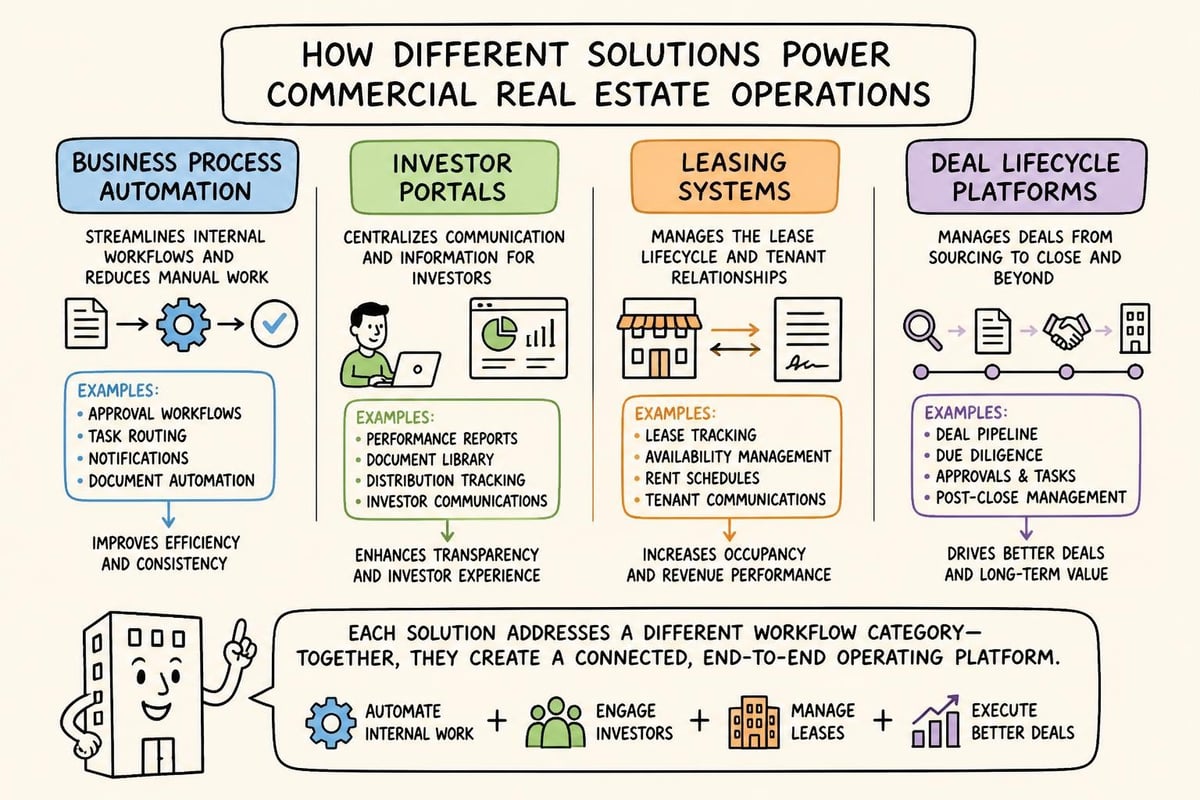
The Category Clarification: Four Different Operational Layers
Investment and asset management teams frequently encounter these platforms during vendor evaluations, but the comparison itself reflects a category confusion. Each platform addresses a distinct operational layer with minimal overlap.
Kognitos operates as a business process automation platform using plain English instructions. The system isn't CRE-native and focuses on repetitive back-office tasks across industries. According to TechCrunch's coverage of their $35M funding round, Kognitos emphasizes deterministic automation where processes follow predictable patterns. This makes it valuable for standardized workflows but less suited for the analytical complexity inherent in deal underwriting or market research.
Agora serves as an investor portal and fund reporting platform. Its primary function centers on LP communication, capital calls, distributions, and performance reporting. The platform streamlines investor relations but doesn't extend into deal execution, underwriting, or day-to-day asset management tasks that consume the majority of investment team hours.
EliseAI specializes in leasing automation for property management, particularly tenant communication and application processing. EliseAI's recent $75M funding underscores its focus on conversational AI for operational property management. The platform excels at tenant-facing workflows but operates outside the investment analysis and portfolio strategy domain.
Where Leni Fits: The AI Operating Layer
Leni represents a different architectural approach: a model-agnostic AI operating layer built specifically for the complete deal and asset management lifecycle. This means end-to-end investment workflows from initial underwriting through ongoing portfolio management, not isolated point solutions.
The platform handles:
Investment underwriting and financial modeling with multi-property portfolio analysis
Lease abstraction from raw documents to structured data tables
Investment committee memo preparation with market context and risk assessment
Live market research pulling current comparables and trend analysis
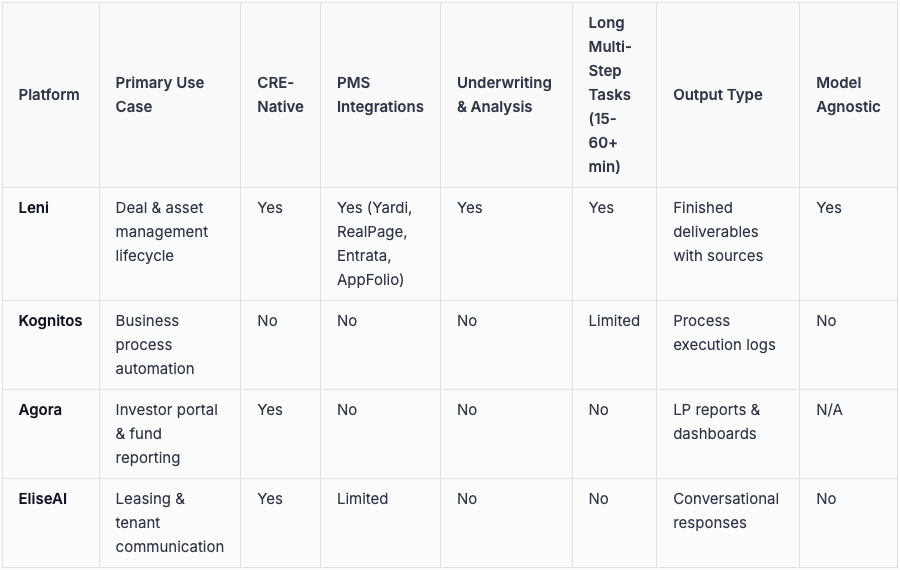
PMS-connected reporting through direct integrations with Yardi, RealPage, Entrata, and AppFolio
This positions Leni as the operational backbone for teams executing complex, multi-step analytical work rather than automating repetitive tasks or managing specific communication channels.
Platform Comparison: Capabilities and Architecture
When examining leni vs kognitos agora eliseai across functional dimensions, the differentiation becomes immediately apparent. The table below outlines where each platform delivers value and where it doesn't apply.
Understanding Model Agnosticism
The model-agnostic architecture deserves particular attention. Leni doesn't lock teams into a single AI model provider, instead routing tasks to the most appropriate model based on the specific analytical requirement. This approach future-proofs your technology investment as model capabilities evolve and prevents vendor lock-in.
Traditional platforms tie you to one underlying AI provider. When that provider's model underperforms on certain task types or when superior alternatives emerge, you're constrained by your platform choice. Leni's architecture treats models as interchangeable components, optimizing for output quality rather than platform allegiance.
Task Complexity and Time Horizons
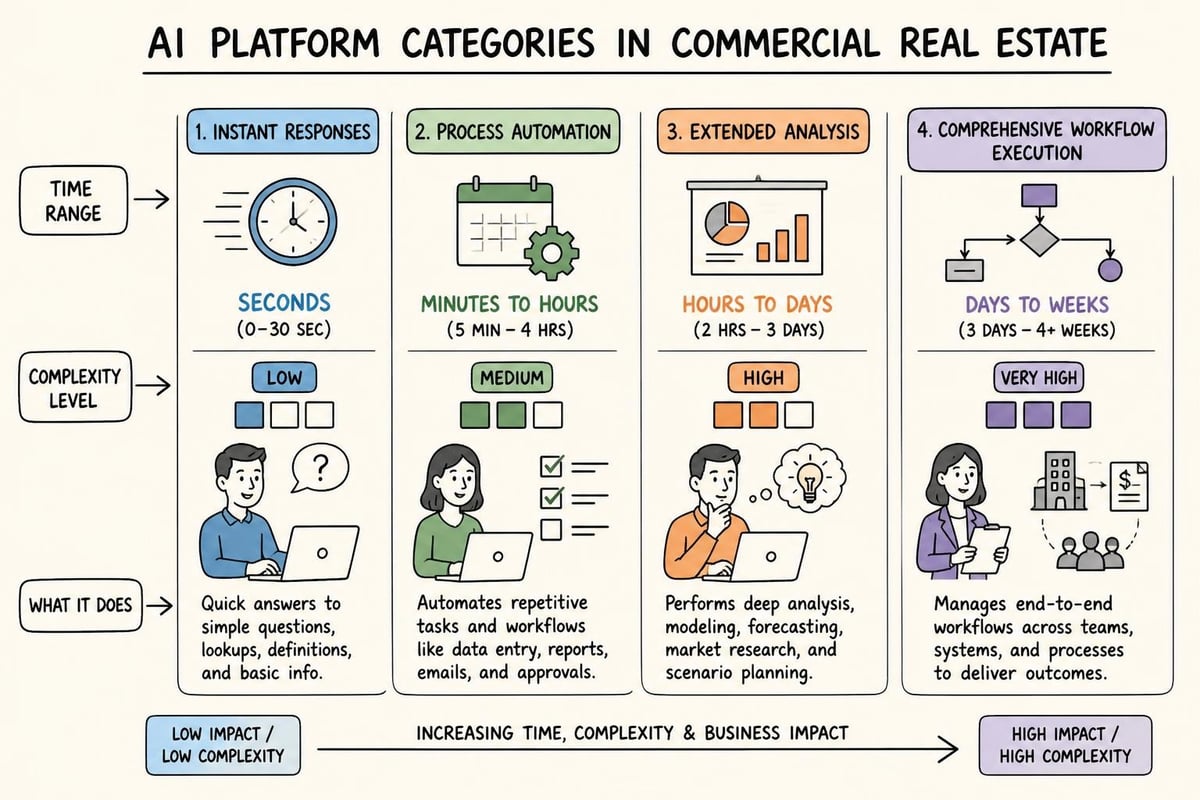
The operational distinction between these platforms becomes clearest when examining task duration and complexity. Most AI tools in 2026 optimize for quick responses: answering questions, generating short summaries, or executing predefined workflows in seconds or minutes.
Investment work operates differently. Underwriting a multifamily acquisition requires:
Financial statement analysis across multiple reporting periods
Market rent comparables from current listings and recent transactions
Operating expense benchmarking against peer properties
Capital expenditure projections based on property condition assessments
Exit scenario modeling with market cycle considerations
Risk factor identification and mitigation strategy development
This represents a 30-60 minute analytical process, not a 30-second query response. According to analysis of Leni's platform capabilities, the system handles these extended, multi-component tasks as single workflows, returning complete deliverables rather than fragmented outputs requiring manual assembly.
The 15-60+ Minute Workflow Threshold
Kognitos excels at automating repetitive tasks that follow consistent patterns, making it valuable for invoice processing, data entry, or report generation from standardized templates. These tasks typically complete in minutes once configured.
EliseAI processes tenant inquiries and application workflows in real-time conversations, optimizing for immediate response rather than deep analysis.
Agora generates investor reports on-demand but relies on data already processed and structured within the platform, not raw analytical work.
Leni's architecture specifically targets the gap between quick responses and multi-hour manual work. Tasks that would consume 2-4 hours of analyst time compress into 15-60 minute automated workflows with verifiable outputs.
Integration Architecture and Data Flow
The comparison of leni vs kognitos agora eliseai reveals fundamental differences in how these platforms connect to existing systems and data sources. Integration architecture determines whether a platform operates as an isolated tool or an embedded layer within your existing technology stack.
Property Management System Connectivity
Leni maintains direct integrations with the major property management systems used across institutional CRE: Yardi Voyager, RealPage, Entrata, and AppFolio. This connectivity enables:
Real-time portfolio performance analysis without manual data exports
Automated variance reporting comparing budgeted vs. actual performance
Lease expiration tracking with renewal analysis and market rent comparisons
Operating expense benchmarking across portfolio properties
These integrations matter because investment teams don't work in isolation from operational data. Asset management workflows require constant reference to actual property performance, not static snapshots.
Kognitos can connect to various enterprise systems through its automation framework, but it lacks pre-built CRE-specific integrations. Teams must configure connections for each use case, and the platform doesn't understand CRE data structures natively.
Agora integrates with fund accounting systems but not property-level PMS platforms, reflecting its focus on LP reporting rather than asset management.
EliseAI connects to property management systems for leasing workflows but doesn't extend into financial analysis or investment decision support.
Industry Data Sources
Beyond internal systems, investment analysis requires external market data. Leni incorporates real-time access to:
CoStar market statistics and comparable properties
Real Capital Analytics transaction data
Local market economic indicators
Demographic and employment trends
This external data integration enables the platform to conduct market research as part of analytical workflows rather than requiring analysts to manually gather context. The system cites sources in its outputs, maintaining the verifiability standards necessary for investment decisions.
Output Quality and Verifiability Standards
When comparing platforms across the leni vs kognitos agora eliseai spectrum, output format and verifiability represent critical differentiators. Investment teams operate under fiduciary responsibilities that demand traceable, auditable analysis.
Leni produces finished deliverables with embedded source citations. An investment memo generated through the platform includes hyperlinks to every data point, comparable property, market statistic, and analytical assumption. This enables reviewers to validate conclusions without recreating the entire analysis.
The platform's focus on verifiable AI outputs addresses a fundamental challenge in applying AI to investment work: how do you trust recommendations when you can't trace the reasoning? Detailed platform reviews emphasize this accuracy-first approach, noting that Leni prioritizes correctness over speed.
Comparative Output Structures
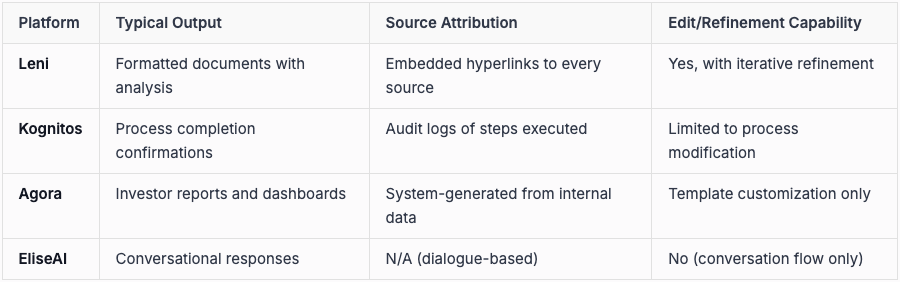
This comparison highlights that only Leni produces the type of analytical deliverables that investment committees review and approve. The other platforms serve their respective functions but don't generate investment analysis documents.
Use Case Mapping: Which Platform for Which Team
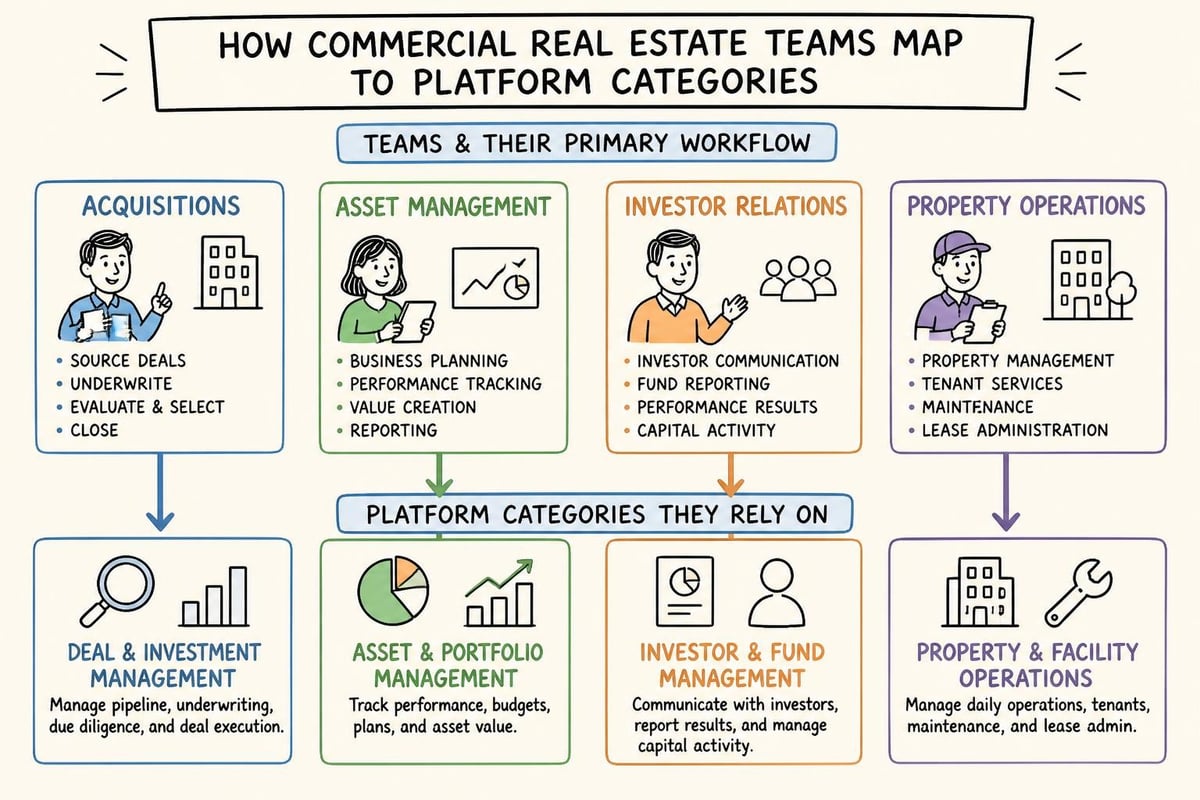
The functional separation between these platforms means most CRE organizations will eventually use multiple tools from different categories rather than selecting one over the others. The question becomes: which operational needs does each platform address?
Teams That Benefit from Kognitos
Organizations with high-volume, standardized back-office processes find value in Kognitos' automation capabilities:
Processing vendor invoices across multiple properties
Generating monthly standardized reports from database queries
Coordinating approval workflows with consistent business rules
Migrating data between systems following defined mappings
These represent important operational efficiencies but don't directly impact deal execution or investment strategy.
Teams That Benefit from Agora
Investment managers with external capital partners require robust investor relations infrastructure:
Private equity funds managing LP communications
Syndicators coordinating with multiple investor groups
Fund administrators handling capital calls and distributions
CFOs producing quarterly performance reports for investors
Agora addresses the investor-facing dimension but doesn't help analysts complete the underlying investment work.
Teams That Benefit from EliseAI
Property management teams focused on operational efficiency and tenant experience find EliseAI's leasing automation valuable:
Multifamily operators managing high application volumes
Student housing providers with seasonal leasing cycles
Retail property managers coordinating tenant mix
Office building operators handling tenant services
This operational automation improves the tenant experience but operates separately from investment decision-making.
Teams That Benefit from Leni
Investment and asset management teams executing complex analytical workflows across the deal lifecycle represent Leni's core use case:
Acquisitions teams underwriting multiple opportunities simultaneously
Asset managers monitoring portfolio performance and identifying value-add opportunities
Development teams analyzing multifamily value-add potential
Portfolio strategists conducting market research and allocation decisions
Investment committee members reviewing detailed analytical memos
These teams require comprehensive analytical capabilities, not isolated automation of specific tasks. Tools for real estate investors must handle the full complexity of investment analysis, not just component pieces.
The Model-Agnostic Advantage in 2026
As AI capabilities evolve rapidly throughout 2026, the architectural choice between model-locked and model-agnostic platforms carries increasing strategic importance. When evaluating leni vs kognitos agora eliseai, this dimension deserves careful consideration.
Most AI platforms in the market select a single underlying model provider (OpenAI, Anthropic, Google, etc.) and build their entire product around that choice. This creates three specific risks:
Performance ceiling limitations - If the chosen model underperforms on specific task types (complex mathematical reasoning, lengthy document analysis, multi-step logic), the platform inherits those weaknesses
Cost structure lock-in - As model pricing evolves, platforms can't optimize for cost efficiency without architectural rebuilding
Innovation lag - When new model capabilities emerge, model-locked platforms require significant redevelopment to incorporate advances
Leni's Routing Architecture
Leni treats AI models as interchangeable computational resources rather than foundational architecture. The platform routes each task component to the optimal model for that specific requirement:
Financial calculations route to models optimized for mathematical precision
Document analysis routes to models with superior long-context handling
Market research routes to models with better web integration capabilities
Summary generation routes to the most cost-effective option meeting quality standards
This routing occurs automatically based on task characteristics, not user configuration. Investment teams receive optimal outputs without managing model selection.
The practical impact: as model capabilities improve throughout 2026 and beyond, Leni's outputs automatically benefit without platform migration or workflow disruption. Teams using model-locked platforms must either accept performance limitations or undergo costly platform changes.
Addressing Common Misconceptions
Several misconceptions emerge when organizations compare these platforms without understanding their categorical differences. Clarifying these misunderstandings prevents poor technology decisions.
Misconception 1: "These are all AI platforms, so they're basically interchangeable."
Reality: The term "AI platform" encompasses wildly different functional categories. Comparing leni vs kognitos agora eliseai is like comparing accounting software vs. CRM vs. project management tools because they all run on computers. The AI component doesn't make them substitutable.
Misconception 2: "We should select the platform with the most features."
Reality: Feature count within the wrong category provides zero value. A platform with 50 leasing automation features doesn't help an acquisitions team underwrite deals. Focus on capability alignment with your actual workflow bottlenecks.
Misconception 3: "We can build these capabilities ourselves with ChatGPT or Claude."
Reality: Consumer AI tools lack enterprise security, audit trails, system integrations, and workflow management necessary for institutional investment work. The gap between experimentation and production deployment is substantial. Purpose-built platforms provide the governance, compliance, and reliability frameworks that general-purpose tools don't address.
Misconception 4: "Process automation platforms can handle investment analysis."
Reality: Investment analysis requires judgment, synthesis of disparate information sources, and handling of ambiguous or incomplete data. Process automation excels at deterministic workflows with clear rules, not analytical work requiring contextual understanding.
Security and Enterprise Readiness
Investment teams handle confidential financial information, proprietary strategies, and material non-public information. Platform security architecture becomes a critical evaluation factor when assessing leni vs kognitos agora eliseai.
Leni operates with SOC 2 Type II compliance, single sign-on integration, role-based access controls, and data encryption in transit and at rest. The platform maintains audit logs of all user interactions and AI-generated outputs, enabling compliance teams to track information access and usage. Data isolation ensures that one client's information never trains models or appears in another client's outputs.
Kognitos provides enterprise security features appropriate for back-office automation, including access controls and process audit trails. However, the platform's cross-industry focus means it lacks CRE-specific data classification and handling capabilities.
Agora specializes in secure investor communications with appropriate controls for financial reporting and capital transactions. The platform meets regulatory requirements for fund administration but operates in a different security context than deal execution platforms.
EliseAI maintains security appropriate for tenant communications and application processing. This differs from the investment-grade security required for confidential deal information and proprietary analytical models.
The security context matters because different operational layers carry different information sensitivity profiles. Tenant communications require basic PII protection. Investment analysis requires protection of competitive advantages and confidential financial information.
Integration Strategy: Building Your CRE Technology Stack
Rather than selecting one platform over others in the leni vs kognitos agora eliseai comparison, sophisticated organizations architect technology stacks that deploy each category of tool where it delivers value.
A comprehensive CRE technology stack in 2026 typically includes:
Property management system (Yardi, RealPage, etc.) as the operational system of record
AI operating layer (Leni) for deal and asset management workflows
Investor portal (Agora or similar) for LP communications and fund reporting
Process automation (Kognitos or similar) for standardized back-office workflows
Leasing automation (EliseAI or similar) for property-level tenant interactions
These layers complement rather than compete. The AI operating layer pulls data from PMS and generates analysis that feeds into investor reporting. Process automation handles repetitive tasks outside core investment work. Leasing automation optimizes property operations that impact the assumptions underlying investment analysis.
Avoiding Redundancy and Gaps
The risk in platform selection lies in creating either redundant capabilities or operational gaps. Redundancy occurs when multiple platforms attempt to solve the same problem, forcing teams to choose which tool to use for each task and preventing workflow standardization. Gaps occur when no platform addresses a critical operational need, leaving manual processes as the only option.
Strategic technology planning maps operational workflows first, then identifies which platform category addresses each workflow component. This prevents the common pattern of acquiring platforms based on individual features without considering the overall architecture.
The Investment Analysis Workflow: A Detailed Example
Examining a complete investment workflow illustrates why leni vs kognitos agora eliseai represents a category distinction rather than a competitive comparison. Consider a typical multifamily acquisition analysis for a 200-unit property in a growing secondary market.
Workflow Components
Initial screening requires pulling market rent trends, population growth, employment statistics, and recent comparable transactions. This 15-20 minute research task establishes whether the opportunity warrants detailed analysis. Leni handles this by executing market research workflows that compile data from multiple sources into a structured screening memo.
Detailed underwriting involves rent roll analysis, operating expense benchmarking, capital expenditure planning, financing structure optimization, and exit scenario modeling. This 45-60 minute analytical process produces a complete underwriting model with supporting documentation. Leni executes the full workflow, returning a formatted model with sources cited for every assumption.
Investment committee memo preparation synthesizes the underwriting into a decision document covering market context, property specifics, financial projections, risk factors, and strategic fit. This 30-45 minute task requires judgment about what information matters most for decision-makers. Leni generates the structured memo based on the analytical work already completed.
Investor reporting (post-acquisition) communicates performance to LPs through quarterly reports showing actual vs. projected performance. This represents Agora's domain, pulling data from PMS and fund accounting systems.
Operational process automation handles ongoing tasks like invoice processing, maintenance request coordination, and compliance documentation. This represents Kognitos' domain, executing defined workflows.
Leasing operations manage tenant inquiries, application processing, and move-in coordination. This represents EliseAI's domain, optimizing the tenant experience.
Notice how these workflow components operate in sequence or parallel but don't overlap functionally. The platforms serve complementary roles within the complete operational lifecycle.
Making the Platform Decision for Your Organization
Organizations evaluating these platforms should structure their decision process around workflow mapping rather than feature comparison. The process involves four specific steps:
Document current workflow bottlenecks - Identify where teams spend excessive time on tasks that could be automated or accelerated
Categorize workflow types - Separate analytical work from process automation, investor communications, and operational tasks
Match categories to platform types - Determine which platform category addresses each workflow category
Evaluate specific vendors within relevant categories - Only after categorization, compare specific platforms within the applicable category
This structured approach prevents the category confusion that leads to poor technology investments. You wouldn't evaluate Salesforce vs. QuickBooks vs. Asana as competing platforms because they serve different operational needs. Apply the same categorical thinking to leni vs kognitos agora eliseai.
Decision Criteria by Platform Category
For AI operating layers (Leni's category), evaluate:
Range of investment workflows supported end-to-end
Quality and verifiability of analytical outputs
Integration depth with existing systems (PMS, market data)
Model agnosticism and architectural flexibility
Security and compliance framework
Team adoption and training requirements
For process automation (Kognitos' category), evaluate:
Process customization flexibility
Integration with existing enterprise systems
Audit trail and compliance capabilities
Implementation complexity
Ongoing maintenance requirements
For investor portals (Agora's category), evaluate:
Reporting customization options
Capital transaction workflow support
LP self-service capabilities
Integration with fund accounting systems
For leasing automation (EliseAI's category), evaluate:
Conversational quality and tenant satisfaction
Application processing workflow integration
PMS connectivity
Lead conversion metrics
Each evaluation framework differs because the operational requirements differ fundamentally across categories.
Selecting the right technology platforms for commercial real estate investment operations requires understanding that leni vs kognitos agora eliseai isn't a competitive comparison but a category clarification exercise. Each platform serves distinct operational layers with minimal functional overlap. Investment and asset management teams executing complex analytical workflows across the deal lifecycle need a purpose-built AI operating layer that handles end-to-end workflows from underwriting through portfolio management. Leni delivers this comprehensive analytical capability with model-agnostic architecture, PMS integrations, and verifiable outputs specifically designed for enterprise-grade investment work. If your team spends hours on tasks that should take minutes, explore how Leni transforms investment workflows while maintaining the accuracy and traceability institutional work demands.

Johanna Gruber
Johanna has spent the last 8 years helping marketing teams connect with audiences through content. Specializing in B2B SaaS and real estate.

Curious About AI?
Join the largest AI community for real estate online. Get bite-sized, real-world use case videos, plus practical tips and proven strategies from top industry experts on adopting AI effectively.
MEET LENI
AI SuperAgent Purpose Built for Investors and Operators.
Experience how professionals and teams in your domain are getting the edge using AI.
