PMS Integration AI: Enterprise Guide for Asset Managers

PMS Integration AI: Enterprise Guide for Asset Managers
You have data locked in your property management system. Thousands of leases, rent rolls, maintenance records, and financial statements living in Yardi or RealPage. Yet every month, your team still spends days manually pulling reports, building models in Excel, and piecing together narratives for investors. The gap between having data and being able to act on it has never been wider. This is precisely where pms integration ai delivers transformative value for commercial real estate portfolios.
Asset managers and portfolio operators face a fundamental challenge: property management systems were built to store and organize data, not to extract strategic insights from it. The promise of pms integration ai isn't about replacing your existing infrastructure. It's about adding an intelligent layer that converts raw PMS data into verifiable analysis, automated workflows, and scalable operations without disrupting the systems your teams already rely on.
Understanding the Operational Trust Problem in Portfolio Management
Traditional AI solutions fail asset managers because they operate in isolation from source data. When you ask a general-purpose AI tool to analyze portfolio performance, it requires manual data exports, loses connection to original documents, and produces outputs you cannot verify. This creates an operational trust problem that makes AI unusable for serious portfolio decisions.
The core issue is traceability. Investment committees demand to see the underlying data behind every assumption. Lenders want source documents for every claim in your refinancing package. Auditors need clear chains of custody for financial figures. When AI for real estate investment lacks direct integration with your property management system, it cannot provide the verification trails that enterprise operations require.
The Three Pillars of Enterprise-Grade PMS Integration AI
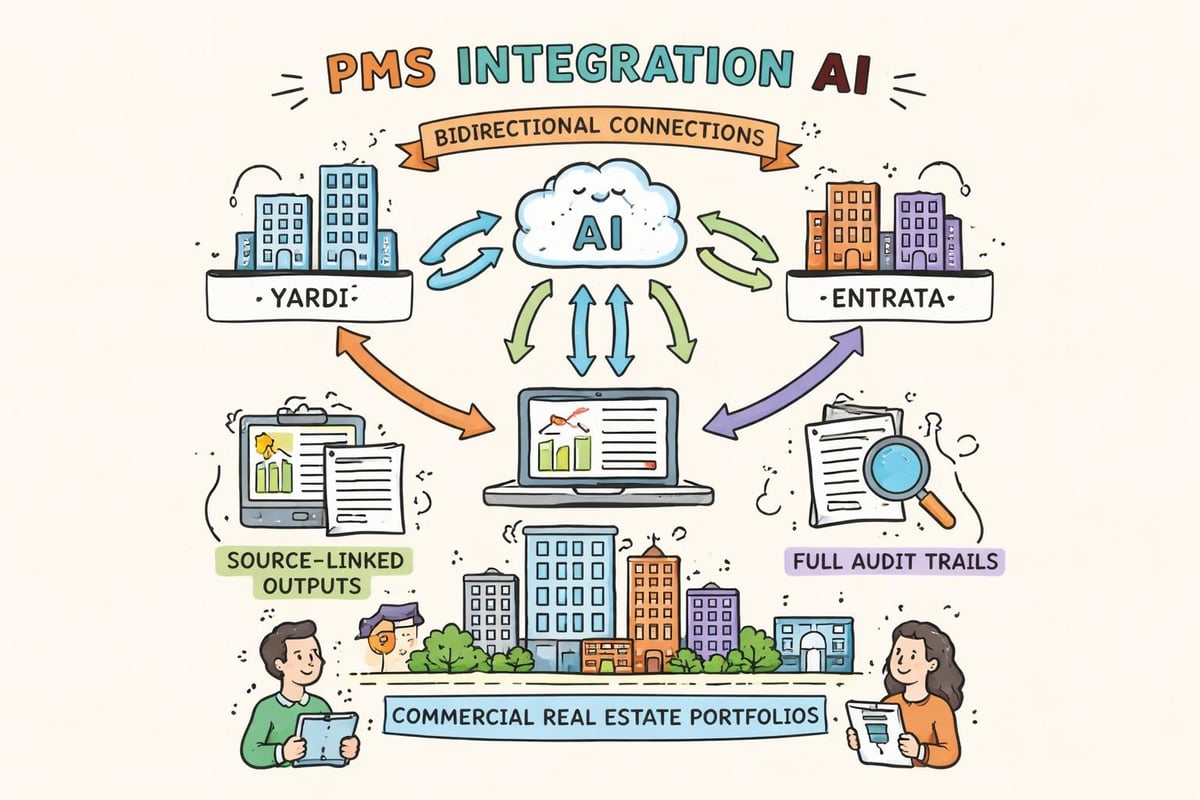
Effective pms integration ai stands on three non-negotiable foundations that separate enterprise platforms from consumer tools:
Verifiable Source-Linked Outputs
Every analysis, financial model, and strategic recommendation must connect directly back to its origin in your PMS. When Leni generates an underwriting model from Yardi data, it doesn't just pull numbers. It maintains active links to specific lease documents, rent rolls, and operating statements. Click any assumption in the model, and you see the exact source record it came from.
This verification capability transforms how acquisition teams work. Instead of spending hours tracking down supporting documents for investment committee questions, source links provide instant validation. The analysis becomes defensible because every data point traces to a system-of-record document.
Enterprise-Grade Data Security and Compliance
Commercial real estate portfolios contain extraordinarily sensitive information: tenant financials, lease terms, acquisition strategies, and proprietary underwriting methodologies. Real-time synchronization between AI agents and PMS through API integration creates new security considerations that require rigorous controls.
SOC 2 Type 2 certification represents the baseline standard for handling enterprise CRE data. This certification validates that an AI platform maintains comprehensive security controls across data encryption, access management, change monitoring, and incident response. When evaluating pms integration ai solutions, verify they hold current SOC 2 Type 2 certification, not just SOC 2 Type 1 or vague security claims.
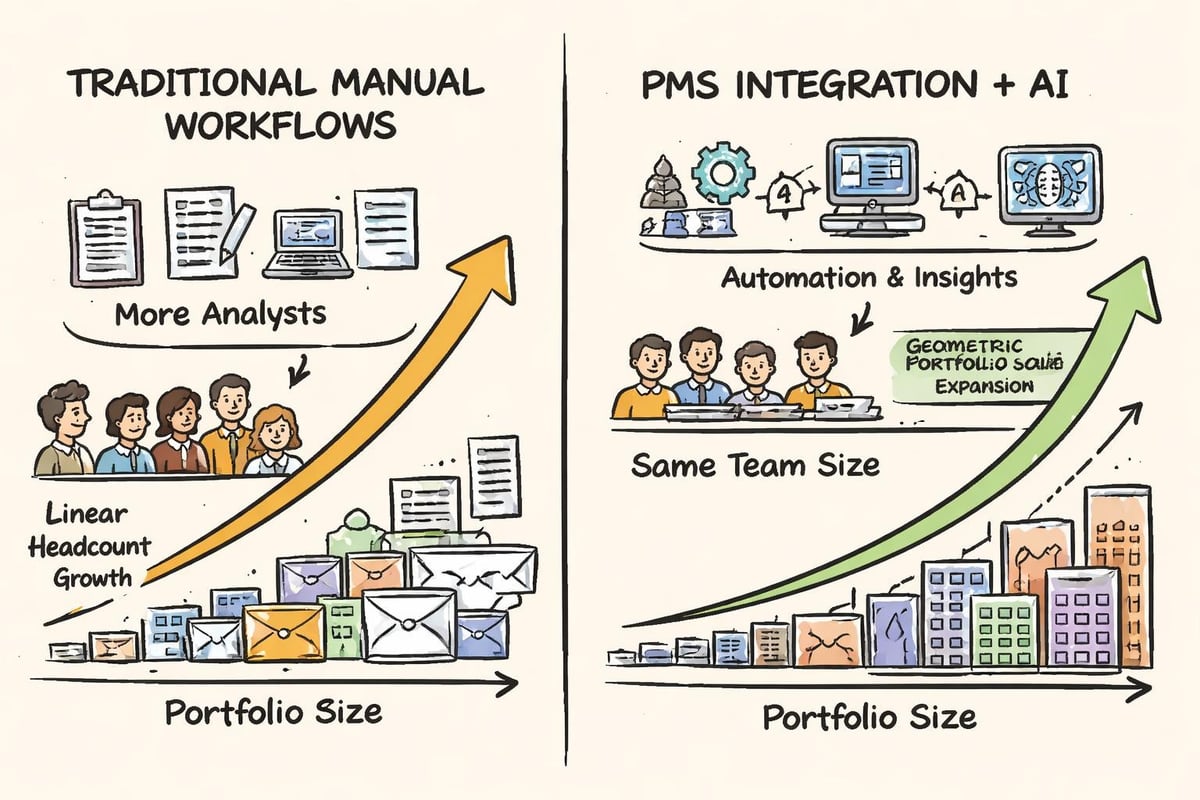
Scalable Operations Without Headcount Expansion
The economic value proposition of pms integration ai centers on portfolio scalability. As your assets under management grow, traditional approaches require proportional increases in analyst headcount. A platform like Leni breaks this linear relationship by autonomously executing the analytical work that previously required manual effort.
Consider a portfolio operator managing 15,000 multifamily units across three markets. Monthly reporting alone consumes 40+ analyst hours: pulling data from multiple PMS instances, standardizing formats, calculating variance analyses, and preparing investor decks. With proper pms integration ai, these workflows run autonomously on schedule, freeing the team to focus on strategic decisions rather than data compilation.
How Native PMS Connectivity Changes Portfolio Workflows
The difference between API-based integration and file uploads fundamentally changes what AI can accomplish for your portfolio. File uploads create point-in-time snapshots that become stale immediately. API connectivity establishes living, bidirectional relationships between your PMS and AI platform.
Real-Time Portfolio Intelligence
Native connectivity to systems like Yardi, RealPage, Entrata, AppFolio, ResMan, RentManager, and MRI Software enables continuous portfolio monitoring that wasn't previously practical. Your AI platform sees new leases the moment they're executed, captures vacancy changes as they happen, and detects maintenance patterns as they emerge.
This real-time awareness transforms reporting and asset management from backward-looking to forward-looking. Instead of analyzing last month's performance, you identify trending issues while there's still time to intervene. Occupancy softening in one submarket? Your AI flags it before it impacts quarterly results.
Traditional ReportingPMS Integration AIMonthly manual data pullsContinuous live sync5-10 day reporting lagReal-time updatesPoint-in-time accuracyAlways-current dataLimited drill-down capabilitySource-linked verificationRequires analyst interpretationAutomated insight generation
Automated Multi-Step Analytical Workflows
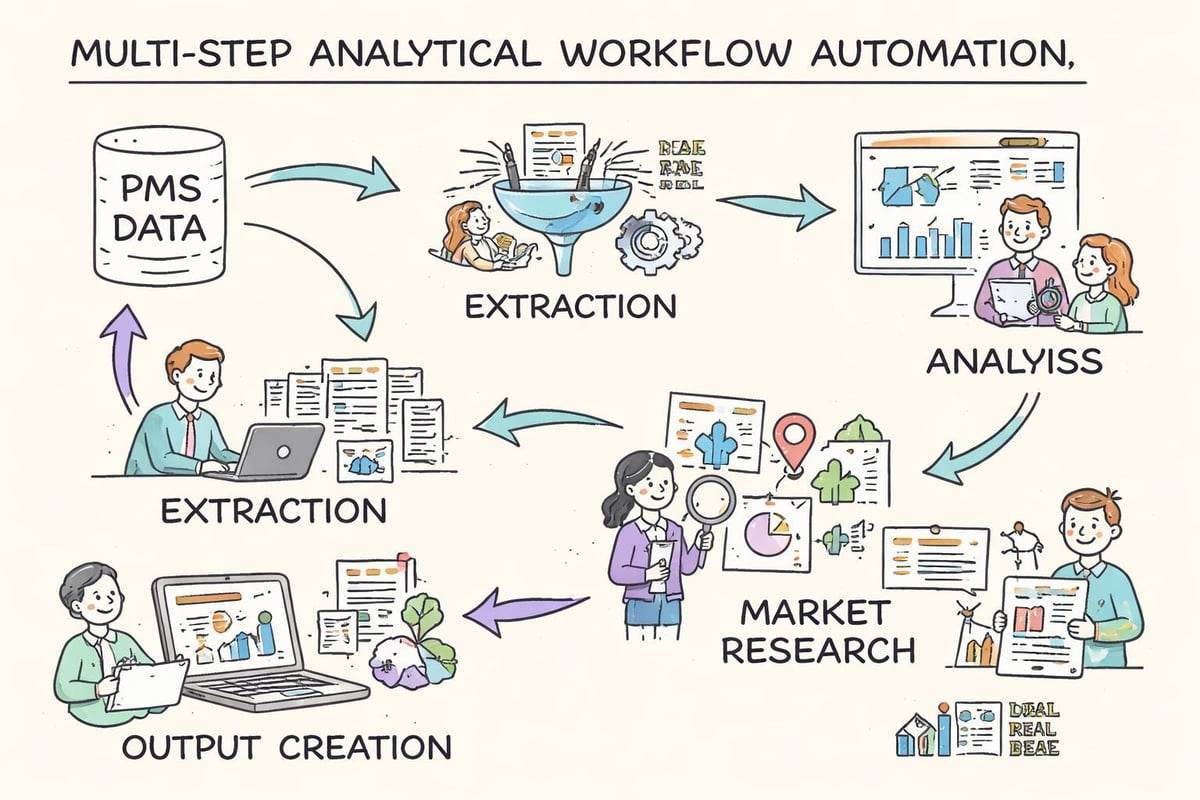
The true power of pms integration ai appears when you chain together multiple analytical steps that previously required different team members and tools. Take the monthly investor reporting workflow:
Data extraction: Pull current rent rolls, operating statements, and lease abstracts from all properties
Financial consolidation: Standardize formats across different PMS instances and property types
Variance analysis: Calculate performance against budget and prior periods
Market contextualization: Compare portfolio metrics to submarket trends using live research
Narrative generation: Draft performance commentary explaining drivers of variance
Deck creation: Assemble formatted investor presentation with supporting exhibits
Source documentation: Link every claim to verifiable PMS records
Platforms designed for document extraction and financial modeling and underwriting can execute this entire sequence autonomously. What once consumed three analysts for a week now runs overnight without intervention.
Cross-Portfolio Pattern Recognition
When AI has native access to your entire portfolio through PMS integration, it identifies patterns that single-property analysis misses. Maintenance cost trends across climate zones. Lease renewal behavior by unit type and market. Operating expense variations between management companies.
This portfolio-level intelligence directly improves key asset management metrics by revealing where small operational improvements compound across dozens of properties. An asset manager with 50 properties who discovers they're spending 12% more on HVAC maintenance in properties managed by one vendor has immediately actionable intelligence worth tens of thousands annually.
The Security Architecture Behind Enterprise PMS Integration
Data security concerns represent the primary barrier preventing asset managers from adopting pms integration ai. These concerns are legitimate. Your PMS contains the crown jewels of your business: tenant lists, lease economics, acquisition pipelines, and strategic plans. Understanding the security architecture requirements helps evaluate whether a platform is truly enterprise-ready.
Encryption Standards and Access Controls
End-to-end encryption represents table stakes for any platform connecting to your property management system. Data must be encrypted in transit using TLS 1.2 or higher and encrypted at rest using AES-256 or equivalent standards. But encryption alone is insufficient.
Granular access controls determine who within your organization can see specific properties, portfolios, or data types. The AI platform should support role-based permissions that mirror your internal organizational structure. Acquisitions teams see target properties but not the full portfolio. Regional managers access their markets but not others. Executive leadership has comprehensive visibility.
Audit Trails and Compliance Documentation
Every interaction with PMS data requires comprehensive logging for compliance purposes. Who accessed which property data? What analyses were run? When were outputs generated and shared? Enterprise pms integration ai platforms maintain immutable audit trails answering these questions.
SOC 2 Type 2 certification validates these controls through independent third-party assessment. The certification process examines security policies, tests control effectiveness over a minimum six-month period, and produces a detailed report you can share with auditors, investors, and compliance officers.
Platforms like Leni achieve SOC 2 Type 2 certification specifically because they're purpose-built for commercial real estate's regulatory environment. The AI analyst platform was designed from the ground up to meet institutional security requirements, not retrofitted after launch.
Data Residency and Vendor Risk Management
Where does your PMS data physically reside once the AI platform accesses it? Enterprise agreements should specify exact data center locations, backup procedures, and disaster recovery protocols. For organizations with data residency requirements, verify the platform can guarantee data never leaves approved jurisdictions.
Vendor risk assessment also examines the AI platform's own security posture. What happens if the vendor experiences a breach? How quickly would they notify you? What indemnification protections exist in your contract? These questions become especially important as AI integration with various practice management systems becomes more common across industries.
Scaling Portfolio Operations With Intelligent Automation
The economic case for pms integration ai ultimately rests on your ability to manage more assets without proportionally increasing overhead. This scalability derives from AI's ability to autonomously execute repeatable analytical workflows that consume significant team capacity.
Identifying High-Value Automation Opportunities
Not every workflow benefits equally from AI automation. The highest-value opportunities share three characteristics: they're performed repeatedly, they require consistent methodology, and they currently consume significant analyst time.
Monthly reporting cycles perfectly fit this profile. The same analysis runs every month with updated data: performance variance calculations, market comparisons, trend identification, and narrative summarization. These workflows follow established methodologies but require hours of manual work to execute.
Acquisition underwriting standardization represents another high-impact opportunity. Every potential acquisition requires financial modeling, market research, comparable property analysis, and investment memo creation. The analytical framework remains consistent even as properties differ. pms integration ai can execute the entire analytical sequence while maintaining deal team oversight of assumptions and strategy.
Portfolio optimization analysis becomes practical at scale with automation. Comparing actual performance across all properties against underwriting projections, identifying systematic variance sources, and recommending operational adjustments requires synthesizing massive datasets. AI handles the analytical heavy lifting while portfolio managers focus on implementation decisions.
Building Autonomous Analytical Workflows
Effective workflow automation requires more than simply connecting systems. It demands platforms capable of executing multi-step processes that involve decision logic, external data enrichment, and quality validation.
Consider the workflow for creating investment memos and presentations for a potential acquisition:
Extract property financial data from broker marketing materials using document AI
Pull comparable property performance from your portfolio via PMS integration
Conduct market research on submarket trends, demographics, and competitive supply
Build acquisition financial model with multiple return scenarios
Draft investment memo narrative synthesizing all analytical inputs
Create presentation deck formatted to IC specifications
Link every assumption to source documents for verification
Platforms designed for development and strategy execute this entire sequence autonomously. The acquisition team reviews and refines the output rather than building it from scratch, compressing timeline from days to hours.
Measuring ROI on Analytical Automation
Quantifying the return on pms integration ai investment requires tracking both direct time savings and strategic value creation. Direct time savings are straightforward: analyst hours previously spent on data compilation, report generation, and model building now available for higher-value work.
Strategic value emerges from capabilities that weren't previously practical. Can you now analyze acquisition opportunities 3x faster, allowing you to evaluate more deals and win better terms? Can portfolio managers spot operational issues weeks earlier, preventing revenue loss? Can you serve investor reporting requests in hours instead of days, strengthening LP relationships?
Metric CategoryBefore AI IntegrationAfter AI IntegrationImpactMonthly reporting40 analyst hours5 review hours88% reductionAcquisition underwriting16 hours per deal3 hours per deal81% reductionAd hoc investor requests8-12 hour turnaround1-2 hour turnaround85% fasterPortfolio analysis frequencyQuarterlyContinuousReal-time intelligence
Framework for Evaluating PMS Integration Readiness
Not every organization is equally positioned to benefit from pms integration ai today. Your current PMS implementation, data quality, and team workflows determine whether AI integration delivers immediate value or requires preparatory work.
Assessing Your Current PMS Data Quality
AI platforms can only be as accurate as the data feeding them. Before pursuing pms integration ai, audit your PMS data quality across several dimensions:
Completeness: Are all properties fully loaded with current leases, operating expenses, and tenant information? Gaps in historical data limit AI's ability to identify trends and build accurate projections.
Consistency: Do you use standardized chart of accounts, lease classification, and property categorization across your portfolio? Inconsistent data structures require normalization before AI can compare across properties.
Currency: How frequently is your PMS updated? Properties with quarterly data loads rather than daily updates provide less value for real-time AI integration.
Accuracy: What validation processes ensure PMS data matches source documents? AI platforms amplify whatever data quality exists in your source systems.
Organizations with mature PMS implementations and rigorous data governance extract immediate value from AI integration. Those with data quality challenges should address foundational issues before pursuing advanced AI capabilities.
Determining Which Workflows to Automate First
The most successful pms integration ai implementations start with focused use cases rather than attempting wholesale workflow transformation. Identify 2-3 high-impact, well-defined processes to automate initially:
Start with standardized reporting: Monthly investor reports, quarterly board packages, and annual budget processes follow established formats and timelines. These workflows deliver quick wins that build organizational confidence in AI outputs.
Expand to analytical deep dives: Once reporting automation proves reliable, tackle more complex analytical projects like portfolio optimization studies, acquisition pipeline analysis, or submarket research synthesis.
Graduate to strategic planning: With foundational trust established, deploy AI for forward-looking work like predictive analytics for market forecasting and scenario modeling.
This phased approach allows teams to develop expertise with AI outputs while proving ROI incrementally. Similar strategies have proven effective as AI automation agencies integrate custom solutions across various industries.
Evaluating Platform Technical Requirements
Different pms integration ai platforms vary significantly in technical architecture and implementation requirements. Evaluate candidates across these dimensions:
PMS compatibility: Does the platform offer native connectors to your specific PMS instances (Yardi, RealPage, Entrata, AppFolio, ResMan, RentManager, MRI Software)? Verify the connection is bidirectional API integration, not just file import.
Implementation complexity: What level of IT resources does initial setup require? Does the vendor handle implementation, or does it require significant internal technical work?
Ongoing maintenance: How often does the integration require updates as PMS versions change? What happens when you add new properties or switch PMS vendors for parts of your portfolio?
Scalability architecture: Can the platform handle your current portfolio size and projected growth? What happens as you expand from 50 properties to 500?
Platforms purpose-built for commercial real estate like Leni typically offer turnkey implementation because they've already built and maintained connectors to major PMS platforms. This contrasts with general-purpose AI tools requiring custom integration work.
Organizational Change Management Considerations
Technology adoption succeeds or fails based on organizational acceptance. Even the most sophisticated pms integration ai delivers zero value if portfolio teams don't trust and use it. Address these change management factors early:
Executive sponsorship: AI integration requires clear leadership mandate. Portfolio executives must communicate why AI matters and how success will be measured.
Team training and enablement: Invest in comprehensive training so team members understand what AI can do, how to interpret outputs, and when to apply verification steps. Training shouldn't be a one-time event but ongoing as capabilities expand.
Gradual autonomy expansion: Start with AI-assisted workflows where humans review every output. As confidence builds, expand to fully autonomous execution for proven use cases. This gradual approach builds trust through demonstrated reliability.
Success metrics and feedback loops: Define clear KPIs for AI performance: time savings, output accuracy, user satisfaction. Create mechanisms for teams to report issues and request improvements. The best platforms get more accurate as they ingest more data, creating positive reinforcement cycles.
Organizations implementing reporting tools for property managers find that early stakeholder involvement in defining requirements and success criteria dramatically improves adoption rates.
Platform Selection Criteria for Asset Managers
Choosing the right pms integration ai platform represents a strategic decision with long-term operational implications. The platform becomes deeply embedded in your analytical workflows, making switching costs high once fully implemented.
Vertical Specialization vs. General-Purpose AI
General-purpose AI tools like ChatGPT offer broad capabilities but lack the domain expertise commercial real estate requires. They don't understand how to calculate NOI correctly, what comparable properties mean in a specific submarket context, or how lease structures impact cash flow projections.
Vertical platforms purpose-built for CRE embed this domain knowledge into every analytical workflow. They know that calculating NPV in real estate requires specific discount rate considerations. They understand that multifamily value-add strategies follow different analytical frameworks than stabilized core assets.
This specialization matters most when AI operates autonomously. You need confidence that the platform applies appropriate methodologies without constant human oversight. Domain-specific platforms like Leni achieve this because their training data, analytical frameworks, and quality validations all come from commercial real estate contexts.
Verifiability and Source Documentation
The ability to verify AI outputs separates enterprise platforms from consumer tools. Every financial figure, market insight, and strategic recommendation should link directly to source documents. This verification capability serves multiple critical functions:
Investment committee defensibility: IC members ask penetrating questions about assumptions. Source-linked outputs let you immediately show the underlying data supporting any claim.
Audit compliance: Internal and external auditors require clear documentation trails. AI platforms that maintain immutable links between outputs and source records simplify compliance.
Error detection and correction: When outputs seem incorrect, source links let you quickly identify whether the issue stems from bad source data, flawed methodology, or AI misinterpretation.
Knowledge transfer: New team members can understand analytical approaches by following source links to see how conclusions were reached.
Platforms offering comprehensive source documentation acknowledge that AI isn't infallible but can be verified and validated through transparent methodologies.
Integration Breadth and Workflow Coverage
Evaluate not just PMS integration but the platform's ability to handle your complete analytical workflow. The most value comes from platforms that eliminate multiple point solutions:
Financial modeling: Can the platform build acquisition models, refinancing analyses, and development proformas directly from PMS data?
Market research: Does it conduct comprehensive submarket analysis with live data sources, or do you still need separate research tools?
Document processing: Can it extract and structure data from leases, offering memorandums, operating statements, and broker marketing packages?
Output creation: Does it generate investment memos, board presentations, and lender packages formatted to your specifications?
Comprehensive platforms like those designed for enterprise teams handle the full analytical lifecycle within a single environment. This integration eliminates the friction and error risk of moving data between multiple tools.
PMS integration AI fundamentally changes how commercial real estate portfolios operate by converting static data into actionable intelligence with full verification trails, enterprise-grade security, and autonomous workflow execution. Asset managers who implement purpose-built platforms gain the ability to scale portfolio operations without proportional headcount increases while maintaining the rigorous verification and compliance standards institutional investors demand. Leni delivers this transformation through native connectivity to major property management systems, SOC 2 Type 2 certified security, and autonomous analytical workflows that execute complex multi-step tasks while maintaining direct links to source documents. Explore how Leni can transform your portfolio operations today.

Johanna Gruber
Johanna has spent the last 8 years helping marketing teams connect with audiences through content. Specializing in B2B SaaS and real estate.

Curious About AI?
Join the largest AI community for real estate online. Get bite-sized, real-world use case videos, plus practical tips and proven strategies from top industry experts on adopting AI effectively.
MEET LENI
AI SuperAgent Purpose Built for Investors and Operators.
Experience how professionals and teams in your domain are getting the edge using AI.
