Portfolio Management: A CRE Operating Discipline Guide

Portfolio Management: A CRE Operating Discipline Guide
Portfolio management in commercial real estate represents far more than periodic performance reviews and quarterly board presentations. It functions as an operating discipline that shapes capital allocation decisions, drives asset-level execution, monitors risk exposure across holdings, and establishes the decision cadence that separates high-performing institutional platforms from those that merely track returns. For enterprise-level investment firms, real estate private equity groups, and institutional asset managers, strong portfolio management integrates data from disparate systems, surfaces actionable insights through consistent reporting, and creates the operational framework for deploying capital efficiently across markets and property types.
The Portfolio Management Operating Framework
Portfolio management establishes the operational heartbeat of investment organizations. This discipline encompasses five core functions that execute continuously rather than episodically.
Capital allocation determines where to deploy available equity, which assets merit additional investment, and when to harvest gains through disposition. Portfolio managers evaluate relative performance across holdings, assess market timing for acquisitions and sales, and balance competing demands for capital improvements, new acquisitions, and return of capital to investors.
Asset-level execution oversight ensures that individual property business plans advance according to underwriting assumptions. This involves monitoring lease-up progress, tracking capital expenditure deployment, validating occupancy targets, and confirming that asset managers execute value-creation strategies. Portfolio managers establish accountability structures and intervention protocols when properties deviate from plan.
Risk monitoring quantifies exposure across multiple dimensions including geographic concentration, tenant credit quality, lease rollover schedules, debt maturity calendars, and market cycle positioning. Effective portfolio management requires continuous assessment of how individual asset risks compound or offset at the portfolio level.
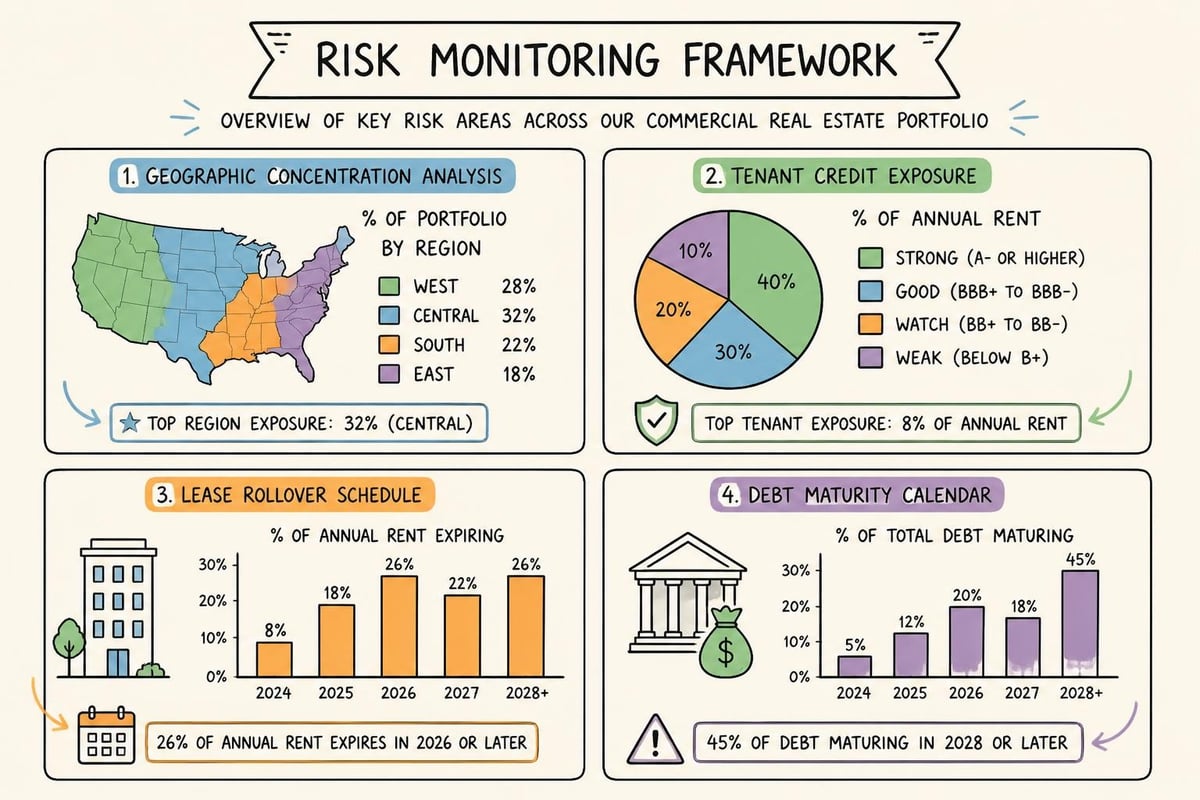
Reporting and stakeholder communication translates operational and financial performance into formats that serve different audiences. Investors require return metrics and risk disclosures, asset managers need operational benchmarks, executives demand exception-based insights, and deal teams seek market intelligence that informs acquisition decisions.
Decision cadence establishment creates the rhythm for portfolio reviews, capital committee meetings, disposition evaluations, and strategic planning sessions. Organizations with disciplined decision cadence respond faster to market opportunities and address underperformance before it metastasizes.
Common Portfolio Management Bottlenecks
Most commercial real estate organizations encounter predictable friction points that constrain portfolio management effectiveness. Understanding these bottlenecks helps teams architect solutions before they become performance limiters.
Data fragmentation represents the most pervasive challenge. Property management systems hold operational metrics, accounting platforms contain financial data, asset managers maintain Excel models with projections, and market intelligence resides in email threads and presentation decks. Assembling a coherent portfolio view requires manual aggregation across these disconnected sources, consuming analyst capacity that should focus on interpretation rather than compilation.
Reporting delays compound when teams rely on month-end close cycles to generate portfolio snapshots. By the time consolidated reports reach decision-makers, the information describes conditions from four to six weeks prior. This temporal gap prevents timely responses to leasing velocity changes, unexpected capital needs, or market dislocation.
Inconsistent data definitions create reconciliation nightmares. Different assets calculate net operating income with varying expense treatments, occupancy percentages reflect different methodologies, and capital expenditure classifications lack standardization. These inconsistencies undermine portfolio-level analytics and erode confidence in reported metrics.
Exception detection through manual review scales poorly. As portfolios expand beyond a dozen properties, identifying anomalies, tracking covenant compliance, and flagging underperformance through spreadsheet review becomes increasingly unreliable. Critical signals disappear in the noise.
Portfolio Management Key Performance Indicators
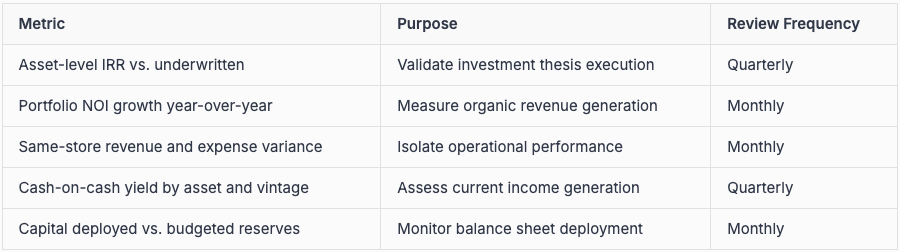
Tracking the right metrics separates performative portfolio management from substantive operating discipline. Leading organizations monitor KPIs across financial performance, operational execution, risk exposure, and strategic positioning.
Financial Performance Metrics
Operational Execution Indicators
Portfolio managers who focus exclusively on financial metrics miss leading indicators that predict future performance. Operational KPIs provide early warning signals and validate business plan progress.
Lease executed vs. budgeted square footage: Measures leasing team productivity and market demand validation
Average rent achieved vs. underwritten pro forma: Quantifies pricing power and market positioning accuracy
Tenant retention rate by property and portfolio: Indicates asset quality and property management effectiveness
Days to lease execution from marketing: Reveals competitive positioning and operational efficiency
Capital expenditure timing vs. schedule: Tracks value-add execution and budget discipline
Occupancy trend analysis across quarters: Identifies momentum shifts before they impact NOI
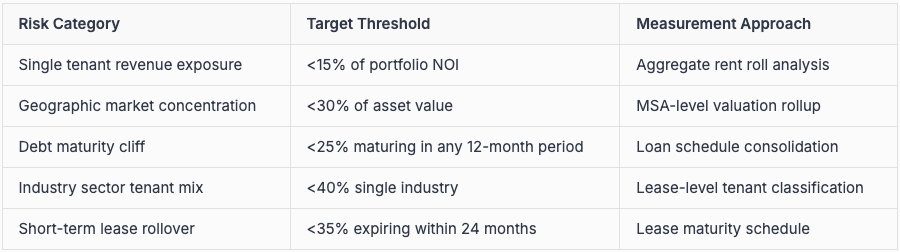
Risk concentration monitoring prevents portfolio managers from inadvertently building correlated exposures that amplify downside scenarios.
Managing Portfolio Data Across Systems
Commercial real estate organizations typically operate with a technology stack that evolved organically rather than by design. Property management systems like Yardi or MRI handle rent collection and maintenance tickets, accounting platforms process financial transactions, Excel models project future performance, and presentation software packages insights for stakeholders. This fragmented architecture creates substantial portfolio management complexity.
Property management system (PMS) integration challenges stem from these platforms optimizing for property-level operations rather than portfolio analytics. Extracting consistent data formats, maintaining historical comparability through system upgrades, and reconciling differences between how various properties configure their PMS instances consumes substantial IT and analyst resources. Many firms maintain dedicated business intelligence teams solely to build ETL processes that normalize PMS outputs.
Accounting system limitations emerge when general ledger structures designed for GAAP compliance fail to surface operational insights portfolio managers require. Chart of accounts architectures optimized for tax reporting and investor distribution calculations often obscure the granularity needed to understand property-level margin trends or capital expenditure patterns. Understanding AI for portfolio management can help bridge these gaps through intelligent data layer abstraction.
Excel dependency persists because spreadsheets offer unmatched flexibility for custom analysis, sensitivity testing, and ad hoc reporting. However, this flexibility creates governance nightmares. Version control deteriorates, formula errors propagate silently, and institutional knowledge becomes trapped in analyst-maintained models that resist documentation and succession planning.
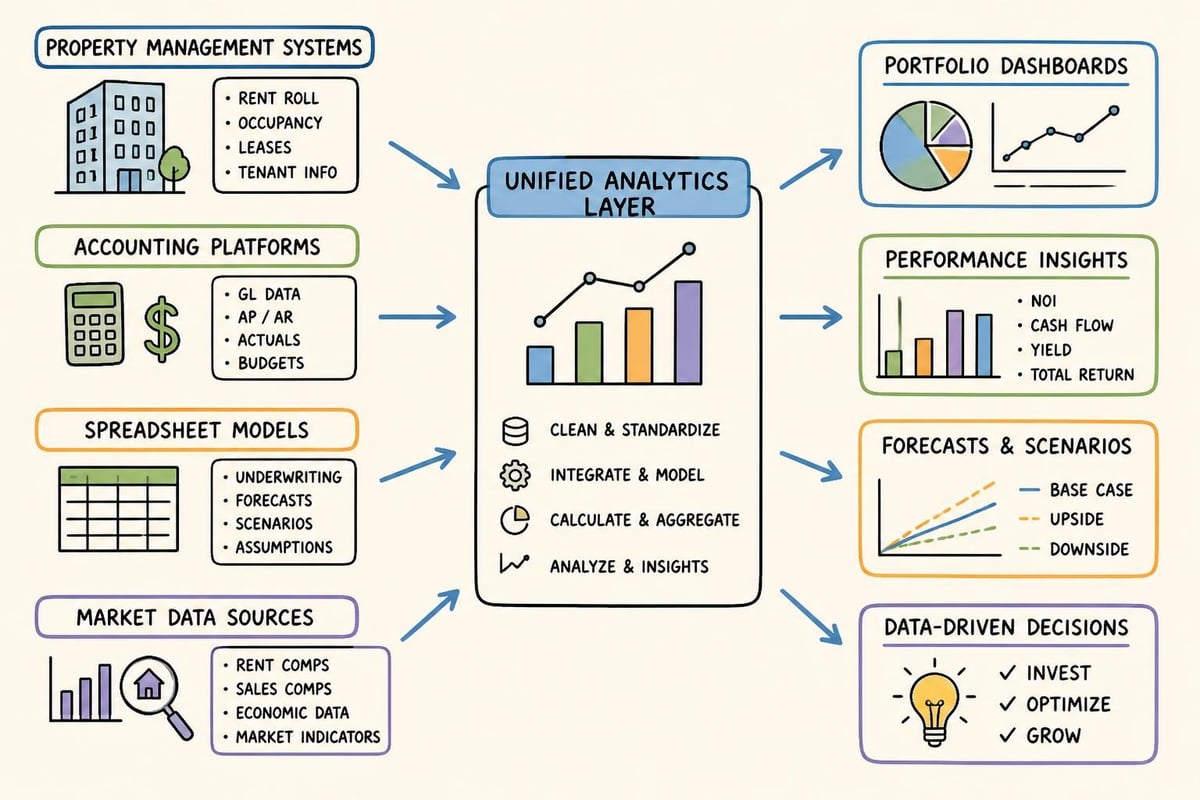
Organizations respond to data fragmentation through three primary approaches, each with distinct trade-offs.
Point Solution Integration
Some firms implement middleware platforms that connect specific systems and automate defined workflows. These solutions excel at solving targeted problems like automated rent roll consolidation or standardized financial reporting but struggle with ad hoc analysis and evolving requirements. Point solutions also introduce additional platforms that require maintenance and create new integration endpoints.
Data Warehouse Development
Larger organizations build enterprise data warehouses that centralize information from all source systems into normalized schemas optimized for analytics. This approach provides powerful query capabilities and supports sophisticated business intelligence tools but requires substantial upfront investment, ongoing data engineering resources, and typically 12-18 month implementation timelines before delivering value.
AI-Enabled Analytics Layers
Modern approaches apply artificial intelligence to create adaptive analytics capabilities that work across existing systems without requiring extensive ETL infrastructure. Platforms designed specifically for commercial real estate portfolio management can interpret data from multiple sources, identify anomalies, automate recurring reporting, and respond to natural language queries about portfolio performance while maintaining full audit trails to source documents.
When Technology Investment Becomes Necessary
Portfolio management technology requirements scale with portfolio complexity rather than simply asset count. A 50-property portfolio concentrated in one market with similar asset types may operate efficiently with manual processes, while a 15-property portfolio spanning multiple markets and property types might require automation to maintain operational control.
Several indicators signal that manual portfolio management approaches have reached sustainability limits. When analysts spend more than 60% of their time compiling data rather than analyzing it, the organization has crossed a critical threshold. Similarly, when portfolio reviews get postponed due to reporting delays, or when executives regularly discover significant property-level issues through informal channels before official reporting surfaces them, technology intervention becomes essential.
Reporting cycle compression requirements emerge as portfolios mature and stakeholder sophistication increases. Investors accustomed to real-time visibility into public market positions expect comparable transparency from private real estate investments. Limited partners increasingly demand monthly reporting with interactive data access rather than quarterly PDF presentations. Meeting these expectations manually creates unsustainable workload that compounds with each property addition. Leveraging tools for data analysis specifically built for investment workflows addresses this compression requirement.
Regulatory and compliance complexity expands as organizations grow. Covenant tracking across multiple loan agreements, investor-specific reporting requirements, and regulatory disclosure obligations create compliance matrices that manual processes struggle to maintain reliably. Technology platforms that automate compliance tracking and provide audit trails become risk management necessities rather than operational conveniences.
Acquisition velocity acceleration stresses portfolio management infrastructure when organizations move from opportunistic deal flow to systematic acquisition programs. Platform businesses executing programmatic buying strategies require portfolio management technology that onboards new assets efficiently, integrates acquisitions into reporting frameworks immediately, and scales analytics capabilities without proportional headcount increases.
Advanced Portfolio Management Practices
Leading commercial real estate organizations extend portfolio management beyond tracking and reporting into active portfolio shaping and strategic positioning. These advanced practices create competitive advantages through superior capital allocation and risk-adjusted return optimization.
Dynamic rebalancing strategies apply active portfolio management principles by continuously evaluating whether the current portfolio composition remains optimal given market conditions and strategic objectives. Rather than holding assets until business plan completion, dynamic rebalancers systematically identify disposition candidates whose current valuations exceed the present value of remaining hold period cash flows, redeploying proceeds into higher-return opportunities.
This approach requires robust portfolio performance evaluation capabilities that account for transaction costs, tax implications, and replacement investment availability. Organizations implementing dynamic rebalancing typically achieve 150-200 basis points of incremental returns versus static hold strategies, though execution demands sophisticated financial modeling and disciplined governance.
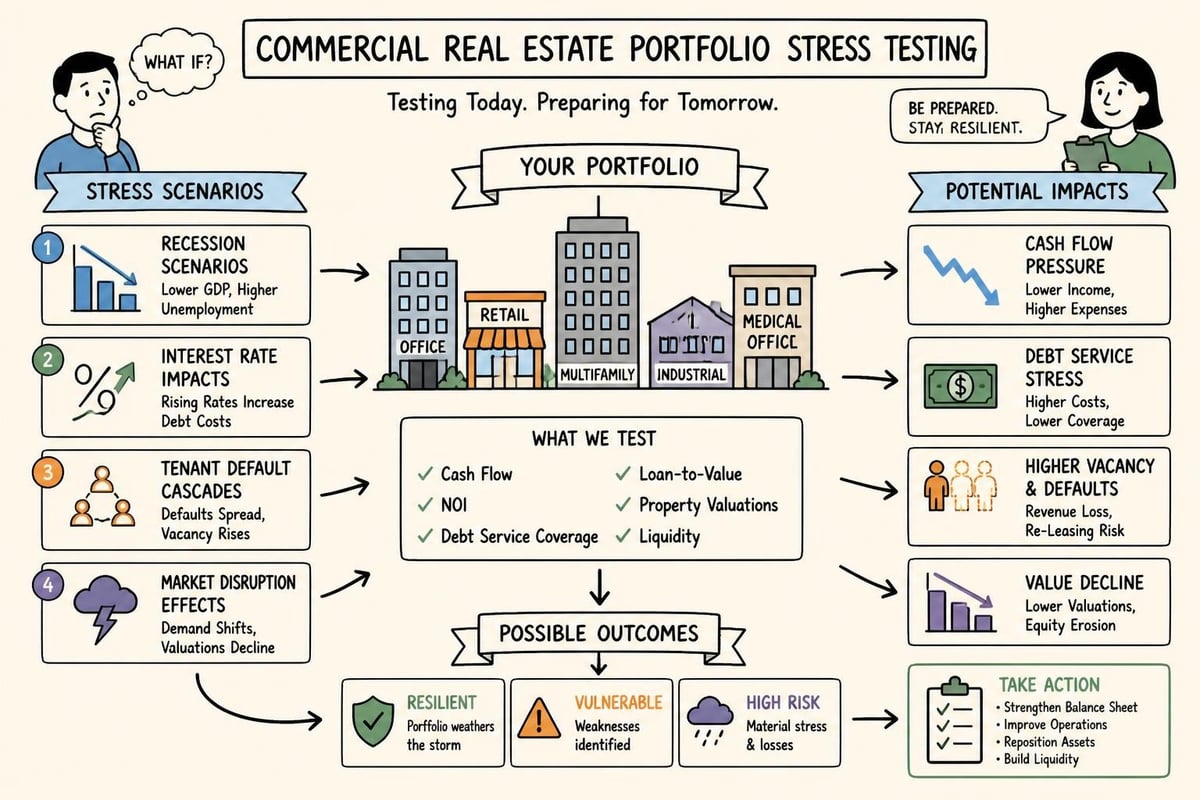
Scenario modeling and stress testing quantifies portfolio resilience under adverse conditions. Advanced practitioners model portfolio-level impacts from recession scenarios, interest rate shocks, tenant bankruptcy cascades, and market-specific disruptions. This forward-looking risk assessment identifies concentration vulnerabilities before they materialize and informs hedging strategies, liquidity reserves, and disposition timing.
Benchmark-relative attribution analysis decomposes portfolio returns into components attributable to market selection, property type allocation, asset selection within sectors, and operational execution. This analytical framework borrowed from public markets provides insights into whether outperformance stems from repeatable skill or favorable market exposure. Organizations that implement attribution analysis systematically improve capital allocation by doubling down on demonstrated competencies and hedging or exiting areas where they lack competitive advantage.
Reporting Architecture for Portfolio Management
Effective portfolio management reporting serves multiple audiences with distinct information needs. Executive leadership requires exception-based dashboards highlighting items demanding intervention, asset managers need detailed operational metrics for individual properties, investors expect risk-adjusted return analytics with peer comparisons, and deal teams seek market intelligence that informs acquisition underwriting.
Tiered reporting frameworks address these diverse needs through layered information architecture. Executive dashboards surface the 12-15 metrics that drive portfolio-level decisions, providing drill-down capability to investigate outliers without overwhelming users with comprehensive data. Asset manager scorecards provide property-level detail on operational and financial performance, benchmarked against budget and prior periods. Investor reports present return calculations, risk metrics, and market commentary formatted for constituent-specific requirements.
Organizations with mature reporting architectures automate recurring deliverables while maintaining flexibility for ad hoc analysis. Standard monthly packages generate automatically from source systems, freeing analyst capacity for investigative work and strategic projects. When executives ask unexpected questions during board meetings or conference calls, teams with proper reporting tools for property managers and portfolio managers can surface answers in minutes rather than days.
Anomaly detection automation represents a frontier in portfolio management reporting where artificial intelligence delivers substantial value. Rather than relying on analysts to manually review hundreds of line items across dozens of properties to identify concerning trends, AI-enabled platforms flag variances, identify patterns, and surface exceptions that warrant investigation. A real estate-native AI analyst layer can detect when property-level expense growth exceeds peer benchmarks, when lease renewal rates decline consecutively, or when capital expenditure velocity suggests business plan delays, automatically generating alerts that focus human attention where it matters most.
Portfolio Strategy and Market Cycle Positioning
Portfolio management extends beyond tracking existing assets to actively shaping portfolio composition in response to market cycles and strategic objectives. Organizations that excel at portfolio strategy treat their holdings as dynamic portfolios rather than static collections, continuously evaluating whether current positioning aligns with return objectives and risk tolerance.
Sector rotation strategies shift capital allocation across property types in response to cycle positioning. Value-oriented investors might emphasize retail and office acquisitions during distress periods when pricing disconnects create opportunities, rotating into industrial and multifamily as markets stabilize and these sectors demonstrate consistent cash flow. Growth-oriented platforms might maintain consistent sector exposure while varying value-add intensity, increasing stabilized asset allocation late cycle and emphasizing repositioning opportunities when markets reset.
Geographic diversification decisions balance concentration risk against local market expertise. Portfolio managers confront fundamental tension between focus strategies that leverage deep market knowledge in limited geographies and diversification approaches that reduce exposure to regional economic shocks. Leading organizations resolve this tension by identifying 4-6 core markets where they maintain permanent platforms and systematic deal flow, supplemented by opportunistic investments in secondary markets when exceptional opportunities emerge.
Vintage management addresses timing risk through structured capital deployment. Rather than investing fund capital during narrow vintage years, sophisticated managers distribute deployment across 24-36 month periods, creating natural vintage diversification that reduces sensitivity to entry timing. This approach requires disciplined capital pacing and resistance to deployment pressure during competitive markets.
Technology's Role in Modern Portfolio Management
Modern portfolio management platforms transcend traditional business intelligence tools by embedding domain expertise into software that understands commercial real estate operating models, accounting conventions, and market dynamics. Rather than requiring users to configure generic analytics platforms to accommodate real estate nuances, purpose-built solutions recognize rent roll structures, understand lease accounting, and interpret property financial statements natively.
Verifiable AI outputs represent a critical requirement for enterprise adoption in investment contexts where accuracy determines capital allocation decisions worth millions of dollars. Unlike consumer AI applications where occasional errors cause minor inconvenience, portfolio management AI must provide source transparency for every data point, calculation, and recommendation. Platforms designed for serious investment work maintain complete audit trails linking outputs to source documents, enabling users to verify accuracy and understand analytical logic. Organizations exploring AI tools for financial modeling should prioritize verification capabilities alongside analytical sophistication.
Contextual intelligence separates generic business intelligence from real estate-specific analytics. Understanding that "occupancy" calculations vary by property type, that expense ratios require size-normalization for meaningful comparison, and that capital expenditure patterns differ between value-add and core strategies enables AI platforms to provide relevant insights rather than technically accurate but operationally meaningless analysis.
System connectivity determines whether technology reduces or increases operational burden. Platforms that require manual data uploads or operate as standalone solutions create additional workflow steps rather than streamlining portfolio management. Modern approaches integrate with existing property management systems, accounting platforms, and data repositories, establishing bidirectional connectivity that keeps analytics current without manual intervention.
Organizations implementing portfolio management technology should evaluate vendors based on four critical dimensions: accuracy and verifiability of outputs, domain expertise embedded in the platform, integration capabilities with existing systems, and enterprise-grade security for handling sensitive investment data. Platforms that excel across these dimensions become force multipliers for investment teams, while solutions that prioritize user interface polish over analytical depth often disappoint during real-world deployment.
Building Portfolio Management Capabilities
Developing institutional-quality portfolio management capabilities requires investment in people, processes, and technology. Organizations that treat portfolio management as a strategic competency rather than a reporting function create sustainable competitive advantages through superior capital allocation and risk management.
Team structure and talent development begin with defining clear responsibilities and decision rights. Portfolio managers require authority to influence capital allocation, override property-level recommendations when portfolio considerations dictate, and drive disposition timing. Organizations where portfolio managers function primarily as data aggregators rather than decision-makers fail to capture the discipline's full value.
Talent profiles for portfolio management roles differ from asset management positions. While asset managers optimize individual property performance, portfolio managers think in terms of relative value, correlation, and aggregate risk. The most effective portfolio managers combine financial analytical capabilities with market intelligence, understanding both spreadsheet mechanics and the qualitative factors that drive real estate fundamentals.
Process documentation and institutional knowledge capture prevent portfolio management capabilities from depending entirely on specific individuals. Organizations should document decision frameworks, reporting specifications, data definitions, and analytical methodologies that enable continuity through personnel transitions. This documentation also facilitates more efficient onboarding and creates accountability for decision quality through retrospective review.
Technology partnerships increasingly determine portfolio management effectiveness. Rather than building proprietary analytics infrastructure from scratch, leading organizations partner with specialized platforms that maintain cutting-edge capabilities while allowing internal teams to focus on investment strategy and execution. Evaluating potential technology partners requires assessing not just current functionality but vendor commitment to continuous innovation, responsiveness to user feedback, and long-term viability as a going concern.
Portfolio management represents a fundamental operating discipline that separates institutional-quality commercial real estate platforms from property-level operators. Organizations that master capital allocation, risk monitoring, reporting automation, and data integration create sustainable competitive advantages through better-informed decisions and faster response to market opportunities. Leni serves enterprise investment organizations as a real estate-native AI analyst layer that connects disparate systems, automates recurring reporting, surfaces portfolio trends, and produces verifiable outputs that support human decision-making across commercial real estate and adjacent investment sectors.

Johanna Gruber
Johanna has spent the last 8 years helping marketing teams connect with audiences through content. Specializing in B2B SaaS and real estate.

Curious About AI?
Join the largest AI community for real estate online. Get bite-sized, real-world use case videos, plus practical tips and proven strategies from top industry experts on adopting AI effectively.
MEET LENI
AI SuperAgent Purpose Built for Investors and Operators.
Experience how professionals and teams in your domain are getting the edge using AI.
