Portfolio Strategy: A Complete Framework for 2026

Portfolio Strategy: A Complete Framework for 2026
Building a robust portfolio strategy means connecting what you want to achieve with how you'll deploy capital, manage risk, and measure success. For enterprise investment teams managing commercial real estate and adjacent asset classes, this isn't a one-time planning exercise. It's an operating system that guides every acquisition, disposition, and hold decision while adapting to market conditions and organizational priorities. The difference between disciplined strategy work and ad hoc decision-making shows up in returns, risk-adjusted performance, and the confidence your stakeholders have in your investment thesis.
Define What Your Portfolio Should Achieve
Every effective portfolio strategy starts with explicit objectives that cascade from organizational goals to specific investment outcomes. These aren't vague aspirations but measurable targets that shape every downstream decision.
Establish Return and Risk Parameters
Your portfolio exists to deliver specific risk-adjusted returns within defined constraints. Start by documenting target returns (IRR, equity multiple, cash yield), acceptable volatility ranges, drawdown limits, and liquidity requirements. These parameters create the boundaries for every opportunity you evaluate.
For commercial real estate portfolios, this means defining targets by property type, geography, and investment strategy. A core-plus office strategy in secondary markets carries different return expectations and risk profiles than opportunistic multifamily development in gateway cities. Document these expectations explicitly so your team evaluates opportunities against consistent benchmarks.
Key objectives to document:
Absolute and relative return targets
Maximum portfolio concentration by asset type, market, or operator
Liquidity requirements and capital call capacity
ESG criteria and impact goals
Time horizon for the overall portfolio and individual positions
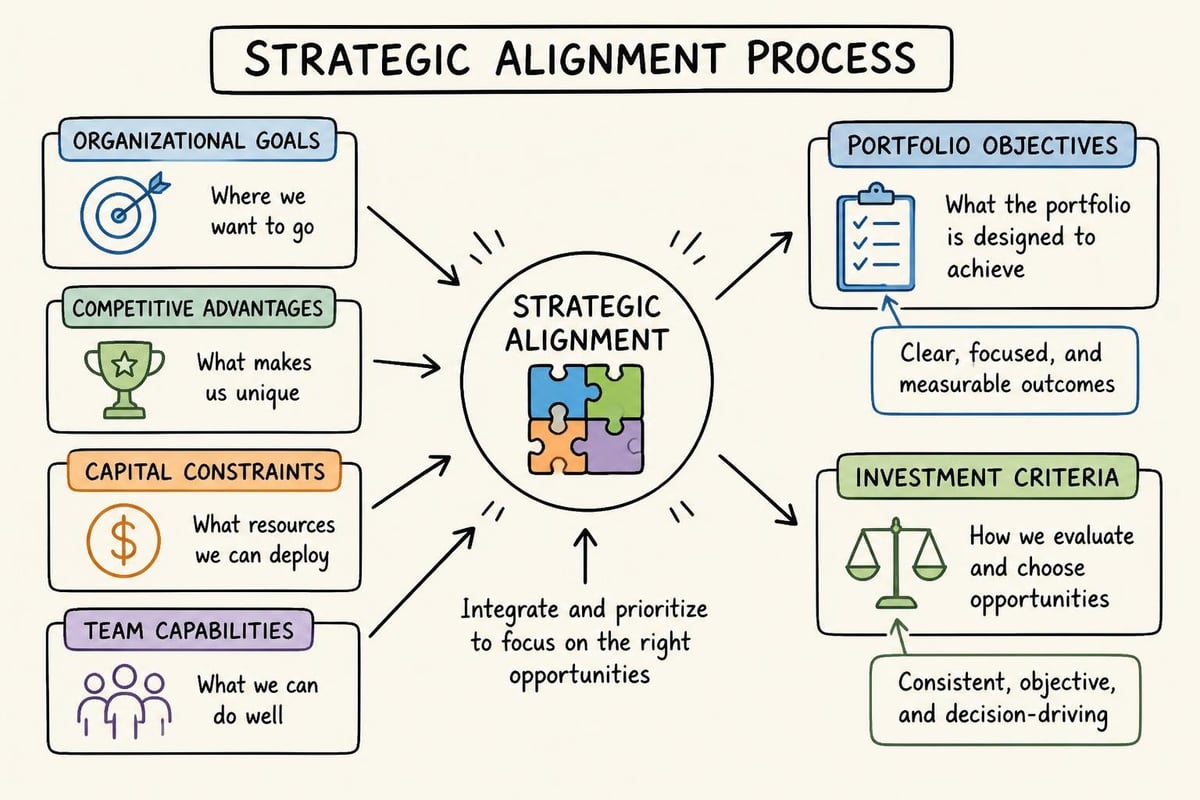
Align Strategy with Organizational Context
Your portfolio strategy must reflect your organization's stage, capabilities, and competitive advantages. A $500 million fund with deep operator relationships approaches portfolio and investment management differently than a $5 billion institutional allocation building internal capabilities.
Consider your access to deal flow, underwriting expertise, asset management resources, and capital flexibility. If you have proprietary relationships with best-in-class multifamily operators, your strategy should reflect that advantage. If you're building capabilities in a new sector, your strategy needs to account for learning curves and potentially lower initial allocations.
Determine Where to Allocate Capital
Capital allocation is where portfolio strategy becomes tangible. Every dollar deployed represents a view on relative value, risk, and opportunity cost across available options.
Build Your Allocation Framework
Start with strategic allocation targets across major categories, then create tactical ranges that allow flexibility without abandoning discipline. For CRE-focused portfolios, this typically means allocation by property type, geography, risk profile, and investment structure.
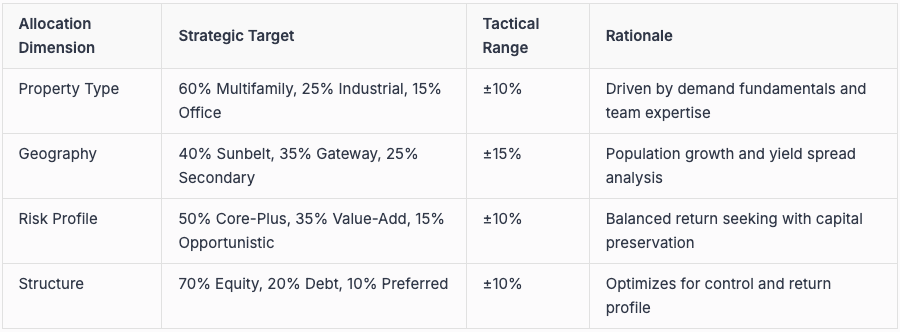
These frameworks prevent portfolio drift while allowing tactical responses to market conditions. When industrial cap rates compress below your thesis, tactical ranges let you reduce exposure without triggering a complete strategy revision.
Evaluate Market Signals and Opportunities
Effective capital allocation requires continuous assessment of relative value across markets, sectors, and structures. This means monitoring cap rate trends, rent growth trajectories, construction pipelines, financing costs, and demographic shifts that drive demand.
For commercial real estate, market selection determines a significant portion of your returns. Understanding which markets offer the best risk-adjusted opportunities requires analyzing employment growth, household formation, supply constraints, and infrastructure investment. Evaluating investment portfolios regularly ensures your allocations still align with current market dynamics.
Critical market signals to monitor:
Cap rate spreads versus historical averages and alternative investments
Rental rate growth relative to inflation and wage growth
New supply as a percentage of existing stock
Transaction volume and bid-ask spread trends
Financing availability and spread compression or expansion
Modern portfolio strategy relies on AI for portfolio management to process market data, identify emerging trends, and surface opportunities that match your criteria. Rather than manually compiling market reports from dozens of sources, enterprise platforms can aggregate data, validate assumptions, and provide source-linked analysis that supports allocation decisions.
Decide What to Hold and What to Exit
Portfolio strategy isn't only about what you buy. Knowing when to hold, when to sell, and when to pass on new opportunities is equally critical to achieving your objectives.
Create Hold/Sell Decision Criteria
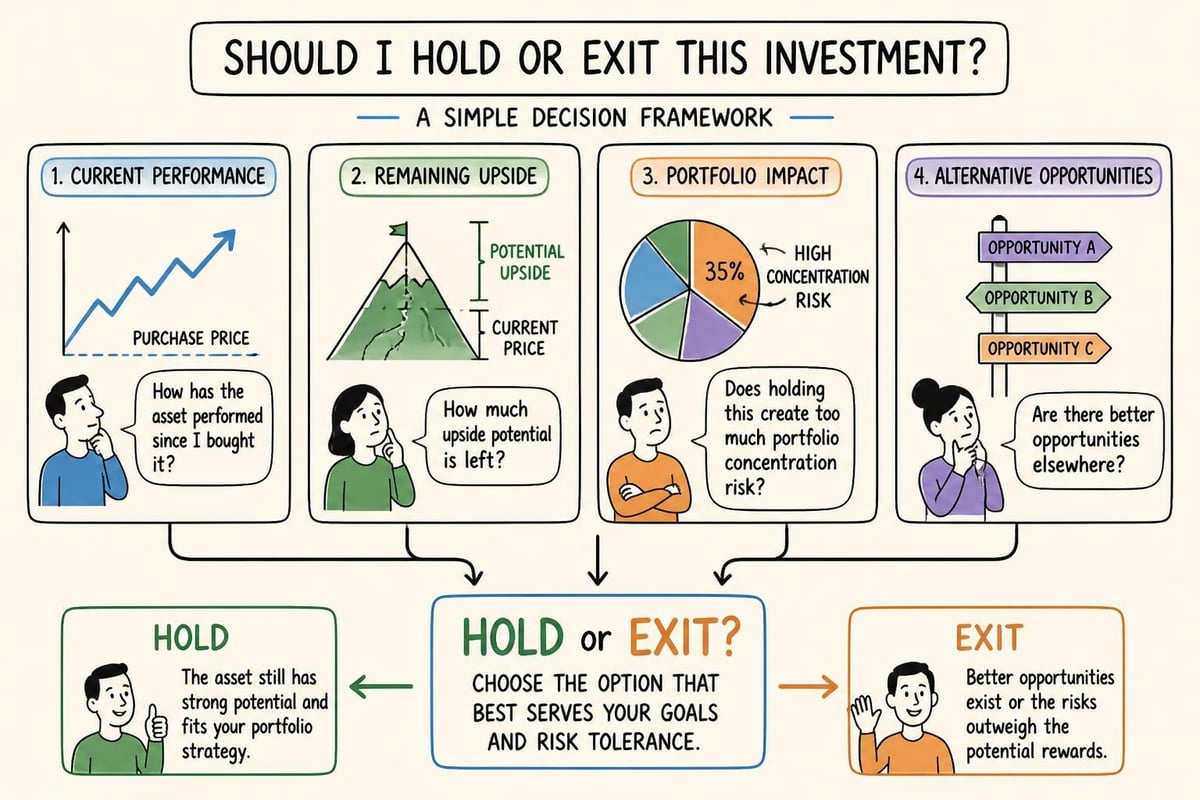
Every asset in your portfolio should justify its continued presence. Establish clear criteria for hold versus sell decisions that consider current performance, future potential, portfolio fit, and opportunity cost.
For each position, evaluate whether it still serves your strategy. A stabilized multifamily asset that delivered strong returns during lease-up might now represent capital better redeployed into higher-return opportunities. Conversely, an industrial property in a supply-constrained market might warrant continued hold despite meeting original return targets.
Decision framework elements:
Current performance versus underwriting projections
Remaining value creation potential (lease-up, renovation, operational improvement)
Forward return expectations at current valuation versus alternatives
Portfolio concentration and diversification impact
Tax efficiency and structure considerations
Market timing and liquidity conditions
Monitor Operator and Asset Performance
For portfolios with commercial real estate portfolio management responsibilities across multiple operators and partnerships, performance monitoring becomes a core strategic capability. You need systems that track NOI variance, leasing velocity, capital deployment, and value creation milestones across every position.
This requires standardized reporting that lets you compare performance across operators, markets, and vintages. When one operator consistently delivers above pro forma while another misses targets, that information should trigger strategic questions about future allocation, asset management intervention, or exit planning.
Compare Opportunities with Consistent Methods
As deal flow increases and market conditions shift, your ability to evaluate opportunities consistently determines whether you select the best risk-adjusted investments or chase shiny objects that don't fit your strategy.
Standardize Your Underwriting Process
Every opportunity should flow through the same analytical framework, using consistent assumptions, sensitivity tests, and approval criteria. This doesn't mean every deal looks identical, but it does mean your process for evaluating a suburban office acquisition mirrors your approach to urban multifamily.
Standardization starts with underwriting templates that enforce assumption consistency. Discount rates should reflect comparable risk profiles. Exit cap rate assumptions should tie to market data and historical spreads. Operating expense growth should align with inflation expectations and property-specific drivers. AI tools for financial modeling can enforce these standards while adapting to deal-specific characteristics.
Components of standardized underwriting:
Market research templates with source-linked data requirements
Cash flow models with enforced assumption hierarchies
Sensitivity analysis on key value drivers (rent growth, exit cap, financing cost)
Risk scoring across defined criteria (location, operator, leverage, lease term)
Investment committee memo templates that surface critical decision points
Build Comparison Frameworks Across Asset Classes
Portfolio strategy requires comparing opportunities that don't look alike on the surface. How do you evaluate a stabilized industrial asset in Phoenix against a value-add multifamily opportunity in Austin? You need frameworks that translate different opportunities into comparable metrics.
This typically means evaluating opportunities across multiple dimensions simultaneously. Consider risk-adjusted returns (Sharpe ratio, Sortino ratio), capital efficiency (ROI, ROIC), income versus appreciation split, leverage sensitivity, and strategic fit scores. When you can plot every opportunity on the same evaluation matrix, relative value becomes clearer.
Test Assumptions and Validate Your Strategy
The most dangerous words in investment management are "this time is different." Effective portfolio strategy means stress-testing assumptions, challenging consensus views, and building frameworks that reveal when your thesis breaks down.
Implement Scenario Analysis and Sensitivity Testing
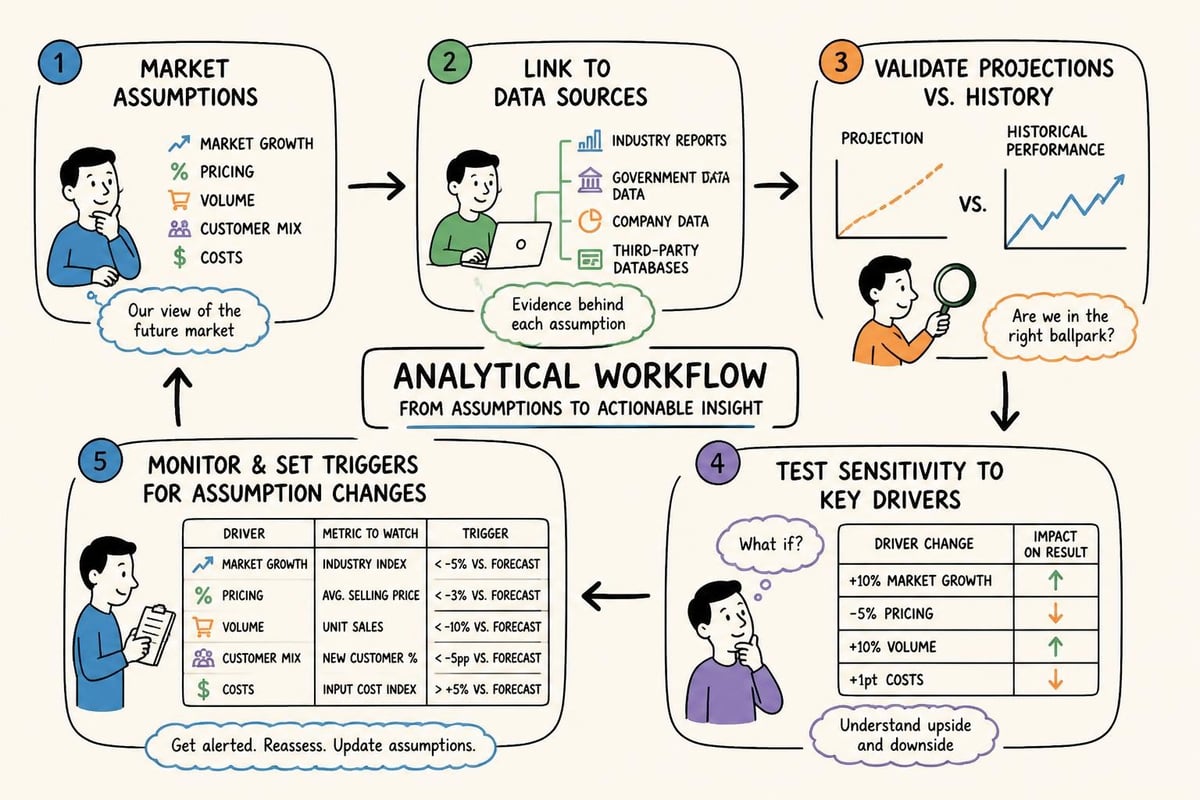
Every investment thesis contains embedded assumptions about future conditions. Interest rates will stay in a certain range. Rent growth will continue at historical rates. Exit markets will provide liquidity at attractive prices. Your portfolio strategy must test what happens when those assumptions prove wrong.
Build scenarios that stress-test your portfolio across multiple dimensions simultaneously. What happens if cap rates expand 100 basis points while rent growth slows by 200 basis points? How does the portfolio perform if refinancing costs increase 150 basis points at maturity? Which positions become distressed, and where do you have capacity to add capital or navigate through difficult periods?
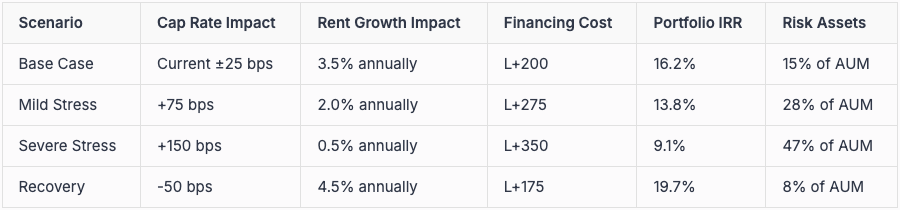
This analysis reveals portfolio vulnerabilities and concentration risks that aren't obvious in base case projections. Understanding how developing portfolio strategy accounts for multiple scenarios ensures you build resilient portfolios that can weather market disruptions.
Validate Market Assumptions with Source-Linked Research
Your assumptions about market fundamentals, competitive dynamics, and demand drivers should connect to specific, verifiable sources. When you assume 5% annual rent growth in Austin multifamily, that assumption should link to employment data, household formation trends, construction pipeline analysis, and comparable property performance.
This validation process prevents groupthink and anchoring bias. If your entire team assumes strong rent growth because "everyone knows Austin is hot," you're making decisions based on narrative rather than evidence. Source-linked research forces you to document the specific data points supporting your view and identify leading indicators that would signal when conditions are changing.
Establish When to Revisit and Adjust Strategy
Markets change, organizations evolve, and new information emerges that challenges existing assumptions. Your portfolio strategy needs defined triggers for review and revision without becoming reactive to short-term noise.
Set Review Cadences and Trigger Events
Establish regular strategy review cycles aligned with your investment timeline and reporting requirements. Quarterly reviews assess tactical positioning within strategic ranges. Annual reviews examine whether strategic allocations still reflect your best thinking about relative value and risk. Multi-year reviews consider fundamental shifts in organizational objectives or market structure.
Beyond scheduled reviews, define trigger events that warrant immediate strategy assessment. These might include significant market dislocations, major regulatory changes, organizational restructuring, or performance that deviates meaningfully from expectations. Portfolio strategy monitoring and value creation requires both discipline and flexibility.
Review triggers and actions:
Quarterly: Tactical allocation adjustments within approved ranges, pipeline prioritization, hold/sell decisions for mature assets
Annual: Strategic allocation targets, return expectations, risk parameters, new sector or market exploration
Event-driven: Market dislocations, regulatory changes, significant performance deviations, organizational priorities shift
Multi-year: Fundamental strategy revision, capability building priorities, structural portfolio transformation
Build Systems for Continuous Performance Monitoring
Effective portfolio strategy requires real-time visibility into how individual positions and the overall portfolio are performing against plan. This means systems that aggregate data from property management software, financial reporting tools, and market data feeds into unified dashboards that highlight variances and emerging trends.
For subscription-based users working with uploaded files and documents, this might mean structured templates that enable consistent analysis across positions without requiring integrated data feeds. For enterprise teams, it requires connected systems with CRE asset management software that provides governed workflows, audit trails, and permissions that support portfolio-wide decision-making.
Deploy Technology That Supports Strategic Decisions
Modern portfolio strategy relies on platforms that transform data into insights and insights into action. The right technology doesn't replace judgment but enhances your team's ability to process information, test assumptions, and execute decisions confidently.
Choose Platforms Built for Enterprise Workflows
Investment teams need different capabilities depending on their scale and structure. Small teams might prioritize speed and simplicity, uploading deal files for quick analysis without complex integrations. Enterprise organizations require governed workflows, audit trails, role-based permissions, and systems that connect portfolio strategy to execution across multiple teams and geographies.
The most sophisticated approaches to how to create portfolio strategy leverage platforms that combine market research, underwriting, portfolio monitoring, and reporting in unified environments. This eliminates the version control nightmares, assumption inconsistencies, and manual aggregation that plague teams using disconnected tools.
Essential platform capabilities:
Source-linked market research and data validation
Standardized underwriting with flexible assumption frameworks
Scenario and sensitivity analysis across individual deals and portfolio aggregations
Performance monitoring with variance analysis and trend identification
Investment committee memo generation with audit trails
Recurring reporting that adapts to stakeholder requirements
Ensure Accuracy and Auditability in AI-Enhanced Analysis
As artificial intelligence becomes central to investment workflows, accuracy and verification become non-negotiable. Platforms that provide analysis without showing their work create regulatory risk, decision-making vulnerability, and stakeholder trust problems. Understanding portfolio-level strategy as an integrated system rather than disconnected analyses requires technology that maintains transparency from data source to final recommendation.
Look for platforms that provide source citations for every data point, maintain version control across assumption changes, and create audit trails that document who made what decisions based on which information. This becomes particularly critical when using AI to process market research, generate financial projections, or compare investment opportunities. The analysis might be faster, but it must be verifiable.
Integrate Market Intelligence into Strategic Planning
Your portfolio strategy is only as good as the market intelligence that informs it. Understanding where markets are headed, which sectors face headwinds, and where opportunities are emerging requires systematic information processing that most teams can't sustain manually.
Build Recurring Market Research Processes
Effective market intelligence isn't about reading every article or attending every conference. It's about systematically monitoring the specific indicators that drive your investment decisions and identifying meaningful changes before they become consensus.
For commercial real estate portfolios, this means tracking supply and demand fundamentals, capital markets conditions, demographic trends, and regulatory changes across your target markets. Rather than relying on quarterly reports from third-party research firms, build processes that continuously update your view of market conditions with verifiable, source-linked data.
This research should feed directly into your portfolio strategy reviews. When you see construction pipeline expansion in Phoenix industrial exceeding absorption trends, that information should trigger questions about hold/sell decisions for existing positions and new investment pacing. When you identify employment growth acceleration in secondary markets with limited new supply, that should inform capital allocation priorities.
Connect Research to Investment Decisions
The gap between market research and investment decisions represents wasted effort and missed opportunities. Your market intelligence should flow directly into underwriting assumptions, strategic allocation reviews, and investment committee discussions. Examining strategic concepts helps bridge this gap by establishing clear connections between macro trends and portfolio positioning.
Modern platforms enable this connection by allowing research findings to populate assumption libraries, inform sensitivity analysis parameters, and provide context for IC memos. When evaluating a new multifamily opportunity, your team should automatically see relevant market research about supply, demand, rent growth, and competitive positioning without manually searching files or remembering previous analyses.
Maintain Governance and Stakeholder Alignment
Portfolio strategy operates within organizational structures that require governance, reporting, and stakeholder management. Your strategy must work within these constraints while maintaining decision-making speed and flexibility.
Establish Clear Decision Rights and Approval Thresholds
Define who can make what decisions at what scale. Individual asset managers might have authority for smaller capital improvements within approved budgets. Portfolio managers might approve acquisitions and dispositions within defined parameters. Investment committees might review larger transactions or those outside strategic ranges.
These decision rights should balance control with efficiency. Requiring IC approval for every $50,000 capital expenditure creates bottlenecks that slow execution and frustrate teams. Allowing unlimited authority without oversight creates risk and drift from strategy. Find the thresholds that give operators autonomy while protecting portfolio integrity.
Governance framework components:
Investment size thresholds requiring different approval levels
Deviation parameters from strategic allocations requiring justification
Performance variance triggers that escalate review requirements
Capital deployment pacing and concentration limit enforcement
Exception processes for opportunities outside normal parameters
Create Reporting That Serves Multiple Stakeholders
Different stakeholders need different views of portfolio strategy and performance. Board members want high-level strategic positioning and aggregate performance. Investment committee members need detailed deal analysis and market context. Limited partners require standardized reporting that enables comparison across managers. Operating teams need tactical dashboards that guide daily decisions.
Your systems should generate all these views from the same underlying data without manual reformatting or re-aggregation. This ensures consistency across stakeholder communications while reducing the administrative burden on investment teams. When everyone works from the same source of truth, strategic conversations focus on decisions rather than reconciling conflicting numbers.
Implementing effective portfolio strategy means connecting objectives, allocation decisions, opportunity evaluation, assumption testing, and performance monitoring into a coherent operating system that guides capital deployment and risk management. Modern enterprise investment teams increasingly rely on purpose-built platforms that bring accuracy, speed, and transparency to these strategic workflows. Leni delivers exactly this capability for commercial real estate and adjacent investment sectors, providing AI-enhanced analysis with source-linked research, governed workflows, and enterprise-grade security that transforms how sophisticated teams execute portfolio strategy. Whether you need quick analysis of uploaded deal files or comprehensive portfolio management with integrated data and recurring reporting, Leni's platform ensures your strategic decisions rest on verified evidence rather than incomplete information.

Johanna Gruber
Johanna has spent the last 8 years helping marketing teams connect with audiences through content. Specializing in B2B SaaS and real estate.

Curious About AI?
Join the largest AI community for real estate online. Get bite-sized, real-world use case videos, plus practical tips and proven strategies from top industry experts on adopting AI effectively.
MEET LENI
AI SuperAgent Purpose Built for Investors and Operators.
Experience how professionals and teams in your domain are getting the edge using AI.
