Real Estate Asset Management: Manual vs. AI-Driven Workflows
.webp&w=1920&q=75)
Real Estate Asset Management: Manual vs. AI-Driven Workflows
Commercial real estate asset management has reached an inflection point. Most platforms store data efficiently but fail to analyze it meaningfully. Asset managers spend countless hours pulling reports, consolidating data across systems, and building deliverables manually. The challenge isn't data availability-it's transforming raw information into actionable intelligence quickly enough to matter. The gap between data collection and analytical insight has created an opportunity for purpose-built AI systems that don't just organize information but autonomously generate finished analysis tied directly to source documents.
The Traditional Real Estate Asset Management Workflow
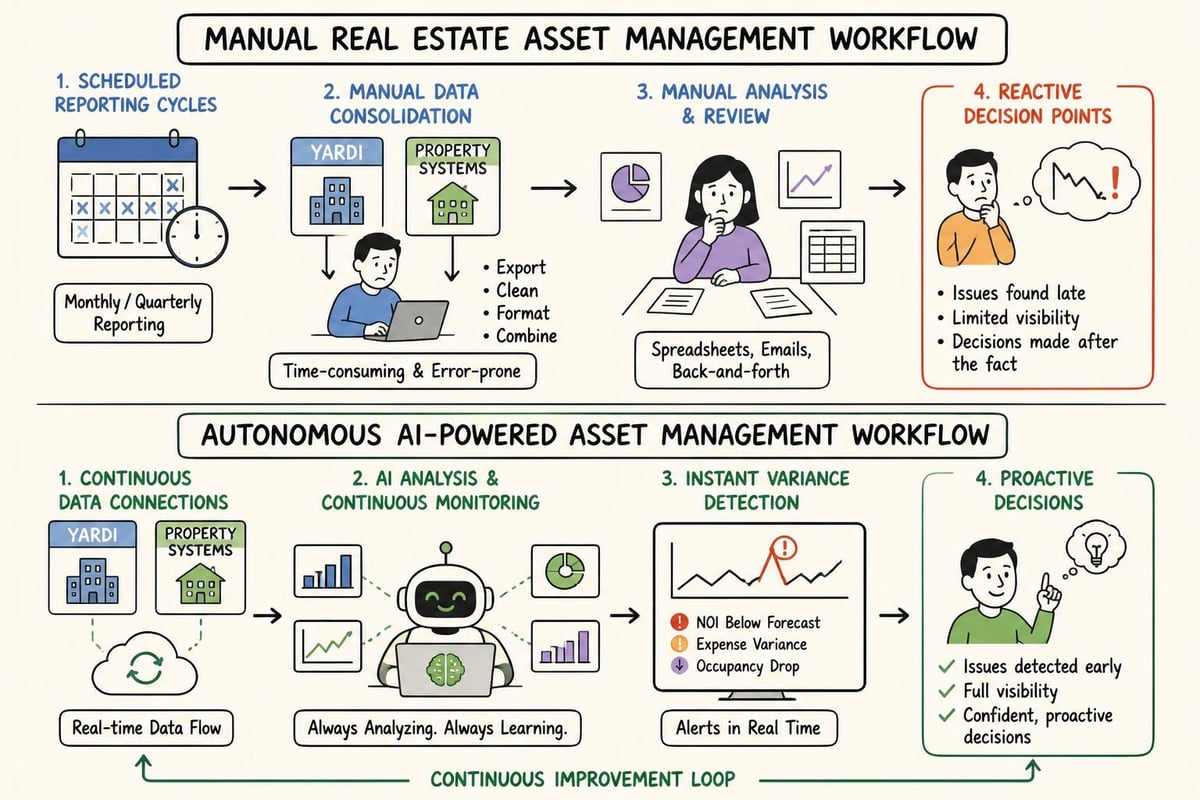
Manual workflows dominate most real estate asset management operations today. Teams rely on scheduled reports from property management systems, reviewing monthly or quarterly snapshots rather than continuous analysis. This reactive approach means decisions happen based on historical data, often weeks after issues emerge.
Data consolidation becomes a bottleneck across every deliverable. Asset managers extract information from Yardi, compile it into spreadsheets, cross-reference lease terms from PDFs, and manually verify figures before creating reports. A single portfolio update might require 10-15 hours of work, with multiple team members touching the same data at different stages.
The Hidden Costs of Reactive Decision-Making
Traditional workflows create several compounding inefficiencies:
Time lag between data generation and insight delivery means problems compound before teams detect them
Manual verification requirements slow every decision and introduce human error
Siloed information across property management, accounting, and market research systems prevents holistic analysis
Inconsistent formatting across properties makes portfolio-level comparisons difficult
Limited analytical depth because teams focus on data gathering rather than strategic interpretation
The result is predictable. According to KPMG's 2025 asset management outlook, operational efficiency remains a top challenge as firms struggle to extract value from existing technology investments. Most platforms store comprehensive property data but require significant manual effort to transform it into actionable intelligence.
Purpose-Built AI for Real Estate Asset Management
Autonomous AI platforms represent a fundamental shift in how real estate asset management operates. Rather than storing data and waiting for human analysts to query it, these systems continuously process information, identify anomalies, and generate finished deliverables without constant prompting.
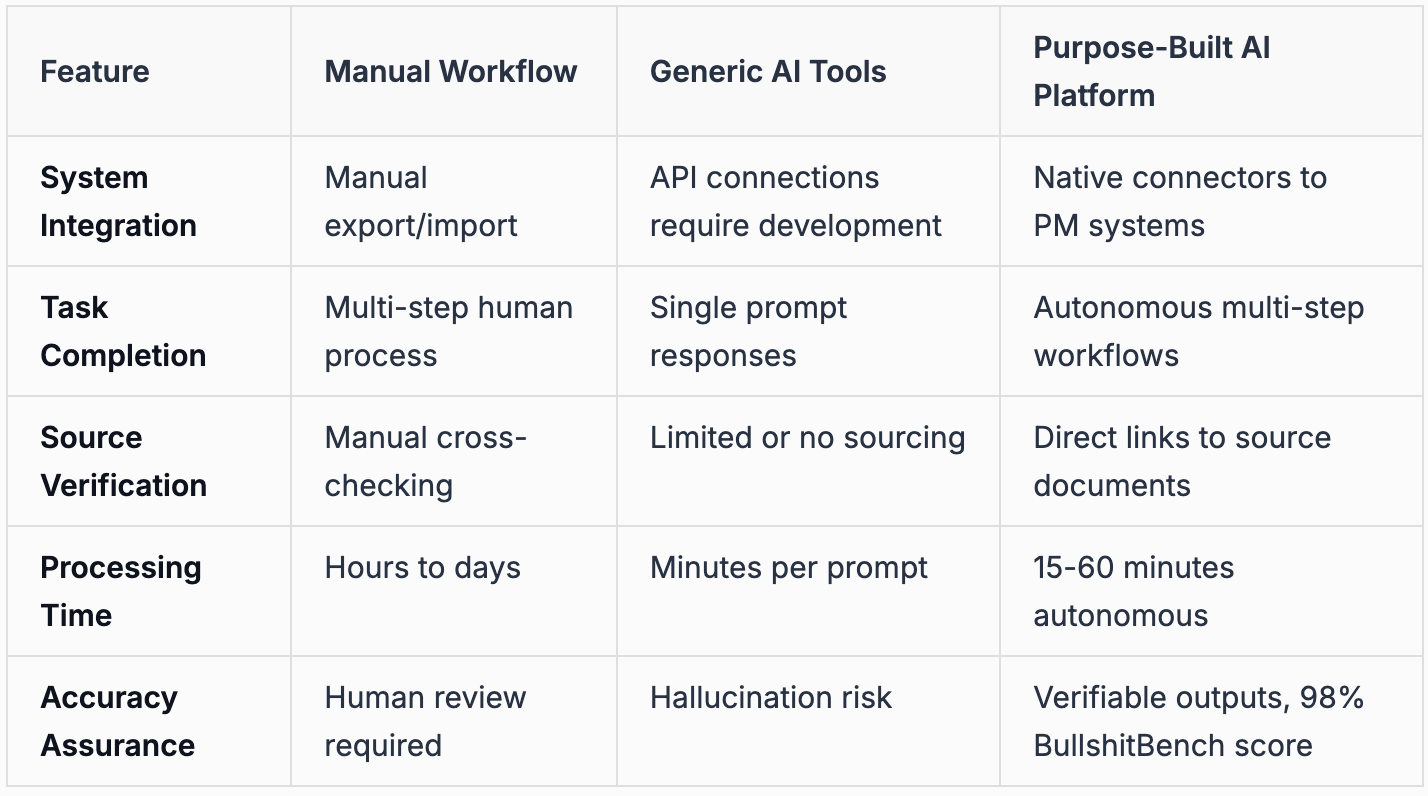
The distinction matters. Generic AI models require detailed instructions for each task, generate outputs that need extensive verification, and lack integration with property management systems. Purpose-built platforms connect directly to existing infrastructure-Yardi, RealPage, Entrata, AppFolio, and MRI Software-and run multi-step analytical workflows autonomously.
Core Capabilities That Transform Daily Operations
Modern AI real estate software handles the analytical work that traditionally consumed the majority of asset management time:
Portfolio reporting automation that pulls live data, applies property-specific parameters, and generates formatted reports with source verification
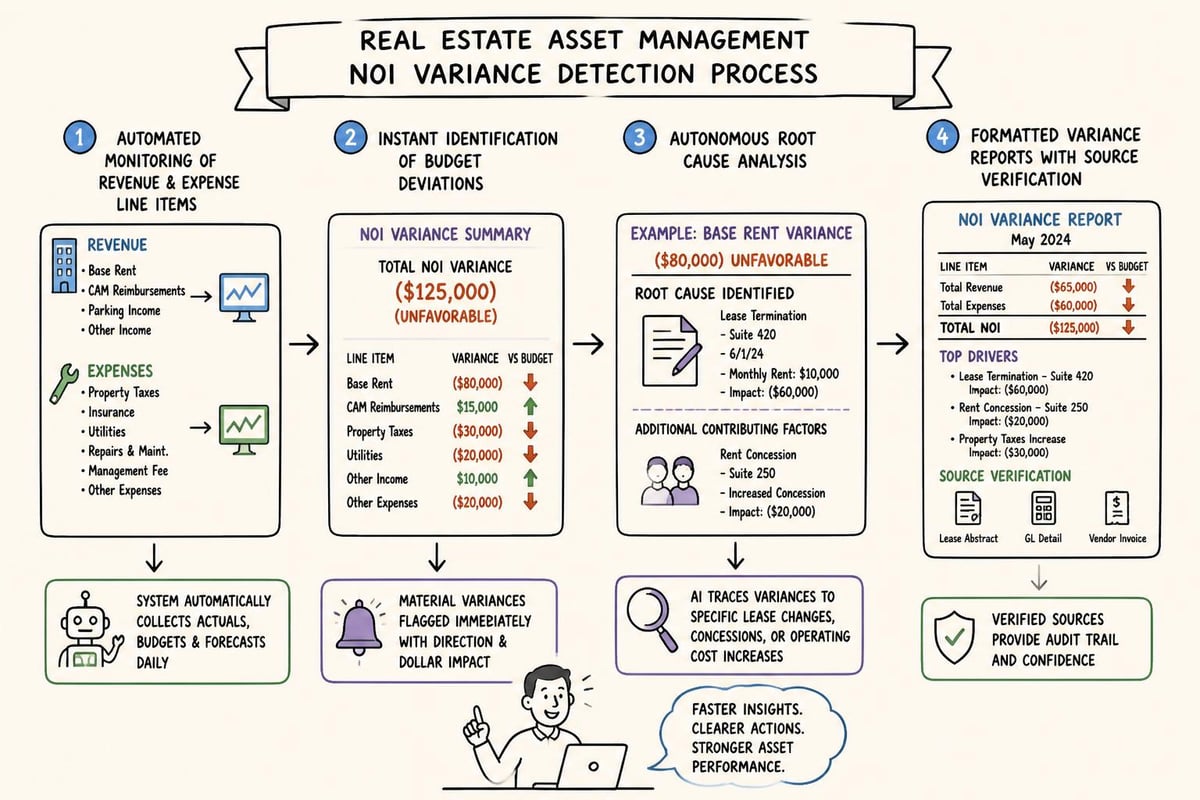
NOI variance analysis that identifies deviations from budget or forecast, traces root causes across rent roll changes, operating expenses, and one-time charges
Lease abstraction and review that extracts key terms, flags renewal deadlines, and compares clauses across the portfolio
Market research compilation with direct source links to comparable properties, submarket trends, and economic indicators
LP update creation that synthesizes performance data, strategic initiatives, and forward projections into investor-ready documents
These capabilities share a common characteristic: they complete tasks from start to finish, not just the first step. An investment memo creation workflow, for example, doesn't just extract data-it performs financial modeling, conducts market research, identifies risks, and formats the complete deliverable with verifiable sources.
Real Estate Asset Management Use Cases: Analysis vs. Storage
The difference between data storage and analytical platforms becomes clear when examining specific workflows. Portfolio reporting exemplifies this distinction. Traditional systems display property performance metrics on dashboards. Asset managers then manually identify trends, calculate variances, and investigate anomalies.
Analytical platforms complete this entire workflow autonomously. They detect NOI variances, trace contributing factors through detailed line-item analysis, compare performance against budget and prior periods, and generate explanatory narratives with supporting calculations. The output is a finished report, not raw data requiring interpretation.
Portfolio Performance Monitoring
Continuous analysis replaces scheduled reporting cycles. Rather than reviewing monthly snapshots, asset managers receive alerts when metrics deviate from expected ranges. This proactive approach catches issues immediately-a sudden increase in vacancy, unexpected operating expense spikes, or lease renewals at below-market rates.
The portfolio analytics workflow operates without human intervention:
Ingests daily data feeds from property management systems
Compares current metrics against historical performance, budgets, and market benchmarks
Identifies statistically significant variances requiring attention
Generates detailed analysis explaining root causes
Produces formatted reports with actionable recommendations
This autonomous operation matters because it scales without increasing headcount. A team managing 50 properties receives the same analytical depth as one managing 500, without proportionally expanding staff.
Lease Review and Abstraction at Scale
Manual lease review consumes disproportionate time relative to its analytical value. Teams spend hours extracting key terms, deadlines, and clauses from hundreds of documents. This document extraction work is necessary but doesn't require strategic judgment until patterns emerge across the portfolio.
Autonomous platforms handle extraction and identify meaningful patterns simultaneously. They process entire lease portfolios, extract standardized data fields, flag unusual clauses, and compile portfolio-wide insights about renewal risk, escalation structures, and tenant concessions. The output is both detailed property-level data and strategic portfolio analysis.
Market Research and Competitive Positioning
Traditional market research workflows require substantial manual effort. Analysts search multiple sources, compile comparable data, verify information accuracy, and synthesize findings into reports. This process repeats for each acquisition analysis, refinancing evaluation, or strategic planning exercise.
Purpose-built platforms conduct comprehensive market research autonomously, returning results with direct source links. They identify comparable properties, extract relevant performance metrics, analyze submarket trends, and compile competitive positioning analysis-all verifiable back to original sources. This capability transforms research from a periodic exercise into continuous competitive intelligence.
The AI Layer Built on Existing Infrastructure
The most effective approach to modernizing real estate asset management doesn't replace existing systems-it adds an analytical layer on top of them. Property management platforms like Yardi, RealPage, and Entrata excel at transaction processing and data storage. What they lack is autonomous analytical capability that generates finished deliverables.
Integration architecture determines platform value. Native connectors that pull data directly from property management systems eliminate manual export/import cycles. Real-time data access ensures analysis reflects current conditions, not outdated snapshots. Bidirectional integration enables platforms to not only read data but potentially write back processed information.
Verification and Source Linking
Generic AI models present a significant verification challenge. They generate plausible-sounding analysis that requires extensive manual fact-checking to validate. This verification burden often exceeds the time saved by automation, particularly in real estate asset management where numerical accuracy is non-negotiable.
Purpose-built platforms solve this through comprehensive source linking. Every figure, calculation, and assertion includes direct references to source documents. Asset managers can instantly verify that a reported NOI variance traces accurately through rent roll changes and expense increases back to the property management system. This verifiable output structure matters for financial modeling and underwriting, where stakeholders must trust analytical accuracy.
The distinction shows up in measurable ways. BullshitBench, a benchmark measuring AI hallucination rates, scored purpose-built commercial real estate platforms at 98% accuracy-first among specialized AI tools. This performance level reflects training on industry-specific data and verification protocols built into the analytical workflow.
Autonomous Task Execution vs. Constant Prompting
Traditional AI interaction requires users to break complex tasks into sequential prompts. Creating an investment committee memo might involve 20-30 separate queries: extract property data, build financial model, conduct market research, analyze risks, format sections, etc. Each prompt requires human judgment about what to request next and how to combine outputs.
Autonomous platforms execute multi-step workflows from a single instruction. The system understands that "create an IC memo for [property]" involves dozens of analytical subtasks, executes them in proper sequence, and delivers a complete document. Typical processing time runs 15-60 minutes depending on complexity, during which the platform operates without human intervention.
This autonomous execution enables asset managers to focus on strategic decisions rather than analytical mechanics. Teams review finished analysis and make investment decisions rather than spending hours constructing the analysis itself.
Evaluating Your Real Estate Asset Management Stack
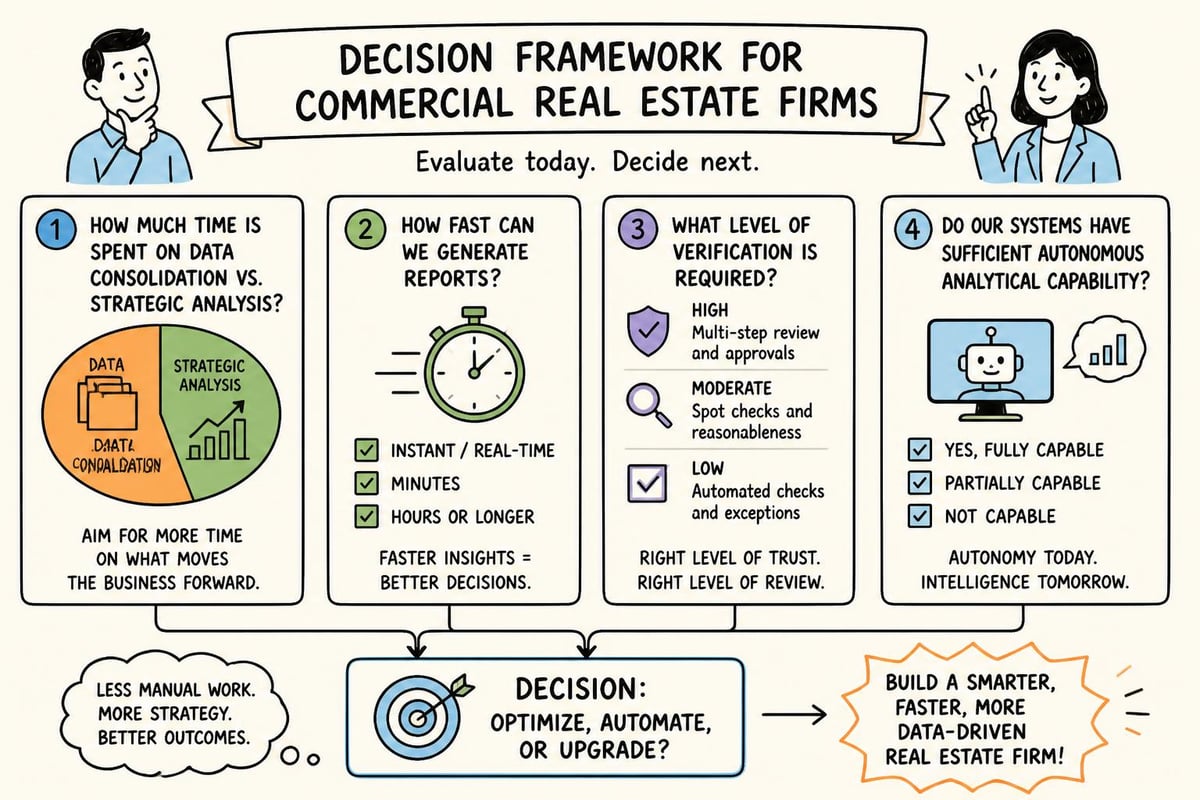
Most firms have invested substantially in property management systems, accounting platforms, and data warehouses. The question isn't whether these systems work-it's whether they deliver analytical output proportional to the data they contain. Several diagnostic questions reveal analytical gaps:
How long does portfolio reporting currently take? If asset managers spend multiple days each month compiling performance reports, the analytical layer is missing. Modern platforms should generate comprehensive portfolio analysis in under an hour.
What percentage of your team's time goes to data consolidation versus strategic analysis? Teams that spend over 50% of their time gathering and organizing data need better analytical infrastructure. The valuable work is interpreting implications and making decisions, not assembling spreadsheets.
Can you identify material NOI variances within 24 hours of occurrence? Reactive discovery of performance issues weeks after they emerge indicates insufficient monitoring capability. Continuous analysis should flag anomalies immediately.
How many manual verification steps do analytical outputs require? If reports need extensive cross-checking before stakeholder distribution, the platform isn't providing verifiable analysis. Source-linked outputs eliminate verification bottlenecks.
The Data Accumulation Advantage
An underappreciated aspect of AI-driven real estate asset management is learning capability. Generic models maintain static knowledge. Purpose-built platforms improve accuracy as they process more property data, learn portfolio-specific patterns, and refine analytical models.
This creates a compounding advantage. Early adoption means the platform learns your portfolio's unique characteristics-typical expense ratios, seasonal patterns, property-specific lease structures. Over time, anomaly detection becomes more precise and recommendations more relevant to your specific context.
The asset management reporting workflow exemplifies this improvement curve. Initial reports may require some formatting preferences, but the platform learns these parameters and applies them consistently across future deliverables. Teams that started using AI-driven platforms 18 months ago now receive substantially more refined outputs than new users, despite using the same underlying technology.
Security and Compliance in AI-Driven Workflows
Introducing AI into real estate asset management workflows raises legitimate security concerns. Property data, financial projections, and strategic plans are highly sensitive. Generic AI models that process data through public APIs or retain training information create unacceptable risks.
Enterprise-grade platforms address these concerns through comprehensive security frameworks:
SOC 2 Type 2 certification demonstrating audited security controls across data handling, access management, and processing protocols
Data residency controls ensuring information remains within specified geographic and system boundaries
Role-based access management aligning platform permissions with organizational hierarchy
Audit trails documenting every data access and analytical operation for compliance verification
Encryption standards protecting data in transit and at rest
These security measures aren't optional extras-they're fundamental requirements for institutional real estate asset management. Industry benchmarking research consistently shows security and compliance as top priorities for real estate investment managers evaluating new technology.
Integration with Existing Property Management Systems
The practical value of any analytical platform depends on integration quality with existing infrastructure. Real estate firms have invested millions in property management systems. Effective AI implementation augments these systems rather than requiring replacement.
Native connectors to major platforms eliminate custom development work. Direct integration with Yardi, RealPage, Entrata, AppFolio, and MRI Software means analytical workflows access live data automatically. Changes in the property management system immediately flow through to AI-driven analysis without manual data exports.
This integration architecture produces several operational benefits:
Single source of truth for all analytical outputs, eliminating version control issues
Real-time analysis reflecting current property conditions rather than outdated snapshots
Reduced IT burden since platform vendors maintain connector compatibility
Faster deployment timelines measured in weeks rather than months or quarters
Lower total cost of ownership compared to custom integration development
The commercial real estate database connectivity enables workflows that were previously impossible at scale. Cross-property analysis, portfolio-wide lease review, and comparative performance analysis all depend on seamless access to comprehensive property data.
Performance Benchmarking: Manual vs. AI-Driven Workflows
Quantifying the operational impact of AI-driven real estate asset management requires comparing specific workflow timelines. The differences are substantial:
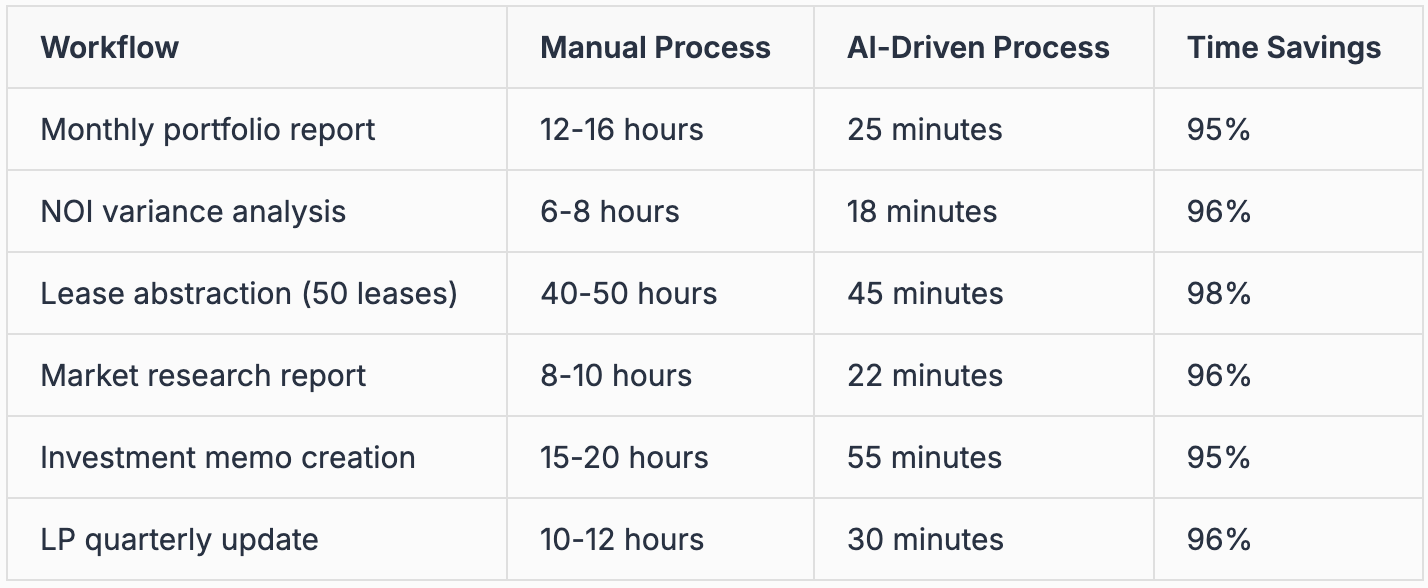
These time savings compound across teams and portfolios. An asset management team that previously spent 60 hours monthly on reporting and analysis can redirect 55+ hours toward strategic initiatives, stakeholder relationships, and value-creation opportunities.
The quality improvement matters as much as speed. Manual workflows introduce consistency variations depending on who performs the analysis. AI-driven platforms apply identical analytical rigor across every property and reporting period, eliminating variability in output quality.
Research from Apex Group's global real estate asset management survey highlights operational efficiency as a critical competitive differentiator. Firms that leverage advanced analytics report higher investor satisfaction and stronger portfolio performance attribution.
Strategic Implications for Asset Management Teams
The shift from manual workflows to AI-driven analysis fundamentally changes how asset management teams operate. Reactive problem-solving gives way to proactive strategy development. Time previously consumed by data consolidation redirects toward value creation.
Role definitions evolve when analytical mechanics become automated. Junior analysts spend less time building spreadsheets and more time interpreting implications. Senior asset managers focus on stakeholder strategy and capital allocation rather than report verification. Portfolio directors receive comprehensive analysis enabling faster, better-informed decisions.
This evolution doesn't eliminate positions-it elevates responsibilities. Teams that previously managed 20 properties with extensive manual effort can oversee 50+ properties with superior analytical depth. The limiting factor shifts from analytical capacity to strategic judgment and relationship management.
Firms competing for institutional capital face increasing pressure to demonstrate analytical sophistication. Limited partners expect detailed performance attribution, proactive risk management, and data-driven strategic planning. Alternative investment benchmarking research from PwC shows analytical capability directly correlates with fundraising success and fee compression resistance.
The Verifiable Output Standard
Perhaps the most significant differentiator between storage platforms and analytical platforms is output verifiability. In real estate asset management, numerical accuracy isn't aspirational-it's mandatory. Investment decisions, stakeholder reports, and regulatory filings depend on precise figures that trace accurately through supporting calculations.
Generic AI models generate plausible analysis that may contain subtle errors requiring extensive verification. A projected NOI figure might be directionally correct but mathematically imprecise. A market rent assumption might reflect general trends without linking to specific comparable properties.
Purpose-built platforms establish verifiable output as the standard. Every calculation includes formulas showing precisely how results were derived. Every market assumption links directly to source data with citations. Every figure in an investment memo traces back through the financial model to property-level inputs from the property management system.
This verification standard enables asset managers to distribute AI-generated analysis with confidence. Investment committees receive memos they can trust without spending hours fact-checking. Limited partners get quarterly updates with transparent sourcing. Acquisition teams present underwriting with full analytical transparency.
Building Your Analytical Capability Roadmap
Implementing AI-driven real estate asset management follows a structured progression. Firms that achieve the greatest value start with high-impact, repetitive workflows before expanding to complex strategic analysis.
Phase 1: Standardize repetitive reporting by automating monthly portfolio performance reports, NOI variance analysis, and occupancy tracking. These workflows generate immediate time savings and build confidence in platform accuracy.
Phase 2: Expand to analytical deliverables including market research, lease review, and comparative performance analysis. These workflows demonstrate the platform's ability to handle multi-step analytical tasks autonomously.
Phase 3: Integrate strategic workflows such as acquisition underwriting, investment memo creation, and LP reporting. These high-value deliverables show the platform's capacity for complex analysis requiring judgment and synthesis.
Throughout this progression, teams should evaluate platform performance against specific criteria:
Accuracy verification: Do outputs match manual calculations when cross-checked?
Source transparency: Can every figure trace back to original documents?
Time efficiency: Does the platform deliver finished analysis faster than manual processes?
Integration stability: Do data connections remain reliable without manual intervention?
Output consistency: Does analytical quality remain uniform across properties and time periods?
Successful implementations prioritize change management alongside technology deployment. Teams need training on how to leverage AI-generated analysis effectively, interpret outputs, and redirect time toward strategic priorities. The goal isn't replacing human judgment-it's eliminating mechanical work that prevents teams from applying judgment at scale.
Real estate asset management has evolved beyond data storage toward autonomous analytical capability. The firms that recognize this shift-and implement purpose-built AI platforms that connect to existing property management systems, run multi-step workflows autonomously, and deliver verifiable source-linked outputs-will capture significant competitive advantages through operational efficiency and analytical depth. Leni provides this AI layer for commercial real estate teams, transforming raw property data into finished deliverables while maintaining full transparency and verification through direct source linking.

Johanna Gruber
Johanna has spent the last 8 years helping marketing teams connect with audiences through content. Specializing in B2B SaaS and real estate.

Curious About AI?
Join the largest AI community for real estate online. Get bite-sized, real-world use case videos, plus practical tips and proven strategies from top industry experts on adopting AI effectively.
MEET LENI
AI SuperAgent Purpose Built for Investors and Operators.
Experience how professionals and teams in your domain are getting the edge using AI.
