Real Estate Investment Opportunities in 2026: A Guide

Real Estate Investment Opportunities in 2026: A Guide
The landscape of real estate investment opportunities continues to evolve in 2026, presenting both seasoned institutional investors and growing firms with a complex decision matrix. With global market uncertainty driving demand for tangible assets and income-generating properties, identifying which opportunities warrant serious diligence has become increasingly critical. Enterprise investment teams now face the dual challenge of scanning broader markets at scale while simultaneously conducting deep analysis on individual deals. This guide examines the most compelling opportunity categories available today, complete with specific examples, evaluation frameworks, and strategies to separate genuine prospects from noise.
1. Multifamily Properties in Secondary Markets
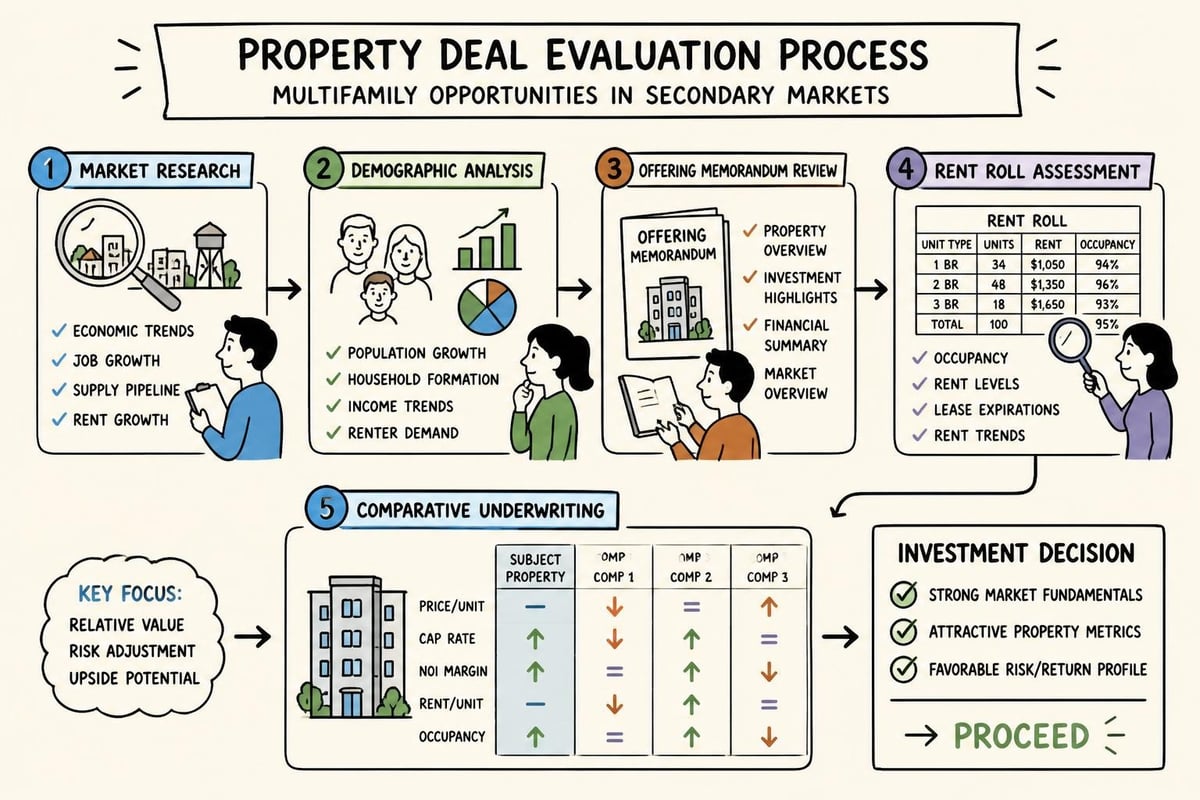
Secondary markets have emerged as one of the most attractive real estate investment opportunities in 2026, driven by migration patterns and relative affordability compared to gateway cities. Markets like Boise, Nashville, and Raleigh continue to demonstrate robust fundamentals that support both appreciation and cash flow.
Key Characteristics of High-Performing Secondary Markets
The strongest secondary markets share several measurable attributes that institutional investors can track systematically:
Population growth exceeding 1.5% annually over the past three years
Job diversification across multiple sectors, reducing economic concentration risk
Median home prices below $450,000, maintaining affordability for renters
Positive net migration from higher-cost coastal markets
Infrastructure investment signaling long-term municipal commitment
When evaluating multifamily opportunities in these markets, enterprise teams benefit from AI-powered real estate market analysis that can quickly aggregate employment data, demographic trends, and competitive supply pipelines across dozens of metros simultaneously.

The critical evaluation moment for these deals occurs when reviewing offering memoranda and rent rolls. Fast extraction of key terms, immediate identification of occupancy flags, and automatic comparison against market benchmarks transforms what was traditionally a multi-day analyst task into an hour of focused decision-making.
2. Industrial and Logistics Assets
E-commerce growth continues to fuel demand for industrial real estate investment opportunities, particularly last-mile distribution centers and temperature-controlled facilities. This sector has shown remarkable resilience through economic cycles, with institutional capital increasingly allocating toward logistics infrastructure.
Last-mile facilities located within 20 miles of major population centers command premium pricing but offer superior occupancy stability. The specific characteristics that distinguish valuable opportunities include:
Clear height exceeding 32 feet for modern racking systems
Trailer parking ratios of at least 1:1,000 square feet
Direct highway access within two miles
Power capacity supporting advanced automation systems
Zoning that permits 24/7 operations
Cold Storage and Specialized Logistics
Temperature-controlled warehousing represents a particularly compelling subset of industrial opportunities. The growth of online grocery delivery and pharmaceutical distribution has created structural demand that outpaces new supply in most markets.
Investors should focus on facilities built or renovated after 2015, as older cold storage properties often require prohibitive capital expenditures to meet current tenant requirements. The underwriting process for these specialized assets demands careful analysis of mechanical systems, energy costs, and tenant creditworthiness, areas where commercial real estate deal analyzers can rapidly surface potential issues from lengthy engineering reports and operating statements.
3. Office-to-Residential Conversions
The structural shift toward hybrid work has created one of the most nuanced real estate investment opportunities available today. Office-to-residential conversions offer the potential for substantial value creation, but success depends on rigorous property selection and market understanding.
Identifying Conversion Candidates
Not all distressed office buildings present viable conversion opportunities. Properties must meet specific physical criteria:
Floor plates narrower than 60 feet to allow natural light penetration
Floor-to-floor heights of at least 10 feet
Locations within walkable urban cores with residential demand
Building systems that can be economically adapted
Favorable zoning or expedited conversion pathways
Cities including Denver, Cleveland, and Atlanta have implemented streamlined approval processes that significantly improve conversion economics. These regulatory frameworks can reduce timeline risk by 12 to 18 months, directly impacting project returns.
The complexity of conversion underwriting requires analyzing both the as-is office asset and the projected residential product. Teams need to model acquisition costs, construction budgets, financing structures, and residual values simultaneously. Real estate AI tools can accelerate this multi-scenario modeling, allowing investors to quickly assess whether a specific building justifies the conversion capital.
4. Build-to-Rent Communities
Single-family rental communities developed specifically for lease rather than sale represent a rapidly growing category of real estate investment opportunities. This asset class appeals to institutional investors seeking residential exposure with operational efficiency advantages over scattered-site portfolios.
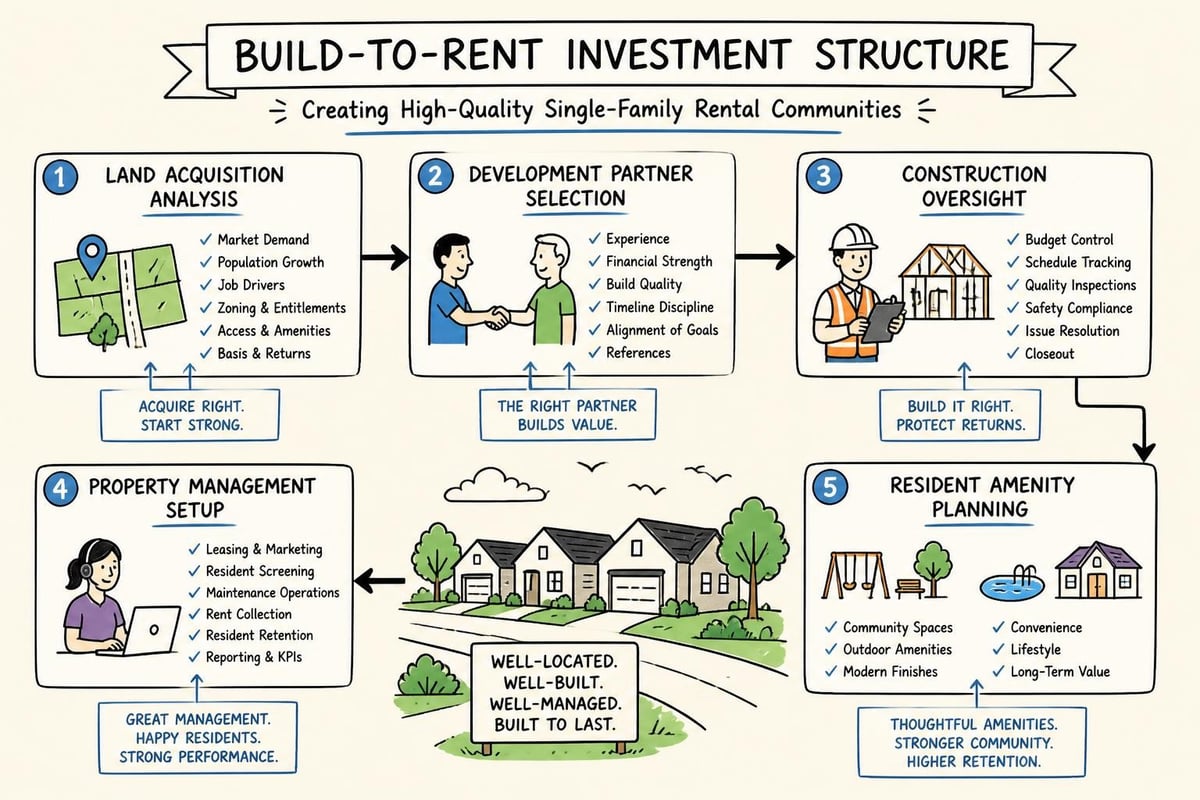
Build-to-rent developments typically feature 100 to 300 single-family homes within a master-planned community, offering residents detached living with amenity packages traditionally associated with apartments. The investment thesis combines single-family demand drivers with multifamily operational scale.
Key success factors for build-to-rent investments include:
Land acquisition in markets with strong single-family rental demand but limited affordable homeownership options
Development partnerships with experienced homebuilders who understand rental-specific design requirements
Property management platforms capable of efficiently operating dispersed units
Amenity programs that justify premium rents over traditional single-family rentals
The build-to-rent sector has attracted significant institutional capital in 2026, with several dedicated funds raising over $500 million specifically for this strategy. However, the development risk inherent in ground-up construction demands thorough feasibility analysis and ongoing construction monitoring.
5. Real Estate Investment Trusts (REITs)
For investors seeking liquid real estate exposure without direct property management responsibilities, REITs offer compelling diversification opportunities across property types and geographic markets. Public REITs trade daily, providing liquidity unavailable in direct property ownership.
Sector-Specific REIT Categories
Different REIT categories offer exposure to distinct real estate investment opportunities, each with unique risk-return profiles:
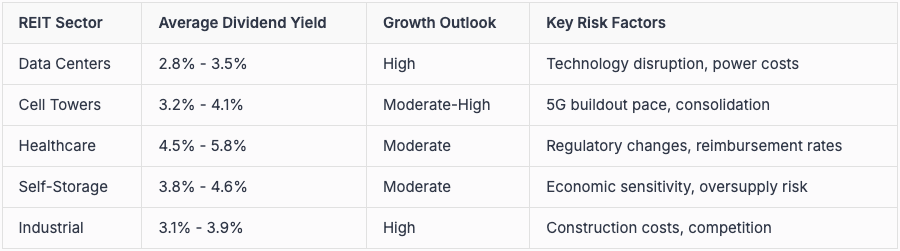
Specialized sectors including data centers and cell towers provide exposure to technology-driven real estate demand that traditional property categories cannot capture. These infrastructure-oriented REITs benefit from long-term tenant contracts and limited competition for existing assets.
When evaluating REIT investments, analyzing quarterly supplemental packages, property-level performance metrics, and management track records requires systematic review of extensive financial disclosures. Enterprise teams tracking multiple REITs benefit from platforms that can extract and compare key performance indicators across quarterly reports automatically.
6. Opportunistic Distressed Debt
The commercial real estate debt market in 2026 presents selective opportunities for investors with expertise in workout situations and asset repositioning. Rising interest rates through 2024 and 2025 created refinancing pressure for properties acquired during the low-rate environment, leading to increased note sales and loan modifications.
Distressed debt strategies require sophisticated analysis capabilities and operational expertise to convert loan positions into either performing debt or owned real estate. Successful investors in this space typically focus on specific property types where they possess repositioning expertise.
Target investment profiles include:
Performing loans on under-managed assets with clear value-add potential
Sub-performing loans where borrower cooperation can enable workout solutions
Non-performing loans backed by properties in recovery markets
Mezzanine positions with favorable control rights
The complexity of evaluating loan portfolios demands rapid analysis of borrower financials, underlying property performance, loan documentation, and market conditions. AI underwriting tools for real estate can accelerate the initial screening process, allowing investment committees to focus diligence resources on the most promising situations.
7. Emerging Markets with Infrastructure Catalysts
Geographic markets experiencing significant infrastructure investment often present compelling real estate investment opportunities ahead of broader institutional recognition. Transportation improvements, university expansions, and corporate relocations serve as predictable demand catalysts.
Identifying Infrastructure-Driven Opportunities
Markets with announced or under-construction infrastructure projects offer quantifiable investment triggers:
Transit expansions: Light rail or commuter rail projects create value along planned corridors
Highway improvements: Interchange additions or corridor widening enhance industrial site viability
Airport expansions: Increased connectivity supports hospitality and office demand
Stadium or arena construction: Anchors mixed-use development in urban cores
University investment: Student housing and off-campus retail follow major campus projects
Cities including Charlotte, Phoenix, and Columbus have announced multi-billion dollar infrastructure programs extending through 2030, creating predictable development timelines for investors willing to commit capital ahead of project completion.
The challenge with infrastructure-play investing lies in accurately timing market entry and exit around construction schedules and demand absorption. Detailed project tracking and market absorption modeling separate successful infrastructure investors from those who enter too early or too late.
8. Senior Housing and Healthcare Properties
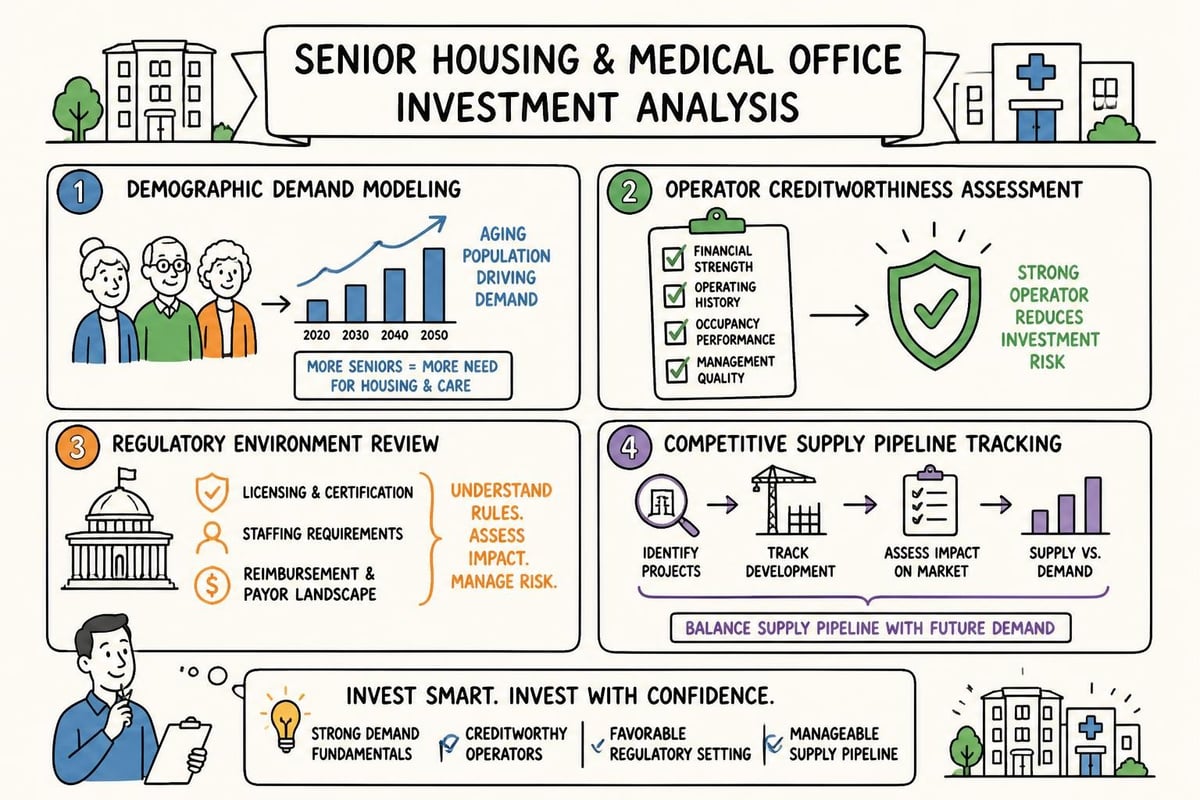
Demographic trends make senior housing one of the most fundamentally supported real estate investment opportunities over the coming decade. The 75+ population segment is projected to grow by 45% through 2035, driving demand for independent living, assisted living, and memory care facilities.
Healthcare real estate extends beyond senior housing to include medical office buildings, ambulatory surgery centers, and life science facilities. These property types offer relatively stable cash flows through tenant types less sensitive to economic cycles than traditional office or retail tenants.
Investment considerations for healthcare properties include:
Operator quality and financial strength
Regulatory environment in target states
Reimbursement trends affecting tenant economics
Certificate of need requirements limiting competition
Physical plant suitability for current care delivery models
Medical office buildings located on or adjacent to hospital campuses command premium valuations due to physician preference for proximity to inpatient facilities. These assets typically feature long-term leases with creditworthy health systems, though some tenant concentration risk exists.
Senior housing investments require careful evaluation of local market supply pipelines, as oversupply can quickly undermine occupancy and rate growth. Enterprise investment teams benefit from systematic tracking of development permits, certificate of need applications, and demographic forecasts across target markets.
9. 1031 Exchange Strategies for Portfolio Scaling
For investors holding appreciated properties, 1031 exchanges provide powerful tax-deferral mechanisms to facilitate portfolio repositioning and scaling. This strategy allows investors to defer capital gains taxes by reinvesting proceeds into like-kind replacement properties.
Strategic use of 1031 exchanges enables systematic portfolio evolution from smaller, management-intensive assets into larger, institutionally-managed properties. A common progression involves exchanging multiple single-family rentals into a multifamily property, then subsequently into a net-lease asset or REIT shares through a Delaware Statutory Trust structure.
Exchange Planning and Execution
Successful 1031 strategies require meticulous planning around tight statutory deadlines:
45-day identification period: Replacement properties must be identified in writing
180-day completion period: Transactions must close within this timeframe
Equal or greater value: Replacement property must equal or exceed relinquished property value
Qualified intermediary: Required third-party facilitator cannot be investor's agent or advisor
The compressed timeline for identifying and acquiring replacement properties creates execution risk, particularly in competitive markets. Investors who maintain ongoing relationships with brokers and systematically track potential acquisition targets before initiating exchanges experience higher success rates.
When evaluating multiple potential replacement properties during the 45-day identification window, the ability to rapidly underwrite several options and compare risk-adjusted returns becomes critical. Teams equipped to quickly analyze offering memoranda and financial statements across multiple opportunities can make more informed exchange decisions under time pressure.
10. Blockchain-Enabled Real Estate Tokenization
Emerging technology is creating novel real estate investment opportunities through property tokenization and blockchain-based ownership structures. Research into tokenization of real estate assets demonstrates how blockchain can address traditional liquidity and transparency challenges in property markets.
Tokenization involves converting property ownership into digital tokens that can be traded on blockchain platforms, potentially enabling fractional ownership and reducing transaction friction. While regulatory frameworks continue to evolve, several platforms now offer tokenized commercial property investments.
Potential advantages of tokenized real estate include:
Fractional ownership enabling smaller investment minimums
Enhanced liquidity through secondary trading
Automated compliance through smart contracts
Reduced transaction costs versus traditional closings
Global investor access to local properties
Current tokenization platforms focus primarily on institutional-quality commercial properties with established cash flows. Residential tokenization remains limited due to regulatory complexity and operational challenges around managing multiple fractional owners.
Investors evaluating tokenized opportunities should carefully review platform security, custody arrangements, regulatory compliance, and exit liquidity. The technology enables novel ownership structures, but fundamental property underwriting remains essential regardless of the ownership vehicle.
11. High-Yield Strategies in the Current Environment
In 2026, investors seeking top yields across asset classes continue to find compelling options within real estate investment opportunities. Property types offering current income through stable cash flows appeal to both institutional investors and individual portfolio managers.
Net-lease properties, where tenants assume responsibility for property expenses, offer relatively predictable income streams with minimal landlord management obligations. Investment-grade tenants including drugstore chains, dollar stores, and quick-service restaurants anchor most net-lease transactions.
Yield-oriented property categories currently offering attractive risk-adjusted returns include:
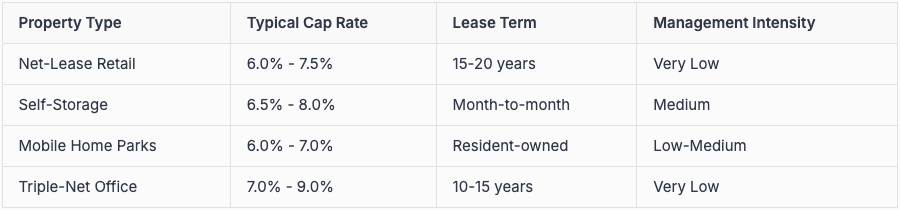
The primary risk in net-lease investing involves tenant credit quality and lease duration. Properties with investment-grade tenants and 15+ year remaining lease terms trade at premium prices but offer greater income security than shorter-lease alternatives.
Self-storage facilities provide yield through operational efficiency rather than long-term leases. Successful operators leverage technology for remote management, reducing payroll costs while maintaining high occupancy through dynamic pricing strategies. Investment monitoring tools help portfolio managers track occupancy trends, rate changes, and competitive pressures across multiple facilities systematically.
12. Technology-Enhanced Deal Sourcing
The proliferation of data and analytical tools has transformed how investors identify real estate investment opportunities. Machine learning applications can detect properties listed below market value in real-time, providing early access to potentially attractive acquisitions.
Modern deal sourcing combines multiple data streams including:
Off-market property owner databases
Distress indicators from public records
Broker relationship management systems
Automated listing alert services
Predictive analytics identifying likely sellers
Enterprise investment teams now employ sophisticated filtering criteria to manage deal flow efficiently. Rather than manually reviewing every opportunity, automated systems surface only those properties meeting predefined investment parameters around location, property type, size, and pricing.
The challenge shifts from finding deals to qualifying which opportunities warrant serious diligence. When an interesting property surfaces, investors need rapid answers: What does recent market research say about this submarket? Are there red flags in the offering documents? How does preliminary underwriting compare to investment criteria?
Platforms designed for AI-assisted deal sourcing can immediately pull relevant market context, extract key terms from deal documents, and run first-pass financial models. This capability allows investment committees to separate genuine opportunities from those that merely appear attractive on initial review.
The emphasis on speed and accuracy in preliminary analysis becomes particularly critical when multiple investors compete for the same opportunity. Teams that can complete initial evaluation and move to letters of intent within 48 hours gain competitive advantages over those requiring week-long analyst review cycles.
Navigating the diverse landscape of real estate investment opportunities in 2026 demands both broad market awareness and the analytical capacity to evaluate specific deals rapidly and accurately. Whether your team manages enterprise-scale portfolios tracking hundreds of markets and potential acquisitions, or you're sizing up individual opportunities from offering memoranda and financial statements, the ability to quickly separate compelling prospects from marginal ones drives investment success. Leni provides purpose-built AI capabilities for exactly these evaluation moments: instant market research with live source citations, automated extraction of critical terms from deal documents, and first-pass underwriting that helps investment professionals focus diligence resources where they matter most.

Johanna Gruber
Johanna has spent the last 8 years helping marketing teams connect with audiences through content. Specializing in B2B SaaS and real estate.

Curious About AI?
Join the largest AI community for real estate online. Get bite-sized, real-world use case videos, plus practical tips and proven strategies from top industry experts on adopting AI effectively.
MEET LENI
AI SuperAgent Purpose Built for Investors and Operators.
Experience how professionals and teams in your domain are getting the edge using AI.
