Real Property Investment: A 2026 Guide for CRE Pros
.webp&w=1920&q=75)
Real Property Investment: A 2026 Guide for CRE Pros
The best real property investment decisions in 2026 aren't made faster-they're made with better information architecture. Asset managers sitting on $500M+ portfolios spend less time debating cap rates and more time questioning whether their analytical infrastructure can actually deliver verifiable answers at scale. The firms winning deals today have solved a specific problem: they've eliminated the gap between data extraction and decision-making. That transformation starts with understanding what real property investment actually demands from your team.
What Separates Institutional Real Property Investment from Speculation
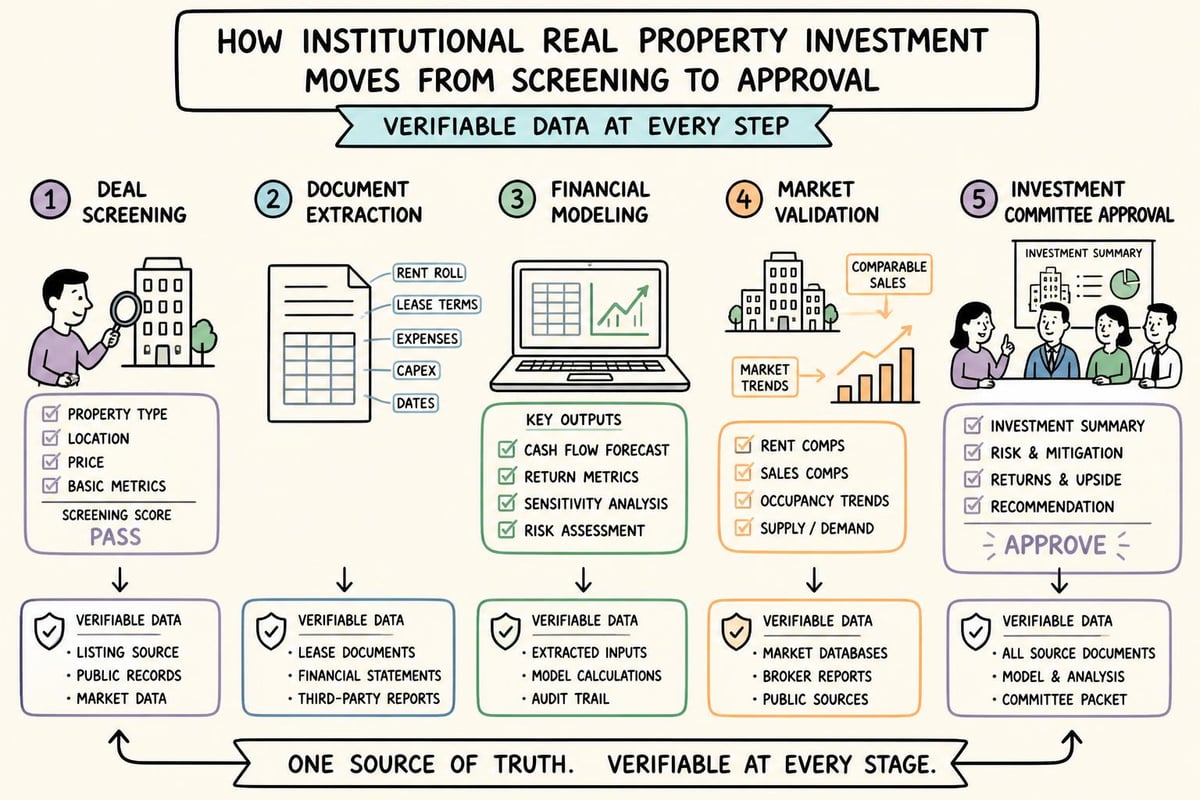
Real property investment at the institutional level operates on verifiable assumptions, not market sentiment. Every acquisition decision requires documented support: rent rolls validated against lease abstracts, operating histories reconciled to T-12 statements, market comps sourced from multiple reliable databases.
The difference between speculation and institutional-grade real property investment shows up in your underwriting documentation. Speculators build models on assumptions. Professional asset managers build models on extracted data with direct source links to every input.
The Core Components of Institutional Real Property Investment
Successful real property investment programs share common analytical infrastructure:
Financial modeling workflows that connect rent rolls, operating statements, and market assumptions into defensible proformas
Document extraction systems that pull lease data, financial statements, and offering memorandums into structured formats
Market research capabilities that deliver sourced, verifiable comparable data rather than anecdotal evidence
Portfolio monitoring tools that track actual performance against underwriting assumptions across multiple assets
According to The National Council of Real Estate Investment Fiduciaries (NCREIF), institutional investors managing significant portfolios require standardized performance measurement and transparent reporting structures. These benchmarks only matter when your analytical systems can produce comparable outputs.
The operational reality: most asset management teams spend 60-70% of their time on data preparation rather than actual analysis. Extracting lease terms, reconciling operating statements, building comparable datasets-this work doesn't require judgment. It requires accuracy and speed.
Building Analytical Capacity for Real Property Investment at Scale
Portfolio operators managing multiple assets face a compounding problem: analytical requirements grow exponentially with portfolio size. A single-asset investor needs one underwriting model. A 50-asset portfolio needs 50 models, quarterly monitoring reports, variance analyses, and strategic repositioning plans.
Real property investment firms solving this problem aren't hiring more analysts. They're restructuring their analytical workflows to separate mechanical work from strategic judgment.
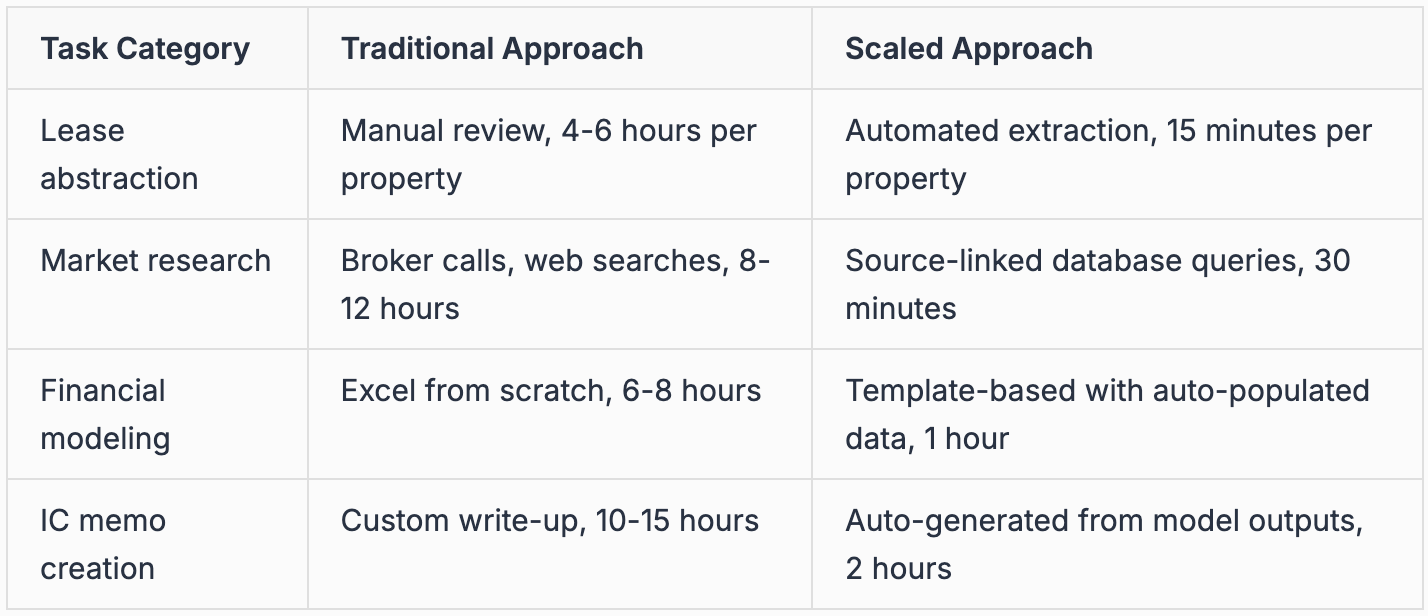
Platforms purpose-built for commercial real estate analytics handle the mechanical work autonomously. They connect directly to property management systems, extract structured data from unstructured documents, and produce verifiable outputs with source links to every assumption.
Why Property Management System Integration Matters
Real property investment decisions made without current operating data are just educated guesses. The gap between underwriting assumptions and actual performance shows up in your property management system first.
Direct integration with Yardi, RealPage, and Entrata means your analytical tools work with live data rather than exported spreadsheets from last quarter. Variance analysis becomes continuous rather than quarterly. Portfolio optimization runs on current occupancy, not lagging indicators.
This connectivity transforms how acquisitions teams evaluate new opportunities. When you can instantly compare a potential acquisition's projected performance against your existing portfolio's actual metrics, deal evaluation shifts from theoretical to empirical.
Advanced Underwriting for Real Property Investment
The quality of your real property investment decisions depends entirely on your underwriting assumptions-and whether you can defend them to your investment committee with documented sources.
Modern financial modeling and underwriting requires more than Excel proficiency. It requires systems that maintain data lineage from source document to final output. Every rent assumption should trace back to a specific lease. Every market rent projection should link to comparable transactions with dates and sources.
Components of Defensible Real Property Investment Underwriting
Asset managers building institutional-grade underwriting systems focus on three elements:
Source-linked assumptions: Every input in your proforma should reference its origin-specific lease clause, market comp transaction, operating statement line item
Scenario analysis at scale: Testing 20+ sensitivity scenarios shouldn't require 20 hours of manual Excel work
Standardized outputs: Investment committee memos and presentation decks should auto-generate from your financial model with consistent formatting
The research presented in the Routledge Companion to Real Estate Investment emphasizes that institutional real property investment requires rigorous analytical frameworks. The practical challenge is building systems that execute those frameworks efficiently.
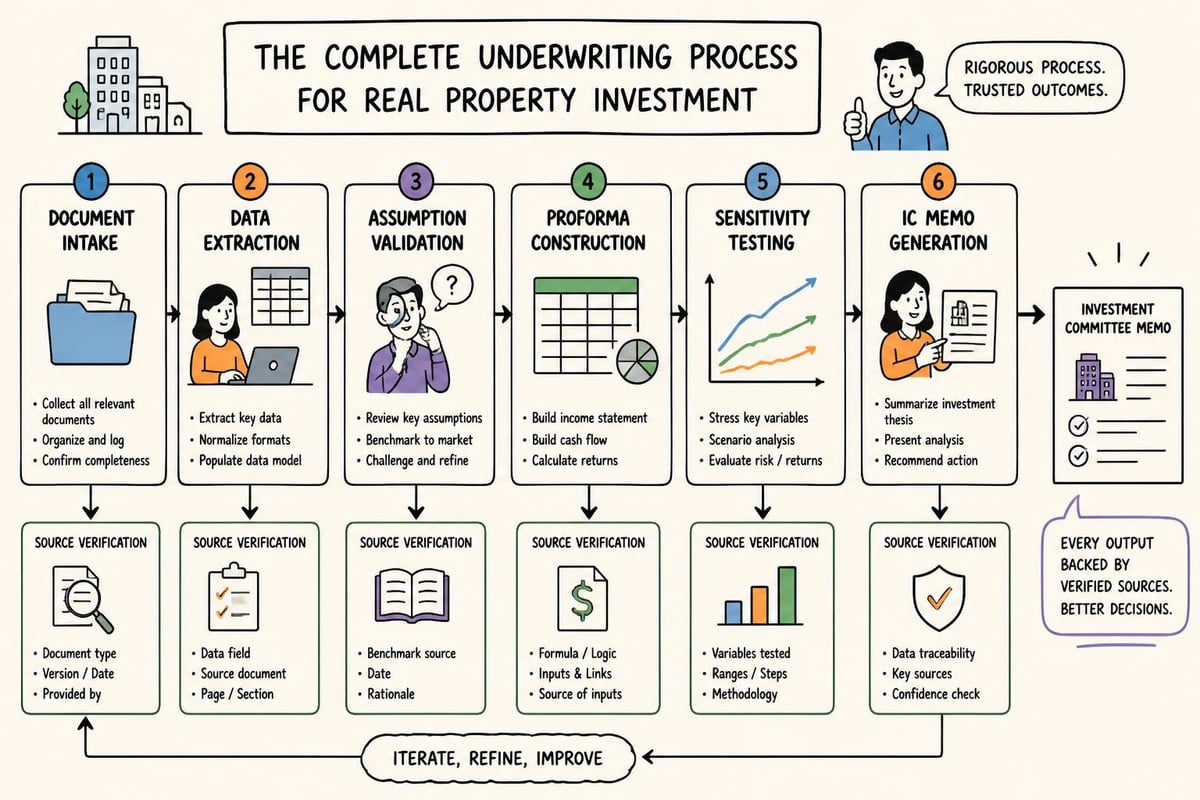
Teams running 50+ underwriting analyses annually can't afford to build each model from scratch. They need template-based systems that adapt to property-specific details while maintaining analytical consistency.
Market Research Infrastructure for Real Property Investment
Real property investment decisions fail when market assumptions don't match reality. The problem isn't access to data-it's organizing that data into actionable intelligence with transparent sourcing.
Acquisitions teams evaluating new markets need answers to specific questions:
What rent growth has actually occurred in comparable properties over the past 36 months?
Which submarkets show occupancy compression that might signal upcoming rent pressure?
How do operating expense ratios in target properties compare to portfolio averages?
Generic market reports don't answer these questions. You need market research capabilities that deliver property-specific, source-linked comparable data.
Building Verifiable Market Assumptions
The difference between defensible and speculative real property investment shows up in how you source market assumptions:
Speculative approach: "Brokers say the market is strong, we're underwriting 4% annual rent growth"
Defensible approach: "Analysis of 47 comparable transactions in the target submarket over the past 24 months shows median rent growth of 3.2%, with performance variance of +/- 1.1% based on property age and proximity to transit"
Professional asset managers demand the second approach. That level of specificity requires analytical infrastructure that can query multiple data sources, filter for relevant comparables, and present findings with direct links to source documents.
According to resources from Cornell University's real estate guide, thorough market research requires combining industry reports, transaction databases, and economic indicators into comprehensive analyses.
Portfolio Management and Real Property Investment Strategy
Real property investment doesn't end at acquisition. Portfolio operators managing multiple assets need continuous monitoring systems that track actual performance against underwriting assumptions and identify optimization opportunities.
The strategic question facing most portfolio managers: which assets deserve capital allocation for repositioning, and which should be prepared for disposition?
Performance Monitoring at Portfolio Scale
Effective commercial real estate portfolio management requires systematic tracking of key metrics across all holdings:
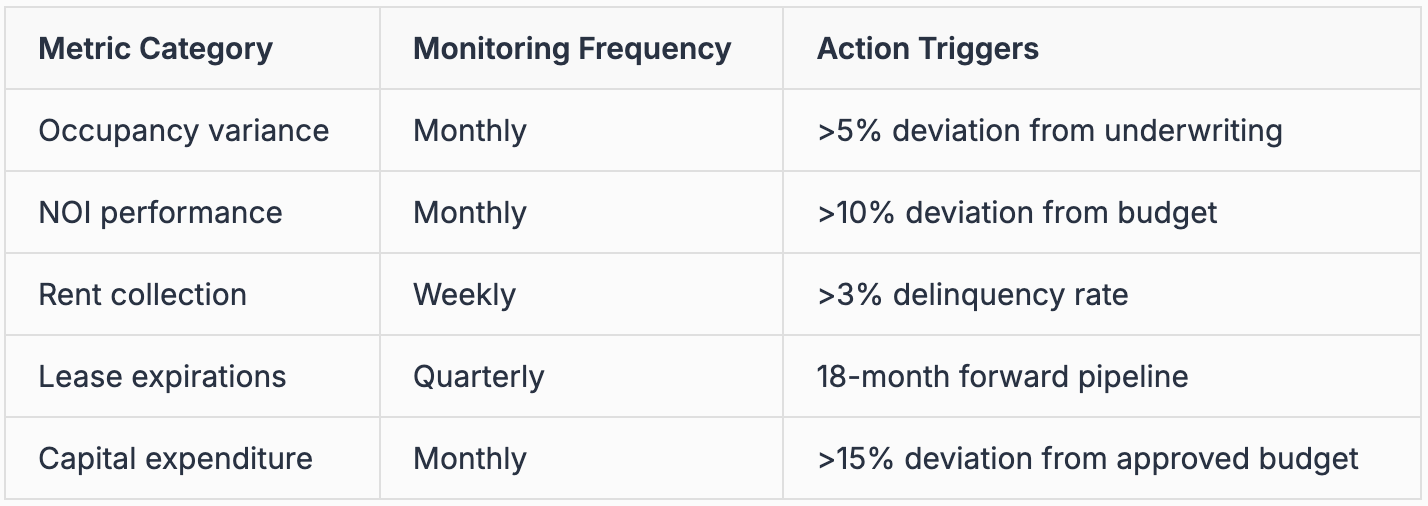
Manual portfolio monitoring breaks down around 15-20 assets. Beyond that threshold, asset managers need automated systems that pull data directly from property management platforms and flag variances requiring attention.
Real property investment firms with mature analytical capabilities run continuous variance analysis. They know which assets are outperforming underwriting assumptions (and why) and which need strategic intervention before performance degrades further.
Document Management and Real Property Investment Due Diligence
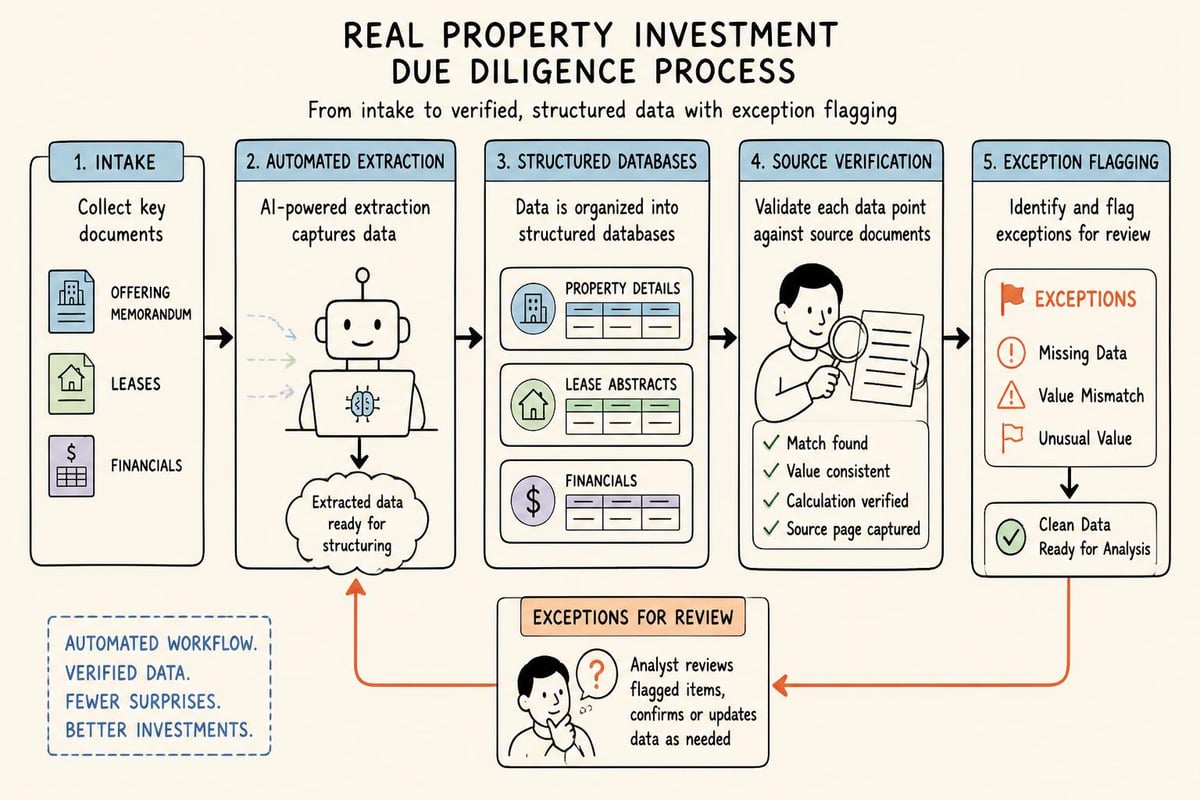
Due diligence determines whether your real property investment thesis survives contact with actual lease terms and operating realities. The volume of documentation in commercial transactions-offering memorandums, rent rolls, lease files, operating statements, environmental reports-creates systematic risk if your extraction process isn't both accurate and efficient.
Asset managers evaluating 10+ acquisitions annually can't spend three weeks manually abstracting leases for each opportunity. The market moves too quickly.
Purpose-built document extraction tools handle the mechanical work: pulling lease terms, tenant improvement allowances, renewal options, and operating expense structures from PDF lease files into structured databases. The outputs aren't summaries-they're extracted data fields with page references to source documents.
Why Extraction Accuracy Matters More Than Speed
Fast but inaccurate lease abstraction creates catastrophic risk in real property investment. A missed renewal option or misread rent escalation clause can destroy your investment thesis.
The solution isn't slower manual review-it's extraction systems that provide verifiable outputs. Every extracted data point should include its source page number and confidence score. Your team reviews exceptions, not every field.
This approach transforms due diligence timelines. What traditionally took 15-20 business days can compress to 3-5 days with maintained accuracy and better documentation.
Investment Committee Preparation for Real Property Investment
Investment committee approval represents the final gate in real property investment decisions. The quality of your IC presentation determines whether your deal receives capital allocation.
Professional acquisitions teams know that IC approval depends on three elements: defensible assumptions, clear risk articulation, and efficient information presentation. Creating investment memos and presentations that deliver all three shouldn't consume 15 hours of senior analyst time.
Components of Effective IC Materials
Strong investment committee packages for real property investment include:
Executive summary: Deal thesis, investment highlights, and key risks in one page
Market overview: Submarket fundamentals with sourced comparable data
Financial analysis: Proforma returns across base, upside, and downside scenarios
Risk assessment: Specific risks with probability-weighted impact analysis
Recommendation: Clear action request with capital allocation requirements
The most sophisticated platforms auto-generate these materials directly from underwriting models. The analyst's role shifts from document assembly to strategic review and refinement.
According to Wikipedia's overview of real estate investing, successful real property investment requires rigorous valuation methods and careful market analysis. IC materials should demonstrate both.
Technology Infrastructure for Real Property Investment Operations
Real property investment firms competing for deals in 2026 need analytical infrastructure that produces answers in hours, not weeks. The bottleneck isn't access to capital-it's analytical capacity.
Asset managers building competitive advantage focus on three technology requirements:
Direct PMS integration: Analytical tools should pull live data from Yardi, RealPage, and Entrata without manual exports
Multi-step task automation: Complex workflows like full deal underwriting should run autonomously from document intake to IC memo generation
Verifiable outputs: Every analytical product should include source links to supporting documentation
Generic AI tools can't deliver this functionality. Real property investment requires purpose-built platforms that understand lease structures, operating statements, and market comps.
The operational difference shows up in cycle time. Traditional teams spend 40-60 hours on initial underwriting and due diligence for a typical acquisition. Teams with proper analytical infrastructure complete the same work in 10-15 hours with better documentation and source verification.
Selecting Real Property Investment Technology
Asset managers evaluating new analytical platforms should focus on specific capabilities rather than general features:
Can the system extract lease data from your actual lease documents with verifiable accuracy?
Does it connect directly to your existing property management system?
Can it generate investment committee memos that meet your specific format requirements?
Does every output include source links to supporting documentation?
Platforms that can't demonstrate these capabilities with your actual documents and workflows won't solve your operational problems. For insights into how modern asset managers evaluate technology solutions, see real estate software for investors.
Risk Management in Real Property Investment
Every real property investment carries specific risks: market risk, tenant credit risk, interest rate risk, operational risk, and exit risk. Professional asset managers don't avoid risk-they identify, quantify, and price it into acquisition decisions.
The analytical challenge: building risk assessment frameworks that move beyond generic checklists into probability-weighted scenario analysis.
Quantifying Real Property Investment Risk
Effective risk management requires systematic evaluation across multiple dimensions:
Market risk: Sensitivity to rent growth assumptions, occupancy changes, and expense inflation
Tenant risk: Concentration analysis, credit evaluation, and lease rollover exposure
Capital markets risk: Interest rate sensitivity, refinancing risk, and exit cap rate assumptions
Operational risk: Management transition, deferred maintenance, and regulatory changes
Each risk category demands specific analytical approaches. Market risk requires robust comparable data and trend analysis. Tenant risk needs credit evaluation and lease term mapping. Capital markets risk demands scenario testing across rate environments.
The Library of Congress guide to real estate investment trusts provides useful context on how institutional investors approach risk management in real property investment vehicles.
Emerging Trends in Real Property Investment Analysis
Real property investment in 2026 operates in a dramatically different analytical environment than even three years ago. Two trends are reshaping how asset managers make decisions:
Trend 1: Shift from static to continuous analysis Traditional underwriting happened at acquisition, then again at refinancing or disposition. Modern portfolio management requires continuous reunderwriting as market conditions and property performance evolve.
Trend 2: Data lineage becomes competitive advantage Investment committees increasingly reject analyses that can't trace assumptions back to source documents. The ability to produce verifiable outputs with transparent sourcing separates institutional-grade analysis from speculation.
Both trends demand analytical infrastructure that most firms don't currently possess. The competitive gap is widening between asset managers who've solved these operational challenges and those still running manual processes.
Research on blockchain-based tokenization of real estate assets suggests that transparency and verifiable provenance will become increasingly important in real property investment markets. The operational systems you build today determine your competitive position tomorrow.
Building Analytical Capacity for Long-Term Success
Real property investment success over the next decade will depend more on analytical infrastructure than on access to deal flow. The firms that can evaluate opportunities faster, with better documentation and verifiable assumptions, will win deals.
That capability requires purpose-built platforms that handle the mechanical analytical work autonomously while maintaining human oversight on strategic decisions. The goal isn't replacing analyst judgment-it's eliminating the manual data preparation that prevents analysts from applying that judgment at scale.
For asset managers serious about real estate equity investment at institutional scale, the question isn't whether to upgrade analytical infrastructure but how quickly you can implement systems that deliver verifiable, source-linked outputs across your entire deal pipeline and portfolio.
Real property investment in 2026 demands analytical infrastructure that most firms haven't built yet. The gap between market-leading performance and operational mediocrity increasingly comes down to whether your team spends time on data preparation or strategic analysis. Leni eliminates that gap by handling the mechanical analytical work autonomously-financial modeling, lease extraction, market research, and IC memo creation-while delivering verifiable outputs with direct source links to every assumption. Purpose-built for asset managers and acquisitions teams, Leni connects directly to your property management systems and learns from your data to become more accurate over time.

Johanna Gruber
Johanna has spent the last 8 years helping marketing teams connect with audiences through content. Specializing in B2B SaaS and real estate.

Curious About AI?
Join the largest AI community for real estate online. Get bite-sized, real-world use case videos, plus practical tips and proven strategies from top industry experts on adopting AI effectively.
MEET LENI
AI SuperAgent Purpose Built for Investors and Operators.
Experience how professionals and teams in your domain are getting the edge using AI.
