How to Reduce AI Inference Costs in Enterprise CRE

How to Reduce AI Inference Costs in Enterprise CRE
Enterprise commercial real estate teams are discovering a costly pattern: their AI bills are growing faster than their output quality. The culprit isn't AI adoption itself, but a fundamental architectural mismatch. When every task, from extracting property addresses to complex market analysis, routes through the same frontier model, inference costs spiral out of control. For teams running AI across underwriting, reporting, market research, and portfolio monitoring, the solution isn't doing less with AI. It's doing more strategically by matching task complexity to the right model size.
Understanding the Core Cost Drivers in AI Inference
AI inference costs accumulate from four primary sources that compound quickly in enterprise workflows. Token volume leads the list, where each API call processes input tokens (your prompt and data) plus output tokens (the generated response). When teams send entire property portfolios or market reports through large language models dozens of times daily, token consumption reaches millions per month.
Model size amplifies every token processed. Frontier models like GPT-4 or Claude Opus deliver exceptional reasoning capabilities, but they also carry premium pricing per token. The cost difference between model tiers is substantial:

Task frequency multiplies these base costs. A workflow that calls an AI model 1,000 times daily costs dramatically more than one with 100 calls, even if individual tasks seem trivial. Redundant calls represent perhaps the most preventable expense: re-processing identical data, regenerating similar reports, or validating information already confirmed.
How CRE Teams Accumulate Unnecessary Inference Costs
Commercial real estate workflows involve high-frequency, data-intensive operations that magnify inefficient AI architecture. Consider a typical real estate investment analysis software workflow: extracting rent rolls from PDFs, validating comparable properties, generating variance reports, drafting investment memos, and synthesizing market conditions.
When all these tasks route to a single frontier model, teams pay premium rates for simple operations. Extracting a tenant name from a standardized rent roll requires pattern recognition, not advanced reasoning. Yet frontier models process this task at 10-15x the cost of smaller alternatives.
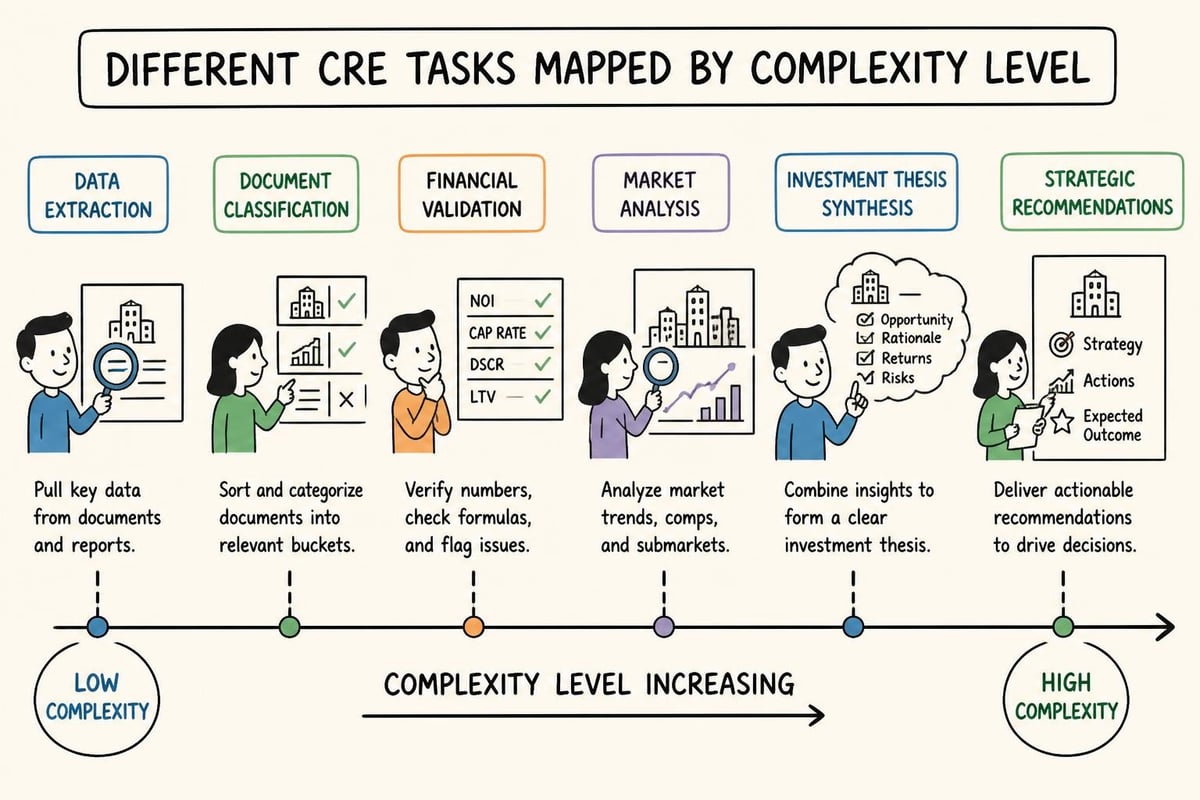
The frequency problem compounds this mismatch. Underwriting teams might process 50-100 properties weekly. Portfolio monitoring runs daily variance checks across hundreds of assets. Each unnecessary frontier model call adds incremental cost that becomes material at scale.
Strategic Model Matching: The Primary Lever to Reduce AI Inference Costs
The most effective strategy to reduce AI inference costs is architectural: route tasks to appropriately sized models based on complexity requirements. This approach maintains output quality while eliminating premium pricing for routine work.
Task complexity determines optimal model selection. Simple extraction, classification, and validation tasks perform excellently on small language models (SLMs). These operations follow consistent patterns, work with structured data, and produce deterministic outputs. Mid-tier models handle standard analytical work: financial calculations, comparative analysis, and draft generation. Frontier models reserve their capabilities for true complexity: synthesizing conflicting data sources, evaluating strategic scenarios, or reasoning through ambiguous situations.
Implementing a Model-Matching Framework
Organizations can reduce AI agent inference costs systematically by categorizing their workflows into three tiers matched to appropriate model sizes.
Tier 1: Small Language Models for High-Volume Extraction
Extracting property details from documents
Classifying document types and data fields
Validating data against known formats
Identifying standard lease terms
Parsing financial statements into structured formats
These tasks represent 60-70% of typical CRE AI calls but require minimal reasoning capability. SLMs deliver 95%+ accuracy at baseline cost, creating immediate savings.
Tier 2: Mid-Tier Models for Standard Analysis
Calculating financial metrics and returns
Comparing properties against market benchmarks
Generating narrative explanations for variance
Drafting sections of investment memos
Summarizing market research reports
Mid-tier models balance capability with efficiency, handling structured analytical work that follows established methodologies without requiring frontier-model reasoning.
Tier 3: Frontier Models for Complex Reasoning
Synthesizing conflicting market indicators
Evaluating strategic positioning decisions
Assessing unusual deal structures
Generating investment thesis narratives
Identifying non-obvious portfolio risks
Reserve frontier models for situations demanding genuine analytical judgment and novel synthesis. This selective deployment maintains decision quality while containing costs.
Advanced Optimization Techniques Beyond Model Selection
While model matching provides the primary cost reduction lever, several complementary techniques further optimize inference spending. Teams using AI for real estate private equity operations should layer these approaches for maximum efficiency.
Caching and Redundancy Elimination
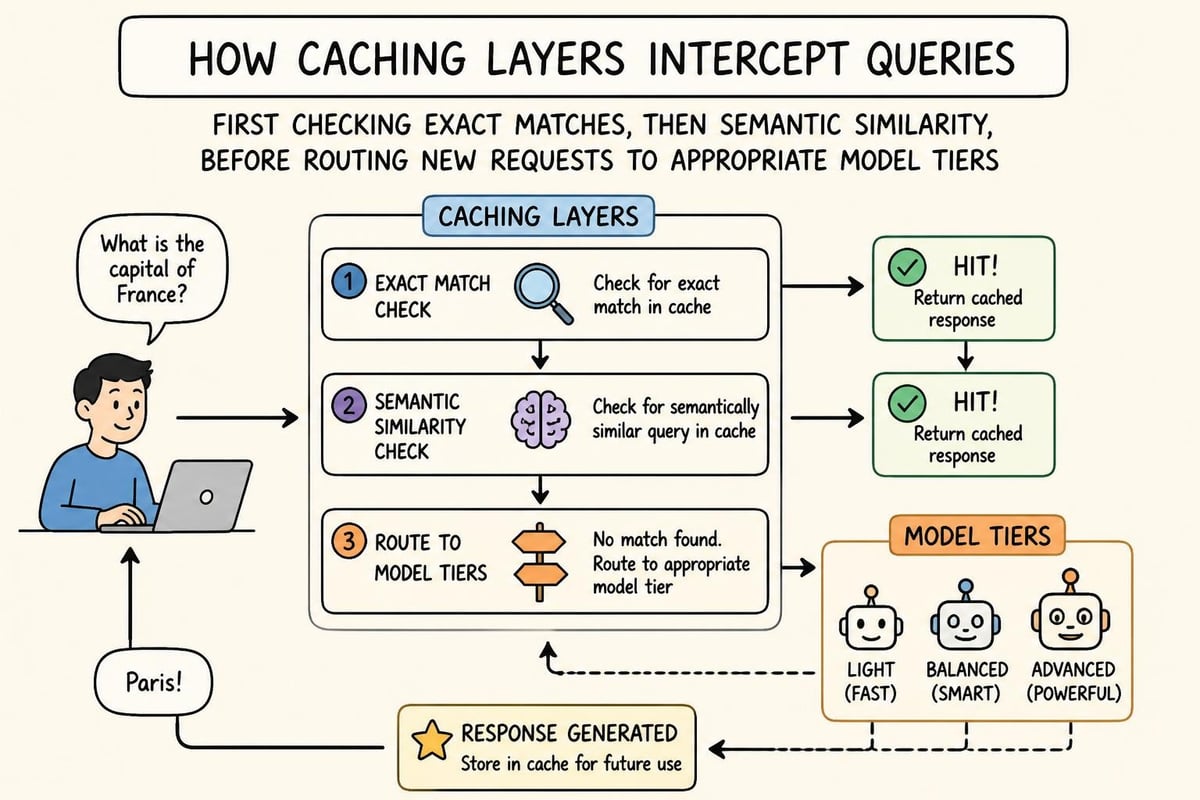
Caching stores frequently accessed results to prevent duplicate processing. When multiple analysts query the same market data or property information, cached responses serve subsequent requests without additional inference costs. According to All Days Tech's comprehensive playbook, effective caching strategies can reduce redundant calls by 40-60%.
Semantic caching extends basic caching by recognizing when new queries seek essentially identical information, even if phrased differently. "What's the cap rate trend in Austin office?" and "Show me Austin office cap rate movement" retrieve the same cached result rather than triggering separate inference calls.
Batching for Volume Operations
Batching consolidates multiple similar tasks into single inference calls, reducing overhead and improving throughput. Instead of processing 100 property descriptions individually, batch processing analyzes them together, cutting API calls from 100 to 1.
Portfolio monitoring workflows benefit significantly from batching. Monthly variance analysis across 200 properties processes as grouped operations: all occupancy checks together, all revenue variances together, all expense reconciliations together. This approach reduces inference calls while maintaining individual asset-level insights.
Prompt Optimization and Context Management
Excessive context increases token consumption without proportional value. Teams often include entire documents as context when targeted excerpts would suffice. A 50-page offering memorandum might contain 40,000 tokens, but the relevant sections for a specific analysis task may total only 2,000 tokens.
Effective prompt engineering reduces costs through:
Structured output formats that minimize verbose responses
Precise instructions that prevent unnecessary explanation
Targeted context extraction rather than full document inclusion
Template-based prompts for recurring task types
Progressive detail requests (summary first, depth on demand)
Model-Agnostic Architecture: Built-In Cost Optimization
Enterprise AI platforms designed for commercial real estate can embed cost optimization directly into their architecture. Model-agnostic systems route tasks to optimal models automatically, eliminating the need for teams to manage model selection manually.
Agentic AI for real estate platforms like Leni implement intelligent routing based on task classification. When an analyst requests property data extraction, the system recognizes this as a Tier 1 task and routes it to a small language model. Complex market synthesis automatically escalates to frontier models. This architectural approach ensures teams reduce AI inference costs without workflow changes or manual oversight.
The Universal Data Model Advantage
A Universal Data Model provides additional cost reduction by normalizing how property, market, financial, and portfolio data connects across sources. Instead of processing raw documents repeatedly, the system maintains structured, validated data that subsequent analyses reference directly.
Consider portfolio monitoring across 300 properties. Without a Universal Data Model, each analysis regenerates property details, financial structures, and market contexts from source documents. With normalized data, the system accesses validated information instantly, processing only net-new analysis rather than reconstructing foundational context.
This architecture shift can reduce token consumption by 50-70% for recurring workflows while improving consistency. Data analytics in asset management benefits particularly from this approach, as portfolio-scale operations involve frequent reference to established datasets.
Measuring and Managing Inference Cost Efficiency
Organizations serious about containing AI spending need systematic measurement frameworks. Cloudoku's insights on inference cost optimization emphasize tracking key metrics that reveal efficiency opportunities.
Essential Metrics for Cost Monitoring
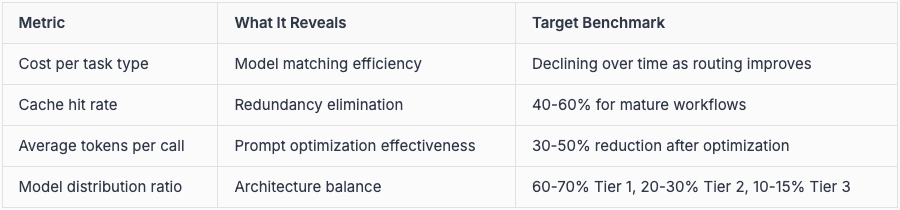
Task-level cost attribution connects inference spending to business value. When teams know that property data extraction costs $0.05 per asset while investment memo generation costs $2.50, they can evaluate whether automation delivers appropriate ROI for each workflow.
Identifying Optimization Opportunities Through Audit
Regular inference audits reveal specific improvement opportunities. Teams should examine their highest-cost workflows quarterly, asking four diagnostic questions:
Could this task run on a smaller model? Many workflows default to frontier models out of habit rather than necessity.
Does this task process redundant data? Repeated analysis of unchanged information wastes inference budget.
Can batching consolidate these calls? High-frequency similar tasks often batch effectively.
Is context appropriately scoped? Excessive document inclusion inflates token counts unnecessarily.
Real estate automation initiatives should build cost monitoring into their implementation from the start, establishing baselines and tracking efficiency improvements as teams refine their approaches.
Practical Implementation Framework for CRE Teams
Enterprise CRE teams can reduce AI inference costs systematically by following a structured implementation framework. This approach balances immediate savings with sustainable long-term efficiency.
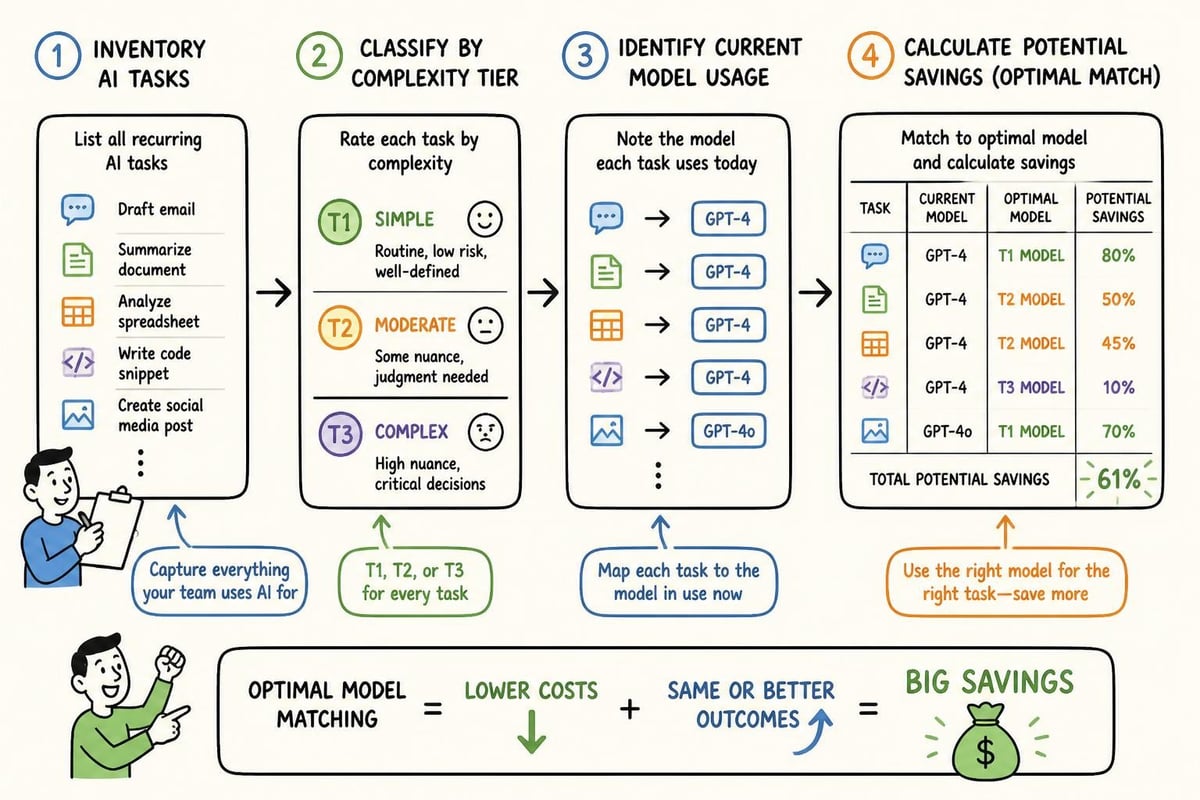
Phase 1: Task Inventory and Classification (Week 1-2)
Document every AI-powered workflow currently in production, capturing task type, frequency, current model usage, and business criticality. Classify tasks into the three complexity tiers based on reasoning requirements, not current routing.
Create a task matrix:
List all automated workflows (underwriting, reporting, research, monitoring)
Identify which model currently processes each task
Estimate monthly inference volume per task
Calculate current monthly cost per task
Assign appropriate complexity tier
This inventory typically reveals that 60-70% of tasks currently using frontier models could run effectively on smaller alternatives.
Phase 2: Model Matching and Pilot Testing (Week 3-6)
Select 5-10 high-volume tasks currently using frontier models but classified as Tier 1 or Tier 2 complexity. Route these to appropriately sized models and conduct parallel testing against current outputs.
Evaluation criteria for model switching:
Accuracy rate compared to current approach
Output consistency across similar inputs
Processing speed and reliability
Edge case handling
User satisfaction with results
According to OneInfer's practical strategies, organizations typically find that 80%+ of downgraded tasks maintain equivalent quality while reducing costs by 70-90% per task.
Phase 3: Architecture Implementation (Week 7-12)
Deploy model-routing logic that automatically directs tasks to optimal models. For teams using platforms like Leni, this routing exists natively. For custom implementations, create decision trees that classify incoming tasks and route accordingly.
Implement caching for high-frequency queries, starting with:
Market data requests (cap rates, rent growth, vacancy)
Property attribute lookups (address, size, class)
Standard financial calculations (NOI, returns, debt service)
Tenant and lease information retrieval
Establish monitoring dashboards tracking cost per task type, model distribution, and cache effectiveness. Set alerts for anomalies that indicate misrouting or inefficiency.
Phase 4: Continuous Optimization (Ongoing)
Cost optimization remains a continuous process as workflows evolve and model capabilities improve. Quarterly reviews should assess:
New optimization opportunities from workflow changes or volume shifts
Model performance improvements that enable further tier reductions
Cache hit rates and expansion opportunities
Emerging cost drivers from new use cases
Teams working with commercial real estate databases should particularly monitor how data access patterns affect inference costs, as evolving portfolio composition changes query frequency and types.
Economic Impact of Inference Cost Management
The financial magnitude of inference optimization becomes clear when extrapolated across enterprise operations. A mid-sized CRE investment firm running AI across 50 professionals might generate 100,000 monthly inference calls. At current frontier model pricing, that represents $15,000-25,000 monthly spend.
Strategic model matching typically achieves 60-70% cost reduction by shifting high-volume simple tasks to appropriate tiers. This same workload costs $4,500-7,500 monthly, saving $120,000-210,000 annually. These savings scale with AI adoption, creating material budget flexibility for teams expanding automation.
Beyond direct cost savings, architectural efficiency enables:
Broader AI deployment across more workflows
Higher task frequency for portfolio monitoring
Expanded market research coverage
More comprehensive scenario analysis
Faster processing for time-sensitive deals
The strategic value often exceeds the direct financial savings. When teams can run AI workflows without budget constraints, they discover use cases previously considered too expensive, particularly in real estate market analysis and portfolio monitoring.
Security and Governance Considerations
Cost optimization strategies must maintain enterprise security and governance standards. Model routing and data caching introduce considerations that teams should address proactively.
Multi-model architectures require:
Consistent data handling policies across model providers
Audit trails tracking which models processed sensitive information
Contractual verification that all model providers meet security requirements
Data retention policies aligned with caching strategies
Access controls preventing unauthorized model or cache access
Organizations handling sensitive deal information, portfolio data, or proprietary analysis should evaluate whether cost optimization techniques introduce acceptable risk. Some teams choose to exclude certain high-sensitivity workflows from caching or restrict them to specific model providers based on data residency requirements.
Best asset management software platforms address these concerns through enterprise-grade security architectures that maintain consistent protection across all model tiers and caching layers.
Future Considerations in AI Cost Management
The AI inference cost landscape continues evolving as model capabilities improve and pricing structures change. Teams building cost optimization strategies should account for several emerging trends.
Smaller models continue improving in capability. GPT-4 class performance increasingly appears in models at 1/10th the size, enabling more tasks to shift to lower-cost tiers without quality sacrifice. TechRadar reports on compression techniques that reduce model memory requirements by 50% with minimal accuracy loss, suggesting continued cost decline for equivalent capabilities.
Custom infrastructure options expand as organizations reach scale. Microsoft's Maia 200 and similar custom AI chips demonstrate how large-scale operators optimize at the hardware level. While most CRE teams won't build custom chips, understanding infrastructure economics helps evaluate vendor offerings and partnership opportunities.
Agentic architectures introduce new cost dynamics. As TechRadar explores regarding hidden operational costs, autonomous AI agents that chain multiple model calls to complete complex tasks can accumulate costs quickly without proper guardrails. Teams deploying agentic workflows need cost controls built into agent design, not applied retroactively.
Reducing inference costs requires matching task complexity to appropriate model tiers, eliminating redundant processing, and building architectural efficiency into AI workflows from the start. Enterprise CRE teams that implement systematic model routing, caching, and batching typically achieve 60-70% cost reduction while maintaining output quality. For organizations running AI across underwriting, portfolio monitoring, reporting, and research operations at scale, Leni provides model-agnostic architecture with intelligent task routing and a Universal Data Model that automatically optimizes inference costs while delivering consistent, decision-ready outputs across all commercial real estate workflows.

Johanna Gruber
Johanna has spent the last 8 years helping marketing teams connect with audiences through content. Specializing in B2B SaaS and real estate.

Curious About AI?
Join the largest AI community for real estate online. Get bite-sized, real-world use case videos, plus practical tips and proven strategies from top industry experts on adopting AI effectively.
MEET LENI
AI SuperAgent Purpose Built for Investors and Operators.
Experience how professionals and teams in your domain are getting the edge using AI.
