Tools for Real Estate Investors: 2026 Tech Stack Guide

Tools for Real Estate Investors: 2026 Tech Stack Guide
The commercial real estate investment landscape in 2026 demands specialized technology at every stage of the deal lifecycle. Most tools for real estate investors handle a single workflow component well but leave teams juggling multiple platforms, manual data entry, and disconnected outputs. Asset managers and acquisitions teams need solutions that deliver finance-grade accuracy across market research, financial modeling, document extraction, investor reporting, and ongoing portfolio oversight. The challenge isn't finding tools-it's assembling a technology stack that eliminates redundant work while maintaining the verifiable precision institutional investors require.
1. Market Research and Comparable Analysis Tools
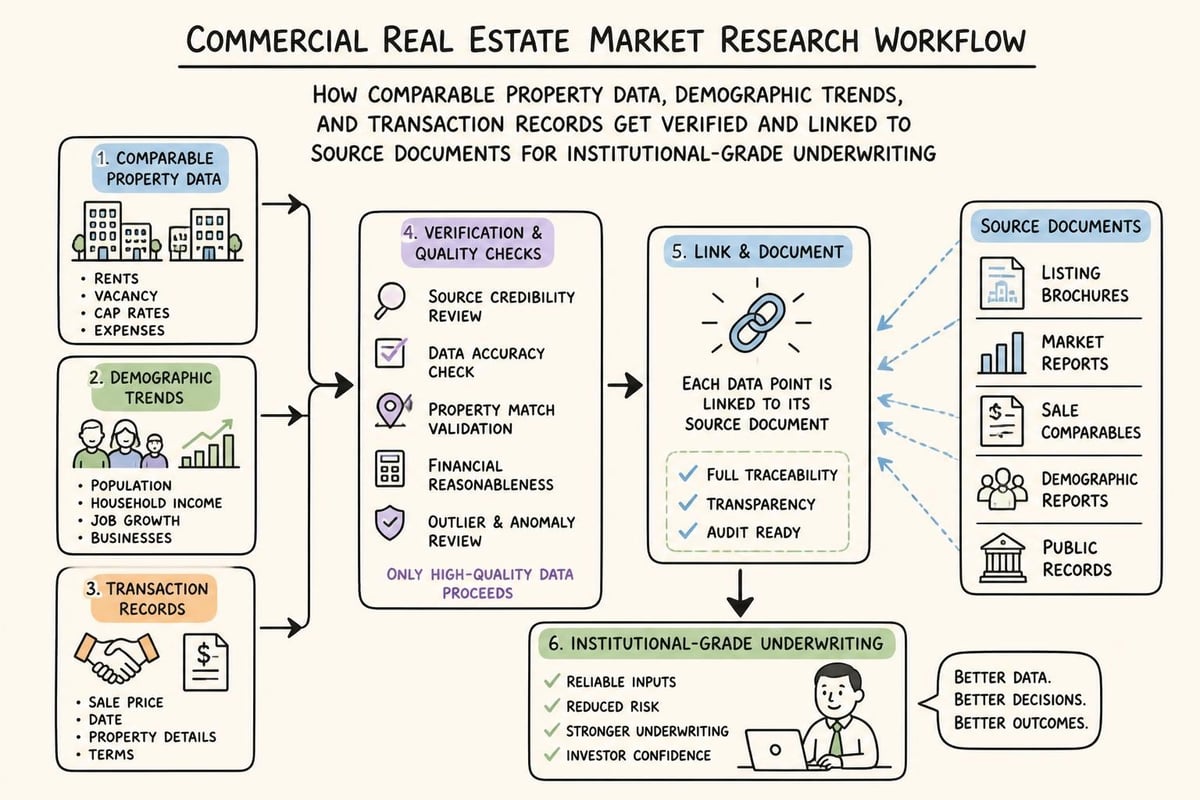
The foundation of any successful acquisition starts with comprehensive market intelligence. Asset managers need tools that provide current rental comps, cap rate trends, demographic shifts, and supply pipeline data specific to their target markets.
What effective market research tools must deliver:
Real-time comparable property data with verified transaction details
Demographic and employment trends tied to specific submarkets
Historical rent growth and occupancy rate trajectories
New construction pipeline visibility by asset class
Direct source attribution for every data point presented
Most real estate investor websites aggregate third-party data without transparent sourcing. This creates verification bottlenecks when investment committees demand proof of assumptions. Generic market reports lack the granularity needed for submarket-specific underwriting, forcing analysts to manually compile data from multiple subscription services.
The Source-Linked Research Advantage
Leni approaches market research differently by generating reports with direct links to source documents for every comp, demographic figure, and market trend. When an underwriting model references a 4.8% cap rate for similar industrial assets in suburban Phoenix, the investment committee can click through to the actual transaction records and offering memorandums that support that assumption.
This transparency matters when presenting to institutional capital partners who scrutinize every assumption. The platform pulls live data from public records, CoStar, broker reports, and proprietary transaction databases, then organizes findings by relevance to your specific asset class and geography.
2. Underwriting and Pro Forma Modeling Platforms
Financial modeling separates viable acquisitions from overpriced mistakes. Tools for real estate investors in this category must transform raw property data into comprehensive cash flow projections that account for lease rollovers, capital expenditures, and exit scenarios.
Critical underwriting tool capabilities:
Multi-scenario sensitivity analysis (base, downside, upside cases)
Lease-by-lease rollover modeling with market rent assumptions
Capital expenditure scheduling tied to property condition reports
Debt structuring with variable interest rate scenarios
IRR and equity multiple calculations across hold periods
Traditional Excel-based underwriting works until teams scale beyond a few deals annually. Version control becomes chaotic, formula errors slip through, and recreating someone else's model takes hours of detective work. Real estate deal analyzer tools have emerged to standardize this process, but most still require extensive manual input from rent rolls, operating statements, and lease abstracts.
Autonomous Model Generation from Source Documents
Leni generates complete underwriting workbooks directly from offering memorandums, rent rolls, and T-12 operating statements without manual data entry. Upload a 147-page OM for a multifamily property, and the platform extracts unit mix, in-place rents, lease expiration schedules, operating expenses by category, and comparable sales data-then assembles them into a structured pro forma model.
The system flags discrepancies between documents (when the OM narrative contradicts the rent roll, for example) and applies market-informed assumptions for vacant units based on recent comparable leases. Because Leni connects to property management systems like Yardi, RealPage, and Entrata, it can pull live operating data for portfolio properties, enabling acquisition teams to underwrite new deals using actual performance metrics from similar assets they already own.
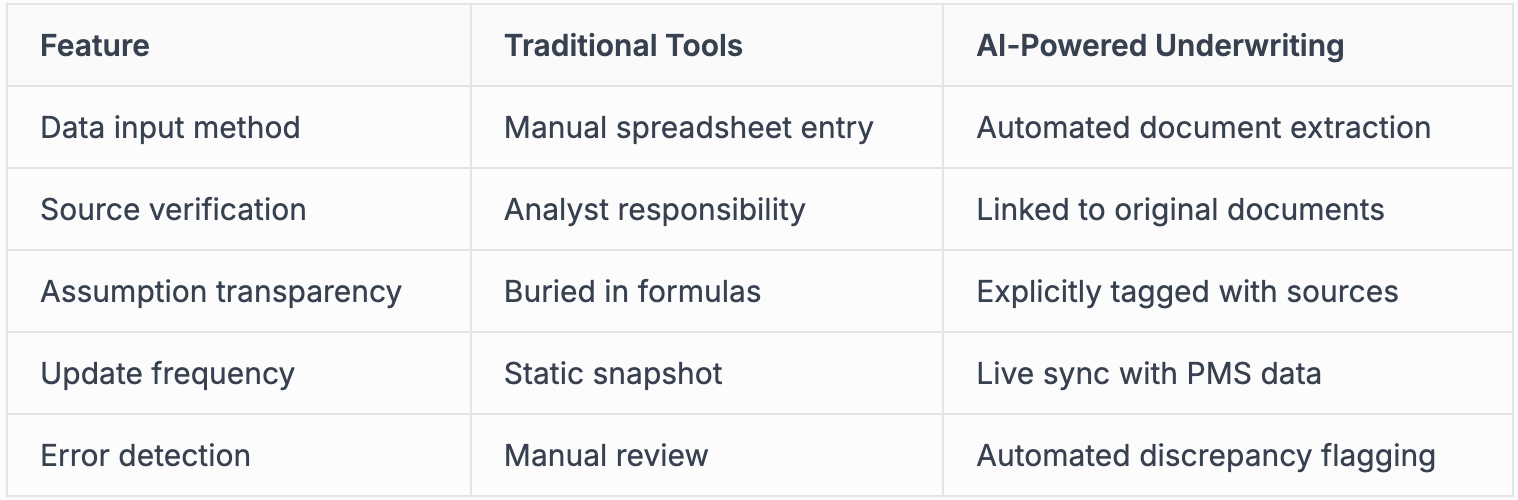
Understanding commercial real estate analytics fundamentals helps teams recognize when automated tools produce outputs that deviate from market norms.
3. Lease Abstraction and Due Diligence Software
Acquisitions due diligence involves extracting critical terms from hundreds of lease documents: renewal options, escalation clauses, tenant improvement allowances, co-tenancy provisions, and termination rights. Missing a single unfavorable clause can destroy deal economics.
What lease abstraction tools need to accomplish:
Extract standard terms (rent, expiration, options) with high accuracy
Identify non-standard clauses that create financial exposure
Flag tenant rights that could accelerate vacancy
Quantify future landlord obligations (TI, capital expenditures)
Cross-reference lease terms against rent roll representations
Most lease abstraction remains manual because the stakes are too high for errors. Junior analysts spend weeks reading through lease PDFs, copying terms into standardized templates, and hoping they caught every material clause. Offshore abstraction services reduce costs but introduce quality control challenges and data security risks.
Generic AI tools can extract basic lease data but consistently miss nuanced provisions. A termination option triggered by specific co-tenancy failures or a rent definition that excludes certain revenue categories requires contextual understanding that general-purpose language models lack.
Risk-Aware Document Extraction
Leni's lease extraction goes beyond basic term identification to flag clauses that create financial or operational risk. When processing a retail center's lease portfolio, it identifies which tenants have co-tenancy kick-out rights tied to anchor occupancy, calculates the revenue exposure if those rights are exercised, and highlights discrepancies between lease-stated square footage and what's reflected in the rent roll.
The platform maintains a growing knowledge base of unfavorable lease provisions across millions of processed documents. This institutional memory means it recognizes problematic language patterns that even experienced analysts might miss on their first read. For teams conducting AI underwriting in real estate, automated lease extraction becomes the foundation for accurate cash flow modeling.
4. Investment Committee Memo and Reporting Tools
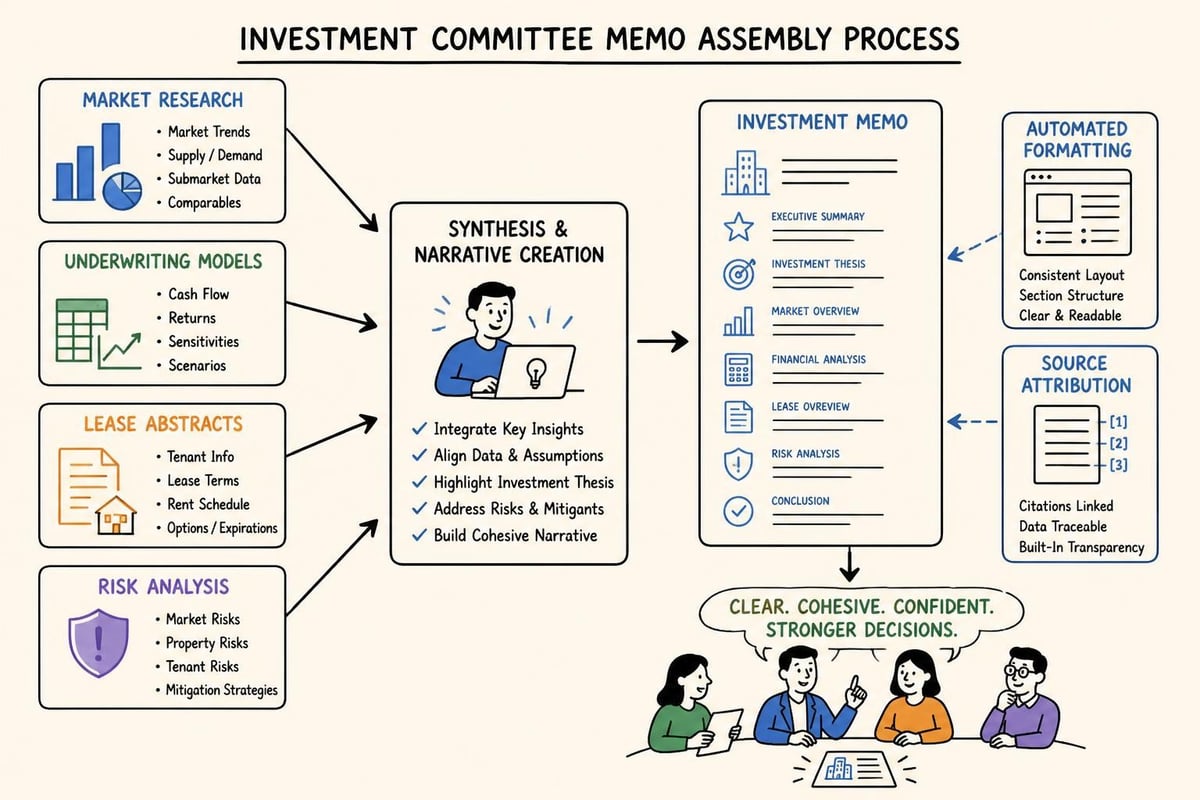
Securing deal approval requires translating complex financial analysis into compelling investment narratives. IC memos must synthesize market context, property specifics, financial projections, risk factors, and strategic rationale into documents that boards and capital partners can evaluate efficiently.
Essential investor reporting capabilities:
Executive summary with key deal metrics (purchase price, projected returns, hold strategy)
Market overview with demographic and supply-demand fundamentals
Property-specific strengths and value-add opportunities
Financial projections with sensitivity across scenarios
Risk analysis identifying material assumptions and mitigations
Creating these materials manually consumes days of senior analyst time. Teams copy data between underwriting models, market research reports, and presentation templates-introducing transcription errors and version control headaches. By the time a polished IC memo reaches decision-makers, the underlying assumptions may have shifted.
The challenge intensifies for commercial real estate portfolio management at scale, where asset managers must produce quarterly investor reports across dozens of properties simultaneously.
Autonomous Investment Documentation
Leni generates IC memos and investor decks directly from the data it has already processed during market research, underwriting, and lease review. The platform assembles a complete investment committee package that includes an executive summary, detailed market analysis with sourced comps, property overview with unit mix and tenant roster, complete financial projections, and identified risk factors with quantified impact scenarios.
Because every data point links back to source documents, investment committees can drill into assumptions without disrupting the analyst presenting the deal. The memo automatically updates when underlying models change-adjust a market rent assumption in the pro forma, and the executive summary's projected IRR refreshes instantly.
For ongoing portfolio reporting, Leni produces quarterly performance reports that compare actual results against acquisition underwriting, highlight variances requiring attention, and update valuation models based on current market conditions. This reporting capability transforms AI report generators from simple templating tools into strategic decision support systems.
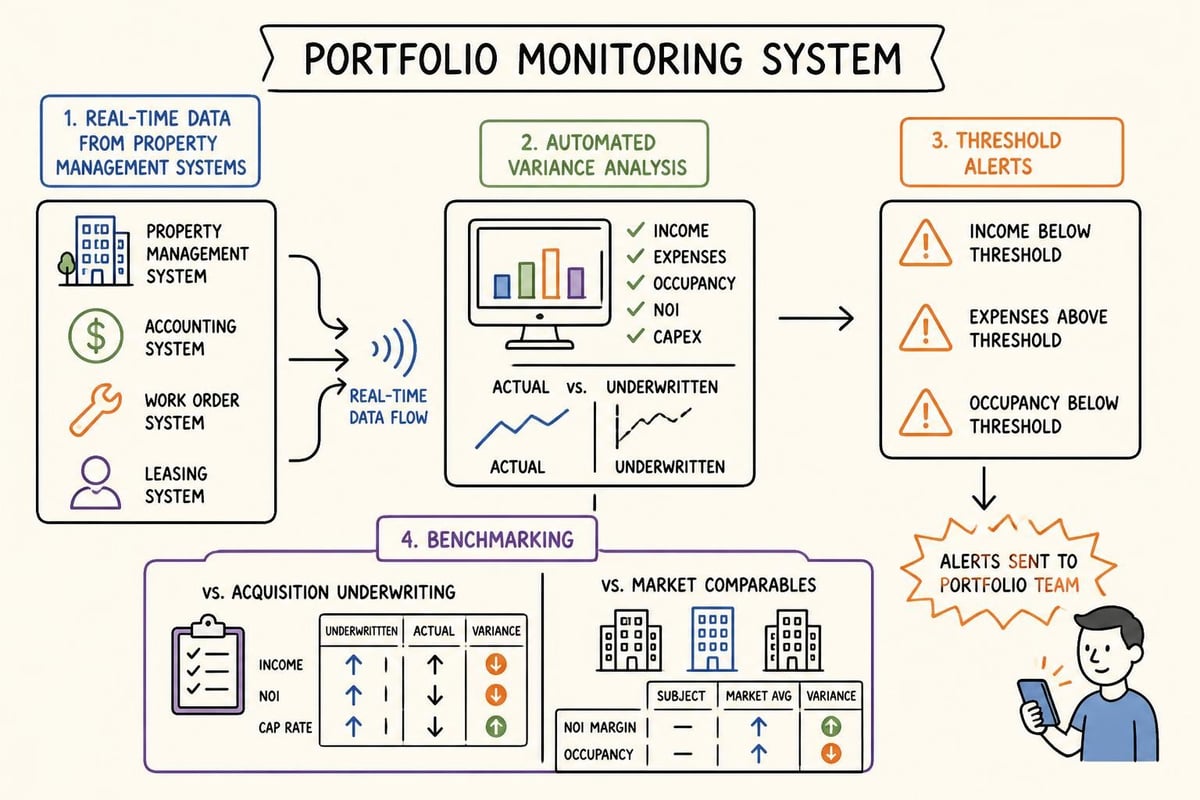
5. Portfolio Monitoring and Performance Tracking Systems
Successful real estate investing extends beyond acquisition. Asset managers need continuous visibility into property performance, early warning systems for underperforming assets, and the ability to identify value-add opportunities across existing holdings.
Requirements for effective portfolio monitoring:
Consolidated financial dashboards across all properties
Automated variance analysis (actual vs. budget vs. underwriting)
Lease expiration tracking with renewal probability scoring
Threshold-based alerts for metrics requiring intervention
Benchmarking against comparable properties and market averages
Many teams cobble together portfolio monitoring through manual reports extracted from property management systems. They export data monthly, manipulate it in Excel, and distribute static PDF reports that are outdated before recipients open them. Real estate portfolio management software has improved visibility, but most solutions require extensive configuration and still don't connect portfolio performance back to original acquisition assumptions.
Intelligent Portfolio Pulse Monitoring
Leni's Pulse system provides threshold-based alerts that notify asset managers when properties deviate from expected performance parameters. Set tolerance levels for occupancy rates, net operating income, leasing velocity, or capital expenditure burn rates-then receive automated notifications when actual performance crosses those boundaries.
The platform compares current operating metrics against three baselines: original acquisition underwriting, annual budgets, and trailing performance trends. When a multifamily property's renewal rate drops 8% below historical norms, Pulse flags the variance, identifies which unit types are seeing the steepest decline, and surfaces comparable properties in the portfolio that maintained stronger retention.
Because Leni integrates directly with Yardi, RealPage, Entrata, AppFolio, ResMan, and MRI Software, portfolio data stays current without manual exports. Asset managers can drill from high-level portfolio summaries into property-specific financials, then into individual lease details-all within a single interface that maintains source attribution throughout.
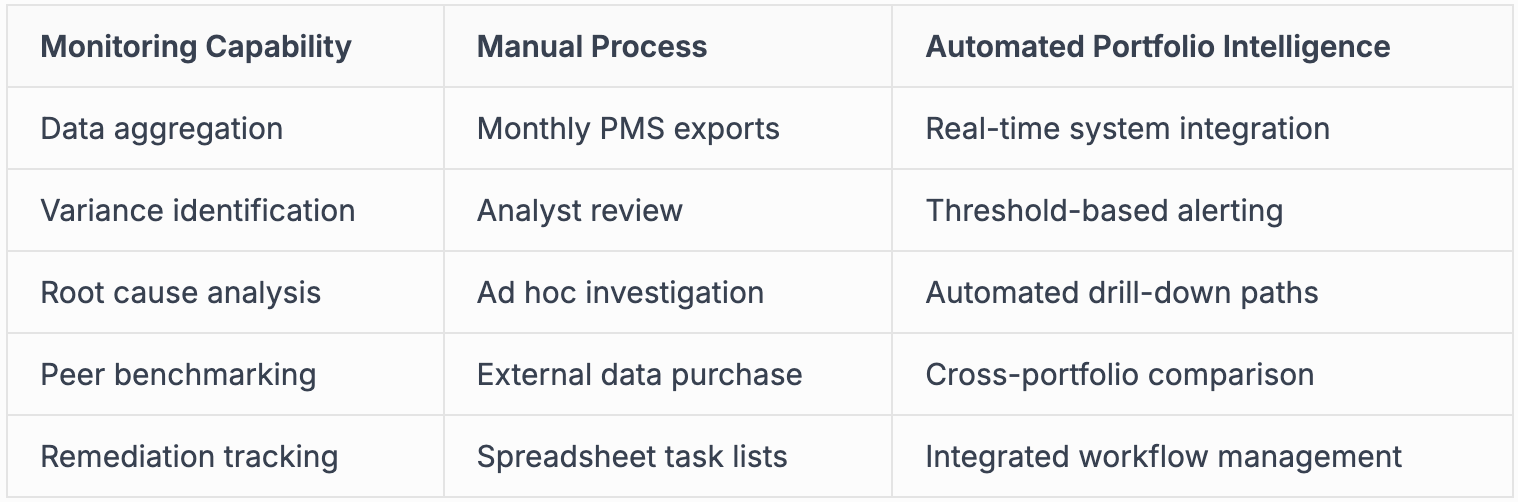
The accuracy of portfolio intelligence improves continuously as Leni ingests more operating data. The platform learns which expense categories show seasonal variation versus concerning trends, recognizes normal lease-up curves for different asset classes, and refines market rent assumptions based on actual renewal outcomes across your properties.
Building a Lean Investor Technology Stack
The proliferation of specialized tools for real estate investors creates a new problem: teams spend as much time managing their technology stack as they do analyzing deals. Each platform requires separate logins, data flows break between systems, and critical context gets lost in the handoffs.
Framework for an integrated deal lifecycle stack:
Centralized data ingestion: Connect property management systems, accounting platforms, and document repositories to a single analytical hub
Workflow continuity: Ensure outputs from market research feed directly into underwriting models without re-keying data
Verifiable outputs: Maintain source attribution from initial research through final investor reports
Role-based access: Enable analysts, asset managers, and executive teams to interact with appropriate detail levels
Automation without black boxes: Automate repetitive tasks while preserving transparency into how conclusions were reached
Traditional approaches force teams to choose between specialized point solutions (best-in-class functionality but fragmented workflows) and all-in-one platforms (integrated but mediocre at each individual function). Neither option delivers the precision institutional investors demand with the efficiency modern deal volume requires.
The Unified Analytical Platform Approach
Leni was purpose-built to handle the complete analytical workflow commercial real estate investors face. Rather than offering surface-level assistance across many domains, it executes long, multi-step tasks autonomously with finance-grade accuracy.
A typical acquisition workflow demonstrates this integration:
Market research phase: Analysts describe the target acquisition (Class A multifamily, 200+ units, Sun Belt growth markets). Leni researches recent transactions, demographic trends, new supply pipelines, and rent growth trajectories-producing a sourced market overview.
Underwriting phase: The team uploads the offering memorandum, rent roll, and trailing twelve financials. Leni extracts property details, builds a complete cash flow model with lease rollover schedules, and generates base, downside, and upside scenarios.
Due diligence phase: Legal uploads 200+ lease documents. Leni abstracts all standard terms, flags concerning provisions (termination rights, below-market renewals, unfunded landlord obligations), and quantifies financial exposure.
IC approval phase: The platform assembles a complete investment committee memo drawing from all prior work, formatted to the firm's template standards, with every assumption linked to supporting documentation.
Portfolio phase: Post-acquisition, Leni monitors actual performance against projections, alerts when key metrics deviate from expectations, and generates quarterly investor reports comparing results to original underwriting.
This continuity eliminates data re-entry, preserves analytical context across workflow stages, and creates an audit trail from initial comp selection through final investor distributions. For teams evaluating AI tools for business analysts, the distinction between general-purpose language models and purpose-built analytical platforms becomes critical.
Evaluating Tools Against Institutional Standards
Not all tools for real estate investors meet the accuracy and transparency requirements institutional capital demands. Asset managers must distinguish between solutions appropriate for initial exploration versus those suitable for investment-grade decision-making.
Questions to assess tool readiness for institutional use:
Can you verify the source of every data point and assumption?
Does the platform maintain calculation transparency or operate as a black box?
How does accuracy change when dealing with non-standard property types or lease structures?
Can outputs be audited by third parties (lenders, investors, regulators)?
Does the system improve with use or deliver static performance?
Generic AI tools excel at drafting marketing materials, summarizing documents, and generating initial research outlines. They fail when assignments require mathematical precision, multi-step logical reasoning, or synthesis of conflicting information from multiple authoritative sources.
A language model can draft a market overview narrative but cannot verify that the cap rates it cites actually reflect closed transactions versus broker quotes. It can extract obvious lease terms but misses nuanced provisions that experienced real estate attorneys flag immediately. It produces plausible-sounding investment memos that contain subtle but deal-killing errors in financial logic.
Purpose-Built Versus General-Purpose AI
Leni was designed specifically for commercial real estate analytical workflows, not adapted from consumer chatbot technology. The architecture reflects the verification requirements, document complexity, and multi-step reasoning chains that characterize institutional real estate decision-making.
The platform connects directly to authoritative data sources rather than relying on training data that may be outdated or unverifiable. When researching industrial cap rates in Dallas, it pulls current transaction records, offering memorandums, and broker reports-then links each data point to its source. This approach mirrors how experienced analysts work, not how consumer AI tools generate responses.
SOC 2 Type 2 certification ensures the platform meets enterprise security and compliance standards required for handling sensitive acquisition targets, proprietary financial models, and confidential lease agreements. Data processing occurs within controlled environments with comprehensive audit logging, not through shared consumer AI services.
Most importantly, accuracy improves as teams use Leni more extensively. The system learns from corrections, builds firm-specific knowledge about preferred assumptions and formatting, and recognizes property types and market nuances specific to your investment strategy. A commercial real estate deal analyzer becomes more valuable the more deals it processes.
Integration Architecture for Enterprise Real Estate Teams
Isolated tools create data silos that force manual reconciliation and introduce error opportunities. Enterprise-grade tools for real estate investors must connect to existing systems while maintaining data integrity and security.
Critical integration requirements:
Direct API connections to property management systems (not CSV exports)
Bi-directional sync ensuring portfolio data stays current
Secure document handling for sensitive acquisition materials
SSO integration with corporate identity management
Audit trails documenting data access and modifications
Many platforms claim integration capabilities but rely on scheduled batch imports that quickly become stale. Real-time connectivity to Yardi, RealPage, Entrata, AppFolio, ResMan, and MRI Software ensures portfolio monitoring reflects current operating conditions, not last month's snapshot.
The technical architecture also determines whether tools can scale from initial pilot projects to firm-wide deployment. Systems built on consumer AI infrastructure hit rate limits, struggle with document processing volume, and lack the governance controls enterprise IT departments require.
Enterprise-Grade Commercial Real Estate Infrastructure
Leni's enterprise deployment supports large asset management teams with complex portfolio requirements and stringent security standards. The platform processes unlimited document volume, handles concurrent users across geographies, and maintains performance even when analyzing decades of historical operating data.
Integration extends beyond property management systems to encompass document repositories (SharePoint, Box, Google Drive), accounting platforms (MRI, Yardi, QuickBooks), and market data services (CoStar, Reis, MSCI). This connectivity creates a unified analytical environment where data flows automatically rather than requiring manual extraction and transformation.
For firms implementing real estate automation initiatives, platform architecture determines which workflows can actually be streamlined versus those that remain perpetually semi-manual.
The right tools for real estate investors eliminate redundant work while maintaining the precision institutional capital demands. Rather than assembling fragmented point solutions that create new integration challenges, commercial real estate teams need platforms purpose-built for the complete analytical lifecycle-from initial market research through ongoing portfolio monitoring. Leni delivers this unified approach with verifiable outputs, direct property management system integration, and accuracy that improves with every deal processed. Discover how Leni transforms your acquisition and asset management workflow today.

Johanna Gruber
Johanna has spent the last 8 years helping marketing teams connect with audiences through content. Specializing in B2B SaaS and real estate.

Curious About AI?
Join the largest AI community for real estate online. Get bite-sized, real-world use case videos, plus practical tips and proven strategies from top industry experts on adopting AI effectively.
MEET LENI
AI SuperAgent Purpose Built for Investors and Operators.
Experience how professionals and teams in your domain are getting the edge using AI.
