Verifiable AI Outputs Real Estate: A Trust Guide

Verifiable AI Outputs Real Estate: A Trust Guide
The rise of artificial intelligence in commercial real estate and investment management has created a fundamental challenge: how do you trust an AI-generated analysis when making decisions worth millions of dollars? The concept of verifiable AI outputs real estate addresses this exact problem by establishing frameworks that allow investment professionals to trace, validate, and audit every claim an AI system makes. Unlike consumer chatbots that provide conversational responses without accountability, verifiable AI outputs real estate demand source citations, transparent calculations, documented assumptions, and clear audit trails that meet the standards of institutional investment work.
What Makes an AI Output Verifiable in Real Estate Investment Work
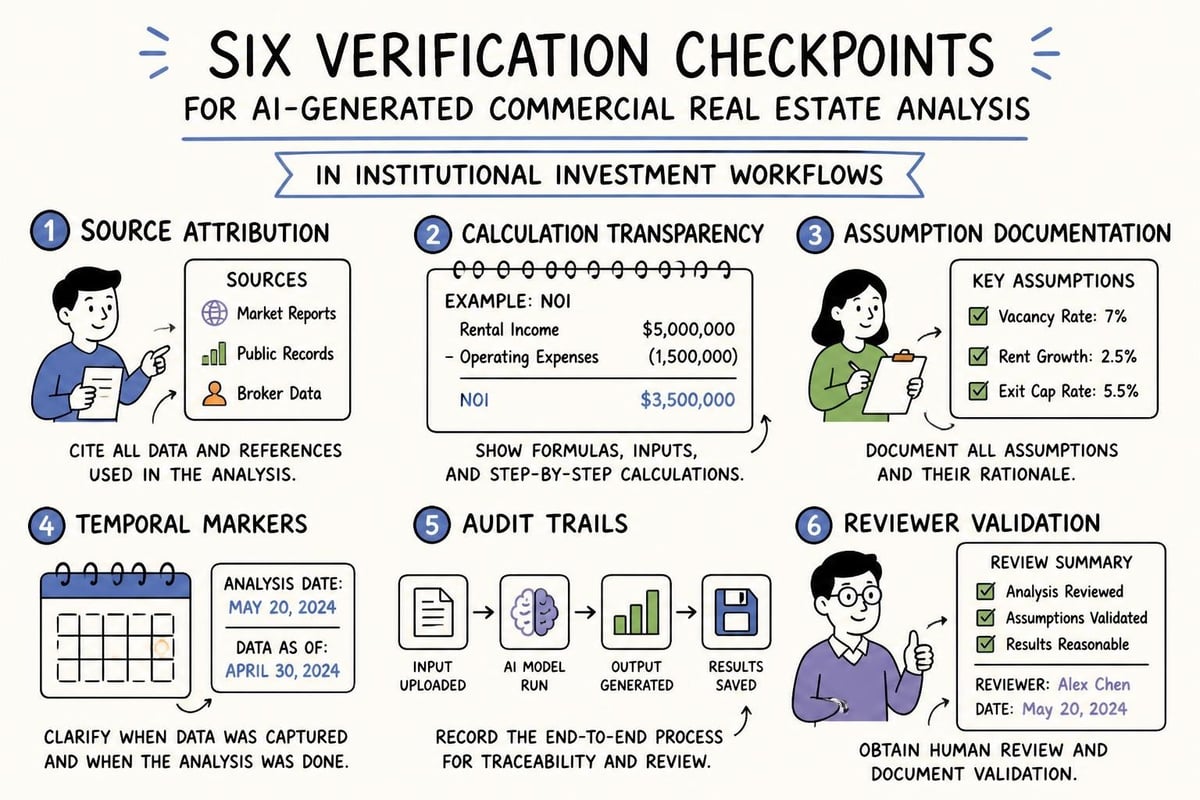
Verifiable AI outputs real estate require six fundamental components that distinguish trustworthy analysis from unsubstantiated claims. Each element serves as a checkpoint that allows investment professionals to validate the accuracy and reliability of AI-generated content before incorporating it into decision-making processes.
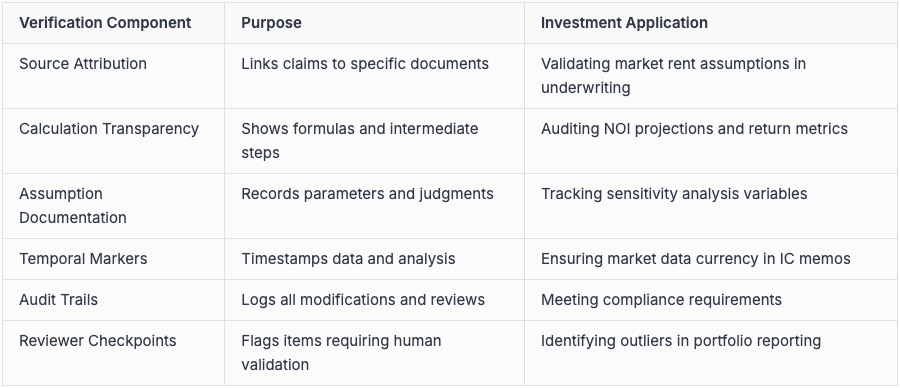
Source attribution stands as the foundation of verifiability. Every data point, market statistic, or property detail must trace back to a specific document, database, or filing. When an AI system states that average Class A office rents in a submarket increased 3.2% year-over-year, that claim needs a direct reference to the CoStar report, broker survey, or public filing that contains that figure.
Calculation transparency ensures that every derived metric shows its work. Cap rate calculations, DCF models, and return projections must display the formulas, inputs, and intermediate steps used to reach final numbers. This allows analysts to spot errors in methodology, identify inappropriate assumptions, or adjust variables based on their own judgment.
Documentation Standards for Investment-Grade AI Analysis
The standards that govern verifiable AI outputs real estate mirror the documentation requirements already established in institutional investment processes. These aren't new inventions but rather adaptations of existing best practices to AI-generated content.
Document-level references must specify exact page numbers, section headings, or data tables within source materials. Generic citations like "according to market research" fail verification standards. Instead, acceptable references include: "Page 47, Table 3.2, CBRE Q4 2025 Atlanta Office Market Report" or "Schedule 3, Rent Roll as of December 31, 2025, attached to January 2026 Asset Management Report."
Investment professionals working with AI tools for financial modeling need systems that automatically generate these precise citations during analysis. Manual verification of hundreds of data points becomes impractical in time-sensitive deal environments, making automated source tracking a necessity rather than a convenience.
Assumption logs document every parameter, threshold, or judgment call embedded in AI-generated analysis. Commercial real estate underwriting relies on dozens of assumptions: vacancy rates, lease renewal probabilities, expense growth rates, exit cap rates, and capital expenditure schedules. Verifiable systems maintain a complete record of where these assumptions originated, whether from user input, historical property data, market benchmarks, or system defaults.
Building Verification Into Real Estate AI Workflows
Implementing verifiable AI outputs real estate requires integrating verification mechanisms directly into investment workflows rather than treating them as post-analysis add-ons. The most effective approach embeds verification at every stage of content generation, from initial data ingestion through final report delivery.
Market Research and Property Analysis
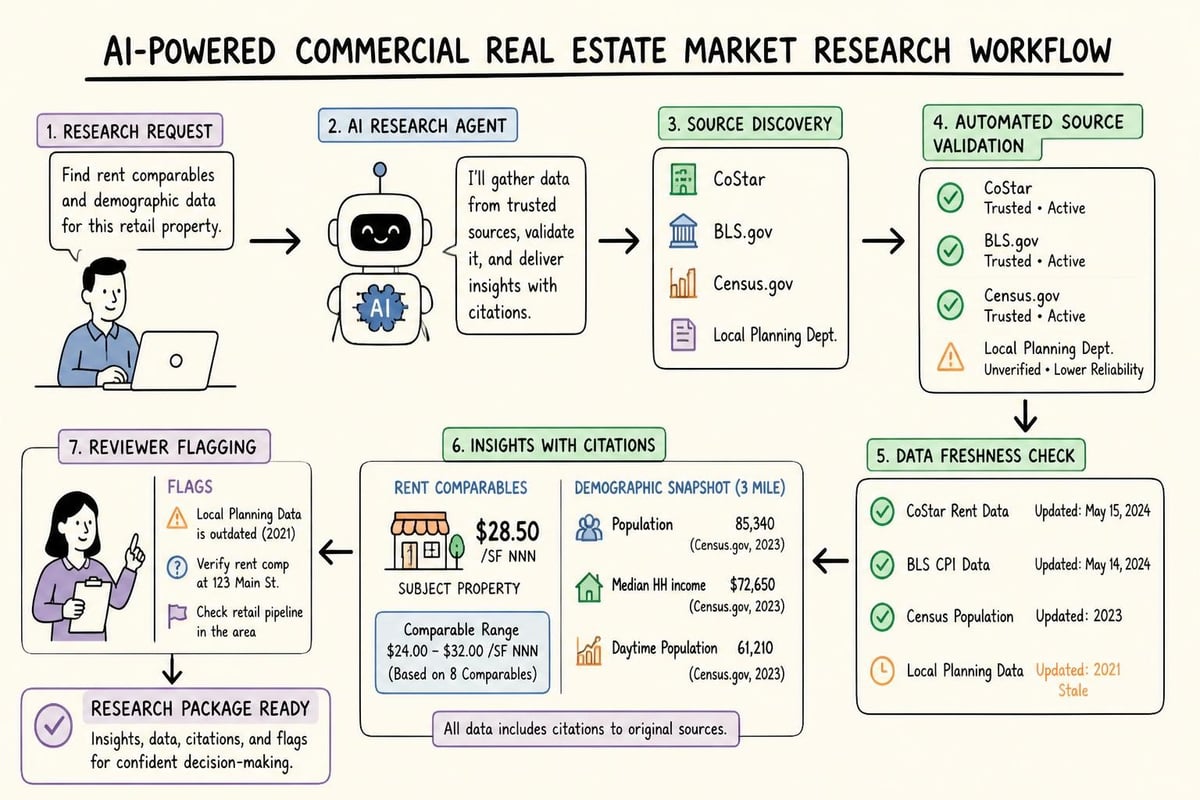
Market research represents one of the highest-value applications for AI in commercial real estate, but also one of the most vulnerable to accuracy issues. When an AI system compiles competitive property analysis, demographic trends, employment statistics, and development pipeline data, each element requires independent verification.
Professional investors using real estate AI tools should demand span-level citations that connect every sentence to its source material. Rather than footnoting entire paragraphs, verification systems need to tag individual claims with their provenance.
Workflow integration checklist for market research:
Configure AI system to require source documents before generating analysis
Set citation frequency standards (minimum one source per factual claim)
Establish data freshness thresholds (reject sources older than specified date)
Implement automated flagging for statistical outliers or anomalies
Create review protocols for claims lacking direct source attribution
Maintain version control for all source documents and generated outputs
Lease Abstraction and Rent Roll Analysis
Lease abstraction showcases both the power and the risk of AI in real estate operations. AI systems can extract key terms from hundreds of lease documents in hours rather than weeks, but a single error in rent commencement date, escalation terms, or renewal options can cascade into major valuation mistakes.
Verifiable AI outputs real estate in lease abstraction require two-layer verification: document reference and calculation validation. Every extracted data point needs a citation to the specific lease clause, and every calculated field (like effective rent or lease expiration date) needs to show its derivation.
Critical verification points in lease abstraction:
Base rent amount and commencement date (cite lease section and page)
Escalation terms and calculation methodology (show formula application)
Renewal options and associated conditions (quote exact lease language)
Tenant improvement allowances and remaining obligations (reference exhibits)
Operating expense reconciliation terms (document CAM calculation method)
Termination rights and associated penalties (cite specific clauses)
Professional real estate asset management teams need AI systems that flag discrepancies between extracted data and existing records, highlight unusual terms that deviate from property norms, and generate audit trails showing who reviewed and approved each abstraction.
Verification Requirements for Investment Committee Materials
Investment committee presentations and memos represent the highest-stakes application of verifiable AI outputs real estate. These documents drive capital allocation decisions, establish valuation assumptions, and create the analytical foundation for acquisitions, dispositions, and refinancing transactions worth tens or hundreds of millions of dollars.
Underwriting Models and Sensitivity Analysis
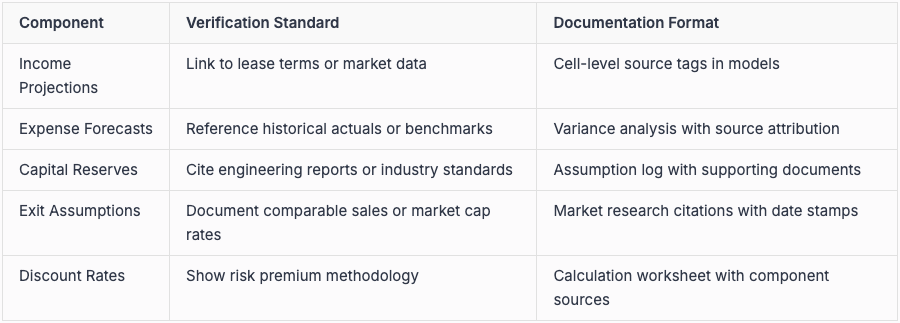
AI-generated underwriting models must meet the same verification standards as manually-built financial models, with additional requirements for algorithmic transparency. Every line item in a pro forma needs clear derivation logic, whether it comes from historical property data, lease terms, market benchmarks, or analyst assumptions.
Institutional investors increasingly expect their commercial real estate deal analyzer tools to produce models with built-in verification documentation. This includes:
Model verification components:
Advanced verification systems, such as those offered by Accurit AI with institutional-grade deal analysis, incorporate automated cross-validation between different data sources, flagging inconsistencies that require human review before finalization.
The scenario modeling capabilities that sophisticated investors require must maintain verification integrity across multiple cases. When testing different exit timing, lease-up assumptions, or capital improvement strategies, each scenario needs documented parameter changes with clear attribution to market conditions, strategic objectives, or risk tolerance specifications.
Investment Committee Memo Generation
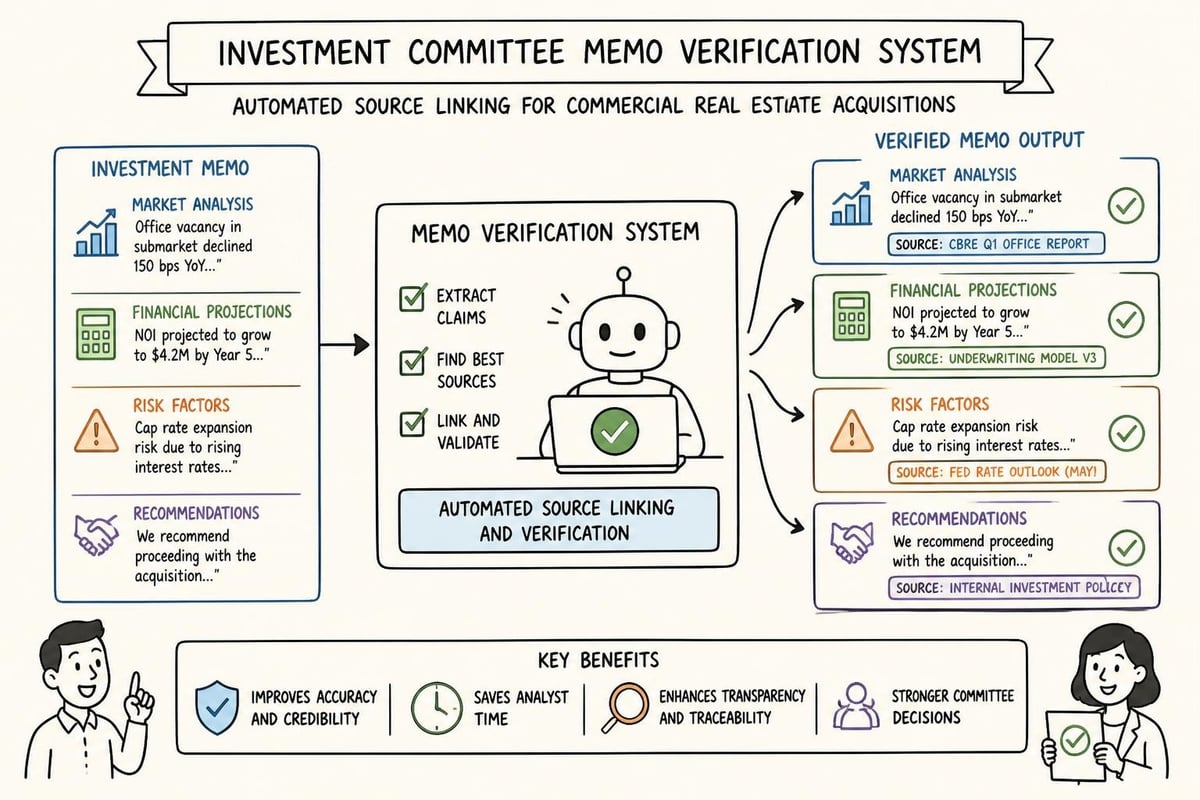
AI-assisted IC memo creation represents one of the most promising efficiency opportunities in real estate investment, but only when outputs maintain institutional credibility through comprehensive verification. A memo that summarizes property characteristics, market conditions, financial projections, and risk factors must provide sourcing for every material claim.
Verification requirements for IC memos:
Executive summary claims must cite specific sections of detailed analysis
Market condition statements require dated sources and geographic precision
Financial metrics need calculation transparency and assumption documentation
Risk assessments must reference specific property conditions or market factors
Recommendation rationale should trace to quantitative analysis and strategic fit
The challenge many investment teams face is maintaining verification standards under time pressure. Deals move quickly, and the team that can produce a credible IC package fastest often wins the opportunity. This creates demand for AI systems that generate verified outputs automatically rather than requiring manual citation addition after drafting.
Audit Trails and Compliance Documentation
Verifiable AI outputs real estate extend beyond initial content creation into long-term auditability and compliance documentation. Investment firms face regulatory requirements, investor reporting obligations, and internal governance standards that demand complete records of analytical processes and decision-making inputs.
Maintaining Comprehensive Audit Logs
Professional-grade AI systems for investment work must maintain detailed audit trails that capture every interaction, modification, and approval in the analysis lifecycle. This goes substantially beyond simple version control to include timestamped logs of data sources accessed, calculations performed, assumptions modified, and reviewer actions taken.
Essential audit trail elements:
User identification and authentication records for all system interactions
Timestamps for data ingestion, analysis generation, and output modification
Source document version tracking with hash verification of file integrity
Parameter change logs showing original values, modified values, and change authors
Review and approval workflows with digital signatures or authenticated confirmations
Output distribution records showing who received which versions of analysis
For investment firms managing significant assets under management in real estate, audit trail completeness directly impacts regulatory examinations, investor due diligence, and litigation defense. Verifiable AI outputs real estate that lack comprehensive audit documentation create liability risks that outweigh any efficiency gains.
Document Integrity and Tamper Evidence
Beyond tracking who did what when, verification systems must also ensure that source documents and generated outputs maintain integrity over time. This becomes particularly critical when AI analysis relies on uploaded property documents, market reports, or third-party data files that could potentially be altered after analysis generation.
Solutions like RealProof, which provides tamper-evident certificates for real estate documents, use blockchain anchoring to create immutable records of document state at specific points in time. This allows firms to prove that the lease agreement, appraisal report, or environmental assessment used in AI analysis matches exactly the version that existed when decisions were made.
Investment teams implementing secure AI for investment firms should prioritize systems that automatically generate cryptographic hashes or digital fingerprints for all source materials and outputs. This relatively simple technical measure provides powerful protection against both accidental file corruption and intentional document manipulation.
Enterprise Verification Requirements vs. Individual User Needs
The verification standards for verifiable AI outputs real estate vary significantly based on organizational context, deal complexity, and regulatory environment. A solo investor analyzing a small multifamily acquisition has different needs than a REIT evaluating a $200 million office portfolio acquisition.
Individual Investor and Small Team Verification
Individual investors and small teams typically prioritize verification elements that protect against gross errors rather than comprehensive audit trails. For these users, verifiable AI outputs real estate focuses on:
Core verification for individual users:
Clear source citations for market data and comparable sales
Visible calculation formulas in financial projections
Flagged assumptions that significantly impact returns
Simple version tracking for iterative analysis refinement
Basic export capabilities for sharing with advisors or lenders
Tools serving this market segment should make verification easy without requiring technical expertise. When a user asks an AI system about market rent trends, the response should automatically include citations to the CoStar data, broker reports, or listing services that inform the answer. The goal is building user confidence without creating additional workflow steps.
For professionals working with AI for real estate investment on a subscription or individual basis, verification features should feel like helpful transparency rather than compliance overhead.
Enterprise-Grade Verification Infrastructure
Enterprise investment organizations face substantially more complex verification requirements driven by regulatory obligations, fiduciary responsibilities, investor reporting needs, and internal governance policies. These organizations need verifiable AI outputs real estate that integrate with existing systems, support multi-level approval workflows, and generate compliance-ready documentation automatically.
Enterprise verification requirements:
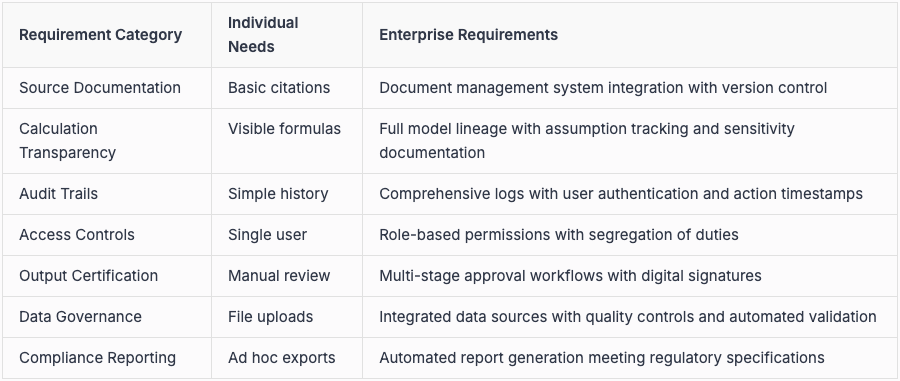
Enterprise teams managing portfolio and investment management across hundreds of properties need AI systems that treat verification as infrastructure rather than feature. This means architectural decisions that prioritize auditability, data lineage, and process governance from the ground up.
Implementing Verification Standards in Day-to-Day Investment Operations
Moving from conceptual understanding to operational implementation of verifiable AI outputs real estate requires systematic workflow redesign and technology selection that prioritizes verification capabilities.
Establishing Internal Verification Protocols
Investment firms adopting AI capabilities should establish clear verification protocols before widespread deployment. These protocols define minimum acceptable standards for AI-generated content across different use cases and risk levels.
Verification protocol framework:
Risk-tier AI outputs by decision impact and materiality
High risk: Acquisition underwriting, IC memos, investor reports
Medium risk: Market research summaries, lease abstraction reviews
Low risk: Administrative summaries, internal status updates
Define verification requirements for each risk tier
High risk: Complete source citation, calculation transparency, dual review, audit trail
Medium risk: Source citation, flagged assumptions, single review
Low risk: Source availability, spot-checking protocols
Assign verification responsibilities across team roles
Analysts: Initial review of sources and calculations
Senior associates: Validation of assumptions and methodology
Principals: Approval of material conclusions and recommendations
Establish review checklists specific to content types
Market research: Source currency, geographic specificity, statistical validity
Financial models: Formula accuracy, assumption reasonableness, sensitivity ranges
Property reports: Document matching, metric calculations, trend analysis logic
Create escalation procedures for verification failures
Document unverifiable claims requiring manual research
Flag systemic accuracy issues for technology vendor resolution
Maintain verification failure logs to identify patterns
Teams using AI tools for reporting in real estate should integrate these protocols directly into their reporting workflows, ensuring that verification happens during content creation rather than as a separate quality control step.
Technology Selection Criteria for Verifiable AI
Selecting AI technology for investment work requires evaluating verification capabilities alongside functionality and user experience. The questions to ask potential vendors reveal whether verification is core to their architecture or an afterthought.
Critical vendor evaluation questions:
How does your system cite sources for factual claims? Can we see examples of citation granularity?
What audit trail information do you maintain? Can we export complete activity logs?
How do you handle conflicting data from multiple sources? What's your resolution methodology?
Can users trace any output back to specific source documents or data points?
What happens when source data is insufficient to answer a query? Do you generate unverified responses or flag the limitation?
How do you version control outputs when underlying data or assumptions change?
What verification documentation do you generate for regulatory or compliance purposes.
For investment firms evaluating real estate investment analysis software, verification capabilities should rank equally with analytical functionality in procurement decisions.
Training Teams on Verification Best Practices
Technology alone cannot ensure verifiable AI outputs real estate without team members who understand verification principles and consistently apply them. Training programs should cover both the "what" and "why" of verification requirements.
Essential training components:
Understanding verification fundamentals: sources, calculations, assumptions, audit trails
Recognizing unverifiable AI outputs and appropriate response procedures
Using verification tools built into AI platforms effectively
Conducting efficient verification reviews without eliminating AI efficiency gains
Documenting verification processes for compliance and quality control
Escalating verification concerns through appropriate channels
Investment organizations implementing AI investment monitoring across their portfolios need teams that view verification as protection rather than bureaucracy. The training should emphasize how verification catches errors early, reduces liability risks, and ultimately makes AI tools more valuable by making them trustworthy.
Regular verification audits, where leadership reviews a sample of AI-generated outputs and their verification documentation, reinforce standards and identify areas where additional training or process refinement is needed.
Future Directions for Verifiable AI in Real Estate Investment
The field of verifiable AI outputs real estate continues to evolve rapidly as both technology capabilities and industry standards mature. Several trends will shape how investment professionals interact with AI-generated analysis in coming years.
Emerging verification technologies:
Cryptographic proof systems that mathematically verify AI reasoning processes
Automated fact-checking against authoritative real estate databases in real-time
Collaborative verification networks where multiple AI systems cross-validate outputs
Blockchain-based audit trails providing immutable records of analytical processes
Natural language transparency that explains AI reasoning in accessible terms
The shift from verification as manual review to verification as automated infrastructure represents the next maturity stage for verifiable AI outputs real estate. Rather than humans checking AI work, verification systems will automatically validate sources, calculations, and logic before presenting outputs to users.
For investment professionals, this evolution means greater confidence in AI-generated analysis without increased time investment. The friction between speed and accuracy diminishes as verification becomes seamless and automatic rather than deliberate and time-consuming.
Verifiable AI outputs real estate transforms artificial intelligence from an experimental tool into foundational infrastructure for institutional investment work by ensuring every generated analysis meets the same standards of accuracy, transparency, and auditability that professionals expect from human-created content. The verification frameworks outlined here-source attribution, calculation transparency, assumption documentation, audit trails, and reviewer checkpoints-provide the trust foundation necessary for AI to handle increasingly sophisticated investment tasks. Leni delivers exactly this accuracy-first approach through purpose-built AI infrastructure that automatically generates source-linked research, transparent financial models, and audit-ready investment documentation, enabling both individual professionals and enterprise teams to leverage AI capabilities without compromising the verification standards that serious investment work demands.

Johanna Gruber
Johanna has spent the last 8 years helping marketing teams connect with audiences through content. Specializing in B2B SaaS and real estate.

Curious About AI?
Join the largest AI community for real estate online. Get bite-sized, real-world use case videos, plus practical tips and proven strategies from top industry experts on adopting AI effectively.
MEET LENI
AI SuperAgent Purpose Built for Investors and Operators.
Experience how professionals and teams in your domain are getting the edge using AI.
