What Is a Real Estate Asset Manager? Role, Responsibilities, and Why It Matters
.webp&w=1920&q=75)
Learn what a real estate asset manager does, how the role differs from property management, and why owners, investors, and operators rely on asset managers to protect and grow portfolio value.
Many real estate teams are good at running buildings. Fewer are good at running the investment behind the buildings.
That distinction matters. A property can be fully leased, financially stable, and still underperform its potential if no one is actively managing strategy, capital decisions, leasing direction, and hold-sell timing at the asset level. That is where the real estate asset manager comes in.
A real estate asset manager is the person or team responsible for maximizing the financial performance and long-term value of a real estate asset or portfolio. In practical terms, they sit between ownership and day-to-day operations, using financial analysis, market insight, leasing strategy, and capital planning to improve returns.
If you are searching for the simplest definition, here it is: a real estate asset manager makes sure a property is not just operating, but performing like an investment.
What Does a Real Estate Asset Manager Do?
A real estate asset manager focuses on performance, not just administration. They look at the full picture: income, expenses, occupancy, lease rollover, capital needs, refinancing risk, market conditions, and business plan execution.
Their job is to answer questions such as:
Is this property meeting underwriting expectations?
Why is NOI rising or falling?
Should ownership invest more capital into the asset?
Is leasing performance strong enough for the submarket?
Should the property be refinanced, repositioned, or sold?
That means asset management is both analytical and strategic. It is not limited to reporting what happened. It is about deciding what should happen next.
.webp)
Core Responsibilities of a Real Estate Asset Manager
While responsibilities vary by company and asset type, most real estate asset managers are responsible for several core functions:
Financial performance oversight: Monitoring revenue, expenses, NOI, cash flow, and variance to budget or underwriting.
Business plan execution: Tracking whether the property is achieving leasing, renovation, occupancy, rent growth, or expense reduction goals.
Capital planning: Evaluating major repairs, upgrades, redevelopment opportunities, and return on capital projects.
Leasing and revenue strategy: Reviewing lease-up pace, renewals, concessions, tenant retention, and pricing relative to market.
Debt and refinancing analysis: Assessing loan covenants, maturities, interest rate risk, and refinancing options.
Disposition and hold strategy: Helping determine whether an asset should be held, sold, recapitalized, or repositioned.
Stakeholder reporting: Preparing clear performance updates for owners, investors, lenders, or investment committees.
Why the Role Matters
This trend stands out: the more complex the portfolio, the more important asset management becomes.
Property operations can keep an asset stable. Asset management is what turns stability into performance. A strong asset manager identifies underperformance early, improves strategic execution, and aligns property-level decisions with ownership goals.
That is especially important when:
debt costs rise
lease rollover risk increases
capital expenditure decisions become more consequential
market conditions change faster than annual budgets
owners need sharper reporting for lenders or investors
Interesting insight: in many organizations, asset management is the layer that translates raw property data into actual investment decisions.
Real Estate Asset Manager vs Property Manager
These roles are closely related, but they are not the same.
Role Primary Focus Typical Questions Property Manager Daily operations of the asset Are maintenance issues resolved? Are rents collected? Are tenants supported? Asset Manager Investment performance and strategy Is the asset meeting return targets? Should we reinvest, refinance, or sell?
A property manager keeps the building functioning. An asset manager makes sure the building is producing the right financial outcome for ownership.
Who Hires Real Estate Asset Managers?
Real estate asset managers are commonly hired by:
Private equity real estate firms
REITs
Family offices
Institutional owners
Developers with stabilized portfolios
Owner-operators managing multiple assets
Lenders or special servicers in certain workout or oversight situations
In smaller organizations, one person may wear both asset management and acquisitions hats. In larger firms, the role is more specialized and often sits between portfolio leadership and property operations.
What Skills a Real Estate Asset Manager Needs
A strong asset manager usually combines financial discipline with market judgment and operational awareness.
Financial analysis: budgeting, forecasting, NOI analysis, cash flow review, and return metrics
Leasing knowledge: understanding renewals, rollover, concessions, lease terms, and rent positioning
Capital planning: evaluating whether a project creates value or only adds cost
Market awareness: knowing how the asset compares to competing properties and local trends
Communication: translating property data into decisions for owners and investors
Decision-making: identifying what matters most instead of just reporting every metric
Key Metrics Asset Managers Watch
Asset managers do not just look at one headline number. They track a group of metrics that show income quality, risk, and strategic progress.
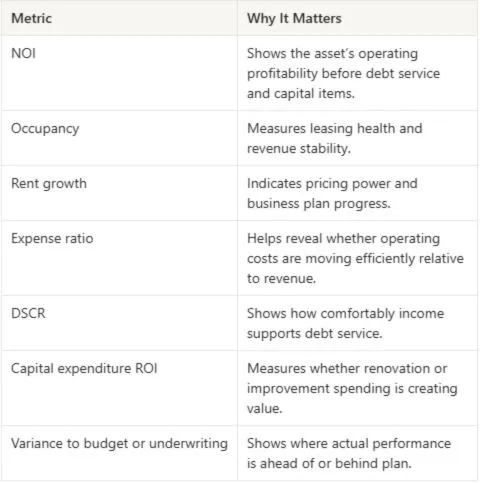

What a Real Estate Asset Manager Looks Like in Practice
Consider a multifamily asset that is 94% occupied but showing weaker cash flow than expected. A property manager may focus on collections, maintenance turnaround, and resident issues. The asset manager will go further by reviewing:
whether concessions are too aggressive
whether renewal rent increases are lagging the market
whether payroll or repairs are above plan
whether upcoming CapEx can justify rent growth
whether refinancing risk is increasing before maturity
That is the practical difference. Asset management connects operations to investment outcomes.
Technology and the Modern Asset Manager
Today’s asset managers rely on more than spreadsheets. They typically work across property management systems, reporting tools, market data platforms, and increasingly AI-driven workflows.
Systems like Yardi, RealPage, Entrata, and MRI often serve as the operating data foundation. But asset managers still need tools that can interpret results, identify issues faster, and turn raw data into action. That is why reporting automation, document extraction, underwriting support, and market research tools have become more important.
For teams that want deeper analysis instead of just stored data, platforms like Leni are part of that shift. The value is not just in pulling numbers. It is in helping teams produce usable output such as underwriting, market research, memos, and reporting faster and with clearer reasoning.
Frequently Asked Questions
Is a real estate asset manager the same as a portfolio manager?
Not always. An asset manager usually focuses on the strategy and performance of individual assets or a subset of properties. A portfolio manager often looks across the full portfolio and makes broader allocation or exposure decisions.
Does an asset manager handle daily tenant issues?
Usually no. Daily tenant communication, maintenance coordination, and on-site operations are generally handled by property management teams.
What property types use asset managers?
Almost all major property types can use asset management, including multifamily, office, retail, industrial, student housing, self-storage, mixed-use, and hospitality.
What is the main goal of asset management in real estate?
The main goal is to maximize value and risk-adjusted returns over the hold period through better financial oversight, operational strategy, capital decisions, and market timing.
Do smaller owners need asset management too?
Yes, although the role may be informal. Even small owners benefit from thinking like asset managers by reviewing returns, lease strategy, CapEx priorities, and refinancing timing instead of focusing only on day-to-day operations.
Final Takeaway
A real estate asset manager is not just there to report on performance or oversee day-to-day operations. The role matters because it sits at the point where strategy, execution, and ownership objectives come together. Asset managers help turn property-level activity into better decisions about leasing, capital, budgeting, risk, and long-term value creation.
That is why the role has become more important, not less, as portfolios grow more complex. Strong systems can organize the data, and tools like Leni can help surface insights faster, but the asset manager is still the one responsible for judgment: deciding what matters, what needs to change, and how to protect and improve investment performance over time.


AI in Real Estate Community
Connect with asset managers, operators, and investors navigating AI adoption in real estate.

Latest Help Articles
Learn about how AI is changing the investment world with in-depth research and industry voices.


MEET LENI
Purpose Built Agentic Platform for Investors
Designed for people who want to do serious work using AI.
We Work with Leaders Shaping the Industry
From automating portfolio reporting to market research, learn how leaders are integrating AI in their businesses.
