What Is Stuytown? Meaning, Real Estate Context, and Why It Matters in New York Housing

What Is Stuytown? Meaning, Real Estate Context, and Why It Matters in New York Housing
When people search for Stuytown, they are usually not looking for a generic real estate term. They are trying to understand a specific residential community with outsized importance in New York housing.
That matters because Stuytown is not a software platform, investment metric, or legal concept. It is the common shorthand for Stuyvesant Town, a large residential apartment complex in Manhattan that is often discussed together with its neighboring development, Peter Cooper Village.
In practical terms, Stuytown refers to one of the best-known large-scale residential housing communities in New York City. It is recognized for its size, location, history, rental housing role, and long-standing relevance in conversations about apartment living, affordability, institutional ownership, and urban real estate operations.
If you want the simplest definition, it is this: Stuytown is a major Manhattan residential apartment community, widely known as shorthand for Stuyvesant Town and often associated with Peter Cooper Village.
What Stuytown Is in Real Estate Terms
At a high level, Stuytown is a large-scale multifamily rental community. It is not just a single building. It is a master-planned residential development made up of multiple apartment buildings, open space, and supporting community infrastructure.
.png)
A master-planned apartment community: multiple buildings and open space
That makes it relevant in several real estate contexts at once:
Multifamily housing: because it functions as a large rental apartment community
Urban planning: because it represents a major postwar housing development model in New York City
Institutional real estate: because of its scale, operating complexity, and ownership history
Housing policy: because it is often discussed in relation to rent regulation, affordability, and tenant protections
Where Stuytown Is Located
Stuytown is located on the east side of Manhattan. In everyday usage, people often use “Stuytown” to refer broadly to the residential area associated with Stuyvesant Town and Peter Cooper Village, positioned between other well-known Manhattan neighborhoods and major transit-accessible areas.
Location is a big part of why the property matters. In New York real estate, a large apartment community in Manhattan has very different significance than a similarly sized development in a lower-density market.
Why Stuytown Is So Well Known
Interesting insight: Stuytown is important not just because of its buildings, but because of what it represents.
It is widely recognized because of a combination of factors:
Scale: it is one of the most visible large apartment communities in Manhattan
History: it has long been part of New York housing and development conversations
Housing role: it is associated with rental housing at meaningful scale in a supply-constrained city
Ownership relevance: it has been discussed in institutional investment and large-asset transaction contexts
Tenant relevance: many New Yorkers know it as an actual place to live, not just a real estate case study
What People Usually Mean When They Search for Stuytown
Search intent around Stuytown usually falls into a few categories:
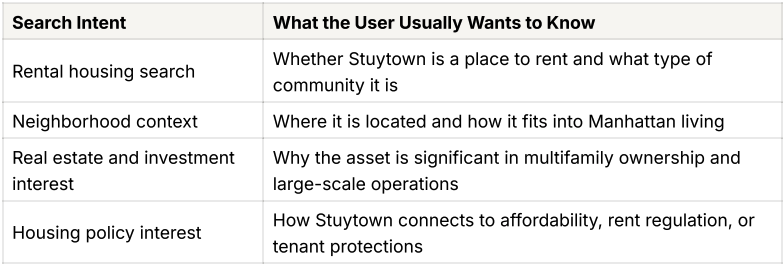
The most important clarification is simple: Stuytown is a real residential community, but it also carries broader significance in New York real estate discussions.
Why Stuytown Matters in Multifamily Real Estate
Stuytown is often discussed as more than a housing complex because it sits at the intersection of several major real estate themes.
Large-Scale Multifamily Operations
Because of its size, Stuytown is relevant as an example of operationally complex multifamily housing. Running a community of that scale involves property management, resident services, maintenance coordination, lease administration, and portfolio-level oversight.
Institutional Ownership
Assets of this size often attract attention from large investors because they are operationally significant, hard to replicate, and important within their local market. That makes Stuytown relevant to people who follow institutional multifamily investing.
Urban Housing Supply
In a city where housing supply is limited and demand is deep, a major rental community matters not only to its residents but also to the broader housing ecosystem.
Rent Regulation and Affordability Conversations
Stuytown often comes up in policy and legal discussions because large New York rental communities frequently intersect with affordability concerns, tenant protections, and regulatory frameworks.
Stuytown vs a Typical Apartment Building
This is one of the most useful distinctions for readers unfamiliar with the term.
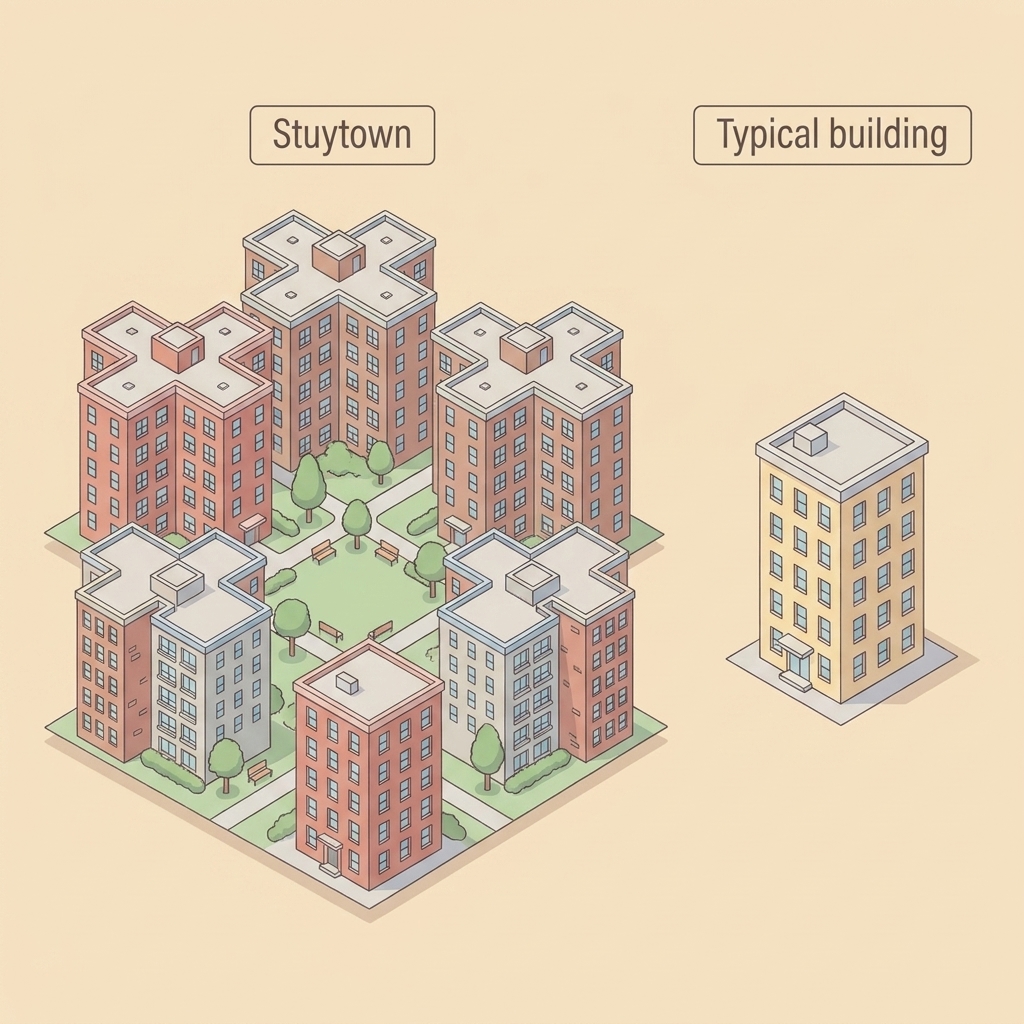
Stuytown vs a typical apartment building (community vs single building)
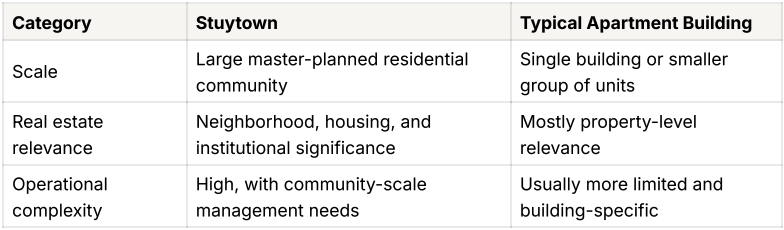
A useful shorthand is this: Stuytown is not just a building. It is a major residential community with neighborhood-level and market-level significance.
Who Typically Cares About Stuytown
Renters who are exploring housing options in Manhattan
Real estate professionals who follow large multifamily assets and New York housing dynamics
Institutional investors interested in landmark residential communities
Urban planners and policy observers focused on housing supply and affordability
Journalists and researchers looking at the history of large-scale housing developments in New York
What Stuytown Does Not Mean
It is also useful to clear up a few misconceptions.
It does not refer to a software platform or real estate technology tool.
It does not mean a general category of housing used nationwide.
It does not refer only to one single apartment tower.
It does not automatically mean the same thing as any standard multifamily asset in another market.
How Stuytown Fits into a Broader Real Estate Workflow
For investors and operators, Stuytown sits closer to the multifamily ownership and operations discussion than to a technology or legal definition. It is relevant as a housing asset, a location, and a case study in scale, management complexity, and New York residential real estate.
That means the name may come up in several contexts: leasing, multifamily operations, rent regulation, market commentary, institutional ownership, and portfolio strategy. It is not a workflow tool. It is a real estate asset and community that represents a much larger set of housing and investment themes.
Frequently Asked Questions
What is Stuytown?
Stuytown is the common shorthand for Stuyvesant Town, a large residential apartment community in Manhattan that is often associated with Peter Cooper Village.
Is Stuytown a neighborhood or a building?
It is better understood as a large residential community rather than a single building. In everyday conversation, people may also use the name as a neighborhood reference point.
Why is Stuytown important in real estate?
It matters because of its scale, Manhattan location, housing role, and relevance in multifamily ownership and policy conversations.
Is Stuytown for renters only?
It is most commonly discussed as a rental housing community, although the reasons people search for it can include real estate history, operations, investment significance, and location context.
Why do investors care about Stuytown?
Because large, well-known residential communities in supply-constrained markets often matter both operationally and strategically within institutional multifamily real estate.
Final Takeaway
Stuytown matters because it is more than a well-known apartment community. It is a clear example of how scale, location, operations, and housing policy can all shape the value and performance of residential real estate at the same time.
That is why it stays relevant to more than just renters. For investors, operators, and asset managers, Stuytown shows how a single property can reflect much larger questions about demand, regulation, and portfolio strategy. And when assets become this operationally and analytically layered, tools like Leni are useful not as a substitute for judgment, but as a way to help teams work through the complexity more clearly.
Put simply, Stuytown is not just a place. It is a high-visibility case study in how large-scale housing actually works in a constrained urban market.

AI in Real Estate Community
Connect with asset managers, operators, and investors navigating AI adoption in real estate.

Latest Help Articles
Learn about how AI is changing the investment world with in-depth research and industry voices.


MEET LENI
Purpose Built Agentic Platform for Investors
Designed for people who want to do serious work using AI.
We Work with Leaders Shaping the Industry
From automating portfolio reporting to market research, learn how leaders are integrating AI in their businesses.
