Data Analysis Tools for CRE Asset Managers: 2026 Guide

Data Analysis Tools for CRE Asset Managers: 2026 Guide
Most data analysis tools fail the moment they encounter a commercial real estate rent roll with percentage rents, CPI escalators, and tenant improvement allowances buried across multiple tabs. What works for analyzing retail sales data or manufacturing output crumbles when faced with the unique complexity of CRE underwriting, where a single misread lease clause can swing an acquisition decision by millions. The brutal truth: general-purpose data analysis tools were never designed for the specific demands of asset management, portfolio monitoring, and deal execution that define our industry.
The Excel Problem: When Spreadsheets Become Liabilities
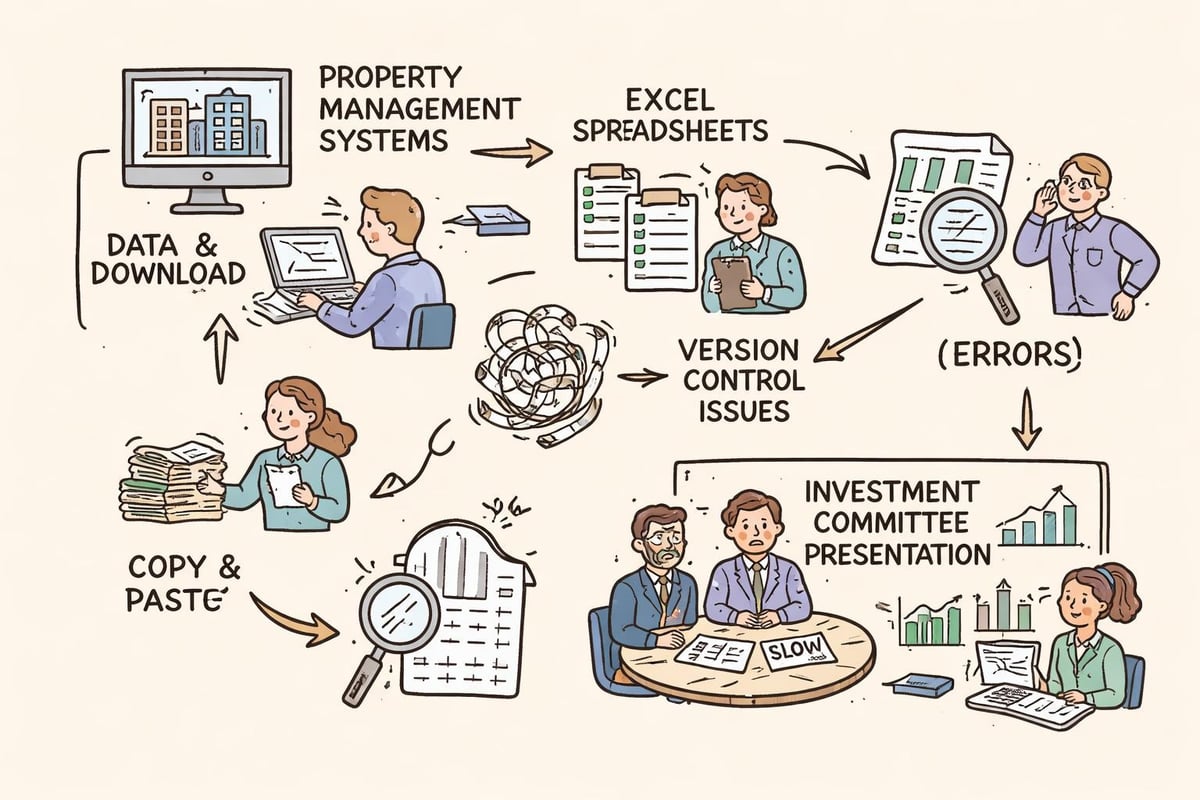
Excel remains the default choice for most CRE professionals, and for good reason. The flexibility to build custom models, the universal file format, and decades of institutional knowledge encoded in templates make it indispensable. Asset managers have built careers mastering XNPV functions, waterfall distribution models, and sensitivity tables that slice IRR projections across dozens of scenarios.
But flexibility creates fragility. Every custom model becomes a unique snowflake that only its creator truly understands. When that analyst leaves, the next person inherits a maze of hidden formulas, circular references, and undocumented assumptions. Version control devolves into files named "Final_v3_ACTUAL_revised_USE_THIS.xlsx" sitting in shared drives.
Data Integrity Challenges
The fundamental limitation isn't Excel itself but how it forces manual data entry and manipulation. Consider the typical underwriting workflow:
Extract financials from a 200-page offering memorandum PDF
Manually type rent rolls into standardized templates
Cross-reference lease abstracts against property management reports
Build cash flow projections linking multiple worksheets
Update assumptions and verify formulas haven't broken
Each step introduces error risk. Data analysis in this context becomes less about analytical insight and more about data wrangling. A study of acquisition teams found analysts spend 60-70% of their time on data preparation rather than actual analysis.
Excel can't connect to your property management system. Every monthly report from Yardi, RealPage, or Entrata requires fresh exports, reformatting, and manual reconciliation. The platform that should enable analysis instead creates endless busy work. For teams evaluating AI for real estate investment, this disconnect becomes the primary pain point.
Power BI and Tableau: Visualization Without CRE Context
Business intelligence platforms brought dashboards and interactive visualizations to the enterprise. Power BI, Tableau, and similar data analysis tools excel at aggregating data from multiple sources and presenting insights through charts, heat maps, and filterable views. Portfolio dashboards showing occupancy trends, rent growth by submarket, and capital expenditure burn rates look impressive in quarterly board presentations.
The visualization strength masks a critical weakness: these platforms lack commercial real estate reasoning. They display what you tell them to display but don't understand what a net effective rent calculation requires or why a T12 NOI needs adjustment for one-time capital events.
FeaturePower BI/TableauCRE-Specific NeedsGapData connectivityGeneric SQL, REST APIsYardi, RealPage, Entrata nativeRequires custom middlewareCalculation engineStandard aggregationsRent steps, reimbursements, TI amortizationManual formula buildingDocument understandingNoneLease abstracts, OMs, appraisalsCannot process source docsOutput verificationCharts and tablesSource-linked, auditable modelsNo provenance tracking
The Integration Tax
Getting CRE data into these platforms requires significant IT resources. Your property management system speaks its own language. Export formats vary. Historical data cleanup becomes a project unto itself before the first dashboard goes live.
Once operational, every new property acquisition or disposition requires reconfiguring data pipelines. The teams at Aligned IQ frequently see middle-market buyers struggle with this challenge when evaluating acquisition targets, as legacy systems and inconsistent data standards compound during due diligence.
These tools can't autonomously execute multi-step analytical tasks. You can visualize trends, but you can't ask Power BI to underwrite a value-add deal, create an IC memo with market comps, and generate sensitivity scenarios. The analysis still happens in your head or back in Excel. The platform simply presents what you've already calculated elsewhere.
Generic AI Chatbots: Hallucinations Meet Financial Models
The 2024-2026 wave of AI adoption brought ChatGPT, Claude, and similar large language models into every professional workflow. CRE teams quickly tested whether these data analysis tools could accelerate underwriting, lease analysis, and market research. The initial demos impressed with natural language interfaces and seemingly sophisticated reasoning.
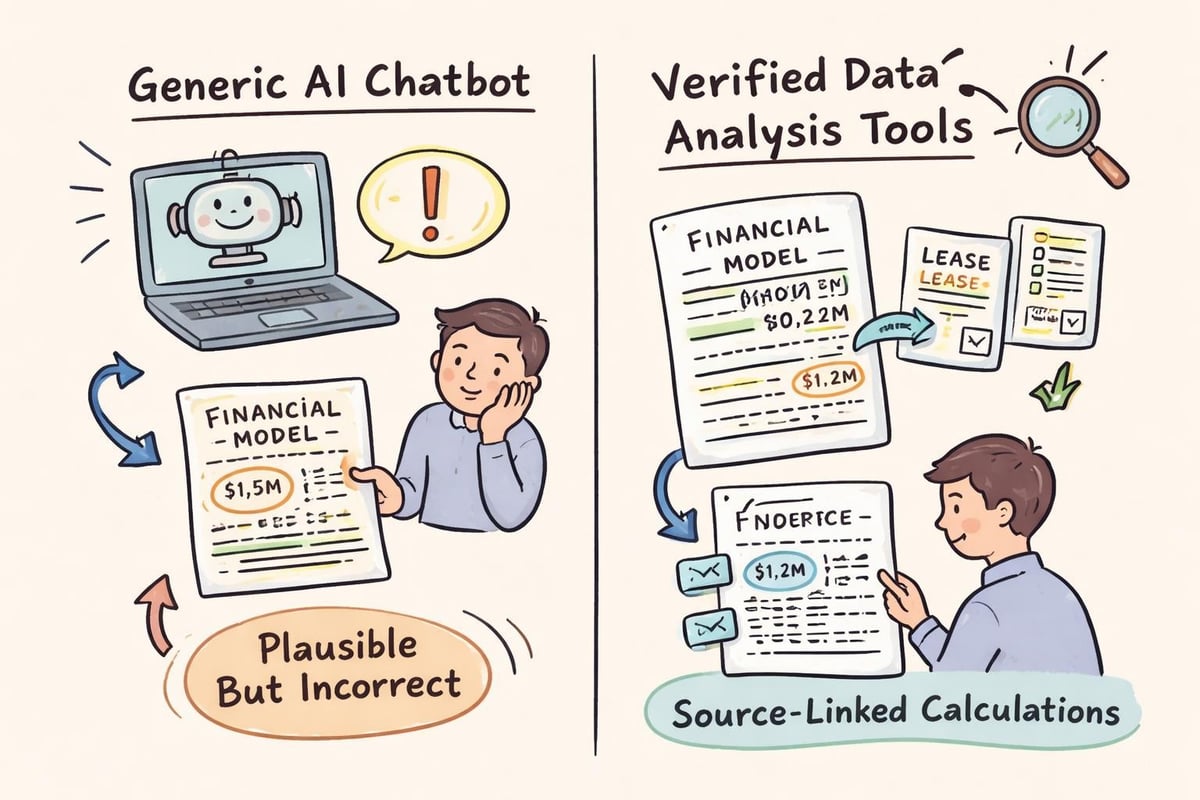
Then came the verification phase. Asset managers discovered AI-generated rent rolls with fabricated tenant names, pro formas that violated basic accounting principles, and market analyses citing nonexistent comparable sales. The hallucination problem proved fatal for high-stakes financial decisions where errors carry seven- or eight-figure consequences.
Generic AI lacks domain-specific training on CRE conventions
No ability to connect directly to property management systems
Cannot verify outputs against source documents
Produces plausible-sounding but factually incorrect analysis
Requires complete human review, eliminating time savings
The Verification Burden
When every AI output needs line-by-line validation against source documents, you haven't automated analysis-you've created a second job checking the AI's work. Experienced analysts found they could build models faster themselves than debugging AI hallucinations.
The security and compliance concerns proved equally problematic. Uploading sensitive offering memorandums, rent rolls with tenant financials, and proprietary underwriting assumptions to consumer AI platforms violates most institutional data governance policies. The convenience of copy-pasting into ChatGPT conflicts with SOC 2 requirements and investor confidentiality obligations that govern institutional asset management.
For acquisitions teams working on competitive deals, the latency between asking questions and receiving answers also matters. General-purpose AI chatbots process queries individually without understanding the broader context of a multi-step underwriting process. This context described in platforms like RAGFlow represents the difference between simple question-answering and true analytical automation.
Purpose-Built Alternatives: When Specificity Matters
The shortcomings of general data analysis tools created market demand for purpose-built solutions designed specifically for commercial real estate workflows. These platforms emerged from a fundamental recognition: CRE analytical needs differ categorically from other industries in ways that generic tools cannot accommodate through customization alone.
What CRE-Specific Tools Deliver
Native understanding of real estate concepts. Purpose-built platforms know that base rent, percentage rent, and expense reimbursements require different treatment in cash flow models. They recognize lease renewal probability affects stabilized valuations. They understand why comparing cap rates requires normalization across different capital structures and market conditions.
This domain expertise extends to document processing. A CRE-focused tool can extract critical data from offering memorandums, understanding the difference between underwritten NOI and T12 actuals, identifying deferred maintenance reserves, and flagging lease rollover risk-tasks that require human analysts hours of careful reading when using traditional data analysis tools.
Direct property management system integration. Rather than monthly CSV exports and manual data entry, specialized platforms connect natively to Yardi, RealPage, and Entrata. This connectivity enables:
Real-time portfolio monitoring with automated threshold alerts
Automatic variance analysis between budgets and actuals
Lease expiration tracking linked to renewal probability models
Maintenance ticket analysis identifying capex needs before they become emergencies
The operational difference proves transformative for commercial real estate analytics software users, who shift from reactive monthly reporting to proactive portfolio management.
Multi-Step Autonomous Task Execution
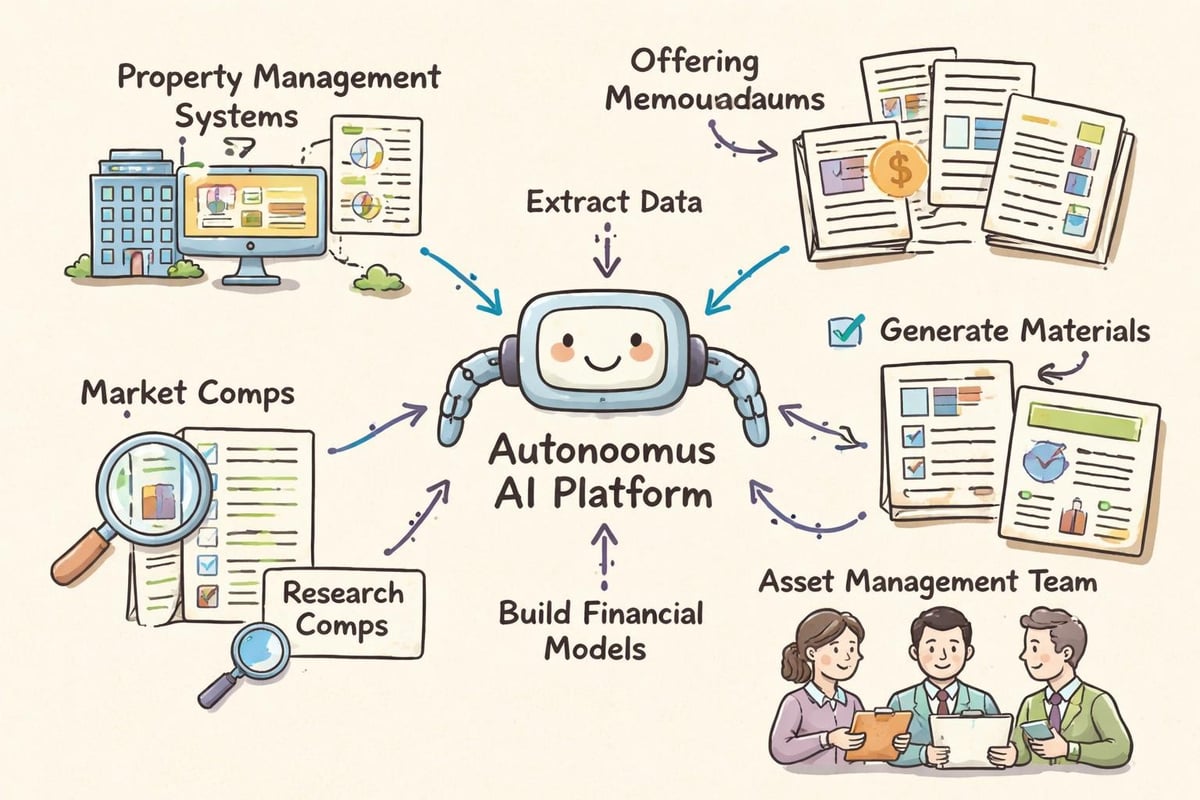
Traditional data analysis tools require you to break complex workflows into discrete steps, executing each manually. Purpose-built AI platforms for CRE run entire analytical sequences autonomously:
Ingest offering memorandum and rent roll
Extract financial data with source links
Build pro forma with market-standard assumptions
Research comparable sales and rental comps
Generate investment committee memo
Create sensitivity analysis across key variables
Produce executive summary with recommendation
This automation directly addresses the analytical bottleneck that AI underwriting in real estate aims to solve-the 40-80 hours typically required for comprehensive acquisition underwriting.
Leni: The AI Analyst Platform Built for CRE
Where general-purpose data analysis tools fail at CRE complexity, Leni succeeds through purpose-built design. Rather than adapting consumer AI or generic business intelligence platforms to commercial real estate, Leni was engineered from inception to handle the specific analytical workflows that define asset management, acquisitions, and portfolio operations.
The platform operates as an autonomous AI analyst. This distinction matters critically. Instead of answering individual questions or generating isolated outputs, Leni executes complete analytical projects-the type that currently occupy analysts for days or weeks.
How Leni Solves the Core Problems
ChallengeTraditional ToolsLeni ApproachDocument processingManual extraction, high error rateAutonomous extraction with source linksPMS connectivityCSV exports, manual reconciliationNative Yardi, RealPage, Entrata integrationModel buildingTemplate-based, requires expertiseAutomated pro formas with CRE logicOutput verificationManual review of all workSource-linked verifiable calculationsTask completionStep-by-step manual executionMulti-step autonomous workflows
Real-world application to acquisitions workflows. When evaluating a potential value-add multifamily acquisition, the traditional process involves three analysts spending 60-80 hours on financial modeling, lease analysis, market research, and memo creation. Leni completes the same scope in hours, not weeks, while maintaining full auditability through direct links to source documents.
This capability extends beyond deal execution to ongoing real estate asset management. The platform monitors portfolios continuously, triggering alerts when metrics breach predetermined thresholds-declining occupancy trends, lease renewal rates falling below projections, or maintenance costs exceeding budgets. Asset managers shift from reactive monthly reviews to proactive intervention.
The Accuracy Advantage
Unlike generic AI that hallucinates plausible-sounding nonsense, Leni's outputs include direct links to source documents for every calculation and assumption. When the platform states a T12 NOI figure, you can click through to the exact line item in the original property management report. When it projects rent growth, the assumption traces to specific market research sources.
This verifiability changes the human-AI dynamic. Instead of reviewing every calculation skeptically, asset managers spot-check critical inputs and validate methodology, dramatically reducing verification time while maintaining analytical rigor. The platform is SOC 2 Type 2 certified, meeting institutional security and compliance requirements that consumer AI tools cannot address.
The learning dimension provides additional leverage. As Leni ingests more data from your portfolio and transactions, accuracy improves. The platform learns your underwriting standards, preferred comparable selection criteria, and investment thesis patterns, delivering increasingly customized outputs aligned with your firm's specific analytical approach.
Selection Criteria: Evaluating Data Analysis Tools for CRE
When comparing data analysis tools for commercial real estate applications, the evaluation framework should prioritize factors specific to our analytical requirements rather than generic software selection criteria. Asset managers evaluating platforms need a structured approach that accounts for both immediate functionality and long-term operational impact.
Critical Assessment Dimensions
CRE domain expertise stands paramount. Can the tool correctly calculate net effective rent with TI and free rent concessions? Does it understand the difference between economic and physical occupancy? Can it process percentage rent clauses and CAM reconciliations? These aren't features you can add through customization-they require fundamental domain knowledge baked into the platform.
PMS integration depth determines whether the tool alleviates or perpetuates manual data work. Surface-level API connections that require middleware and custom development deliver limited value. Native integration that pulls data directly, understands the source system's data model, and handles updates automatically represents the standard that real estate automation demands.
Direct connectivity to Yardi, RealPage, Entrata without middleware
Automated synchronization, not manual exports
Historical data access for trend analysis
Lease-level detail, not just property aggregates
Maintenance and financial data integration
Autonomous task completion separates truly advanced platforms from sophisticated calculators. The question isn't whether the tool can perform individual calculations, but whether it can execute complete analytical workflows from raw data to finished deliverable. Can it produce an investment committee memo, or just the financial model that feeds into a memo you still write manually?
Security and Compliance Requirements
Institutional asset managers operate under strict data governance mandates. Tools handling sensitive financial information, tenant data, and proprietary underwriting models must meet enterprise security standards. SOC 2 Type 2 certification, data encryption in transit and at rest, role-based access controls, and audit logging represent minimum requirements, not aspirational features.
The compliance dimension extends to output verifiability. When presenting investment recommendations to committees or LP investors, data analysis tools must provide clear audit trails linking conclusions to source data. The ability to demonstrate that pro forma assumptions derive from verifiable market research rather than algorithmic guesswork directly impacts fiduciary responsibility.
Scalability across portfolio size affects total cost of ownership. A tool that works brilliantly for analyzing individual acquisitions but requires manual reconfiguration for each new property fails at portfolio scale. Similarly, platforms that perform adequately with 10-property portfolios but degrade with 100 properties create future migration pain. Platforms serving multifamily investors must handle complexity that scales with asset count.
The Specificity Advantage in High-Stakes Decisions
Financial decisions in commercial real estate carry consequences that demand analytical precision beyond what general-purpose data analysis tools can reliably deliver. A 50-basis-point error in cap rate assumption affects acquisition pricing by millions. Misreading lease expiration timing impacts cash flow projections that determine debt serviceability. These aren't acceptable risks when deploying institutional capital.
Purpose-built tools deliver superior outcomes precisely because they constrain flexibility in favor of correctness. Excel lets you calculate anything-including plenty that violates basic CRE principles. Generic AI generates creative outputs, some factually wrong. Specialized platforms embed domain expertise as guardrails, making it harder to produce nonsensical results.
This design philosophy mirrors other professional domains. Tax professionals don't use spreadsheets for complex returns when purpose-built software like those offered by Law Cyborg ensures compliance with current code. Architects don't sketch building plans in generic drawing programs when CAD tools enforce structural integrity. The same logic applies to commercial real estate analysis, where stakes justify specialized tooling.
The Competitive Dimension
Markets move faster than ever. The acquisitions team that completes underwriting in two days beats competitors requiring two weeks, particularly in lightly marketed off-market deals where speed creates negotiating leverage. Data analysis tools that accelerate analytical throughput without sacrificing quality provide quantifiable competitive advantage.
Beyond speed, comprehensive analysis depth matters. When your team can quickly model multiple scenarios, stress-test assumptions across economic cycles, and identify value-creation opportunities that surface only through detailed analysis, superior tools translate directly to superior outcomes. The platform becomes competitive infrastructure, not back-office software.
For teams building commercial real estate databases across portfolios, the analytical foundation determines what questions you can answer. Generic tools query what you've already calculated. Purpose-built platforms with CRE reasoning can answer questions you haven't explicitly programmed, finding patterns and insights that emerge from comprehensive data understanding.
When firms evaluate whether to deploy AI real estate deal analyzers, the decision framework should weigh not just current analytical efficiency but strategic positioning. The team equipped with superior analytical infrastructure compounds advantages over years of deployment-faster decisions, deeper insights, and continuous improvement as systems ingest more data.
Implementation Considerations and Change Management
Adopting new data analysis tools requires more than software selection. Successful implementation demands change management that addresses workflow disruption, training requirements, and the inevitable resistance from analysts comfortable with existing approaches-no matter how inefficient those approaches prove objectively.
Start with clearly defined use cases. Rather than attempting wholesale replacement of all analytical processes simultaneously, identify specific workflows where new tools deliver immediate measurable value. Acquisition underwriting represents an ideal starting point given clear time savings metrics and defined deliverables. Portfolio monitoring follows logically once acquisition workflows stabilize.
The gradual rollout approach lets teams build confidence while maintaining continuity. Analysts can validate new platform outputs against traditional methods initially, confirming accuracy before trusting autonomous execution. This parallel operation period addresses legitimate concerns about replacing proven (if slow) processes with unfamiliar technology.
Training and Adoption Strategy
Different data analysis tools require different skill sets. Excel mastery involves formula logic and model construction. Purpose-built AI platforms shift the required expertise from tool operation to analytical judgment-asking the right questions, validating outputs, and translating findings into actionable recommendations.
This competency shift changes hiring profiles and training priorities. Junior analysts spend less time on data entry and model troubleshooting, more time on market research and strategic thinking. Senior team members focus on complex judgment calls rather than repetitive mechanical tasks. The transition requires intentional skill development aligned with new workflows.
For organizations working with talent marketplaces like Augmnt to source specialized expertise, clarifying whether roles require traditional financial modeling skills or AI-assisted analytical capabilities helps match candidates to actual workflow requirements rather than historical job descriptions.
Integration with existing systems determines whether new tools feel like productivity enhancements or disruptive additions. Platforms that play nicely with established workflows, export to familiar formats, and enhance rather than replace trusted processes gain adoption faster than those demanding complete workflow overhaul.
The commercial real estate industry faces analytical demands that general-purpose data analysis tools simply cannot meet efficiently. Excel, Power BI, and generic AI chatbots each fail in characteristic ways when confronted with rent rolls, OMs, PMS data, and the multi-step workflows that define institutional asset management. Purpose-built alternatives designed specifically for CRE workflows deliver the accuracy, integration, and autonomous execution that high-stakes financial decisions require. When specificity matters more than versatility, Leni provides asset managers, acquisitions teams, and portfolio operators the analytical infrastructure to make faster, better-informed decisions with full auditability and source verification.

Johanna Gruber
Johanna has spent the last 8 years helping marketing teams connect with audiences through content. Specializing in B2B SaaS and real estate.

Curious About AI?
Join the largest AI community for real estate online. Get bite-sized, real-world use case videos, plus practical tips and proven strategies from top industry experts on adopting AI effectively.
MEET LENI
AI SuperAgent Purpose Built for Investors and Operators.
Experience how professionals and teams in your domain are getting the edge using AI.
