Market Insights: 8 Signal Types for Smarter Decisions

Market Insights: 8 Signal Types for Smarter Decisions
The investment landscape generates thousands of signals daily, but only a fraction truly influence decision quality. Market insights represent the distilled, actionable intelligence that separates noise from opportunity, helping asset managers, investment committees, and portfolio teams allocate attention to what genuinely moves outcomes. The challenge lies not in accessing information but in identifying which signals warrant deeper diligence before capital commitments are made. This discovery-and-prioritization process determines whether teams chase false patterns or capture genuine market shifts that inform underwriting assumptions, competitive positioning, and portfolio strategy.
1. Demand Shift Signals: Reading Behavioral Changes Before They Become Obvious
Demand signals reveal how end-user preferences and behaviors are evolving, often months before they appear in traditional metrics. Understanding these shifts requires monitoring reservation rates, tenant inquiry patterns, absorption timelines, and sector-specific usage data.
Leading Versus Lagging Demand Indicators
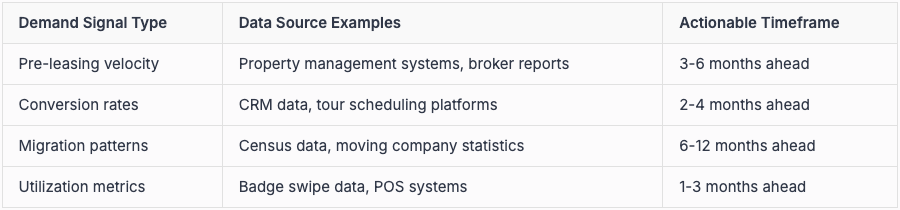
Investment professionals must distinguish between indicators that predict future performance and those that merely confirm what already occurred. Leading indicators include pre-leasing velocity, tour-to-lease conversion rates, and geographic search volume patterns. According to research on web search query volumes and market trading volumes, online behavior patterns can predict market activities with measurable accuracy.
Key demand metrics to track:
Pre-leasing or reservation velocity relative to historical baselines
Tour-to-application conversion rates across property types
Geographic migration patterns from employment and relocation data
Sector-specific utilization rates (office occupancy, retail foot traffic, industrial throughput)
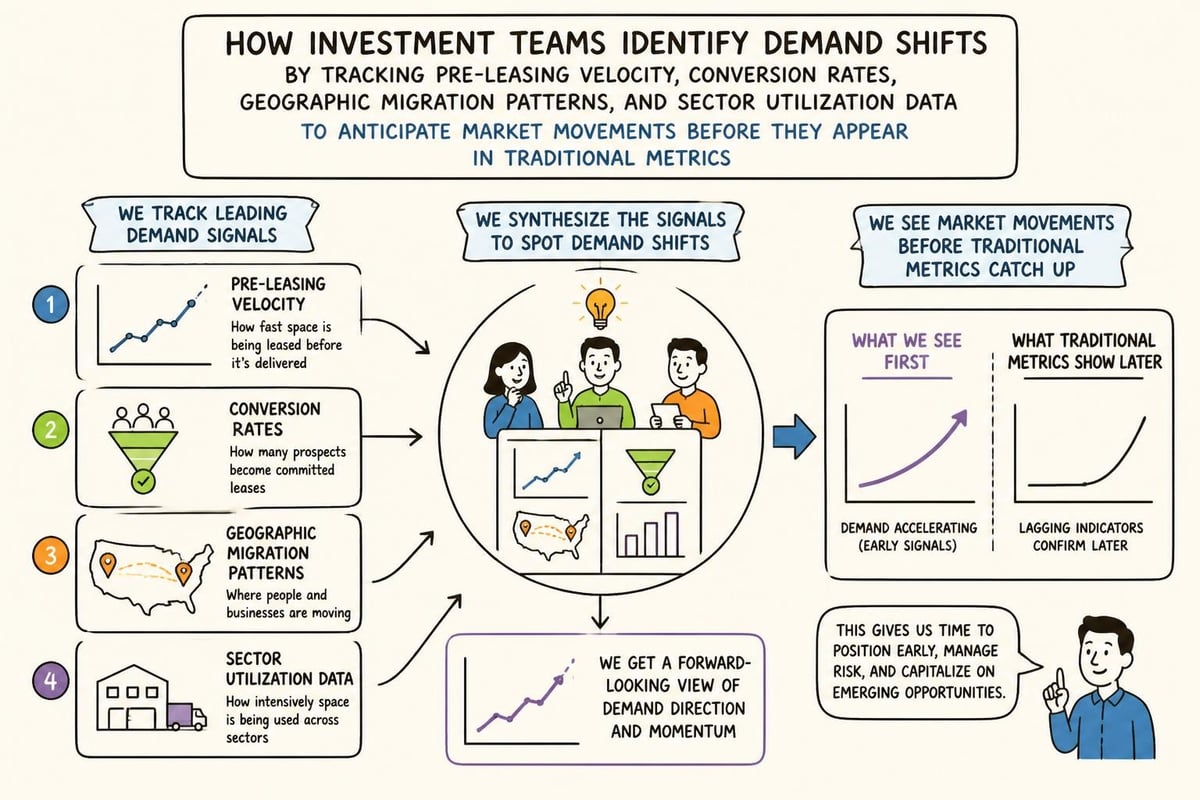
The value of demand insights lies in timing. Teams that identify weakening conversion rates six months early can adjust acquisition criteria, while those relying solely on quarterly occupancy reports react after opportunities have passed. AI tools for real estate investment enable continuous monitoring of these signals across multiple markets simultaneously.
2. Rent and Pricing Movement: Tracking Revenue Potential Across Markets
Pricing signals directly impact pro forma assumptions and valuation models. Market insights into rent growth, concession trends, and effective rent calculations separate optimistic underwriting from reality-tested projections.
Effective rent analysis requires looking beyond asking rents to understand net effective income after concessions, tenant improvement allowances, and free rent periods. Markets experiencing asking rent growth of 4% annually may deliver effective rent growth of only 1.5% once concessions are factored in.
Pricing Signal Reliability
Pricing data quality varies dramatically by source. Proprietary property management data provides the most accurate picture but covers limited inventory. Broker surveys offer broader coverage with less precision. Third-party aggregators sit somewhere between, with accuracy depending on their data partnerships.
Investment committees increasingly demand source-linked pricing assumptions. When underwriting models cite "market rent growth of 3.2%," decision-makers need to trace that figure to specific comps, time periods, and adjustment methodologies. This transparency becomes critical when preparing investment committee memos that require defendable assumptions.
Pricing insight checklist:
Asking rent trends by submarket and property class
Concession packages (free months, TI allowances, parking)
Effective rent calculations accounting for all concessions
Renewal versus new lease pricing spreads
Premium or discount to submarket averages with justification
3. Supply Pipeline Analysis: Anticipating Competitive Inventory
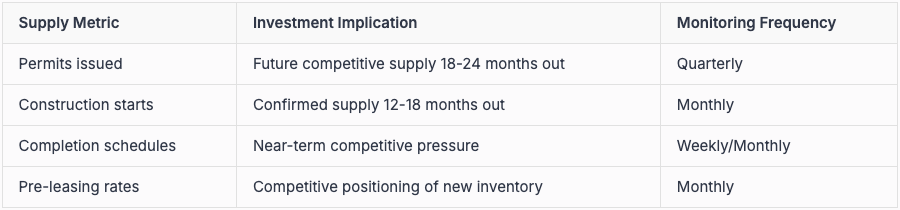
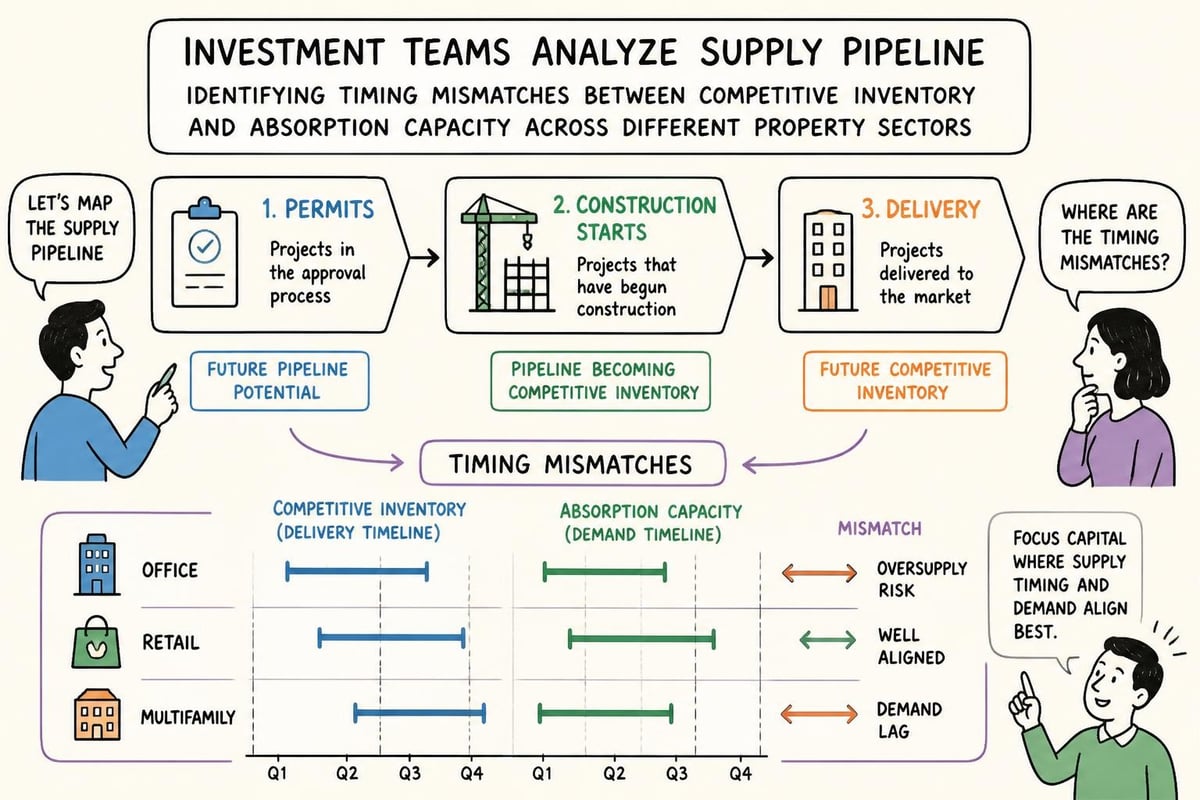
Supply signals reveal future competitive pressure before it materializes in the market. Tracking construction starts, permitting activity, delivery timelines, and pre-leasing progress allows teams to model absorption capacity and timing risks.
The gap between permitted units and delivered units matters significantly. Markets with aggressive permitting but constrained construction financing may see fewer deliveries than pipeline reports suggest. Conversely, markets with streamlined approval processes and abundant capital can surprise with accelerated delivery schedules.
NielsenIQ and similar consumer intelligence providers offer data on retail and consumer-facing sectors that influence demand for various property types. Understanding these broader consumption patterns helps contextualize supply decisions.
Supply-Demand Timing Mismatches
The most valuable supply insights identify timing disconnects. A market adding 2,000 units annually can absorb that inventory comfortably if employment growth supports 2,500 new households. The same supply becomes problematic if deliveries concentrate in six months while demand spreads across twelve.
4. Demographic and Economic Drivers: Understanding the Foundation
Demographic shifts operate on longer timeframes but establish the foundation for demand across asset classes. Population growth, age distribution changes, household formation rates, income trends, and employment composition all cascade into property-level performance.
Markets experiencing millennial family formation see increased demand for:
Larger multifamily units with flexible workspaces
Suburban properties with school proximity
Retail centers with family-oriented tenants
Industrial space supporting e-commerce delivery
These demographic insights inform not just acquisition targeting but also renovation strategies, amenity packages, and tenant mix decisions for existing portfolios. Commercial real estate portfolio management increasingly incorporates demographic overlays to prioritize capital allocation across holdings.
Employment Mix as a Leading Indicator
Employment composition matters as much as employment growth. Markets adding 5,000 jobs in technology, finance, and healthcare generate different demand than markets adding 5,000 jobs in distribution and hospitality. The former supports office, upscale multifamily, and amenity retail. The latter drives industrial, workforce housing, and value retail.
Investment professionals cross-reference employment data with wage trends to identify markets where job growth translates into rent-paying capacity. A market adding jobs at $45,000 median wages requires different property targeting than one adding jobs at $85,000 median wages.
5. Policy and Regulatory Shifts: Tracking Rule Changes That Alter Economics
Regulatory signals often receive insufficient attention until they directly impact property economics. Zoning changes, tax policy shifts, rent control proposals, environmental regulations, and incentive programs all alter investment returns.
The most actionable regulatory insights arrive early in the legislative or approval process, allowing teams to model scenarios before rules finalize. Teams that identify inclusionary zoning proposals six months before passage can adjust land acquisition criteria and development pro formas accordingly.
Quantifying Regulatory Impact
Translating regulatory changes into financial impact requires specific modeling. A rent control proposal capping annual increases at 3% in a market historically averaging 4.5% growth alters 10-year cash flow projections significantly. Environmental requirements adding $15 per square foot to renovation costs change value-add return expectations.
Real estate analytics software enables teams to model regulatory scenarios quickly, comparing base case, optimistic, and pessimistic outcomes across multiple properties simultaneously. This scenario analysis supports informed positioning before regulatory uncertainty resolves.
Critical regulatory monitoring areas:
Zoning and land use changes affecting development rights
Property tax assessment methodologies and rate changes
Rent control or tenant protection proposals
Environmental compliance requirements and timelines
Opportunity zone or tax incentive program modifications
6. Capital Markets Dynamics: Following the Money
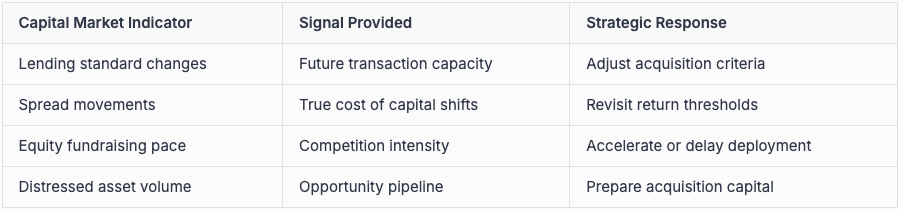
Capital flow patterns dictate pricing, availability, and competition across investment strategies. Market insights into lending standards, cap rate compression or expansion, equity deployment preferences, and distressed asset pipelines inform timing and strategy decisions.
The Artificial Intelligence Index Report 2024 demonstrates how AI is transforming data analysis across sectors, including financial services and capital allocation processes. Understanding these technological shifts helps predict where capital will flow as institutions adopt new analytical capabilities.
Debt Market Signals
Lending conditions often shift before equity pricing fully adjusts. When lenders tighten loan-to-value requirements from 70% to 65%, or increase debt service coverage ratio minimums from 1.25x to 1.35x, acquisition capacity declines even if cap rates remain stable. These lending signals forecast pricing pressure months before transaction volume reflects the change.
Interest rate movements receive significant attention, but spread changes between treasury rates and commercial real estate debt often matter more. A 50-basis-point spread widening while base rates remain flat increases borrowing costs as effectively as a 50-basis-point rate increase.
7. Competitor Activity Patterns: Understanding Positioning and Behavior
Competitor signals reveal strategic positioning, capital deployment patterns, and market beliefs. Tracking which markets, property types, and investment strategies competitors prioritize provides context for your own decisions.
Monitoring competitor activity extends beyond public transaction announcements. Development permitting patterns, hiring in specific markets, partnership formations, and strategic statements all telegraph future moves. When three major competitors simultaneously increase hiring in secondary Sunbelt markets, that pattern deserves analysis.
Competitive Intelligence Sourcing
Effective competitor tracking requires systematic collection across multiple channels. Public filings provide transaction data for REITs and public companies. Industry conferences reveal strategic priorities through panel discussions and networking. Broker relationships offer insight into active buyers and their criteria. Property records show acquisition and disposition activity.
Research from market research and insights organizations provides frameworks for systematic competitive monitoring, ensuring coverage remains comprehensive rather than anecdotal. The goal is identifying patterns that reveal strategic shifts, not just cataloging individual transactions.
The challenge lies in distinguishing meaningful strategic shifts from opportunistic transactions. A competitor acquiring one property in a new market may represent testing rather than strategic expansion. Three acquisitions over six months signals commitment. Understanding this distinction prevents overreacting to noise while ensuring genuine strategic shifts receive appropriate attention.
8. Portfolio Performance Patterns: Internal Data as Market Signal
Your own portfolio generates valuable market insights that external sources cannot provide. Property-level performance trends, tenant health indicators, operational efficiency metrics, and capital project outcomes all reveal market conditions in real time.
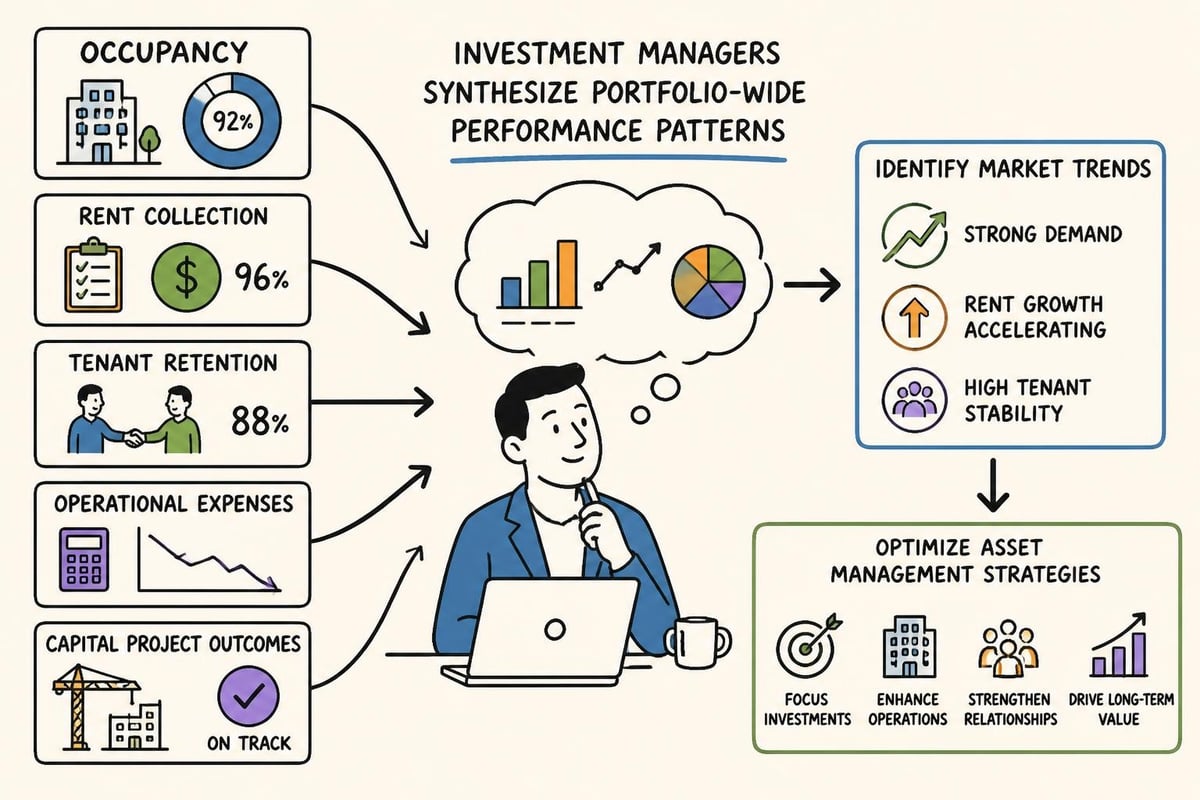
Portfolio-derived insights include:
Rent collection trends as early warning of economic stress
Tenant expansion or contraction patterns indicating sector health
Maintenance and capital expenditure trend analysis
Operational expense inflation across property types
Leasing velocity and concession requirement changes
Portfolio and investment management platforms centralize this internal data, enabling pattern recognition across dozens or hundreds of properties. A 200-basis-point decline in rent collection rates across 15 office properties in three months provides a more immediate demand signal than quarterly market reports.
Turning Portfolio Data Into Actionable Insights
The difference between portfolio reporting and portfolio insights lies in comparative analysis and pattern recognition. Knowing that Property A experienced 8% turnover last quarter becomes meaningful when compared to the property's historical average, peer properties in the portfolio, and market benchmarks.
Investment committees need this context to make informed decisions. When evaluating acquisition opportunities, understanding how similar properties in your existing portfolio have performed provides the most relevant comparable data available. Real estate investment management software that connects acquisition underwriting to portfolio performance creates this feedback loop automatically.
Systematic Portfolio Review Cadence
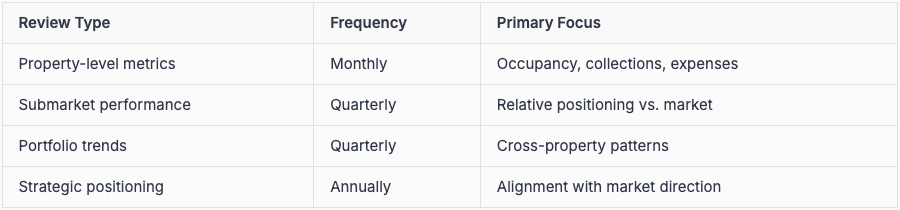
According to Informa TechTarget's strategy research, organizations that systematically capture and analyze their operational data gain significant competitive advantages in developing informed strategies. This principle applies directly to investment portfolio management, where internal data represents a proprietary advantage.
Integrating Multiple Signal Types for Decision Confidence
Individual signal types provide partial pictures. Investment confidence emerges from integrating multiple signal types into coherent narratives. A market showing strong demand growth (Signal Type 1) and limited supply pipeline (Signal Type 3) but facing regulatory headwinds (Signal Type 5) requires nuanced interpretation.
The Synthesis Challenge
Most investment teams collect these signals across disconnected systems: spreadsheets for pricing data, email threads for regulatory updates, presentations for competitor activity, and separate platforms for portfolio performance. This fragmentation makes synthesis time-intensive and inconsistent.
The most sophisticated teams create systematic processes for signal collection, verification, and integration. This might include weekly market intelligence meetings, shared databases with source documentation, or platforms that centralize research inputs. Secure AI for investment firms enables teams to query across uploaded documents, internal data, and market research simultaneously, accelerating synthesis while maintaining audit trails.
Professional organizations like Esomar provide ethical guidelines and industry standards for market research that help investment teams maintain methodological rigor when collecting and interpreting market signals.
Signal Weighting by Investment Horizon
Different signal types carry different weights depending on investment strategy and time horizon. Core holdings with 10-year holds weight demographic trends and policy shifts heavily, while value-add strategies emphasize near-term demand and pricing signals.
Signal weighting framework by strategy:
Core/Core-Plus: Demographics (30%), Policy (25%), Supply (20%), Demand (15%), Capital Markets (10%)
Value-Add: Demand (30%), Pricing (25%), Portfolio Performance (20%), Supply (15%), Competitors (10%)
Opportunistic: Capital Markets (35%), Competitors (25%), Demand (20%), Pricing (15%), Policy (5%)
This weighting guides resource allocation toward the signals that most influence each strategy's success factors.
Building Organizational Capabilities for Market Intelligence
Individual analysts tracking market insights create limited organizational value if that knowledge remains siloed. Building systematic capabilities requires infrastructure, processes, and culture that make intelligence accessible across investment, asset management, and portfolio strategy teams.
Two Operating Models: Subscription Professionals and Enterprise Teams
Subscription professionals working independently or in small teams need fast access to verifiable research. They upload market reports, broker packages, and property documents, then query across this content to support acquisition memos or investment committee presentations. The priority is speed and accuracy without complex integration requirements.
Enterprise teams managing larger portfolios require different capabilities: connected data across properties, governed workflows with approval chains, recurring reporting that updates automatically, permission structures that control access, and model flexibility that accommodates diverse property types. These teams need commercial real estate technology that scales across hundreds of users while maintaining data integrity and auditability.
Both models share a common requirement: transforming scattered signals into usable judgment. Whether preparing underwriting assumptions, competitive scans, or portfolio performance reports, the core challenge remains filtering signal from noise and documenting the reasoning behind conclusions.
Documentation and Institutional Memory
Market insights lose value without proper documentation. An analyst who identifies an emerging supply glut in a target market creates limited organizational impact if that insight exists only in their notes. When captured in searchable, source-linked formats, the same insight informs multiple decision processes and builds institutional knowledge.
The UCLA Anderson School of Management maintains a curated list of market research databases that demonstrates the importance academic institutions place on systematic information organization. Investment firms should apply similar rigor to their proprietary research and analysis.
Investment committees increasingly require source documentation for key assumptions. When an underwriting model projects 3% annual rent growth, decision-makers want immediate access to the comps, time periods, and adjustments underlying that figure. Tools for data analysis that maintain these source links enable faster due diligence and more confident approvals.
Market insights transform from overwhelming information flows into strategic advantages when teams systematically identify, verify, and integrate the signals that genuinely influence outcomes. The eight signal types covered here-demand shifts, pricing movement, supply pipeline, demographics, policy changes, capital markets, competitor activity, and portfolio performance-provide a comprehensive framework for directing analytical resources toward what matters most. Leni helps investment and asset management teams turn these scattered signals into governed workflows, source-linked research, and recurring reports that support faster, more confident decisions across acquisition underwriting, portfolio management, and strategic planning. Whether you're an individual professional needing fast research capabilities or an enterprise team requiring connected data and auditability, purpose-built platforms designed for serious investment workflows make the difference between reactive reporting and proactive intelligence.

Johanna Gruber
Johanna has spent the last 8 years helping marketing teams connect with audiences through content. Specializing in B2B SaaS and real estate.

Curious About AI?
Join the largest AI community for real estate online. Get bite-sized, real-world use case videos, plus practical tips and proven strategies from top industry experts on adopting AI effectively.
MEET LENI
AI SuperAgent Purpose Built for Investors and Operators.
Experience how professionals and teams in your domain are getting the edge using AI.
