Portfolio and Investment Management: A Complete Guide

Portfolio and Investment Management: A Complete Guide
Managing a portfolio isn't a quarterly exercise. It's a continuous cycle of synthesis, reconciliation, and decision-making that demands current information without the burden of rebuilding the same views by hand every period. Whether you're overseeing institutional assets or individual holdings, the challenge remains consistent: maintaining a live, decision-ready understanding of performance, variance, and opportunity across your entire portfolio. The difference between effective and ineffective portfolio and investment management often comes down to how quickly you can move from raw data to actionable insight.
Understanding the Core Framework of Portfolio and Investment Management
Portfolio and investment management centers on three fundamental activities: construction, monitoring, and adjustment. Each requires distinct capabilities but all share a common requirement for accurate, timely information synthesis.
The Portfolio Approach to Asset Management
The portfolio management process represents a systematic approach to balancing risk and return across multiple holdings. Rather than evaluating each investment in isolation, this framework assesses how assets interact within the broader portfolio context.
Key principles include:
Diversification across asset classes, sectors, and geographies
Risk-adjusted return optimization rather than absolute return maximization
Regular rebalancing to maintain target allocations
Tax-efficient positioning and transition management
Alignment with investor-specific constraints and objectives
Modern portfolio and investment management demands understanding correlations, examining how different assets behave under various market conditions, and structuring positions that deliver consistent performance across economic cycles.
Building Your Investment Policy Statement
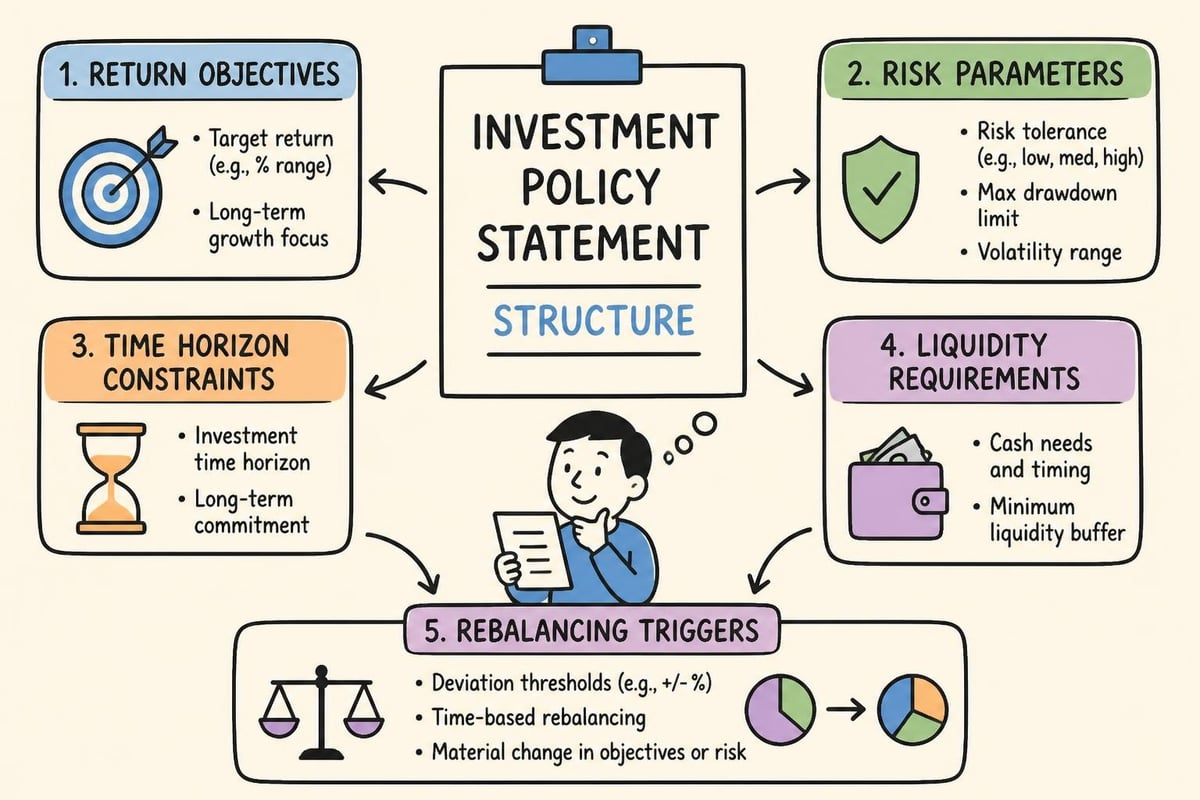
The investment policy statement (IPS) serves as your portfolio's constitution. This document establishes return objectives, risk tolerance, time horizon, liquidity requirements, tax considerations, and regulatory constraints that govern all subsequent decisions.
For institutional investors, the IPS typically addresses specific liability structures, spending policies, and governance frameworks. Individual investors focus more heavily on personal circumstances, retirement timelines, and legacy goals. Both require precise documentation of what drives portfolio decisions.
Establishing Your Portfolio Structure and Asset Allocation
Asset allocation represents the primary driver of long-term portfolio returns. Research consistently demonstrates that allocation decisions matter more than individual security selection for most investors.
Strategic vs. Tactical Allocation Decisions
Strategic asset allocation sets your long-term target weights based on expected returns, volatility, and correlation assumptions. These targets reflect fundamental beliefs about risk premiums and your specific return requirements.

Tactical allocation involves temporary deviations from strategic targets to capitalize on shorter-term market dislocations. These adjustments require disciplined processes for identifying opportunities and reverting to baseline allocations once conditions normalize.
Implementing Allocation Across Investment Vehicles
Real-world implementation demands understanding how different vehicles deliver exposure. Direct holdings, mutual funds, ETFs, separately managed accounts, and alternative investments each offer distinct advantages for accessing specific market segments.
For commercial real estate portfolios, allocation extends beyond geography and property type. Vintage year diversification, sponsor relationships, development stage, and capital structure all influence portfolio characteristics. AI-powered asset management tools increasingly help teams track these dimensions across entire portfolios without manual consolidation.
The transition from allocation strategy to actual positions requires consideration of transaction costs, tax implications, minimum investment sizes, and operational complexity. Each decision affects not just expected returns but also the ongoing monitoring burden.
Developing Systematic Monitoring and Reporting Processes
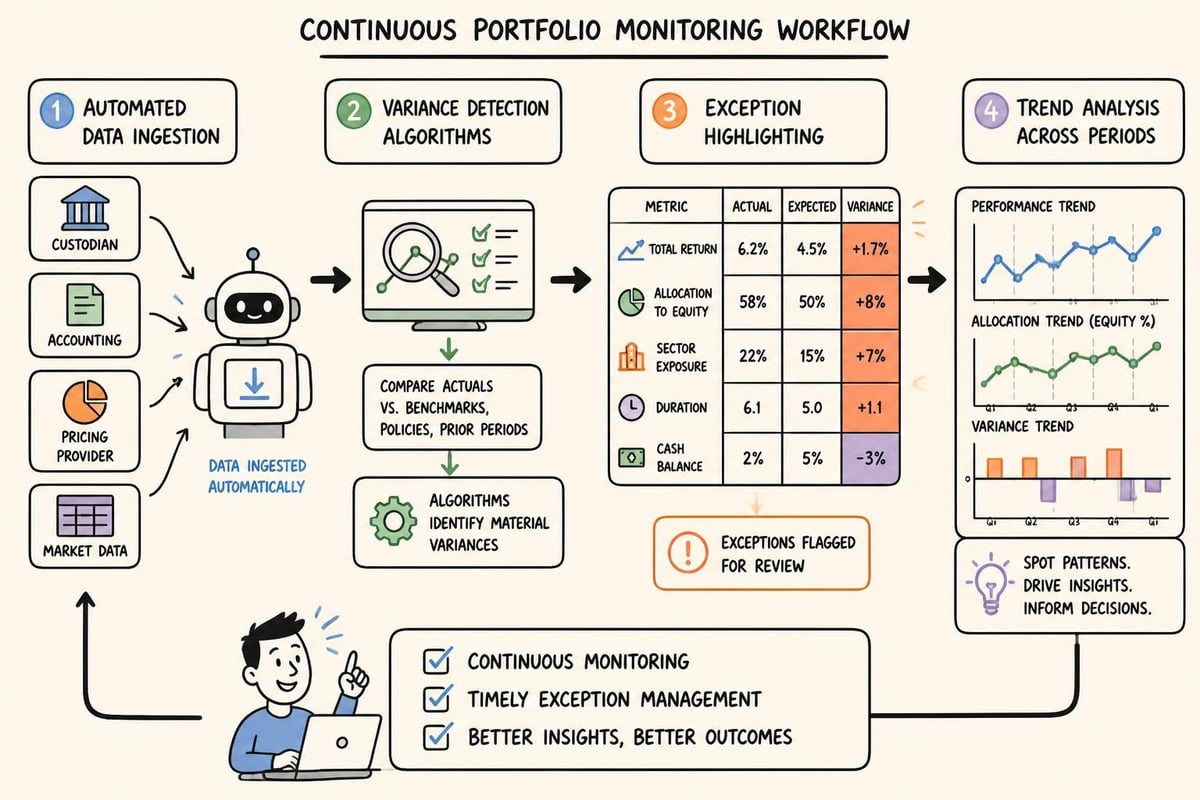
The monitoring phase consumes the majority of time in portfolio and investment management. Performance measurement, attribution analysis, variance investigation, and narrative reporting recur every period, creating substantial operational overhead.
Performance Measurement Fundamentals
Accurate performance measurement requires time-weighted or money-weighted return calculations depending on whether you control cash flows. Time-weighted returns isolate management skill by removing the impact of contributions and withdrawals. Money-weighted returns (IRR) better reflect the actual investor experience when timing decisions matter.
Essential performance metrics:
Absolute returns across various time periods
Risk-adjusted returns (Sharpe ratio, Sortino ratio, information ratio)
Tracking error relative to benchmarks
Maximum drawdown and recovery periods
Up-capture and down-capture ratios
Beyond basic returns, portfolio performance evaluation requires attribution analysis that decomposes results into allocation effects, selection effects, and interaction effects. This decomposition reveals whether outperformance stems from being in the right asset classes or choosing superior securities within those classes.
Building Automated Reporting Workflows
Manual report generation from multiple data sources introduces errors and consumes hours each reporting cycle. Enterprise teams connecting property management systems can automate much of this synthesis, while individual managers benefit from platforms that consolidate data from uploaded statements and models.
The goal isn't eliminating human judgment but rather spending analytical time on exceptions and decisions rather than data compilation. When variance occurs, you need the ability to drill into underlying positions, understand drivers, and generate explanations without rebuilding entire reports. Automated real estate reporting capabilities enable this shift from compilation to analysis.
Catching Variance and Managing Portfolio Risk
Risk management extends beyond volatility measurement to encompass liquidity risk, concentration risk, counterparty risk, and operational risk. Each dimension requires specific monitoring approaches and mitigation strategies.
Identifying and Responding to Portfolio Drift
Portfolio drift occurs naturally as different holdings appreciate or depreciate at varying rates. Left unchecked, drift causes actual allocations to deviate substantially from strategic targets, altering portfolio risk characteristics.
Effective drift management requires:
Rebalancing thresholds that trigger review (commonly 5% absolute deviation or 20% relative deviation from target weights)
Tax-loss harvesting opportunities that offset gains while maintaining exposure
Cash flow management that uses contributions and distributions to rebalance without trading
Transition analysis weighing rebalancing benefits against transaction costs
For institutional investors managing real estate portfolios, illiquidity complicates rebalancing. You cannot readily adjust property allocations, requiring more careful attention to commitment pacing and distribution reinvestment.
Stress Testing and Scenario Analysis
Static risk measures based on historical volatility fail to capture tail risks and regime changes. Comprehensive portfolio and investment management incorporates forward-looking stress tests that examine portfolio behavior under adverse scenarios.
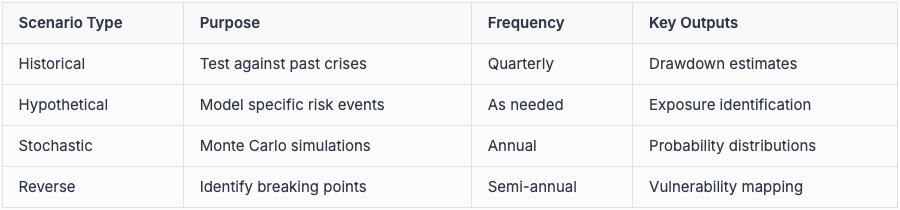
Modern approaches leverage AI for investment monitoring to continuously evaluate positions against defined risk parameters, flagging concentrations or exposures that exceed policy limits without waiting for scheduled reviews.
Executing Portfolio Adjustments and Rebalancing
Implementation quality separates theoretical portfolio optimization from realized returns. Transaction costs, market impact, tax consequences, and timing all affect the net benefit of portfolio changes.
Strategic Trading and Cost Minimization
Every portfolio adjustment involves trade-offs between the benefit of moving toward optimal allocation and the cost of executing transactions. Best execution requires understanding explicit costs (commissions, spreads) and implicit costs (market impact, opportunity cost of delayed execution).
Cost-conscious implementation strategies include:
Batching trades to minimize fixed transaction costs
Using cash flows to rebalance rather than selling appreciated positions
Employing limit orders to avoid paying wide spreads
Timing trades to avoid predictable liquidity shortfalls
Considering alternative execution venues for better pricing
For illiquid assets like commercial real estate, transitions span months or years rather than days. Patient capital and careful pacing replace immediate rebalancing, making real estate investment management software essential for tracking intended versus actual exposures over extended transition periods.
Tax-Aware Portfolio Management
Taxes represent one of the largest drags on portfolio returns for taxable investors. Effective tax management coordinates harvesting losses, deferring gains, utilizing tax-advantaged account locations, and transitioning positions efficiently.
Different securities occupy different tax treatments. Municipal bonds offer tax-exempt income for high-bracket investors. Qualified dividends receive preferential rates. Short-term gains face ordinary income treatment. Structuring portfolios to optimize after-tax returns requires coordinating these considerations across all holdings.
Leveraging Technology for Portfolio Intelligence
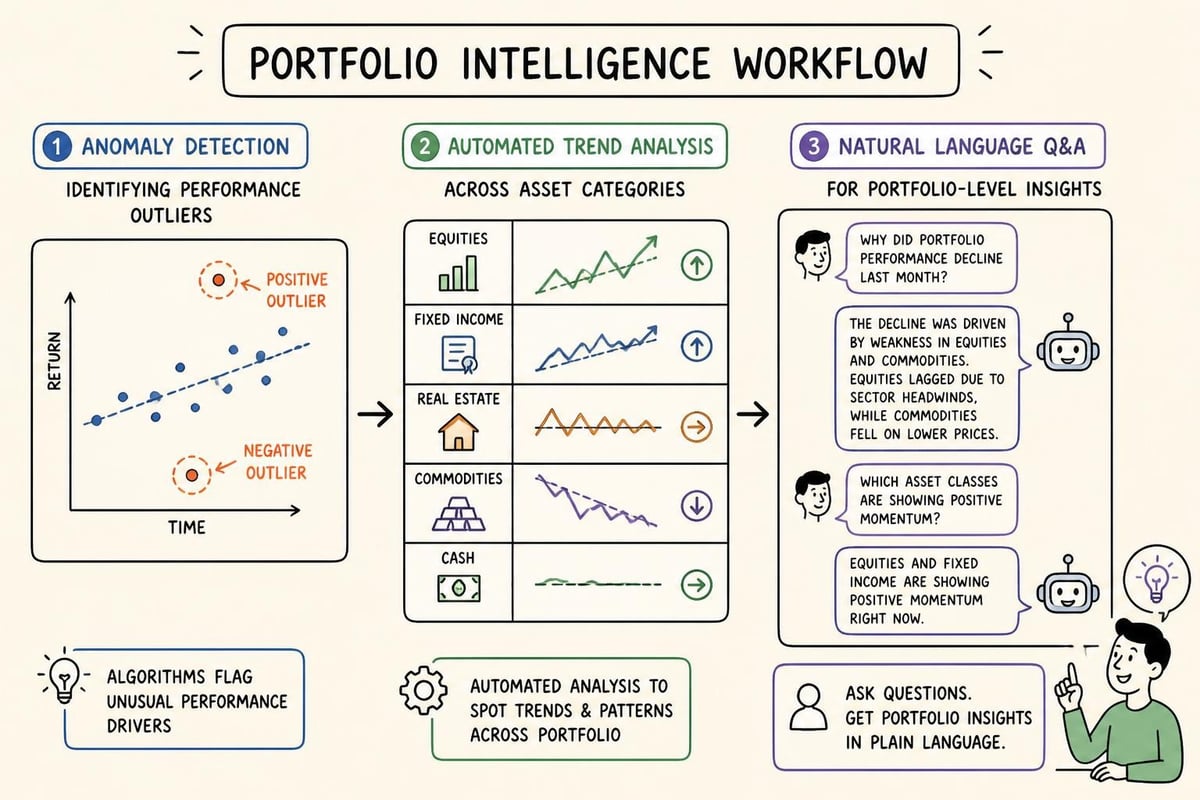
Technology transforms portfolio and investment management from periodic reporting exercises into continuous intelligence systems. The shift enables proactive management based on real-time signals rather than reactive responses to month-old reports.
Integrating Data Sources for Complete Portfolio Visibility
Enterprise portfolios draw data from custodians, property management systems, fund administrators, and direct holdings. Consolidating these sources manually creates delays and introduces reconciliation errors. Systematic integration enables current views without rebuilding datasets each period.
For teams using systems like Yardi or RealPage, integration capabilities pull performance data automatically, applying consistent calculations and enabling portfolio-level analysis. Individual professionals achieve similar outcomes by uploading statements and models into platforms that standardize and synthesize the information.
The transition from fragmented point solutions to integrated real estate portfolio intelligence systems eliminates redundant data entry and creates a single source of truth for portfolio decisions.
Applying AI to Recurring Portfolio Synthesis
The repetitive nature of portfolio monitoring-pulling performance, calculating metrics, comparing to benchmarks, generating narratives-makes it ideal for automation. Purpose-built platforms now handle these recurring tasks while maintaining accuracy through verifiable, source-linked outputs.
Rather than replacing judgment, AI handles synthesis and calculation, freeing portfolio managers to focus on exceptions, trends, and strategic decisions. When performance deviates from expectations, you can drill into contributing factors through natural language queries rather than rebuilding custom analyses.
This workflow orientation positions technology as infrastructure rather than disruption. Secure AI for investment firms maintains enterprise-grade security while automating routine synthesis, ensuring consistent quality across reporting periods.
Managing Different Portfolio Types and Investor Classes
Portfolio and investment management adapts significantly based on investor type, time horizon, and operational structure. Institutional portfolios require different approaches than individual accounts, while alternative assets demand specialized expertise.
Institutional Portfolio Considerations
Institutions including pension plans, endowments, foundations, and sovereign wealth funds operate under specific constraints that shape portfolio construction. Defined benefit pensions manage liability-relative risk, seeking assets that move with obligations. Endowments balance current spending with perpetual capital preservation.
Understanding diversification strategies remains critical, but institutional scale enables access to alternative investments, private markets, and customized mandates unavailable to smaller investors. This access introduces operational complexity in valuation, governance, and manager oversight.
Individual and High-Net-Worth Management
Individual portfolios prioritize tax efficiency, estate planning integration, and personal cash flow management alongside return objectives. High-net-worth investors often concentrate wealth in specific industries or business interests, requiring carefully structured diversification around existing positions.
Goal-based approaches segment the portfolio into timeframes and objectives-funding near-term expenses from stable allocations while positioning longer-term capital for growth. This bucketing strategy provides emotional comfort during volatility while maintaining return potential for distant goals.
Evaluating Managers and Investment Strategies
Manager selection and ongoing evaluation represent critical portfolio and investment management decisions for those using external expertise. Due diligence extends beyond past performance to assess process consistency, organizational stability, and alignment of interests.
Quantitative and Qualitative Assessment
Performance analysis examines return consistency across different market environments, avoiding recency bias that overweights recent results. Long-term track records spanning multiple market cycles provide more reliable signals than short-term outperformance.
Qualitative factors matter equally:
Investment philosophy coherence and consistency
Portfolio construction process discipline
Team stability and key person risk
Fee structure reasonableness and transparency
Operational infrastructure and control environment
Client servicing capabilities and responsiveness
For alternative investments and private markets, qualitative assessment becomes even more important given limited performance transparency and longer evaluation horizons. Reference calls with existing clients, operational due diligence, and background checks complement quantitative analysis.
Ongoing Monitoring and Replacement Decisions
Manager relationships require continuous monitoring rather than set-and-forget approaches. Style drift, organizational changes, performance deterioration, and fee increases all trigger evaluation of whether to maintain, reduce, or terminate allocations.
Replacement decisions balance the conviction that alternative managers will perform better against transition costs and the possibility that underperformance represents temporary rather than permanent deterioration. Protecting your investments requires systematic monitoring processes that catch problems early while avoiding premature terminations.
Generating Investment Committee Materials and Stakeholder Reports
Portfolio decisions rarely occur in isolation. Investment committees, boards, beneficiaries, and regulatory bodies all require reporting tailored to their specific needs and expertise levels.
Crafting Decision-Ready Investment Narratives
Effective investment committee materials present recommendations with supporting analysis, risk assessment, and implementation plans. The narrative explains not just what you propose but why it makes sense given current market conditions, portfolio positioning, and policy objectives.
Essential elements include:
Executive summary with clear recommendations
Market environment assessment and outlook
Current portfolio positioning and performance attribution
Proposed changes with expected impact
Risk analysis and scenario outcomes
Implementation timeline and resource requirements
The recurring nature of IC presentations benefits from platforms that maintain institutional knowledge across meetings, enabling consistent narratives that build on previous discussions rather than starting fresh each quarter. When discussion turns to specific positions or historical decisions, having immediate access to supporting documentation improves decision quality.
Regulatory and Compliance Reporting
Regulated portfolios face extensive reporting requirements covering position disclosures, risk metrics, compliance certifications, and trade documentation. Maintaining audit trails that connect portfolio decisions to policy guidelines protects against regulatory inquiry and litigation risk.
Documentation requirements extend beyond performance reports to include meeting minutes, due diligence files, rebalancing justifications, and exception approvals. Systematic record-keeping within portfolio management platforms creates defensible audit trails while reducing manual compilation time.
Adapting to Market Conditions and Portfolio Evolution
Static portfolios fail under dynamic market conditions. Successful portfolio and investment management requires adapting to changing opportunity sets while maintaining discipline around core objectives.
Navigating Market Cycles and Economic Transitions
Different market regimes favor different investment approaches. Growth-oriented strategies thrive in economic expansions with low inflation. Value and income strategies perform better during slower growth periods. Real assets provide inflation protection when pricing pressures build.
Recognizing regime shifts early enables positioning adjustments that capture opportunity or mitigate risk. However, market timing difficulties mean most investors benefit more from gradual tactical tilts than wholesale portfolio reconstructions based on economic forecasts.
Incorporating New Asset Classes and Strategies
Investment opportunity sets expand continuously as new structures, strategies, and asset classes emerge. Cryptocurrency assets, direct indexing, alternative credit, and operational real estate strategies didn't exist or weren't accessible to most investors twenty years ago.
Evaluating new opportunities requires assessing whether they provide genuine diversification benefits, offer reasonable risk-adjusted return prospects, and fit within operational capabilities. Portfolio complexity itself creates costs-adding positions or strategies only makes sense when benefits exceed implementation burdens.
Measuring Success Beyond Returns
Portfolio and investment management success extends beyond beating benchmarks to encompass meeting investor objectives, maintaining acceptable risk levels, and operating efficiently.
Goal Achievement and Risk-Adjusted Performance
Absolute and relative returns matter, but meeting specific goals represents the ultimate measure of success. A pension fund that matches liability growth while maintaining funded status succeeds even if absolute returns disappoint. An endowment that sustains spending while preserving real purchasing power accomplishes its mission regardless of benchmark comparisons.
Risk-adjusted metrics like Sharpe ratios account for volatility, but even these miss dimensions like drawdown pain, recovery speed, and behavioral sustainability. The best portfolio means nothing if investors cannot maintain discipline through inevitable rough patches.
Operational Efficiency and Scalability
As portfolios grow, operational efficiency becomes increasingly important. Manual processes that work for ten holdings break down at one hundred. Investment teams scaling assets under management require systematized workflows that maintain quality without proportional headcount growth.
Understanding portfolio management research reveals that operational alpha-returns gained through efficient implementation-often exceeds alpha from security selection. Reducing errors, minimizing costs, and harvesting tax benefits compound meaningfully over time.
Effective portfolio and investment management transforms from periodic fire drills into continuous intelligence when supported by the right infrastructure and workflows. The repetitive nature of performance synthesis, variance investigation, and portfolio-level reporting creates opportunity for systematization that frees analytical capacity for decisions rather than data compilation. Whether you're managing institutional portfolios with integrated data feeds or individual holdings through uploaded statements, maintaining a decision-ready view of your portfolio without manual reconstruction each period separates reactive from proactive management. Leni provides the accuracy-focused infrastructure enterprise teams need for automated portfolio synthesis, trend detection, and verifiable analytics across commercial real estate and adjacent investment sectors, transforming routine reporting cycles into continuous portfolio intelligence.

Johanna Gruber
Johanna has spent the last 8 years helping marketing teams connect with audiences through content. Specializing in B2B SaaS and real estate.

Curious About AI?
Join the largest AI community for real estate online. Get bite-sized, real-world use case videos, plus practical tips and proven strategies from top industry experts on adopting AI effectively.
MEET LENI
AI SuperAgent Purpose Built for Investors and Operators.
Experience how professionals and teams in your domain are getting the edge using AI.
