Portfolio Building: A Complete Guide for 2026

Portfolio Building: A Complete Guide for 2026
Portfolio building transforms scattered investment ideas into coherent, defensible allocations you can monitor and improve over time. Whether you manage institutional capital, advise clients, or oversee enterprise real estate holdings, the gap between understanding individual assets and constructing effective portfolios remains wide. This guide walks through the complete workflow: establishing goals, defining criteria, evaluating evidence, navigating tradeoffs, managing risk, documenting decisions, and maintaining portfolios through changing markets.
Establish Clear Investment Goals and Constraints
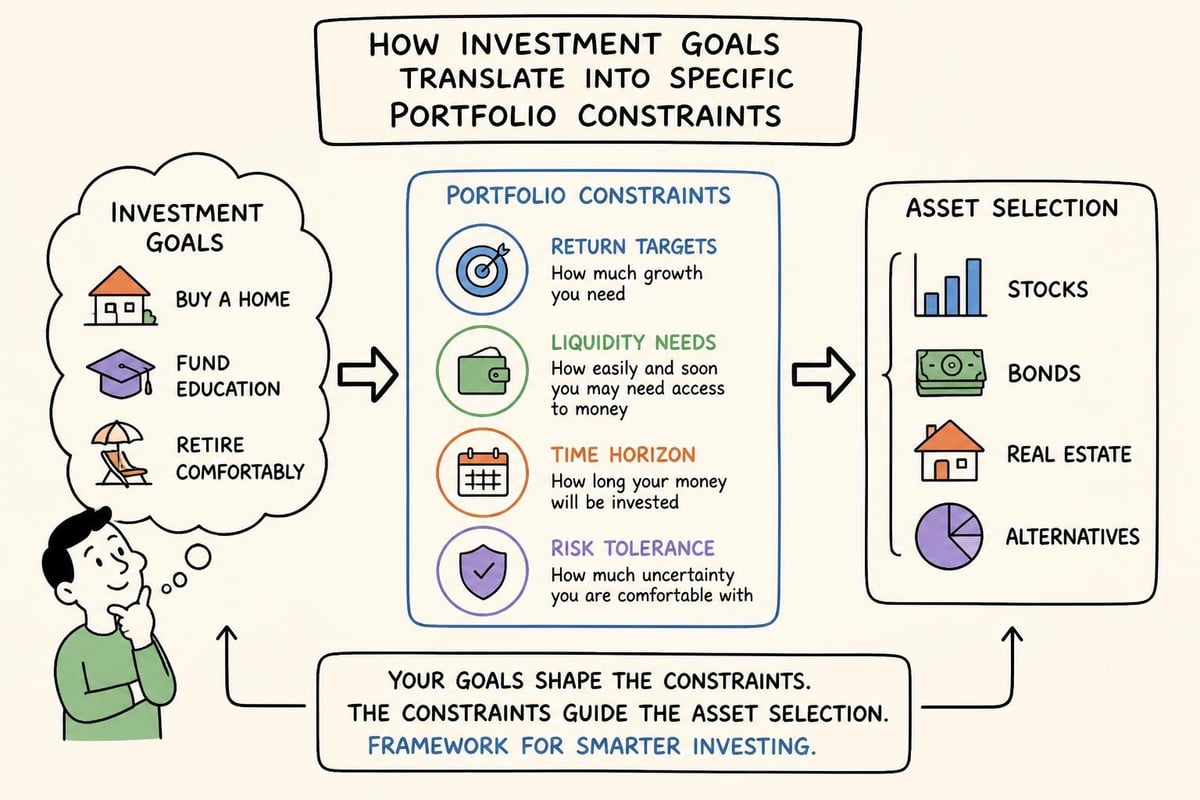
Portfolio building begins with explicit goals. Vague objectives like "maximize returns" or "reduce risk" lead to portfolios that satisfy no one and optimize nothing.
Define Specific Outcomes
Start by documenting what success looks like in measurable terms. An institutional investor might target 8% annual returns with maximum 15% drawdown. A family office could prioritize capital preservation with 4% distributions. A development firm might need liquidity for opportunistic acquisitions while maintaining stable cash flow from core holdings.
Write these goals as testable statements:
Target return range with acceptable volatility bounds
Required liquidity at specific intervals
Tax considerations and jurisdictional constraints
Time horizon for each capital pool
Distribution requirements or reinvestment mandates
Identify Genuine Constraints
Real constraints limit your portfolio construction options. Distinguish these from preferences. A pension fund's liability schedule creates genuine constraints. A personal preference for avoiding certain sectors does not, though it may influence decisions.
Common institutional constraints include:
Regulatory capital requirements
Leverage restrictions or covenant limitations
Concentration limits by asset, geography, or counterparty
Redemption schedules and liquidity buffers
Governance requirements for approval thresholds
Document these constraints before evaluating any assets. They establish the boundaries within which portfolio building occurs, preventing wasted effort on structures that won't meet fundamental requirements.
Define Asset Selection Criteria and Evaluation Standards
Once goals are clear, establish the criteria that determine whether an asset belongs in your portfolio. This framework ensures consistent evaluation across different opportunities and asset classes.
Build Evaluation Frameworks
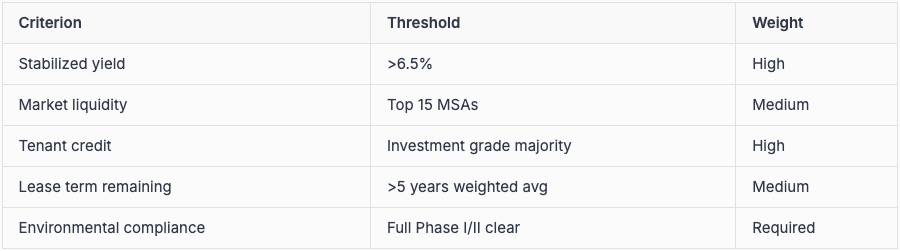
Create scoring models or decision matrices that reflect your actual priorities. Understanding portfolio construction requires translating abstract goals into concrete selection criteria that teams can apply uniformly.
For commercial real estate portfolios, criteria might include:
Establish Evidence Requirements
Specify what documentation and analysis you need before including assets in portfolio building decisions. This prevents decisions based on incomplete information and creates audit trails.
Minimum evidence standards typically include:
Third-party valuations or appraisals with methodology disclosure
Historical performance data spanning multiple market cycles
Audited financial statements for income-producing assets
Market comparables with transaction evidence
Risk assessments covering operational, market, and structural factors
Modern platforms like Leni help teams transform scattered documents, market research, and underwriting notes into source-linked analysis and comparison tables, ensuring evaluation criteria connect directly to verified evidence rather than assumptions.
Evaluate Assets Within Portfolio Context
Individual asset quality matters less than portfolio contribution. An excellent standalone investment may duplicate existing exposures or amplify concentrated risks.
Assess Correlation and Diversification
Portfolio building demands understanding how assets interact. Two properties with similar yields contribute differently if one correlates with your existing holdings and one provides genuine diversification.
Calculate correlation coefficients for:
Returns across different market environments
Cash flow timing and volatility patterns
Exposure to common risk factors (interest rates, employment, consumer spending)
Geographic and sector concentration
Action steps for correlation analysis:
Gather historical return data for existing holdings and proposed additions
Identify shared risk factors using regression or factor analysis
Simulate portfolio returns under various scenarios
Measure diversification benefit using portfolio variance reduction
Document assumptions and data sources for future review
Quantify Marginal Contribution
Evaluate what each asset adds to your portfolio's risk-return profile. The portfolio construction approach recognizes that optimal allocation depends on how new positions change overall portfolio characteristics.
For each candidate asset, calculate:
Change in portfolio expected return
Change in portfolio standard deviation or VaR
Sharpe ratio or risk-adjusted return metrics before and after addition
Liquidity profile impact on overall portfolio liquidity
Correlation with largest existing positions
This analysis often reveals that moderate-performing assets with low correlation contribute more value than higher-returning positions that amplify existing risks. Real estate portfolio intelligence tools help firms track these portfolio-level metrics across holdings.
Navigate Tradeoffs and Allocation Decisions
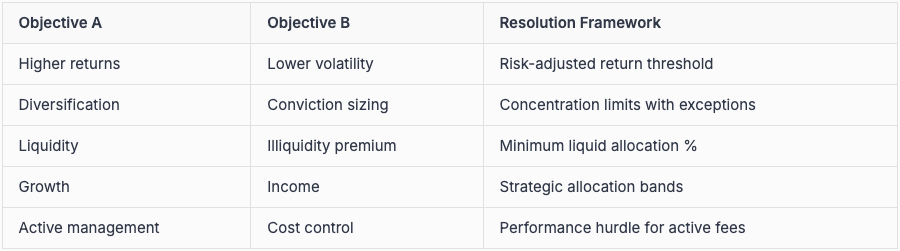
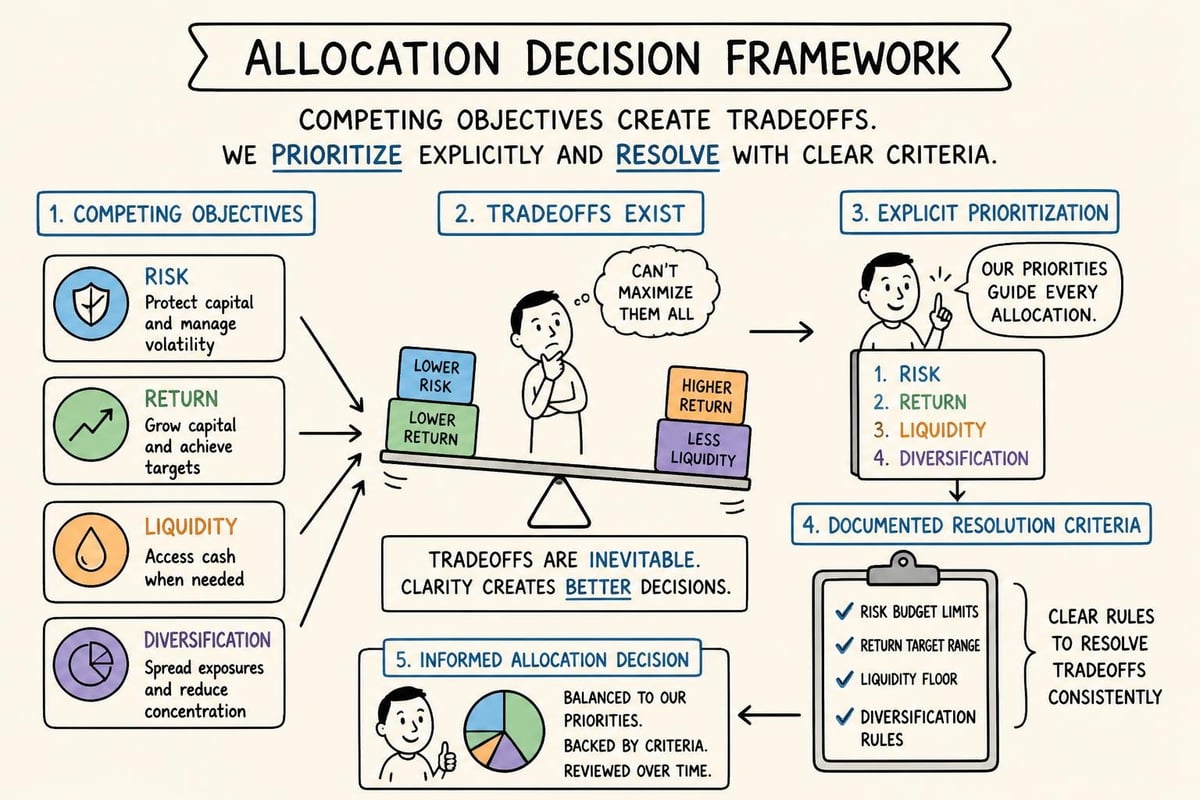
Portfolio building involves constant tradeoffs between competing objectives. Higher returns typically require accepting greater risk or reduced liquidity. Diversification may mean including assets with lower individual appeal.
Balance Competing Objectives
Create explicit decision frameworks that weight your priorities. When forced to choose between two assets where one offers higher yield and another better liquidity, your framework should provide clear guidance.
Common tradeoff dimensions:
Apply Strategic vs. Tactical Allocation
Distinguish between strategic allocation (long-term target weights) and tactical adjustments (short-term deviations based on market views). Strategic allocation reflects your fundamental beliefs about risk and return. Tactical shifts exploit temporary opportunities.
Set explicit bounds on tactical deviations: perhaps ±5% from strategic weights for each major asset class. This prevents drift from disciplined portfolio building while allowing responsiveness to market conditions.
Implement Comprehensive Risk Management
Risk management extends beyond volatility metrics. Effective portfolio building addresses operational risks, liquidity mismatches, counterparty exposures, and tail events that standard models miss.
Layer Risk Controls
Build multiple risk management layers into your portfolio structure. Single-point risk controls create fragility; layered approaches provide resilience.
Risk management layers include:
Position-level limits on concentration and exposure
Portfolio-level limits on aggregate risk measures
Liquidity matching between assets and liabilities
Stress testing across multiple adverse scenarios
Operational controls on decision authority and execution
The risk management approaches that advisors increasingly emphasize recognize that mathematical risk models capture only part of the story. Operational failures, model errors, and unforeseen events require robust governance.
Stress Test Realistic Scenarios
Standard deviation and correlation statistics assume normal distributions and stable relationships. Portfolio building for real-world conditions requires testing extreme scenarios and correlation breakdowns.
Identify historical stress periods relevant to your assets
Model portfolio performance during those episodes
Create forward-looking scenarios based on current vulnerabilities
Test portfolio resilience to multiple simultaneous shocks
Establish triggers for risk reduction or defensive positioning
For commercial real estate portfolios, scenarios might include rising interest rates combined with recession, major tenant bankruptcies during market downturns, or regional economic shocks affecting concentrated holdings. CRE scenario modeling software enables firms to test assumptions across multiple market conditions systematically.
Document Decisions and Create Audit Trails
Portfolio building generates complex decisions based on numerous assumptions and tradeoffs. Without rigorous documentation, you cannot evaluate past decisions, explain current positions, or maintain consistency across team changes.
Build Investment Memos
Create detailed investment memos for each portfolio addition or significant allocation change. These documents should stand alone, providing future readers complete context without institutional knowledge.
Essential memo components:
Investment thesis with supporting evidence and sources
Quantitative analysis including returns, risks, and portfolio impact
Alternatives considered and reasons for selection
Assumptions and sensitivities
Risk factors and mitigation strategies
Decision authority and approval record
Modern AI tools for financial modeling help teams transform raw research, property data, and market assumptions into structured investment memos with source attribution, making it easier to maintain comprehensive documentation without overwhelming analysts.
Maintain Decision Registers
Track all significant portfolio decisions in a searchable register. This creates institutional memory and enables pattern analysis across decisions.
Include for each decision:
Date and decision-makers involved
Assets or allocations affected
Rationale and supporting analysis references
Expected outcomes and success metrics
Actual outcomes (updated periodically)
Lessons learned and process improvements
This register becomes invaluable for performance attribution, process improvement, and governance. It also protects against key person risk when team members transition.
Monitor Portfolio Performance and Risk Exposures
Portfolio building doesn't end at implementation. Systematic monitoring ensures portfolios remain aligned with goals and identifies when rebalancing becomes necessary.
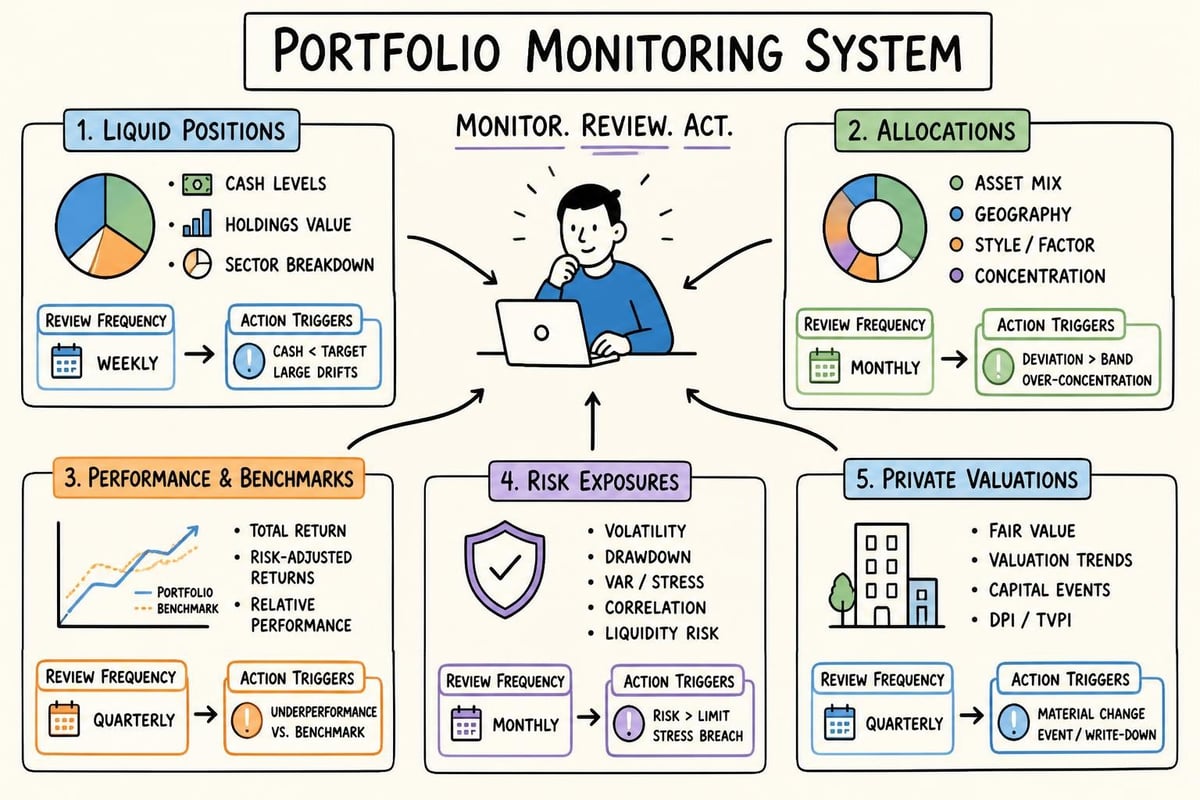
Establish Monitoring Cadence
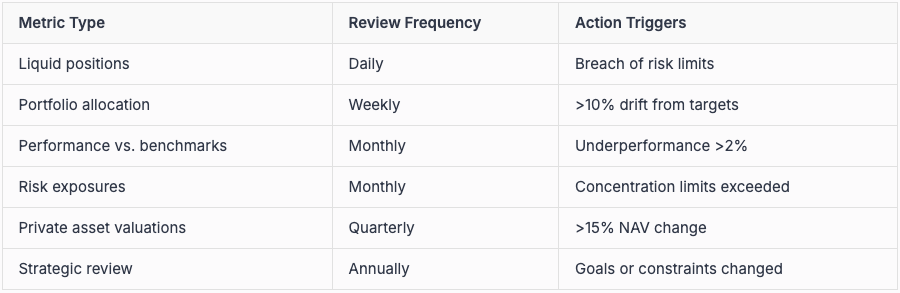
Different portfolio metrics require different monitoring frequencies. Daily market-to-market for liquid securities may be appropriate, while quarterly valuations suffice for private real estate.
Recommended monitoring schedule:
Track Against Benchmarks and Goals
Measure portfolio performance against both market benchmarks and your specific goals. Outperforming broad indexes matters less if you're underdelivering on stated objectives like income generation or capital preservation.
Create custom benchmarks when standard indexes don't reflect your strategy. A portfolio built for stable income with capital preservation should be measured against appropriate fixed income and real asset benchmarks, not equity indexes.
Automated real estate reporting helps institutional teams maintain consistent monitoring across diverse portfolios, ensuring that performance tracking doesn't consume resources better spent on analysis and decision-making.
Execute Strategic Rebalancing
Markets drift portfolios away from target allocations. Rebalancing maintains strategic positioning and can add value through systematic contrarian trading.
Set Rebalancing Rules
Establish clear rules for when and how to rebalance. Rules-based approaches remove emotion and prevent reactive decisions during market stress.
Common rebalancing approaches:
Calendar rebalancing (quarterly, semi-annual, annual)
Threshold rebalancing (trade when allocation drifts >5% from target)
Hybrid (check quarterly, trade if thresholds breached)
Opportunistic (rebalance during extreme market moves)
Each approach involves tradeoffs between maintaining targets and minimizing transaction costs. The basics of portfolio planning and construction from CFA Institute provides frameworks for establishing rebalancing policies aligned with investment strategy.
Account for Transaction Costs and Taxes
Rebalancing creates costs that can exceed diversification benefits if executed too frequently. Calculate break-even points where rebalancing value exceeds costs.
Consider these factors:
Trading commissions and bid-ask spreads
Market impact for large positions or illiquid assets
Tax consequences of realizing gains
Opportunity cost of cash drag during transitions
Time and attention costs for portfolio managers
For institutional portfolios, particularly those including commercial real estate, transaction costs can reach 2-5% of position value. This argues for wider rebalancing bands and longer holding periods compared to liquid securities portfolios.
Adapt Portfolio Building for Different Asset Classes
While core principles remain constant, portfolio building tactics vary across asset classes based on liquidity, transparency, and correlation characteristics.
Real Estate Portfolio Construction
Commercial real estate demands specialized approaches to portfolio building given illiquidity, transaction costs, and local market dynamics.
Key considerations include:
Geographic diversification across MSAs with different economic drivers
Property type allocation reflecting different risk-return profiles
Lease term laddering to manage rollover and re-leasing risk
Debt structuring across the portfolio to optimize leverage
Development vs. stabilized asset mix based on risk tolerance
Real estate asset management platforms help firms track portfolio-level metrics across properties, market exposures, lease schedules, and debt maturities, essential for active portfolio construction decisions.
Multi-Asset Portfolio Integration
For portfolios spanning public securities, private equity, real estate, and alternative investments, coordination across asset classes becomes critical.
Integration challenges:
Inconsistent valuation timing across public and private assets
Different liquidity profiles requiring careful planning
Correlation estimates using different data frequencies
Manager selection and due diligence across strategies
Consolidated reporting and performance attribution
Enterprise-grade platforms that handle portfolio and investment management across asset types help teams maintain unified views despite underlying complexity, preventing siloed decision-making that misses portfolio-level risks.
Leverage Technology for Portfolio Building Efficiency
Manual portfolio building processes limit analysis depth and create operational risk. Modern technology enables more sophisticated approaches without proportional resource increases.
Centralize Data and Analysis
Consolidate portfolio data, market information, and analysis tools into unified platforms. Scattered spreadsheets and disconnected databases make comprehensive portfolio building impractical at scale.
Technology infrastructure should support:
Single source of truth for holdings, valuations, and performance
Integrated market data and comparable transaction information
Scenario modeling and sensitivity analysis tools
Automated reporting for monitoring and governance
Audit trails connecting decisions to supporting evidence
Platforms offering AI for real estate investment can transform how teams approach portfolio building, particularly for firms managing hundreds of properties where manual analysis becomes prohibitive.
Automate Routine Workflows
Free analytical capacity by automating repetitive portfolio building tasks. Data aggregation, performance calculation, exposure reporting, and compliance monitoring can run automatically, allowing teams to focus on judgment-intensive decisions.
Priority automation opportunities:
Data extraction from property financial statements and reports
Valuation updates using comparable transactions and market data
Risk metric calculation across portfolio positions
Variance analysis comparing actual to budgeted performance
Regulatory and internal compliance reporting
Organizations using AI investment management tools report significant time savings on data aggregation and report generation, redirecting those hours toward strategic analysis and stakeholder communication.
Scale Portfolio Building Processes
As portfolios grow in size and complexity, ad hoc processes break down. Institutionalizing portfolio building requires documented procedures, defined roles, and governance structures.
Establish Investment Committee Processes
Formalize how portfolio decisions get made, reviewed, and approved. Investment committees provide discipline, diverse perspectives, and accountability.
Effective committee structures include:
Clear charter defining scope, authority, and decision thresholds
Regular meeting schedule with advance materials requirements
Voting procedures and dissent documentation
Escalation paths for time-sensitive decisions
Post-decision review and learning processes
Minutes and materials from committee meetings create institutional memory and demonstrate fiduciary responsibility. They also enable process improvement by revealing patterns in successful and unsuccessful decisions.
Build Team Capabilities
Portfolio building requires diverse skills: financial analysis, market research, legal and tax expertise, risk management, and operational execution. Growing organizations must develop these capabilities internally or access them through advisors.
Key capability areas:
Quantitative analysis and financial modeling
Market research and economic forecasting
Legal structuring and tax optimization
Technology and data management
Communication and stakeholder management
Training programs, external education, and strategic hiring build organizational capacity for sophisticated portfolio building. Investment in capabilities pays dividends through better decisions and reduced reliance on expensive external advisors.
Maintain Governance and Compliance Standards
Portfolio building occurs within regulatory and fiduciary frameworks. Robust governance prevents conflicts of interest, ensures duty of care, and documents prudent processes.
Implement Conflict Management
Establish clear policies for identifying and managing conflicts of interest in portfolio decisions. Common conflicts include related-party transactions, personal holdings overlapping portfolio positions, and compensation structures creating misaligned incentives.
Governance policies should address:
Disclosure requirements for potential conflicts
Approval processes for conflicted transactions
Restrictions on personal trading by decision-makers
Compensation alignment with stated portfolio objectives
Independence requirements for advisors and service providers
Documentation of conflict identification and management demonstrates good faith and supports defensible decision-making if challenged.
Ensure Audit Readiness
Maintain portfolio building records assuming they will face external review. Auditors, regulators, or litigation discovery may scrutinize investment processes years after decisions occurred.
Create systems ensuring:
Complete decision documentation with supporting analysis
Clear chain of custody for valuation inputs and assumptions
Evidence of policy compliance at decision time
Communication records showing information sharing with stakeholders
Version control for models and analytic tools used in decisions
Organizations using secure AI for investment firms benefit from built-in audit trails connecting analytical outputs to source documents and assumptions, critical for demonstrating process rigor during reviews.
Effective portfolio building transforms investment management from asset collection into strategic allocation guided by explicit goals, documented criteria, and disciplined processes. The workflow from establishing objectives through monitoring and rebalancing creates portfolios you can explain, defend, and improve systematically. For enterprise teams managing complex portfolios across commercial real estate and adjacent investment sectors, maintaining this discipline while handling increasing data volumes and reporting requirements demands purpose-built infrastructure. Leni provides the accuracy-focused platform institutional investors need to transform scattered research, property data, and market assumptions into source-linked analysis, comparison frameworks, and recurring reports that support rigorous portfolio building at scale.

Johanna Gruber
Johanna has spent the last 8 years helping marketing teams connect with audiences through content. Specializing in B2B SaaS and real estate.

Curious About AI?
Join the largest AI community for real estate online. Get bite-sized, real-world use case videos, plus practical tips and proven strategies from top industry experts on adopting AI effectively.
MEET LENI
AI SuperAgent Purpose Built for Investors and Operators.
Experience how professionals and teams in your domain are getting the edge using AI.
