Real Estate Asset Manager: Evolving Beyond the Spreadsheet

Real Estate Asset Manager: Evolving Beyond the Spreadsheet
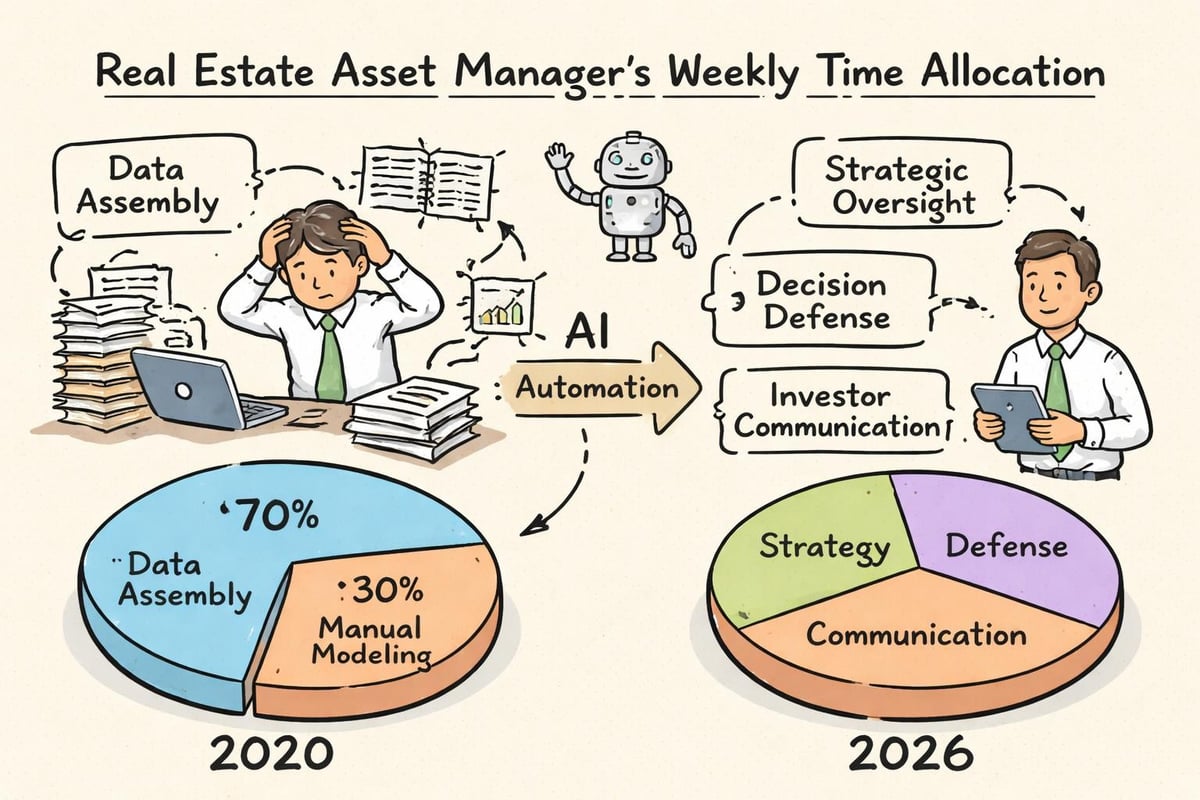
The best real estate asset manager in 2026 is no longer defined by how fast they can build a five-year cash flow model or extract lease terms from a hundred-page document. They're defined by how clearly they can defend a disposition decision in front of a skeptical LP, how quickly they catch underperformance before it impacts quarterly returns, and how effectively they deploy capital across a diversified portfolio under pressure. The analytical layer that once consumed 60% of an asset manager's week has become a commodity. What separates exceptional performers now is strategic judgment backed by verifiable data, delivered at speeds that match investor expectations.
The Dual Transformation of Asset Management
Two fundamental shifts are happening simultaneously in commercial real estate, and they're reshaping what it means to be effective in asset management. The first shift is internal: the role itself is migrating from data assembly to strategic oversight. The second is external: investor relationships now demand unprecedented transparency and turnaround speed. These changes aren't happening in isolation. They're forcing asset management teams to either evolve their workflows or fall behind competitors who have.
From Data Assembly to Strategic Oversight
Traditional asset management workflows followed a predictable pattern. Teams spent Monday through Wednesday gathering data from property management systems, Thursday building models and reconciling inconsistencies, and Friday preparing reports that were often outdated by the time they reached stakeholders. The real estate asset manager who excelled in this environment was the one who could navigate Yardi exports fastest, spot formula errors in complex Excel workbooks, and remember which version of a lease amendment contained the current rent escalation terms.
That model is collapsing under its own inefficiency. Portfolio sizes have grown while team sizes have remained flat. According to research from the Institute of Real Estate Management on market analysis and monitoring, asset managers now oversee broader responsibilities with compressed timelines. The analytical bottleneck has become the constraint that determines whether an opportunity gets pursued or a problem gets addressed.
The new reality requires a fundamental reallocation of time:
Data extraction and reconciliation: Previously 25-30 hours per week, now approaching zero for teams using integrated systems
Financial modeling and scenario analysis: Previously 15-20 hours, now measured in minutes with AI-driven automation
Strategic decision-making and stakeholder communication: Previously 5-10 hours, now the primary focus consuming 30+ hours weekly
Exception handling and portfolio monitoring: Previously reactive and sporadic, now continuous and threshold-based
The Investor Relations Pressure Point
The second shift is equally demanding. Limited partners and institutional investors who once accepted quarterly reports delivered 30 days after period close now expect real-time visibility into portfolio performance. They want to understand why occupancy dropped 200 basis points at a Class A office property before the next board meeting, not three months later. They demand sourced explanations for every variance from pro forma assumptions, complete with links to the underlying lease documents or market comparables that support your conclusion.
This isn't unreasonable. These investors are managing their own stakeholders and boards, and they're being held to the same accelerated standards. Defining what real estate asset management means today includes this expanded transparency requirement. The real estate asset manager who can't provide immediate, defensible answers to performance questions loses credibility, regardless of their technical competence.
The challenge is that traditional workflows can't support this speed and verification level simultaneously. You can deliver fast answers or thoroughly sourced answers, but not both. Until now.
How AI Transforms Portfolio-Wide Visibility
Artificial intelligence built specifically for commercial real estate changes both dimensions of the asset manager challenge. It eliminates the analytical bottleneck while simultaneously making every output verifiable and sourced. This isn't about chatbots that summarize documents or generic tools that require constant prompting. It's about autonomous systems that run multi-step analytical workflows, connect directly to property management platforms, and deliver investor-grade outputs with complete audit trails.
Catching Underperformance Before the Quarterly Report
The most valuable application of AI in asset management isn't modeling a new acquisition. It's identifying problems in existing portfolios before they metastasize into material underperformance. Traditional monitoring approaches relied on backward-looking reports that captured what happened last month or last quarter. By the time a variance appeared in a quarterly package, the underlying issue had often been compounding for weeks.
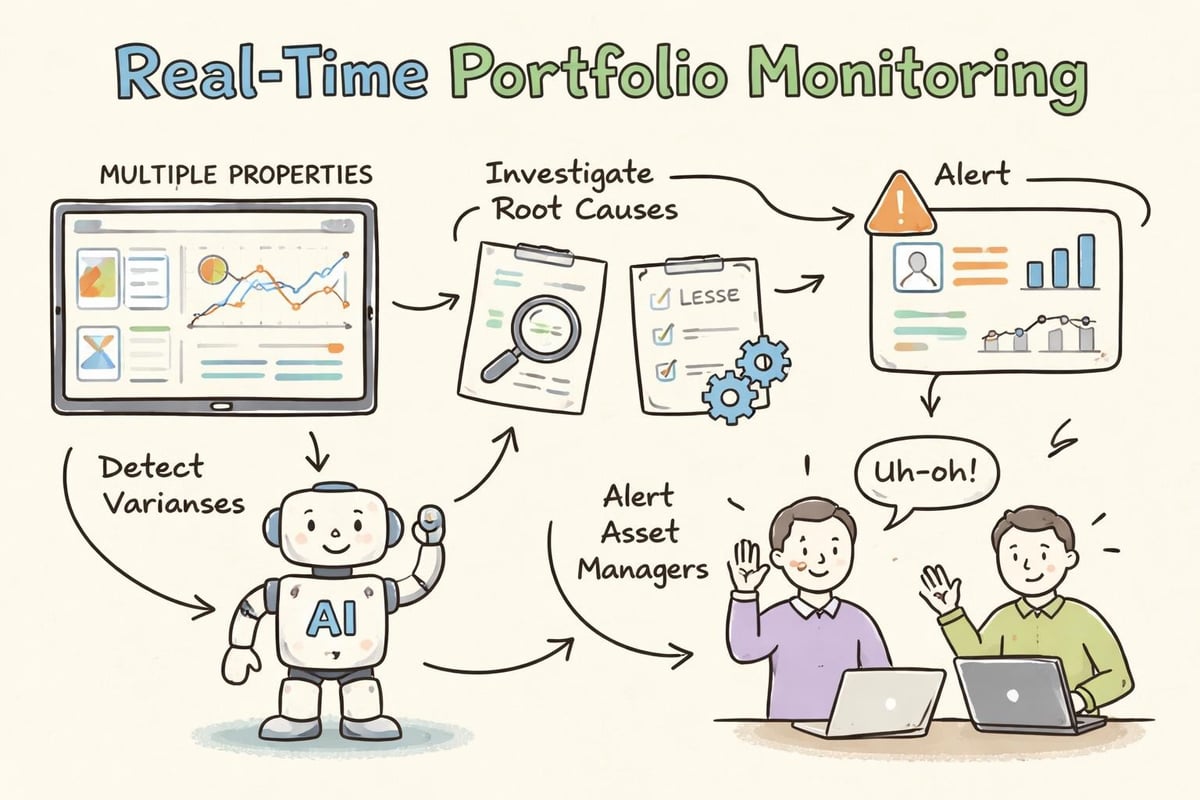
Modern AI-driven monitoring operates fundamentally differently:
Continuous data ingestion from property management systems means performance metrics update daily, not monthly
Threshold-based alerting flags variances the moment they exceed predetermined tolerances
Automated root cause analysis investigates why a metric changed, identifying specific leases, tenants, or operational issues
Source-linked documentation provides direct references to the underlying data supporting each finding
A real estate asset manager using this approach might receive a Pulse alert on Tuesday morning indicating that effective gross income at a multifamily property dropped 3.2% week-over-week. The alert doesn't just flag the variance. It identifies that six leases representing $47,000 in monthly revenue didn't renew on expected terms, links to the specific lease documents, and compares the actual renewal rates to both pro forma assumptions and submarket benchmarks. The asset manager can be on the phone with the property management team that afternoon with specific, sourced questions, rather than discovering the issue six weeks later in a monthly report.
This shift from reactive discovery to proactive monitoring represents the core of how AI changes real estate asset management workflows. The analytical work still happens, but it happens continuously and autonomously, allowing the asset manager to focus on the response rather than the discovery.
Integration with Property Management Systems
The verification requirement creates a technical challenge that generic AI tools can't solve. When an investor asks why same-store NOI missed budget by $280,000 in Q1, the answer needs to trace back to specific general ledger entries, lease terms, and operational decisions. Reconstructing that chain of evidence manually defeats the purpose of automation.
Direct integration with property management platforms solves this problem at the source. When AI connects natively to Yardi, RealPage, and Entrata, it doesn't just access data. It maintains the complete lineage from analytical output back to source record. A variance explanation doesn't just state that utility expenses increased 18%. It links to the specific GL accounts, compares to historical patterns in the same property and peer assets, and references the underlying invoices if they're available in the system.
Integration ApproachData CurrencySource VerificationManual Reconciliation RequiredAudit Trail CompletenessManual CSV exportsWeekly to monthlyNoneExtensiveIncompleteAPI connectionsDailyPartialModeratePartialNative platform integrationReal-timeCompleteMinimal to noneFull source-to-output
The difference between these approaches becomes critical during investor reviews or audit processes. When every number in a report links directly to its source record in the property management system, reporting and asset management shifts from evidence gathering to interpretation and recommendation.
Building Defensible Investor Communications
Speed without verification is speculation. The modern real estate asset manager needs both, particularly when the audience is a sophisticated institutional investor who will challenge assumptions and demand supporting evidence. AI-generated outputs are only valuable in investor contexts if they can withstand scrutiny and provide clear chains of evidence.
Source-Linked Analysis for LP Conversations
Consider the difference between these two responses to an investor question about why a retail portfolio's occupancy declined:
Traditional response: "Occupancy dropped from 94.2% to 91.8% primarily due to tenant turnover in the grocery-anchored centers. We're seeing longer lease-up periods as retailers reassess their footprints."
Source-linked response: "Occupancy declined 240 basis points quarter-over-quarter, driven by eight tenant departures totaling 127,400 square feet across three properties. Five of these were in grocery-anchored centers (see lease termination notices dated 1/15/26, 1/22/26, and 2/3/26). Current average days-to-lease increased from 87 to 134 days, compared to 98 days for comparable retail properties in the same submarkets (source: CoStar Q1 2026 retail report, pages 23-27). Three lease proposals are under negotiation representing 68,900 square feet of the vacant space, with expected lease commencement in Q3 2026."
The second response takes the same amount of time to deliver when the analytical infrastructure supports it, but it accomplishes something fundamentally different. It doesn't just answer the question. It provides the evidence chain that allows the investor to verify the answer independently. That verification capability is what transforms a data point into a defensible position.
Automated Memo and Presentation Creation
Investor communications don't end with answering ad hoc questions. Quarterly reports, IC memos for disposition decisions, and board presentations consume significant time for asset management teams. These documents follow similar structures but require customization for each property and presentation context. They also need to be current, accurate, and sourced.
Automating this process while maintaining quality and verification standards requires understanding the specific workflows of commercial real estate asset management. Generic document generation tools produce generic outputs. Purpose-built systems understand that an IC memo for a multifamily disposition needs to include:
Current property performance with source links to operating statements
Market positioning with comparable sales and rental data from specific sources
Hold-sell analysis showing NPV calculations under multiple exit timing scenarios
Risk factors identified from lease rollover schedules and capital expenditure requirements
Recommendation with clear supporting rationale
These components need to connect to actual property data, reflect current market conditions from verifiable sources, and present analysis that withstands investor scrutiny. The real estate asset manager who can generate this output in two hours rather than two days gains a compound advantage over time. That advantage isn't just speed. It's the ability to consider more alternatives, run more scenarios, and present better-informed recommendations because the analytical barrier has been removed.
Understanding how to leverage AI for investment memos and presentations has become a core competency for asset managers competing at institutional levels. The teams that master this workflow can respond to market opportunities and problems with decision-quality analysis before competitors finish gathering their data.
Strategic Capabilities That Scale
The transition from analytical work to strategic oversight doesn't just mean doing the same job faster. It means taking on responsibilities and analysis depth that weren't feasible under manual workflows. Portfolio-wide optimization, predictive performance modeling, and systematic value-add identification become possible when the marginal cost of additional analysis approaches zero.
Portfolio-Level Decision Making
A real estate asset manager overseeing a 40-property multifamily portfolio faces continuous capital allocation decisions. Which properties should receive the planned $12 million in renovation capital? Where should we push rent growth versus prioritizing occupancy? Which assets should be marketed for disposition to fund new acquisitions in stronger growth markets?
Answering these questions properly requires analyzing each property's forward-looking cash flows under multiple scenarios, comparing returns to portfolio alternatives, and stress-testing assumptions against market data. Doing this comprehensively for 40 properties using traditional methods would consume weeks. Doing it quarterly is impossible.
When AI handles the analytical layer, portfolio-wide optimization becomes a routine quarterly exercise rather than an annual strategic planning event. The real estate asset manager can evaluate every property's highest and best use simultaneously, identify the properties where capital deployment generates the highest risk-adjusted returns, and model the portfolio-level impact of different allocation strategies.
This capability enables several high-value activities:
Systematic identification of properties where operational improvements would generate higher returns than the next acquisition
Quarterly rebalancing of portfolio composition based on updated market conditions and forward projections
Stress testing of entire portfolios against different economic scenarios to identify concentrated risks
Optimization of disposition timing across multiple assets to manage tax implications and capital deployment
The strategic value of this capability extends beyond the immediate decisions. It creates a systematic, data-driven approach to portfolio management that institutional investors increasingly expect. The ability to demonstrate that capital allocation decisions result from comprehensive portfolio-wide analysis rather than sequential property-level reviews builds investor confidence and supports capital raising for future opportunities.
Market Research Integration
Asset management decisions require current market context. What are competitive properties achieving for lease rates on comparable units? How are cap rates trending in the target submarket? What's the historical volatility of retail occupancy in this micro-market during economic downturns?
These questions require research that traditionally involved manual searches across multiple data providers, conversations with brokers, and assembly of comparable datasets. The research itself might take days, and by the time it's compiled, some of it's already outdated.
AI-powered market research capabilities that maintain direct connections to data sources solve this problem through continuous updating and automated analysis. When market conditions change or new comparable transactions close, the analysis updates automatically. The real estate asset manager receives research that's both comprehensive and current, with direct links to the source data for verification.
This integration between property-level data and market intelligence creates a complete analytical framework. An asset manager evaluating whether to renovate units at a Class B multifamily property can compare current in-place rents to renovated comparable units across the submarket, model the incremental revenue against renovation costs and expected vacancy during construction, and stress test the returns against different lease-up absorption scenarios. The entire analysis connects to verifiable sources and updates as new market data becomes available.
The Modern Asset Manager Profile
The role evolution we've outlined produces a different type of real estate asset manager. Technical modeling skills remain important, but they're no longer the differentiating capability. The asset manager who thrives in 2026 and beyond combines traditional real estate expertise with new capabilities enabled by AI-driven workflows.
Core Competencies That Matter Now
Strategic judgment moves to the center. With analytical constraints removed, the limiting factor becomes the quality of decisions rather than the speed of data assembly. The ability to interpret what the data means, identify implications that aren't obvious from the numbers alone, and formulate recommendations that balance multiple stakeholder interests becomes the primary value driver.
Communication effectiveness determines whether strategic insights translate into action. An asset manager might identify that three properties in a 25-asset portfolio are systematically underperforming their submarkets and should be marketed for disposition. Executing that recommendation requires convincing investors, coordinating with property management teams, and managing the disposition process. The analysis identifies the opportunity. Communication skills determine whether it gets implemented.
Systems thinking about how different portfolio components interact and how decisions cascade through multiple stakeholders separates competent asset managers from exceptional ones. Understanding that pushing occupancy at one property might cannibalize leasing at a nearby asset in the same portfolio, or that timing a disposition to align with a tax loss harvesting opportunity in an unrelated property, requires seeing the portfolio as an integrated system rather than a collection of independent assets.
These capabilities have always mattered in asset management. What's changed is their relative importance and the time available to apply them. Research on the asset manager's role in leading teams and promoting efficiency emphasizes these interpersonal and strategic skills as increasingly central to the profession.
Performance Metrics for the AI-Enabled Era
How success gets measured is evolving alongside the role itself. Traditional metrics like occupancy, NOI growth, and total returns remain important, but they're lagging indicators that measure outcomes rather than the quality of asset management decision-making. New performance metrics reflect the capabilities that AI-driven workflows enable.
Traditional MetricLimitationEnhanced MetricWhat It MeasuresQuarterly NOI variance to budgetBackward-lookingDays from variance occurrence to management actionResponse speed and monitoring effectivenessAnnual return vs pro formaSingle outcome measurementPercentage of opportunities evaluated before pursuingDecision quality through comprehensive analysisProperties per asset managerVolume-basedPortfolio optimization score vs benchmarkStrategic allocation effectivenessReport delivery timeInternal processInvestor question resolution time with sourcesCommunication effectiveness and verification capability
These enhanced metrics capture the value that modern asset management workflows deliver. An asset manager who identifies and addresses an operational issue at a property within three days of occurrence, supported by complete sourced analysis, delivers more value than one who produces a comprehensive quarterly report showing what happened three months ago. Understanding key asset management metrics in this context means focusing on the metrics that drive forward-looking value rather than just documenting historical results.
Implementation Roadmap for Teams
Transitioning from traditional workflows to AI-enabled asset management isn't instantaneous. It requires systematic implementation that addresses technology, processes, and team capabilities simultaneously. Asset management teams that execute this transition effectively follow a structured approach.
Phase One: Establish the Data Foundation
The quality of AI-driven analysis depends entirely on the quality and accessibility of underlying data. Teams with fragmented data across multiple systems, incomplete property management records, or inconsistent categorization will get unreliable outputs regardless of the AI platform they deploy.
Priority actions in this phase:
Audit current data quality across property management systems, identifying gaps in lease documentation, financial records, and operational metrics
Establish consistent coding standards for income and expense categories across all properties
Implement systematic lease abstract updates to ensure current terms are accurately reflected in property management systems
Create integration pathways between property management platforms and analytical tools, prioritizing real-time data access over periodic exports
This foundation work often reveals operational issues that were hidden by manual workflows. Properties where lease expirations weren't properly recorded, expense allocations that didn't match budget categories, or capital expenditures that were misclassified as operating expenses all surface during data standardization. Addressing these issues delivers immediate value beyond enabling AI capabilities.
Phase Two: Automate Core Analytical Workflows
With clean data foundations established, teams can implement AI-driven automation for the most time-consuming analytical tasks. Priority typically goes to the workflows that occur most frequently and consume the most time under traditional approaches.
High-impact automation targets:
Monthly property-level financial statement analysis with automated variance identification and investigation
Quarterly portfolio performance reporting with market benchmarking and source documentation
Lease renewal modeling showing tenant-by-tenant economics and optimal renewal strategies
Capital expenditure prioritization across portfolios based on return optimization
Each automated workflow should maintain complete source linkage and produce outputs that meet investor-grade standards. The goal isn't just to generate analysis faster, but to generate better analysis that withstands scrutiny and supports defensible decision-making. Understanding financial modeling and underwriting capabilities specific to commercial real estate ensures the automation delivers institutional-quality outputs.
Phase Three: Enable Strategic Capabilities
The final phase leverages the time freed by automation to implement strategic capabilities that weren't feasible under manual workflows. This is where the real value multiplication occurs, as asset managers shift from reactive firefighting to proactive value creation.
Portfolio-wide optimization, systematic market opportunity identification, and predictive performance modeling all become routine rather than exceptional activities. Asset managers can spend their time on the questions that drive long-term value: Which markets should we be entering or exiting? How should we reposition this asset class within our portfolio strategy? What operational improvements would generate the highest returns across our holdings?
These strategic initiatives require the same analytical rigor as property-level decisions, but they operate at a different scale and time horizon. They're only feasible when the daily and weekly analytical burden has been eliminated through automation.
The real estate asset manager role in 2026 demands capabilities that would have been impossible to deliver consistently just three years ago: real-time portfolio monitoring, investor-grade analysis delivered in hours, and strategic oversight across dozens of properties simultaneously. The teams that make this transition successfully build their workflows around platforms designed specifically for the demands of commercial real estate asset management, not generic AI tools adapted from other industries. Leni provides purpose-built infrastructure for this evolution, connecting directly to property management systems, maintaining complete source verification, and delivering the analytical depth that institutional investors expect. Whether you're managing a 10-property portfolio or overseeing institutional real estate across multiple asset classes, the question isn't whether AI will transform your workflow, it's whether you'll lead that transformation or react to it.

Johanna Gruber
Johanna has spent the last 8 years helping marketing teams connect with audiences through content. Specializing in B2B SaaS and real estate.

Curious About AI?
Join the largest AI community for real estate online. Get bite-sized, real-world use case videos, plus practical tips and proven strategies from top industry experts on adopting AI effectively.
MEET LENI
AI SuperAgent Purpose Built for Investors and Operators.
Experience how professionals and teams in your domain are getting the edge using AI.
