Unlocking AI Potential in Commercial Real Estate
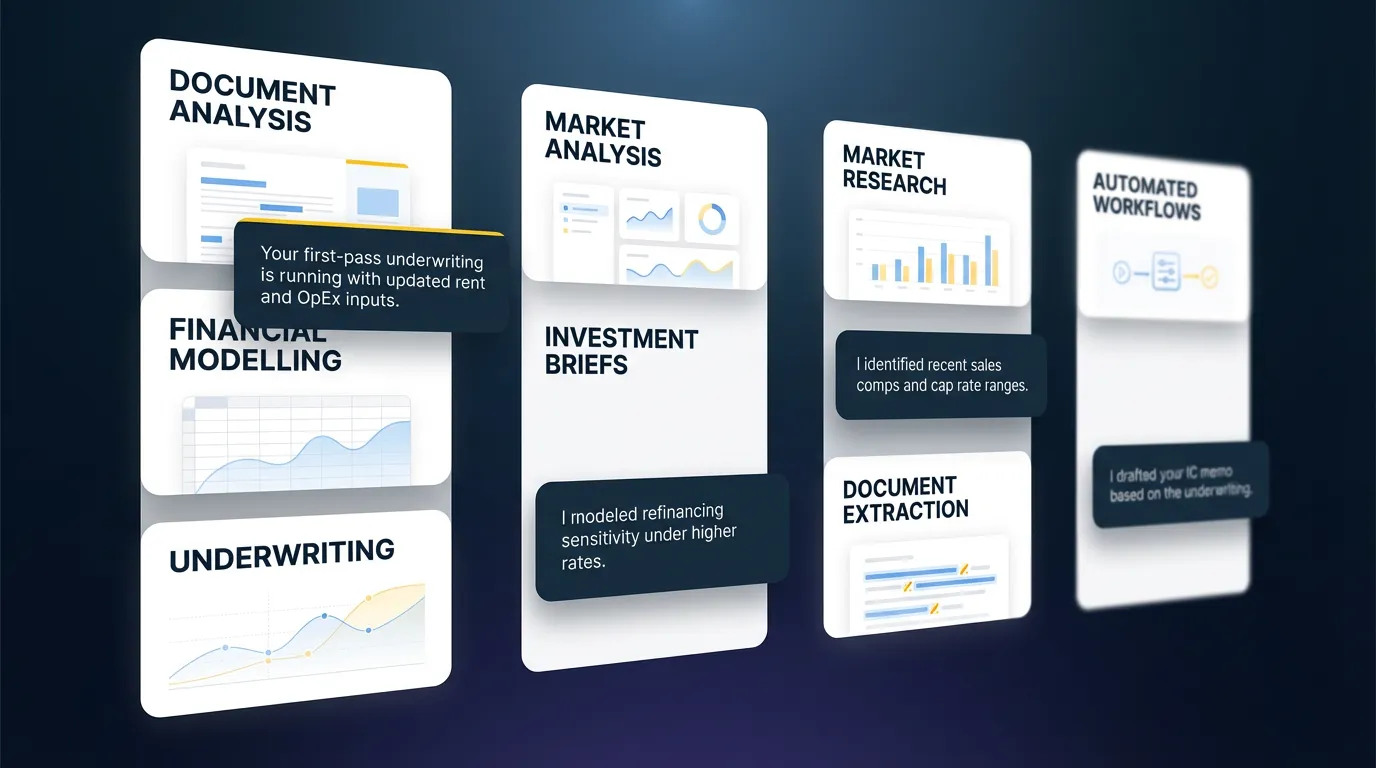
The commercial real estate industry stands at an inflection point where the conversation around artificial intelligence has shifted from theoretical potential to operational necessity. Senior asset managers and portfolio operators no longer question whether AI will transform their workflows, but rather which applications deliver measurable returns and integrate seamlessly into existing decision-making frameworks. Unlocking AI potential in commercial real estate requires moving beyond general-purpose chatbots toward purpose-built tools that understand the nuances of real estate reasoning, from cap rate compression to lease abstraction accuracy. The firms that capture this advantage are those recognizing that AI's value lies not in experimentation, but in finished analytical work that saves hours while maintaining the precision their fiduciary responsibilities demand.
Where AI Creates Measurable Value in Asset Management
The practical applications of AI in multifamily and commercial real estate cluster around repetitive, high-stakes analytical tasks that consume disproportionate amounts of senior talent time. Portfolio reporting, underwriting standardization, and lease data extraction represent the clearest opportunities for operational leverage. Each of these functions requires domain expertise, but the mechanical aspects, such as data aggregation, formatting consistency, and variance analysis, are precisely where AI in commercial real estate is being deployed today to compress timelines and reduce human error.
Automating Portfolio Reporting and Performance Tracking
Portfolio managers typically spend 10 to 15 hours per month consolidating performance data across assets, standardizing metrics, and preparing investor updates. AI-powered platforms now handle this workflow end-to-end: pulling data from property management systems, calculating NOI variance by asset, flagging occupancy trends against historical benchmarks, and generating narrative summaries that explain performance drivers.
Key automation capabilities include:
Variance analysis that identifies which properties are outperforming or underperforming relative to budget
Automated peer benchmarking using comparable asset data
Narrative generation that translates spreadsheet outputs into investor-ready language
Scheduled report delivery aligned to board calendars and investor timelines
The operational advantage compounds when managing portfolios above 10 assets, where manual consolidation introduces version control risks and delays decision velocity. Platforms designed for portfolio management and asset management understand organizational hierarchies, allowing users to slice performance by region, vintage, or asset manager without rebuilding reports from scratch.
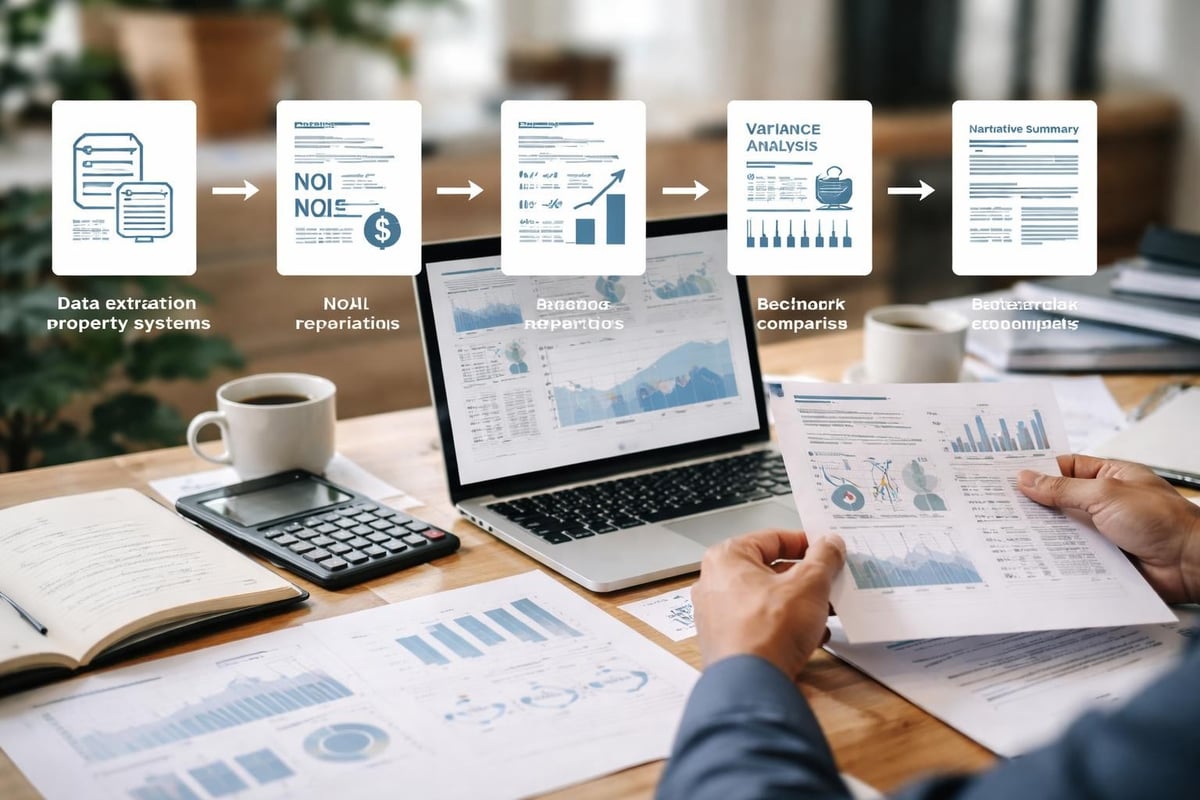
Traditional ApproachAI-Enabled WorkflowTime SavingsManual data extraction from 5+ systemsAutomated data aggregation4-6 hours/monthExcel-based variance calculationsReal-time NOI and occupancy analysis2-3 hours/monthManual narrative draftingAI-generated performance summaries3-4 hours/monthVersion control across stakeholdersSingle source of truth with role-based access1-2 hours/month
Underwriting Acceleration Through Structured Data Extraction
Acquisition teams evaluating 30 to 50 opportunities annually spend enormous bandwidth standardizing financial models and extracting key assumptions from offering memoranda. AI tools built for real estate now read rent rolls, operating statements, and market studies to populate underwriting models directly, cutting preliminary analysis time from hours to minutes.
The differentiation between general AI tools and real estate underwriting software lies in understanding context. A purpose-built platform recognizes that a "management fee" line item should flow through to operational expenses at a percentage of effective gross income, not as a fixed cost. It knows that Seattle's multifamily market operates differently than Phoenix in terms of concession norms and lease-up velocity.
Critical underwriting tasks now automated:
Rent roll normalization across different property management formats
T-12 and T-3 operating statement reconciliation
Market rent assumption validation using recent comparable lease data
Sensitivity analysis across cap rate, exit timing, and renovation budget scenarios
Investment memo generation with source citations for all key assumptions
This level of automation doesn't eliminate the need for analyst judgment. Rather, it shifts the investment team's time from data entry and formula checks toward evaluating market positioning, competitive threats, and capital allocation strategy.
The Real Estate Reasoning Gap
Unlocking AI potential in commercial real estate hinges on a platform's ability to apply real estate logic, not just pattern recognition. General-purpose AI tools struggle with industry-specific calculations, terminology nuances, and the contextual reasoning that separates a good underwriting from a flawed one. When an analyst asks about NOI margin compression, the system must understand whether the question relates to expense growth outpacing revenue, occupancy decline, or concession pressure, and each scenario requires different data sources and analytical approaches.
Why Domain Expertise Matters in AI Architecture
The architecture of AI systems designed for CRE differs fundamentally from consumer chatbots. Real estate platforms train on millions of lease documents, offering memoranda, and market reports to recognize patterns specific to property types, markets, and transaction structures. This training enables the system to extract a renewal option correctly from a lease, understanding that "tenant may extend for two additional five-year terms at 95% of then-prevailing market rent" requires flagging both the term length and the rent escalation mechanism.
Recent analysis from Morgan Stanley on AI in real estate highlights that efficiency gains concentrate in firms using purpose-built tools rather than adapting general AI to real estate tasks. The difference manifests in accuracy rates: a CRE-trained model achieves 95%+ accuracy in lease data extraction, while general tools plateau around 70% to 75%, requiring extensive human review that negates time savings.
Verifiability and Source Transparency
Investment committees operate under fiduciary standards that demand verifiable assumptions. AI-generated analysis becomes operationally valuable only when outputs link back to source documents and data points. A market rent assumption of $2.85 per square foot for Class A multifamily in Austin's Domain submarket requires citation: which comparable properties, which lease dates, and how the system adjusted for unit mix differences.
Leading platforms now provide source attribution as a standard feature, allowing users to click through from a summary statistic to the underlying lease comps or market reports. This transparency addresses the "black box" concern that has slowed AI adoption among institutional investors who need to defend assumptions to investment committees and lenders. Tools that enhance decision-making through AI without sacrificing auditability represent the threshold between experimentation and operational deployment.
Integrating AI Into Existing Workflows
The adoption curve for AI in commercial real estate separates along a clear fault line: tools that require workflow redesign versus those that augment existing processes. Senior professionals resist platforms that demand learning new interfaces or migrating historical data. The most successful implementations involve AI that operates within familiar frameworks, enhancing Excel-based models, outputting to standard reporting templates, and integrating with property management systems already in use.
Workflow Compatibility and Change Management
Asset managers typically rely on established reporting cadences, investment committee templates, and portfolio tracking spreadsheets refined over years. AI platforms that respect these existing structures see faster adoption than those requiring complete process overhauls. A system that can ingest a firm's proprietary underwriting model, populate it with extracted data, and return it in the original format eliminates the training burden and preserves institutional knowledge embedded in those templates.
Integration points that minimize friction:
API connections to Yardi, RealPage, and Entrata for automated data pulls
Excel add-ins that bring AI analysis into existing spreadsheet workflows
Template compatibility that respects firm-specific formatting and calculation methodologies
Role-based permissions aligned to organizational hierarchies
The commercial real estate analytics software landscape now includes platforms designed specifically for this workflow integration challenge. These tools recognize that the value proposition isn't replacing established processes, but rather accelerating the mechanical components while preserving the strategic decision-making authority that senior professionals must retain.
Deployment Timelines and ROI Measurement
Firms evaluating AI platforms typically pilot with a subset of their portfolio, often 5 to 10 assets, to measure time savings and output quality before broader rollout. Successful pilots establish clear success metrics upfront: hours saved per reporting cycle, reduction in underwriting turnaround time, or error rate improvement in lease abstraction.
Deployment PhaseTimelineKey ActivitiesSuccess MetricsInitial Setup2-4 weeksData integration, template configuration, team trainingSystem connectivity, template accuracyPilot Testing1-2 monthsLimited asset deployment, output validationTime savings vs. baseline, error rate comparisonScaled Rollout2-3 monthsPortfolio-wide deployment, workflow refinementAdoption rate, sustained efficiency gainsOptimizationOngoingFeature utilization increase, custom reportingExpanded use cases, user satisfaction scores
The ROI case for unlocking AI potential in commercial real estate becomes compelling when time savings translate into capacity for additional deal evaluation or deeper portfolio analysis. An acquisition team that compresses preliminary underwriting from 4 hours to 45 minutes per opportunity can evaluate 3x more deals with the same headcount, improving capital deployment precision without adding personnel costs.
Market Intelligence and Competitive Positioning
Beyond internal operational efficiency, AI tools now deliver market intelligence that was previously accessible only through expensive third-party research subscriptions or extensive manual data compilation. Platforms can aggregate comparable sales, track rent growth trajectories across submarkets, and identify emerging supply concentrations that signal future competitive pressure.
Automated Market Research With Source Attribution
Investment professionals need current market data to validate rent assumptions, assess competitive positioning, and identify acquisition opportunities. AI platforms now automate this research by continuously monitoring public records, listing services, and transaction databases, then synthesizing insights tailored to specific asset types and markets.
A portfolio manager evaluating a Phoenix multifamily asset can query recent comparable sales within a 3-mile radius, filter by vintage and unit count, and receive not just a list but an analysis of pricing trends, cap rate movement, and buyer composition. The system attributes each data point to its source, whether county records, CoStar listings, or published sale announcements, maintaining the verifiability standards investment committees require.
Market intelligence capabilities now standard:
Comparable sales analysis with automated adjustments for property differences
Rent comp tracking with lease-level detail and concession transparency
New supply monitoring by submarket with delivery timeline tracking
Buyer and seller activity patterns to identify market momentum shifts
This level of market intelligence supports strategic decisions around hold-versus-sell timing, renovation budget allocation, and acquisition pricing discipline. Firms using AI real estate software for market research report improved negotiating positions because they enter discussions with more current data than brokers often provide in marketing materials.

Scenario Analysis and Strategic Planning
The ability to rapidly model multiple scenarios separates reactive portfolio management from strategic capital allocation. AI platforms enable instant sensitivity analysis across variables like interest rate movements, rent growth assumptions, and exit cap rates without rebuilding models manually. A 30-second query can generate a matrix showing how a 50-basis-point cap rate expansion impacts returns across a 20-asset portfolio, informing decisions about refinancing timing or disposition sequencing.
Investment committees increasingly expect this level of scenario planning, particularly as basis points in commercial real estate financing costs have compressed and expanded dramatically over recent cycles. The firms that can rapidly quantify strategic alternatives, whether accelerating value-add renovations or delaying planned dispositions, maintain capital deployment discipline that compounds over time.
Data Quality and System Integration Challenges
Unlocking AI potential in commercial real estate confronts a persistent challenge: data fragmentation and quality inconsistency across property management systems, accounting platforms, and third-party data providers. Portfolio operators working with legacy systems often find that data standardization becomes the bottleneck, not AI capability itself.
Overcoming Data Fragmentation
Multifamily portfolios frequently involve multiple property management platforms, each with different data export formats and field naming conventions. One asset might track "Other Income" while another uses "Ancillary Revenue" for the same category. AI systems must normalize these variations to enable portfolio-level analysis, requiring either extensive upfront mapping or intelligent field recognition that adapts to different source formats.
The most effective platforms handle this normalization automatically, using pattern recognition to identify equivalent fields across disparate systems. A "Move-In Date" field in Yardi becomes "Lease Start" in RealPage, but the AI recognizes both as the same data point for occupancy analysis. This automation eliminates weeks of manual data cleaning that traditionally delayed analytics initiatives.
Common data integration obstacles:
Inconsistent chart of accounts across properties acquired from different sellers
Property management system migrations that create historical data gaps
Third-party data providers with overlapping but non-identical coverage
Custom reporting needs that require blending internal and external data sources
Firms that successfully deploy AI for real estate portfolio management often invest upfront in data governance standards, establishing field naming conventions and required data points even when operating across multiple systems. This standardization pays dividends beyond AI deployment, improving data quality for all analytical purposes.
Balancing Automation With Human Oversight
Even sophisticated AI systems require human oversight for edge cases and strategic judgment calls. A lease with unusual escalation clauses or a property with significant deferred maintenance might flag for manual review rather than flowing directly into automated outputs. The optimal workflow involves AI handling the 80% of routine analysis while routing exceptions to experienced professionals.
This division of labor aligns with how senior asset managers prefer to work: freed from mechanical data aggregation but retained for the judgment calls that define investment performance. Platforms designed for this balance use confidence scoring to indicate when outputs warrant additional review, typically based on data completeness or the presence of non-standard terms requiring interpretation.
Moving From Pilots to Operational Deployment
The gap between successful AI pilots and sustained operational deployment often comes down to change management and user adoption rather than technical capability. Teams accustomed to manual workflows need clear incentives to shift toward AI-assisted processes, and those incentives must extend beyond generic "efficiency" claims to specific, measurable improvements in daily work.
Building Internal AI Literacy
Investment teams don't need to understand transformer architectures or neural network training to deploy AI effectively, but they do need sufficient literacy to evaluate outputs critically and understand system limitations. Successful deployments include training on when to trust AI-generated analysis versus when human review remains essential.
A portfolio operator should understand that AI excels at comparative analysis across large datasets but may struggle with truly unique situations lacking historical precedent. New development underwriting in an emerging market, for instance, benefits less from AI assistance than stabilized asset acquisition in established submarkets with deep comparable datasets. This understanding prevents over-reliance in situations where human judgment remains superior.
Key training components for operational teams:
How to evaluate AI output quality and identify potential errors
When to use automated analysis versus manual deep dives
How to phrase queries to get relevant, actionable responses
Understanding confidence scores and source attribution
Escalation protocols for outputs that seem inconsistent or questionable
Organizations that invest in this training see adoption rates above 75% within six months, while those treating AI as a plug-and-play solution struggle to exceed 40% utilization even after a year.
Unlocking AI potential in commercial real estate requires purpose-built tools that understand real estate reasoning, integrate seamlessly into existing workflows, and deliver verifiable outputs that meet fiduciary standards. The transition from experimentation to operational value happens when platforms automate finished analytical work rather than simply providing another data source requiring human interpretation. Leni provides exactly this capability for multifamily portfolio managers and asset managers, delivering automated reporting, underwriting acceleration, and market intelligence that compounds decision velocity across entire portfolios.

Johanna Gruber
Johanna has spent the last 8 years helping marketing teams connect with audiences through content. Specializing in B2B SaaS and real estate.
MEET LENI
Get Portfolio Insights With Leni Analytics
Dive into a live demonstration of Leni Analytics and discover how intuitive data visualization and real-time insights can transform your decision-making process.