Reporting Tools for Property Managers: 2026 Guide

Reporting Tools for Property Managers: 2026 Guide
Property managers waste an average of 12-15 hours per week consolidating data from disparate systems, formatting reports in Excel, and hunting down numbers that become stale before the PDF hits an owner's inbox. This reporting bottleneck compounds as portfolios grow. What works for managing five properties collapses under the weight of fifty. The challenge isn't just volume, it's velocity. Owners demand real-time insights, banks require standardized reporting packages, and asset managers need granular performance metrics to identify value-add opportunities before they evaporate. The right reporting tools for property managers eliminate this friction entirely, transforming data extraction from a manual slog into an automated competitive advantage.
1. Spreadsheet-Based Reporting Systems
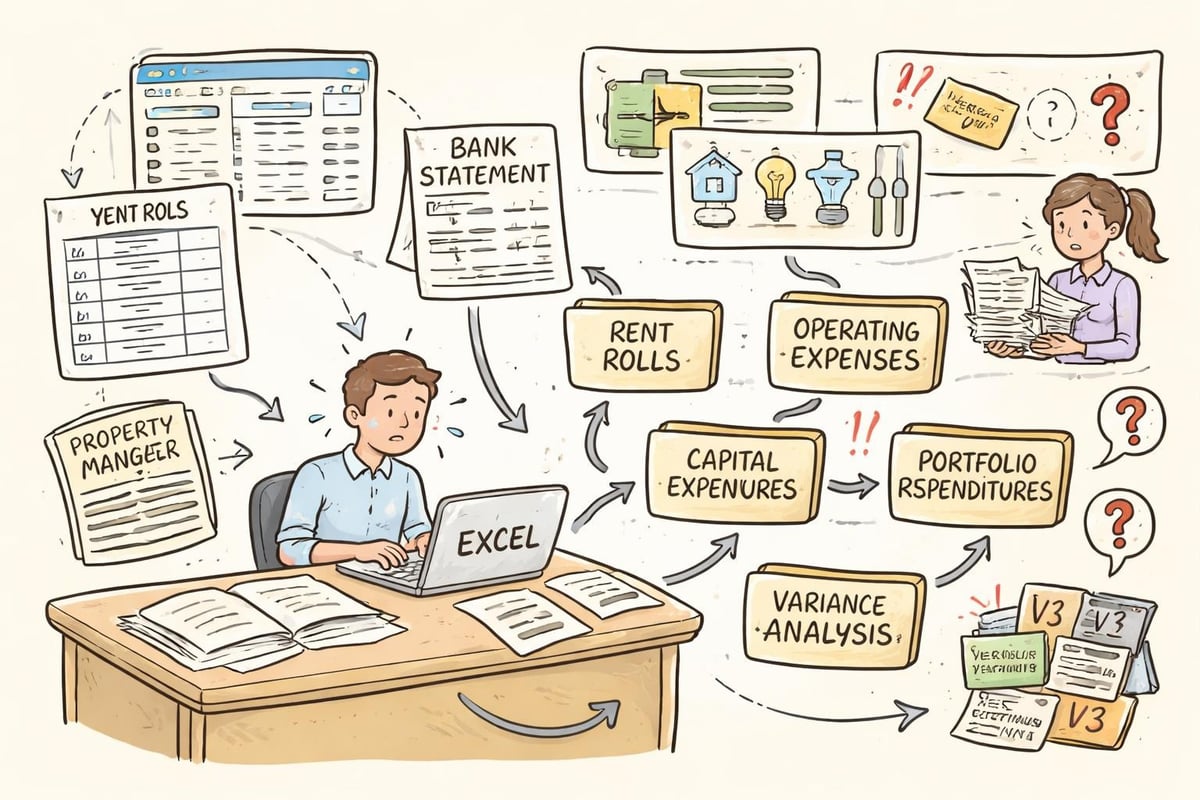
Spreadsheet-based workflows remain the default for many property management teams because they're familiar and infinitely customizable. Excel and Google Sheets cost nothing to implement and can handle complex calculations when properly configured.
The Real Cost of Manual Data Entry
The apparent simplicity of spreadsheets masks their operational expense. Every data point requires manual input or copy-paste transfers from property management systems, bank statements, and utility bills. This creates three critical vulnerabilities:
Formula errors compound across linked worksheets
Version control becomes impossible with multiple team members
Audit trails disappear when cells get overwritten
Property managers working with spreadsheets typically maintain separate files for each property, then consolidate them into master portfolio reports. This structure works until something breaks. One misplaced decimal point in a rent roll can cascade through months of financial projections.
AdvantageDisadvantageZero software costHigh labor cost in hoursComplete customizationNo standardization across propertiesOffline accessibilityError-prone manual transfersFamiliar interfaceNo automated data validation
The bookkeeping best practices for property management companies emphasize purpose-built chart of accounts structures that spreadsheets struggle to enforce consistently across growing portfolios.
When Spreadsheets Still Make Sense
For single-property operations or small portfolios under ten units, spreadsheet reporting remains viable. The breakpoint occurs when data entry time exceeds the cost of purpose-built software, which typically happens between 10-20 units depending on property complexity.
Spreadsheet advocates argue that formulas can automate calculations, but they cannot automate data acquisition. That fundamental limitation explains why most property managers eventually migrate to dedicated reporting tools for property managers that connect directly to operational systems.
2. Property Management Software with Built-In Reporting
Modern property management platforms like Yardi, RealPage, Entrata, AppFolio, and MRI Software include native reporting modules designed to eliminate manual data consolidation. These systems serve as the operational backbone for most commercial and multifamily portfolios.
Standard Report Libraries
Property management software provides pre-configured reports that cover essential operational needs:
Rent rolls with lease expiration schedules
Accounts receivable aging summaries
Maintenance work order tracking
Budget versus actual variance reports
Occupancy trends and turnover metrics
The best property management software solutions of 2026 share a common architecture: centralized databases that eliminate duplicate data entry and provide single-source-of-truth reporting. This represents a massive improvement over spreadsheet fragmentation.
The Customization Gap
Despite their sophistication, property management systems face a structural limitation. Their reporting modules optimize for operational compliance rather than strategic analysis. Standard reports answer "what happened" but struggle with "why it happened" or "what should we do next."
Custom report development requires either expensive consultant engagements or internal technical resources who understand both the software's database schema and SQL query language. Most property management teams lack this expertise, leaving them dependent on vendor-provided templates that rarely align perfectly with their reporting requirements.
SystemStrengthLimitationYardi VoyagerDeep functionality across asset classesSteep learning curve for custom reportsRealPageStrong ancillary service integrationsLimited cross-property consolidationEntrataModern interface with API accessPrimarily multifamily-focusedAppFolioUser-friendly for small portfoliosCustomization requires workarounds
Portfolio-level reporting across multiple properties often requires exporting data to Excel for final consolidation, reintroducing the manual workflow bottlenecks these systems were meant to eliminate. The comprehensive property management reporting guide confirms this pattern: most teams use property management software for property-level reports but still rely on external tools for portfolio analytics.
3. Business Intelligence Platforms and Dashboard Solutions
Business intelligence (BI) platforms like Tableau, Power BI, and Looker represent the next sophistication tier for reporting tools for property managers. These systems connect to property management databases and transform raw operational data into interactive visualizations.
Visual Analytics That Tell Stories
BI platforms excel at pattern recognition across large datasets. Heat maps reveal which properties underperform relative to market conditions. Trend lines identify seasonal occupancy patterns. Drill-down capabilities let asset managers click from portfolio-level metrics into property-specific details without opening multiple reports.
The top property management dashboards for 2025 highlight platforms that combine real-time data feeds with customizable KPI tracking. These tools answer questions like:
Which properties are trending below budget by more than 5%?
How does our occupancy compare to same-store performance last year?
What's the average time-to-lease across different property managers?
This analytical depth transforms reporting from historical record-keeping into forward-looking strategy development. Property managers can identify underperforming assets before quarterly reviews and implement corrective action while opportunities still exist.
The Implementation Investment
Business intelligence platforms demand significant upfront investment in three areas:
Data integration engineering: Connecting BI tools to property management systems requires API configuration, data mapping, and ongoing synchronization maintenance
Dashboard design: Effective visualizations require understanding both data structure and stakeholder decision-making processes
User training: Teams need education on both the platform mechanics and proper analytical interpretation
Most BI implementations take 3-6 months before delivering consistent value. Smaller property management firms rarely justify this investment unless they manage exceptionally complex portfolios or operate as third-party managers serving multiple ownership groups with distinct reporting requirements.
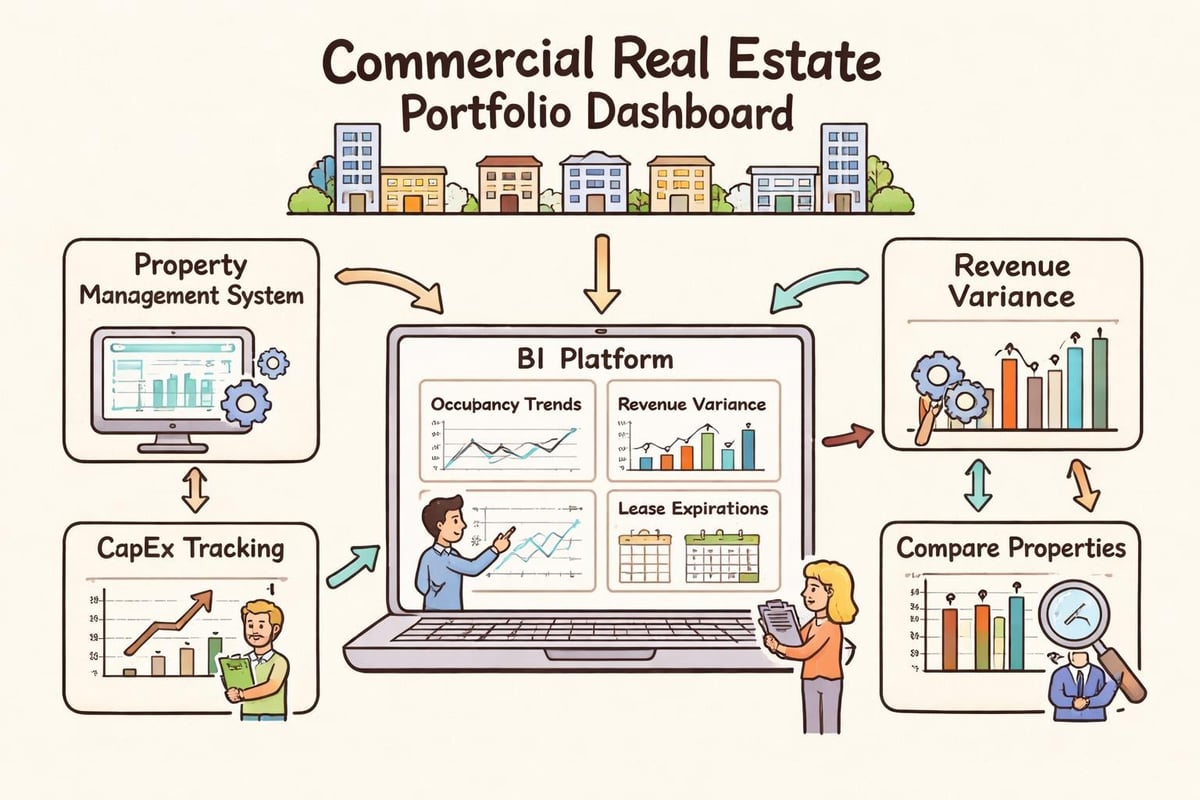
The property management systems comparison evaluating real-time reporting capabilities reveals that even the best property management software generates static reports, while BI platforms enable dynamic exploration. This flexibility comes at the cost of complexity.
4. Financial Reporting and Benchmarking Services
Specialized financial reporting services provide standardized packages designed for investor and lender compliance. These platforms focus less on operational metrics and more on presentation-ready financial statements formatted to industry standards.
Standardization for Stakeholder Communication
GAAP-compliant financial statements, investor distribution waterfall reports, and lender compliance packages require specific formatting that operational reporting tools don't prioritize. Financial reporting services maintain template libraries aligned with institutional requirements.
The financial reporting and benchmarking services analysis demonstrates how property managers use these platforms to compare their performance against market benchmarks, identifying where their properties rank within peer groups.
Key deliverables include:
Quarterly investor packages with executive summaries
Annual audited financial statements
Lender compliance certifications
Performance benchmarking against comparable properties
The Narrow Focus Problem
Financial reporting services excel within their specific domain but operate in isolation from operational decision-making. They format numbers beautifully but don't help property managers understand which operational changes would improve those numbers.
Most property management teams use financial reporting services as a supplement to, rather than replacement for, their core reporting infrastructure. Data still requires export from property management systems, manual verification, and reformatting before these specialized platforms can generate their polished outputs.
5. AI-Powered Analytics Platforms Built for Real Estate
Purpose-built AI platforms designed specifically for commercial real estate represent the newest category of reporting tools for property managers. Unlike generic business intelligence software, these systems understand real estate logic natively and automate the analytical reasoning that property managers traditionally perform manually.
How Real Estate-Specific AI Changes Reporting
Traditional reporting tools display data. AI platforms interpret it. They don't just show that rent collection dropped 3% last quarter; they identify which specific units drove the decline, compare those units' characteristics against high-performing comps, and suggest targeted retention strategies based on market positioning.
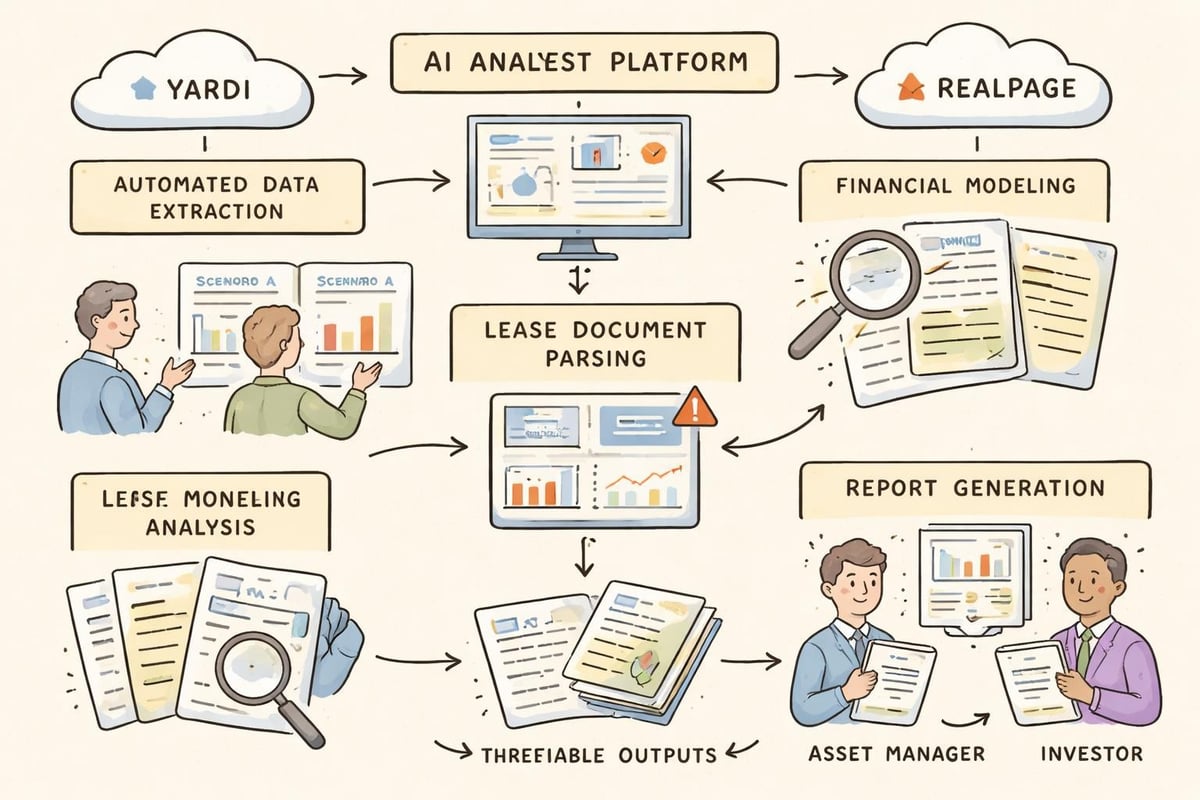
Leni exemplifies this approach as an AI analyst platform purpose-built for commercial real estate asset management. The platform connects directly to property management systems including Yardi, RealPage, Entrata, AppFolio, ResMan, and MRI Software, eliminating the data extraction bottleneck that consumes hours in traditional workflows.
The architectural difference matters. Generic AI tools require extensive prompt engineering and lack context about real estate operations. Purpose-built platforms incorporate domain expertise into their analytical frameworks:
Lease expiration risk assessment considers both timing and market rental rate trajectories
Capital expenditure prioritization factors property-specific ROI alongside portfolio-level cash flow constraints
Variance analysis distinguishes between controllable operational issues and market-driven headwinds
Automation That Goes Beyond Data Visualization
The most powerful capability of AI-powered reporting tools for property managers is autonomous execution of multi-step analytical tasks. Rather than manually pulling data, building pivot tables, and writing commentary, property managers define what they need once and let automation handle recurring execution.
Leni's Pulse monitoring system tracks portfolio KPIs continuously and triggers threshold-based alerts when metrics deviate from expected ranges. This transforms reporting from a periodic retrospective exercise into real-time operational intelligence.
Traditional ApproachAI-Powered ApproachMonthly manual report generationAutomated recurring reports with source linksStatic historical analysisContinuous monitoring with proactive alertsGeneric templates requiring customizationReal estate-specific analytical frameworksDisconnected from source systemsDirect integration with property management platformsUnverifiable calculationsSource-linked verifiable outputs
The platform handles analytical work that typically requires dedicated personnel: financial modeling across scenarios, document extraction from leases and offering memorandums, investment committee memo creation, and real estate market analysis with live source-linked research.
Verifiable Outputs with Source Documentation
One critical distinction separates professional-grade reporting tools for property managers from consumer AI products: verifiability. Every calculation, assumption, and data point in a Leni-generated report links directly to its source document. Asset managers can click through to verify any number, satisfying audit requirements and building stakeholder confidence.
This source-linking architecture proves especially valuable during acquisition underwriting and quarterly investment committee presentations where decision-makers need to trust the analysis driving multi-million-dollar capital allocation decisions. The AI for real estate investment approach combines analytical speed with the rigor institutional investors demand.
The Learning Curve Advantage
AI platforms improve with usage. Unlike static software that performs identically regardless of how long you've used it, Leni becomes more accurate as it ingests more property data. The system learns property-specific patterns, market dynamics, and portfolio strategy preferences, delivering increasingly relevant insights over time.
This real estate automation capability compounds value across growing portfolios. The marginal cost of adding properties to reporting coverage approaches zero while analytical depth increases.
6. Inspection and Operational Reporting Tools
Property condition reporting represents a distinct category within reporting tools for property managers. Inspection software focuses on visual documentation, maintenance tracking, and regulatory compliance rather than financial metrics.
Digital Inspection Workflows
Modern inspection platforms replace paper checklists with mobile applications that:
Capture photos with embedded timestamps and GPS coordinates
Generate automated work orders from identified deficiencies
Track remediation progress with completion verification
Create standardized reports for owners and regulatory agencies
The top property management inspection software tools emphasize mobile-first design that enables property managers to complete inspections on-site without returning to office computers for data entry.
Integration with Financial Reporting
Inspection data becomes most valuable when connected to financial planning. Deferred maintenance backlogs inform capital expenditure budgets. Unit turn costs derived from move-out inspections feed into financial projections.
Most inspection tools operate as standalone systems, requiring manual transfer of findings into financial planning processes. This disconnection limits their strategic value despite strong operational utility.
The various property reporting types overview confirms that best-in-class property management combines inspection reporting with financial analytics, though achieving this integration typically requires custom development work.
7. What to Prioritize When Selecting Reporting Tools
Evaluating reporting tools for property managers requires balancing immediate needs against long-term scalability. The right platform for a 500-unit portfolio differs dramatically from what serves a 5,000-unit institutional operation.
Critical Selection Criteria
Direct integration with existing property management systems eliminates the manual data extraction that undermines reporting efficiency. Tools that require CSV exports and manual uploads perpetuate the bottlenecks they claim to solve.
Portfolio managers should prioritize platforms that:
Connect natively to their property management software via API
Automate recurring reports rather than requiring manual regeneration
Provide source-linked verifiable outputs for audit compliance
Support real estate-specific analytical frameworks out of the box
Scale economically as portfolio size increases
The property management software market analysis indicates accelerating demand for advanced reporting capabilities, driven by institutional investors requiring more frequent and detailed portfolio transparency.
Build Versus Buy Considerations
Some property management firms attempt to build custom reporting infrastructure using in-house development resources. This approach offers maximum customization but typically underestimates three factors:
Ongoing maintenance costs as property management systems update their APIs
The specialized real estate domain knowledge required for meaningful analytics
The opportunity cost of technical talent focused on internal tools rather than portfolio operations
Purpose-built platforms like Leni deliver sophisticated analytical capabilities immediately, without the multi-year development timelines and seven-figure budgets that custom solutions demand. The platform's data analysis tools handle complex scenarios like portfolio stress testing and acquisition modeling that would require significant engineering investment to replicate.
Security and Compliance Requirements
Commercial real estate data includes sensitive financial information, personally identifiable tenant details, and proprietary investment strategies. Reporting platforms must meet institutional security standards including SOC 2 Type 2 certification, encryption at rest and in transit, and role-based access controls.
Leni maintains SOC 2 Type 2 certification and connects to enterprise property management systems using the same security protocols that banks and institutional investors require. This eliminates the security review delays that often derail vendor onboarding for generic software products.
Total Cost of Ownership Analysis
Software licensing fees represent only one component of reporting tool costs. Complete TCO analysis includes:
Cost CategoryTraditional ToolsAI-Powered PlatformsSoftware licenses$500-2,000/user/year$1,500-5,000/user/yearImplementation services$25,000-100,000Often includedOngoing customization$50,000-200,000/yearMinimal with purpose-built designStaff time for report generation15-20 hours/week2-3 hours/weekTraining and maintenance$10,000-25,000/yearContinuous product updates
When factoring in the labor cost savings from automation, AI-powered reporting tools for property managers often deliver lower total cost of ownership despite higher nominal licensing fees. The accounts payable best practices for property management framework applies equally to reporting tool evaluation: optimize for total process cost rather than individual line items.
Scalability and Portfolio Growth
Reporting infrastructure should accommodate portfolio expansion without requiring platform migration. Asset managers acquiring additional properties need tools that maintain consistent analytical frameworks across growing asset counts.
Generic business intelligence platforms scale linearly: doubling your portfolio roughly doubles configuration complexity. Purpose-built real estate platforms achieve economies of scale because they understand property operations natively. Adding properties to Leni's analytical coverage requires minimal configuration beyond initial property management system connection.
This scalability proves especially valuable for multifamily investors pursuing acquisition strategies that rapidly expand portfolio size, where reporting capabilities must keep pace with deal flow.
Selecting the right reporting infrastructure determines whether your property management operation scales efficiently or drowns in administrative overhead. The most effective reporting tools for property managers combine direct property management system integration, real estate-specific analytical frameworks, and verifiable source-linked outputs that satisfy institutional requirements. Leni delivers these capabilities through an AI analyst platform that automates the recurring analytical work consuming your team's time while maintaining the rigor and transparency that commercial real estate asset management demands. Explore how Leni transforms portfolio reporting from a bottleneck into a competitive advantage.

Johanna Gruber
Johanna has spent the last 8 years helping marketing teams connect with audiences through content. Specializing in B2B SaaS and real estate.

Curious About AI?
Join the largest AI community for real estate online. Get bite-sized, real-world use case videos, plus practical tips and proven strategies from top industry experts on adopting AI effectively.
MEET LENI
AI SuperAgent Purpose Built for Investors and Operators.
Experience how professionals and teams in your domain are getting the edge using AI.
