Secure AI for Investment Firms: A Complete Guide

Secure AI for Investment Firms: A Complete Guide
Investment firms operate in a unique environment where a single data breach or inaccurate analysis can result in regulatory fines, reputational damage, and material financial loss. As artificial intelligence transforms how firms analyze deals, manage portfolios, and generate reports, the pressure to implement secure ai for investment firms has intensified. Yet security cannot exist in isolation from accuracy. The most sophisticated encryption means nothing if the AI outputs guiding million-dollar decisions cannot be traced, verified, or trusted. This guide provides a comprehensive evaluation framework for what secure AI actually requires when handling sensitive deal and portfolio data, and how to assess platforms that claim to meet enterprise standards.
Understanding Security Requirements Beyond Basic Compliance
Security in AI deployment extends far beyond installing a chatbot with password protection. Investment firms must evaluate platforms against a rigorous set of criteria that address data protection, access controls, operational transparency, and architectural resilience.
SOC 2 Type II Certification as Foundation
SOC 2 Type II certification represents the baseline for any platform handling confidential financial data. Unlike Type I, which evaluates security design at a single point in time, Type II requires continuous monitoring over at least six months, proving that security controls function effectively under real operating conditions.
Key aspects of SOC 2 Type II compliance include:
Ongoing third-party audits of security practices
Documented evidence of control effectiveness over time
Validation of security policies across all organizational levels
Proof that incidents are detected, logged, and remediated
When evaluating secure ai for investment firms, verify that the certification covers the AI platform itself, not just the hosting infrastructure. Many vendors obtain SOC 2 for their cloud provider but fail to extend those controls to their application layer where your data actually flows.
Encryption Standards That Protect Data Everywhere
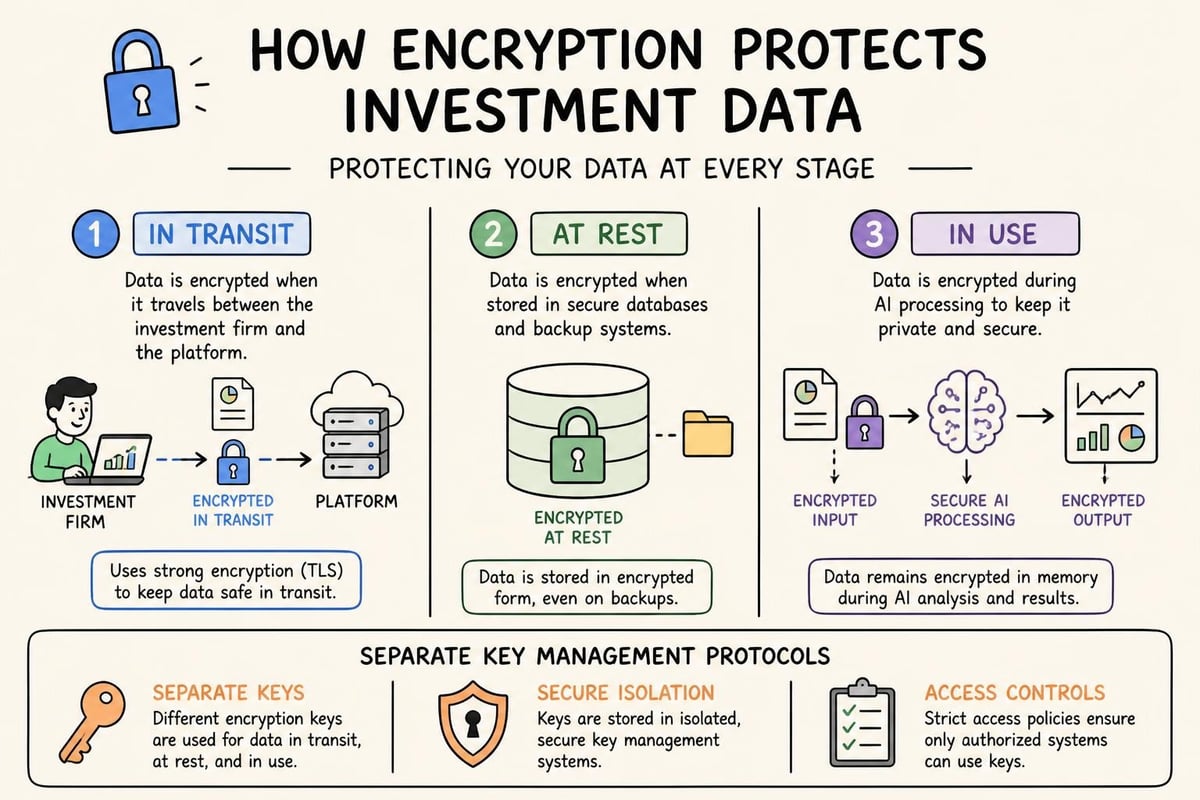
Encryption must function at every stage of the data lifecycle. In transit, data moving between your systems and the AI platform requires TLS 1.3 or equivalent protocols to prevent interception. At rest, all stored data including training materials, uploaded documents, and query histories must use AES-256 encryption or stronger.
The distinction matters because gaps create vulnerabilities. A platform might encrypt stored files but transmit API calls over unencrypted connections. Evaluate whether encryption keys are managed through hardware security modules (HSMs) and whether the firm maintains control over key rotation schedules.
Implementing Access Controls That Reflect Organizational Structure
Investment firms organize teams around deal types, asset classes, and client mandates. Your AI platform must mirror this structure through granular access controls that prevent unauthorized exposure.
Role-Based Access and Least-Privilege Principles
Least-privilege access means users receive only the permissions essential to their specific responsibilities. An analyst underwriting multifamily properties should not access hedge fund portfolio data. A reporting specialist should not modify deal models.
Role-based access control (RBAC) systems enable this separation by defining permissions at the role level rather than individually. Consider this framework:
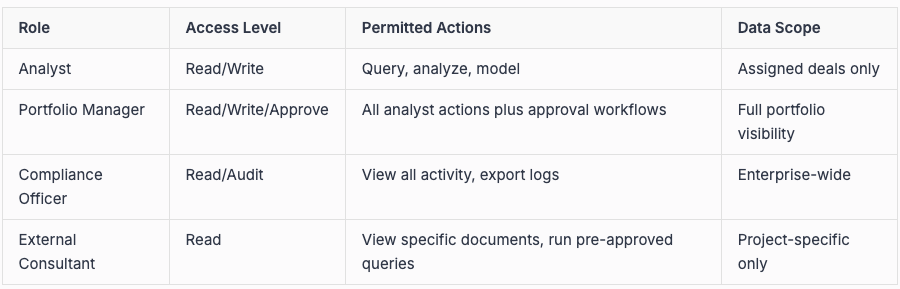
When evaluating platforms, test whether they support custom role creation, attribute-based access control (ABAC) for nuanced permissions, and time-limited access grants for temporary team members.
Tenant Isolation in Multi-Client Environments
If your firm serves multiple clients or manages separate funds, tenant isolation becomes critical. Each client's data must exist in a logically separated environment where queries, models, and outputs cannot cross boundaries.
Strong isolation requires containerization at the infrastructure level, separate encryption keys per tenant, and database schemas that prevent accidental or malicious data leakage. Platforms built on shared databases with application-level filtering create unacceptable risk. Research from Proofpoint's AI Innovation Centre demonstrates how enterprise security architectures must isolate AI workloads to maintain data integrity across multiple tenants.
Establishing Audit Logging and Operational Transparency
Secure ai for investment firms demands complete visibility into who accessed what data, when, and what the system did with it. Comprehensive audit logging transforms AI from a black box into an accountable system that supports regulatory examinations and internal reviews.
What Comprehensive Audit Trails Capture
Effective audit logs record every interaction with sufficient detail to reconstruct events:
User authentication events including successful logins, failed attempts, and session durations
Data access patterns documenting which documents were uploaded, queried, or exported
Query submission and modification preserving the exact prompts users submitted and any edits
Model invocation records showing which AI models processed each request
Output generation details linking responses to specific training data or retrieval sources
Administrative changes tracking permission modifications, role assignments, and configuration updates
These logs must be immutable, meaning historical records cannot be altered or deleted, and timestamped with precision sufficient for forensic analysis. Platforms that meet enterprise standards provide log retention for seven years or longer and support export to external security information and event management (SIEM) systems.
Building Verification Into AI Outputs
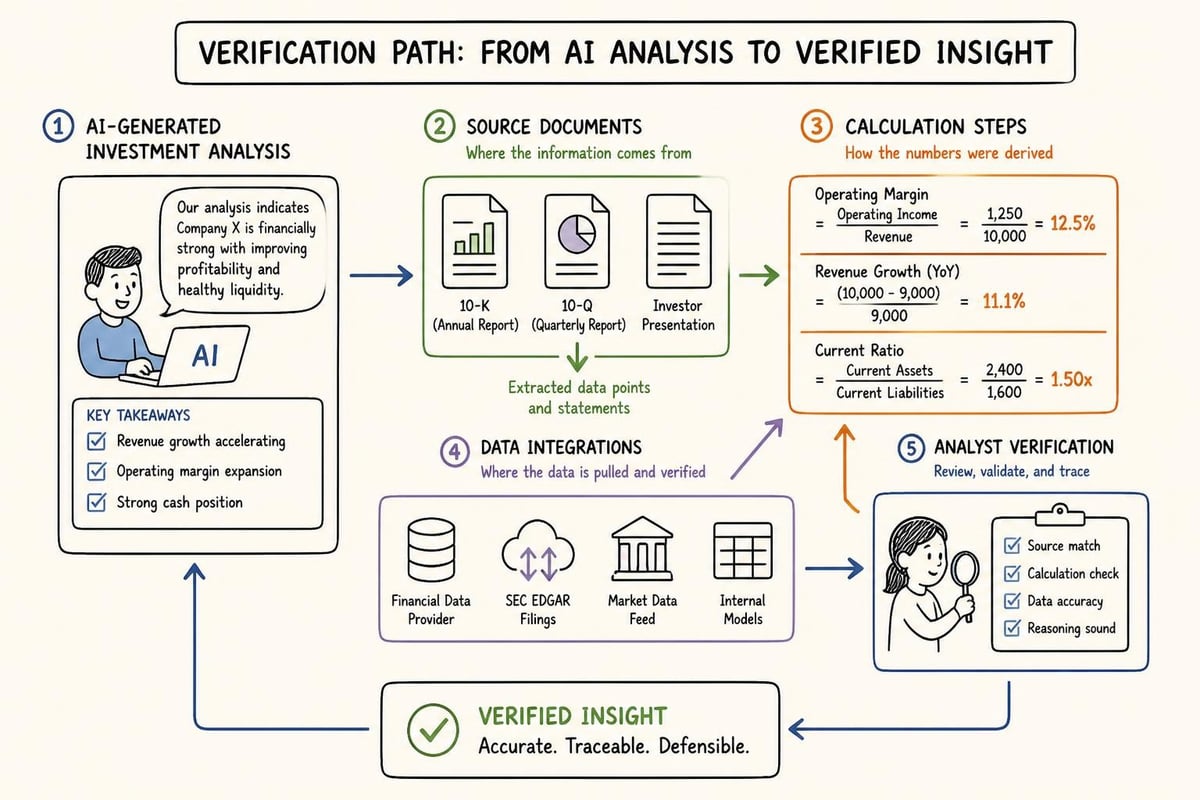
Security and accuracy converge in output verification. An AI system might be perfectly secure but operationally worthless if investment teams cannot validate its analysis. Traceable outputs mean every calculation, assumption, or recommendation links back to source data.
When the platform states that a property generates $2.4 million in net operating income, users should click through to the specific rent roll, expense ledger, and calculation methodology. This transparency serves dual purposes: it builds user trust and creates an audit trail proving the AI didn't hallucinate figures.
For investment workflows, AI tools for business analysts must surface their reasoning chains, not just final answers. Platforms designed for serious financial work provide citation systems where outputs reference specific paragraphs in offering memorandums, line items in financial statements, or market data points from integrated sources.
Architecting for Model Flexibility and Risk Mitigation
A critical but frequently overlooked aspect of secure ai for investment firms involves the underlying AI architecture. Platforms locked to a single large language model create concentration risk and limit your ability to respond to evolving capabilities.
The Model-Agnostic Advantage
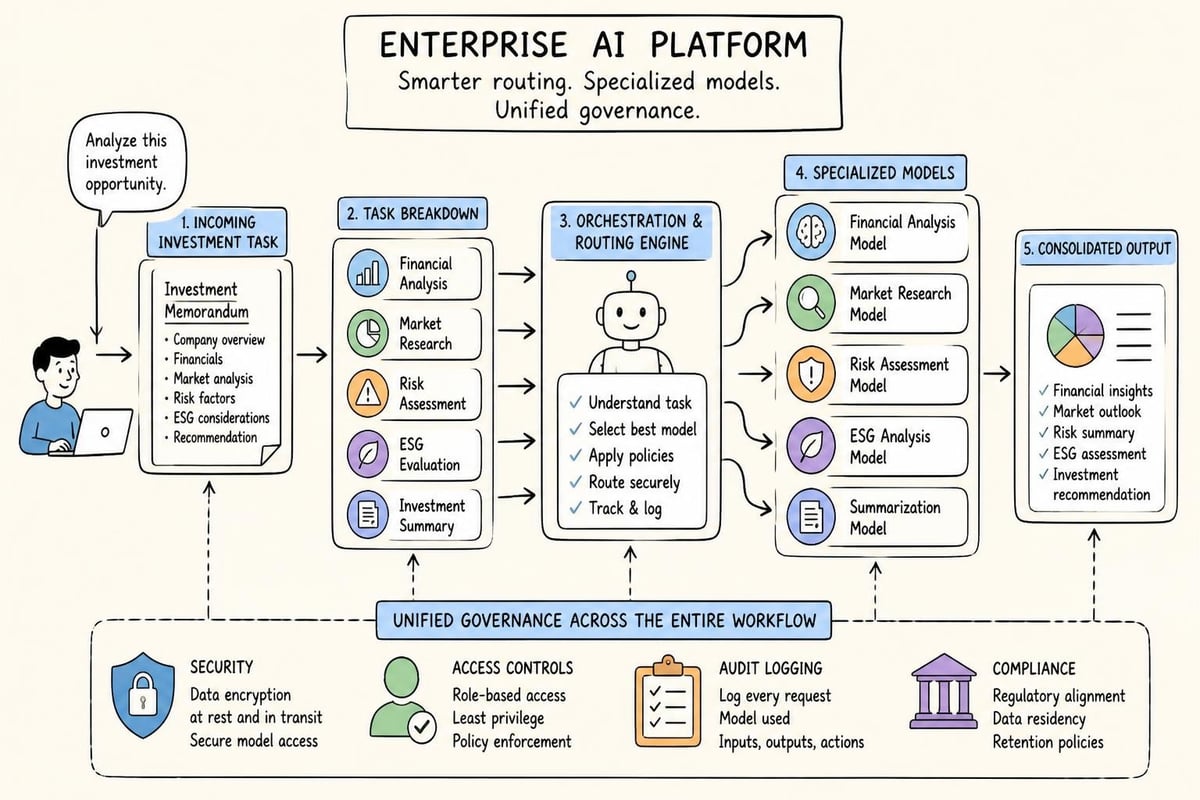
Model-agnostic design means the platform can route different tasks to different AI models based on their strengths, all within a unified security envelope. Financial summarization might route to one model, complex quantitative analysis to another, and document comparison to a third.
This approach delivers several security and operational benefits:
Reduced vendor lock-in preserving negotiating leverage and exit options
Performance optimization by matching tasks to the most capable model
Risk diversification avoiding single points of failure if one model provider experiences outages
Rapid capability updates as new models emerge with superior accuracy or efficiency
Investment firms exploring AI for real estate investment should prioritize platforms that abstract the model layer, allowing them to upgrade or switch models without rebuilding workflows or retraining users.
Containerized Models With Execution Guardrails
Beyond model selection, architectural security requires containerization where each AI model runs in an isolated environment with defined resource limits and security boundaries. Containers prevent one model from accessing another's memory space, training data, or temporary files.
Execution guardrails add another protection layer by filtering both inputs and outputs. Input guardrails block attempts to inject malicious prompts designed to bypass security controls or extract training data. Output guardrails prevent the system from returning personally identifiable information (PII), proprietary trading strategies, or other sensitive content that shouldn't appear in responses.
Investment platforms handling commercial real estate portfolios, private equity deal flow, or asset management reporting need these controls to comply with data privacy regulations and protect competitive intelligence. The Alliance for Secure AI emphasizes that guardrails must evolve continuously as adversarial techniques become more sophisticated.
Evaluating Real-World Implementation at Enterprise Scale
Theory matters less than execution. When assessing platforms, investment firms must examine how security controls function under the pressure of daily operations across hundreds of users and thousands of sensitive documents.
Integration Security With External Data Sources
Investment workflows depend on external data: market comparables from CoStar, financial metrics from Preqin, economic indicators from Bloomberg. Each integration point represents a potential vulnerability.
Secure integration architecture includes:
API authentication using OAuth 2.0 or similar token-based protocols
Encryption of credentials stored for recurring data pulls
Network segmentation isolating integration services from user-facing systems
Rate limiting and anomaly detection to prevent data exfiltration
Audit logging of all external data requests and responses
Platforms offering real estate market analysis or commercial real estate technology capabilities must demonstrate that their integrations maintain security standards equivalent to their core platform. A SOC 2 Type II platform that pulls data through unencrypted FTP connections negates its own security posture.
Performance Under Regulatory Examination
Regulators increasingly scrutinize how investment firms use AI in decision-making processes. During examinations, firms must produce documentation proving AI systems operate within established risk management frameworks.
Secure platforms support regulatory readiness through:
Model governance documentation explaining how AI models are selected, validated, and monitored
Bias testing results demonstrating that outputs don't systematically disadvantage protected classes
Explainability reports translating AI reasoning into language compliance officers understand
Change management logs tracking platform updates that might affect analytical outcomes
Disaster recovery plans proving business continuity if the AI platform experiences outages
These requirements extend beyond security into operational resilience, but they're inseparable. A platform can be perfectly secure yet fail regulatory standards if it cannot explain its outputs or prove consistent operation over time.
Building an Integrated Operating Layer for Investment Workflows
The most effective approach to secure ai for investment firms moves beyond point solutions toward an integrated operating layer that governs AI across the entire investment lifecycle.
Why Single-Model Chatbots Create Security Gaps
Generic chatbots like standalone ChatGPT or Claude implementations force firms to build security, integration, and governance manually around tools designed for consumer use. This creates multiple problems:
Each user develops their own prompts and workflows, creating consistency issues. Data moves between platforms, multiplying encryption requirements and access control complexity. Audit trails fragment across systems. Knowledge doesn't accumulate because there's no shared context or memory.
Investment firms need platforms purpose-built for their workflows where security, accuracy, and integration exist as foundational design principles, not afterthoughts.
How Governed AI Systems Route Work Intelligently
A governed operating layer maintains security boundaries while routing each task to the optimal model. When an analyst uploads a rent roll for commercial real estate deal analysis, the system:
Authenticates the user and verifies permissions for this asset
Encrypts the document and stores it in the appropriate tenant container
Routes financial extraction to a model specialized in structured data
Routes market positioning analysis to a model trained on contextual reasoning
Assembles outputs with citations linking to source documents
Logs all activity for audit and compliance purposes
Presents results within reporting and asset management workflows
This orchestration happens within a single security envelope with unified access controls, comprehensive logging, and traceable outputs. Users work in one interface while the platform handles model selection, security, and integration complexity.
Connecting Security to Accuracy and Business Value
Investment firms implementing AI face a fundamental question: does this system make us better at our core business? Security enables that improvement by creating the trust necessary for widespread adoption.
How Security Supports Analytical Confidence
When analysts trust that the AI platform protects sensitive data, they're willing to upload complete deal files rather than sanitized excerpts. This completeness directly improves output quality. An AI tool for reporting in real estate analyzing partial rent rolls produces partial insights. Full data access enables comprehensive analysis.
Security also enables collaboration across teams. Portfolio managers share sensitive strategy documents with analysts. Acquisition teams compare competing deals. Compliance officers review investment rationale across all transactions. These workflows require absolute confidence that access controls function perfectly and audit trails capture everything.
Measuring Security ROI in Investment Operations
Quantifying security's business impact requires tracking operational metrics:
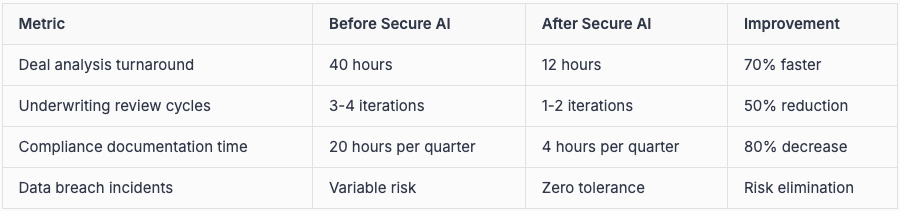
These improvements compound. Faster analysis means evaluating more opportunities. Fewer review cycles accelerate capital deployment. Reduced compliance burden frees senior staff for strategic work.
Research on AI-oriented quantitative investment platforms demonstrates that security and performance reinforce each other. Firms confident in their AI security deploy it more broadly, generating more data to improve model accuracy in a virtuous cycle.
Implementing Enterprise AI Security: A Practical Roadmap
Moving from evaluation to implementation requires a structured approach that addresses technical, organizational, and operational dimensions simultaneously.
Phase One: Security Baseline Assessment
Begin by documenting your current state and requirements:
Catalog sensitive data types including deal files, portfolio holdings, LP information, and proprietary models
Map existing access controls identifying who currently accesses each data category and why
Review regulatory obligations across SEC, FINRA, GDPR, and industry-specific mandates
Identify integration requirements for market data, accounting systems, and portfolio management tools
Define acceptable risk thresholds for data exposure, system downtime, and vendor dependencies
This assessment creates the baseline against which you'll evaluate platforms claiming to provide secure ai for investment firms.
Phase Two: Platform Evaluation and Selection
Armed with requirements, evaluate platforms systematically:
Technical evaluation includes penetration testing results, architecture reviews, and hands-on security audits. Request documentation of encryption implementations, access control mechanisms, and audit logging capabilities. Test whether containerization and tenant isolation function as advertised.
Operational evaluation examines how security controls affect daily workflows. Deploy pilot projects with real deal files and portfolio data. Monitor whether security requirements slow analysis or create friction that encourages workarounds.
Vendor evaluation assesses the company's security culture and commitment. Review their incident response history, security team composition, and investment in ongoing improvements. Firms considering AI investment management solutions should examine whether the vendor treats security as a compliance checkbox or a competitive differentiator.
Phase Three: Deployment and Governance
Implementation requires coordinating across IT, compliance, and business teams:
Technical deployment includes configuring single sign-on (SSO), establishing role hierarchies, setting up audit log forwarding to your SIEM, and testing disaster recovery procedures. Platforms designed for CRE asset management should integrate with existing systems like Yardi, MRI, or Argus without compromising security boundaries.
User training emphasizes security alongside functionality. Teams must understand why certain controls exist and how they protect the firm. Training that frames security as bureaucracy encourages violations. Training that connects security to job protection and professional reputation builds compliance.
Ongoing governance establishes quarterly reviews of access permissions, annual penetration tests, and continuous monitoring of emerging threats. Security isn't a one-time implementation but an ongoing practice that evolves with both technology and threats.
Advanced Considerations for Specialized Investment Sectors
Different investment strategies create unique security requirements that generic platforms often miss.
Commercial Real Estate and Property-Level Data
CRE firms manage massive document collections across property types, geographies, and ownership structures. Real estate AI tools must handle sensitive tenant information, construction budgets, and acquisition strategies while maintaining strict separation between competing deals.
Property-level security controls enable showing certain asset data to potential buyers while restricting access to portfolio-wide strategy. Time-based access supports due diligence periods where external parties receive temporary, monitored access to specific documents.
Private Equity and Fund-Level Confidentiality
Private equity firms juggle multiple funds with different LP bases, investment strategies, and confidentiality requirements. Platform security must support fund-level isolation while enabling firm-wide analytics on aggregate performance.
Cross-fund analysis creates particular challenges. The platform must aggregate metrics without exposing individual deal details across funds. Benchmarking performance requires sophisticated data masking that preserves statistical validity while protecting confidential information.
Hedge Funds and Algorithmic Trading
Quantitative funds deploying machine learning platforms for investment strategies face security requirements around proprietary algorithms and trading signals. AI platforms must prevent model extraction attacks where adversaries reverse-engineer strategies by analyzing outputs.
Rate limiting becomes crucial to prevent competitors from systematically querying the platform to map your investment approach. Output filtering must block responses that inadvertently reveal position sizing, sector weights, or risk factor exposures.
Future-Proofing Your AI Security Architecture
The secure ai for investment firms landscape evolves continuously as both AI capabilities and threat vectors advance. Building resilient systems requires anticipating changes and maintaining architectural flexibility.
Emerging Security Standards and Certifications
Beyond SOC 2 Type II, new frameworks specifically address AI security. The National Institute of Standards and Technology (NIST) AI Risk Management Framework provides guidance on identifying, assessing, and mitigating AI-specific risks. ISO/IEC 42001 establishes requirements for AI management systems.
Investment firms should engage vendors who actively participate in these emerging standards rather than waiting for regulatory mandates. Early adopters gain competitive advantage through superior risk management and regulatory relationships.
Preparing for Quantum Computing Threats
Quantum computers threaten current encryption standards by potentially breaking RSA and similar algorithms. While practical quantum attacks remain years away, firms should verify that their AI platforms plan migration paths to quantum-resistant encryption.
This planning includes inventory of cryptographic dependencies, timelines for transitioning to post-quantum algorithms, and assurance that vendors monitor NIST's post-quantum cryptography standardization project.
Maintaining Competitive Advantage Through Security
The most successful firms recognize that security enables competitive differentiation rather than merely preventing disasters. Superior security allows working with more sensitive data, collaborating with more demanding partners, and entering regulated markets that exclude firms with weaker controls.
Investment in robust AI asset management platforms creates network effects. As security proves itself, teams upload more data, improving AI accuracy, which encourages broader adoption, generating more operational intelligence that compounds competitive advantage.
Venture capital firms like Forgepoint Capital recognize this dynamic, investing in companies that treat security not as overhead but as strategic capability that enables new business models.
Implementing secure ai for investment firms requires rigorous evaluation of certifications, encryption, access controls, audit logging, and architectural design that prioritizes both security and accuracy. The firms that succeed don't bolt AI onto existing systems but build integrated operating layers where security, compliance, and analytical power work together. Leni provides this purpose-built approach for enterprise investment workflows, combining SOC 2 Type II certification, comprehensive audit trails, and model-agnostic architecture within a platform designed specifically for commercial real estate and adjacent investment sectors. Organizations committed to leveraging AI for serious day-to-day investment work can explore how Leni's security framework supports their requirements.

Johanna Gruber
Johanna has spent the last 8 years helping marketing teams connect with audiences through content. Specializing in B2B SaaS and real estate.

Curious About AI?
Join the largest AI community for real estate online. Get bite-sized, real-world use case videos, plus practical tips and proven strategies from top industry experts on adopting AI effectively.
MEET LENI
AI SuperAgent Purpose Built for Investors and Operators.
Experience how professionals and teams in your domain are getting the edge using AI.
