What are key asset management metrics in real estate?
.webp&w=1920&q=75)
Learn which real estate asset management metrics matter most, what they measure, and how owners, asset managers, and investors use them to track performance, reduce risk, and improve returns.
Most real estate teams do not suffer from a lack of numbers. They suffer from tracking the wrong ones.
That is the real challenge in asset management. If you only watch high-level financials, you can miss early operational problems. If you only watch operational KPIs, you can lose sight of the investment outcome. Good asset management depends on tracking both.
Asset management metrics in real estate are the key performance indicators used to evaluate how well a property or portfolio is performing financially, operationally, and strategically. They help teams measure income, expenses, occupancy, maintenance efficiency, capital performance, and overall asset value creation.
In simple terms, these metrics help answer one question: is this asset performing the way it should, and if not, where is the problem?
What Key Asset Management Metrics Tell You
At a high level, asset management metrics help owners and operators understand three things:
financial performance — how well the property is generating income relative to costs and capital
operational efficiency — how effectively the asset is being maintained and run
strategic health — whether the business plan is working and long-term value is improving
This matters because strong asset management is not just about collecting rent or producing reports. It is about turning property-level information into better investment decisions.
Core Financial Asset Management Metrics
These are the metrics most directly tied to asset value and portfolio performance.

Net Operating Income
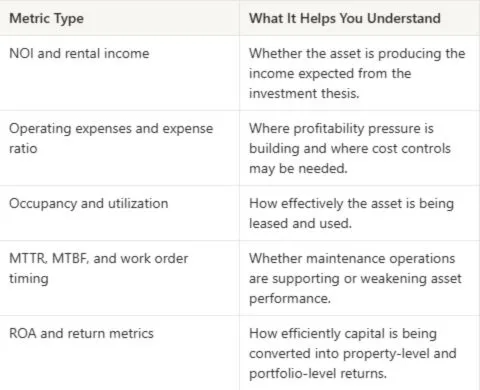
NOI is one of the most important real estate asset management metrics. It measures property income after operating expenses but before debt service and capital expenditures. If NOI is improving, the asset is generally becoming more valuable. If it is weakening, the asset manager needs to identify why.
Operating Expenses
Operating expenses include the costs required to run and maintain the property, such as payroll, repairs, utilities, insurance, taxes, and vendor contracts. Tracking them closely helps asset managers spot overspending, improve efficiency, and protect margins.
Occupancy Rate
Occupancy shows the percentage of leased or occupied space or units. It is a core indicator of revenue stability, leasing health, and market competitiveness. Falling occupancy usually affects more than just rent collections. It can signal pricing issues, tenant dissatisfaction, or market softness.
Rental Income
Rental income tracks the money the property generates from tenants over time. Reviewing it monthly and annually helps show whether rent growth is actually materializing and whether revenue is keeping pace with the business plan.
Expense Ratio
The expense ratio compares operating expenses to revenue. It helps determine whether costs are consuming too much of the asset’s income. A rising expense ratio can be an early warning sign even before NOI shows major deterioration.
Return on Assets
ROA measures profitability relative to total assets. It is useful at the portfolio level because it shows how efficiently ownership is using capital to generate returns.
Cap Rate and Yield Metrics
Capitalization rate, yield on cost, and similar return metrics help investors understand valuation and return relative to income. These are especially important when evaluating acquisitions, dispositions, recapitalizations, or business plan progress.
Core Operational Asset Management Metrics
Not every important metric is purely financial. Strong asset management also depends on operational signals that affect future performance.
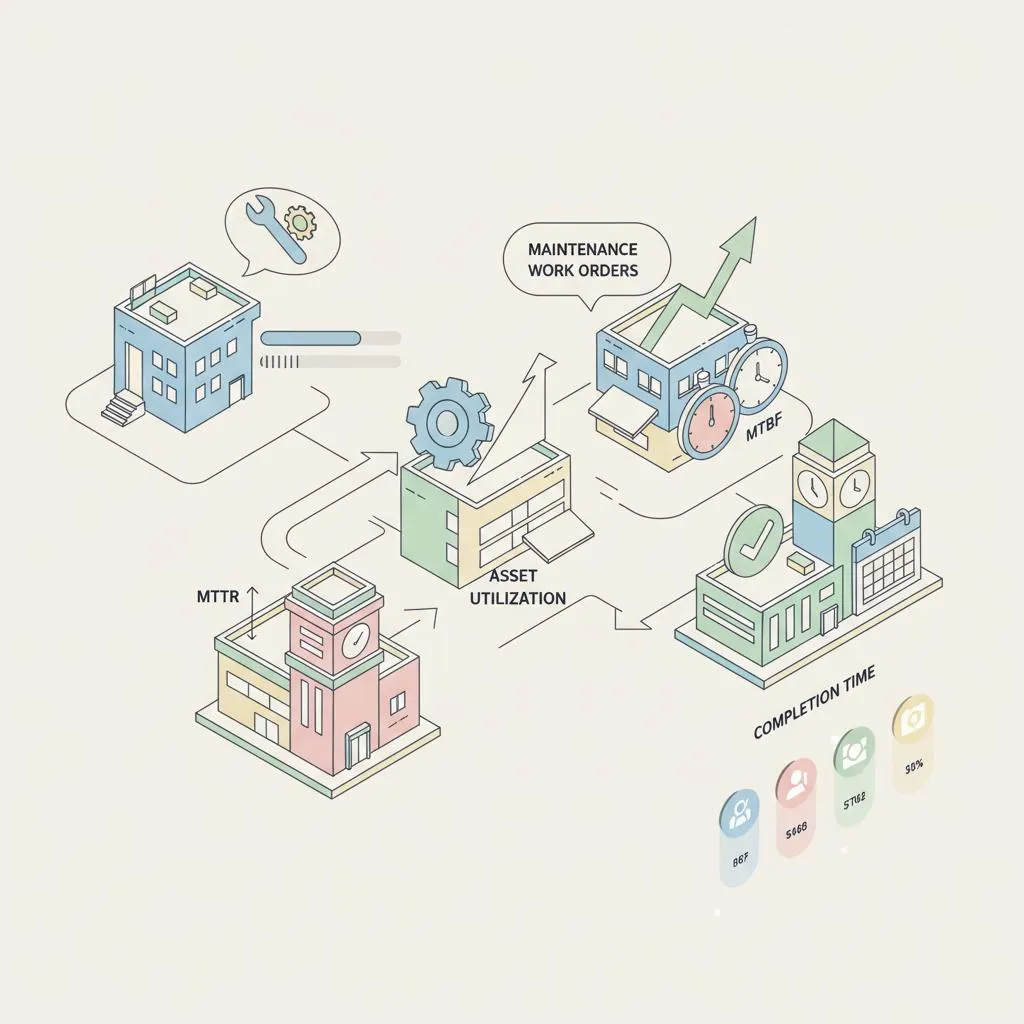
Asset Utilization Rate
Asset utilization rate measures how much of an asset’s available capacity is actually being used. In real estate terms, this can relate to rentable space usage, amenity activation, parking utilization, or broader physical asset productivity. Higher utilization usually means better capital efficiency.
Mean Time to Repair
MTTR estimates how long it takes to restore an asset or system after a failure. Lower MTTR generally indicates stronger maintenance responsiveness and less operational disruption. This is especially useful in assets where downtime affects tenant satisfaction, costs, or revenue continuity.
Mean Time Between Failures
MTBF measures the average time between asset failures. A higher MTBF typically suggests stronger reliability and better preventive maintenance. In practice, this can help asset managers understand whether recurring equipment issues are creating hidden risk.
Work Order Completion Time
This metric shows how efficiently maintenance teams complete service requests. Shorter completion times usually improve resident experience and reduce operational friction. They can also help prevent small issues from turning into larger capital problems.
Resource Performance
Resource performance evaluates whether internal teams, vendors, or maintenance resources are meeting expected standards. This is important because underperforming vendors or teams can quietly erode asset value through delays, cost overruns, or poor service quality.
Why These Metrics Matter
The strongest asset management programs do not treat KPIs as a reporting exercise. They use them to improve decisions.
How Asset Managers Use These Metrics in Practice
The value of these KPIs is not in the dashboard itself. It is in what they help you do next.
Spot underperformance early: A drop in occupancy paired with rising concessions can signal leasing weakness before annual results deteriorate.
Control costs faster: Rising repair costs and falling MTBF may indicate that equipment replacement is more rational than repeated repairs.
Improve capital allocation: Tracking return metrics helps determine which assets deserve more capital and which do not.
Support better forecasting: Reliable operational and financial KPIs improve budget planning and scenario analysis.
Strengthen investor reporting: Clear KPI tracking helps explain performance changes to lenders, partners, and investment committees.
Beyond Basic Tracking: Optimization Strategies
Interesting insight: the best asset management teams do not just monitor metrics. They connect them.
For example, real-time asset tracking and KPI monitoring can improve decision-making because they show how operational problems affect financial performance. Predictive maintenance can reduce unnecessary repair costs, increase asset life, and support better tenant experience. Better resource performance data can help managers renegotiate vendor contracts or reallocate maintenance efforts before costs escalate.
That is where KPI monitoring becomes more than reporting. It becomes a real optimization tool.

What Good KPI Monitoring Should Help You Answer
Which assets are producing the strongest income relative to plan?
Where are operating costs rising too quickly?
Are maintenance teams resolving issues fast enough to protect resident satisfaction?
Which systems or assets are failing too often?
Is capital being allocated to the right properties and the right priorities?
Are operational improvements actually translating into higher returns?
Where Technology Fits In
Technology matters because most portfolios already have the raw data. What they often lack is a clean way to connect performance monitoring, maintenance tracking, reporting, and financial analysis.
That is why many teams use software to consolidate data streams, automate recurring analysis, and surface exceptions faster. Platforms that combine asset tracking, KPI monitoring, and financial performance analysis can make it easier to reduce manual work and improve decision quality.
For real estate teams that want more than static dashboards, platforms like Leni can support reporting, analytical workflows, and portfolio insight generation in a more automated way.
Frequently Asked Questions

What are asset management metrics in real estate?
Asset management metrics are the key performance indicators used to track a property’s financial results, operating efficiency, utilization, and long-term value. They help managers evaluate whether an asset is meeting its investment objectives.
Why are MTTR and MTBF important in real estate asset management?
They measure maintenance efficiency and asset reliability. Lower MTTR and higher MTBF generally indicate that assets are being maintained effectively, with less downtime and lower operational disruption.
How does asset utilization rate affect real estate performance?
A higher utilization rate usually means resources or physical space are being used more effectively. That can improve income potential and reduce wasted investment in underused assets.
What financial KPIs should real estate investors monitor?
The most common ones include NOI, operating expenses, occupancy, rental income, expense ratio, ROA, cap rate, and other return-based metrics tied to the investment strategy.
How can predictive maintenance improve asset management?
Predictive maintenance helps prevent failures before they happen. That can lower repair costs, reduce downtime, extend asset life, and protect tenant experience and property value.
Final Takeaway
Key asset management metrics in real estate are not just numbers to report upward. They are the signals that tell you whether a property is actually performing, where pressure is building, and what needs attention before performance slips. The best teams do not just track NOI, occupancy, expenses, and operational KPIs. They build a repeatable way to read them together. That is where tools like Leni can be useful, helping teams turn scattered reporting into clearer analysis without replacing the judgment behind the decisions.


AI in Real Estate Community
Connect with asset managers, operators, and investors navigating AI adoption in real estate.

Latest Help Articles
Learn about how AI is changing the investment world with in-depth research and industry voices.


MEET LENI
Purpose Built Agentic Platform for Investors
Designed for people who want to do serious work using AI.
We Work with Leaders Shaping the Industry
From automating portfolio reporting to market research, learn how leaders are integrating AI in their businesses.
