What does prime real estate mean?
777.webp&w=1920&q=75)
Learn what prime real estate means, which traits define it, and why prime locations tend to matter so much to investors, asset managers, owners, and developers.
In real estate, the word prime is used constantly, but it means more than “high-end” or “expensive.”
A property is usually considered prime real estate when it sits in one of the strongest locations in its market and benefits from durable demand, limited supply, strong tenant or buyer interest, and long-term pricing power. In practice, prime real estate is not just about image. It is about how consistently a property can attract demand, hold value, and outperform weaker locations over time.
If you want the simplest definition, it is this: prime real estate is property in a top-tier location with exceptional desirability and lasting market strength.
What Prime Real Estate Means in Practice
Prime status is usually driven first by location quality, then reinforced by factors such as access, tenant appeal, surrounding amenities, market depth, and supply constraints.
That is why prime real estate is often found in city centers, leading residential neighborhoods, major commercial corridors, and locations with strong connectivity to jobs, retail, healthcare, schools, and transportation.
This trend stands out: prime real estate is not judged the same way across every asset type. A prime multifamily property, prime office tower, and prime retail center may all be “prime,” but each will be evaluated through a different lens based on tenant expectations, local competition, and market fundamentals.
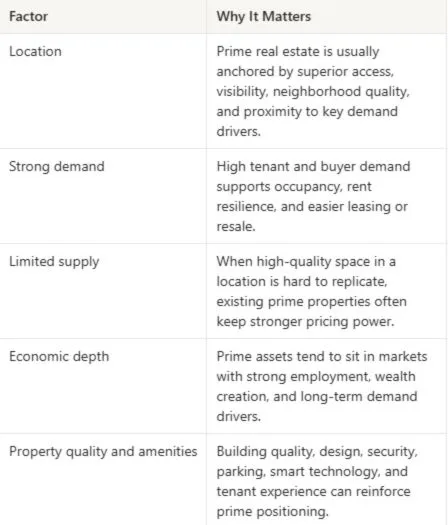

Key Characteristics of Prime Real Estate
Top-tier location: Prime properties are usually in the most established or most strategically valuable parts of a market.
Durable tenant appeal: They continue attracting users even when market conditions soften.
Pricing power: Owners often have stronger ability to command premium rents or sale pricing.
Better liquidity: Prime assets are generally easier to sell because buyer demand is deeper.
Resilience: They often hold occupancy and value better than secondary or weaker locations during downturns.
Why Prime Real Estate Is Often Viewed as Lower Risk
Many investors view prime properties as relatively lower-risk assets. That does not mean they are risk-free. It means they often benefit from structural advantages that weaker assets do not.
Stronger tenant depth: More tenants usually want to be there.
Higher occupancy durability: Prime assets often recover faster from leasing weakness.
Better exit liquidity: More buyers are typically willing to compete for high-quality, well-located property.
More stable income potential: Rent levels and value may hold up better during weaker economic periods.
Interesting insight: prime real estate usually earns its reputation not because it always grows fastest, but because it can combine growth, resilience, and liquidity better than most alternatives.
Prime Real Estate vs Secondary Real Estate
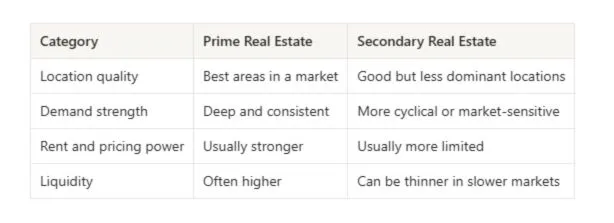
Why Asset Managers and Investors Care About Prime Properties
For asset managers, prime properties can play an important role in portfolio construction because they often combine income stability, tenant quality, and stronger long-term defensiveness.
For investors, prime real estate is attractive for several reasons:
Stronger capital preservation: Prime locations often retain value better over long holding periods.
Stable income potential: High tenant demand can support more reliable rent collections and occupancy.
Better resale prospects: Prime assets are usually easier to market when it is time to sell.
Portfolio quality improvement: Prime holdings can raise the overall resilience and perceived quality of a portfolio.
That said, prime properties also come with tradeoffs. Entry pricing is usually higher, yields may be tighter, and competition for deals is often intense.

Examples of Prime Real Estate
A luxury apartment tower in the strongest live-work district of a major city
A grocery-anchored retail center in a wealthy, supply-constrained neighborhood
A modern office building in the leading business corridor of a top metro
A residential property in a highly desirable school district with strong long-term demand
In each case, the common theme is not just property quality. It is location strength plus durable demand.
Frequently Asked Questions
Does prime real estate always mean luxury real estate?
No. A prime property is not always luxury, although luxury assets are often prime. Prime refers more to market position, location quality, and demand strength than to price alone.
Is prime real estate the same in every market?
No. Prime is relative to the market, submarket, and asset type. What qualifies as prime in one city or property category may not qualify in another.
Why do prime properties usually command higher rents?
Because they typically offer stronger access, higher demand, better surrounding amenities, and more competitive positioning than non-prime alternatives.
Are prime properties safer investments?
They are often viewed as relatively lower-risk, but not risk-free. They may offer stronger resilience, but pricing, leverage, market timing, and asset execution still matter.
Can a property become prime over time?
Yes. A location can strengthen because of infrastructure, demographic change, employer growth, retail evolution, or broader neighborhood improvement. But prime status usually takes time and durable market support.

Final Takeaway
Prime real estate is not just about prestige or a well-known address. It describes property in a location where demand tends to hold, pricing power tends to be stronger, and long-term relevance is easier to sustain than in the broader market.
That is why the term matters to owners, investors, and asset managers. Prime status usually says something important about resilience, liquidity, and the ability to protect value over time. And as markets become more data-heavy, tools like Leni can help teams evaluate those signals more clearly, without changing the basic truth that prime real estate is still defined by durable demand in the right place.
Put simply, prime real estate is where location quality and lasting market strength come together.


AI in Real Estate Community
Connect with asset managers, operators, and investors navigating AI adoption in real estate.

Latest Help Articles
Learn about how AI is changing the investment world with in-depth research and industry voices.


MEET LENI
Purpose Built Agentic Platform for Investors
Designed for people who want to do serious work using AI.
We Work with Leaders Shaping the Industry
From automating portfolio reporting to market research, learn how leaders are integrating AI in their businesses.
