What is multifamily asset management software for real estate?
.webp)
Learn what multifamily asset management software is, how it works, and why owners, operators, and investors use it to track performance, streamline oversight, and improve portfolio returns.
Most real estate software is good at recording activity. Far less of it is good at helping you understand what that activity means for performance.
That is the role of multifamily asset management software. It helps owners, asset managers, and investment teams oversee apartment properties at a higher level by connecting operational data, financial reporting, portfolio analytics, and strategic workflows.
In simple terms, multifamily asset management software is a real estate software category designed to help users manage and improve the performance of multifamily properties throughout the investment lifecycle. It connects relevant data sources, automates repetitive tasks, and generates insights that support better decisions on revenue, expenses, maintenance, compliance, and long-term asset value.
If property management software helps run the building, asset management software helps make sure the building is performing like the investment it is supposed to be.
What Multifamily Asset Management Software Does
At a practical level, this software gives teams a clearer view of what is happening across one property or an entire multifamily portfolio.

Tracks asset performance: monitors occupancy, rent growth, collections, expenses, NOI, and cash flow.
Consolidates data: brings together information from property management, finance, maintenance, and reporting systems.
Supports strategic planning: helps evaluate leasing performance, renovation impact, budget variance, and business plan progress.
Improves reporting: makes investor, lender, and internal reporting faster and more consistent.
Highlights operational issues: surfaces underperformance, cost pressure, compliance risk, and asset-level exceptions earlier.
Guides portfolio decisions: supports hold-sell analysis, capital allocation, refinancing preparation, and value-add strategy review.
Key Features of Multifamily Asset Management Software
1. Performance Monitoring
Performance monitoring is usually the foundation. Good software helps teams track the metrics that most directly affect asset value.
Occupancy rates: helps monitor move-ins, move-outs, vacancy exposure, and leasing momentum.
Rental income: shows monthly and annual revenue trends and helps identify rent growth opportunities.
Operating expenses: tracks controllable and fixed costs so teams can manage profitability more tightly.
Net operating income: pulls revenue and expense performance together into the metric most owners care about.
These KPIs matter because they let asset managers see beyond one property and understand portfolio performance at a broader level.
.webp)
2. Data Consolidation
Multifamily portfolios often run on fragmented systems. Asset management software helps unify that information into a more usable layer.
Property management systems: leases, tenants, rent rolls, and operating activity
Financial systems: budgets, statements, general ledger outputs, and forecast data
Maintenance records: service history, work orders, scheduled repairs, and vendor activity
Reporting sources: owner updates, lender materials, board reporting, and portfolio summaries
Data consolidation removes unnecessary barriers between systems. That improves communication, reduces reporting discrepancies, and makes it easier for decision-makers to work from the same information.
3. Maintenance and Repairs Oversight
While day-to-day maintenance is usually handled in a property management system, asset management software helps leadership evaluate maintenance performance from a portfolio perspective.
Scheduling visibility: tracks recurring maintenance schedules and major repair timing.
Budget tracking: monitors repair spending against plan.
Asset preservation: helps reduce long-term wear and deferred maintenance risk.
This matters because good maintenance management does more than reduce tenant complaints. It can also protect rentability, retention, and long-term property value.
4. Reporting and Financial Analysis
This is where many teams see the biggest benefit. Instead of manually building recurring reports, users can standardize performance analysis and distribute it faster.
Cash flow analysis: reviews where income is strong, where costs are rising, and where ROI can improve.
Budgeting and forecasting: helps teams plan future spending and evaluate expected performance.
Stakeholder reporting: creates clear summaries for investors, ownership groups, and leadership.
These tools reduce manual work, improve transparency, and help teams make faster and more informed decisions.

5. Compliance Tracking
Compliance is easy to underestimate until a missed deadline becomes expensive. Many platforms support compliance oversight through:
Inspection and certification tracking
Automated deadline reminders
Centralized file and documentation storage
This trend stands out because compliance risk is not just administrative. It can affect legal exposure, tenant safety, financing, and reputation.
6. Portfolio and Fund Strategy Support
At the highest level, multifamily asset management software should help users think across the portfolio, not just inside a single property.
Income source analysis: shows where revenue is strong or vulnerable.
Cost structure review: identifies expense categories that may need action.
Market context: supports decisions using external trends and competitive signals.
Capital prioritization: helps determine where investment dollars can create the most value.
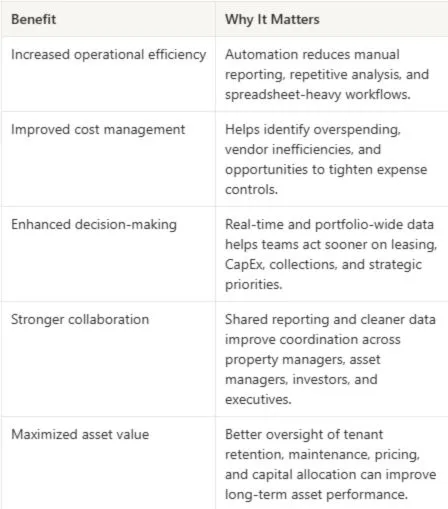
Why Multifamily Asset Management Software Matters
The main value is not just visibility. It is better decision quality.
Multifamily Asset Management Software vs Property Management Software
These categories overlap, but they are built for different jobs.
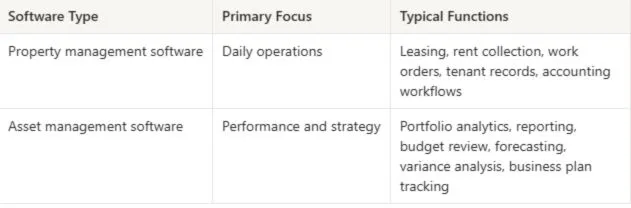
A useful shorthand is this: property management software tells you what happened at the building. Asset management software helps explain what it means for the investment.
Who Uses It
Multifamily asset management software is commonly used by:
owner-operators managing multiple apartment properties
real estate asset managers and portfolio managers
private equity real estate firms
family offices with multifamily holdings
institutional investors and operating partners
executives who need portfolio-wide reporting and strategic visibility
What Good Software Should Help You Answer
Which properties are outperforming or underperforming budget?
Are occupancy gains translating into stronger NOI?
Which expenses are expanding too quickly?
Is a renovation plan producing the expected rent lift?
Where are the biggest compliance or maintenance risks?
Which assets need immediate strategic attention?
Interesting insight: the most valuable software usually does not just give you more charts. It reduces the amount of interpretation work your team has to do after the chart is already on the screen.
Where AI Fits In
Newer platforms increasingly add AI-driven features on top of traditional dashboards and integrations. That can include:
automated recurring reporting
document extraction from rent rolls, leases, and operating statements
variance summaries and anomaly flagging
source-linked outputs for verification
workflow automation across reporting and analysis tasks
For teams evaluating software seriously, this matters because there is a real difference between tools that store data, tools that visualize data, and tools that actually help perform analytical work. Platforms like Leni are part of that third category, helping real estate teams turn documents and portfolio data into underwriting, research, memos, and reporting outputs faster.
Frequently Asked Questions
Is multifamily asset management software only for large portfolios?
No. Larger portfolios usually see the biggest efficiency gains, but smaller owners can still benefit from better reporting, forecasting, and performance visibility.
Does it replace property management software?
Usually no. It often sits on top of existing systems and helps teams interpret and report on the data those systems generate.
What metrics should it track?
At a minimum, it should help users monitor occupancy, rental income, operating expenses, NOI, lease expirations, collections, budget variance, and major capital projects.
Why is data consolidation important?
Because fragmented systems slow down reporting and create conflicting versions of the truth. Consolidation improves speed, accuracy, and collaboration.
Can it help maximize ROI?
Yes. By helping teams manage revenue, control expenses, monitor maintenance, improve reporting, and prioritize portfolio decisions, it can support stronger returns over time.
Final Takeaway
Multifamily asset management software matters because it helps teams move from scattered property data to clearer, more consistent decisions across the portfolio. The real value is not in adding more systems, but in making operating, financial, and reporting information easier to use. That is also where platforms like Leni fit naturally: not as noise on top of the stack, but as a way to help teams turn information into action with more speed and clarity.

AI in Real Estate Community
Connect with asset managers, operators, and investors navigating AI adoption in real estate.

Latest Help Articles
Learn about how AI is changing the investment world with in-depth research and industry voices.


MEET LENI
Purpose Built Agentic Platform for Investors
Designed for people who want to do serious work using AI.
We Work with Leaders Shaping the Industry
From automating portfolio reporting to market research, learn how leaders are integrating AI in their businesses.
