AI for Deal Sourcing in CRE: A 2026 Playbook
.webp&w=1920&q=75)
AI for Deal Sourcing in CRE: A 2026 Playbook
The commercial real estate industry operates on information asymmetry. The teams that identify opportunities first, analyze them fastest, and execute with confidence consistently outperform those still relying on manual spreadsheets and broker relationships alone. In 2026, artificial intelligence has fundamentally changed where superior deals come from and how acquisitions teams uncover them before properties hit marketed listings. AI for deal sourcing represents more than automation; it creates proprietary insights from public data, portfolio performance patterns, and document analysis that human analysts simply cannot process at scale.
Where AI Creates Advantage Before Properties Go to Market
Traditional deal sourcing relies heavily on broker relationships, CoStar alerts, and industry networking. These channels remain valuable, but they're also saturated. Every competing firm receives the same marketed listings, reviews identical offering memorandums, and bids against the same capital chasing the same opportunities.
The competitive edge in 2026 comes from proprietary market intelligence that identifies targets before they're formally marketed. AI for deal sourcing excels at parsing massive datasets to surface opportunities invisible to traditional methods.
Market Research That Identifies Supply-Demand Imbalances
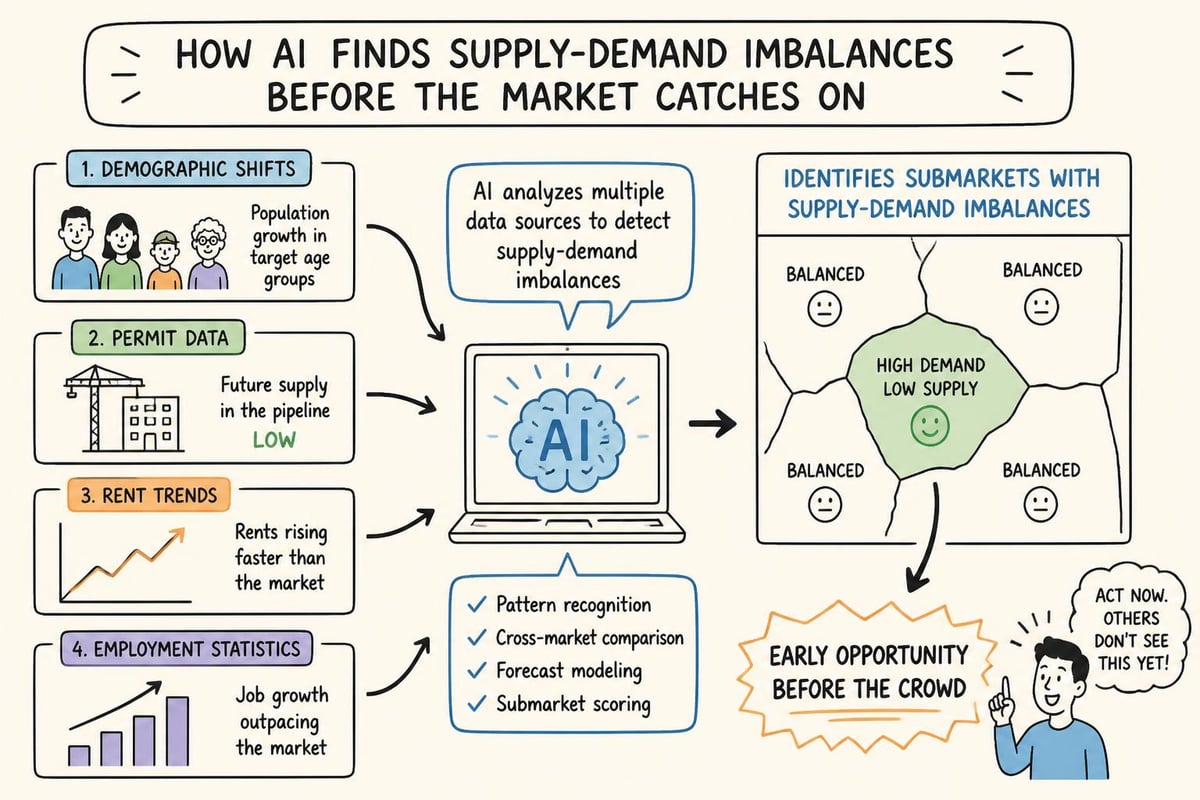
Advanced platforms now analyze permit data, demographic migration patterns, employment growth statistics, and rent trend trajectories across hundreds of submarkets simultaneously. While a human analyst might compare three to five markets in a week, AI systems process thousands of data points across entire metropolitan areas in minutes.
Consider multifamily acquisitions in secondary markets. An AI-powered market research platform can identify submarkets where:
Population growth exceeds the three-year average by 15% or more
New construction permits lag population increases
Median household income growth outpaces regional averages
Rental vacancy rates trend below 4% despite seasonal fluctuations
These signals, when combined, point to submarkets with strong fundamentals and supply constraints. Properties in these areas represent acquisition opportunities before broader market recognition drives up pricing. Academic research on AI's transformative impact on investment strategies confirms that funds developing proprietary AI capabilities for deal identification maintain significant competitive advantages.
Document Intelligence for Accelerated Diligence
Once a target property enters your pipeline, speed determines whether you win the deal. AI for deal sourcing extends beyond identification into rapid document analysis that compresses diligence timelines from weeks to days.
Upload an offering memorandum, and purpose-built AI platforms extract:
Operating expense breakdowns with year-over-year variance analysis
Lease roll schedules with renewal probability assessments
Capital expenditure histories and deferred maintenance flags
Rent comparisons against submarket averages with source citations
This isn't generic document summarization. Specialized AI real estate software understands commercial real estate terminology, financial statement structures, and the relationships between rent rolls, T-12 statements, and market position.
The Sourcing Workflow: Where AI Fits at Each Stage
Effective deal sourcing follows a systematic progression from broad market scanning to focused property evaluation. AI for deal sourcing integrates at multiple critical decision points throughout this workflow, amplifying analyst productivity at each stage.
Stage 1: Market Identification and Thesis Development
Objective: Determine which geographic markets and property types align with fund strategy and offer compelling risk-adjusted returns.
AI Applications:
Macroeconomic trend analysis across 50+ metropolitan statistical areas
Submarket segmentation identifying pockets of outperformance within broader markets
Correlation analysis between job growth, migration patterns, and rental demand
Competitive supply pipeline tracking from permit data and construction activity
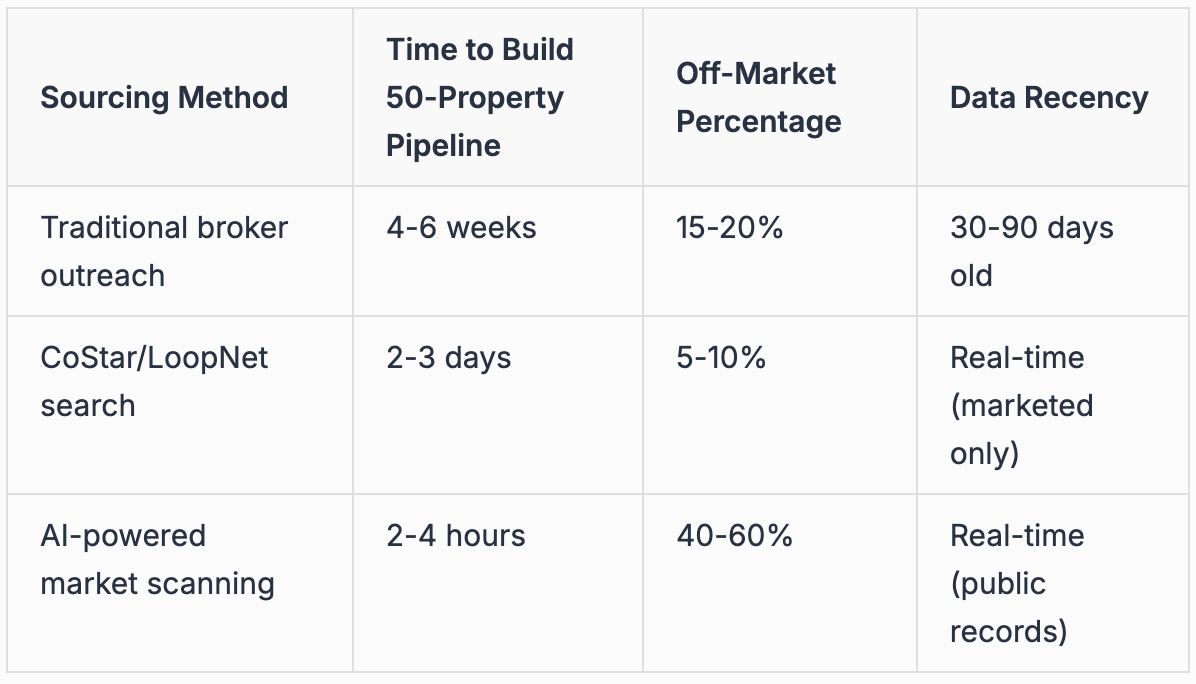
Traditional approach: Analyst reviews market reports from CBRE, JLL, and Cushman & Wakefield over two weeks, creates comparison spreadsheet.
AI-enhanced approach: Platform analyzes comprehensive datasets in under an hour, generates source-linked market research with direct citations, highlights outlier submarkets with statistical justification.
Stage 2: Target Property Identification
Objective: Build a pipeline of specific properties matching investment criteria within priority markets.
AI Applications:
Off-market opportunity detection through ownership change probability models
Distressed asset identification analyzing tax delinquency, code violations, and performance metrics
Portfolio optimization analysis for owners with multiple properties where divestment likely
Comparable property analysis establishing valuation benchmarks before engaging sellers
Platforms like Grata's AI engine demonstrate how machine learning interprets signals across disparate data sources to understand property performance and ownership patterns, identifying targets that haven't formally entered the market.
Stage 3: Preliminary Underwriting and Risk Assessment
Objective: Rapidly evaluate whether target properties warrant deeper due diligence investment.
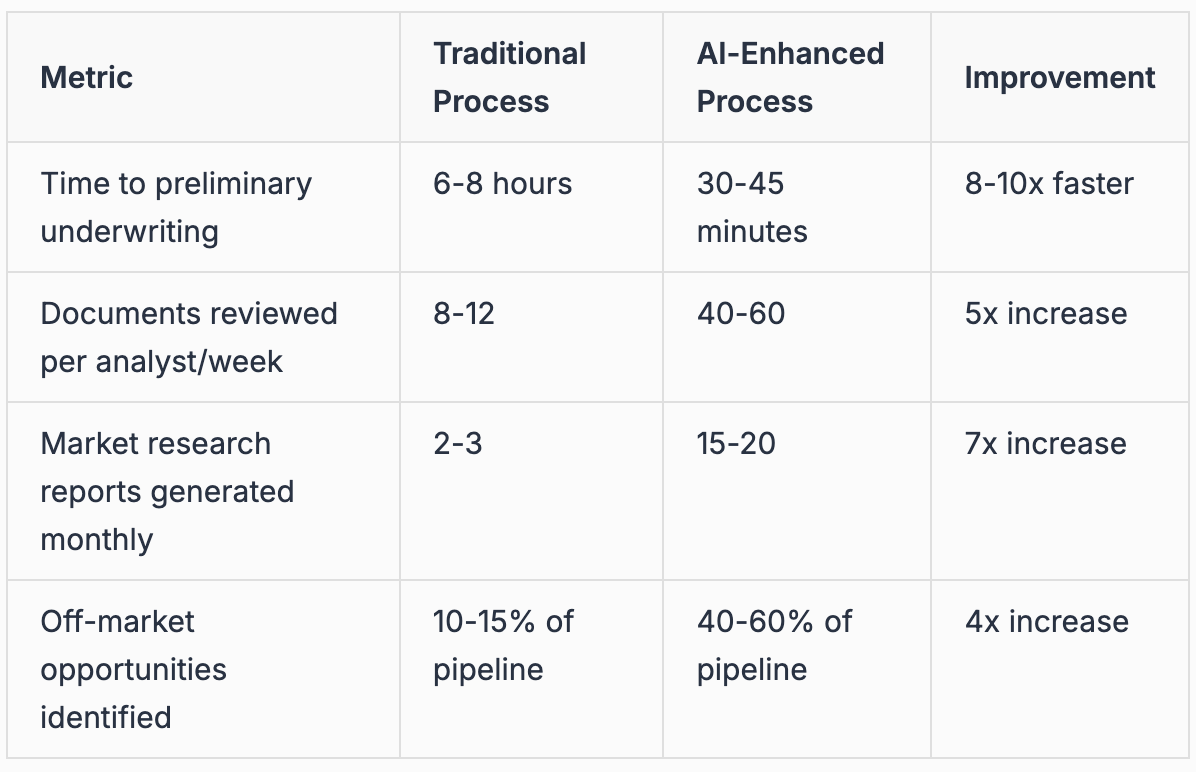
This stage separates competitive teams from overwhelmed ones. You've identified 50 potential opportunities. Manual underwriting requires 6-8 hours per property. That's 300-400 hours of analyst time before you've even made first contact with sellers.
AI transforms this bottleneck completely.
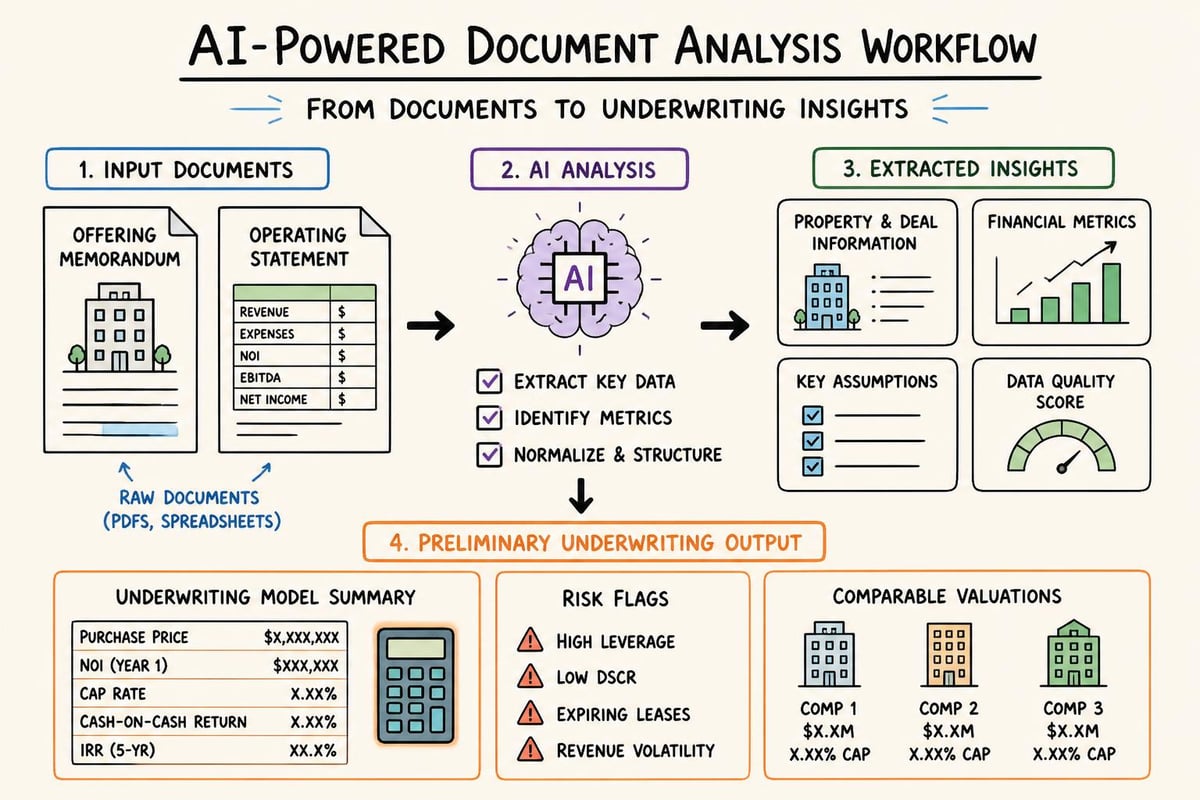
Upload an offering memorandum or property operating statement. Financial modeling and underwriting platforms built for commercial real estate automatically:
Generate pro forma operating models with market rent assumptions
Calculate key metrics: cap rate, cash-on-cash return, IRR across multiple hold periods
Identify expense ratios outside normal ranges for property type and market
Flag lease concentration risks and upcoming rollover exposure
Compare asking price against comparable sales with valuation ranges
For teams without full property management system integration, this represents immediate value. The moment a document lands, you have analytical firepower that previously required senior analyst involvement.
Stage 4: Deep Diligence and Investment Committee Preparation
Objective: Validate assumptions, stress-test scenarios, and build investment committee materials for shortlisted opportunities.
Once a property advances past preliminary screening, diligence intensity increases exponentially. Teams examine rent rolls, lease agreements, inspection reports, environmental assessments, title documents, and market studies-often hundreds of pages per property.
Document extraction capabilities accelerate this phase substantially. AI platforms extract structured data from unstructured documents:
Individual lease terms, renewal options, and tenant improvement allowances from 50+ lease agreements
Operating expense detail from utility bills, service contracts, and vendor invoices
Market rent comparables from broker reports and competing property listings
Inspection findings categorized by severity and capital requirement
Beyond extraction, advanced systems like commercial real estate deal analyzers synthesize information across documents to identify inconsistencies. When the rent roll shows different square footage than lease agreements, or when reported expenses don't reconcile with vendor contracts, AI flags these discrepancies for human review.
Integrating Portfolio Data to Inform Acquisition Strategy
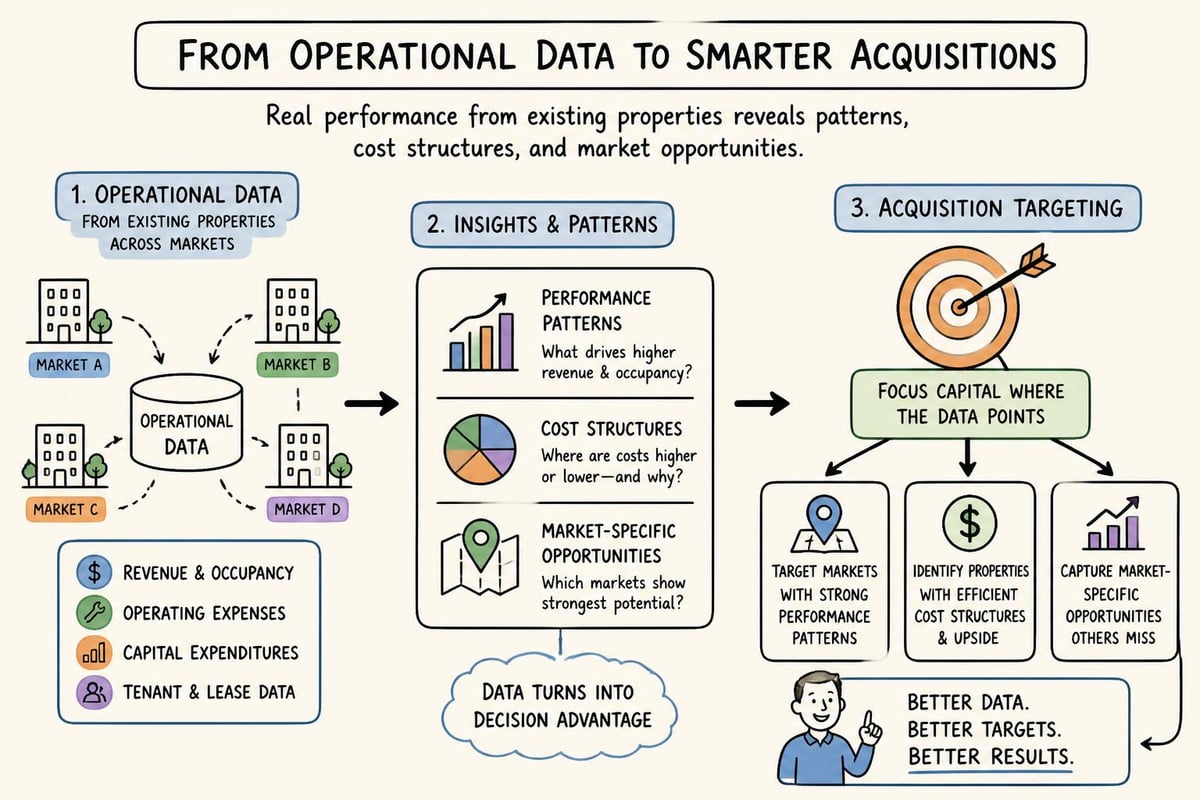
For asset managers operating existing portfolios, the most sophisticated application of AI for deal sourcing involves connecting current portfolio performance to acquisition targeting. This feedback loop creates proprietary insights competitors cannot replicate.
Performance Gap Analysis as Sourcing Signal
Teams with property management system connectivity gain strategic advantages. When your AI platform connects directly to Yardi, RealPage, or Entrata through AI PMS integration, it analyzes operational performance across your entire portfolio to identify patterns.
Example acquisition signals from portfolio analysis:
Properties in markets where your Class B multifamily assets consistently achieve 96%+ occupancy despite 5% market vacancy rates (signal: acquire more inventory in supply-constrained submarkets)
Office properties where your buildings command $3-5/SF rent premiums over comparable properties due to specific amenities (signal: target acquisitions with value-add potential to add those amenities)
Retail centers where inline tenant performance significantly outperforms anchor tenants (signal: acquire properties where you can reposition underperforming anchor space)
This approach transforms your existing portfolio into a proprietary research database. Every lease renewal, every turnover, every maintenance request becomes data that informs where and what to acquire next.
Benchmarking Against Acquisition Targets
When evaluating a new acquisition opportunity, comparing its projected performance against your portfolio's actual operating history provides validation traditional underwriting cannot match.
Your models project 3.5% annual rent growth for a target property in Phoenix. Your existing Phoenix portfolio-with similar unit mixes and tenant demographics-achieved 4.1% growth over the past three years. That discrepancy suggests either conservative underwriting or unrecognized upside potential.
Conversely, if your models assume 8% expense growth when your comparable properties experienced 12% increases due to insurance and utility cost pressures, you're underestimating the challenge.
AI for Deal Sourcing Without Full System Integration
Not every team operates at enterprise scale with comprehensive property management system integration. Independent sponsors, emerging managers, and acquisitions teams at smaller firms still gain substantial advantages from AI for deal sourcing.
Document-First Workflow for Lean Teams
The barrier to entry has collapsed. You don't need custom integrations or six-figure software contracts to deploy AI effectively. Purpose-built platforms deliver immediate value through document-centric workflows.
Practical implementation for teams without PMS connectivity:
Receive offering memorandum from broker or identify off-market opportunity
Upload document to AI platform (OM, rent roll, T-12 statement, market report)
Review extracted data and preliminary underwriting (generated in minutes, not hours)
Request source-linked market study for property submarket with demographic, employment, and supply data
Identify risk flags and diligence priorities before committing significant resources
Generate IC memo outline with key investment highlights and concerns
This workflow means analysts spend time on judgment and negotiation rather than data entry and basic financial modeling. A two-person acquisitions team can evaluate the same deal volume as a five-person team using traditional methods.
Market Research Without Proprietary Databases
Commercial real estate market research typically requires expensive subscriptions to CoStar, Real Capital Analytics, and local brokerage reports. While these sources remain valuable, AI platforms now aggregate publicly available data sources into comprehensive market studies.
Census Bureau demographic data, Bureau of Labor Statistics employment figures, local planning commission permit records, and property tax assessor databases-all public information-combine to create robust market analysis when processed through AI systems designed for AI multifamily portfolio analytics.
The differentiator: source linking. Generic AI might summarize market conditions. Purpose-built CRE platforms cite every claim with direct links to source documents, enabling you to verify data and dive deeper into specific statistics.
Evaluating AI Deal Sourcing Platforms: Critical Capabilities
The market for AI-powered deal sourcing tools has expanded rapidly. Platforms like Cyndx and specialized systems like Inven demonstrate varying approaches to applying artificial intelligence to investment opportunity identification.
When evaluating AI for deal sourcing capabilities, prioritize these requirements:
Real Estate Specialization vs. General AI
General-purpose AI tools like ChatGPT lack the specialized knowledge required for commercial real estate analysis. They don't understand how to read rent rolls, can't calculate debt service coverage ratios correctly, and make fundamental errors in property valuation.
Purpose-built platforms understand commercial real estate terminology, financial structures, and analytical frameworks. When evaluating ChatGPT for real estate versus specialized solutions, the difference becomes immediately apparent in output quality and reliability.
Verification and Source Citation
AI-generated analysis means nothing if you cannot verify its accuracy. The platform must provide direct links to source documents for every claim, statistic, and calculation.
When an AI system reports that median household income in a submarket increased 8.3% over three years, you need a clickable link to the Census Bureau data table supporting that claim. This verification capability separates professional-grade tools from consumer applications.
Multi-Step Task Execution
Document upload and extraction represents basic functionality. Advanced AI for deal sourcing platforms execute complex, multi-step workflows autonomously.
Example workflow: Upload offering memorandum → Extract financial data → Build preliminary underwriting model → Research market comparables → Identify valuation outliers → Generate investment committee memo → Flag diligence priorities based on risk analysis.
Each step requires context from previous steps. The system must maintain coherent analysis across the entire workflow, not just respond to isolated prompts.
Integration Capabilities
While document-first workflows deliver immediate value, integration potential matters for scaling operations. Platforms should connect to:
Property management systems (Yardi, RealPage, Entrata) for portfolio data
Deal management systems (Dealpath, Juniper Square) for pipeline tracking
Data rooms and document repositories for due diligence materials
Financial modeling tools for detailed analysis and scenario planning
Dealpath's AI Studio demonstrates how integration with existing deal management workflows accelerates screening and decision-making by embedding AI capabilities into established processes.
Building Proprietary Advantages Through Data Accumulation
The most sophisticated application of AI for deal sourcing involves creating self-reinforcing analytical capabilities that improve with every transaction. This represents the true competitive moat that technology-forward firms are building in 2026.
The Learning Loop in Action
Every offering memorandum you upload, every market you research, every underwriting model you review creates training data. Purpose-built AI platforms designed for commercial real estate become more accurate and more valuable as they ingest more information specific to your investment strategy.
Consider how this compounds over time:
Year 1: Upload 50 offering memorandums, build 30 underwriting models, research 15 markets
Year 2: System recognizes patterns in your acquisition criteria, proactively flags similar opportunities, suggests markets with comparable characteristics to your best performers
Year 3: Platform identifies subtle correlations between property characteristics and outcomes that even experienced analysts miss, recommends counter-intuitive opportunities based on pattern recognition
This feedback loop creates proprietary analytical capabilities that competitors cannot easily replicate. Your data, combined with sophisticated AI, becomes a strategic asset.
Security and Compliance Considerations
Building these capabilities requires trusting platforms with sensitive financial data, confidential deal information, and proprietary investment strategies. SOC 2 Type 2 certification represents the industry standard for data security in financial services.
Platforms handling commercial real estate deal flow must demonstrate:
Encrypted data transmission and storage
Role-based access controls for sensitive documents
Audit trails documenting who accessed what information and when
Regular penetration testing and security assessments
Disaster recovery and business continuity capabilities
AI tools for business analysts in real estate must meet the same security standards as traditional financial software given the confidential nature of acquisition analysis.
Practical Implementation: 90-Day Roadmap
Teams ready to deploy AI for deal sourcing effectively should follow a structured implementation roadmap that delivers quick wins while building toward more sophisticated capabilities.
Days 1-30: Foundation and Quick Wins
Week 1-2: Platform Selection and Setup
Evaluate platforms based on real estate specialization, verification capabilities, and workflow automation
Complete security review and data handling protocols
Configure user access and establish document management procedures
Week 3-4: Initial Use Cases
Upload three recent offering memorandums and compare AI-generated analysis to manual work
Request market research reports for target acquisition markets
Build preliminary underwriting models for current pipeline opportunities
Success metric: Reduce time from OM receipt to preliminary underwriting from 6 hours to 45 minutes.
Days 31-60: Workflow Integration
Week 5-6: Process Standardization
Document standard operating procedures for AI-assisted deal evaluation
Create templates for IC memos and investment summaries
Establish quality control checkpoints for AI-generated outputs
Week 7-8: Team Training and Expansion
Train junior analysts on platform capabilities and limitations
Expand use cases to lease analysis and market research
Begin building library of market studies for target geographies
Success metric: Evaluate 50% more opportunities per analyst without increasing headcount.
Days 61-90: Advanced Capabilities
Week 9-10: Data Integration
Connect portfolio data sources (if applicable)
Import historical deal data for pattern analysis
Build custom workflows for recurring analysis tasks
Week 11-12: Competitive Advantage Development
Identify unique market signals and patterns from accumulated data
Develop proprietary scoring models for opportunity prioritization
Create automated alerts for target property characteristics
Success metric: Identify two off-market opportunities before they reach broker marketing based on AI-surfaced signals.
The Analyst Amplification Effect
The most common misconception about AI for deal sourcing involves replacement rather than amplification. Technology doesn't eliminate the need for experienced acquisitions professionals. It removes the constraints that limit how many opportunities they can evaluate and how deeply they can analyze each one.
A senior acquisitions director with 15 years of market knowledge makes better investment decisions than an algorithm. But that same professional, equipped with AI that handles data extraction, preliminary modeling, and market research, can apply their expertise to 10 times more opportunities.
This amplification effect reshapes competitive dynamics in commercial real estate investment. The firms winning deals in 2026 aren't necessarily those with the most capital or the longest track records-they're the ones that combine institutional knowledge with technological leverage.
Consider the practical reality: Your competitors receive the same marketed listings you do. They have access to the same brokers, the same market data, and similar capital structures. The edge comes from evaluating more opportunities faster, identifying off-market targets earlier, and executing diligence more efficiently.
Teams leveraging AI agents for real estate report 3-5x increases in deal evaluation capacity without proportional increases in headcount. That efficiency translates directly to competitive advantage in time-sensitive acquisition processes.
AI for deal sourcing fundamentally changes where superior commercial real estate opportunities come from and how quickly teams can identify and evaluate them. The competitive advantages come from market intelligence that surfaces targets before broad recognition, document analysis that compresses diligence timelines, and portfolio data integration that creates proprietary insights. Leni delivers these capabilities through an AI analyst platform purpose-built for commercial real estate, handling financial modeling, document extraction, market research, and workflow automation autonomously. Whether you're uploading your first offering memorandum or connecting comprehensive portfolio data, Leni works the moment a document lands, providing verifiable analysis with direct source links and becoming more accurate as it ingests your data.

Johanna Gruber
Johanna has spent the last 8 years helping marketing teams connect with audiences through content. Specializing in B2B SaaS and real estate.

Curious About AI?
Join the largest AI community for real estate online. Get bite-sized, real-world use case videos, plus practical tips and proven strategies from top industry experts on adopting AI effectively.
MEET LENI
AI SuperAgent Purpose Built for Investors and Operators.
Experience how professionals and teams in your domain are getting the edge using AI.
