AI for Refinancing: Shallow vs. Deep CRE Platforms

AI for Refinancing: Shallow vs. Deep CRE Platforms
The commercial real estate refinancing landscape has shifted dramatically in 2026. Asset managers who once spent weeks assembling refi packages now face a choice: adopt AI that merely assists or deploy systems that autonomously complete the entire workflow. The difference between these approaches determines whether your team gains hours or days back. Not all AI platforms handle refinancing workflows equally. Some generate summaries and answer questions. The best ones return lender-ready packages with verified data, source links, and complete financial models. Understanding this distinction separates teams that struggle with AI adoption from those that transform their refinancing operations.
What AI Tools Exist for Real Estate Refinancing
The market for ai for refinancing has expanded rapidly, but platforms fall into distinct categories based on their capabilities and architecture. Generic AI assistants provide conversational support and document summaries. Specialized platforms built for commercial real estate execute multi-step analytical tasks autonomously.
Generic AI Assistants and Chatbots
Most teams encounter AI tools designed for general business use first. These platforms answer questions, draft emails, and summarize documents. They operate through conversational interfaces where users ask questions and receive text responses.
Key characteristics include:
Question-and-answer format requiring constant user input
Manual copy-paste workflows between systems
Limited integration with property management systems
No verification of data sources or calculations
Outputs require substantial human review and formatting
These tools help with preliminary research and basic communication but cannot autonomously complete refinancing analyses. They serve as productivity enhancers for tasks already in progress rather than systems that execute entire workflows independently.
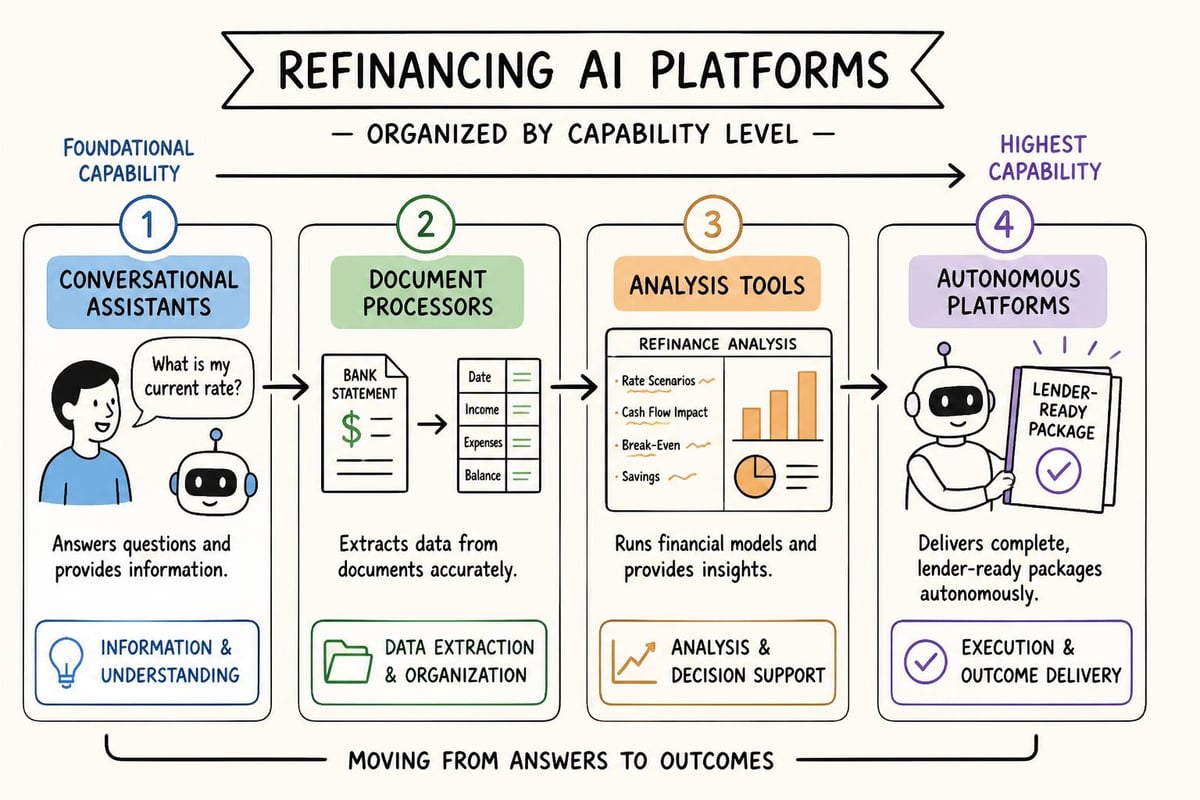
Purpose-Built Commercial Real Estate Platforms
AI platforms designed specifically for commercial real estate take a fundamentally different approach. They understand property-specific documents, connect to industry-standard systems, and execute complex analytical workflows without continuous human supervision.
These platforms distinguish themselves through several technical capabilities:
Direct integration with property management systems like Yardi, RealPage, and Entrata
Autonomous execution of multi-step tasks from data extraction through final deliverable creation
Source verification with direct links to underlying documents
Industry-specific training on lease structures, operating statements, and market data
Security certifications including SOC 2 Type 2 compliance
The emergence of AI agents for CRE financing demonstrates how specialized platforms are reshaping the industry. Unlike general-purpose tools, these systems understand the specific requirements of lender packages and regulatory frameworks governing commercial real estate transactions.
Document Extraction and Data Intelligence Systems
A critical component of ai for refinancing involves extracting structured data from unstructured documents. Loan agreements, rent rolls, operating statements, and offering memorandums contain the essential information for refinancing analysis, but this data exists in PDFs, scanned images, and inconsistent formats.
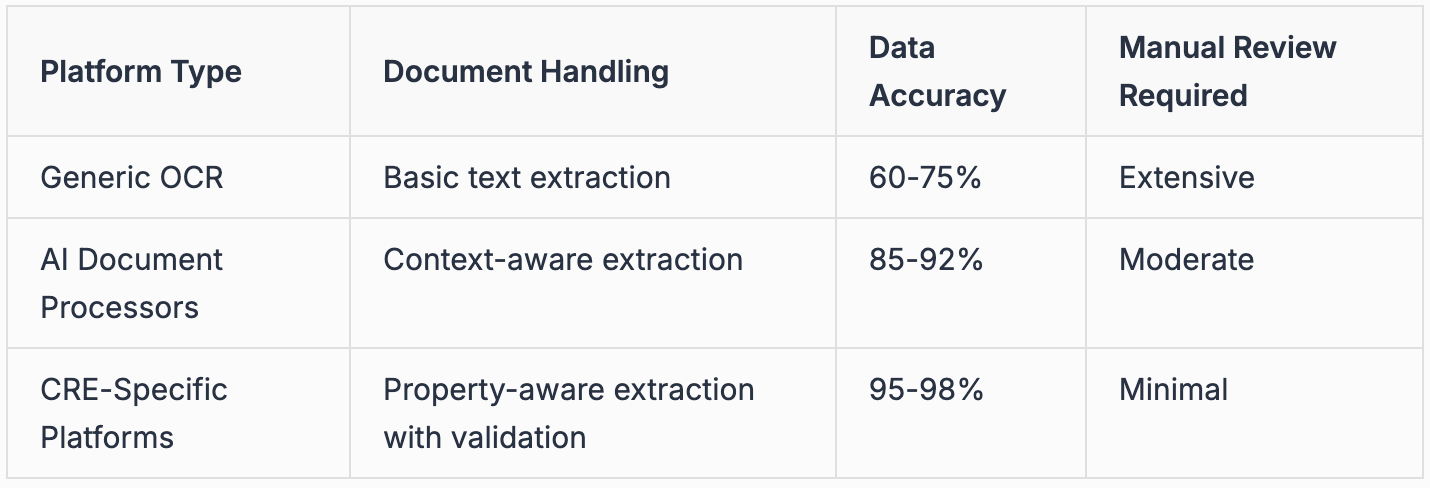
Purpose-built platforms for real estate underwriting use trained models that recognize lease clauses, understand rent escalations, and validate operating expense categories against industry standards. This specificity delivers accuracy that generic tools cannot match.
How AI Speeds Up Refinancing Analysis
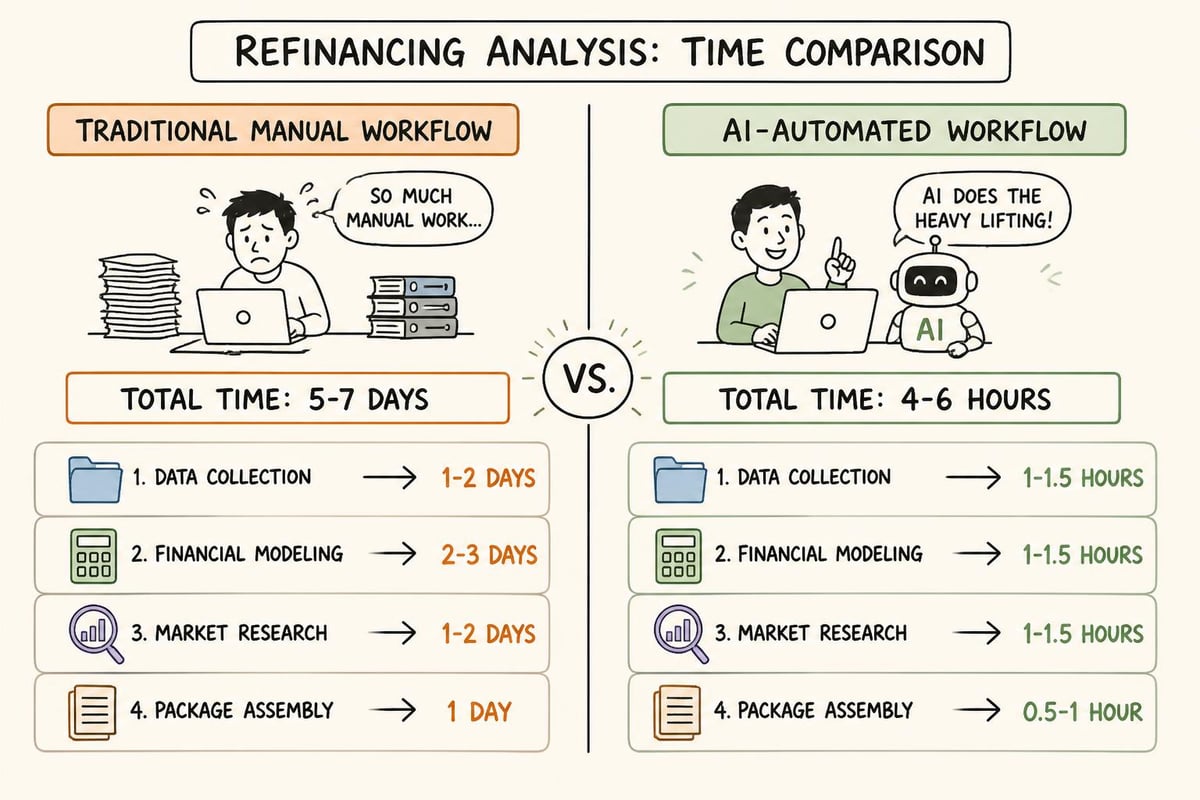
Traditional refinancing analysis consumes substantial time across multiple phases: data gathering, financial modeling, market research, and package assembly. AI for refinancing compresses these timelines by automating the analytical work that previously required days of manual effort.
Data Collection and Normalization
Asset managers typically spend 40-60% of refinancing preparation time gathering and organizing data from disparate sources. AI integration with property management systems eliminates this bottleneck by pulling data directly from operational systems.
Traditional workflow challenges:
Manual export of reports from Yardi, RealPage, or Entrata
Reconciliation of data across multiple time periods
Formatting inconsistencies between properties
Version control issues with updated documents
Missing or incomplete historical records
Purpose-built platforms connect directly to these systems, extract relevant data, normalize formats, and identify gaps automatically. What previously required two days of analyst time now completes in minutes with higher accuracy.
Financial Modeling and NOI Analysis
Refinancing decisions hinge on current and projected net operating income. Understanding how to increase NOI requires analyzing historical performance, market trends, and operational improvements. AI platforms execute these analyses by processing years of operating data, identifying patterns, and generating multiple scenarios.
The modeling process includes:
Historical performance analysis across trailing 12, 24, and 36 months
Expense benchmarking against comparable properties
Revenue optimization identification through vacancy analysis and market rent comparisons
Scenario modeling for different refinancing structures and terms
Sensitivity analysis showing impact of rate changes and market conditions
Advanced platforms complete comprehensive financial models in under an hour, compared to the 4-8 hours required for manual spreadsheet development. More importantly, they maintain source links to every data point, enabling rapid verification.
Market Research and Comparable Analysis
Lenders require market context to evaluate refinancing applications. This means current comparable sales, rental rate trends, vacancy data, and economic indicators for the specific submarket. Manual research involves checking multiple data providers, verifying transaction details, and assembling supporting documentation.
AI-powered market research capabilities transform this process by simultaneously querying multiple data sources, validating information across providers, and returning results with direct links to source documents. The system identifies truly comparable properties based on location, asset class, vintage, and quality rather than relying on simple geographic proximity.
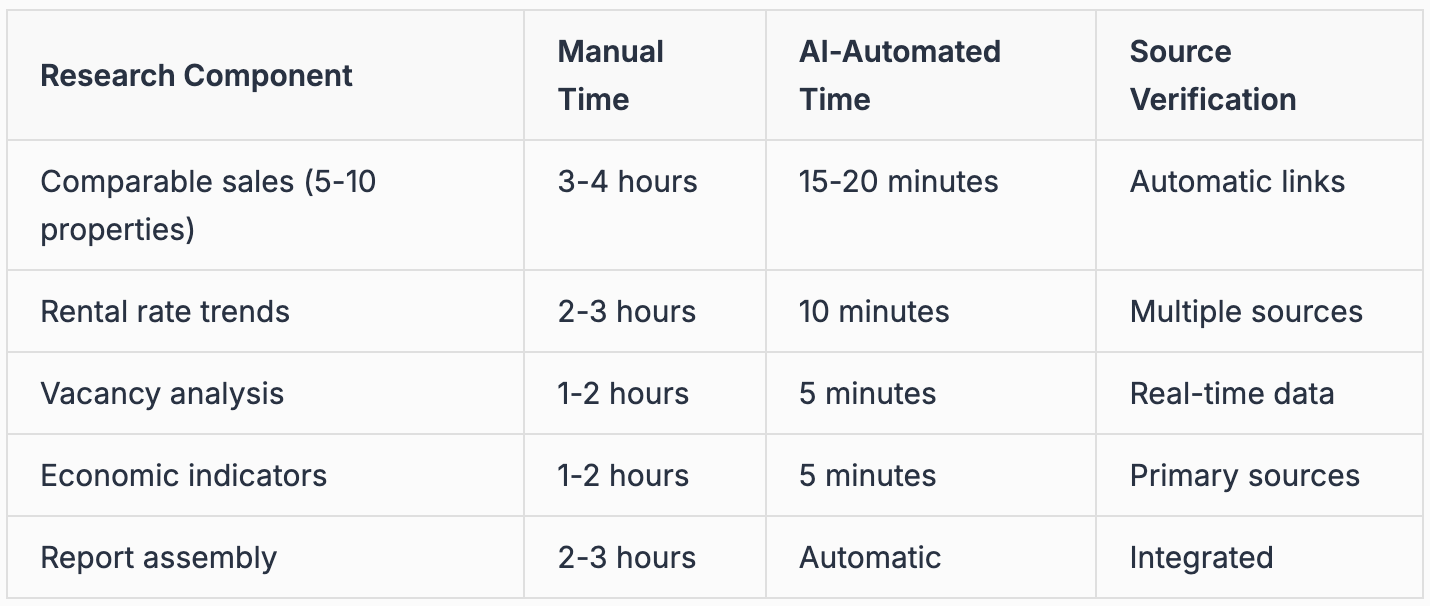
The difference extends beyond speed. Manual research risks missing recent transactions or relying on outdated information. AI systems monitor data continuously and flag when new information becomes available that impacts the analysis.
Shallow Versus Deep AI Support in Refinancing Workflows
Understanding the distinction between superficial AI assistance and comprehensive workflow automation determines whether your technology investment delivers marginal improvements or transformational change. The difference becomes apparent when examining how each approach handles a complete refinancing cycle.
Question-Answer Platforms: The Shallow Approach
Generic AI tools operate through conversational exchanges. Users ask questions about refinancing strategies, request document summaries, or seek help drafting communications. These platforms provide value for specific tasks but require users to orchestrate the overall workflow manually.
What shallow AI provides:
Answers to specific questions about refinancing terms and concepts
Summaries of uploaded documents (one at a time)
Template generation for common communications
General market insights without property-specific analysis
Suggestions requiring manual implementation
The user remains responsible for gathering all source documents, structuring the analysis, verifying outputs, cross-referencing information across documents, and assembling components into a coherent package. The AI serves as an intelligent assistant rather than an autonomous analyst.
This approach may suit small portfolios or occasional refinancing needs where the investment in purpose-built systems exceeds the benefit. However, it scales poorly and creates bottlenecks as portfolio size increases.
Autonomous Platforms: The Deep Approach
Purpose-built platforms for ai for refinancing operate fundamentally differently. They receive high-level instructions-"prepare a refinancing package for 123 Main Street using current loan documents, 24 months of operating data, and market comps within 2 miles"-and execute the entire workflow autonomously.
What deep AI delivers:
Automatic document extraction from loan agreements, rent rolls, and operating statements
Financial model generation with trailing and projected periods
Market research with verified comparables and source links
Compliance checking against lender requirements
Package assembly in lender-preferred formats
The system handles data validation, identifies anomalies, flags missing information, and produces outputs ready for lender submission. Real estate automation at this level transforms team productivity by eliminating repetitive analytical work.
Integration Depth: The Critical Differentiator
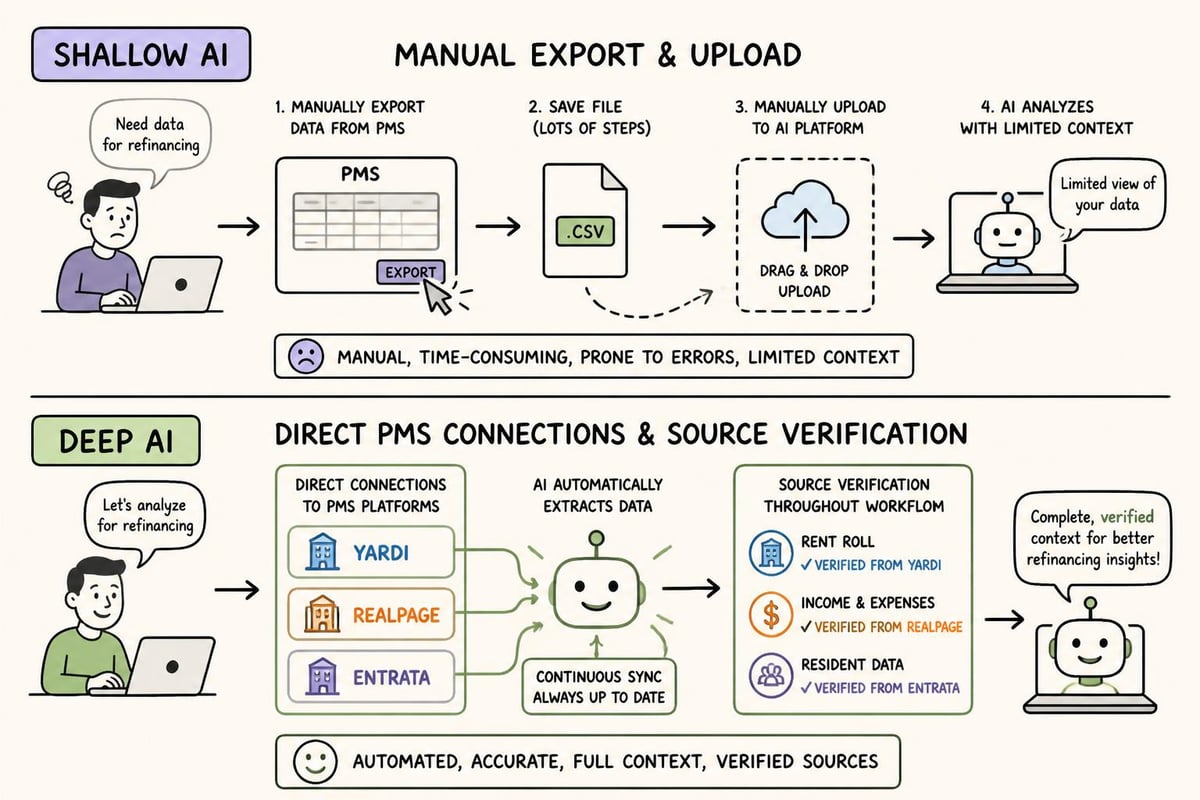
The most significant distinction between shallow and deep AI for refinancing lies in system integration. Generic tools exist as isolated applications requiring manual data transfer. Purpose-built platforms connect directly to your operational technology stack.
Consider the workflow for assembling current financial performance data:
Shallow AI approach:
Export reports from Yardi or RealPage manually
Upload files to AI platform one by one
Request analysis of each document
Copy results into spreadsheet
Verify calculations manually
Format for lender presentation
Deep AI approach:
Platform connects to PMS via API
Extracts relevant data automatically
Processes across properties simultaneously
Generates consolidated analysis
Returns formatted lender package
Maintains audit trail with source links
The integration depth affects not only speed but also accuracy and auditability. Data analyst AI capabilities that access source systems directly eliminate transcription errors and ensure current information.
What a Lender-Ready AI-Generated Package Includes
Understanding what constitutes a complete refinancing package helps evaluate whether an AI platform delivers truly autonomous results or merely assists with components. Lenders expect specific documentation presented in standardized formats with verifiable data.
Essential Components of the Refinancing Package
A comprehensive refinancing submission includes multiple document types, each requiring specific data and formatting. AI platforms capable of producing lender-ready packages must generate all components with proper structure and validation.
Core documentation requirements:
Executive summary with property overview, current financing, and refinancing objectives
Financial statements including historical operating performance (typically 24-36 months)
Rent roll analysis with current occupancy, lease expirations, and revenue projections
Proforma operating statements showing stabilized and projected performance
Market analysis with comparable sales, rental rates, and economic indicators
Property condition assessment documenting capital improvements and deferred maintenance
Environmental and compliance documentation
Loan sizing calculations based on lender-specific DSCR and LTV requirements
AI tools for business analysts that claim refinancing capabilities should demonstrate the ability to produce each component autonomously, not merely provide templates or partial assistance.
Source Verification and Audit Trail
The credibility of AI-generated refinancing packages depends entirely on data verification. Lenders scrutinize assumptions, question calculations, and require supporting documentation. Platforms that cannot trace every data point to its source create risk rather than reducing it.
Purpose-built systems maintain comprehensive audit trails showing:
Data source for every figure (PMS export, market data provider, document page number)
Extraction timestamp documenting when information was retrieved
Calculation methodology with formulas and assumptions explicit
Version history tracking changes and updates
Direct links to source documents for instant verification
This level of transparency addresses a critical concern in AI-driven financial analysis: the need for explainability and accountability in automated decisions. Without source verification, AI outputs remain unverifiable black boxes unsuitable for lender submission.
Formatting and Presentation Standards
Lenders maintain specific requirements for document formatting, organization, and presentation. Some require particular calculation methodologies, specific time periods, or predetermined page layouts. Generic AI tools generate outputs in arbitrary formats requiring manual reformatting.
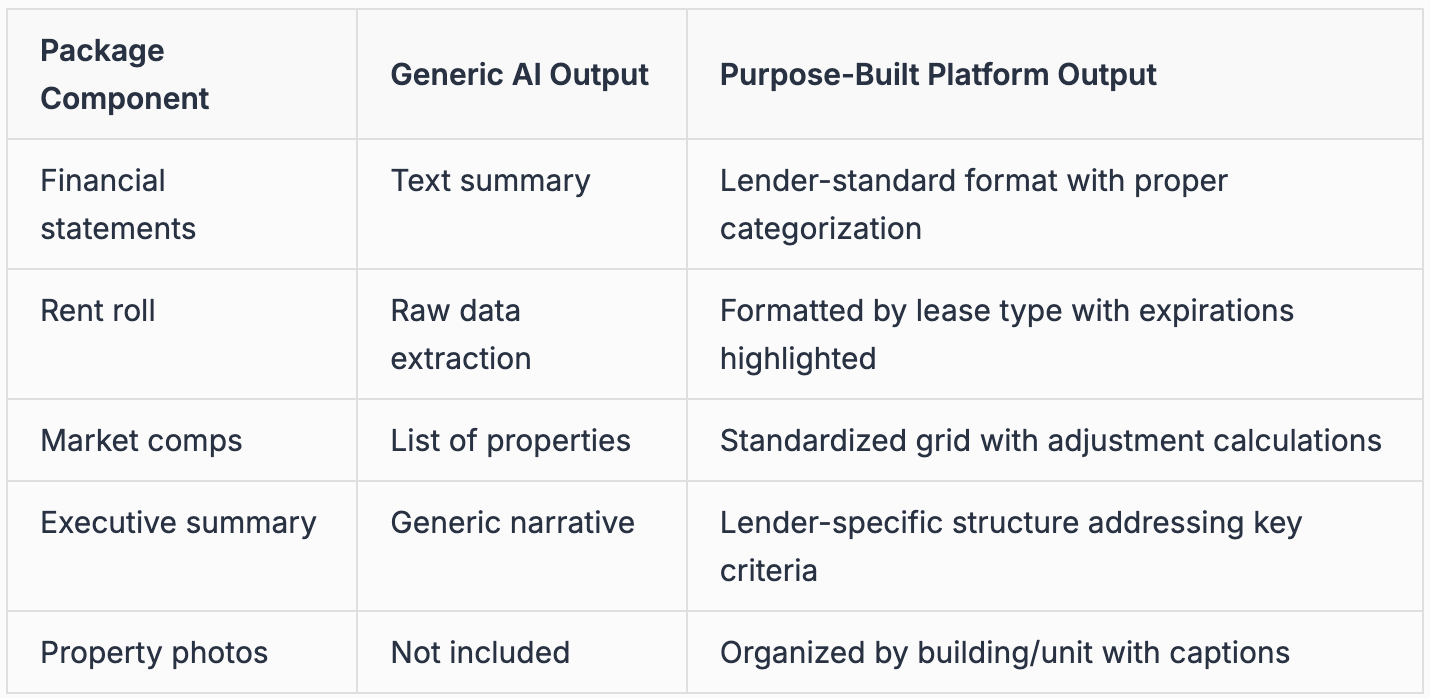
The ability to adapt outputs to specific lender requirements separates platforms that assist from platforms that deliver. Commercial real estate deal analysis tools must understand these variations and adjust automatically.
Scenario Analysis and Sensitivity Testing
Sophisticated refinancing packages include multiple scenarios showing how different terms affect returns and risk metrics. This requires generating complete financial models for each scenario, calculating key metrics, and presenting results in comparative format.
Scenarios typically include:
Base case using most likely assumptions
Conservative case with stressed vacancy and expense assumptions
Optimistic case reflecting potential operational improvements
Rate sensitivity showing impact of different interest rates
Term comparison analyzing different loan durations and amortization periods
AI platforms handling these requirements must run multiple complete analyses, not simply adjust individual variables. The investment analysis capabilities required exceed what general-purpose tools can deliver.
Evaluating AI Platforms for Full Refinancing Workflows
Asset managers considering AI adoption for refinancing need objective criteria to separate marketing claims from genuine capabilities. The following checklist provides a structured framework for evaluation.
Technical Capability Assessment
Data Integration:
Does the platform connect directly to your property management system?
Can it extract data from Yardi, RealPage, or Entrata without manual exports?
Does it handle multiple data formats (PDFs, Excel, scanned images)?
Can it process documents in bulk across portfolio properties?
Analytical Depth:
Does it generate complete financial models or just summaries?
Can it run NOI analysis across multiple time periods?
Does it identify comparable properties using appropriate criteria?
Can it execute sensitivity analysis and scenario modeling?
Output Quality:
Does it produce lender-ready formatted documents?
Can it adapt to specific lender requirements?
Does it maintain source links for every data point?
Can it generate executive summaries and detailed appendices?
Security and Compliance Verification
Given the sensitive financial and operational data involved in refinancing, security certification becomes non-negotiable. Understanding explainable AI and its importance to transparency helps frame security evaluation.
Essential certifications and practices:
SOC 2 Type 2 compliance demonstrating ongoing security controls
Data encryption in transit and at rest
Role-based access controls
Audit logging of all system activities
Regular security assessments and penetration testing
Clear data retention and deletion policies
Platforms lacking these certifications expose organizations to data breaches, compliance violations, and operational risk. The due diligence required for security evaluation matches the scrutiny applied to any enterprise software handling confidential financial data.
Autonomy and Workflow Completion
The defining characteristic separating shallow from deep AI for refinancing is the ability to complete entire workflows without continuous human intervention. Evaluation should test this directly.
Autonomy assessment questions:
Can the platform complete a full refinancing package from a single high-level instruction?
Does it require human input at each step or run multi-step processes independently?
How does it handle missing or inconsistent data?
Can it identify when additional information is needed?
Does it produce outputs requiring substantial editing or formatting?
Test the platform with a real refinancing scenario from your portfolio. Provide access to relevant documents and systems, specify the deliverable required, and evaluate how much manual intervention the process requires. Platforms requiring constant guidance or producing incomplete outputs demonstrate shallow capability regardless of marketing claims.
Accuracy and Learning Capabilities
AI platforms improve through exposure to data, but the mechanisms and transparency of this improvement vary significantly. How AI platforms disrupt traditional workflows depends partly on their ability to learn from organizational data.
Learning and accuracy evaluation:
How does the platform improve accuracy over time?
Does it learn from your specific portfolio and organizational standards?
Can you verify and correct outputs to improve future results?
Does it provide confidence scores or uncertainty indicators?
How does it handle edge cases or unusual property types?
Request accuracy benchmarks specific to refinancing workflows, not general platform statistics. Ask how the system was trained, what commercial real estate data it incorporates, and how it validates outputs against known-good results.
Cost and Scalability Analysis
The economics of AI for refinancing depend on portfolio size, refinancing frequency, and team capacity. Understanding the total cost of ownership requires looking beyond subscription fees.
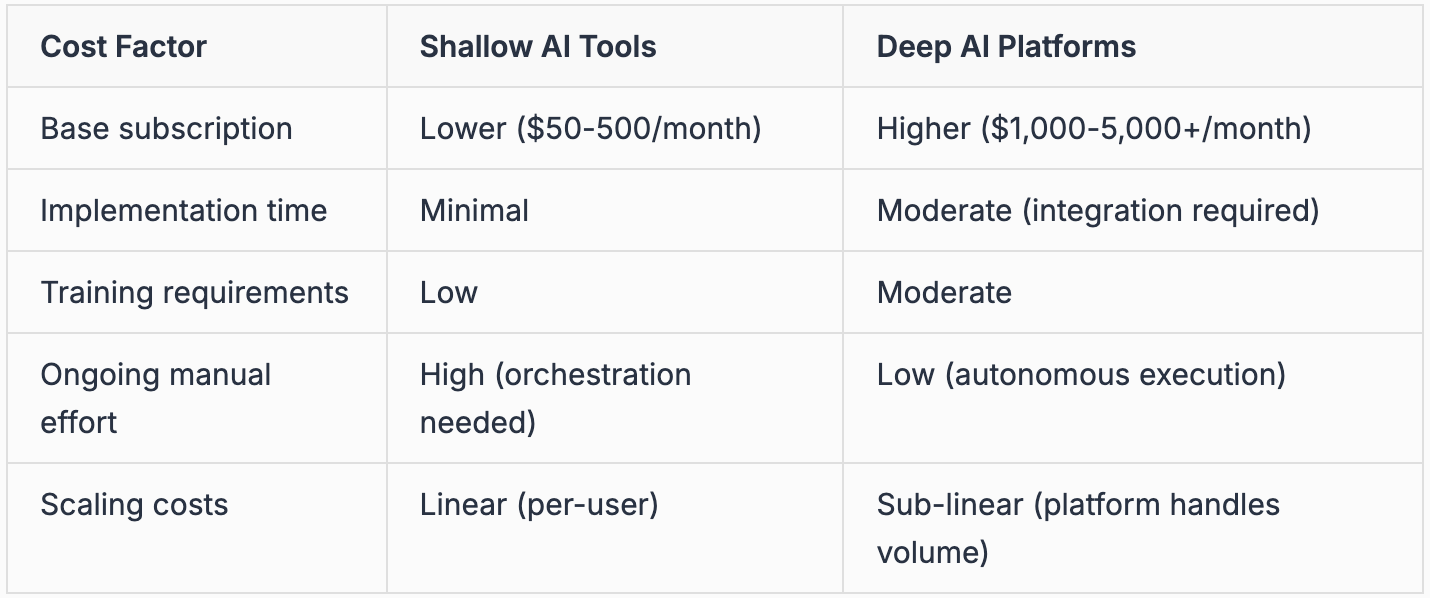
Calculate cost per refinancing package completed, not cost per user or per month. Include the value of analyst time saved and the opportunity cost of delayed refinancings. For portfolios with regular refinancing needs, purpose-built platforms typically deliver superior economics despite higher subscription costs.
Checklist: Can Your AI Platform Handle the Full Refi Workflow?
Use this comprehensive checklist to evaluate whether an AI platform delivers complete refinancing workflow automation or merely assists with components:
Document Processing
Extracts data from existing loan documents automatically
Processes rent rolls regardless of format
Handles trailing 12-month (T12) operating statements
Recognizes and categorizes lease clauses
Identifies and flags missing critical information
Financial Analysis
Generates complete proforma operating statements
Calculates NOI across multiple time periods
Performs expense benchmarking against market standards
Creates debt service coverage ratio (DSCR) analysis
Runs sensitivity analysis on key variables
Market Research
Identifies comparable properties using appropriate criteria
Pulls current market rental rates for the submarket
Retrieves recent comparable sales with details
Sources economic and demographic data
Provides direct links to all data sources
System Integration
Connects to Yardi, RealPage, or Entrata directly
Extracts data without manual exports
Processes multiple properties simultaneously
Maintains data synchronization
Handles updates and changes automatically
Package Assembly
Produces executive summaries in lender-standard format
Generates complete financial statements
Creates formatted rent roll analyses
Compiles market research into presentation-ready format
Assembles all components into coherent package
Verification and Compliance
Maintains source links for every data point
Provides audit trail of all calculations
Flags potential data quality issues
Validates against lender-specific requirements
Enables rapid verification of assumptions
Security and Certification
Holds SOC 2 Type 2 certification
Implements role-based access controls
Encrypts data in transit and at rest
Maintains detailed activity logs
Follows industry security best practices
Autonomy and Workflow
Executes multi-step tasks without constant supervision
Handles missing data gracefully
Completes workflows from high-level instructions
Delivers finished outputs requiring minimal editing
Scales across portfolio without linear cost increase
Platforms meeting 90% or more of these criteria demonstrate the depth required for true refinancing workflow automation. Those meeting fewer than 70% serve as assistive tools rather than autonomous systems.
Recent developments like UWM's AI system for identifying refinancing opportunities show how specialized platforms are reshaping the industry. The key differentiator remains the ability to execute complete analytical workflows autonomously while maintaining verification and compliance standards.
The gap between AI platforms that answer questions and those that deliver complete refinancing packages determines whether your team gains hours or merely convenience. For commercial real estate asset managers handling multiple refinancings across portfolios, the economics and operational impact diverge dramatically based on platform depth. Leni represents the purpose-built approach: autonomous execution of financial modeling and underwriting, document extraction from loan documents and operating statements, source-linked market research, and direct integration with Yardi, RealPage, and Entrata. Unlike general-purpose AI, Leni completes the analytical work that traditionally consumes days of analyst time, delivering verifiable lender-ready packages with full audit trails. Explore how Leni transforms refinancing workflows for your portfolio.

Johanna Gruber
Johanna has spent the last 8 years helping marketing teams connect with audiences through content. Specializing in B2B SaaS and real estate.

Curious About AI?
Join the largest AI community for real estate online. Get bite-sized, real-world use case videos, plus practical tips and proven strategies from top industry experts on adopting AI effectively.
MEET LENI
AI SuperAgent Purpose Built for Investors and Operators.
Experience how professionals and teams in your domain are getting the edge using AI.
