AI Investment Monitoring for Commercial Real Estate
.webp&w=1920&q=75)
AI Investment Monitoring for Commercial Real Estate
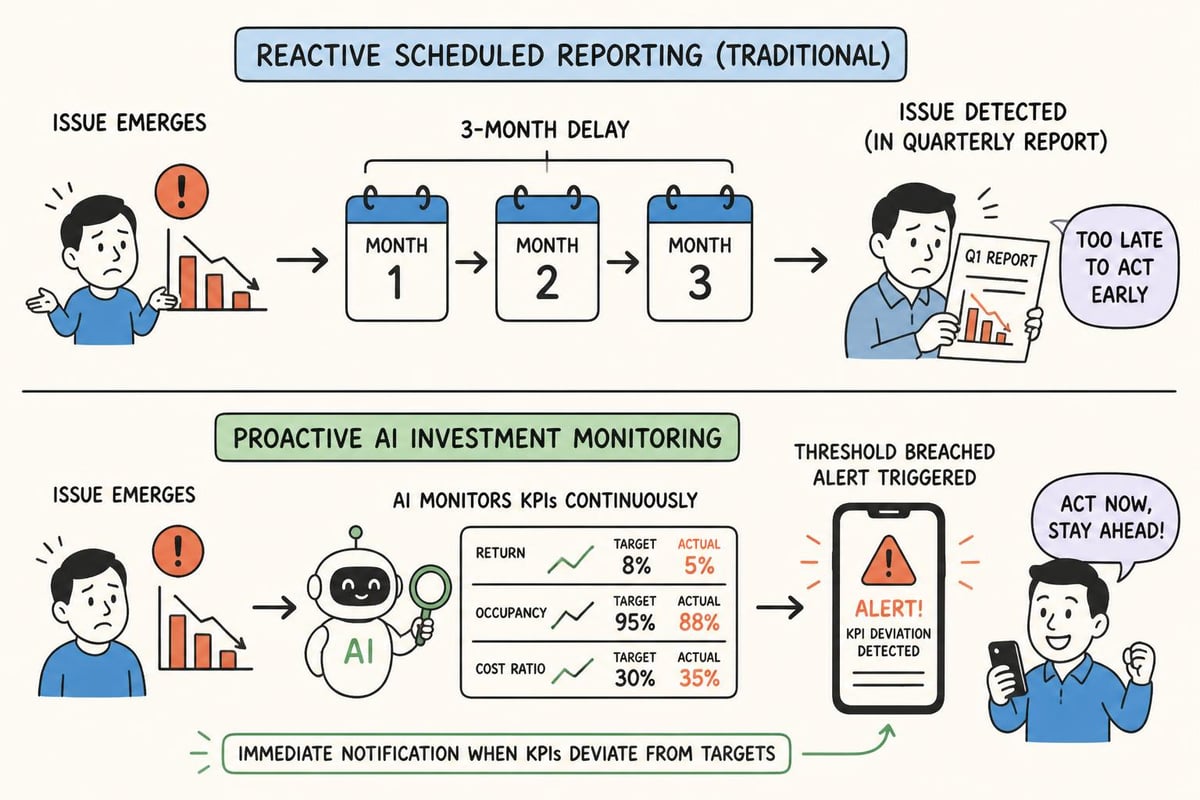
Traditional investment monitoring operates on a dangerous lag. Asset managers receive monthly or quarterly reports, analyze historical data, and by the time they identify a variance, the issue has already compounded for weeks. A 5% occupancy drop discovered in a quarterly report might represent three months of lost revenue and deteriorating property performance. This reactive approach to investment oversight creates blind spots that erode portfolio value systematically. AI investment monitoring fundamentally changes this paradigm by shifting from scheduled reporting to continuous, proactive surveillance of portfolio performance with threshold-based alerts that surface issues the moment they emerge.
The Fundamental Problem with Scheduled Investment Reporting
Most commercial real estate portfolios rely on reporting cycles that create inherent delays between when problems emerge and when teams can respond. Monthly financial packages arrive 10-15 days after month-end. Quarterly board reports synthesize data that's already 45-60 days old. During these gaps, variances compound silently.
Consider the cascade effect of delayed visibility:
Delinquency spike goes unnoticed for 30 days while additional tenants fall behind
Maintenance issues escalate from minor repairs to capital expenditures
Leasing velocity slows without immediate intervention from asset management
Vendor costs exceed budgets systematically across multiple properties
The financial impact extends beyond the initial variance. A $50,000 budget overrun discovered three months late represents both the direct loss and the opportunity cost of capital that could have been redeployed. Research on AI-powered investing approaches demonstrates how real-time data analysis creates substantial performance advantages across investment portfolios.
Traditional reporting also suffers from aggregation blindness. Portfolio-level summaries can mask property-specific problems. A portfolio maintaining 92% occupancy might hide one asset that dropped from 95% to 78% while others improved. Scheduled reports present snapshots, not trends, making it difficult to distinguish normal variance from systematic deterioration.
Why Manual Monitoring Doesn't Scale
Asset managers overseeing 20, 50, or 100+ properties cannot realistically monitor every metric manually. The mathematics are prohibitive. Even with dedicated analysts, daily review of occupancy, rent rolls, accounts receivable, operating expenses, and capital projects across dozens of properties requires thousands of data points.
Teams resort to exception-based review, only investigating properties that appear in summary reports as outliers. This approach misses early warning signals and relies on problems becoming severe enough to surface in aggregated data. By that point, intervention options are limited and more costly.
What Proactive AI Investment Monitoring Actually Means
AI investment monitoring inverts the traditional model. Instead of generating reports on a schedule and hoping humans notice problems, the system continuously analyzes live data streams and alerts teams when specific conditions are met. This shift from "scheduled reporting" to "exception alerting" fundamentally changes how asset management teams operate.
Threshold-Based Alert Architecture
Proactive monitoring systems establish performance thresholds for every critical metric across every asset. When actual performance crosses these boundaries, the system generates immediate alerts with full context. This approach delivers several distinct advantages:
Zero lag detection between when a variance occurs and when teams are notified
Automatic prioritization based on severity, impact, and trend direction
Portfolio-wide consistency in monitoring standards across all assets
Contextual analysis that distinguishes seasonal patterns from genuine issues
Audit trails documenting when issues emerged and how teams responded
The most sophisticated implementations connect directly to property management systems like Yardi, RealPage, Entrata, and AppFolio, pulling live transaction data. Teams without full integrations can still implement active monitoring through structured document uploads and scheduled data refreshes. Platforms purpose-built for reporting and asset management enable threshold monitoring regardless of integration depth.
Live Data Versus Stale Snapshots
Data freshness determines monitoring effectiveness. An alert based on yesterday's data enables immediate intervention. An alert based on 30-day-old data documents history without enabling action. The distinction is critical for commercial real estate where market conditions, tenant behavior, and operational performance change rapidly.
Consider delinquency monitoring across a multifamily portfolio. Live data integration reveals when a tenant misses rent payment on the 5th of the month. The asset manager can initiate contact, offer payment plans, or begin collection procedures while the tenant is only days behind. A monthly report reveals the same delinquency 25 days later, after late fees have compounded and the tenant has become significantly more difficult to collect from.
Portfolio operators implementing AI PMS integration gain continuous visibility that transforms how quickly they can respond to operational issues. The speed advantage compounds across dozens or hundreds of properties.
Critical Metrics for Proactive CRE Portfolio Monitoring
Not all metrics deserve real-time monitoring. Effective ai investment monitoring focuses on indicators that (1) change frequently, (2) impact financial performance materially, and (3) enable intervention when detected early. Commercial real estate portfolios should prioritize these categories.
Occupancy and Leasing Velocity
Physical occupancy represents the most fundamental performance driver. A drop from 95% to 92% across a 200-unit property means six additional vacant units generating zero revenue while still incurring turnover costs. Alert thresholds should trigger when:
Occupancy falls below property-specific targets (typically 90-95% for stabilized multifamily)
Month-over-month occupancy declines exceed 2-3%
Competitive properties show occupancy gains while the subject property declines
Lease-up velocity for new units falls below projections
Economic occupancy (rental revenue as percentage of gross potential rent) often diverges from physical occupancy due to concessions, discounts, and collection issues. Monitoring both metrics reveals whether occupancy problems stem from vacant units or revenue management issues.
Lease expiration exposure requires forward-looking monitoring. Alerts should surface when upcoming lease expirations exceed normal absorption capacity. A property facing 40% lease expirations in the next 90 days needs immediate action on renewal campaigns and leasing resources.
Revenue Performance and Collections
Revenue variance alerts catch problems before they cascade:
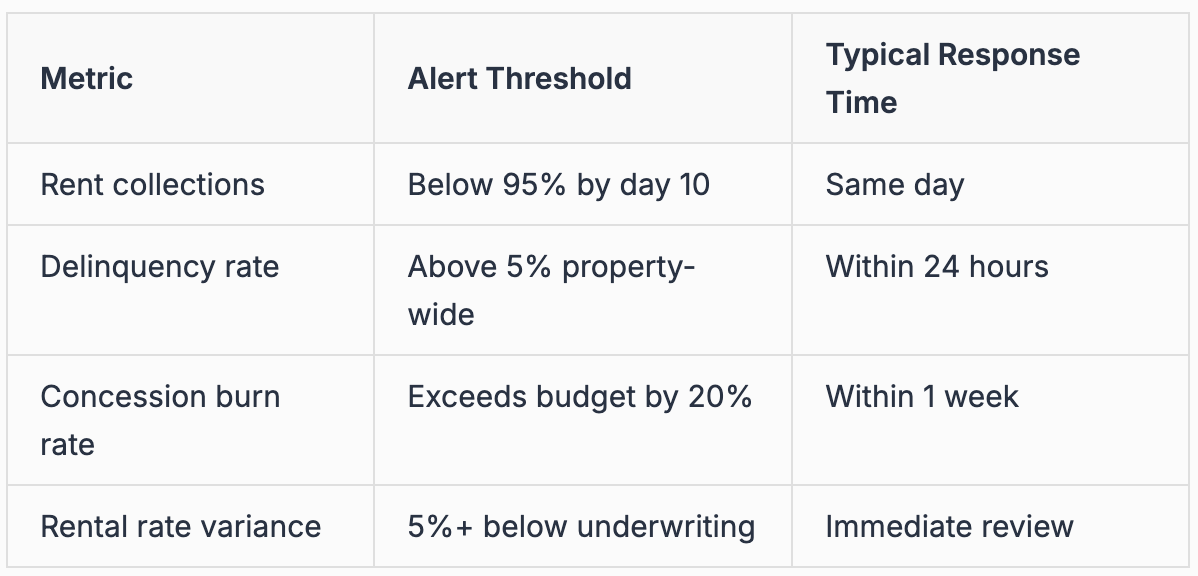
Platforms designed for financial modeling and underwriting can automatically compare actual collections against proforma projections, highlighting properties underperforming expectations with enough lead time to implement corrective strategies.
Operating Expense Variance
Operating expenses drift from budgets systematically without active monitoring. AI investment monitoring systems track category-level spending and alert when:
Any expense category exceeds monthly budget by 15%+
Utilities show abnormal spikes indicating potential system failures
Maintenance spending trends suggest deferred capital needs
Property-level expense ratios deviate from peer benchmarks
Expense monitoring proves particularly valuable for identifying vendor cost creep across portfolios. When landscaping costs increase 20% at one property, it might be a contract issue. When they increase across eight properties with the same vendor, it signals systematic overcharging that requires immediate renegotiation.
NOI Variance and Margin Compression
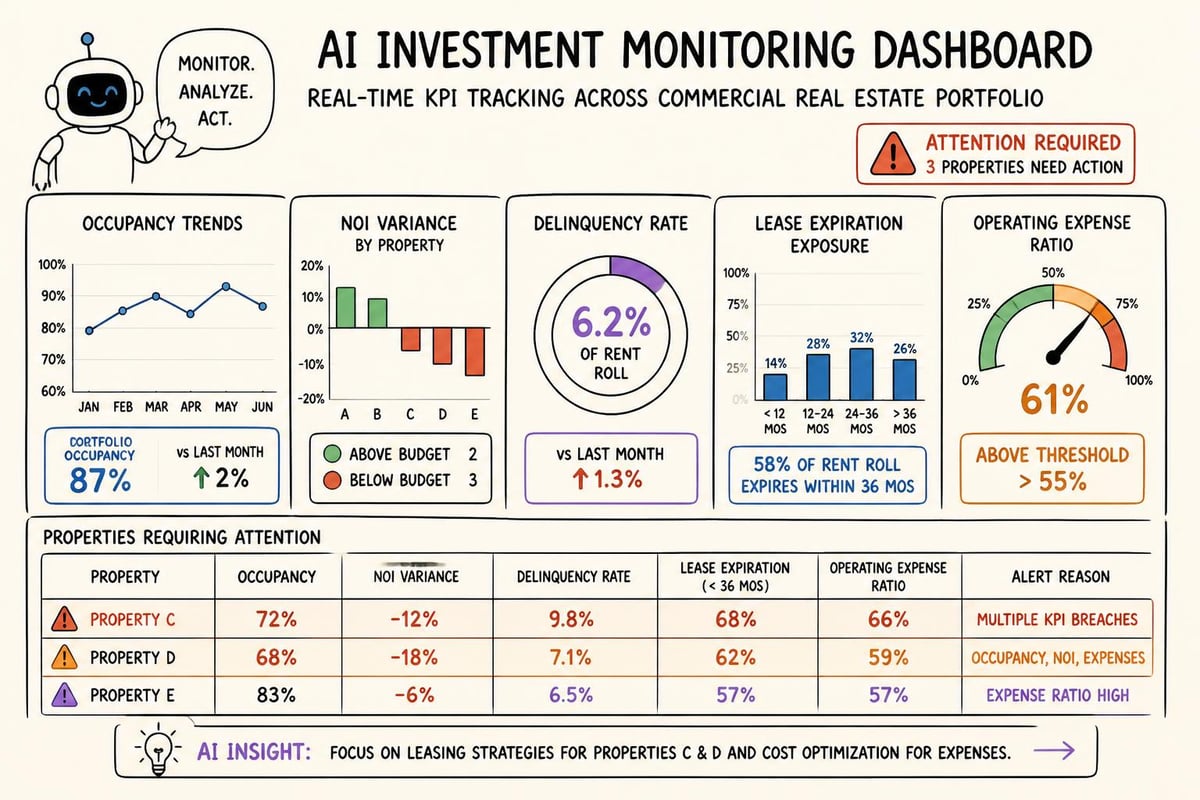
Net Operating Income represents the definitive measure of property performance. Monitoring NOI variance requires analyzing both revenue and expense components to understand root causes. Effective alerts track:
Absolute NOI variance: Dollar deviation from budget or prior period
NOI margin: NOI as percentage of revenue, revealing efficiency trends
Variance velocity: Rate of change in NOI performance
Peer comparison: NOI per unit relative to comparable properties
Research platforms like Qlib demonstrate how AI-oriented quantitative investment systems can continuously track performance metrics and identify meaningful deviations from expected patterns, principles that apply directly to commercial real estate portfolio monitoring.
Implementing Proactive Monitoring Across Your Tech Stack
The beauty of modern ai investment monitoring is accessibility regardless of technical infrastructure. Teams don't need complete system integration to benefit from proactive alerting.
Full PMS Integration: Live Automated Monitoring
Organizations with direct connectivity to Yardi, RealPage, Entrata, or AppFolio achieve the highest monitoring sophistication. These integrations enable:
Daily automated data pulls refreshing every metric without manual intervention. Transaction-level data flows automatically from property management systems to analytics platforms, maintaining complete currency.
Real-time threshold monitoring across all properties and metrics simultaneously. The system continuously compares current performance against established thresholds, generating alerts the moment conditions are met.
Automatic variance analysis calculating deviations from budgets, proformas, and historical patterns. Teams receive not just raw data but interpreted analysis highlighting what changed, by how much, and compared to what benchmark.
Source-linked verification connecting every alert and insight back to underlying transaction data. Asset managers can trace alerts to specific ledger entries, lease agreements, or operational reports, ensuring complete transparency.
SOC 2 Type 2 certification ensures that data flowing through integrated systems maintains security standards required for institutional portfolios. Organizations exploring AI real estate software should prioritize platforms offering both integration depth and security compliance.
Document-Based Monitoring: Active Alerts Without Integration
Teams operating without full PMS integration can still implement effective proactive monitoring through structured document workflows. This approach requires:
Scheduled data uploads from monthly financial packages, rent rolls, and operating reports
Standardized formatting enabling automated extraction and analysis
Threshold configuration establishing alert conditions for each property and metric
Pulse alert systems that analyze newly uploaded data against previous periods and alert on significant variances
While not truly real-time, document-based monitoring compresses lag from weeks to days. A monthly report uploaded on the 10th triggers immediate analysis and alerts, enabling teams to respond 20+ days faster than traditional review cycles.
Hybrid Approaches: Strategic Integration Priorities
Most organizations adopt hybrid monitoring architectures, integrating the most critical systems while maintaining document-based workflows for peripheral data sources. Strategic integration priorities typically include:
Core PMS first: Yardi, RealPage, or Entrata integration for transaction-level data
Accounting systems second: General ledger data for complete expense visibility
Leasing platforms third: Rent roll and occupancy data for revenue monitoring
Vendor systems last: Maintenance, utilities, and service provider platforms
This staged approach balances implementation complexity against monitoring value. Studies on AI agents in end-to-end professional workflows reveal that phased integration often outperforms attempting comprehensive system overhauls.
Building Your Threshold Alert Framework
Effective ai investment monitoring requires thoughtful alert design. Too many alerts create noise and alert fatigue. Too few alerts miss critical issues. The optimal framework balances sensitivity, specificity, and actionability.
Establishing Property-Specific Thresholds
Generic portfolio-wide thresholds miss property-level nuance. A 90% occupancy target makes sense for stabilized Class A multifamily but represents failure for a luxury high-rise that underwrote to 97%. Threshold design should account for:
Asset class differences: Office, retail, industrial, and multifamily properties operate with different normal ranges for key metrics. Office buildings typically run higher expense ratios than industrial. Retail faces higher tenant turnover than office.
Market conditions: Properties in different markets face different competitive dynamics. A 5% vacancy in a supply-constrained market signals serious problems. The same vacancy in an oversupplied market might be acceptable.
Property lifecycle stage: Stabilized assets, value-add repositioning, and new development require completely different monitoring frameworks. A lease-up property should trigger alerts when absorption falls below 8-10 units monthly. A stabilized property might alert at 3% occupancy variance.
Historical performance: Properties consistently performing at 96% occupancy should alert when dropping below 94%. Properties that fluctuate between 88-92% need wider tolerance bands.
Platforms supporting multifamily portfolio strategies enable customized threshold configuration at the property level while maintaining portfolio-wide visibility.
Severity Tiering and Escalation Protocols
Not all alerts demand immediate C-suite attention. Effective monitoring systems tier alerts by severity and route them to appropriate responders:
Critical alerts: Material NOI variance, significant delinquency spikes, or occupancy drops triggering loan covenant concerns. Route immediately to senior asset management and potentially investors.
High-priority alerts: Operating expense overruns, leasing velocity misses, or revenue variances exceeding 10%. Route to asset managers with 24-hour response requirements.
Standard alerts: Minor budget variances, routine maintenance issues, or seasonal fluctuations. Route to property managers with weekly review cycles.
Informational notices: Trending data that doesn't yet cross thresholds but shows concerning direction. Include in weekly summaries without immediate action requirements.
Alert routing should also consider trend persistence. A single day of low collections might not warrant escalation. Three consecutive days trending down triggers progressive alert levels.
Alert Specificity and Actionability
The most valuable alerts provide complete context enabling immediate action:
What changed: Specific metric, property, and magnitude of variance
When it changed: Exact timing and duration of the deviation
Why it matters: Financial impact quantified in dollars and percentage terms
Compared to what: Relevant benchmarks (budget, proforma, prior period, peer average)
What to investigate: Potential root causes and recommended next steps
Source verification: Direct links to underlying transaction data or documents
Generic alerts like "Property X has high expenses" provide limited value. Specific alerts like "Property X utilities exceeded budget by $8,400 (34%) in March due to 285% increase in water usage; possible leak detected based on consumption pattern analysis" enable immediate investigation and resolution.
Teams using AI multifamily portfolio analytics benefit from alerts that automatically connect variance to probable causes based on pattern recognition across historical data.
Evaluating Alert Specificity and Data Freshness
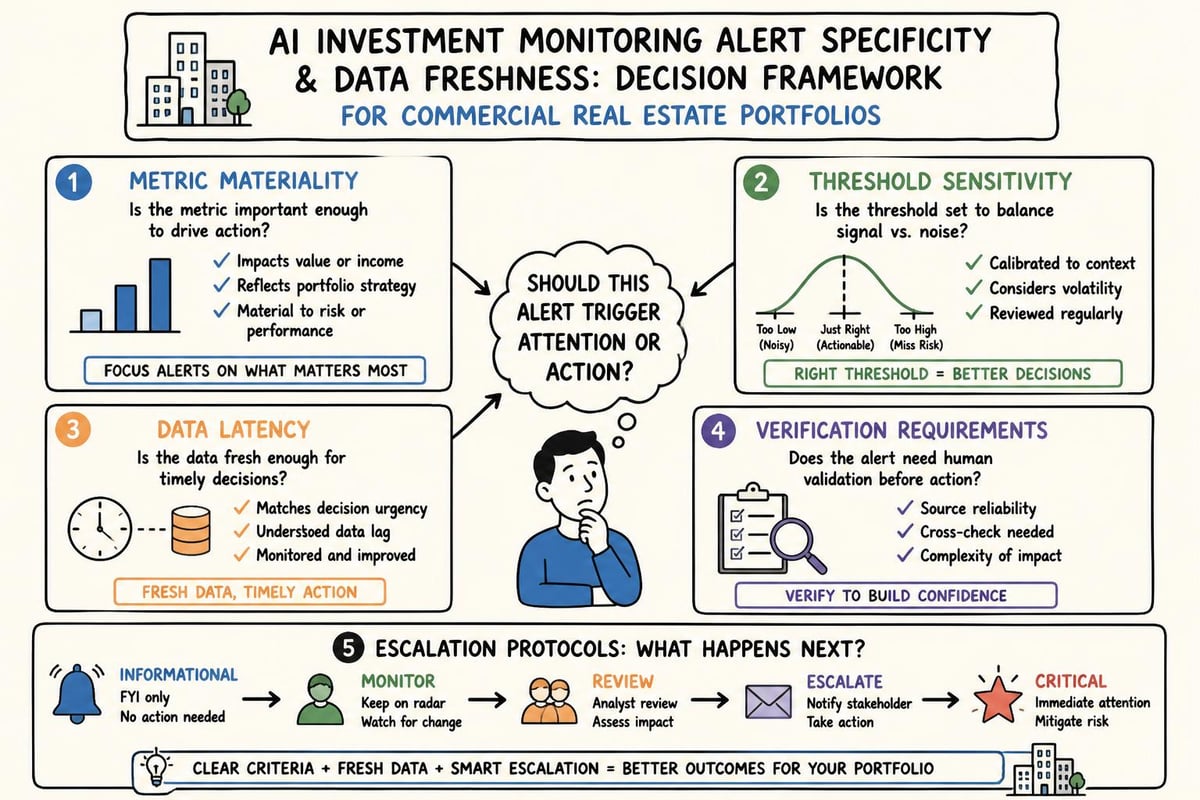
Organizations implementing or upgrading ai investment monitoring systems should evaluate solutions across these critical dimensions:
Data Freshness Assessment
Integration depth: Does the platform connect directly to source systems or rely on manual uploads? Direct integration delivers hourly or daily refreshes. Document-based systems operate on weekly or monthly cycles.
Update frequency: How often does new data flow into the monitoring system? Daily updates enable day-over-day analysis. Monthly updates limit detection speed regardless of alert sophistication.
Processing lag: What delay exists between data creation and alert generation? Best-in-class systems process incoming data within minutes. Legacy systems might batch-process overnight.
Historical depth: Does the system maintain sufficient historical data for meaningful trend analysis? Effective monitoring requires at least 24-36 months of historical data for seasonal adjustment and pattern recognition.
Platforms providing real-time market research capabilities demonstrate the infrastructure required for continuous data processing and analysis.
Alert Precision Metrics
Evaluate monitoring systems using these precision indicators:
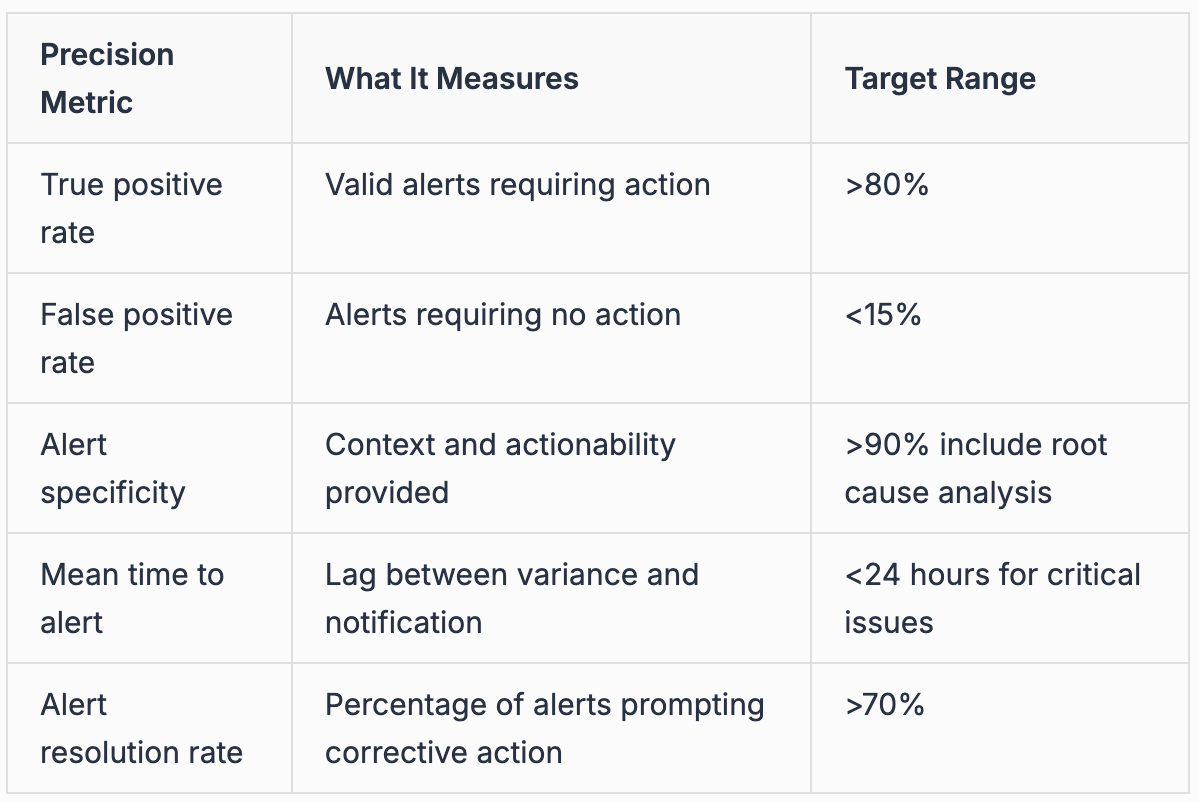
Systems generating excessive false positives train teams to ignore alerts, defeating the entire purpose of proactive monitoring. Solutions incorporating machine learning improve precision over time by learning which patterns actually predict material issues versus normal variance.
Verification and Auditability
Investment monitoring systems must support verification of every alert and insight. Key requirements include:
Source linking: Direct connection from alerts to underlying transaction data, enabling teams to validate findings immediately without searching through multiple systems.
Calculation transparency: Clear documentation of how metrics were calculated, what data was included or excluded, and what assumptions were applied.
Version control: Complete audit trail showing when data was updated, what changed, and who made modifications to thresholds or configuration.
Compliance certification: SOC 2 Type 2 or equivalent security standards ensuring data handling meets institutional requirements.
Platforms like VistIQ and Venture Sentinel demonstrate how AI-powered investment monitoring can deliver both automated analysis and strong auditability, principles that apply across asset classes including commercial real estate.
Configuring Alerts for Maximum Portfolio Intelligence
The final step in implementing effective ai investment monitoring involves configuring alert logic that balances comprehensiveness with focus. Start with these core alert categories and expand based on portfolio composition and investment strategy.
Revenue Protection Alerts
Configure immediate notifications when revenue metrics deviate from targets:
Daily rent collections falling below 95% of expected by the 10th of each month
Renewal rates trending below 60% for upcoming lease expirations
Market rent growth lagging competitive properties by more than 5%
Concession levels exceeding budgeted amounts by 20%+
Revenue alerts should trigger escalation protocols when multiple properties show simultaneous weakness, potentially indicating market-wide issues requiring strategic response.
Expense Control Alerts
Operating expense monitoring should alert on both absolute variances and efficiency metrics:
Category-level overruns exceeding monthly budget by 15%
Expense ratio increases of 200+ basis points compared to prior period
Vendor cost inflation outpacing CPI by more than 3%
Utility consumption spikes suggesting equipment failure or operational issues
Effective expense monitoring connects spending patterns to operational causes. A 40% increase in maintenance costs accompanied by declining occupancy might indicate property condition issues driving resident departures.
Capital Preservation Alerts
Protect investment value through early detection of potential impairment:
Occupancy trends showing three consecutive months of decline
NOI shortfalls exceeding 10% of underwritten projections
Debt service coverage approaching loan covenant thresholds
Deferred maintenance accumulation based on spending below replacement reserves
Capital preservation alerts should factor portfolio concentration risk. A single struggling asset might represent acceptable variance. Multiple properties in the same submarket showing simultaneous weakness indicates systematic problems requiring immediate attention.
Market Position Alerts
Competitive intelligence monitoring reveals when properties lose market position:
Occupancy gaps widening compared to competitive set
Rental rate discounts increasing relative to comparable properties
Leasing velocity falling behind market absorption rates
Expense efficiency deteriorating compared to peer benchmarks
Tools supporting how to increase NOI often incorporate competitive benchmarking, enabling teams to identify properties underperforming their market potential and implement targeted improvement strategies.
From Reactive Reports to Predictive Intelligence
The evolution from scheduled reporting to proactive ai investment monitoring represents more than operational efficiency. It fundamentally changes how asset management teams allocate attention and resources. Instead of reviewing all properties equally, teams focus precisely on assets requiring intervention while maintaining confidence that strong performers will generate alerts if conditions deteriorate.
This shift enables portfolio managers to operate larger portfolios without proportionally expanding teams. An asset manager who could effectively oversee 30 properties with monthly reporting might monitor 50-75 properties with proactive alert systems, maintaining higher performance standards across the expanded portfolio.
The compound effect of faster variance detection delivers substantial financial impact. Consider a 100-unit multifamily property with average rents of $1,500. A 3% occupancy decline detected and corrected within one week costs approximately $1,800 in lost revenue ($1,500 × 3 units × 0.25 weeks). The same decline undetected for three months costs $54,000 ($1,500 × 3 units × 12 weeks). Across a 20-property portfolio, the cumulative difference between reactive and proactive monitoring easily exceeds seven figures annually.
Advanced implementations move beyond reactive alerting to predictive intelligence. Machine learning models trained on historical portfolio data can forecast which properties face elevated risk of performance deterioration based on early warning indicators. Research on quantitative investment approaches using AI demonstrates how automated, explainable, and knowledge-driven systems enhance decision-making, principles directly applicable to commercial real estate portfolio management.
Proactive AI investment monitoring transforms portfolio oversight from periodic review to continuous intelligence, enabling teams to detect and resolve issues before they compound into material losses. Threshold-based alerts, live data connectivity, and property-specific configuration create monitoring systems that surface precisely the information asset managers need exactly when they need it. Leni delivers this proactive monitoring capability regardless of your current tech stack, with direct integrations to Yardi, RealPage, Entrata, and AppFolio for teams ready for live automated alerts, or document-based Pulse monitoring for teams working with uploaded financial packages and reports. Purpose-built for commercial real estate with SOC 2 Type 2 certification, Leni enables asset managers to operate larger portfolios with greater confidence and faster response times.

Johanna Gruber
Johanna has spent the last 8 years helping marketing teams connect with audiences through content. Specializing in B2B SaaS and real estate.

Curious About AI?
Join the largest AI community for real estate online. Get bite-sized, real-world use case videos, plus practical tips and proven strategies from top industry experts on adopting AI effectively.
MEET LENI
AI SuperAgent Purpose Built for Investors and Operators.
Experience how professionals and teams in your domain are getting the edge using AI.
