AI PMS Integration: Real vs. Marketing Claims in 2026

AI PMS Integration: Real vs. Marketing Claims in 2026
Most AI platforms promise seamless property management system integration, but when you dig into the implementation details, you discover they mean "we can accept a CSV file you export every month." This gap between marketing claims and operational reality costs asset management teams hundreds of hours annually in manual data transfers, broken workflows, and stale analytics. For commercial real estate portfolios operating across Yardi, RealPage, Entrata, and other enterprise PMS platforms, the depth of ai pms integration directly determines whether your AI analyst becomes a strategic advantage or another tool gathering dust after the first quarter.
The Three Tiers of AI PMS Integration
Understanding the fundamental differences between integration approaches helps asset managers evaluate vendor claims accurately. The commercial real estate industry has seen three distinct levels of ai pms integration emerge, each with dramatically different operational implications.
Manual Export Workflows: The Illusion of Integration
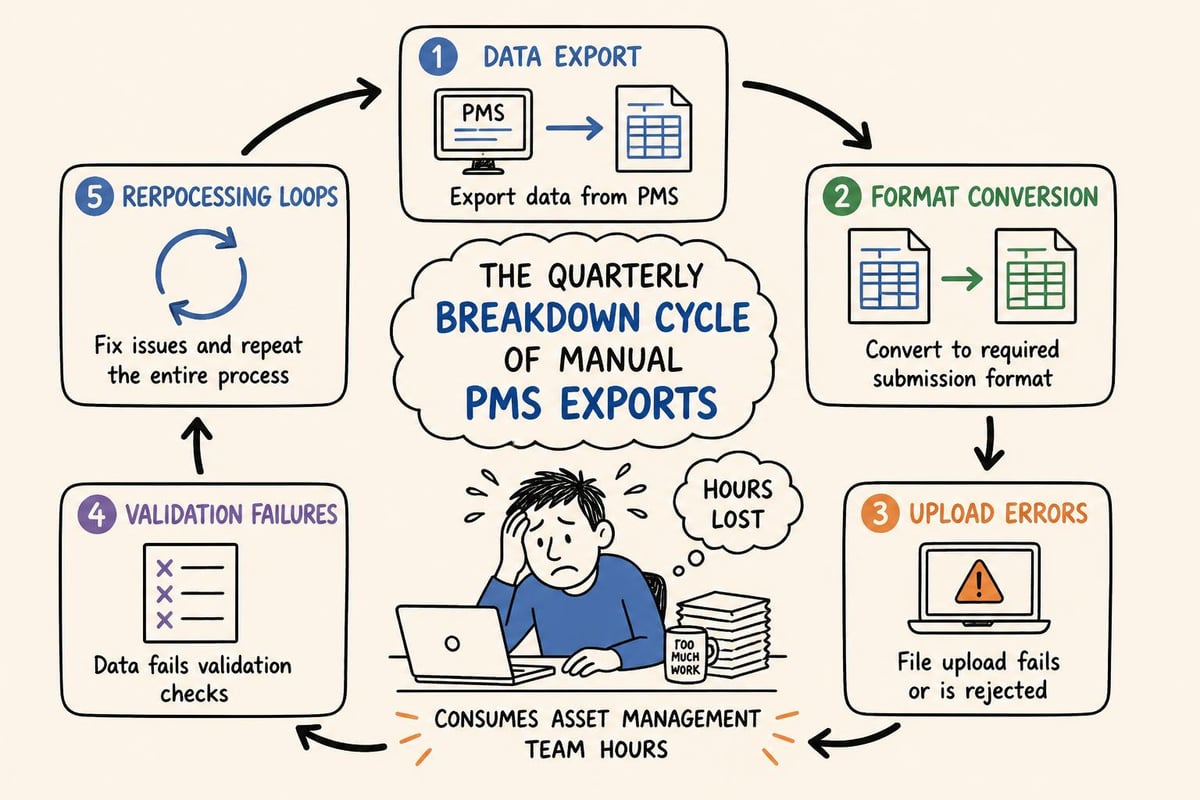
The most common "integration" approach requires property management teams to manually export data from their PMS, format it according to specific requirements, and upload files to the AI platform. This method dominates the market because it's technically simple for vendors to implement.
Operational characteristics of manual export workflows:
Monthly or quarterly data refresh cycles create analysis based on outdated information
Format changes in PMS exports break upload processes without warning
Multiple properties across different PMS platforms require separate export procedures
Data validation happens after upload, leading to frequent reprocessing cycles
Team members spend 4-8 hours monthly on data preparation instead of analysis
This approach fails the fundamental test of automation. When your acquisitions team needs current rent roll data to evaluate a potential add-on acquisition, waiting for the next scheduled export cycle eliminates the competitive advantage AI should provide. Research on AI integration with business process management systems demonstrates that manual intervention points fundamentally limit AI's ability to deliver proactive, context-sensitive insights.
Shallow API Connections: Surface-Level Data Access
The second tier involves basic API connectivity that pulls predetermined data sets from property management systems. These integrations represent genuine technical progress but remain limited in scope and flexibility.
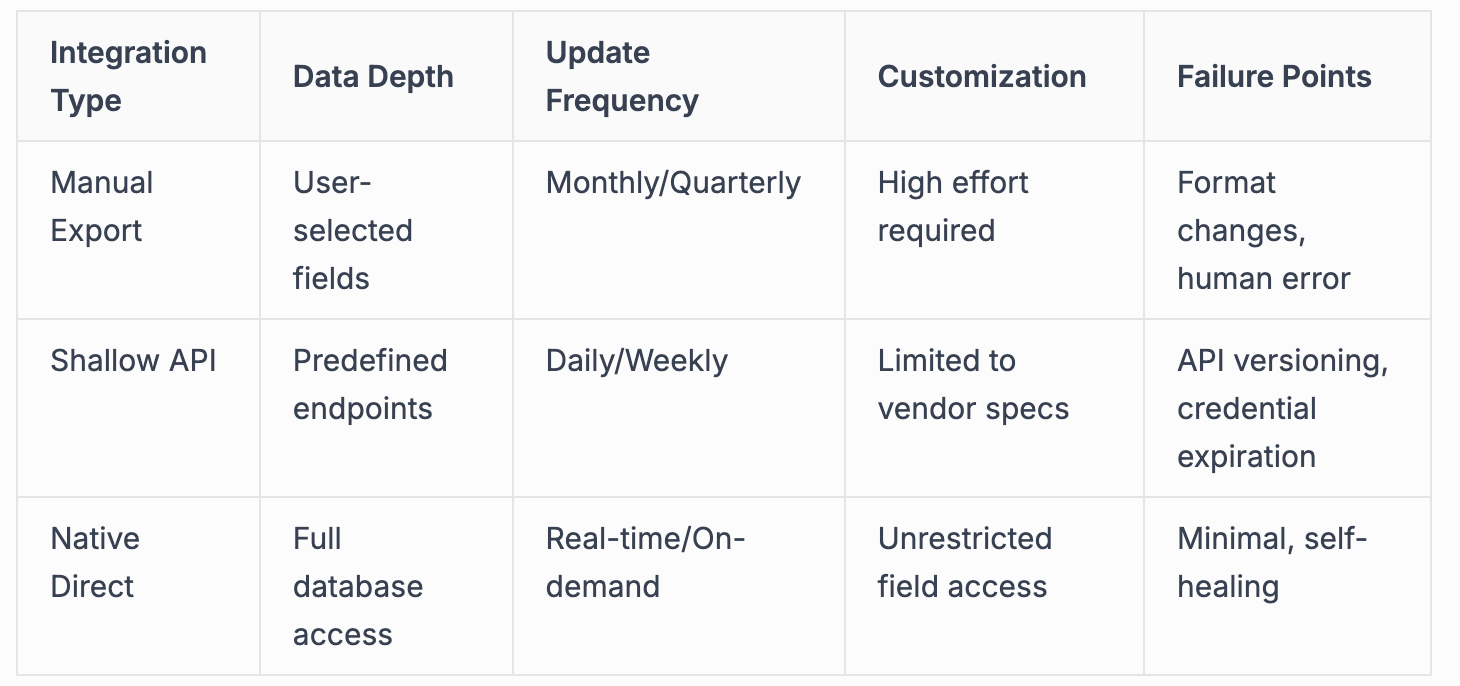
Shallow API integrations typically access standard reports and summary data that PMS vendors expose through their public APIs. This creates several operational limitations for asset management teams managing diverse portfolios.
Common limitations of shallow API connections:
Restricted to vendor-approved data endpoints rather than comprehensive database access
Cannot pull custom fields or property-specific data structures
Update frequency constrained by API rate limits and vendor policies
Breaking changes when PMS providers update API versions
Authentication failures requiring manual re-authorization every 30-90 days
The evolving role of AI in product management highlights how delegation practices require reliable, comprehensive data access. When your AI analyst can only access summary metrics rather than transaction-level detail, it cannot perform the deep financial modeling and variance analysis that drives portfolio optimization decisions.
Native Direct Integration: Autonomous Data Synchronization
The highest tier of ai pms integration establishes direct connections to property management databases, enabling unrestricted field access and real-time data synchronization without human intervention. This approach requires substantial technical investment and security infrastructure but delivers transformative operational capabilities.
Native direct integrations connect to the actual database layer of enterprise PMS platforms like Yardi Voyager, RealPage OneSite, Entrata, AppFolio Property Manager, ResMan, RentManager, and MRI Software. Rather than requesting data through limited API endpoints, these integrations read directly from source tables with appropriate security controls and audit trails.
The operational difference manifests in specific use cases that matter to portfolio operators. When a property crosses a debt service coverage ratio threshold that triggers loan covenant reporting, native integration enables immediate alert generation and automated memo creation with supporting documentation. Shallow API connections would miss this event until the next scheduled data pull, potentially hours or days later.
Evaluating Integration Depth for Portfolio Operations
Asset managers evaluating AI platforms need specific criteria to distinguish marketing claims from operational capabilities. The integration architecture fundamentally determines what becomes possible in advanced asset portfolio management.
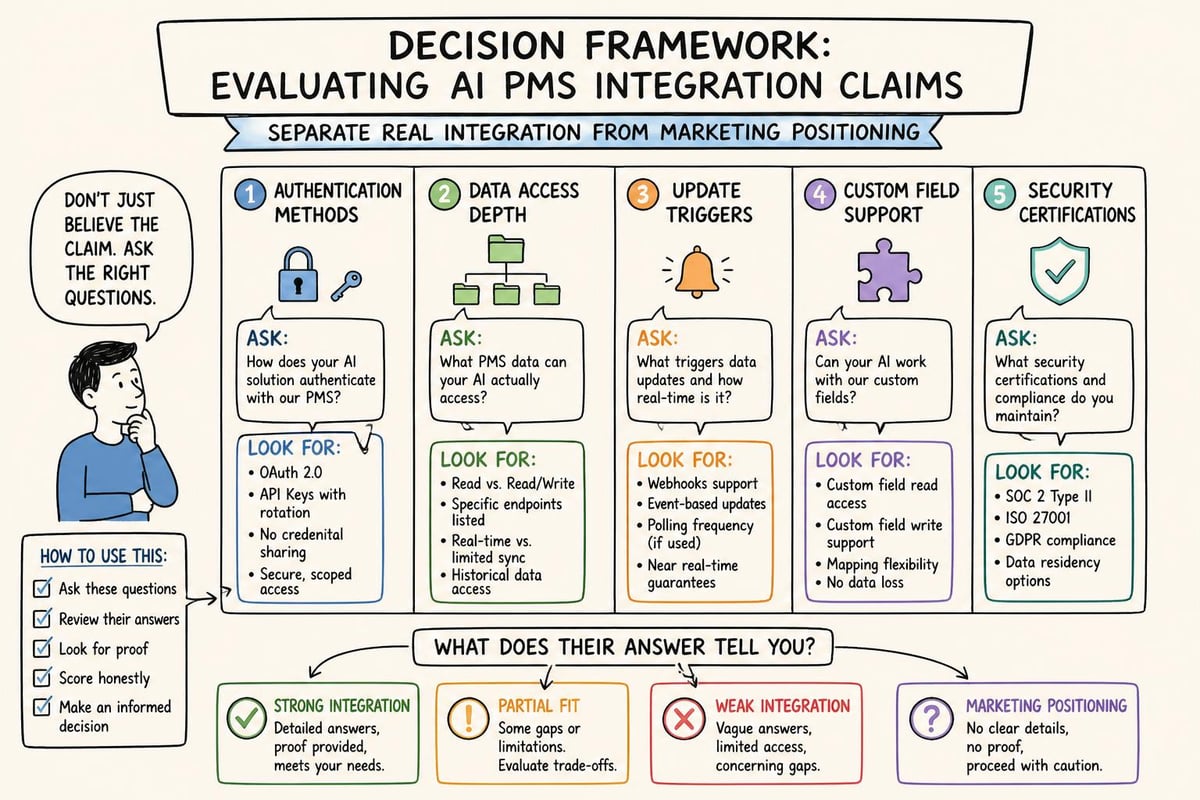
Critical evaluation questions for ai pms integration:
Does the integration pull data automatically, or does it require scheduled manual processes?
Can the system access custom fields and property-specific data structures?
How does the platform handle PMS version updates and API changes?
What happens when authentication expires or credentials need rotation?
Can the integration trigger actions based on real-time data changes?
Does the vendor maintain SOC 2 Type 2 certification for data security?
The distinction between "connects to" and "integrates with" reveals vendor positioning versus actual capability. A platform that "connects to Yardi" might simply accept Yardi exports. True integration means reading live data from Yardi Voyager's database layer with appropriate security controls.
Direct PMS Connectivity Across Enterprise Platforms
Commercial real estate portfolios rarely operate on a single property management system. Institutional asset managers typically encounter four to seven different PMS platforms across their portfolio, each acquired through different ownership transitions or managed by third-party operators with established systems.
Multi-Platform Integration Requirements
Enterprise PMS platforms requiring native connectivity:
Yardi Voyager: Dominant in institutional commercial real estate, complex database schema requiring deep integration expertise
RealPage OneSite: Common in multifamily portfolios, proprietary data structures and reporting frameworks
Entrata: Growing market share in multifamily, modern API architecture but limited historical data access
AppFolio Property Manager: Prevalent in smaller portfolio segments, cloud-native architecture
ResMan: Affordable housing and multifamily focus, compliance-specific data requirements
RentManager: Single-family rental and small multifamily properties, flexible but inconsistent implementations
MRI Software: Commercial office and retail properties, extensive customization creates integration complexity
The technical challenge extends beyond simply connecting to each platform. Data standardization across systems with different field naming conventions, calculation methodologies, and reporting periods requires sophisticated mapping logic that preserves accuracy while enabling cross-portfolio analytics.
Research on agentic AI in product management demonstrates how AI systems require consistent, structured data inputs to deliver reliable autonomous operations. When integration depth varies across PMS platforms in a portfolio, the AI analyst's effectiveness becomes limited by the weakest connection.
Automation Capabilities Enabled by Deep Integration
The real value of native ai pms integration emerges in automated workflows that eliminate repetitive analytical tasks while maintaining accuracy and auditability. Asset management teams spend substantial time on recurring reports, variance analysis, and threshold monitoring that deep integration can fully automate.
Automated Recurring Reports from Live Data
Traditional reporting processes require analysts to pull data from multiple PMS platforms, standardize formats, perform calculations, and assemble presentations. This monthly ritual consumes 20-40 hours of senior analyst time across a typical institutional portfolio.
Deep PMS integration transforms this workflow entirely. The AI data analyst connects directly to each property's PMS, pulls current data on a scheduled or on-demand basis, performs calculations according to predefined methodologies, and generates complete reports with direct source links for verification.
Automated reporting workflows enabled by native integration:
Monthly portfolio performance summaries with property-level variance analysis
Weekly occupancy and leasing velocity tracking across all properties
Daily delinquency reports with tenant payment history and collection recommendations
Quarterly financial model updates with actual vs. budget comparisons
Annual budget preparation with historical trend analysis and market comparisons
The automation extends beyond simple data aggregation. When integrated with document extraction capabilities, the AI analyst can pull lease execution data from the PMS, extract relevant terms from signed documents, validate consistency, and flag discrepancies for review.
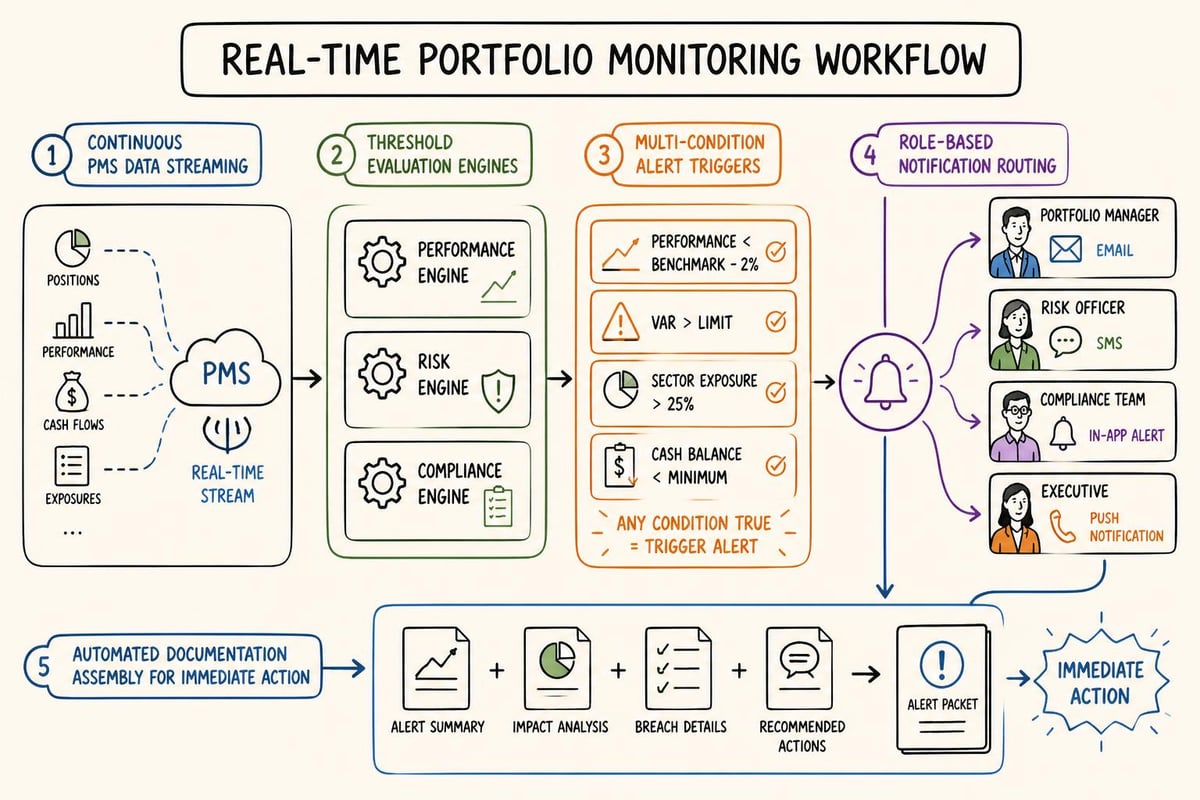
Threshold-Based Pulse Alerts for Portfolio Monitoring
Portfolio operators need immediate notification when metrics move beyond acceptable ranges. Manual monitoring requires daily review of dashboards across multiple PMS platforms, an unsustainable approach that inevitably misses critical changes.
Native ai pms integration enables sophisticated threshold monitoring that triggers alerts based on real-time data changes. These Pulse alerts notify relevant team members immediately when conditions requiring attention emerge across the portfolio.
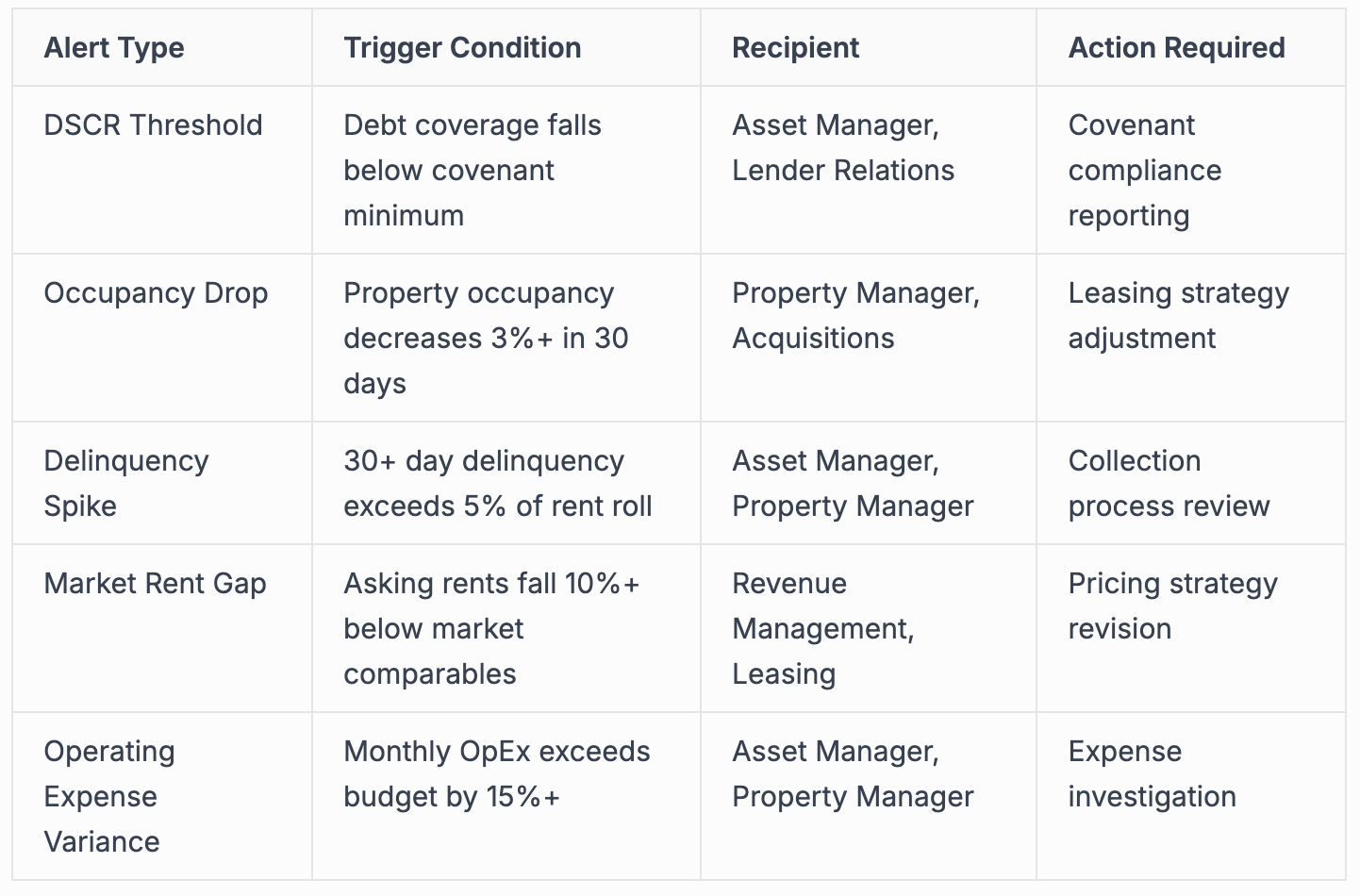
These automated monitoring systems deliver value that shallow integrations cannot match. When your AI analyst continuously monitors live PMS data rather than waiting for scheduled data pulls, it catches problems while they're still manageable rather than after they've compounded into portfolio-level issues.
Security and Compliance in Direct Database Access
Asset managers rightfully question the security implications of granting AI platforms direct access to property management databases containing sensitive financial and tenant information. The regulatory environment around data protection, fair housing compliance, and financial reporting creates legitimate concerns about integration architecture.
SOC 2 Type 2 Certification Requirements
Service Organization Control (SOC) 2 Type 2 certification represents the industry standard for data security and operational controls in software platforms handling sensitive information. This certification requires independent auditors to verify not just that appropriate security controls exist, but that they operate effectively over time.
Critical security components for ai pms integration:
End-to-end encryption for data in transit and at rest
Role-based access controls limiting data visibility to authorized users
Comprehensive audit logging of all data access and system actions
Regular penetration testing and vulnerability assessments
Incident response procedures with defined escalation paths
Data retention and deletion policies aligned with regulatory requirements
Platforms without SOC 2 Type 2 certification should raise immediate concerns about their ability to handle enterprise PMS integration securely. The certification process requires substantial investment in security infrastructure and ongoing compliance monitoring, distinguishing serious enterprise platforms from tools built for smaller market segments.
The importance of security architecture extends beyond regulatory compliance. When your AI analyst accesses data analytics in asset management through direct PMS connections, that data includes tenant social security numbers, bank account information, and sensitive financial details that create liability if compromised.
Integration Architecture for Multi-Step Autonomous Tasks
The distinguishing characteristic of purpose-built AI platforms versus general-purpose tools manifests in their ability to execute complex, multi-step analytical tasks autonomously. This capability depends entirely on integration depth and data access reliability.
From Data Pull to Deliverable Output
Consider the workflow for preparing an acquisition committee memo for a potential portfolio addition. Traditional processes require analysts to:
Export comparable property data from PMS platforms
Pull market research from multiple third-party sources
Build financial models incorporating rent rolls and operating expenses
Analyze lease rollover schedules and renewal probability
Prepare executive summary and investment recommendations
Assemble supporting documentation and source citations
Format presentation materials according to firm standards
Each step introduces potential errors, delays, and inconsistencies. When analysts manually transfer data between systems, transcription mistakes and outdated information compromise the analysis before it reaches decision-makers.
Deep ai pms integration enables the AI analyst to execute this entire workflow autonomously. It pulls current rent rolls and operating expense data directly from the PMS, accesses live source-linked market research, performs financial modeling and underwriting calculations, and assembles complete IC memos with direct links to every source document supporting each assertion.
Autonomous workflow capabilities requiring native integration:
Rent roll analysis with tenant credit evaluation and renewal probability modeling
Operating expense benchmarking against comparable properties in the portfolio
Capital expenditure planning based on property age, condition reports, and deferred maintenance schedules
Lease rollover risk assessment with market rent comparisons and re-leasing assumptions
Cash flow projections incorporating actual payment history and delinquency trends
Sensitivity analysis showing downside scenarios based on portfolio historical performance
The accuracy of these analyses depends on accessing comprehensive, current data rather than summary statistics from shallow API connections. When your AI analyst can see transaction-level detail-individual tenant payment histories, specific expense line items, actual lease terms rather than summary statistics-it delivers insights that generic analytics tools cannot match.
The Integration Depth Decision Framework
Asset managers face a binary choice when selecting AI platforms: accept shallow integration with limited automation potential, or demand native connectivity that enables transformative workflow changes. The decision framework should focus on operational outcomes rather than technical specifications.
Cost Structure Analysis: Hidden vs. Visible
The apparent cost advantage of platforms with shallow integration evaporates when accounting for ongoing manual labor requirements. If your analysts spend 30 hours monthly preparing data for AI analysis, that represents $6,000-$12,000 in fully-loaded labor costs for a typical institutional asset management team.
Compare this hidden cost against the visible subscription price of platforms with native integration. The difference in platform fees rarely exceeds the ongoing labor costs of manual data preparation, making deep integration economically advantageous even before considering the value of faster, more accurate insights.
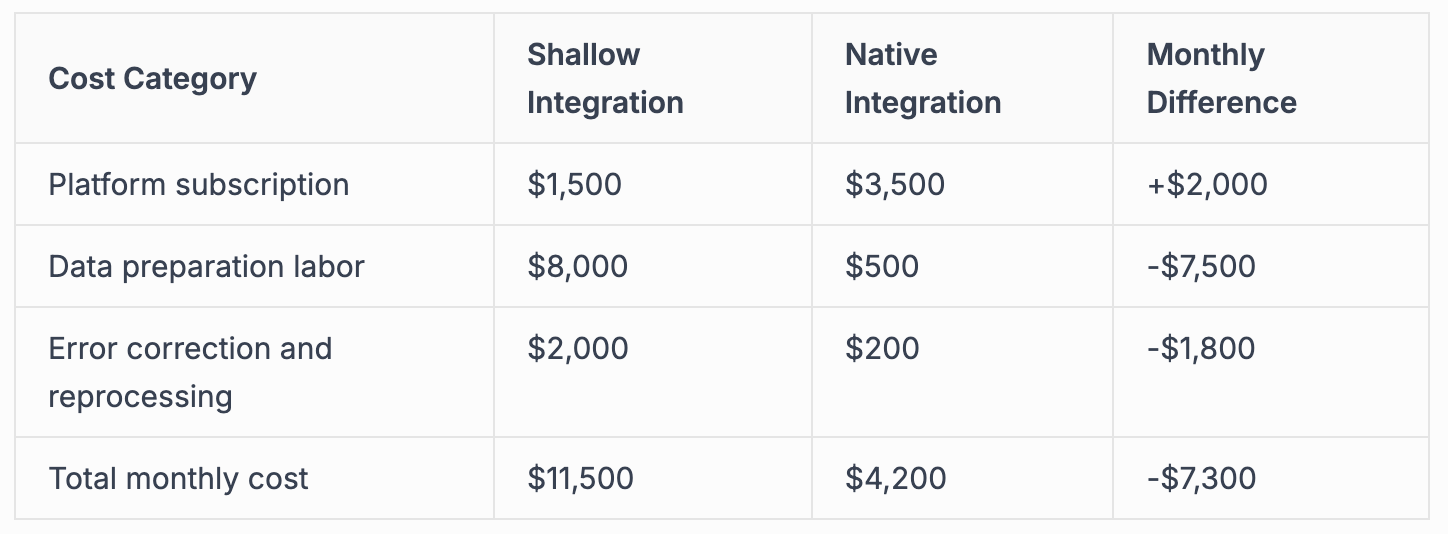
These calculations assume a mid-sized portfolio with 15-25 properties across 3-4 PMS platforms. Larger portfolios with more diverse PMS implementations show even greater cost advantages for native integration.
Workflow Disruption and Change Management
Implementing shallow AI integration requires minimal workflow changes because analysts continue performing most data preparation and validation tasks manually. This apparent advantage actually represents a missed opportunity to fundamentally improve operational efficiency.
Native ai pms integration requires upfront investment in connecting systems, establishing security protocols, and training teams on new workflows. However, this one-time disruption eliminates ongoing manual processes that consume analyst time indefinitely.
Implementation timeline comparison:
Shallow integration: 2-3 weeks to set up export templates and upload procedures, minimal technical requirements, ongoing manual processes remain
Native integration: 4-8 weeks for database connections and security audits, substantial technical requirements, eliminates manual processes permanently
The organizations seeing greatest value from AI in commercial real estate are those willing to invest in proper integration rather than seeking minimal-disruption implementations that preserve inefficient workflows.
Real Integration Checklist for Vendor Evaluation
Asset managers need a concrete framework for evaluating whether vendors deliver actual ai pms integration or simply accept manual data uploads. This checklist separates marketing claims from operational capabilities.
Authentication and access methodology:
Does the vendor connect using OAuth or similar secure authentication methods?
Can the integration operate continuously without manual credential renewal?
Does the vendor request read-only database access rather than requiring admin credentials?
Are connection credentials stored using enterprise-grade encryption?
Data access depth and breadth:
Can the platform access custom fields and property-specific data structures?
Does integration extend to transaction-level detail or only summary reports?
Can the system pull historical data for trend analysis and benchmarking?
Does the vendor maintain field mapping documentation for each supported PMS?
Update frequency and automation:
Does data synchronization occur automatically without manual triggering?
Can the platform pull data in real-time or on-demand rather than scheduled batches?
How quickly do PMS changes appear in the AI analyst's working dataset?
Does the vendor provide latency specifications for data synchronization?
Error handling and reliability:
What happens when the PMS platform undergoes maintenance or version updates?
Does the integration include automatic retry logic for temporary connection failures?
How does the vendor communicate integration issues to clients?
What service level agreements cover integration uptime and reliability?
Security and compliance framework:
Does the vendor maintain current SOC 2 Type 2 certification?
Can integration activity be audited for compliance reporting?
Does the platform support role-based access controls for data visibility?
How does the vendor handle data retention and deletion requirements?
Multi-platform portfolio support:
Does the vendor support all PMS platforms in your current portfolio?
Can the integration standardize data from different PMS systems for cross-portfolio analysis?
How does the vendor handle acquisitions that introduce new PMS platforms?
Does pricing scale linearly with the number of PMS connections required?
This evaluation framework reveals that most "AI platforms for commercial real estate" fail basic integration requirements. When vendors cannot provide specific answers about authentication methods, data access depth, or update frequency, they likely offer manual export workflows rather than genuine integration.
Integration Depth as Competitive Advantage
The commercial real estate industry operates on compressed decision timelines where information advantages translate directly to investment returns. When an off-market acquisition opportunity emerges, the first qualified buyer to submit a credible offer often wins regardless of whether they're offering the absolute highest price.
Native ai pms integration creates this information advantage by eliminating the delay between "we need analysis on this opportunity" and "here's the complete underwriting with comps from our existing portfolio." Asset managers operating with deep integration complete analyses in hours that would require days using manual data preparation workflows.
The advantage compounds over time as the AI analyst ingests more portfolio data. Unlike general-purpose AI tools that treat each analysis as independent, purpose-built platforms with comprehensive PMS access build institutional knowledge about your portfolio's performance characteristics, tenant behaviors, and market positioning.
Cumulative advantages of deep ai pms integration:
Portfolio-specific benchmarking showing how new acquisitions compare to existing assets
Tenant credit analysis leveraging payment history across multiple properties
Operating expense expectations based on actual portfolio performance rather than industry averages
Market positioning insights from tracking rent growth and occupancy across your portfolio
Risk assessment incorporating actual rather than theoretical downside scenarios
These capabilities explain why sophisticated institutional investors demand native PMS integration rather than accepting shallow connections or manual workflows. The question isn't whether deep integration provides value-it's whether organizations can afford to operate without it in an increasingly competitive acquisition environment.
Making the Integration Decision
The ai pms integration decision ultimately determines whether your AI analyst becomes a strategic tool that transforms portfolio operations or another system requiring constant manual feeding that delivers modest incremental improvements. Asset managers should evaluate integration depth with the same rigor applied to PMS selection itself, recognizing that the two systems must work together to deliver operational value.
The evaluation checklist provided above offers a starting point, but the fundamental question remains simple: does the platform eliminate manual data preparation work, or does it simply add another system requiring human intervention? Vendors claiming "integration" while requiring monthly CSV uploads fail this basic test regardless of their other capabilities.
For asset management teams managing portfolios across Yardi, RealPage, Entrata, and other enterprise platforms, the integration architecture decision carries long-term implications. Shallow integrations may appear adequate during initial demos, but operational reality reveals their limitations as teams attempt to scale usage across diverse portfolios and complex analytical requirements.
The investment in proper integration-both the platform subscription costs and the implementation effort-pays returns through eliminated manual labor, faster decision cycles, and more accurate analysis based on comprehensive current data rather than stale exports. Organizations committed to operational excellence recognize that integration depth represents a competitive advantage worth pursuing despite higher upfront costs and implementation complexity.
The gap between marketing claims and operational reality in ai pms integration costs asset management teams hundreds of hours annually in manual data work and missed opportunities from delayed analysis. Asset managers evaluating AI platforms must demand specific evidence of native database connectivity, automated data synchronization, and comprehensive security certifications rather than accepting vendor assurances about "seamless integration." Leni delivers the native PMS connectivity that institutional portfolios require, with direct connections to Yardi, RealPage, Entrata, AppFolio, ResMan, RentManager, and MRI Software that eliminate manual exports and enable autonomous multi-step analytical workflows with SOC 2 Type 2 certified security. See how deep integration transforms portfolio operations rather than just adding another dashboard to your workflow.

Johanna Gruber
Johanna has spent the last 8 years helping marketing teams connect with audiences through content. Specializing in B2B SaaS and real estate.

Curious About AI?
Join the largest AI community for real estate online. Get bite-sized, real-world use case videos, plus practical tips and proven strategies from top industry experts on adopting AI effectively.
MEET LENI
AI SuperAgent Purpose Built for Investors and Operators.
Experience how professionals and teams in your domain are getting the edge using AI.
