AI Tools for Business Analysts: General vs Purpose-Built

AI Tools for Business Analysts: General vs Purpose-Built
The proliferation of AI tools for business analysts has created a critical choice: adopt general-purpose platforms that promise to do everything, or invest in purpose-built systems designed for specific analytical workflows. Most guidance materials focus exclusively on mainstream options like ChatGPT, Microsoft Copilot, and generic business intelligence platforms, overlooking a fundamental problem. These general tools lack domain reasoning, cannot verify their outputs against source documents, and fail when analytical tasks require multi-step execution over hours or days. For commercial real estate asset managers, acquisitions professionals, and portfolio operators, this distinction determines whether AI becomes a productivity multiplier or another abandoned experiment.
The General-Purpose AI Trap
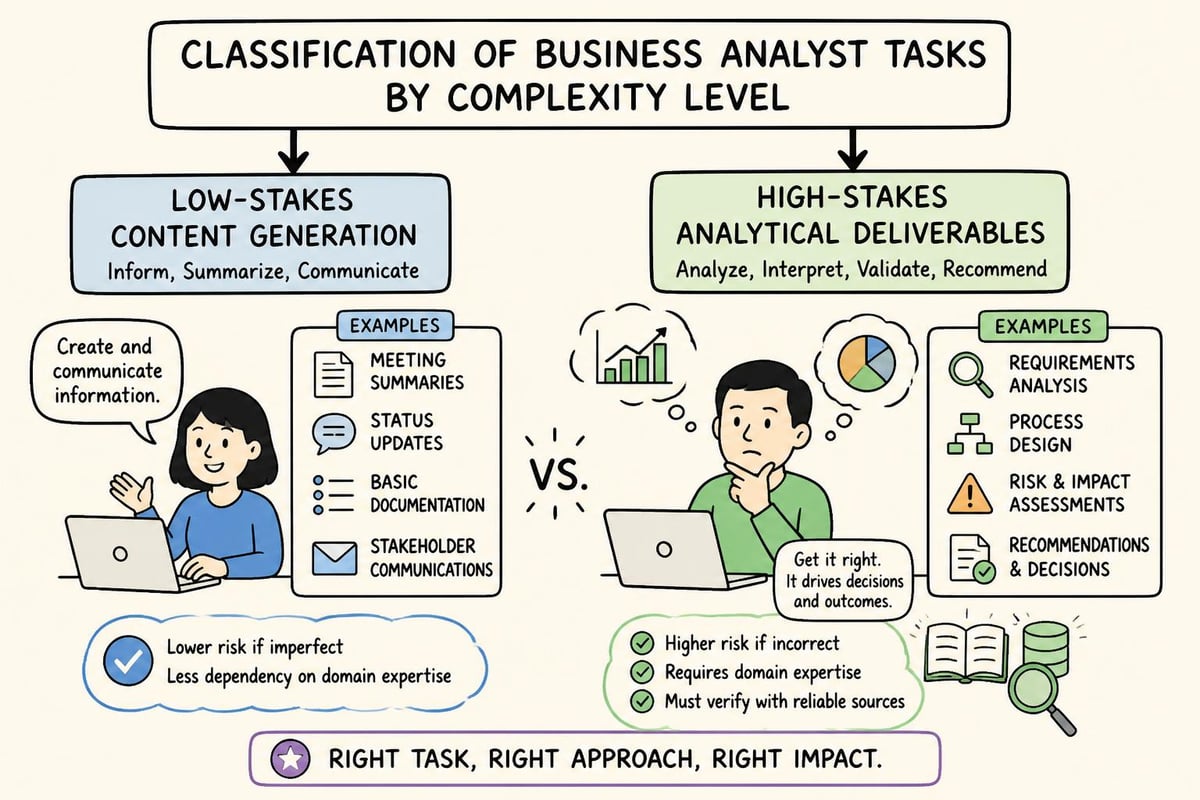
General ai tools for business analysts like ChatGPT, Claude, and Microsoft Copilot excel at short-burst tasks: drafting emails, summarizing meeting notes, generating initial research outlines. They process natural language queries and return immediate responses, making them accessible and appealing for quick wins.
The breakdown occurs when analytical work requires domain expertise and verifiable accuracy. Ask a general-purpose tool to build a commercial real estate underwriting model, and you receive formulas without market context. Request variance analysis between budgeted and actual NOI, and the output lacks connections to underlying lease documents or financial statements.
Key limitations of general AI platforms:
No domain-specific reasoning frameworks
Inability to run multi-hour analytical processes autonomously
No direct integration with industry systems (property management software, financial databases)
Outputs cannot be traced back to source documents
No workflow automation for recurring analytical tasks
A 2026 survey by TechRadar covering AI tools confirms this pattern: general platforms rank highest for accessibility but lowest for specialized analytical accuracy. The tools that appear most versatile often deliver the least reliable results when precision matters.
When General Tools Work
General-purpose ai tools for business analysts serve specific functions effectively. Content ideation, first-draft creation, and pattern detection in qualitative data represent appropriate use cases outlined in practical insights from business analysis experts.
Effective applications:
Meeting transcription and summary generation
Email template creation and response drafting
Preliminary competitive research gathering
Brainstorming session facilitation
Simple data formatting and cleanup
These tasks share common characteristics: low stakes, tolerance for minor errors, and human review before distribution. They complement rather than replace core analytical work.
Purpose-Built Analyst Platforms
Purpose-built ai tools for business analysts start from a different premise: analytical work demands domain knowledge, verifiable accuracy, and the ability to execute complex workflows autonomously. These platforms embed industry-specific logic, integrate directly with operational systems, and produce outputs that link back to source documents.
The difference becomes clear through finished deliverables. A purpose-built platform for commercial real estate doesn't just generate underwriting formulas. It produces a complete financial model with market-rate assumptions sourced from comparable properties, rent roll analysis extracted from actual lease documents, and variance explanations tied to specific line items in property management systems.
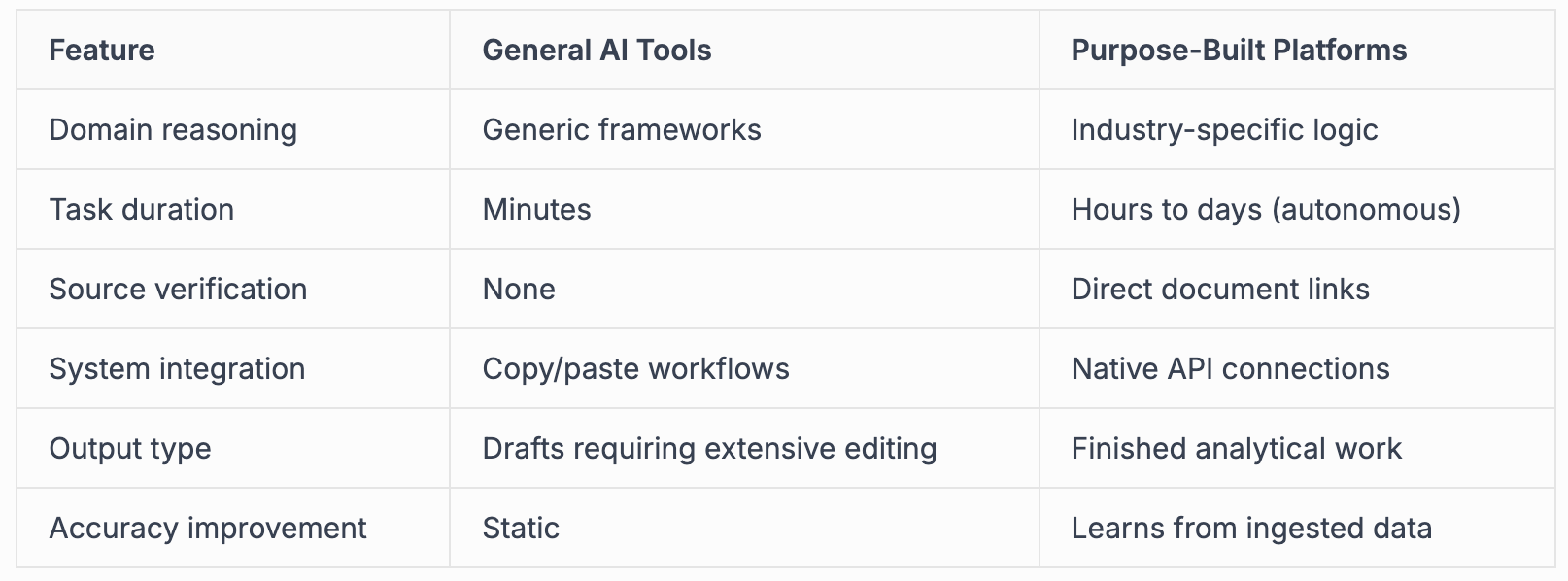
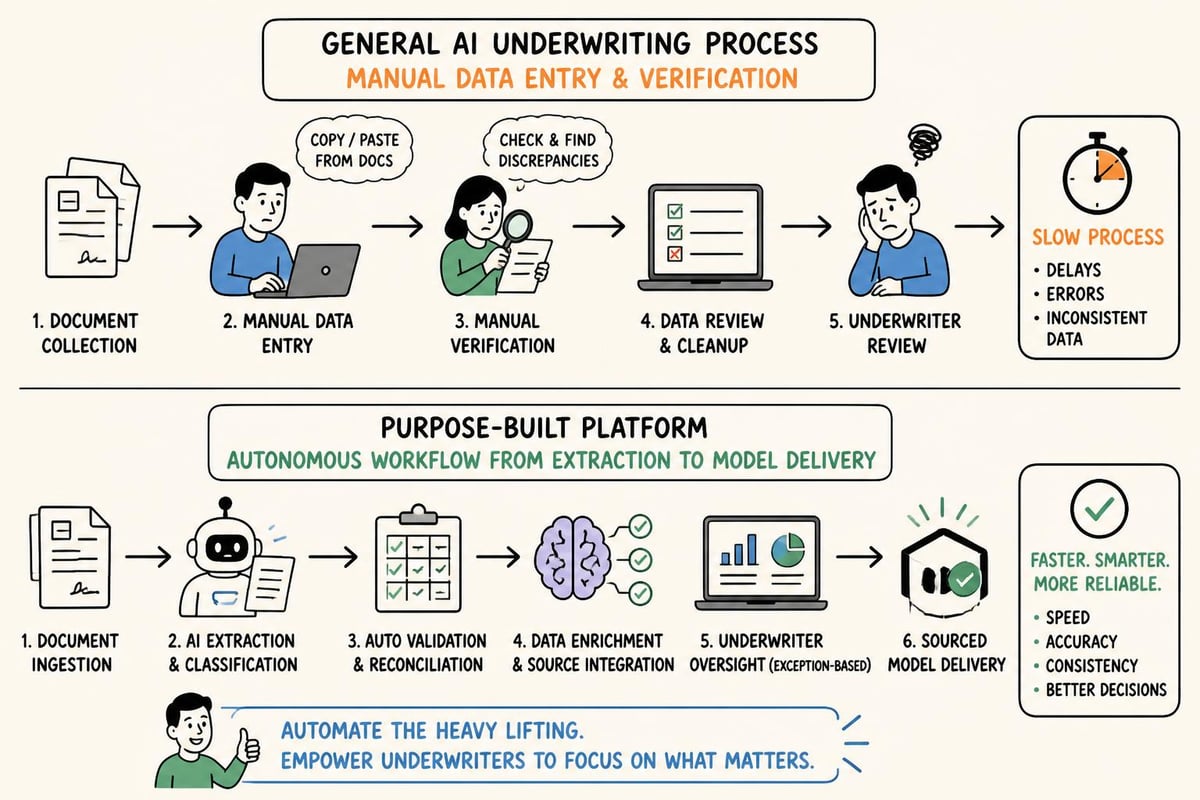
Consider the investment committee memo workflow common in commercial real estate. General AI requires manual data gathering, document uploading in fragments, repeated prompting, and extensive fact-checking. A purpose-built platform extracts financial data from offering memorandums, pulls comparable transactions from market databases, generates analysis automatically, and delivers a sourced memo ready for executive review.
The Integration Spectrum
The most sophisticated purpose-built ai tools for business analysts operate across an integration spectrum. Entry-level users without direct system connectivity can upload documents (PDFs, spreadsheets, lease agreements) and receive source-linked analysis immediately. Teams with property management system access to platforms like Yardi, RealPage, and Entrata unlock automated recurring workflows.
This flexibility matters because it eliminates the adoption barrier that kills many enterprise software initiatives. Analysts gain value from day one, regardless of their organization's technical infrastructure. As data analytics capabilities in asset management mature, the platform scales with them.
Integration levels:
Document upload: Immediate value for individual analysts
Database connection: Automated data refresh for recurring reports
PMS integration: Full workflow automation across portfolio operations
Custom workflows: Multi-step processes tailored to organizational requirements
Evaluating AI Tools Against Real Analytical Work
The evaluation framework for ai tools for business analysts should center on finished deliverables, not feature lists. What does the platform produce after hours of autonomous work? Can you trace every number back to a source document? Does the analysis reflect domain expertise or generic reasoning?
Financial Modeling and Underwriting
Commercial real estate underwriting demands precision. A single miscalculated rent escalation compounds across a ten-year hold period, distorting IRR and equity multiple projections. General AI tools generate pro forma templates but cannot validate assumptions against market data or flag inconsistencies between rent rolls and lease terms.
Purpose-built platforms like Leni's financial modeling and underwriting solution execute the complete workflow: extract rent rolls from property management systems, cross-reference lease terms from scanned documents, apply market-rate growth assumptions from comparable properties, and deliver a sourced model with variance explanations. The analyst reviews and refines rather than building from scratch.
This approach aligns with how real estate AI tools should function: augmenting expertise rather than requiring constant supervision.
Document Extraction at Scale
Lease abstraction represents another breaking point for general AI. A portfolio operator reviewing acquisition targets needs every critical lease term extracted: expiration dates, renewal options, tenant improvement allowances, percentage rent provisions, co-tenancy clauses. Manual extraction takes days per property. General AI extracts inconsistently and requires extensive validation.
Purpose-built document extraction platforms process hundreds of pages autonomously, maintain extraction consistency across properties, flag unusual terms for review, and link every extracted data point back to the source page. The analyst validates exceptions rather than processing everything manually.
Market Research with Source Verification
Investment committees demand sourced market research. "Comparable properties show 4.2% rent growth" requires citations: which properties, what time period, which data provider. General AI synthesizes information without maintaining source links. Every assertion requires manual fact-checking.
Purpose-built platforms for market research deliver sourced analysis automatically. Rent growth statistics link to specific comparable properties. Supply pipeline data references municipal permit databases. Demographic trends cite census sources. The analyst reviews conclusions knowing the evidence trail exists.
According to comprehensive guidance on AI tools for business analysts, this source verification capability separates professional-grade AI from consumer tools.
The Commercial Real Estate Standard
Commercial real estate asset management requires analytical rigor that general ai tools for business analysts cannot deliver consistently. Portfolio operators need variance reports that explain every NOI deviation above threshold. Acquisitions teams need underwriting models that withstand investment committee scrutiny. Asset managers need quarterly reporting that connects property-level performance to portfolio strategy.
Leni exemplifies the purpose-built approach. The platform runs as an AI analyst for commercial real estate, handling financial modeling, document extraction from leases and offering memorandums, IC memo creation, market research with source links, and workflow automation. Unlike general-purpose AI, Leni executes multi-step tasks autonomously and connects directly to property management systems.
Leni's operational model:
Subscribers without PMS connectivity upload documents (PDFs, Excel files, lease scans) and receive source-linked analysis, underwriting models, and market research immediately
Teams with Yardi, RealPage, or Entrata integration get automated recurring workflows: variance reports that update monthly, portfolio dashboards that refresh automatically, alert systems that flag lease expirations
SOC 2 Type 2 certification ensures enterprise-grade security
Accuracy improves as the platform ingests more property data
This accessibility regardless of integration level addresses the primary barrier to AI adoption in commercial real estate: the perception that value requires extensive technical infrastructure. An analyst can start using Leni this afternoon by uploading acquisition documents, receiving a complete underwriting model and market analysis, and presenting findings tomorrow.
The platform handles reporting and asset management workflows that consume hours weekly: budget-versus-actual analysis, portfolio performance dashboards, investor reporting packages. As organizations mature their portfolio management capabilities, Leni scales from individual analyst productivity tool to portfolio-wide automation platform.
Choosing the Right Platform
The decision framework for selecting ai tools for business analysts depends on task complexity and output requirements. Organizations should map their analytical workflows against these criteria before evaluating specific platforms.
Decision Matrix
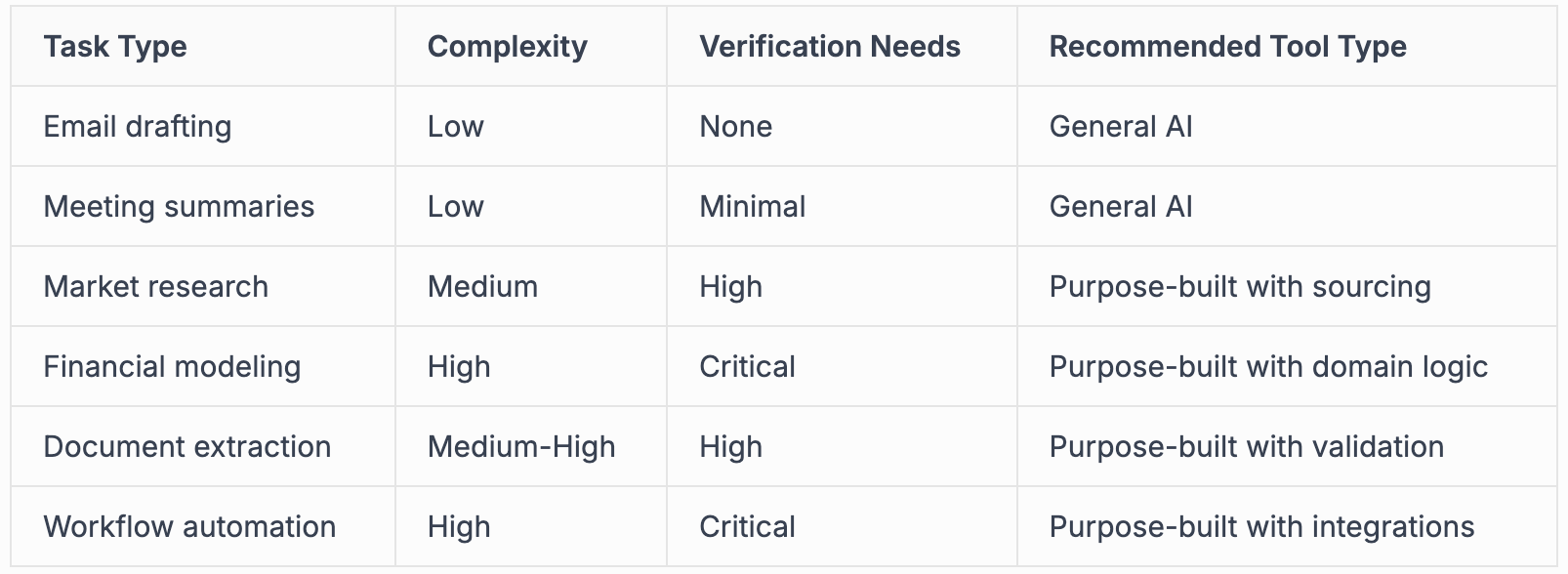
Organizations often benefit from a dual approach: general AI for low-stakes content work, purpose-built platforms for analytical deliverables that inform investment decisions. The key insight from AI tools beneficial for business analysts centers on matching tool capabilities to task requirements rather than forcing versatile platforms into specialized roles.
Implementation Strategy
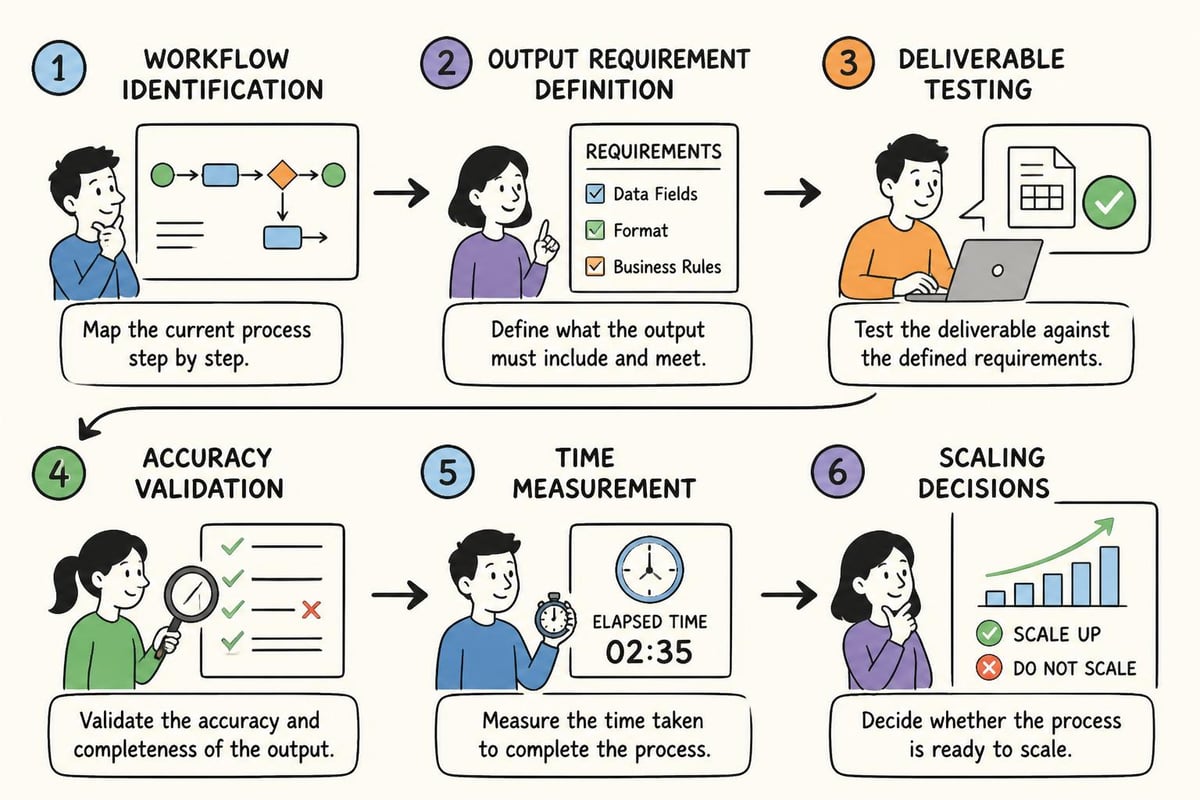
Successful AI adoption follows a phased approach:
Identify high-value analytical workflows that consume disproportionate time relative to strategic impact
Evaluate output requirements: Does this work demand source verification? Does it require domain-specific reasoning?
Test with real deliverables: Request the platform to produce finished work, not demonstrations
Validate accuracy: Check every number, trace every assertion to sources
Measure time savings: Compare autonomous execution time to manual analytical processes
Scale gradually: Expand from individual analysts to team-wide workflows
This methodology prevents the common mistake of selecting AI based on marketing promises rather than delivered results. Business analysis platforms should prove their value through finished analytical work before organizations commit to enterprise rollouts.
Beyond Traditional Business Intelligence
Traditional business intelligence platforms like Tableau, Power BI, and Looker serve visualization and dashboard functions. They excel at presenting data but require analysts to perform the underlying analytical work: building models, extracting insights, explaining variances, sourcing market data.
Modern ai tools for business analysts operate differently. They execute the analytical work itself, producing finished deliverables rather than visualization frameworks. This represents a fundamental shift in how analytical teams allocate time.
Traditional BI workflow:
Analyst extracts data from multiple systems manually
Analyst builds financial models in Excel
Analyst researches market comparables
Analyst writes variance explanations
Analyst creates visualizations in BI tool
Total time: 8-12 hours for quarterly portfolio report
AI analyst workflow:
Platform extracts data from connected systems automatically
Platform builds sourced financial models with domain logic
Platform researches comparables and maintains source links
Platform generates variance explanations tied to specific line items
Platform delivers finished report with embedded visualizations
Total time: 2 hours for analyst review and refinement
The time savings compound across recurring workflows. Monthly variance reports, quarterly investor packages, acquisition underwriting, and lease analysis all benefit from autonomous execution rather than manual processing.
Commercial real estate firms implementing AI automation report 60-80% time reduction on routine analytical work, freeing senior analysts to focus on strategic recommendations rather than data processing.
The Accuracy Question
The most common objection to ai tools for business analysts centers on accuracy concerns. If general AI hallucinates facts and generates plausible-sounding errors, how can organizations trust AI-generated analytical work?
The answer lies in verification architecture. General-purpose AI operates without source tracking, making validation impossible without manual fact-checking. Purpose-built platforms maintain direct links between every output and its source document.
When a platform generates a variance explanation stating that parking income declined 8.3% due to reduced occupancy at a specific property, that assertion should link directly to the financial statement line item and the occupancy report from the property management system. When market research cites 4.2% rent growth, that figure should reference specific comparable transactions with dates and sources.
This verification capability transforms AI from a productivity risk into a scalable analytical resource. Analysts review conclusions and validate logic rather than checking every calculation manually. Organizations implementing AI data analyst platforms establish review protocols based on materiality thresholds: outputs below defined dollar amounts or variance percentages require standard review; outliers trigger detailed validation.
Learning Systems
The most sophisticated ai tools for business analysts improve accuracy through data ingestion. Generic platforms trained on public internet data lack commercial real estate context. Purpose-built platforms that ingest property-specific data (lease terms, historical financials, market transactions, operating metrics) develop increasingly accurate domain reasoning.
Leni's architecture exemplifies this approach: the more lease documents the platform processes, the better it recognizes standard versus unusual terms. The more underwriting models it builds, the more accurately it applies market-rate assumptions. The more variance reports it generates, the more precisely it explains performance deviations.
This learning mechanism creates compound value over time. Early adopters invest effort in platform training through document uploads and workflow refinement. Later users inherit that accumulated knowledge, receiving more accurate outputs from day one.
Marketing and Content Intersections
While ai tools for business analysts focus primarily on data analysis and financial modeling, forward-thinking firms recognize content creation opportunities. Investor communications, market commentary, acquisition summaries, and thought leadership all benefit from AI augmentation.
Platforms like AdsRaw demonstrate how AI transforms content production in adjacent domains. By generating realistic user-generated content style video ads without hiring creators, organizations test messaging quickly and cost-effectively. The same principles apply to business analysis: rapid iteration on content variations, data-driven performance measurement, and continuous optimization.
Commercial real estate firms increasingly leverage AI for SEO content creation through platforms like RankPill, automating blog post generation and competitor keyword analysis. This content marketing capability complements analytical work, allowing asset management teams to demonstrate expertise through regular market commentary without diverting analyst time from core responsibilities.
The intersection matters because modern business analysts increasingly own external communication alongside internal analysis. The ability to transform analytical findings into investor-ready narratives, market reports, and acquisition summaries extends the value of ai tools for business analysts beyond pure number-crunching.
Integration with Property Management Systems
The most powerful ai tools for business analysts in commercial real estate connect directly to property management systems. Yardi, RealPage, and Entrata contain the operational data that drives analytical work: rent rolls, ledgers, maintenance requests, lease terms, tenant communications.
Manual data extraction from these systems consumes hours weekly. Analysts export reports, reformat data, cross-reference inconsistencies, and build analytical models in separate tools. Each monthly reporting cycle repeats this process.
Direct PMS integration eliminates manual extraction. The AI platform queries property management systems automatically, maintains data freshness through scheduled updates, and executes analytical workflows without human intervention. Monthly variance reports generate automatically. Portfolio dashboards refresh overnight. Alert systems flag lease expirations and renewal deadlines.
Organizations implementing advanced portfolio management systems report that PMS integration delivers the highest ROI among technology initiatives. The combination of autonomous execution and verifiable accuracy transforms analytical capacity.
Integration implementation:
API connections established during initial platform setup
Data mapping configured to align PMS fields with analytical frameworks
Workflow automation rules defined based on organizational requirements
Security protocols validated to meet SOC 2 and enterprise standards
Scheduled execution configured for recurring analytical tasks
The critical insight: organizations don't need PMS integration to gain value from purpose-built AI. Individual analysts upload documents and receive immediate analytical support. As teams mature their technical capabilities, PMS integration scales that value across entire portfolios.
The 2026 Landscape
The evolution of ai tools for business analysts accelerates in 2026. General-purpose platforms continue improving at conversational interfaces and content generation. Purpose-built systems deepen domain expertise and expand workflow automation.
According to future trends in business analysis, the distinction between these categories widens rather than narrows. Organizations that selected general AI for specialized analytical work face increasing accuracy and verification challenges. Teams that adopted purpose-built platforms benefit from continuous learning and expanding capabilities.
The commercial real estate sector exemplifies this divergence. Generic business intelligence platforms cannot match the domain reasoning required for acquisition underwriting, lease analysis, or portfolio variance reporting. Purpose-built platforms like Leni designed specifically for CRE deliver increasingly sophisticated analytical capabilities as they ingest more property data.
2026 platform capabilities:
Autonomous multi-day analytical processes requiring no human intervention
Predictive modeling that forecasts portfolio performance based on historical patterns
Natural language query interfaces that generate custom analytical deliverables
Automated workflow orchestration across acquisition, asset management, and reporting
Real-time collaboration where multiple analysts interact with shared AI-generated work
These capabilities position purpose-built AI as infrastructure rather than tools. Organizations build analytical processes around AI capabilities, with human analysts focusing on strategic interpretation and decision-making rather than data processing.
Building the Evaluation Framework
Organizations selecting ai tools for business analysts should develop structured evaluation criteria based on their specific analytical requirements. Generic feature comparisons miss the essential question: What finished deliverables does this platform produce autonomously?
Evaluation framework components:
Task complexity: Can the platform execute multi-step workflows without human intervention?
Domain reasoning: Does the platform apply industry-specific logic and market context?
Source verification: Can every output be traced to source documents?
Integration capability: Does the platform connect to operational systems or require manual data upload?
Accuracy validation: How does the platform ensure and improve output accuracy?
Scalability: Does value increase as organizational adoption expands?
Testing should involve real analytical scenarios from the organization's current workload. Request the platform to generate a complete underwriting model from offering memorandum documents. Ask for portfolio variance analysis with explanations. Demand market research with source citations. Evaluate the finished deliverables against analyst-produced work.
Organizations implementing this rigorous evaluation process consistently select purpose-built platforms over general-purpose AI for mission-critical analytical work, while maintaining general AI for appropriate low-stakes applications. The comprehensive review of analytical tools confirms this pattern across industries.
The choice between general-purpose and purpose-built ai tools for business analysts ultimately depends on output requirements and task complexity. Organizations need both: general AI for content and communication, purpose-built platforms for analytical deliverables that inform investment decisions. For commercial real estate professionals managing portfolios, underwriting acquisitions, or producing investor reporting, Leni delivers the domain expertise and verifiable accuracy that general tools cannot match. Start with document uploads for immediate analytical support, scale to PMS integration for portfolio-wide automation, and experience how purpose-built AI transforms analytical capacity from day one.

Johanna Gruber
Johanna has spent the last 8 years helping marketing teams connect with audiences through content. Specializing in B2B SaaS and real estate.

Curious About AI?
Join the largest AI community for real estate online. Get bite-sized, real-world use case videos, plus practical tips and proven strategies from top industry experts on adopting AI effectively.
MEET LENI
AI SuperAgent Purpose Built for Investors and Operators.
Experience how professionals and teams in your domain are getting the edge using AI.
