CRE Analyst Workflow: From OM to IC Memo in Hours, Not Days

CRE Analyst Workflow: From OM to IC Memo in Hours, Not Days
A seasoned CRE analyst receives a 48-page offering memorandum on Monday morning. By Thursday afternoon, the investment committee wants a complete package: extracted lease data, pro forma model, market comparables, risk assessment, and an executive summary. The reality? Most teams lose 60% of that time to manual document extraction and data entry before the real analytical work even begins. In competitive markets where the best deals move in days, not weeks, this delay is the difference between winning and watching from the sidelines.
Understanding the CRE Analyst Role in 2026
The modern CRE analyst operates at the intersection of finance, real estate fundamentals, and increasingly, technology. Your primary responsibility centers on converting raw property information into actionable investment decisions. This means building financial models that capture every revenue assumption, examining lease structures that determine cash flow stability, and synthesizing market data that validates pricing.
Core responsibilities that define the role include:
Financial modeling and sensitivity analysis for acquisition targets
Lease abstraction and rent roll verification across property types
Market research and comparable sales analysis
Investment committee memo preparation and presentation support
Portfolio monitoring and variance reporting post-acquisition
The challenge is straightforward: every hour spent copying lease terms from PDFs is an hour not spent analyzing whether the deal actually makes sense. Training programs for CRE analysts emphasize technical skills, but the bottleneck in most firms isn't knowledge but capacity.
The Path to Conviction Starts With Document Review
You open the offering memorandum and immediately face a decision tree. Which data points matter for this asset class? What assumptions need verification before they enter your model? A multifamily property requires unit mix analysis, rent roll accuracy checks, and expense ratio validation. An office building demands lease expiration schedules, tenant credit analysis, and capital expenditure forecasts.
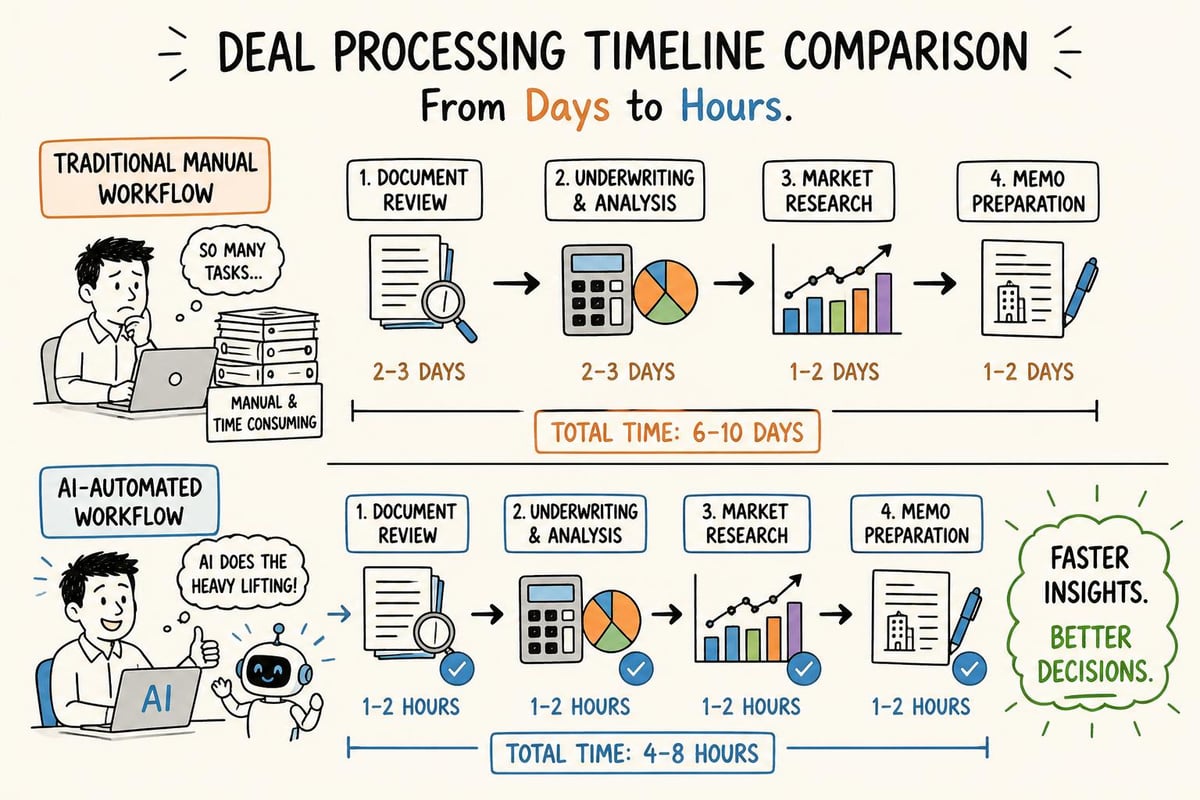
Manual extraction from offering memoranda typically consumes 6-8 hours for a standard acquisition package. You're hunting through PDFs for current rent rolls, scanning for embedded lease options, and cross-referencing operating statements against industry benchmarks. The document extraction process represents pure data transfer, yet it remains the first bottleneck in most deal workflows.
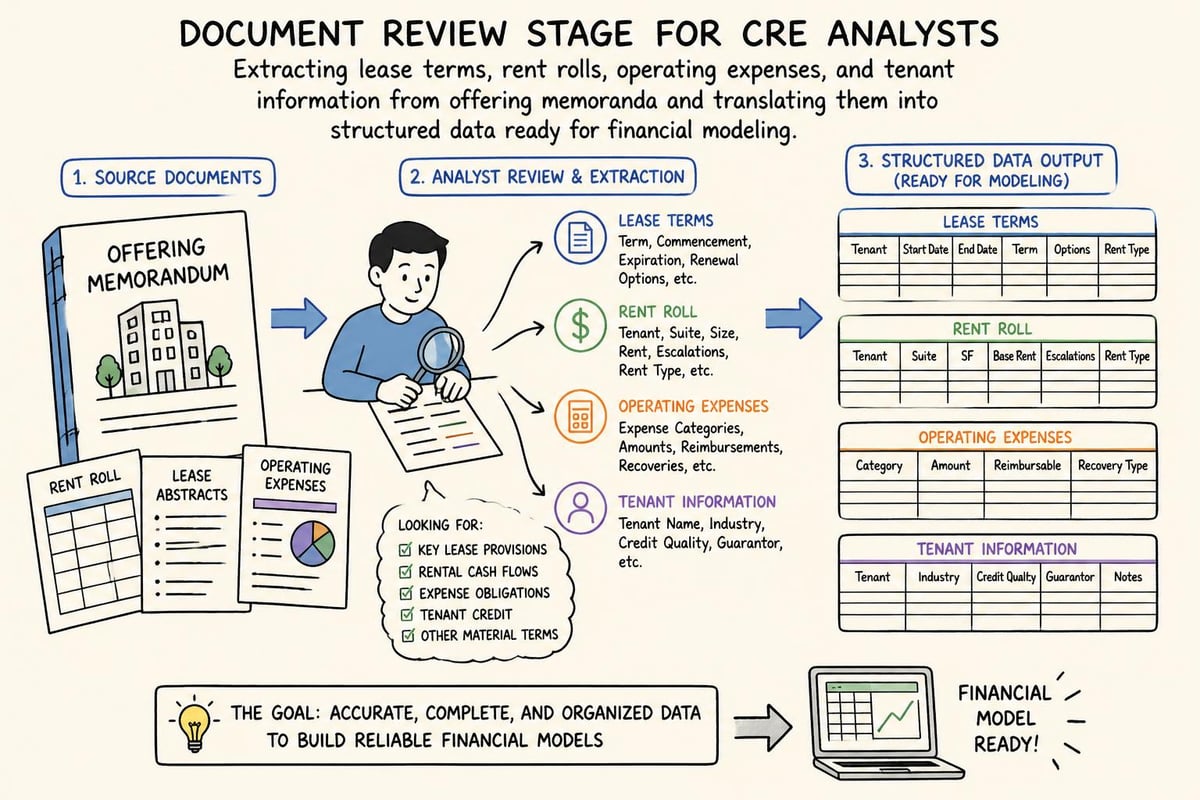
Document TypeManual Processing TimeKey Data PointsVerification RequirementsOffering Memorandum4-6 hoursProperty overview, financials, market positionCross-reference with public recordsRent Roll2-3 hoursUnit details, lease terms, rental ratesValidate against lease documentsOperating Statements1-2 hoursIncome breakdown, expense categories, NOICompare to industry benchmarksLease Abstracts3-4 hours per leaseTerms, options, escalations, TI allowancesLegal review for material terms
Building the Underwriting Model That Stands Up to Scrutiny
Once you've extracted the data, the real analytical work begins. Your underwriting model needs to capture base case assumptions, stress test key variables, and present returns across multiple scenarios. A robust CRE analyst builds models that can answer the IC's toughest questions before they're asked.
Essential components of a defensible underwriting model:
Revenue projections grounded in market rent analysis and realistic absorption assumptions
Operating expense forecasts that account for property-specific cost drivers and inflation
Capital expenditure planning tied to building condition assessments and lease rollover requirements
Exit assumptions supported by cap rate trends and comparable sale transactions
Return calculations across IRR, equity multiple, cash-on-cash, and yield on cost metrics
The modeling phase typically requires 8-12 hours for a standard acquisition, longer for complex deals with multiple revenue streams or partnership structures. You're not just plugging in numbers but validating every assumption against market reality. Financial modeling and underwriting capabilities determine whether your analysis holds up under pressure.
Market Research That Validates Your Assumptions
Your pro forma shows a 15% IRR, but does the market support your exit cap rate? Can you actually achieve those rental increases? The market research phase separates hopeful projections from credible forecasts. You need current comparable sales, rent surveys from competing properties, and demographic trends that support demand assumptions.
This stage introduces another time sink. Pulling CoStar data, reviewing recent transactions, calling brokers for off-market intelligence, and synthesizing findings into a cohesive narrative consumes 4-6 hours minimum. The market research process must deliver source-linked validation for every material assumption in your model.
Critical market research deliverables include:
Comparable sales analysis with adjustments for property condition, location, and timing
Rental rate surveys showing effective rents, concession packages, and absorption trends
Supply pipeline assessment quantifying competitive new construction
Demographic and employment data supporting demand forecasts
Submarket performance metrics relative to broader market trends
A thorough CRE analyst doesn't just report market data but interprets what it means for the specific investment thesis. Is the seller's pricing realistic given recent cap rate compression? Do your renovation plans align with tenant preferences in this submarket?
Assembling the Investment Committee Package
You've built a solid model, validated your assumptions, and identified the key risks. Now you need to communicate all of this to decision-makers who may review five deals in a single meeting. The IC memo must tell a compelling story while providing the analytical rigor that justifies a capital commitment.
Standard IC package components:
Executive summary distilling the investment thesis into two pages
Property overview with location analysis and competitive positioning
Financial analysis presenting returns, sensitivity cases, and key metrics
Market overview establishing supply-demand dynamics and growth drivers
Risk assessment identifying and quantifying material concerns
Recommendation with clear action items and decision points
Memo creation typically requires 6-8 hours after all analytical work is complete. You're translating spreadsheets into narrative, selecting the most persuasive data points, and anticipating questions. The presentation deck adds another 3-4 hours for formatting, chart creation, and visual refinement.
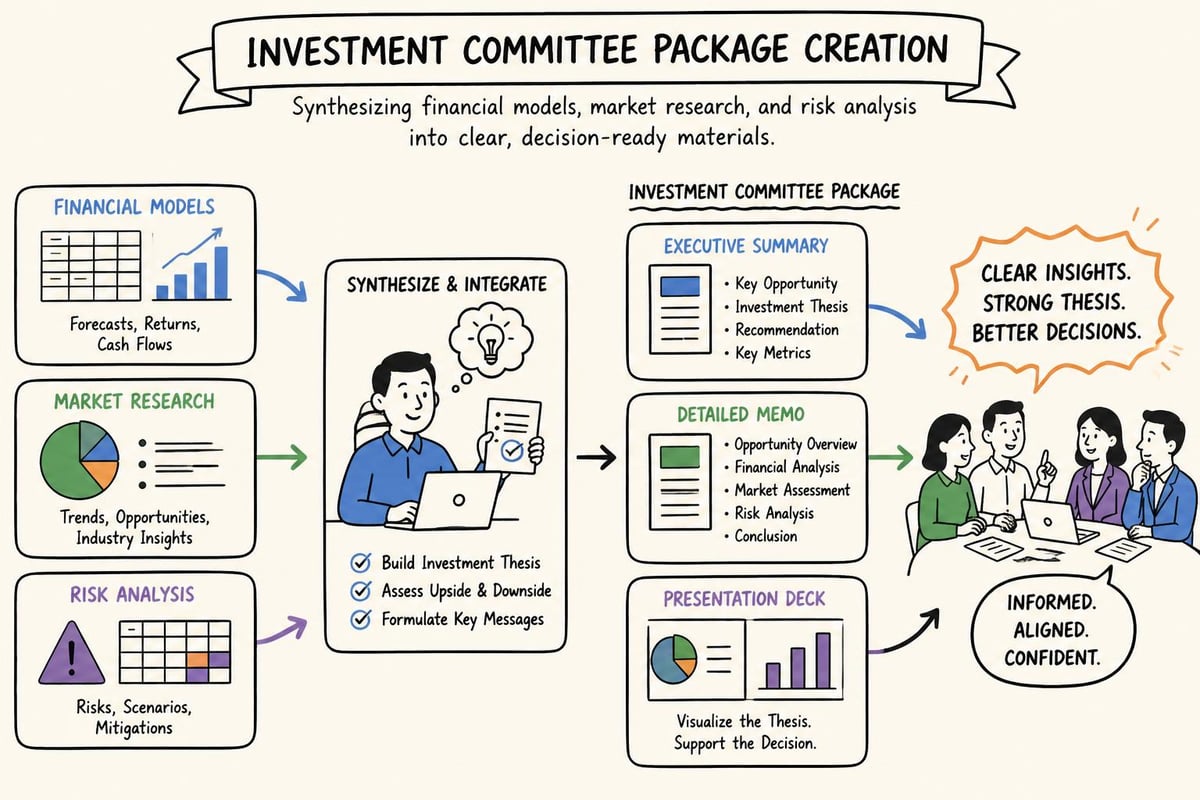
This is where the cumulative time investment becomes clear. A straightforward acquisition requires 25-35 hours from OM receipt to IC-ready package. Job postings for CRE analyst positions emphasize efficiency, but traditional workflows make it nearly impossible to evaluate multiple deals simultaneously without expanding headcount.
Where AI Compresses the Analytical Timeline
The transformation in CRE analyst productivity centers on automating the data extraction and synthesis work that consumes the majority of deal processing time. AI purpose-built for commercial real estate doesn't just speed up existing workflows but fundamentally restructures how deals move from initial review to investment decision.
Key stages where AI eliminates manual bottlenecks:
Document ingestion that extracts every material data point from OMs, rent rolls, and lease documents
Automated model population that builds pro formas directly from extracted data
Market research automation that pulls comparable data and synthesizes findings
Memo generation that translates analytical outputs into IC-ready narratives
The difference between general-purpose AI and platforms designed for CRE work shows up in accuracy and verifiability. A CRE analyst needs outputs with direct links to source documents, not hallucinated data that requires complete verification. AI analyst platforms built specifically for commercial real estate deliver verifiable results because they understand property types, financial structures, and market dynamics.
The New Benchmark for Deal Velocity
What does fast actually look like when AI handles the analytical layer? Consider the realistic timeline for a standard multifamily acquisition in 2026:
Process StageTraditional TimelineAI-Enabled TimelineTime SavedDocument extraction6-8 hours15 minutes95% reductionModel building8-12 hours30 minutes94% reductionMarket research4-6 hours20 minutes93% reductionIC memo creation6-8 hours45 minutes90% reductionTotal process24-34 hours2 hours93% reduction
This compression doesn't mean the CRE analyst role disappears. It means shifting focus from data entry to data interpretation. You spend time validating AI outputs, stress-testing assumptions, and developing investment perspectives rather than copying lease terms from PDFs.
Real-World Application: From OM to Complete Analysis
Walk through a practical example. Your acquisitions team receives an offering memorandum for a 150-unit multifamily property on Tuesday morning. The seller wants first-round bids by Friday. Using traditional methods, you're making tradeoffs: do you build a comprehensive model or prioritize getting something in front of the IC quickly?
With AI automation integrated into your workflow, the calculation changes. You upload the OM, rent roll, and operating statements to your AI analyst platform. Within minutes, you have extracted lease data, populated revenue and expense assumptions, and identified data gaps that require seller follow-up.
The autonomous analysis delivers:
Complete rent roll with unit-level detail and lease expiration schedule
Pro forma model with 10-year projections and sensitivity analysis
Market research report with comparable sales and rent surveys
Risk assessment highlighting tenant concentration and deferred maintenance
Executive summary and detailed IC memo ready for review
Your role becomes validation and refinement. You verify that rental growth assumptions align with submarket fundamentals, adjust capital expenditure timing based on property condition, and add qualitative observations from your site visit. The analytical foundation is complete, allowing you to focus on insight rather than data processing.
Enhancing Your Analytical Capabilities
Senior positions like CRE senior credit analyst roles require the ability to evaluate complex capital structures and multi-property portfolios. The skills that separate good analysts from great ones increasingly involve knowing how to leverage technology for deeper analysis rather than faster data entry.
Advanced analytical capabilities enabled by AI include:
Portfolio-level analysis that aggregates metrics across multiple assets and identifies trends
Scenario modeling that tests dozens of sensitivity cases to identify break points
Comparative deal analysis that benchmarks current opportunities against historical acquisitions
Automated reporting that tracks portfolio performance metrics without manual data gathering
The integration with property management systems like Yardi, RealPage, and Entrata means your analysis doesn't stop at acquisition. Post-closing, the same platform that underwrote the deal can track actual performance against projections, flag variances, and support asset management decision-making.
Building Conviction Through Better Data
A CRE analyst's ultimate deliverable isn't a spreadsheet but conviction. Your IC needs to believe in the investment thesis enough to commit millions of dollars based on your analysis. That conviction comes from thorough, verifiable work that addresses every material question.
Data analytics capabilities that connect directly to source documents provide the audit trail that builds confidence. When an IC member questions your rent growth assumption, you can immediately show the comparable lease transactions that support it. When someone challenges your exit cap rate, you have recent sales data ready.
Elements that build analytical conviction:
Source-linked data that traces every number back to original documents
Comprehensive sensitivity analysis showing how returns change under stress
Market validation that ties assumptions to observable trends
Risk quantification that measures downside scenarios
Clear documentation that explains methodology and judgment calls
This level of rigor traditionally required sacrificing deal velocity. You could be thorough or you could be fast, but rarely both. Purpose-built AI platforms eliminate that tradeoff by delivering comprehensive analysis at speeds that match market timing.
Integrating AI Into Your Deal Process
Implementation doesn't require rebuilding your entire analytical workflow overnight. The most effective approach involves identifying the highest-impact bottlenecks and introducing automation strategically. For most CRE analyst teams, document extraction provides the best starting point.
Phased implementation approach:
Phase 1: Automate document extraction and data population
Phase 2: Integrate automated model building with manual review
Phase 3: Add market research automation and synthesis
Phase 4: Implement memo generation with analyst refinement
Phase 5: Enable portfolio monitoring and reporting automation
Security considerations matter when you're processing confidential financial data and competitive information. SOC 2 Type 2 certification provides independent verification that data handling meets institutional standards. Integration capabilities with existing property management systems ensure you're working with live data rather than static exports.
Business intelligence capabilities increasingly define advanced CRE analyst roles. The ability to identify patterns across portfolios, predict performance trends, and recommend strategic adjustments requires analytical infrastructure that traditional tools can't support.
Measuring the Impact on Deal Capacity
The financial impact of compressed timelines extends beyond winning individual deals. Consider a two-person acquisitions team evaluating $200M in annual transaction volume. Under traditional workflows, thorough analysis of 8-10 deals per analyst per year represents realistic capacity. Everything else gets cursory review or no review at all.
Capacity expansion with AI automation:
Traditional capacity: 16-20 deals analyzed per year
AI-enabled capacity: 80-100 deals analyzed per year
Deal flow increase: 5x improvement in analytical throughput
Hidden opportunity: Previously overlooked deals now get full evaluation
This capacity expansion doesn't just mean more deals but better deals. You can afford to evaluate opportunities in secondary markets, pursue value-add strategies that require complex analysis, or stress-test creative financing structures. The commercial real estate deal analysis becomes comprehensive rather than constrained by time.
The Competitive Advantage of Analytical Speed
Markets reward speed when it's paired with accuracy. Sellers favor buyers who demonstrate quick but thorough due diligence. Equity partners choose managers who can move from LOI to close efficiently. The CRE analyst who delivers complete investment packages in hours rather than days creates tangible competitive advantage.
Where speed creates deal wins:
Proprietary deal flow from brokers who know you can move quickly
Negotiating leverage from completing diligence faster than competitors
Capital deployment that maximizes time in market during favorable conditions
Opportunity cost reduction by evaluating more deals with the same resources
The analytical infrastructure you build today determines which deals you can pursue tomorrow. Firms still relying on manual workflows face a widening gap against competitors who've embraced AI-enabled analysis. This isn't about replacing judgment with automation but augmenting analytical capacity to make better decisions faster.
The CRE analyst workflow has fundamentally changed in 2026, shifting from manual data processing to AI-augmented analysis that delivers complete deal packages in hours instead of days. This transformation directly addresses the capacity constraints that limit deal evaluation and slow competitive response times. Leni provides the purpose-built AI platform that handles document extraction, financial modeling, market research, and IC memo creation autonomously while maintaining the verifiability and accuracy that institutional investors require. When speed and thoroughness both matter, the right analytical infrastructure becomes the competitive advantage that separates firms who win deals from those who watch them close.

Johanna Gruber
Johanna has spent the last 8 years helping marketing teams connect with audiences through content. Specializing in B2B SaaS and real estate.

Curious About AI?
Join the largest AI community for real estate online. Get bite-sized, real-world use case videos, plus practical tips and proven strategies from top industry experts on adopting AI effectively.
MEET LENI
AI SuperAgent Purpose Built for Investors and Operators.
Experience how professionals and teams in your domain are getting the edge using AI.