Data Analytics Tools for CRE: Leni vs Argus vs Dealpath

Data Analytics Tools for CRE: Leni vs Argus vs Dealpath
Commercial real estate teams drown in data. Portfolio managers juggle spreadsheets, acquisitions teams manually extract lease terms from hundreds of pages, and asset managers spend hours compiling reports that executives need yesterday. The challenge isn't accessing information-it's transforming fragmented data sources into actionable intelligence fast enough to matter. While traditional data analytics tools serve general business intelligence needs, CRE workflows demand specialized capabilities that bridge financial modeling, document processing, and portfolio-level insights. Understanding which tools solve which problems determines whether your team closes deals faster or stays buried in administrative work.
The Traditional CRE Analytics Landscape: What Teams Actually Use
Commercial real estate professionals have relied on established tools for decades, each serving distinct functions within the deal lifecycle and portfolio management workflow.
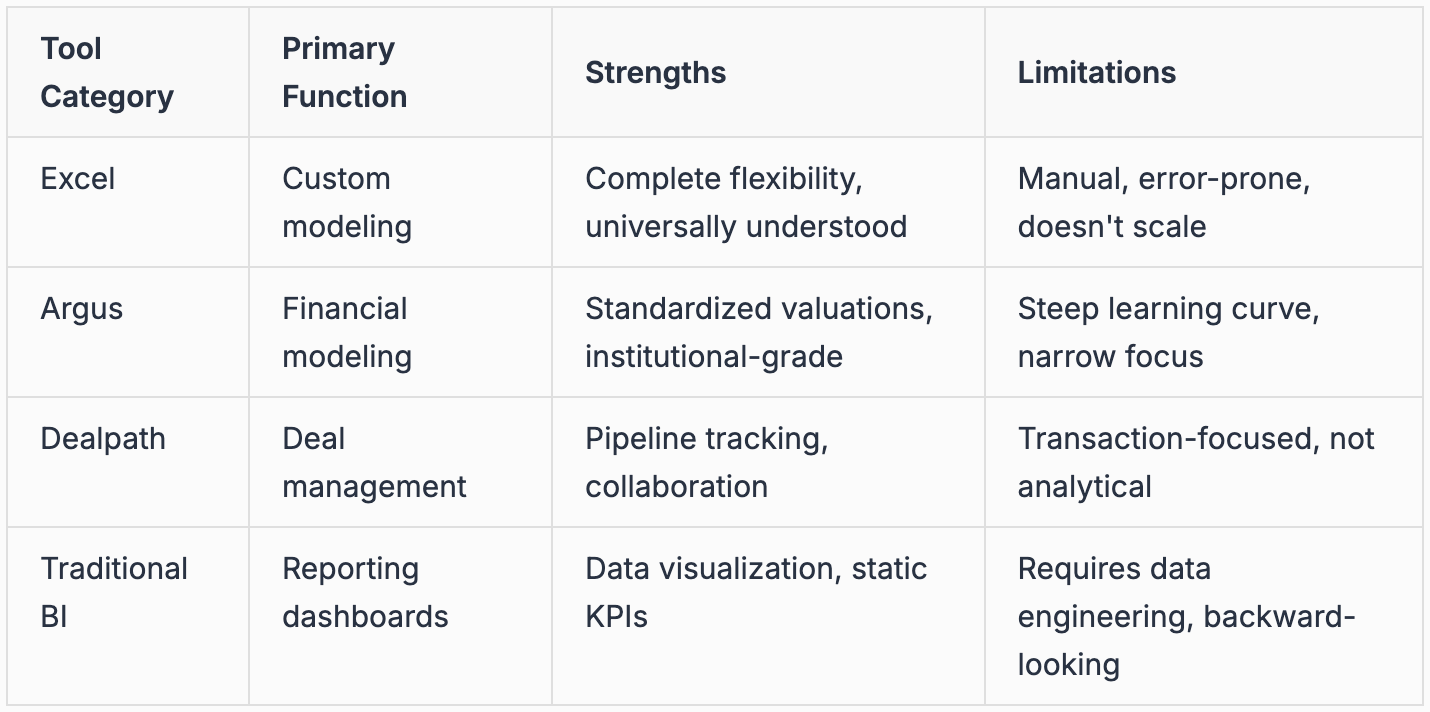
Excel remains the foundation of CRE analysis for good reason. Teams build custom underwriting models, manipulate property-level data, and create presentations tailored to specific investor preferences. The flexibility is unmatched-every formula, assumption, and output format can be customized exactly as needed.
Yet this flexibility creates problems at scale. Models break when team members update formulas differently. Version control becomes a nightmare across multiple properties. Error rates climb as complexity increases, and according to guidance on choosing the best data analytics tools, manual processes create consistency and accuracy challenges that compound over time.
Specialized Software: Argus and Dealpath
Argus Enterprise dominates CRE financial modeling with sophisticated cash flow projections and valuation capabilities. The software handles complex lease structures, capital expenditures, and debt assumptions with precision that manual spreadsheets struggle to match. Institutional investors and large operators standardize on Argus because it creates audit trails and ensures modeling consistency across portfolios.
Dealpath tackles a different problem: deal pipeline management and collaboration. Teams track opportunities from sourcing through closing, centralize communications, and maintain deal room documentation in one platform. The tool excels at workflow coordination and stakeholder visibility during active transactions.
Where Traditional Tools Leave Analytical Gaps
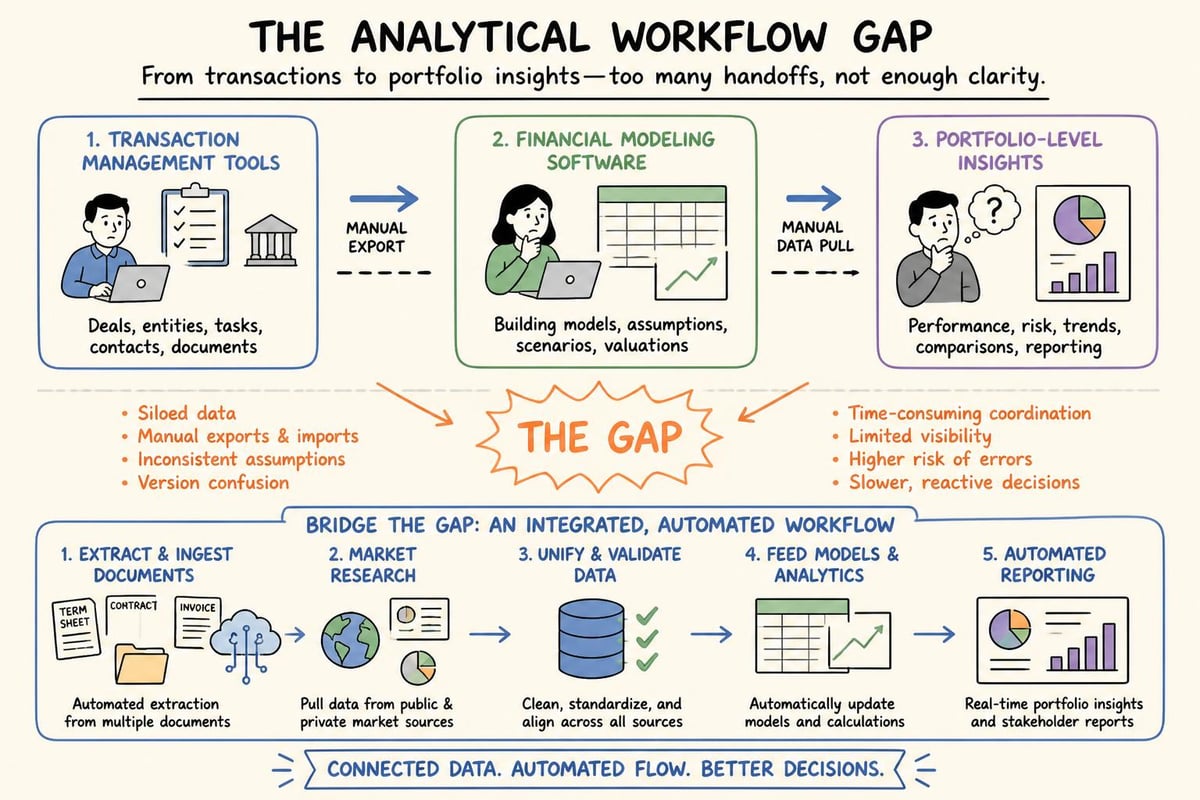
Commercial real estate operations generate questions that existing data analytics tools can't answer efficiently. An asset manager reviewing Q1 performance across 47 multifamily properties needs to understand not just what the numbers show, but why occupancy dropped at three specific assets, how local market conditions changed, and what operational adjustments the data suggests.
The Document Processing Bottleneck
Lease abstracts, offering memorandums, and property management reports contain critical information locked in unstructured formats. Analysts spend hours manually extracting rent rolls, expense escalations, and tenant improvement allowances into spreadsheets. Commercial real estate analytics require synthesizing information from dozens of document types-a process traditional tools don't address.
When evaluating acquisition opportunities, teams manually compare T12 operating statements against pro forma assumptions, cross-reference market rent comps, and validate expense ratios. This work consumes days of senior analyst time per property, delaying investment committee presentations and reducing the number of deals teams can evaluate simultaneously.
Portfolio-Level Intelligence Versus Property-Level Reports
Property management systems like Yardi, RealPage, and Entrata generate excellent property-level reports. Connecting insights across entire portfolios-identifying trends, spotting anomalies, and explaining performance variations-requires analytical work that reporting dashboards can't handle.
An acquisitions team analyzing retail properties in secondary markets needs to understand how employment trends, competitor openings, and demographic shifts affect different asset classes. This research crosses multiple data sources: CoStar for market data, census information for demographics, local news for developments, and internal operating histories. Market research becomes a multi-day manual process when data analytics tools don't integrate external and internal information sources.
Specialized Data Analytics Tools for CRE Workflows
The gap between transaction management and portfolio intelligence created space for purpose-built analytical platforms that understand commercial real estate operations.
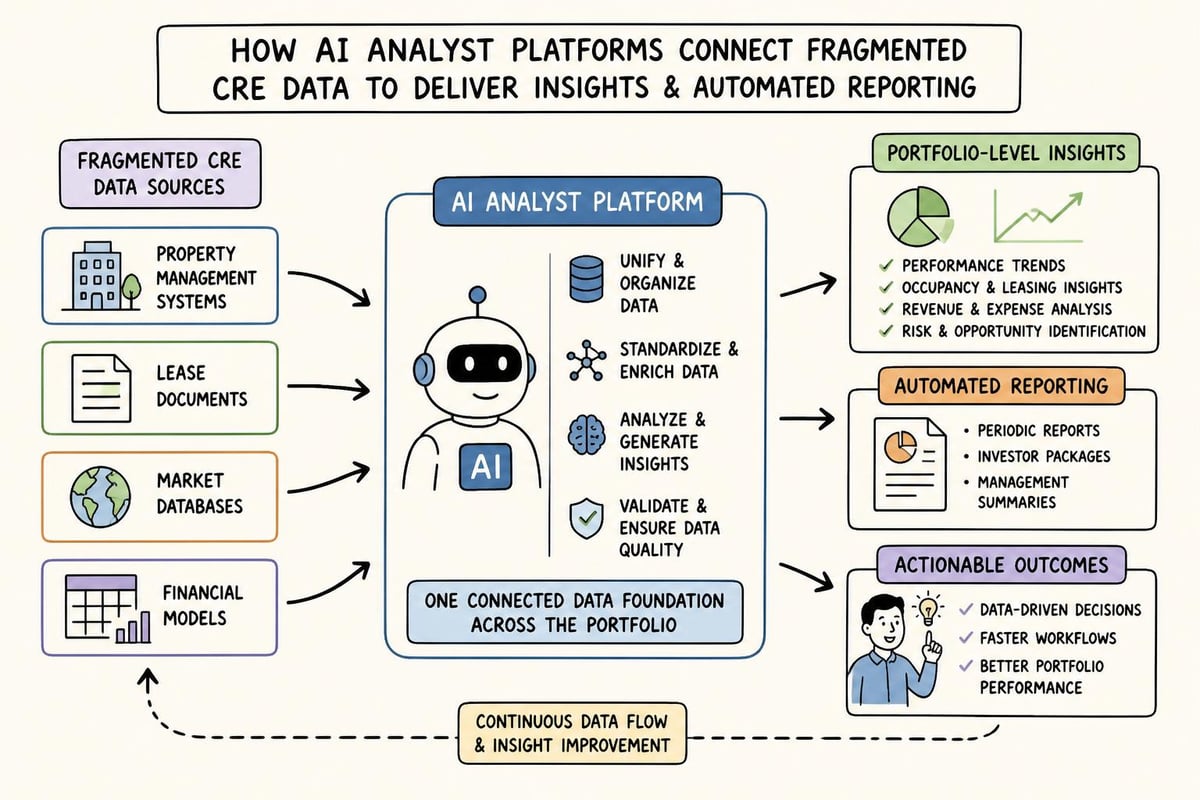
AI analyst platforms represent a fundamentally different approach than traditional business intelligence. Rather than visualizing data you've already cleaned and structured, these systems perform the analytical work: reading documents, connecting disparate data sources, running financial models, and generating executive summaries with source citations.
For commercial real estate specifically, this means handling workflows that general-purpose data analytics tools miss entirely:
Extracting complete rent rolls from PDF leases with complex escalation structures
Building market comparable sets by analyzing location, property type, vintage, and amenity profiles
Generating variance explanations when actual NOI differs from budget by investigating operating expense categories
Creating investment committee memos that synthesize financial models, market conditions, and risk factors with citations to source documents
Automation That Understands Context
The distinction between automated reporting and intelligent analysis matters significantly. A dashboard that shows occupancy trending downward provides visibility but not insight. An AI analyst platform investigates why occupancy declined-examining lease expiration schedules, competitive supply additions, pricing strategies, and local employment data-then delivers an explanation with supporting evidence.
This capability transforms recurring workflows that traditionally require senior analyst intervention:
Monthly portfolio reviews that automatically identify the five properties with the largest variance from budget and explain the operational drivers
Quarterly market updates that pull comparable transaction data, analyze cap rate movements, and summarize relevant market news by property type and geography
Weekly pipeline summaries that track deal progress, flag potential issues, and prioritize opportunities based on team-defined criteria
Leni Versus Traditional Analytics: The AI Analyst Layer
Leni approaches commercial real estate analysis as an AI analyst teammate rather than another software tool requiring manual data input. The platform connects directly to property management systems, processes unstructured documents, and runs multi-step analytical tasks autonomously.
Where Argus Stops and Leni Begins
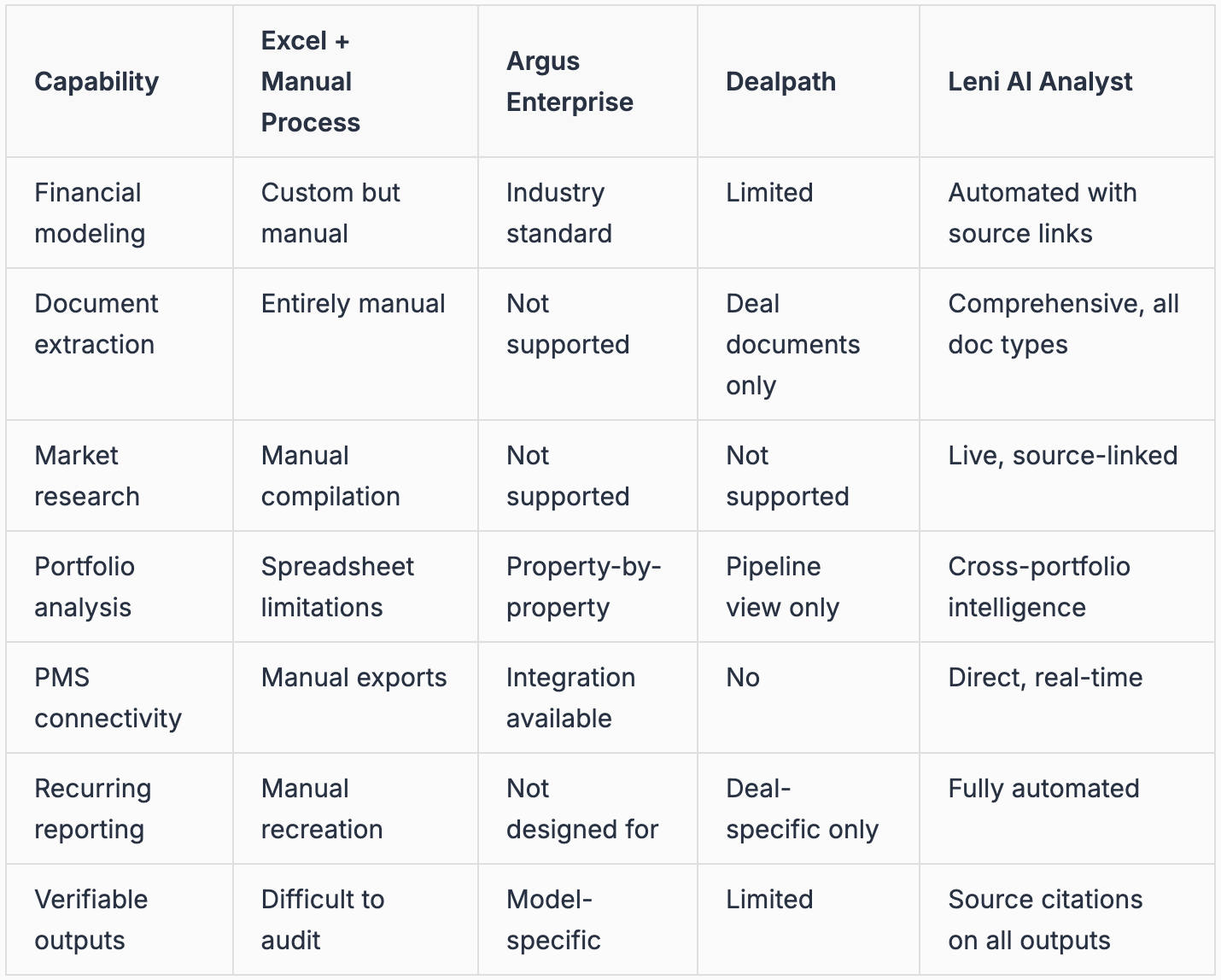
Argus builds detailed cash flow models once you've gathered all assumptions and inputs. Leni gathers those inputs-extracting lease terms from documents, researching market rent comparables, pulling actual operating expenses from Yardi-then uses that information for financial modeling and underwriting that connects directly to source data.
Consider an acquisition opportunity with 237 leases across a retail portfolio. Argus models the cash flows beautifully once you've manually abstracted every lease. Leni reads all 237 lease documents, extracts rent schedules, identifies co-tenancy clauses and percentage rent provisions, validates against the rent roll, and surfaces discrepancies-then feeds clean data into financial models.
The tools serve complementary purposes: Argus provides institutional-grade modeling precision; Leni handles the analytical work that feeds those models and extends analysis beyond pure financial projections into operational intelligence.
Direct PMS Connectivity Changes the Game
Traditional data analytics tools require data exports, transformation pipelines, and engineering resources to connect operational systems. AI-powered PMS integration means Leni pulls data directly from Yardi, RealPage, and Entrata without manual exports or IT involvement.
This connectivity enables analytical workflows impossible with disconnected tools:
Automated variance analysis that compares actual performance against budget monthly, investigates significant deviations by property and expense category, and generates explanatory narratives
Lease renewal optimization that identifies approaching expirations, analyzes current market conditions, and recommends negotiation strategies based on property performance and tenant payment history
Capital expenditure prioritization that correlates maintenance requests, property age, and NOI impact to recommend investment sequencing across portfolios
The Investment Committee Workflow Test
Investment committees demand comprehensive materials that synthesize financial projections, market analysis, risk assessment, and strategic rationale. Creating these presentations typically requires three to five days of senior analyst time, pulling from multiple data sources and coordinating input from various team members.
Leni handles investment memos and presentations end-to-end: financial modeling from extracted property data, market research with live source links, risk analysis based on historical performance patterns, and executive summaries formatted for IC consumption. The platform doesn't just compile information-it performs the analytical synthesis that transforms raw data into investment recommendations.
Traditional data analytics tools display information but don't generate narrative insights. Understanding why a cap rate expansion makes sense given local market dynamics, how projected rent growth compares to historical performance, and what operational improvements could accelerate value creation requires analytical work that dashboards can't perform.
Choosing Data Analytics Tools for Your CRE Operation
The right technology stack depends on your team's specific workflows, portfolio complexity, and analytical bottlenecks. Most sophisticated CRE operations use multiple tools that serve different purposes.
When Traditional Tools Remain Sufficient
Excel continues serving teams effectively when:
Portfolio size stays under 10-15 properties with manageable complexity
Deal volume allows manual underwriting without creating backlogs
Custom models require extreme flexibility that standardized platforms don't provide
Teams have strong controls preventing version inconsistencies and formula errors
Argus makes sense for firms prioritizing:
Institutional-grade modeling standards that investors and lenders expect
Complex lease structures requiring sophisticated cash flow projections
Audit requirements demanding detailed assumption documentation
Valuation precision for large, complicated assets
Dealpath fits operations focused on:
High transaction volume requiring pipeline visibility
Team collaboration across geographically distributed deal participants
Document centralization during active transactions
When AI Analyst Capabilities Become Essential
Commercial real estate teams benefit from AI-powered real estate software when operational complexity outpaces manual analytical capacity. Several indicators suggest you've reached this threshold:
Document processing consumes excessive analyst time. If team members spend more than 20% of their hours manually extracting information from leases, offering memorandums, and property reports, automation delivers immediate ROI. The comprehensive list of available data analysis tools shows general options, but CRE-specific document types require specialized understanding.
Recurring reports delay strategic work. Monthly portfolio reviews, quarterly investor updates, and weekly pipeline summaries shouldn't require senior analysts to recreate analyses from scratch. Reporting and asset management automation frees experienced team members for higher-value work while improving report consistency and timeliness.
Deal volume exceeds analytical capacity. Acquisitions teams evaluating 40-50 opportunities monthly can't manually underwrite every property while maintaining quality and speed. Automated underwriting with verifiable outputs lets teams evaluate more deals without proportionally expanding headcount.
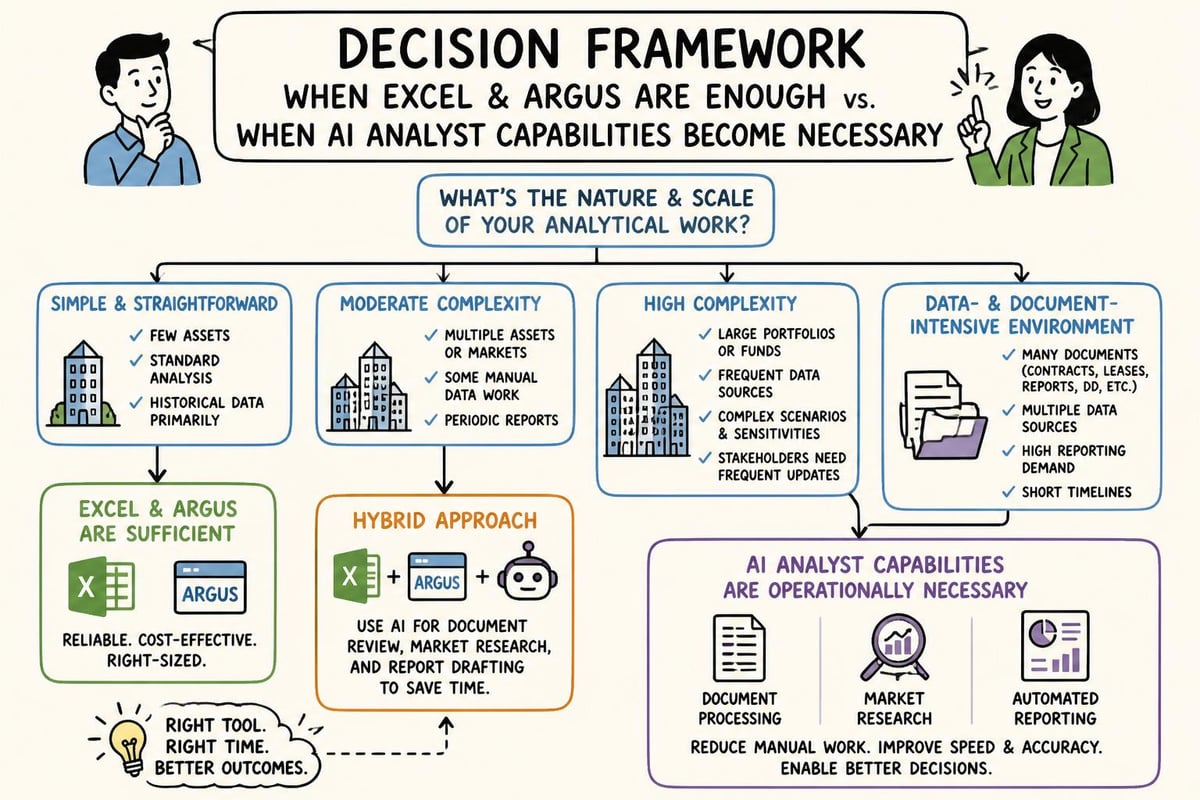
Portfolio size creates insight gaps. Asset managers overseeing 30+ properties struggle identifying performance patterns, operational anomalies, and optimization opportunities without analytical support. Multifamily portfolio analytics at scale requires technology that connects property-level data into portfolio-level intelligence.
Integration Over Replacement
The most effective approach treats data analytics tools as complementary rather than mutually exclusive. A sophisticated CRE operation might use:
Argus for final underwriting models on significant acquisitions requiring institutional modeling standards
Dealpath for pipeline tracking and deal team collaboration during active transactions
Leni for document extraction feeding Argus models, automated portfolio reporting, market research, and recurring analytical tasks
Excel for ad hoc analysis requiring complete customization flexibility
This layered approach deploys each tool where it delivers maximum value rather than forcing single-platform solutions onto workflows they weren't designed to handle.
Real-World Application: Portfolio Acquisition Scenario
Consider a real estate investment firm evaluating a 12-property multifamily portfolio acquisition in Sun Belt markets. The seller provides offering memorandums, historical financials, current rent rolls, and sample leases-hundreds of pages across scattered document formats.
Traditional Workflow Timeline
Week 1: Junior analysts manually extract rent rolls from PDFs, building spreadsheets with unit mixes, current rents, lease expiration schedules, and concession tracking. They identify discrepancies between OM summaries and underlying lease documents, requiring seller clarification.
Week 2: Analysts research comparable properties in each market, pulling CoStar data, reviewing recent transactions, and documenting market rent assumptions. They validate historical expense ratios against industry benchmarks and local market conditions.
Week 3: Senior analyst builds Argus models for each property, incorporating extracted data and market assumptions. Models run scenarios testing sensitivity to occupancy changes, rent growth, and expense management.
Week 4: Team compiles investment committee presentation synthesizing financial projections, market analysis, and investment rationale. Multiple revision cycles incorporate partner feedback and additional research requests.
Total timeline: Four weeks from opportunity receipt to investment committee presentation, consuming 120+ analyst hours.
AI Analyst Workflow
Leni ingests all offering materials, lease documents, and historical financials immediately. The platform:
Extracts complete rent rolls from all properties, validating against lease documents and flagging discrepancies for review
Researches market comparables pulling recent transactions, employment trends, supply pipeline data, and demographic shifts for each submarket
Builds financial models incorporating extracted data, market assumptions, and historical performance patterns with direct links to source documents
Generates IC memo synthesizing investment thesis, market opportunity, risk factors, and return projections with full source citations
Total timeline: Three days from opportunity receipt to draft IC presentation, consuming 10-15 analyst hours for review and refinement rather than initial creation.
The time savings allow the team to evaluate more opportunities simultaneously while improving analytical depth through comprehensive document review and market research that manual processes often compress or skip entirely.
Implementation Considerations Beyond Features
Deploying new data analytics tools successfully requires more than selecting software with the right capabilities. Several operational factors determine whether technology investments deliver promised returns.
Data Quality and System Integration
The effectiveness of any analytical platform depends on underlying data quality. Properties tracked in multiple systems with inconsistent naming conventions, incomplete historical records, and fragmented document storage create challenges regardless of analytical capabilities.
Audit your data infrastructure before selecting tools. Understanding where information lives, how systems connect, and what data quality issues exist helps match tools to reality rather than idealized workflows. Platforms promising automated insights from property management systems deliver value only when PMS data is complete, accurate, and consistently structured.
Team Adoption and Change Management
Sophisticated analytical capabilities mean nothing if teams continue using familiar manual processes. Successful implementation requires:
Clear workflow definitions showing exactly which tasks move from manual to automated processes
Training investments ensuring team members understand how to use new tools effectively and interpret automated outputs
Gradual rollout starting with specific use cases that demonstrate clear value before expanding platform usage
Quality controls maintaining human review of automated outputs during initial implementation phases
Research on documentation practices in data analytics software emphasizes that even sophisticated tools require substantial learning curves and ongoing support.
Security and Compliance Requirements
Commercial real estate portfolios contain sensitive financial information, proprietary investment strategies, and confidential tenant data. Data analytics tools must meet institutional security standards:
SOC 2 Type 2 certification demonstrating robust security controls and regular third-party audits
Data encryption protecting information in transit and at rest
Access controls limiting sensitive information to authorized users
Audit trails documenting who accessed what information and when
These requirements eliminate many general-purpose analytics platforms and favor purpose-built solutions designed for institutional deployment.
Scalability and Future Needs
Consider not just current portfolio size but growth trajectories. A platform serving 15 properties well might break at 50. Evaluation criteria should include:
Performance at scale: How do processing speeds, report generation times, and system responsiveness change as data volume grows?
Pricing models: Do costs scale linearly with property count, or do volume discounts make growth more efficient?
Feature roadmaps: Does the vendor invest in capabilities your team will need as operations expand?
The University of Wisconsin-Milwaukee maintains a curated resource on data analytics tools useful for understanding broader platform categories beyond CRE-specific solutions.
The Emerging Analytics Stack for CRE Teams
Forward-looking commercial real estate operations are building analytical technology stacks that combine specialized tools rather than seeking single platforms addressing all needs. This layered approach matches tool capabilities to specific workflow requirements.
The foundation layer consists of property management systems and accounting platforms that capture operational data. Yardi, RealPage, Entrata, and similar systems remain essential for day-to-day property operations and financial record-keeping.
The modeling layer includes specialized financial software like Argus for complex valuations, Excel for custom analyses requiring complete flexibility, and deal management platforms for pipeline tracking.
The intelligence layer-where AI analyst platforms operate-sits above foundational systems and specialized tools. This layer connects fragmented data sources, processes unstructured documents, automates recurring analytical tasks, and generates insights that inform strategic decisions. Rather than replacing existing systems, the intelligence layer makes them more valuable by extracting and synthesizing information automatically.
Understanding how real estate software serves investors across different operational needs helps teams build technology stacks that complement rather than duplicate capabilities.
Beyond Dashboards: The Future of CRE Analytics
The next generation of data analytics tools for commercial real estate will focus less on visualizing information and more on performing analytical work autonomously. Several trends are reshaping what's possible:
Predictive maintenance and operational optimization using machine learning models that identify equipment failures before they occur, optimize energy consumption patterns, and recommend preventive actions based on historical performance data across similar properties.
Automated deal sourcing that monitors public records, news sources, and market indicators to identify acquisition opportunities matching specific investment criteria before properties formally list.
Dynamic portfolio optimization recommending hold/sell decisions, capital allocation priorities, and operational improvements based on continuous market monitoring and performance analysis rather than periodic manual reviews.
Executive decision support that answers complex strategic questions by synthesizing information from multiple sources and running scenario analyses: "How would a 50 basis point rate increase affect our refinancing pipeline and which properties should we prioritize for debt restructuring?"
These capabilities require data analytics tools that don't just report what happened but understand context, perform multi-step analysis, and generate recommendations with supporting evidence-exactly what distinguishes AI analyst platforms from traditional business intelligence.
Selecting the right data analytics tools for commercial real estate operations requires matching platform capabilities to specific workflow bottlenecks rather than chasing comprehensive solutions that attempt everything. Excel, Argus, and Dealpath each serve important functions, but they leave analytical gaps that manual processes can't efficiently fill at scale. When document processing, market research, and recurring reporting consume disproportionate analyst time, Leni provides the AI analyst layer that connects fragmented data sources, automates complex workflows, and delivers verifiable insights with direct source citations-letting your team focus on strategic decisions rather than administrative analysis.

Johanna Gruber
Johanna has spent the last 8 years helping marketing teams connect with audiences through content. Specializing in B2B SaaS and real estate.

Curious About AI?
Join the largest AI community for real estate online. Get bite-sized, real-world use case videos, plus practical tips and proven strategies from top industry experts on adopting AI effectively.
MEET LENI
AI SuperAgent Purpose Built for Investors and Operators.
Experience how professionals and teams in your domain are getting the edge using AI.
