Investment Property Analysis Software for CRE Teams 2026

Investment Property Analysis Software for CRE Teams 2026
Investment property analysis software has evolved from basic spreadsheet templates to sophisticated platforms that handle the complex analytical demands of commercial real estate teams. Asset managers, acquisitions professionals, and portfolio operators face mounting pressure to underwrite more deals, maintain accurate portfolio reporting, and deliver investment committee materials faster than ever. The right analytical tools determine whether your team closes competitive deals or gets buried in Excel workbooks and manual data entry.
Why Traditional Excel Workflows No Longer Scale
Commercial real estate teams have relied on Excel underwriting models for decades. These workbooks contain intricate formulas for cash flow projections, debt service coverage calculations, sensitivity analyses, and return metrics. The problem isn't Excel's capability; it's the manual effort required to populate models with property-specific data.
When you receive an offering memorandum for a 250-unit multifamily property, someone must manually extract unit mix, current rents, operating expenses, and market assumptions. That same person then populates multiple tabs in your underwriting model, double-checks formulas, runs sensitivities across different debt scenarios, and reformats outputs for internal presentations.
This workflow breaks down at scale:
Acquisitions teams evaluating 50+ opportunities per quarter spend 60-70% of their time on data entry
Portfolio managers maintaining quarterly reports across 20+ assets manually consolidate data from property management systems
Investment committee materials require reformatting the same analysis into PowerPoint decks
Market research involves searching across multiple data sources without consistent documentation
The fragmentation creates bottlenecks. Your analysts become data processors instead of strategic thinkers.
The Cost of Manual Underwriting
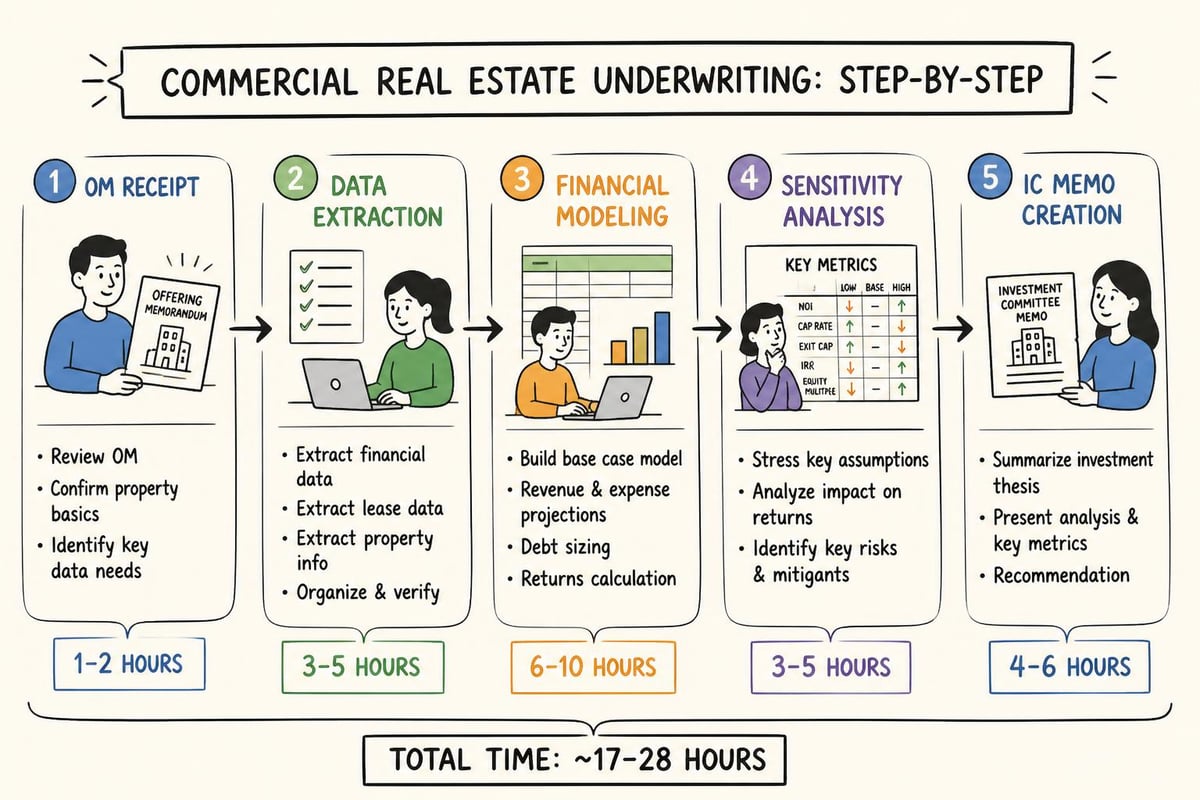
Consider the timeline for a typical acquisition underwriting. Your team receives an OM on Monday morning. By Friday, you need investment committee materials ready for review.
Here's how the week typically unfolds:
Monday-Tuesday: Extract rent rolls, T12 statements, and market data from the OM
Wednesday: Populate underwriting model and build cash flow projections
Thursday: Run sensitivity analyses on rent growth, exit cap rates, and debt terms
Friday morning: Create IC memo and presentation deck
Each step requires manual work. If the sponsor sends updated financials Thursday afternoon, you restart portions of the analysis. Investment property analysis software addresses these inefficiencies by automating data extraction, model population, and document generation.
Core Capabilities Every CRE Analysis Platform Needs
Not all investment property analysis software delivers the same value for commercial real estate workflows. Residential fix-and-flip calculators serve different needs than institutional multifamily underwriting platforms. Understanding which capabilities matter for your specific use cases prevents wasted implementation time on tools that can't handle CRE complexity.
Financial Modeling and Underwriting Automation
The foundation of any serious platform is robust financial modeling and underwriting capability. Your software should generate complete Excel workbooks with property-specific assumptions, not just calculators that produce summary metrics.
Essential underwriting features include:
Multi-year cash flow projections with monthly or annual granularity
Debt service calculations supporting multiple loan tranches
Waterfall structures for preferred equity and promote calculations
Sensitivity tables showing returns across rent growth and exit cap scenarios
Customizable assumption sets that reflect your investment thesis
Advanced platforms go further by extracting property data directly from source documents. When you upload a rent roll, the system should populate unit counts, average rents, and occupancy rates into your model automatically. Document extraction capabilities eliminate the manual transcription that consumes analyst time.
Market Research with Verifiable Sources
Investment decisions require market context. What are comparable properties trading at? How do submarket rent trends compare to your pro forma assumptions? How does local employment growth support your hold period projections?
Traditional approaches involve searching CoStar, visiting municipality websites, reading brokerage reports, and assembling insights into a coherent narrative. This research takes hours and rarely includes direct citations to source materials.
Investment property analysis software should provide market research with direct links to underlying data sources. When your IC memo states that Class A multifamily rents in the submarket grew 4.2% annually over the past three years, you need verifiable documentation supporting that claim.
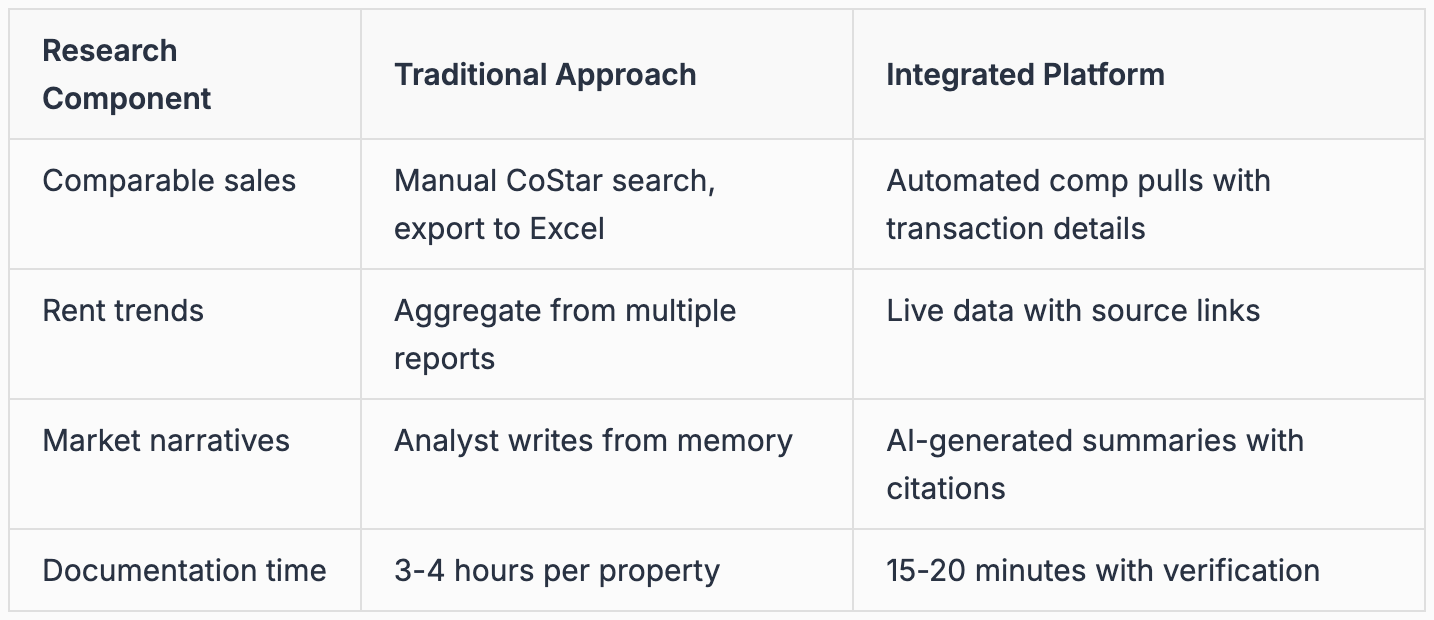
The time savings matter, but accuracy and verifiability matter more. Investment committees ask tough questions. Having instant access to source documentation strengthens your credibility.
Investment Committee Materials and Reporting
Underwriting models contain the analytical foundation, but investment committees don't read Excel workbooks. They review memos and presentation decks that translate complex financial analysis into strategic investment narratives. Creating these materials represents another layer of manual work.
Automated IC Memo Generation
Your investment property analysis software should transform underwriting outputs into formatted investment memos. The best platforms understand commercial real estate memo structure: executive summary, property overview, market analysis, financial projections, risk factors, and investment recommendation.
Investment memos and presentations require consistent formatting across deals. When your team underwrites 40 opportunities per quarter, standardized output formats ensure investment committees can compare deals efficiently. Automation doesn't eliminate human judgment; it eliminates reformatting and copy-paste work.
Strong IC memo automation includes:
Executive summaries highlighting key investment metrics and risks
Market sections with embedded research and source citations
Financial summary tables pulled directly from underwriting models
Risk analysis sections based on sensitivity outputs
Consistent formatting matching your firm's templates
The goal isn't generic AI-generated content. Purpose-built platforms for commercial real estate produce memos that reflect CRE terminology, metrics, and investment logic.
Portfolio Reporting and Asset Management
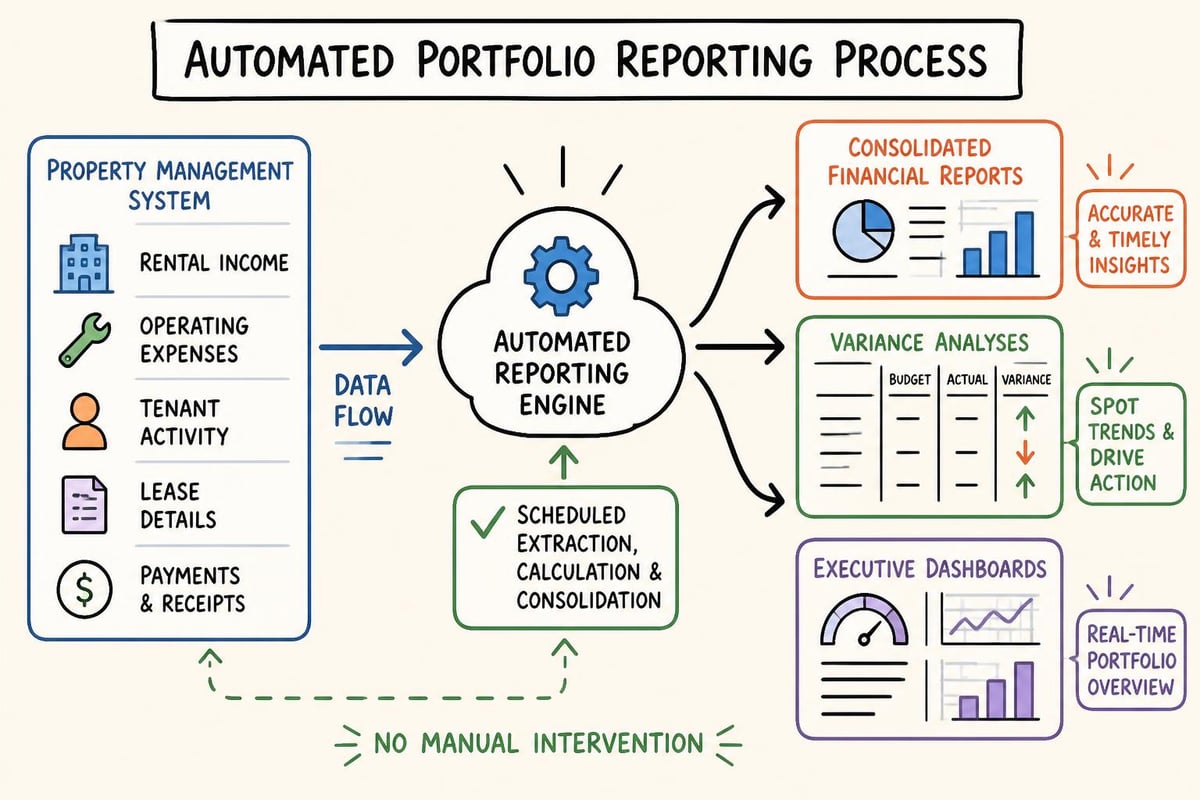
Acquisition underwriting represents one workflow. Portfolio monitoring represents another equally demanding workflow. Asset managers overseeing 15-25 properties spend significant time consolidating performance data from property management systems for quarterly reports.
This process involves logging into Yardi, RealPage, or Entrata to export financials, then manually reconciling actuals against budgets in Excel. You create variance reports, update portfolio dashboards, and prepare board materials. Every quarter, you repeat the same workflow.
Reporting and asset management platforms should connect directly to your property management systems. When your PMS data updates, your reporting updates automatically. This eliminates manual exports and reduces the risk of transcription errors.
Key portfolio reporting features:
Direct integrations with Yardi, RealPage, MRI, and other PMSs
Automated variance analysis comparing actuals to budgets
Portfolio-level rollups aggregating metrics across multiple assets
Trend analysis showing NOI, occupancy, and revenue patterns over time
Customizable templates for board decks and investor reports
Consider exploring tools designed specifically for rental property analysis to understand baseline feature requirements, then evaluate whether platforms meet commercial real estate complexity standards.
Evaluating Software Options for Commercial Real Estate
The investment property analysis software market includes dozens of options. Some platforms target residential investors with simple calculators. Others focus on commercial real estate with institutional-grade capabilities. Understanding where different tools fit helps you avoid selecting software that can't scale with your workflow requirements.
Residential vs Commercial Focus
Many popular tools like DealCheck and Zilculator serve residential investors analyzing single-family rentals and small multifamily properties. These platforms excel at importing MLS data, calculating basic cash-on-cash returns, and generating simple investment reports.
Commercial real estate teams need different capabilities. Your underwriting involves complex capital structures, multi-year hold periods, sophisticated exit assumptions, and institutional investor reporting requirements. Platforms designed for house flippers won't handle preferred equity waterfalls or sensitivity analyses across multiple variables.
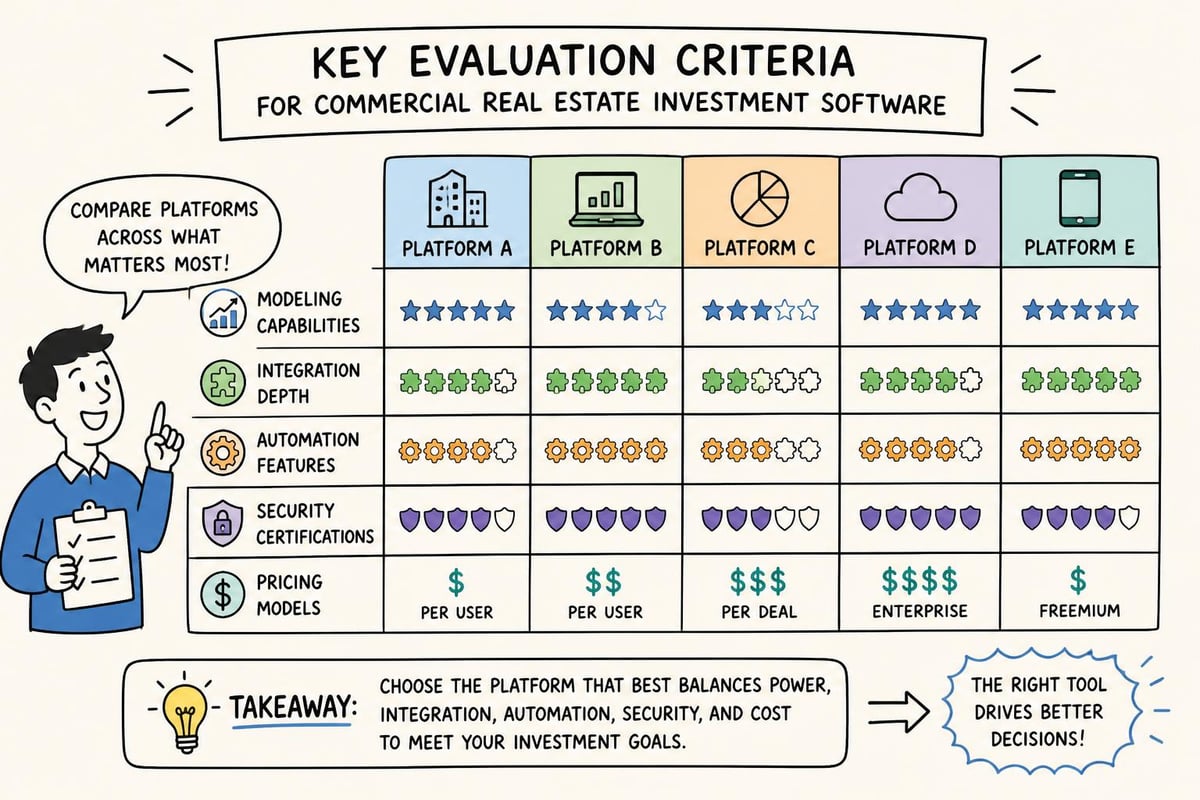
When evaluating tools, assess:
Maximum property size the platform can model effectively
Support for commercial lease structures and rent rolls
Debt modeling capability beyond simple mortgage calculators
Integration with enterprise property management systems
Security and compliance certifications (SOC 2, GDPR)
Several platforms like PropAnalyzer AI and PropertyIQ AI incorporate artificial intelligence for deal analysis. While AI can accelerate certain tasks, verify whether these tools produce the detailed underwriting workbooks and source-linked research your investment committees require.
Integration and Automation Depth
Surface-level automation delivers limited value. A platform that generates basic cash flow projections saves some time but still requires manual data entry, market research, and memo creation. Deep automation handles multi-step workflows from data extraction through final deliverable creation.
Purpose-built platforms for commercial real estate, like those focused on CRE investment analysis, run long analytical tasks autonomously. You upload an offering memorandum and receive a complete underwriting workbook, market research summary with source links, and draft IC memo without manual intervention.
This level of automation requires:
Document processing that extracts data from PDFs and scanned images
Financial modeling engines that apply your firm's methodology consistently
Research capabilities that query multiple data sources and cite findings
Integration with property management systems for live portfolio data
Template engines that generate formatted outputs matching your standards
The distinction between basic calculators and comprehensive analytical platforms becomes clear when you map your actual workflow. If your team spends 20 hours per deal on manual work, tools that save two hours provide marginal value. Tools that automate 15 hours of work transform your capacity.
Implementation Considerations for Asset Management Teams
Selecting investment property analysis software represents the first step. Successful implementation requires planning around data migration, team training, workflow integration, and security requirements.
Data Integration and Migration
Your existing underwriting models contain years of institutional knowledge. Formulas reflect your investment criteria, return thresholds, and risk tolerances. Migration to new software shouldn't mean abandoning this expertise.
Look for platforms that allow custom assumption sets and modeling logic. You should be able to configure rent growth assumptions, expense ratio ranges, debt parameters, and exit cap criteria to match your investment thesis. Some teams maintain hybrid workflows, using new platforms for data extraction and document generation while keeping core models in Excel.
Property management system integration deserves careful evaluation:
Which PMSs does the platform support natively?
Does integration require API access or manual file exports?
How frequently does data sync between systems?
Can you map PMS chart of accounts to your reporting structure?
What happens when PMS data structures change?
Platforms with direct PMS integration capabilities eliminate ongoing manual work. Your portfolio reporting updates automatically as property performance data flows through. This proves particularly valuable for teams managing multifamily portfolio analytics across dozens of assets.
Security and Compliance Requirements
Commercial real estate underwriting involves confidential financial data, proprietary investment strategies, and material non-public information. Your investment property analysis software must meet institutional security standards.
Essential security requirements include:
SOC 2 Type 2 certification demonstrating operational controls
Data encryption in transit and at rest
Role-based access controls limiting data visibility
Audit logging tracking user actions and data access
Compliance with GDPR and other data privacy regulations
Beyond certifications, understand where your data resides and who can access it. Cloud-based platforms offer collaboration benefits but require confidence in provider security practices. Some firms maintain on-premises solutions for particularly sensitive analysis work.
Workflow Optimization Through Purpose-Built Platforms
Generic business intelligence tools and general-purpose AI chatbots can't replicate the domain expertise embedded in commercial real estate analytical platforms. ChatGPT for real estate provides general assistance, but it doesn't understand rent roll structures, T12 reconciliation, or debt service coverage ratio calculations without extensive prompting.
Purpose-built investment property analysis software understands CRE workflows natively. When you upload a rent roll, the system knows to extract unit numbers, square footage, current rents, lease expiration dates, and tenant names. It applies your loss-to-lease assumptions, calculates revenue potential, and populates your underwriting model automatically.
Multi-Step Task Execution
The distinction between AI chatbots and analytical platforms becomes apparent with complex tasks. Asking ChatGPT to "underwrite this property" produces generic guidance. A platform designed for financial modeling and underwriting executes the complete workflow: extract property data, build cash flow projections, run sensitivities, generate Excel workbooks, draft IC memos, and compile market research with citations.
This autonomous execution of multi-step tasks changes team capacity. Your senior analysts focus on strategic questions-should we pursue this deal, what are the key risks, how does this fit our portfolio strategy-while the platform handles analytical execution.
Verifiable Outputs and Source Linking
Investment committees and lenders don't accept analysis based on unstated assumptions or unverifiable data sources. Every market statistic in your IC memo needs supporting documentation. Every rent growth assumption needs market justification.
The best investment property analysis software maintains direct links between outputs and source documents. When your memo states that comparable properties traded at a 4.5% cap rate, you can click through to the actual transaction records. When projections assume 3% annual rent growth, you can review the submarket data supporting that assumption.
This verifiability serves two purposes. First, it accelerates due diligence when investment committees challenge assumptions. Second, it builds institutional knowledge. New team members can review past deals and understand why specific assumptions were made, creating consistency across investment cycles.
Emerging Capabilities and Future Trends
Investment property analysis software continues evolving rapidly. Platforms incorporating artificial intelligence now handle tasks that required significant manual effort just two years ago. Understanding emerging capabilities helps you select tools that will remain valuable as analytical workflows advance.
AI-Powered Research and Analysis
Modern platforms leverage AI to automate research synthesis. Rather than manually reading 20 pages of market reports to write a two-paragraph market overview, AI engines scan documents, extract relevant insights, and generate summaries with citations. This capability proves particularly valuable for market research supporting acquisition underwriting.
The accuracy of AI-generated analysis depends heavily on training data and domain expertise. General-purpose AI tools trained on broad internet content lack the specificity needed for commercial real estate. Platforms trained specifically on CRE documents-rent rolls, offering memorandums, appraisals, market reports-produce more reliable outputs.
Compare platform types for research tasks:
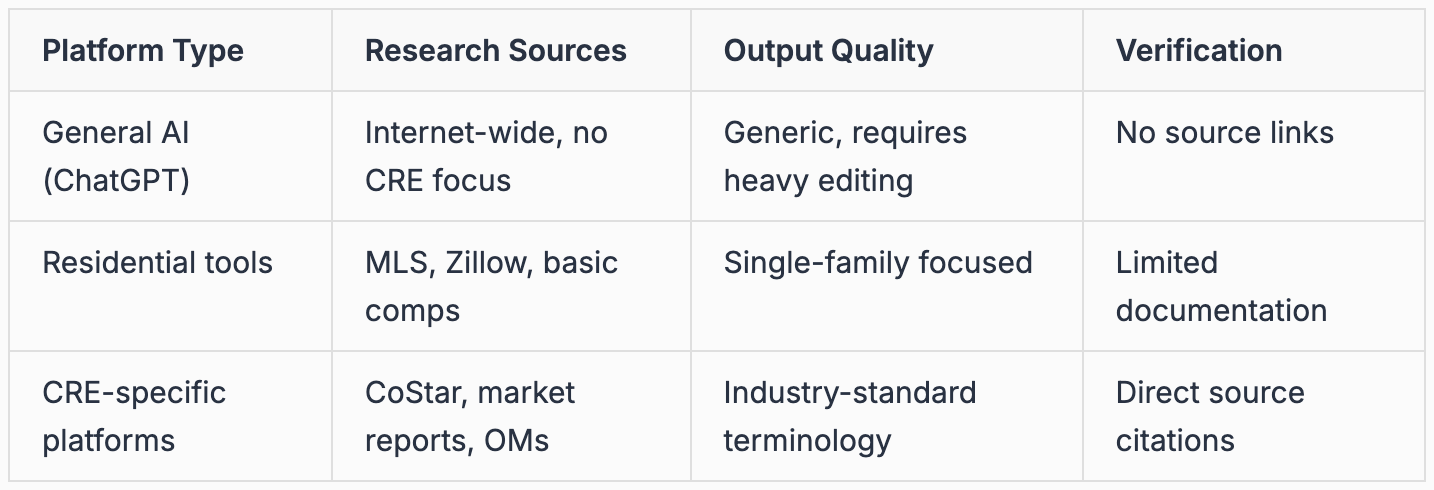
AI tools for business analysts serve various industries, but commercial real estate demands specialized capabilities found in purpose-built platforms.
Continuous Learning from Portfolio Data
The most sophisticated platforms improve accuracy over time by learning from your portfolio data. As you feed more rent rolls, operating statements, and market data into the system, it better understands your specific property types, markets, and investment strategies.
This continuous learning creates competitive advantages. Your investment property analysis software becomes increasingly customized to your workflow without manual configuration. It suggests assumptions based on your historical deals, flags outliers in operating expenses based on your portfolio benchmarks, and prioritizes market research areas based on your acquisition focus.
Consider how data analyst AI capabilities enable platforms to identify trends across your portfolio that might not be apparent in individual asset analysis.
Building Your Technology Stack for CRE Investment
Investment property analysis software represents one component of your broader technology infrastructure. Consider how analytical tools integrate with your property management systems, accounting platforms, investor portals, and data warehouses.
Centralized vs Point Solutions
Some teams prefer all-in-one platforms handling everything from deal sourcing through portfolio management. Others build technology stacks combining specialized tools for different workflows. Both approaches work depending on your team size, deal volume, and existing systems.
All-in-one platforms offer:
Consistent data models across workflows
Single vendor relationship and support
Integrated user experience
Simplified security and access management
Point solutions provide:
Best-of-breed capabilities for specific functions
Flexibility to swap components as needs evolve
Lower switching costs if tools underperform
Ability to maintain existing systems while adding capabilities
For many commercial real estate teams, hybrid approaches work best. You might use a purpose-built platform for acquisition underwriting and IC memo creation while maintaining your existing property management system and investor reporting tools. The key is ensuring data flows efficiently between systems without manual exports and imports.
Measuring ROI and Adoption Success
Implementing new investment property analysis software requires investment in licensing, training, and workflow changes. Measuring return on this investment helps justify costs and guides future technology decisions.
Key metrics to track include:
Time from OM receipt to completed underwriting package
Number of deals analyzed per analyst per quarter
Errors or revisions required in investment committee materials
Portfolio reporting cycle time from data pull to final deliverables
Team satisfaction scores with analytical workflows
Beyond efficiency metrics, consider strategic value. Can your team now compete for deals that previously moved too quickly? Can portfolio managers provide more detailed variance analysis to asset level teams? Does your investment committee have better information for decision-making?
Some improvements prove difficult to quantify but matter tremendously. When your analysts spend less time on data entry and more time thinking strategically about deal risks and opportunities, investment quality improves even if raw deal volume stays constant.
Investment property analysis software transforms how commercial real estate teams approach underwriting, portfolio management, and investment decision-making by automating the analytical workflows that traditionally consumed the majority of analyst time. Teams evaluating platforms should prioritize capabilities that handle CRE complexity: comprehensive financial modeling, source-linked market research, automated document generation, and direct property management system integration. Leni serves as an AI analyst platform purpose-built for these exact workflows, enabling asset managers and acquisitions teams to run multi-step analytical tasks autonomously while delivering verifiable outputs with complete source documentation. By connecting directly to your systems and learning from your data, Leni becomes more accurate over time, transforming your analytical capacity without expanding headcount.

Johanna Gruber
Johanna has spent the last 8 years helping marketing teams connect with audiences through content. Specializing in B2B SaaS and real estate.

Curious About AI?
Join the largest AI community for real estate online. Get bite-sized, real-world use case videos, plus practical tips and proven strategies from top industry experts on adopting AI effectively.
MEET LENI
AI SuperAgent Purpose Built for Investors and Operators.
Experience how professionals and teams in your domain are getting the edge using AI.
