Investment Property Analysis Tool: AI-Powered Guide 2026

Investment Property Analysis Tool: AI-Powered Guide 2026
The commercial real estate industry has long operated under an uncomfortable trade-off: analyze deals carefully and watch your competitors close faster, or move quickly and accept higher risk from missed details. Every investment property analysis tool traditionally forced this choice. Manual document review takes hours per deal, financial modeling demands experienced analysts, and verifying assumptions across multiple sources creates bottlenecks that limit how many opportunities your team can evaluate. In 2026, AI-powered platforms have fundamentally changed this equation by delivering both accuracy and speed simultaneously through automated document extraction, source-linked analysis, and autonomous task completion.
What Investment Property Analysis Tools Actually Do
Investment property analysis tools exist to answer one critical question: does this deal generate returns that justify the risk? The path to that answer requires extracting data from multiple document types, building financial models that project cash flows, and verifying every assumption against market conditions.
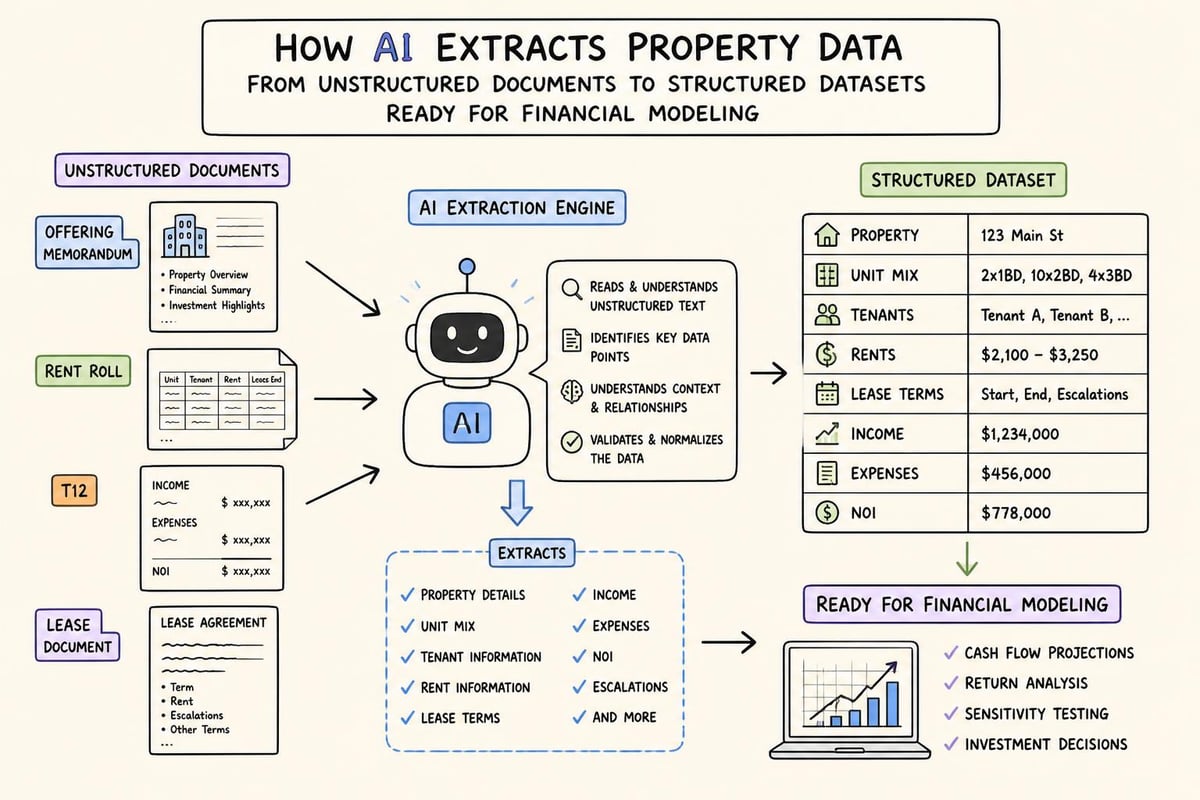
Traditional approaches involve analysts manually reviewing offering memorandums, rent rolls, trailing twelve-month statements, and lease abstracts. They extract unit mixes, rental rates, operating expenses, and capital requirements. This data feeds into Excel-based financial models that calculate metrics like cap rates, internal rates of return, and cash-on-cash returns.
The Document Extraction Challenge
Commercial real estate transactions generate massive document volumes. A single acquisition may include:
Offering memorandums spanning 50-200 pages
Rent rolls with hundreds of tenant records
T12 statements showing monthly operating performance
Individual lease agreements requiring abstraction
Property condition reports flagging capital needs
Market research supporting rent growth assumptions
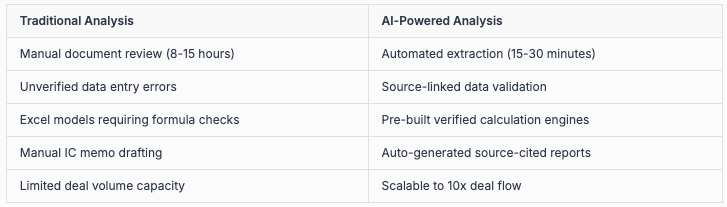
Extracting accurate data from these sources manually consumes 8-15 hours per property for experienced analysts. Errors compound quickly when teams rush through documents to maintain deal velocity. A single misread lease expiration date or overlooked capital expenditure can invalidate an entire underwriting model.
Modern AI-powered real estate analysis platforms approach this differently. Purpose-built document extraction engines process offering memorandums, rent rolls, and financial statements simultaneously, pulling structured data directly into analysis workflows. These systems identify specific data points like unit types, lease terms, expense categories, and capital requirements without human intervention.
How AI Transforms Investment Property Analysis Tool Accuracy
Accuracy in property analysis means every number traces back to a verifiable source, every assumption connects to supporting evidence, and every calculation follows established methodologies. An investment property analysis tool that prioritizes accuracy must do more than compute metrics correctly; it must maintain an audit trail showing exactly where each input originated.
Source-Linked Findings Replace Manual Verification
The breakthrough in AI-powered analysis comes from maintaining connections between outputs and source documents. When a platform extracts an average rent of $2,150 per unit, it doesn't just insert that number into a model. It links that figure back to the specific page in the rent roll where it appeared, the calculation methodology used, and any adjustments made for vacant units or concessions.
This source-linking capability transforms how teams validate assumptions. Instead of reopening documents and searching manually, analysts click directly to the supporting evidence. Investment committees reviewing deals see not just conclusions but the complete chain of reasoning with direct links to original sources.
Key accuracy improvements from AI-powered analysis:
Automated cross-referencing between rent rolls and lease abstracts
Flagged discrepancies between seller-provided data and market benchmarks
Highlighted assumptions requiring additional validation
Version control tracking changes across document iterations
Calculation transparency showing formula logic for every metric
Research on automated valuation models demonstrates how AI systems that integrate heterogeneous data sources achieve superior accuracy compared to single-source approaches. Commercial real estate demands this multi-source validation because no single document tells the complete story.
Verifiable Outputs for Investment Committee Presentations
Investment committees don't approve deals based on spreadsheet cells. They approve based on confidence that the analysis accurately represents opportunity and risk. An investment property analysis tool designed for institutional workflows must produce deliverables that communicate this confidence clearly.
AI platforms now generate complete investment committee memos, underwriting summaries, and presentation decks that include:
Executive summaries highlighting key investment metrics
Property overviews with market positioning analysis
Financial projections with sensitivity analyses
Risk factors extracted from due diligence documents
Source citations linking every claim to supporting evidence
The difference between generic AI and purpose-built commercial real estate AI becomes apparent in output quality. Generic large language models produce plausible-sounding text without grounding in actual property data. Purpose-built platforms for financial modeling and underwriting generate outputs directly from extracted documents, maintaining verifiable connections throughout.
Scaling Deal Volume Without Adding Headcount
The commercial real estate acquisitions process rewards speed without sacrificing discipline. Firms that can evaluate more opportunities find better deals. Teams that can underwrite faster secure properties before competitors. But traditionally, increasing deal volume meant hiring more analysts, expanding office space, and accepting longer onboarding timelines.
Long Autonomous Tasks Replace Manual Workflows
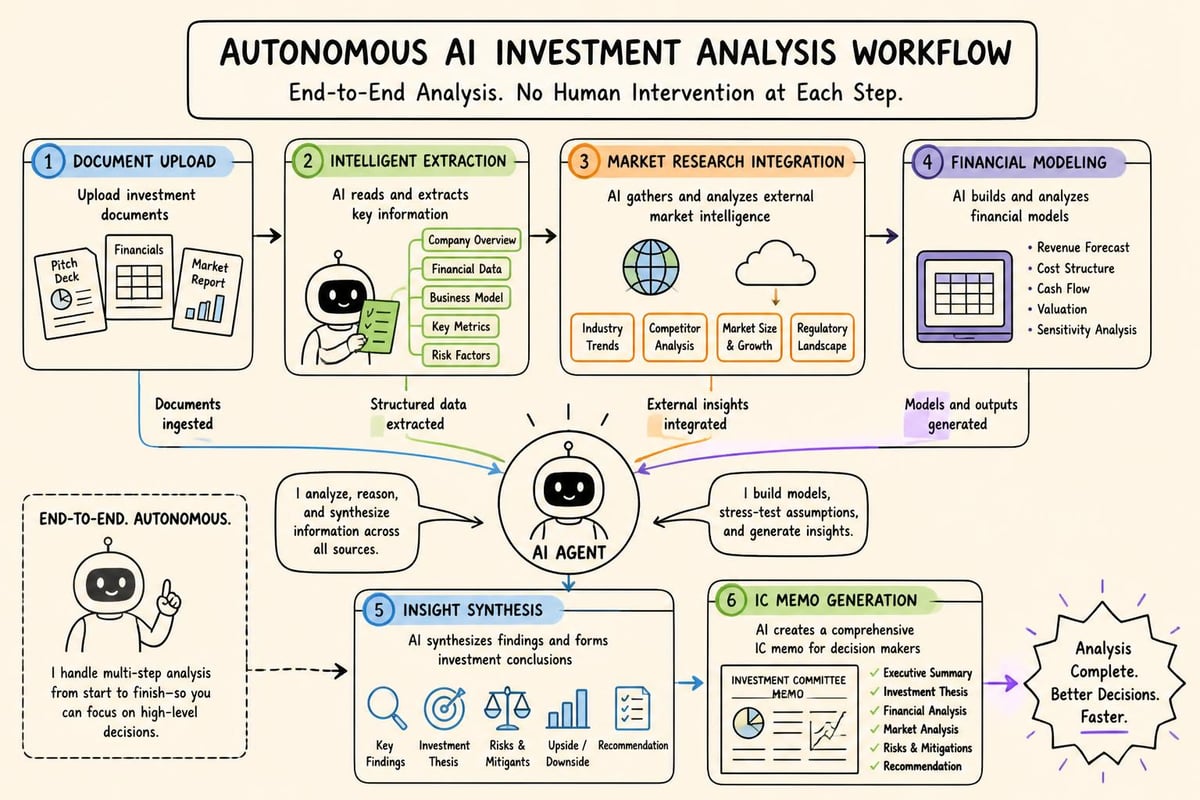
An investment property analysis tool built for scale must handle multi-step processes autonomously. This means accepting a task like "underwrite this acquisition and prepare an IC memo" and returning a complete deliverable without requiring human intervention for each intermediate step.
Modern AI platforms accomplish this through task orchestration that manages complex workflows:
Document ingestion: Accept OMs, rent rolls, T12s, and supplementary materials
Data extraction: Pull structured information from all sources simultaneously
Cross-validation: Check consistency across documents and flag discrepancies
Financial modeling: Build cash flow projections using extracted inputs
Market research: Pull comparable sales, rent surveys, and economic data
Output generation: Create complete IC memos with embedded source links
Each step executes automatically, with the system making decisions about data interpretation, assumption application, and output formatting based on commercial real estate best practices. The analyst reviews the finished deliverable rather than shepherding the process through each stage.
Platforms like those described in resources on real estate analytics companies demonstrate how integrated data systems support scalable decision-making. When analysis tools connect directly to property management systems like Yardi, RealPage, and Entrata, they access operating data in real-time rather than waiting for manual exports.
What Accuracy Improvement Through Data Ingestion Means
AI systems improve through exposure to more examples. An investment property analysis tool that analyzes its hundredth multifamily property understands typical rent roll structures, common expense categories, and standard lease terms better than one processing its tenth deal. This learning effect creates compound advantages over time.
How ongoing data ingestion improves accuracy:
Recognition of document format variations across brokers and markets
Identification of unusual expense items requiring scrutiny
Detection of optimistic assumptions in seller-provided projections
Benchmarking against actual performance from similar properties
Refinement of market-specific rent growth and occupancy forecasts
The importance of considering economic vulnerabilities in local markets highlights why investment analysis tools must incorporate broader data context. Properties don't perform in isolation; their success depends on employment trends, demographic shifts, and competitive supply dynamics that AI systems can monitor continuously.
Security becomes paramount when platforms ingest sensitive deal information. SOC 2 Type 2 certification verifies that systems maintain enterprise-grade controls for data protection, access management, and audit logging. Asset managers handling institutional capital require this level of security assurance before uploading confidential offering memorandums and financial statements.
Investment Property Analysis Tool Selection Framework
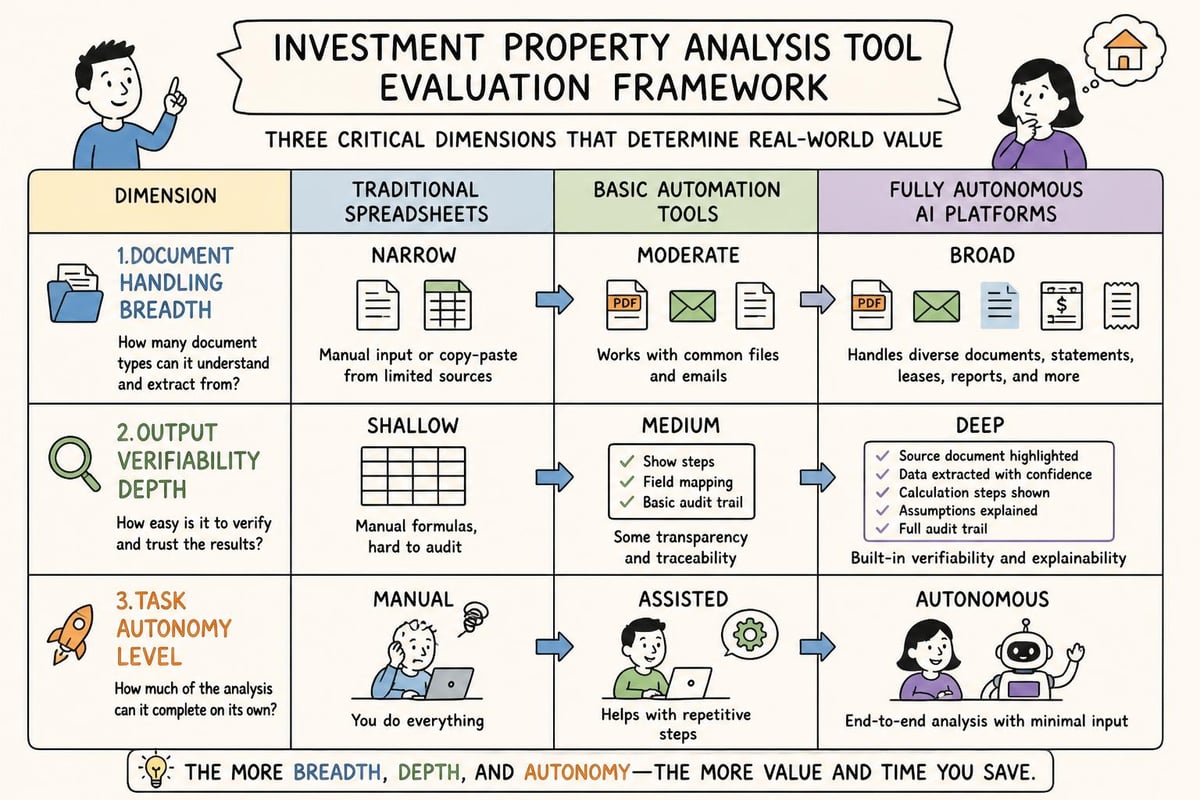
Choosing the right platform requires evaluating capabilities across three critical dimensions: document handling, output verifiability, and task autonomy. Each dimension directly impacts both analysis accuracy and team capacity.
Document Handling Capabilities
Effective document handling means processing the full range of materials that accompany commercial real estate transactions. An investment property analysis tool should extract data from:
Offering memorandums: Property descriptions, location data, unit mix, amenities
Rent rolls: Tenant names, unit numbers, lease terms, monthly rents, expiration dates
T12 statements: Monthly revenue and expense line items across twelve months
Lease abstracts: Rental rates, escalation terms, tenant improvement allowances, renewal options
Capital needs assessments: Deferred maintenance items, replacement reserves, required upgrades
Platforms that handle only one or two document types force analysts to manually enter data from remaining sources, defeating the automation purpose. Comprehensive document extraction eliminates this manual gap.
According to insights from commercial real estate database analysis, the most sophisticated platforms also connect to external data sources for market research, pulling comparable sales, rent surveys, demographic data, and economic indicators to validate assumptions against third-party benchmarks.
Output Verifiability Standards
Verifiable outputs include direct links from every data point, calculation, and conclusion back to supporting source material. When evaluating platforms, test whether you can:
Click on a projected rent figure and see the exact rent roll entry
Review the calculation methodology for every financial metric
Trace assumptions about rent growth to market research sources
Verify expense projections against historical T12 performance
Access original document pages supporting qualitative observations
Tools from providers like RealData and others in the market emphasize calculation transparency, but the critical distinction lies in whether that transparency extends to source document integration or stops at formula visibility.
Investment committees increasingly demand this level of documentation. According to research on REIT investment behaviors, institutional investors prioritize verifiable data over projected returns when evaluating opportunities. An investment property analysis tool that cannot demonstrate the provenance of its conclusions creates approval friction that slows deal execution.
Task Autonomy Assessment
Task autonomy determines whether a platform truly scales your capacity or simply digitizes manual steps. Evaluate platforms based on:
Fully autonomous capabilities:
Complete underwriting from raw documents to finished IC memo
Market research integrated automatically into analysis
Risk factor identification without manual prompting
Comparable property analysis pulling live market data
Presentation deck generation with formatted exhibits
Semi-autonomous capabilities (requiring intervention):
Data extraction requiring manual verification before modeling
Financial models needing assumption inputs at multiple steps
Output generation requiring template customization per deal
Market research necessitating separate tool access
AI underwriting platforms designed for commercial real estate handle long, multi-step processes without breaking the workflow into discrete manual stages. This seamless execution separates tools that merely assist analysis from those that perform analysis autonomously.
Integration With Property Management Systems
The most powerful investment property analysis tools don't operate in isolation. They connect directly to property management systems where operational data lives, creating continuous feedback loops between analysis and actual performance.
Real-Time Data Access Advantages
When platforms integrate with Yardi, RealPage, and Entrata, they access:
Current rent rolls reflecting real-time occupancy
Actual expense data eliminating reliance on seller projections
Lease expiration schedules showing near-term rollover risk
Historical variance between budgets and actual performance
Tenant payment histories indicating collection risk
This integration transforms underwriting from a point-in-time snapshot to a dynamic process that updates as conditions change. Post-acquisition, the same integration supports ongoing asset portfolio management by monitoring performance against original underwriting assumptions.
Resources like SitusAMC's data analytics research demonstrate how robust data integration supports informed decision-making across the investment lifecycle. The firms that combine acquisition analysis with portfolio monitoring achieve superior risk-adjusted returns because they identify underperformance early and adjust strategies proactively.
Workflow Automation Beyond Analysis
Integration enables workflow automation that extends beyond financial modeling into operational execution:
Automatic budget variance reports comparing projections to actuals
Rent roll analysis flagging upcoming lease expirations
NOI optimization recommendations based on strategies to increase NOI
Capital expenditure tracking against reserve budgets
Portfolio-level reporting aggregating performance across properties
These capabilities matter because acquisition analysis doesn't end at closing. The underwriting assumptions become hypotheses that operating performance tests continuously. An investment property analysis tool that connects analysis to operations creates accountability mechanisms that improve future underwriting accuracy.
Measuring ROI on Analysis Technology
Technology investments require clear ROI justification. For investment property analysis tools, return manifests through time savings, capacity expansion, and decision quality improvement.
Quantifiable Time Savings
Track hours spent on specific tasks before and after implementation:
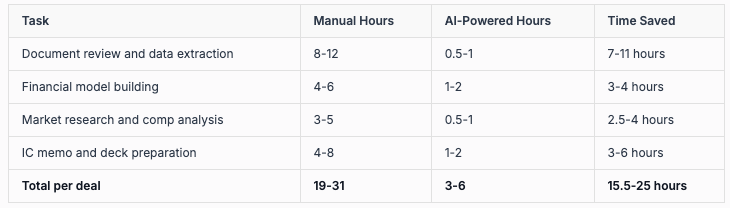
For teams analyzing 50 deals annually, this time savings translates to 775-1,250 hours recaptured. At an analyst cost of $75,000 annually (approximately 2,000 working hours), that represents $29,000-$46,875 in capacity value per year.
Capacity Expansion Without Headcount
More valuable than time savings is capacity expansion. The same team that previously analyzed 50 deals can now evaluate 250-400 opportunities, dramatically improving the probability of finding exceptional investments. This selection advantage compounds over time as portfolios built from larger opportunity sets outperform those assembled from limited options.
Firms using advanced AI real estate software report 5-10x increases in deal evaluation capacity without proportional headcount growth. This scaling effect becomes particularly valuable during competitive acquisition environments when speed determines success.
Decision Quality Improvements
Harder to quantify but equally important, AI-powered analysis improves decision quality through:
Reduced errors: Automated extraction eliminates transcription mistakes
Comprehensive analysis: Every deal receives thorough evaluation rather than rushed review
Consistent methodology: Standardized approaches prevent analytical shortcuts
Better documentation: Complete audit trails support post-mortem learning
Risk identification: Automated flagging catches issues human review might miss
Research on real estate deal analysis emphasizes how systematic evaluation processes lead to superior long-term performance. The goal isn't just analyzing faster; it's making better decisions consistently while maintaining deal velocity.
Implementation Roadmap for Analysis Automation
Successful implementation of an investment property analysis tool requires structured planning across technology deployment, team training, and process redesign.
Phase 1: Pilot Testing and Validation
Begin with a controlled pilot analyzing 5-10 recent deals where you already know the correct answers:
Select representative deals: Include various property types, document qualities, and complexity levels
Run parallel analysis: Have AI process deals while analysts work manually
Compare outputs: Verify data extraction accuracy, model logic, and conclusion alignment
Document discrepancies: Understand where human judgment differs from automated analysis
Refine configurations: Adjust platform settings based on pilot findings
This validation phase builds team confidence in automated outputs before relying on them for live transactions. Expect 2-3 weeks for thorough pilot testing with deals of moderate complexity.
Phase 2: Process Integration
Integrate the tool into existing acquisition workflows:
Deal intake: Establish document upload protocols and naming conventions
Review checkpoints: Define where human review occurs in automated workflows
Approval routing: Configure how outputs flow to investment committees
Feedback loops: Create mechanisms for analysts to flag issues and improve accuracy
Performance tracking: Monitor time savings and capacity expansion metrics
For platforms with property management system integrations, coordinate with IT teams to establish secure API connections. SOC 2 Type 2 certified platforms simplify this process by meeting enterprise security requirements without extensive custom configuration.
Phase 3: Continuous Improvement
Analysis accuracy improves as platforms process more deals and teams provide feedback:
Review automated outputs against actual performance quarterly
Document systematic biases in assumptions requiring adjustment
Share edge cases where AI struggled to improve future handling
Update market research integrations as data sources evolve
Expand use cases beyond initial acquisition analysis to portfolio management
Tools from companies like Teronzi demonstrate how AI systems that integrate government data and market intelligence become more valuable over time as their knowledge bases expand. The investment property analysis tool you implement today should perform noticeably better twelve months from now without manual reprogramming.
Common Implementation Challenges and Solutions
Teams implementing analysis automation encounter predictable obstacles. Anticipating these challenges accelerates successful deployment.
Data Quality and Standardization
Challenge: Offering memorandums and rent rolls arrive in countless formats, some machine-readable and others scanned PDFs with poor OCR quality.
Solution: Purpose-built platforms for commercial real estate handle format variations through training on thousands of industry-specific documents. Rather than expecting perfect inputs, these systems extract what they can and flag items requiring manual verification. Over time, extraction accuracy improves as the platform encounters similar format variations.
Change Management and Adoption
Challenge: Experienced analysts resist automation, viewing it as replacement rather than augmentation of their expertise.
Solution: Position the investment property analysis tool as eliminating tedious work so analysts focus on judgment-intensive activities like market timing, risk assessment, and strategic positioning. Demonstrate time savings quantitatively and redirect that capacity toward higher-value analysis. Analysts who previously spent 60% of their time on data entry and modeling can now spend 80% on evaluation and decision-making.
Integration Complexity
Challenge: Connecting AI platforms to property management systems, data rooms, and existing software stacks requires technical coordination across multiple vendors.
Solution: Prioritize platforms with pre-built integrations to major systems like Yardi, RealPage, and Entrata. These established connections eliminate custom development requirements. For other integrations, SOC 2 Type 2 certified platforms typically provide implementation support and clear documentation that accelerates deployment.
Resources like NYU's real estate data guide illustrate the breadth of potential data sources that sophisticated analysis incorporates. The goal isn't connecting everything immediately but establishing a roadmap that expands integration depth over time.
Future Direction of Investment Analysis Technology
The trajectory of investment property analysis tools points toward increasingly autonomous systems that handle not just individual deals but entire acquisition strategies.
Portfolio-Level Analysis and Optimization
Next-generation platforms will evaluate how individual acquisitions fit portfolio-level objectives around:
Geographic diversification targets
Property type concentration limits
Vintage balancing across assets
Lease expiration staggering
Aggregate leverage constraints
This portfolio context transforms deal evaluation from isolated transactions to strategic fit assessment. An acquisition that looks attractive standalone may create undesirable concentration risk when viewed against existing holdings.
Predictive Performance Modeling
Moving beyond historical analysis, advanced platforms will integrate predictive modeling that forecasts:
Tenant retention likelihood based on payment history and market alternatives
Renovation ROI projections using actual performance from similar upgrades
Market rent trajectory incorporating economic indicators and supply pipelines
Capital event timing optimizing tax treatment and portfolio liquidity
These capabilities require platforms that continuously ingest operating data from acquired properties, building performance databases that inform future underwriting. The feedback loop between acquisitions and operations becomes the foundation for continuously improving analysis accuracy.
Decision Support Beyond Underwriting
The most sophisticated investment property analysis tools will expand from supporting acquisition decisions to guiding entire asset management strategies:
Disposition timing recommendations based on market cycle positioning
Value-add opportunity identification from operational data patterns
Refinancing optimization analyzing rate environments and leverage costs
Portfolio rebalancing suggestions maintaining target allocation ranges
This expansion reflects the reality that reporting and asset management form a continuous cycle rather than discrete phases. The same analytical capabilities that evaluate acquisitions should monitor performance and guide strategic adjustments throughout the holding period.
Investment property analysis in commercial real estate has fundamentally shifted from a manual bottleneck limiting deal capacity to an automated engine enabling unprecedented scale. The firms that embrace AI-powered analysis tools gain decisive advantages in competitive acquisition markets by evaluating more opportunities thoroughly while maintaining rigorous standards for accuracy and verifiability. Leni delivers this transformation through purpose-built AI that autonomously handles document extraction, financial modeling, market research integration, and deliverable creation while maintaining source-linked verification throughout. As commercial real estate becomes increasingly data-driven, the platforms connecting analysis to operational performance through direct property management system integrations will define which firms build superior portfolios efficiently.

Johanna Gruber
Johanna has spent the last 8 years helping marketing teams connect with audiences through content. Specializing in B2B SaaS and real estate.

Curious About AI?
Join the largest AI community for real estate online. Get bite-sized, real-world use case videos, plus practical tips and proven strategies from top industry experts on adopting AI effectively.
MEET LENI
AI SuperAgent Purpose Built for Investors and Operators.
Experience how professionals and teams in your domain are getting the edge using AI.
