Real Estate Acquisitions: AI in Due Diligence (2026)

Real Estate Acquisitions: AI in Due Diligence (2026)
Due diligence is where real estate acquisitions deals slow down, budgets explode, and opportunities vanish to faster competitors. Every acquisitions team knows this reality: you receive an offering memorandum on Monday, scramble through hundreds of lease documents by Wednesday, attempt to validate market assumptions by Friday, and somehow need an investment committee memo ready by the following week. Meanwhile, the team that moves faster wins the deal. In 2026, the difference between winning and losing competitive acquisitions often comes down to how efficiently teams process information during due diligence. The manual approach-spreadsheets, email chains, and analysts working late nights-cannot match the speed and accuracy that purpose-built AI platforms now deliver across every stage of the acquisitions process.
1. Document Extraction from Offering Memorandums and Rent Rolls
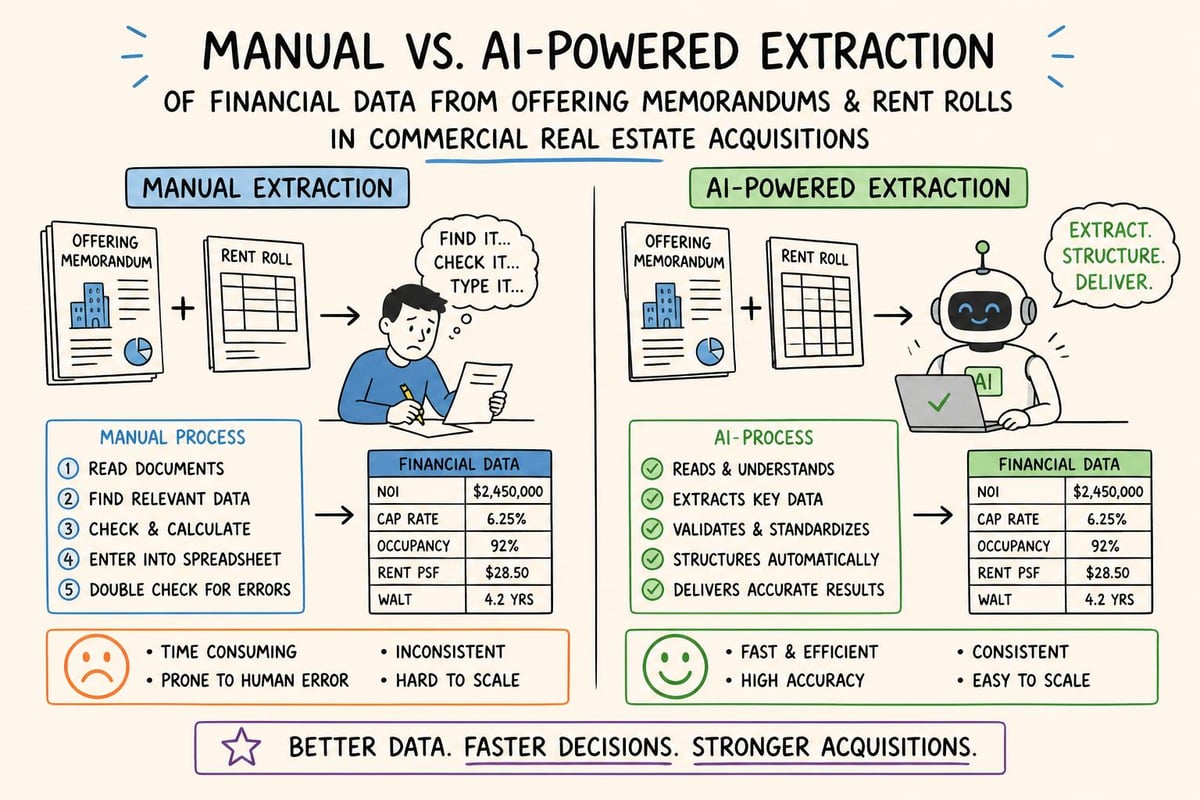
The first bottleneck in real estate acquisitions appears immediately when teams receive deal materials. Offering memorandums arrive as PDFs with inconsistent formatting, rent rolls exist as scanned images or protected spreadsheets, and critical financial data hides across dozens of pages.
The Manual Process
Traditional document extraction requires junior analysts to manually transcribe data from OMs into underwriting models. This process typically consumes 8-12 hours per property for a standard multifamily acquisition. Analysts copy rental income figures, expense line items, capital expenditure histories, and unit mix data one cell at a time. Human error rates average 3-5% according to best practices for managing real estate transactions, which means critical numbers frequently require multiple quality control passes.
Common issues with manual extraction:
Inconsistent categorization across different broker formats
Missed footnotes containing material assumptions
Version control problems when OMs get updated
Time delays that push back entire deal timelines
Inability to process multiple deals simultaneously
The AI-Powered Alternative
Modern AI platforms built specifically for real estate acquisitions can extract structured data from unstructured documents in minutes rather than hours. These systems recognize property-specific terminology, identify financial tables regardless of format, and pull data directly into financial models with full source attribution.
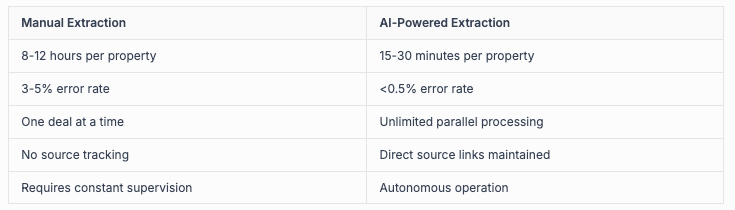
The difference becomes exponential when acquisitions teams evaluate multiple opportunities simultaneously. Where manual processes force sequential review, AI enables parallel processing across entire deal pipelines. Teams using AI-powered real estate deal analyzers report 90% time savings on initial data extraction, allowing analysts to focus on interpretation rather than transcription.
2. First-Pass Underwriting and Financial Modeling
Once data extraction completes, acquisitions teams face the critical task of building comprehensive financial models. This stage determines whether deals advance to deeper due diligence or get eliminated from consideration.
First-pass underwriting in real estate acquisitions traditionally represents the most time-intensive analytical work. Analysts build 10-year cash flow projections, sensitivity analyses, waterfall distributions, and return metrics while making assumptions about market rent growth, expense escalation, and exit capitalization rates.
Manual Underwriting Challenges
Building acquisition underwriting models from scratch requires deep Excel expertise and property-type knowledge. A single multifamily deal typically needs 20-30 hours of modeling time for an experienced analyst. This timeline extends when deals involve complex capital structures, multiple property types, or value-add business plans requiring detailed renovation assumptions.
The manual approach also creates consistency problems across deal teams. Different analysts use different templates, apply varying assumption sets, and structure outputs in ways that make portfolio-level comparison difficult. When acquisitions teams evaluate five competing opportunities simultaneously, reconciling these differences adds another layer of time consumption.
AI-Driven Underwriting Speed
Purpose-built AI platforms transform underwriting from a multi-day process into a same-day deliverable. These systems automatically populate financial models using extracted property data, apply market-standard assumptions based on asset class and geography, and generate complete sensitivity analyses without manual intervention.
Advanced platforms connect directly to property management systems like Yardi, RealPage, and Entrata to validate actual operating performance against broker representations. This integration enables real estate portfolio intelligence that catches discrepancies early in the acquisitions process, before teams invest significant due diligence resources.
Key capabilities of AI underwriting:
Automated cash flow modeling with property-specific assumptions
Instant sensitivity analysis across 20+ variables
Benchmark comparison against comparable acquisitions
Real-time updates when assumptions change
Standardized output formats for portfolio analysis
The speed advantage compounds when acquisitions teams operate in competitive bidding situations. Understanding that real estate acquisition differs from ongoing asset management helps teams allocate analytical resources appropriately across both functions.
3. Market Research and Comparable Sales Analysis
Every real estate acquisitions decision requires validation against current market conditions. Teams need to verify rent assumptions, confirm capitalization rate expectations, and benchmark operating expenses against comparable properties.
Traditional market research involves manually searching databases like CoStar, analyzing broker reports, calling local contacts for insights, and compiling findings into summary documents. This scattered approach produces inconsistent results and leaves teams uncertain about data recency and accuracy.
The Manual Research Burden
Analysts spend 6-10 hours per acquisition opportunity gathering and synthesizing market intelligence. The process includes:
Searching multiple databases for comparable sales
Reading through dozens of market reports for relevant trends
Calling brokers to verify unlisted transaction details
Assembling disparate sources into coherent narratives
Updating research when new comparables emerge
Beyond time consumption, manual research suffers from recency problems. By the time an analyst compiles a market summary, several data points may already be outdated. In fast-moving markets like multifamily or industrial, this lag creates real risks in real estate acquisitions due diligence.
AI-Powered Market Intelligence
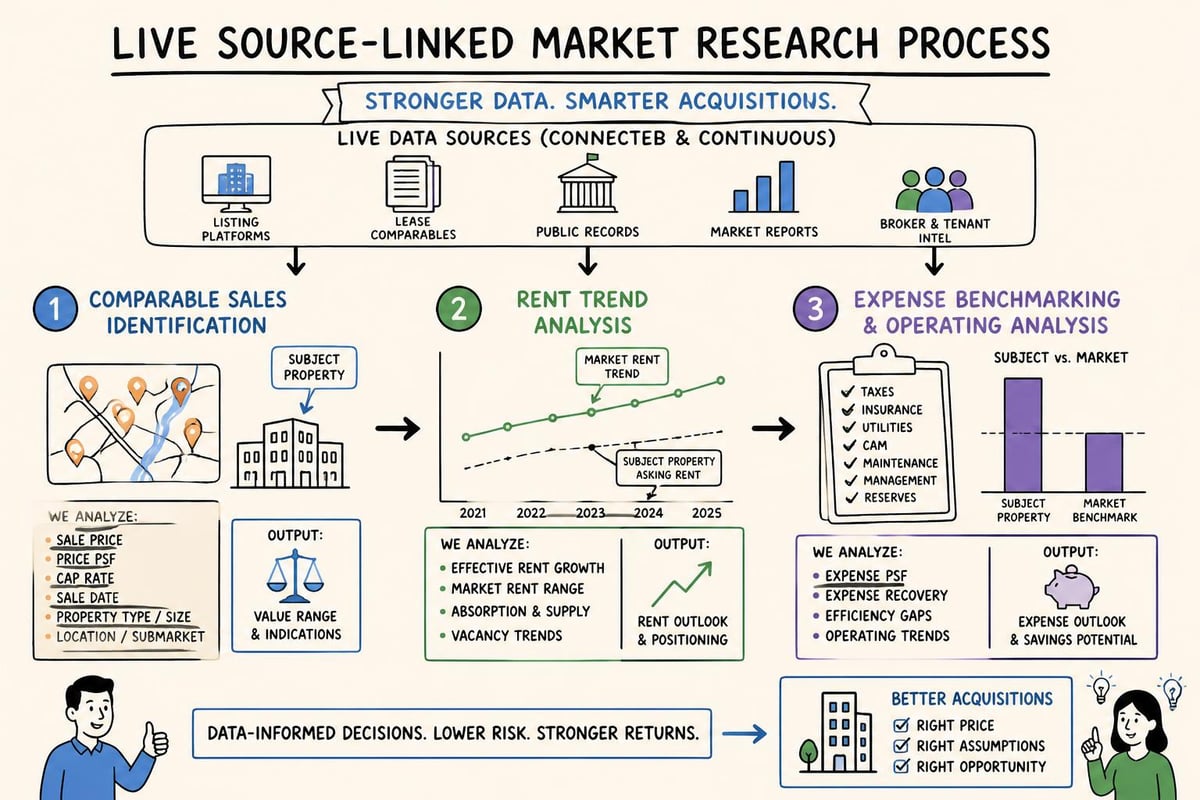
Modern AI platforms deliver live, source-linked market research that updates continuously as new data becomes available. Rather than static reports, acquisitions teams access dynamic intelligence feeds that highlight emerging trends, flag market shifts, and automatically update comparable analyses.
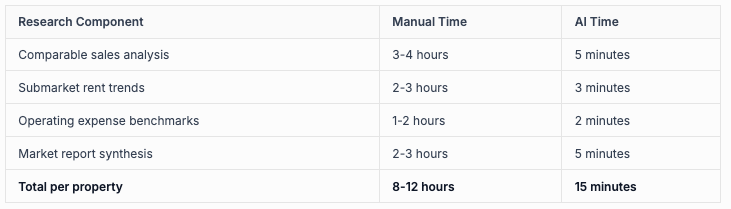
The transformation extends beyond speed to comprehensiveness. AI systems can simultaneously analyze hundreds of comparable transactions, identify patterns across multiple market cycles, and surface insights that manual review would miss. Every finding includes direct links to source documents, enabling teams to verify AI-generated conclusions instantly.
4. Lease Review and Risk Identification
For income-producing real estate acquisitions, lease analysis represents one of the most critical and time-consuming due diligence components. Missing a problematic lease provision can destroy deal economics after closing.
Manual Lease Review Limitations
Acquisitions teams evaluating multifamily, office, or retail properties often face hundreds of individual lease documents. A 200-unit apartment acquisition might include 200 separate leases, each requiring review for renewal options, rent escalations, tenant improvement allowances, and termination rights.
Manual review typically follows a sampling approach where analysts examine a percentage of leases in detail while spot-checking others. This methodology creates gaps-the unreviewed lease containing the most problematic provision is precisely the one that causes post-acquisition headaches.
A comprehensive manual lease review for a mid-sized commercial property requires 40-60 hours of attorney or senior analyst time. For acquisitions teams evaluating multiple opportunities simultaneously, this timeline forces difficult prioritization decisions about which deals receive thorough lease analysis and which proceed with partial review.
Critical lease provisions requiring review:
Extension and renewal options affecting hold period
Co-tenancy clauses in retail properties
Above-market tenant improvement obligations
Percentage rent calculations and audit rights
Early termination options and break clauses
ROFO, ROFR, and other purchase rights
Operating expense pass-through limitations
AI-Enabled Lease Intelligence
Purpose-built AI platforms extract every material provision from every lease, enabling 100% review coverage regardless of portfolio size. These systems identify risk factors automatically, flag non-standard provisions, and calculate the financial impact of option exercises across entire lease portfolios.
The advantage extends beyond comprehensive coverage to consistency. AI applies uniform analysis standards across all leases, eliminating the variability that occurs when multiple team members review different portions of the portfolio. Teams gain instant visibility into aggregate exposure across dimensions like lease expiration concentration, renewal option timing, and above-market rent positions.
Advanced platforms track changes between lease abstracts provided by sellers and actual lease documents, automatically flagging discrepancies that might indicate larger due diligence issues. This verification capability proves especially valuable in competitive real estate acquisitions where due diligence timelines compress to days rather than weeks.
5. Investment Committee Memo and Presentation Assembly
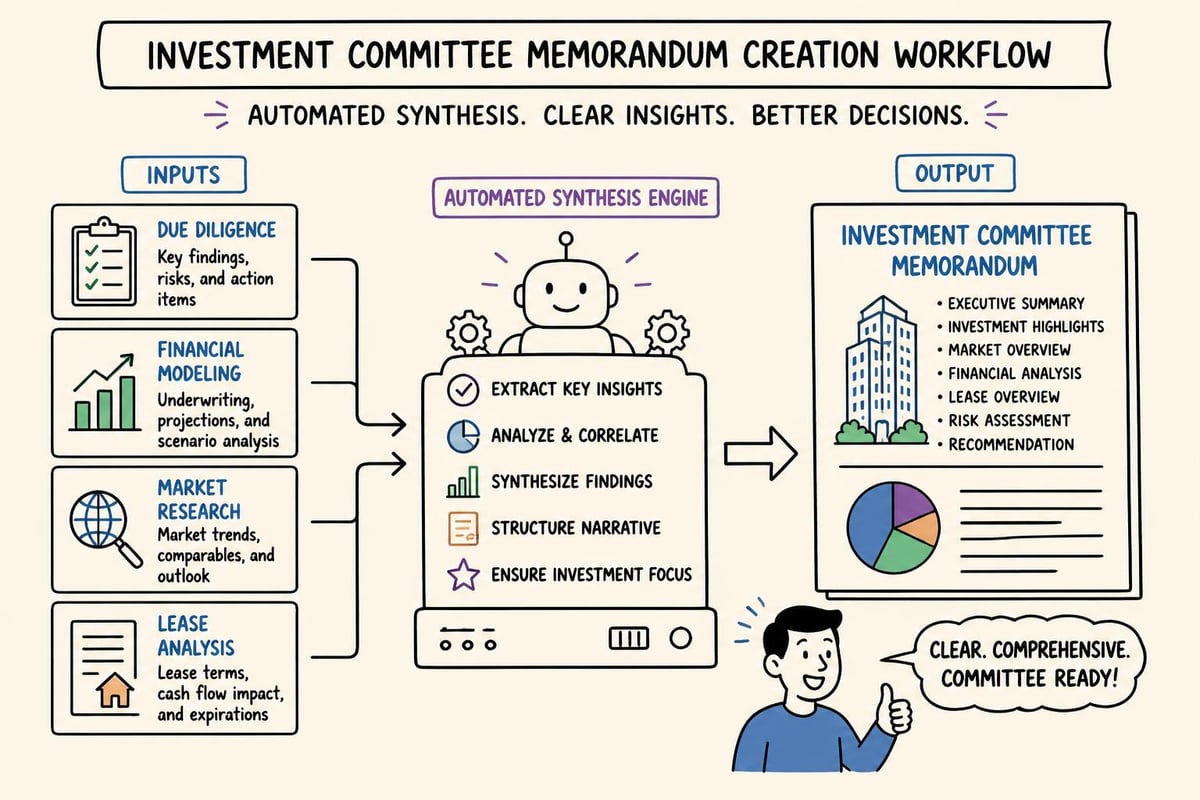
The final stage of real estate acquisitions due diligence involves synthesizing all findings into investment committee deliverables. IC memos and presentations must tell a coherent story while providing sufficient detail for decision-makers to approve capital deployment.
The Manual Assembly Process
Creating IC memos manually requires analysts to gather insights from all previous due diligence stages, write executive summaries, compile supporting exhibits, and format everything into presentation-ready documents. This process typically consumes 12-20 hours per acquisition opportunity, even when underlying analysis is complete.
The challenge multiplies when deal dynamics change during due diligence. A seller price reduction, updated rent roll, or new market comparable requires updating analysis throughout the IC package. Manual processes make these updates time-consuming and error-prone, as changes in one section must cascade through multiple dependent calculations and narratives.
Teams also struggle with consistency across IC presentations. Different analysts emphasize different aspects, use varying formats, and present information in ways that make cross-deal comparison difficult for investment committee members evaluating multiple opportunities.
AI-Generated Investment Memorandums
AI platforms built for real estate acquisitions generate complete IC memos automatically from underlying analysis. These systems produce executive summaries, investment highlights, risk factors, market overviews, financial summaries, and supporting schedules in standardized formats that decision-makers recognize instantly.
The transformation goes beyond formatting to analytical depth. AI-generated memos include source attribution for every major assertion, enabling committee members to drill into underlying documentation with a single click. When assumptions change, memos update automatically across all affected sections, maintaining internal consistency without manual coordination.
Components auto-generated by AI platforms:
Executive summary with deal highlights and recommendation
Property and market overview with source-linked research
Financial analysis including base case and sensitivities
Risk factors extracted from lease review and due diligence
Comparable transactions analysis with benchmarking
Investment structure and return waterfall modeling
Exit strategy and market timing considerations
According to research on successful real estate acquisitions strategies, well-documented investment theses correlate strongly with long-term portfolio performance. AI-generated documentation ensures this rigor applies consistently across all deals rather than only to the opportunities that happen to receive senior analyst attention.
Platforms offering advanced asset portfolio management capabilities enable teams to track how acquisition underwriting compared to actual performance post-closing, creating feedback loops that improve future investment decisions.
The Competitive Advantage of Faster Due Diligence
Speed in real estate acquisitions due diligence translates directly to competitive positioning and deal volume capacity. Teams that complete thorough analysis in days rather than weeks win more opportunities in competitive situations while maintaining quality standards that protect capital.
Deal Volume Capacity
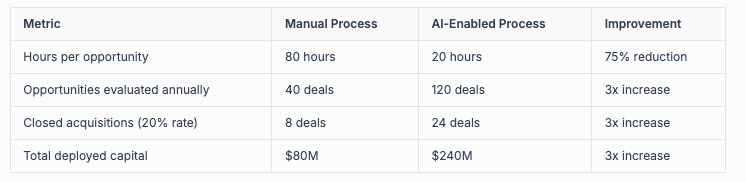
The mathematics of time savings become compelling at portfolio scale. An acquisitions team that traditionally evaluates 40 opportunities annually to close 8 deals operates at a 20% conversion rate. If due diligence consumes 80 hours per evaluated opportunity, the team spends 3,200 hours annually on deals that don't close.
Reducing due diligence time by 75% through AI automation frees 2,400 hours for evaluating additional opportunities. That same team could now assess 120 opportunities annually while maintaining the same 20% conversion rate, resulting in 24 closed acquisitions-a 3x increase in deal volume without adding headcount.
Impact on acquisition capacity:
Speed in Competitive Situations
Beyond volume, faster due diligence wins competitive bid situations. When multiple qualified buyers pursue the same asset, sellers favor teams that demonstrate quick execution capability. The ability to deliver comprehensive analysis within 72 hours of receiving materials signals operational sophistication that translates to closing confidence.
This advantage compounds in off-market and lightly marketed opportunities where sellers give a single buyer a short window to commit before broader marketing. Teams equipped with AI-powered due diligence can act decisively on these situations while competitors are still scheduling kickoff calls.
Real-world examples demonstrate this dynamic. Looking at case studies of successful acquisitions, speed-to-market consistently emerges as a differentiating factor in competitive processes.
Risk Management at Scale
Faster due diligence might suggest corner-cutting, but purpose-built AI platforms actually enhance risk management by enabling comprehensive analysis that manual processes cannot match. When systems review 100% of leases rather than samples, extract every data point from offering memorandums rather than summaries, and validate every market assumption against current comps, risk identification improves dramatically.
The verification layer that AI provides-with every finding linked directly to source documents-creates an audit trail that manual processes rarely achieve. Investment committee members can validate any assertion instantly, and acquisition teams can defend their recommendations with evidence that stands up to third-party scrutiny.
Organizations focused on data analytics in asset management recognize that better data leads to better decisions across the entire investment lifecycle, from initial acquisitions through ongoing operations and eventual disposition.
Integration with Property Management Systems
Real estate acquisitions due diligence reaches maximum effectiveness when AI platforms connect directly to property management systems that will manage acquired assets post-closing. This integration enables validation of broker-provided financials against actual operating data and creates seamless transitions from acquisitions to asset management.
Pre-Closing Validation
For portfolio acquisitions or deals involving existing relationships, direct property management system integration allows teams to verify rent rolls, expense histories, and occupancy trends without relying solely on seller-provided data. Discrepancies between offering memorandum representations and actual PMS data surface immediately, triggering deeper investigation before capital commitment.
This validation capability proves especially valuable when evaluating multifamily investment opportunities in 2026, where operating performance can vary significantly from broker pro formas in markets experiencing rapid change.
Post-Closing Continuity
Beyond pre-closing validation, PMS integration ensures that acquisition underwriting assumptions flow directly into asset management systems. Teams can track actual performance against acquisition underwriting from day one, identifying variances that require operational intervention and creating feedback loops that improve future investment decisions.
Benefits of PMS integration:
Real-time validation of seller-provided financials
Automated variance analysis between underwriting and actuals
Seamless transition from acquisitions to operations
Consistent data architecture across deal lifecycle
Improved accuracy of future acquisition models
Platforms connecting to Yardi, RealPage, and Entrata cover the vast majority of institutionally-managed commercial real estate, ensuring that integrations work across diverse portfolio compositions. This compatibility matters for acquisitions teams that evaluate opportunities across multiple property types and management platforms.
Technology Requirements for Acquisitions Teams
Selecting AI platforms for real estate acquisitions requires evaluating capabilities beyond general-purpose artificial intelligence. Acquisitions teams need systems purpose-built for commercial real estate that understand property-specific terminology, workflows, and analytical requirements.
Essential Platform Capabilities
The difference between general AI tools and purpose-built acquisitions platforms becomes apparent in complex due diligence scenarios. General tools may summarize documents but cannot extract lease provisions into structured databases. They may generate text but cannot produce financial models with verifiable source attribution. They may answer questions but cannot run autonomous multi-step analytical workflows that span document extraction through IC memo generation.
Purpose-built platforms must deliver:
Autonomous task execution - Running complete analytical workflows from start to finish without manual intervention at each step
Structured data extraction - Converting unstructured documents into databases ready for financial analysis
Source attribution - Linking every output to specific source documents for verification
Property system integration - Connecting directly to Yardi, RealPage, Entrata, and other PMS platforms
Security compliance - Meeting SOC 2 Type 2 certification standards required for institutional capital
The platform's ability to improve with data ingestion also matters. Systems that learn from each processed deal become more accurate over time, while static tools maintain constant performance regardless of usage volume.
Workflow Automation Depth
Beyond individual task automation, leading platforms orchestrate entire due diligence workflows. Rather than using AI for document extraction, then switching to manual processes for underwriting, then returning to AI for research, integrated platforms handle complete acquisitions pipelines end-to-end.
This workflow depth eliminates the context-switching and data transfer overhead that plague fragmented toolsets. When the same platform that extracted rent roll data also builds the financial model and generates the IC memo, information flows seamlessly without manual coordination.
Teams exploring real estate automation should prioritize platforms that reduce total workflow time rather than just individual task duration. The compound benefits of integrated automation far exceed the sum of isolated efficiency gains.
Faster, more thorough due diligence fundamentally changes what acquisitions teams can accomplish with existing resources. The ability to evaluate 3x more opportunities while improving risk identification and maintaining investment discipline creates sustainable competitive advantages in commercial real estate markets. Leni handles exactly this challenge: running autonomous analytical workflows from document extraction through IC memo generation, connecting directly to property management systems for data validation, and delivering verifiable outputs with complete source attribution. Purpose-built for acquisitions teams that need to move faster without sacrificing rigor, Leni transforms due diligence from a bottleneck into a competitive weapon.

Johanna Gruber
Johanna has spent the last 8 years helping marketing teams connect with audiences through content. Specializing in B2B SaaS and real estate.

Curious About AI?
Join the largest AI community for real estate online. Get bite-sized, real-world use case videos, plus practical tips and proven strategies from top industry experts on adopting AI effectively.
MEET LENI
AI SuperAgent Purpose Built for Investors and Operators.
Experience how professionals and teams in your domain are getting the edge using AI.