Real Estate Financial Modeling Tool: What Actually Works

Real Estate Financial Modeling Tool: What Actually Works
Your acquisitions team just sent you a 400-unit value-add opportunity with a 72-hour LOI deadline. The seller wants proof of funds, a detailed sources and uses, and sensitivity tables on three exit scenarios. Your analyst is building the model from scratch in Excel. Again. This scenario repeats itself across commercial real estate firms because most organizations still treat financial modeling as a custom exercise rather than a systematic workflow. The right real estate financial modeling tool doesn't just speed up calculations. It standardizes assumptions, maintains version control, and integrates directly with the data sources that matter for institutional-grade work.
Why Excel Alone No Longer Cuts It for Enterprise CRE
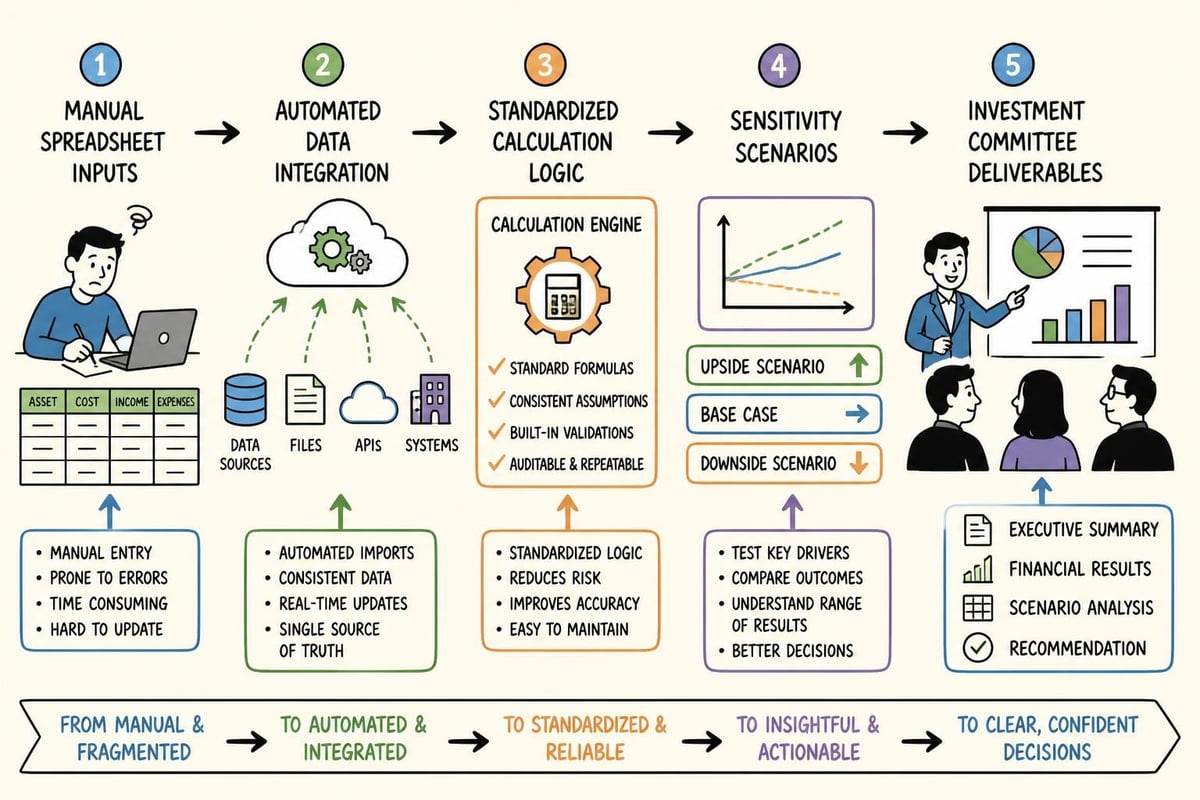
Excel remains the foundation of financial analysis, but relying exclusively on spreadsheets creates systematic risks that compound as portfolios scale. Version control becomes impossible when multiple team members work on the same deal model. Formula errors propagate silently through linked cells. Audit trails disappear when someone overwrites a critical assumption without documentation.
The operational costs add up quickly:
Junior analysts spend 60-70% of their time on data entry and formatting rather than analysis
Deal teams rebuild similar models for each new acquisition instead of leveraging templates
Portfolio reviews require manual aggregation across dozens of property-level spreadsheets
Sensitivity analysis means copying entire workbooks and manually adjusting variables
The issue isn't Excel's calculation engine. The problem is treating complex, multi-asset real estate portfolios as if they're isolated spreadsheet exercises. Real estate investment analysis software built for enterprise workflows addresses these friction points through standardization, automation, and direct integration with property management systems.
Core Capabilities That Define Institutional-Grade Modeling Tools
A real estate financial modeling tool designed for serious asset management work delivers specific outputs that spreadsheets can't match without extensive customization. The platform should generate underwriting models that pull actual operating data rather than requiring manual input. It needs to produce investment committee memos with source attribution for every market assumption and comparable sale.
Automated Data Integration and Validation
Enterprise platforms connect directly to property management systems, eliminating the manual export-import cycle that introduces errors and delays. When a commercial real estate deal analyzer integrates with your PMS, rent rolls update automatically. Operating expense trends reflect actual performance rather than analyst estimates. Capital expenditure tracking becomes real-time rather than quarterly.
This integration also enables validation logic that catches inconsistencies before they reach senior stakeholders. The system flags when proforma occupancy assumptions diverge from historical stabilization periods. It identifies when exit cap rate spreads fall outside market norms for the submarket and property type.
Scenario Modeling and Sensitivity Analysis at Scale
CRE scenario modeling software allows portfolio managers to stress test assumptions across multiple dimensions simultaneously. Instead of manually copying models and adjusting variables, institutional tools generate comprehensive sensitivity tables that show IRR impacts across ranges of exit cap rates, hold periods, rent growth assumptions, and capital expenditure scenarios.
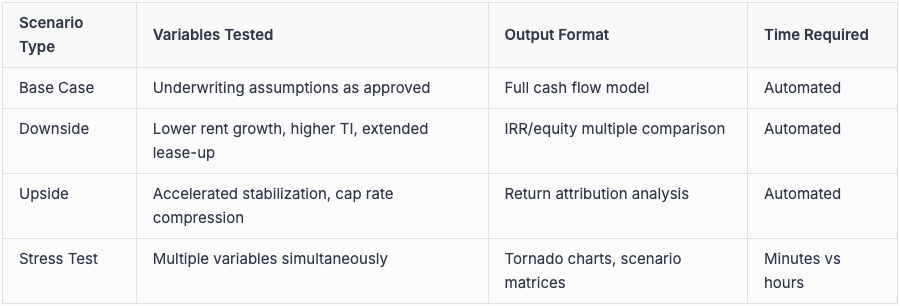
The best real estate financial modeling software makes scenario analysis a repeatable process rather than a custom project for each deal or portfolio review.
How AI Enhances Accuracy Without Replacing Judgment
Artificial intelligence in real estate financial modeling tool applications focuses on tasks that consume analyst time without adding strategic value. AI for real estate investment excels at data extraction, assumption validation, and output generation. It doesn't replace the investment committee's judgment on whether to proceed with an acquisition.
Market Research and Comparable Analysis
AI-powered platforms pull comparable sales, lease comps, and market rent data from multiple sources, then synthesize findings into structured summaries with complete source attribution. When your IC asks why the model assumes 3.2% annual rent growth, the system provides links to the three market reports, five comparable properties, and two broker opinions that support that figure.
This capability transforms market research from a week-long project into a same-day deliverable. More importantly, it creates audit trails that satisfy institutional due diligence requirements. Every assumption ties back to a verifiable data point rather than "analyst judgment" or "market knowledge."
Document Processing and Data Extraction
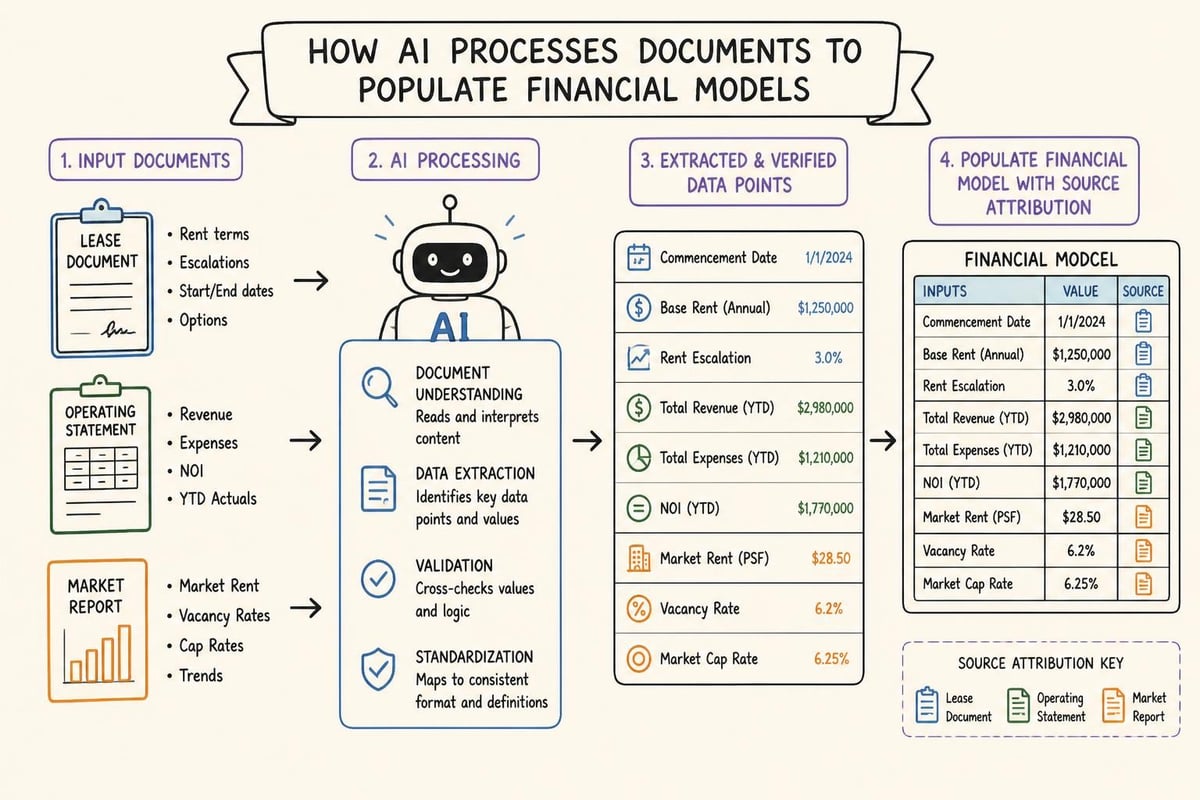
Enterprise real estate workflows involve processing rent rolls, operating statements, lease abstracts, and environmental reports. Real estate AI tools extract structured data from these documents with accuracy rates that exceed manual review, then validate the extracted information against expected ranges and flag outliers for human verification.
Rent rolls: Extract unit mix, lease expirations, tenant improvement allowances, and renewal options
Operating statements: Categorize expenses, identify one-time items, normalize recurring costs
Lease documents: Abstract key economic terms, renewal rights, expansion options, termination clauses
Due diligence reports: Flag material issues, extract cost estimates, identify required capital work
The time savings compound across portfolio operations. What previously required three days of analyst review becomes a two-hour validation exercise.
Integration Requirements for Portfolio-Scale Operations
A real estate financial modeling tool that works for a single-asset shop won't necessarily scale to portfolio management or fund operations. Enterprise platforms require specific integration capabilities that support real estate asset management workflows across multiple properties, markets, and asset classes.
Property Management System Connectivity
Direct PMS integration enables real-time performance tracking against proforma assumptions. Portfolio managers see exactly which properties are outperforming underwriting and which require intervention. The platform should support bi-directional data flow: pulling actual results for reporting and pushing approved budgets back to property operations teams.
Common PMS platforms requiring integration include Yardi, MRI, RealPage, and Buildium. The modeling tool should handle data normalization across these systems since each formats financial information differently. Commercial real estate technology that requires manual data mapping for each property creates bottlenecks that defeat the purpose of automation.
Accounting and Investor Reporting Systems
Institutional investors expect performance reporting that reconciles to GAAP financials and waterfall distributions. The modeling platform needs to export to accounting systems and investor portals without requiring manual reformatting. This integration ensures consistency between what the investment committee approved, what asset management tracks, and what investors receive in quarterly reports.
Automated real estate reporting functionality should generate investor letters, portfolio dashboards, and performance attribution analyses directly from the underlying deal models. When distributions occur, the waterfall calculations should reference the exact terms modeled during underwriting.
Building vs Buying: The Real Cost Analysis
Many enterprises consider building custom financial modeling solutions rather than adopting third-party platforms. This decision deserves rigorous analysis beyond simple software licensing costs. The total cost of ownership for custom-built systems includes ongoing development resources, maintenance overhead, and opportunity cost of delayed feature delivery.
Internal development costs often overlooked:
Engineering resources: 2-3 full-time developers minimum for initial build and ongoing maintenance
Data engineering: ETL pipelines for PMS, accounting, and market data integrations require specialized expertise
Quality assurance: Testing across property types, markets, and deal structures demands dedicated QA resources
Security and compliance: SOC 2 certification, penetration testing, audit trail requirements add significant overhead
The resources required to build enterprise-grade capabilities typically exceed $2-3 million annually once you account for fully-loaded developer costs and infrastructure. Purpose-built platforms like Leni spread these development costs across multiple clients while maintaining the customization and security that institutional investors require.
Template Libraries vs Dynamic Modeling Engines
Traditional real estate financial modeling tool approaches rely on template libraries: pre-built Excel models for multifamily, office, retail, industrial, and hospitality. Users download the relevant template and customize it for their specific deal. This works for firms that execute a handful of transactions annually in a single asset class.
Portfolio operators and active acquirers need dynamic modeling engines that adapt to property characteristics without requiring template selection and customization. The platform should identify whether it's analyzing a stabilized core asset or a value-add opportunity based on occupancy, capital expenditure requirements, and business plan inputs.
Property-Type Specific Calculations
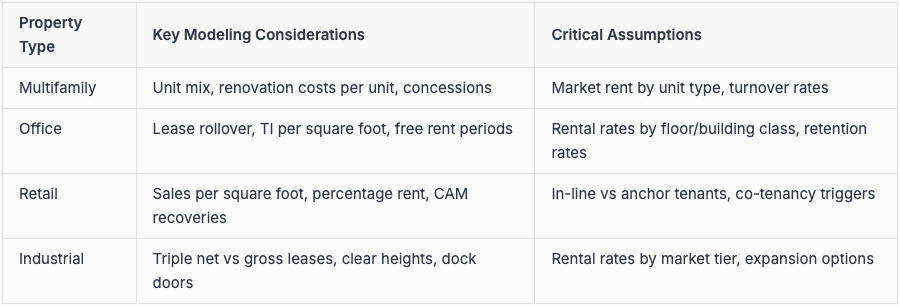
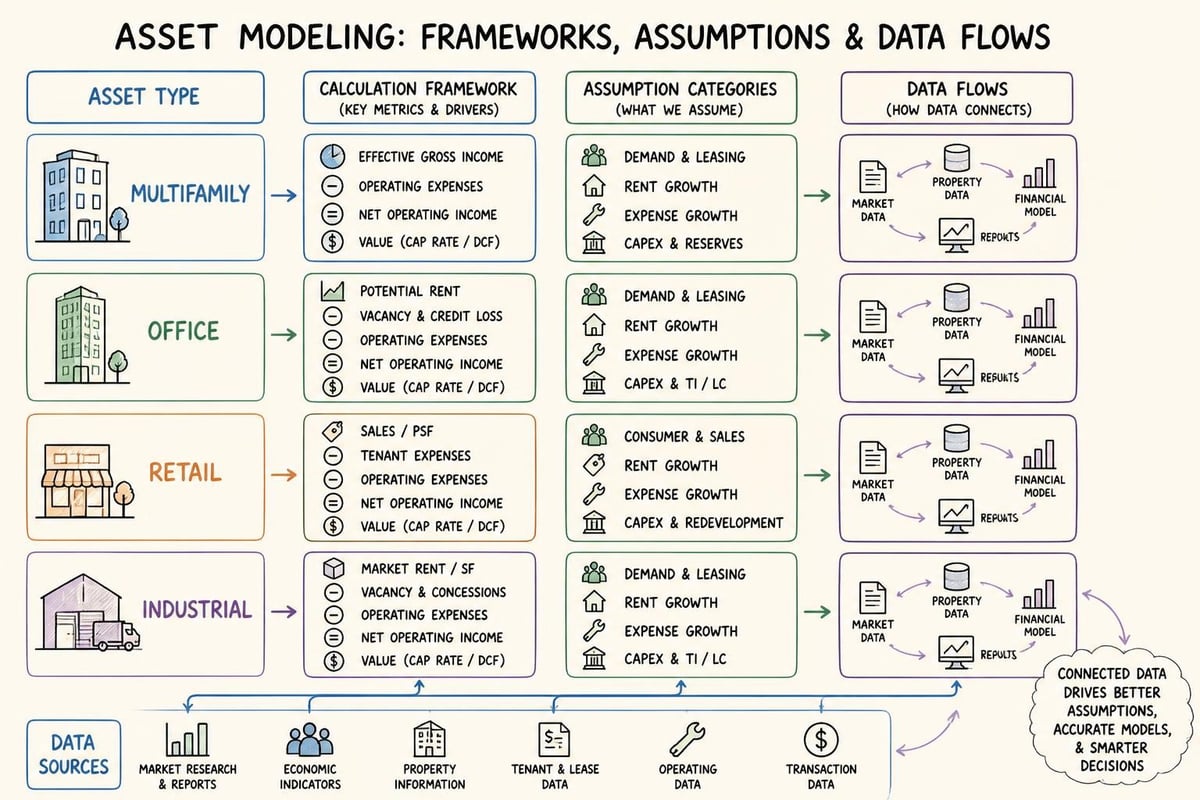
Each commercial real estate sector requires distinct modeling logic. Multifamily models emphasize unit-level economics and renovation programs. Office models focus on lease rollover schedules and tenant improvement costs. Retail models incorporate percentage rent and co-tenancy clauses. Commercial real estate database systems that support multiple property types need calculation engines that handle these nuances automatically.
Educational resources like REFM's comprehensive financial modeling solutions and Adventures in CRE's training programs provide strong foundations for understanding these property-specific modeling requirements.
Security and Compliance for Institutional Deployments
Enterprise investment firms handle confidential deal information, proprietary underwriting assumptions, and investor data subject to strict regulatory requirements. A real estate financial modeling tool deployed at institutional scale must satisfy security standards that consumer-grade applications don't address.
SOC 2 Type II Certification and Data Encryption
Institutional platforms require SOC 2 Type II certification demonstrating audited security controls for data handling, access management, and change control processes. All data should be encrypted at rest and in transit using industry-standard protocols. Secure AI for investment firms means implementing role-based access controls that restrict deal visibility to authorized team members and maintaining complete audit trails of who accessed which models when.
Single Sign-On and Enterprise Authentication
Integration with corporate identity providers through SAML or OAuth enables centralized access management. When an employee leaves the firm, deactivating their corporate account immediately revokes access to all deal models and portfolio data. This centralized control proves essential for regulatory compliance and investor reporting requirements.
Training and Change Management Considerations
Implementing new financial modeling infrastructure requires more than software deployment. Investment teams have established workflows, preferred analytical approaches, and institutional knowledge embedded in existing Excel models. Successful platform adoption requires structured training programs and change management that respects existing expertise while demonstrating clear workflow improvements.
Effective rollout strategies include:
Pilot programs with one deal team or asset class before firm-wide deployment
Side-by-side validation where new platform outputs are compared against existing Excel models
Dedicated implementation support during the first 90 days of usage
Regular training sessions covering advanced features and workflow optimization
Documentation of firm-specific modeling standards and assumption libraries
Research on institutional real estate financial modeling emphasizes the importance of grounding new platforms in established analytical frameworks rather than forcing teams to abandon proven methodologies.
Measuring ROI Beyond Time Savings
Time savings represent the most obvious benefit of purpose-built modeling platforms, but return on investment extends to areas that don't appear in simple hour-counting exercises. Improved accuracy reduces blown underwriting that leads to disappointing asset performance. Faster deal analysis enables firms to compete effectively in competitive bidding situations where speed-to-term-sheet matters.
Deal Volume and Win Rate Improvements
Investment teams equipped with efficient modeling tools can evaluate more opportunities in the same timeframe. This increased capacity means fewer passed deals due to bandwidth constraints. Firms report 30-40% increases in deal flow evaluation capacity after implementing automated modeling platforms.
Win rates improve when teams can deliver detailed investment committee packages faster than competitors. The ability to submit a comprehensive bid package within 48 hours of receiving seller information provides a material advantage in competitive processes.
Portfolio Monitoring and Risk Management
Portfolio and investment management platforms enable continuous performance monitoring rather than quarterly reviews. Portfolio managers identify underperforming assets earlier, allowing faster intervention before value erosion becomes material. This proactive management approach generates returns that exceed the platform's direct costs by orders of magnitude.
Academic research like data-driven strategies for real estate pricing models demonstrates how systematic analytical approaches reduce valuation variance and improve portfolio-level outcomes.
Selecting the Right Platform for Your Firm
Evaluating real estate financial modeling tool options requires mapping platform capabilities against your specific workflow requirements. A fund manager focused on core multifamily will have different needs than a value-add office investor or a diversified REIT. Real estate investment management software selection should begin with documenting current pain points and desired outcomes rather than feature checklists.
Critical Evaluation Criteria
Asset class coverage: Does the platform support your target property types with appropriate calculation logic and assumption frameworks?
Integration capabilities: Can it connect to your existing PMS, accounting system, and investor reporting tools without extensive custom development?
Scalability: Will it handle your current portfolio size and anticipated growth over the next 3-5 years?
Security and compliance: Does it meet institutional requirements for SOC 2 certification, data encryption, and access controls?
Support and training: What implementation assistance, ongoing support, and training resources does the vendor provide?
Resources comparing top real estate financial modeling software provide starting points for platform research, though institutional buyers should conduct detailed assessments based on their specific requirements.
Advanced Capabilities Separating Leading Platforms
Beyond core modeling functionality, leading platforms incorporate capabilities that address sophisticated institutional workflows. These advanced features differentiate tools built for occasional use from platforms designed for daily portfolio operations and fund management.
Waterfall Modeling and Carried Interest Calculations
Real estate funds with promote structures require precise waterfall calculations showing how distributions flow between limited partners and general partners across multiple hurdle rates and catch-up provisions. The modeling platform should handle complex preferred return structures, lookback provisions, and clawback calculations automatically.
This functionality becomes critical for AUM in real estate management where accurate LP reporting directly affects fundraising for subsequent vehicles. Errors in distribution calculations erode investor confidence and create legal exposure.
Multi-Currency and International Property Support
Institutional investors operating across borders need platforms that handle multiple currencies, varying fiscal calendars, and international accounting standards. The real estate financial modeling tool should convert between currencies using appropriate spot and forward rates while maintaining separate reporting in both local and fund currencies.
Tax treatment varies significantly by jurisdiction, requiring flexibility in how the platform models depreciation, capital gains, and withholding obligations. Educational resources like Foundations of Real Estate Financial Modelling provide theoretical grounding, but practical implementation requires platform-specific capabilities.
The Path Forward for Real Estate Financial Analysis
Commercial real estate's analytical infrastructure is evolving from artisanal Excel craftsmanship toward systematized, automated workflows that maintain accuracy while dramatically reducing time requirements. This transition doesn't eliminate the need for experienced analysts and investment professionals. Instead, it redirects their expertise toward strategic decision-making rather than data manipulation and formatting.
The firms gaining competitive advantage recognize that financial modeling infrastructure isn't a technology decision-it's an investment in analytical capacity and institutional knowledge management. Purpose-built platforms capture your firm's underwriting standards, preserve deal-specific lessons learned, and create accessible repositories of market assumptions and comparable transactions.
Organizations still debating whether to modernize their modeling infrastructure should calculate the opportunity cost of maintaining status quo spreadsheet workflows. Every hour analysts spend reformatting data represents time not spent on market research, risk analysis, or strategic positioning. The question isn't whether to adopt specialized tools but which platform best aligns with your firm's workflow requirements, security standards, and growth trajectory.
The commercial real estate industry's analytical tools are finally catching up to the complexity of institutional portfolios and the pace of modern deal flow. Purpose-built platforms deliver the accuracy, integration, and automation that enterprise investment operations demand. Leni provides exactly this capability: an AI-powered analyst platform designed specifically for real estate professionals who need verifiable outputs, direct PMS connectivity, and enterprise-grade security for their most critical investment workflows.

Johanna Gruber
Johanna has spent the last 8 years helping marketing teams connect with audiences through content. Specializing in B2B SaaS and real estate.

Curious About AI?
Join the largest AI community for real estate online. Get bite-sized, real-world use case videos, plus practical tips and proven strategies from top industry experts on adopting AI effectively.
MEET LENI
AI SuperAgent Purpose Built for Investors and Operators.
Experience how professionals and teams in your domain are getting the edge using AI.
