


The multifamily market in 2026 faces a risk environment that is markedly different from just a few years ago. Interest rates that once shocked investors in 2023 have stabilized, creating structural challenges that demand operational discipline over unchecked growth.
Successful operators aren’t merely managing individual properties, they are executing real estate portfolio management strategies with precision, balancing unit-level performance, geographic diversification, and capital efficiency. This real estate portfolio management guide outlines the frameworks and tactical approaches portfolio managers need to optimize returns, mitigate risk, and maintain long-term value across multifamily assets in today’s evolving market.
Why Traditional Portfolio Theory Fails Multifamily Operators
Real estate portfolio management isn’t about importing Modern Portfolio Theory wholesale from equities. The asset class fundamentals differ too dramatically. Multifamily properties generate cash flow through operational performance, not market sentiment. Correlation coefficients between markets matter less than understanding how local employment dynamics affect absorption rates and rent growth trajectories.
Most institutional frameworks emphasize diversification across property types and geographies. That’s necessary but insufficient. The critical insight: within multifamily, micromarket selection and asset quality tier create more performance variance than geography alone. A Class A property in a weak Sun Belt suburb can underperform a well-positioned Class B asset in a strong Midwest neighborhood by 400 basis points annually.
The Asset Allocation Framework That Actually Works
Effective multifamily portfolio construction begins with defining risk tolerance across three dimensions: vintage risk, basis risk, and operational complexity. Vintage risk addresses the question of development versus stabilized acquisitions. Real estate portfolio management yields higher returns but introduces construction, lease-up, and market timing risks that can destroy portfolios during rate spikes.
Key allocation considerations include:
- Geographic diversification: Target 4-6 metro areas minimum to avoid single-market concentration
- Vintage spread: Balance stabilized assets (60-70%) with value-add (20-30%) and opportunistic plays (10%)
- Unit mix strategy: Align bedroom counts with demographic demand in each submarket
- Basis risk management: Stagger acquisition timing to avoid concentrated exposure to market peaks
Basis risk deserves particular attention in 2026. Portfolios heavy with 2021-2022 acquisitions carry inflated cost bases that compress spreads between NOI and debt service. The operators managing this successfully either refinanced early into longer-term fixed debt or maintained sufficient value-add runway to grow into their basis through operational improvements.

Performance Measurement Beyond Simple Returns
Cash-on-cash returns and IRR calculations tell incomplete stories. Sophisticated portfolio managers in 2026 track performance across multiple dimensions simultaneously. NOI growth rates matter more than absolute NOI when assessing operational effectiveness. Same-store performance isolates real estate portfolio management skill from acquisition activity. Economic occupancy reveals pricing power more accurately than physical occupancy.
The performance measurement hierarchy for multifamily portfolios operates on three levels: property-level operations, portfolio-level composition, and capital efficiency. Property-level metrics include revenue per available unit, operating expense ratios, and turnover costs. Portfolio metrics address diversification benefits, correlation patterns, and aggregate leverage. Capital efficiency measures assess how effectively equity generates returns relative to debt costs and opportunity costs.
| Metric Category | Key Indicators | Target Benchmarks |
|---|---|---|
| Operational | Economic Occupancy, Revenue/Unit | 94-96%, Market Rate +3-5% |
| Financial | NOI Margin, Debt Yield | 60-65%, 9-11% |
| Capital | Equity Multiple, DSCR | 1.8-2.2x, 1.25-1.35x |
| Portfolio | Geographic HHI, Vintage Spread | <2500, 15+ years |
Business intelligence tools have evolved substantially, enabling portfolio managers to track these metrics in near real-time rather than relying on quarterly appraisals. The competitive advantage flows to operators who identify underperformance early and adjust strategies before problems compound.
The Data Infrastructure Challenge
Most portfolio managers underestimate the data architecture requirements for effective oversight. Managing five properties might work with spreadsheets. Managing fifty requires systematic data collection, normalization, and analysis frameworks. The problem isn’t just volume; it’s consistency across different property management systems, accounting platforms, and market data sources.
Building effective portfolio analytics requires three foundational elements: standardized chart of accounts across all properties, automated data feeds from property management systems, and normalized market data for benchmarking. Without these, performance attribution becomes guesswork. Was that NOI improvement driven by better real estate portfolio management or market rent growth? Proper data infrastructure answers that question definitively.
Strategic Repositioning and Value-Add Execution
Value-add strategies dominate multifamily portfolio management conversations, but execution separates winners from losers. The challenge isn’t identifying renovation opportunities; it’s sequencing capital deployment across multiple assets while maintaining portfolio-level cash flow stability. Renovating every property simultaneously maximizes disruption while minimizing flexibility.
Successful value-add execution follows a tiered approach. Tier one properties receive immediate capital for high-return renovations targeting 15%+ rent premiums. Tier two assets undergo staged improvements aligned with natural turnover. Tier three properties operate as cash cows, funding renovations elsewhere while awaiting optimal exit timing or market improvement.
Critical execution factors:
- Renovation sequencing that maintains portfolio occupancy above 93%
- Capital budgeting with 15-20% contingency reserves for unforeseen costs
- Rent premium validation through test units before full-scale rollout
- Supply chain management to avoid material cost escalation mid-project
- Contractor relationships that deliver consistent quality across markets
The operators who struggled in 2024-2025 made a common mistake: they underestimated renovation costs while overestimating achievable rent premiums. Markets saturated with Class B renovations discovered that premium compression eroded projected returns. Understanding deal analysis fundamentals becomes essential before committing capital.

Risk Management That Goes Beyond Insurance
Portfolio-level risk management extends far beyond property insurance and liability coverage. Operational risks, market risks, financing risks, and counterparty risks all require active real estate portfolio management. The holistic approach to portfolio optimization recognizes these interconnected risk factors.
Concentration risk appears in multiple forms. Geographic concentration exposes portfolios to regional economic downturns. Tenant concentration creates renewal risk when large blocks of leases expire simultaneously. Lender concentration creates refinancing risk if a single institution holds multiple loans. Vendor concentration introduces operational disruption risk.
Building Resilience Through Diversification
Effective diversification requires intentionality across multiple dimensions. Geographic diversification should target markets with different economic drivers. A portfolio concentrated in tech-heavy markets faces correlated risk during industry downturns. Adding exposure to healthcare-driven or education-anchored markets creates counter-cyclical balance.
Lease term diversification prevents cliff effects. If 40% of portfolio leases expire in Q4 2026, renewal risk compounds with market risk and capital risk simultaneously. Staggering lease expirations through proactive renewal management smooths cash flow volatility and reduces negotiating pressure during market downturns.
Financing diversification matters more in 2026 than most previous cycles. The regional banking crisis in 2023 demonstrated counterparty risk in stark terms. Portfolios financed entirely through regional banks faced sudden liquidity constraints. Maintaining relationships with life companies, debt funds, and agencies provides options when any single channel contracts.
Operational Excellence as Competitive Moat
Technology debates in multifamily often fixate on proptech adoption without addressing fundamental operational discipline. Smart locks and automated leasing matter, but they don’t fix poor maintenance response times or ineffective revenue management. The comprehensive approach to portfolio management emphasizes operational fundamentals.
Revenue management separates average operators from exceptional ones. Dynamic pricing based on real-time market conditions, unit-specific features, and lease term flexibility optimizes revenue per available unit. Most operators still rely on annual rent surveys and gut instinct. The sophistication gap creates arbitrage opportunities for data-driven competitors.
Expense management requires equal attention. Operating expense ratios that drift upward by 50-100 basis points annually compound into margin compression over time. Regular vendor rebidding, utility benchmarking, and staffing optimization maintain competitive cost structures. The properties that maintain sub-40% expense ratios in high-tax markets execute these disciplines relentlessly.
Operational performance drivers:
- Real-time pricing optimization across unit types and lease terms
- Preventive maintenance programs reducing reactive repair costs
- Turnover standardization minimizing days vacant between residents
- Energy efficiency initiatives lowering utility expenses
- Technology integration eliminating redundant labor costs
The portfolio management fundamentals that institutional investors implement at scale apply equally to operators managing smaller portfolios. Process discipline matters more than portfolio size.
Capital Strategy and Refinancing Navigation
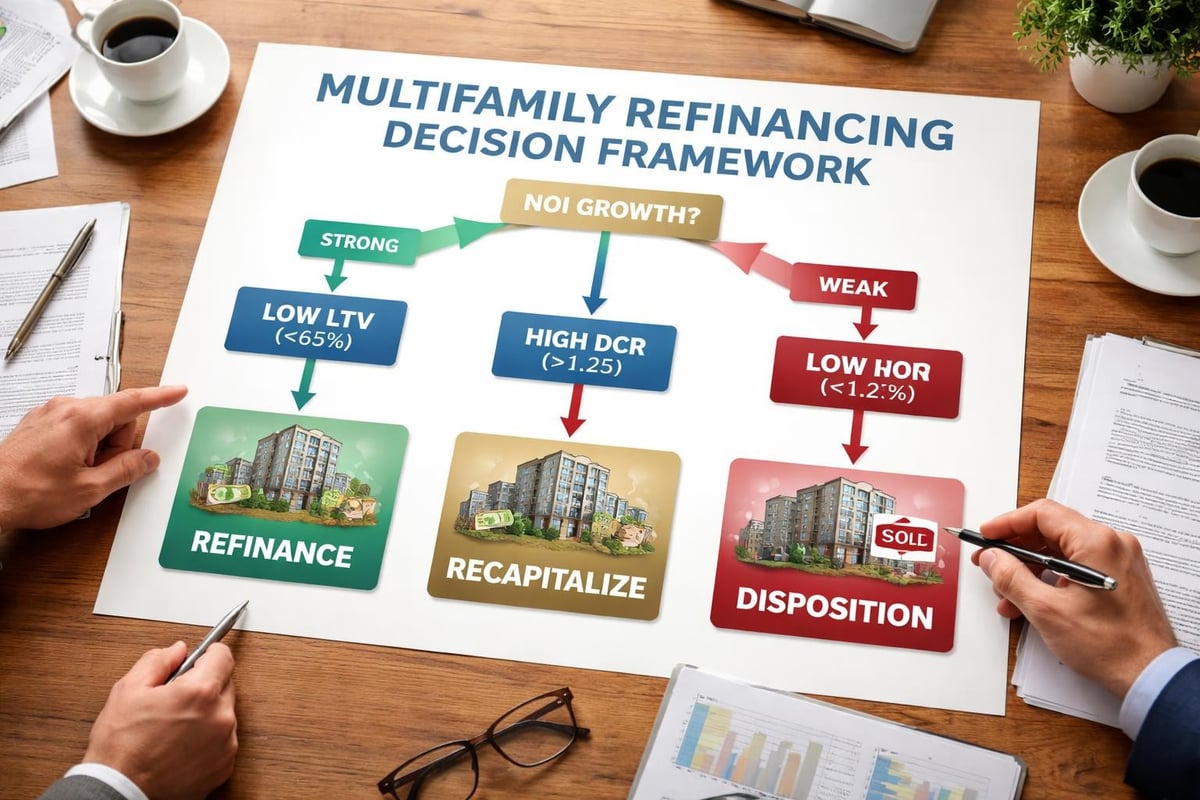
The refinancing wave facing multifamily portfolios in 2026-2027 represents the most significant capital challenge since the Global Financial Crisis. Roughly $1.5 trillion in commercial real estate debt matures through 2027, with multifamily representing substantial exposure. Properties financed in 2020-2022 at 3-4% rates face refinancing into 6-7% environments.
This creates three distinct portfolio segments. Properties with strong NOI growth relative to their acquisition basis refinance successfully, though with compressed cash flow. Properties with modest NOI growth face debt downsizing or equity infusions. Properties that haven’t grown into their basis face potential distress or strategic defaults.
Proactive Capital Planning
Waiting until loan maturity to address refinancing creates negotiating weakness. Effective capital strategy begins 18-24 months before maturity. This timeline allows for performance improvements, lender relationship building, and market timing flexibility. Properties underperforming pro forma require immediate intervention, not deferred hope.
The capital stack optimization question extends beyond debt-versus-equity. Mezzanine debt, preferred equity, and joint venture structures each serve specific purposes in portfolio capitalization. Properties requiring growth capital benefit from structures that avoid refinancing the entire basis. Stabilized assets optimize toward low-cost permanent debt.
Investor reporting becomes critical during refinancing periods. Limited partners or equity investors need transparent communication about refinancing challenges, capital calls, or return adjustments. The operators who maintained investor confidence through the 2023-2024 transition communicated early and often about market realities.
Market Intelligence and Positioning
Portfolio performance depends substantially on market selection quality. The strongest operators in 2026 made market entry and exit decisions based on forward-looking employment trends, housing supply pipelines, and demographic shifts rather than trailing performance data. Markets that performed well in 2020-2022 often face oversupply in 2025-2026 as development pipelines deliver.
Analyzing market fundamentals requires moving beyond simplistic population growth metrics. Job growth quality matters more than quantity. Adding 10,000 retail jobs affects multifamily demand differently than adding 10,000 professional services positions. Wage growth trajectories influence achievable rent levels more than employment levels alone.
Supply pipeline analysis separates sophisticated market assessment from superficial research. Delivered units this year matter less than permitted units delivering next year and the year after. Markets with strong absorption can handle moderate supply. Markets with weakening absorption facing heavy supply delivery create performance headwinds regardless of current strength.
Market intelligence components:
- Employment growth by sector and wage level
- Housing supply pipeline with delivery timing
- Absorption trends and days-on-market data
- Rent growth trajectories and concession patterns
- New household formation and migration data
The portfolio management playbook approach emphasizes systematic market evaluation over opportunistic deal-chasing. Markets selected through disciplined analysis outperform over full cycles.
Technology Integration and Data Analytics
Portfolio management technology evolved significantly between 2020 and 2026. What began as basic reporting dashboards transformed into predictive analytics platforms and AI-driven optimization tools. The technology divide separating leaders from laggards widened as data infrastructure advantages compounded.
Effective technology integration serves three primary functions: operational automation, performance analytics, and strategic intelligence. Operational automation eliminates manual data entry, reconciliation, and reporting tasks. Performance analytics identify outlier properties, units, or expense categories requiring attention. Strategic intelligence synthesizes market data, property performance, and capital markets information into actionable insights.
The challenge most portfolio managers face isn’t technology availability; it’s implementation discipline. Purchasing software solves nothing without data standardization, user training, and process integration. The most successful implementations treat technology as enablers of better decision-making, not replacements for judgment.
Building the Analytics Infrastructure
Portfolio analytics architecture requires five foundational layers. Data collection aggregates information from property management systems, accounting platforms, and market data providers. Data normalization standardizes information across different systems and properties. Data storage creates accessible repositories for historical analysis. Data visualization presents information in actionable formats. Data intelligence applies analytical frameworks to generate insights.
Most operators implement the first three layers adequately but struggle with visualization and intelligence. Raw data and basic reports don’t drive decisions. Comparative analytics showing how properties perform relative to peers, budgets, and historical trends enable rapid intervention. Predictive models that forecast NOI trajectories or refinancing risks support strategic planning.
Commercial real estate databases provide market context that property-level systems can’t deliver. Rent comparisons, occupancy trends, and new supply data inform pricing strategies and market positioning decisions. Integrating external market intelligence with internal performance data creates comprehensive analytical frameworks.
Portfolio Optimization and Strategic Exits
Optimizing existing portfolios requires honest assessment of which properties deserve continued ownership versus strategic disposition. Many operators suffer from endowment effect bias, overvaluing properties because they own them. Disciplined portfolio management requires regular hold-sell analysis based on forward-looking returns, not sunk costs.
Strategic disposition criteria should include market position, competitive set dynamics, capital requirements, and opportunity cost. Properties facing significant capital needs in weakening markets often justify disposition even at modest gains. Redeploying that capital into stronger markets or better-positioned assets improves portfolio-level returns.
The timing of strategic exits matters enormously. Selling into market peaks maximizes proceeds but requires contrarian thinking when markets feel strongest. Properties performing well often represent optimal exit candidates when buyer appetite peaks and pricing multiples expand. The properties operators want to sell during downturns typically attract minimal buyer interest.
Strategic exit indicators:
- Market supply pipeline projecting oversaturation
- Capital requirements exceeding probable return improvements
- Portfolio concentration requiring geographic rebalancing
- Pricing multiples reaching historical peaks for property tier
- Buyer demand from less sophisticated capital sources
Property portfolio analysis frameworks provide systematic approaches to hold-sell decisions. Regular portfolio reviews, conducted semi-annually, identify optimization opportunities before market conditions deteriorate.
Asset Management Versus Portfolio Management
The distinction between asset management and real esatate portfolio management creates confusion in multifamily operations. Asset management focuses on individual property performance optimization. Portfolio management addresses aggregate performance, diversification, and strategic allocation. Both matter, but they require different skill sets and analytical approaches.
Asset managers maximize NOI at individual properties through revenue optimization, expense control, and capital improvement execution. Portfolio managers maximize risk-adjusted returns across the entire portfolio through market selection, disposition timing, and capital allocation. The best operators excel at both but recognize when property-level optimization conflicts with portfolio-level strategy.
This real estate portfolio management guide emphasizes the portfolio perspective because that’s where sophisticated operators create most value. Improving NOI by $50,000 at one property matters less than reallocating $10 million from weak markets into strong ones. Property-level execution enables portfolio strategy but doesn’t replace it.
Organizational Structure for Portfolio Success
Organizational design influences portfolio performance more than most operators acknowledge. Centralized versus decentralized structures each offer advantages. Centralized portfolio management enables consistent standards, bulk purchasing leverage, and capital allocation discipline. Decentralized regional management provides market intimacy and operational responsiveness.
The most effective structures blend both approaches. Portfolio-level functions including capital allocation, market selection, financing strategy, and performance analytics operate centrally. Property-level functions including leasing, maintenance, and resident relations operate regionally or locally. This hybrid structure captures economies of scale while maintaining operational flexibility.
Regulatory and ESG Considerations
Environmental, social, and governance factors increasingly influence portfolio management decisions. Regulatory changes around energy efficiency, building performance standards, and climate risk disclosure affect property values and capital requirements. Markets implementing aggressive efficiency mandates create compliance costs that impact returns.
Energy benchmarking requirements now exist in most major markets. Properties that lag efficiency standards face mandatory retrofit requirements or operating restrictions. Forward-looking portfolio managers address efficiency proactively through capital improvements rather than reactively under regulatory pressure. The properties that installed energy-efficient systems in 2020-2023 face lower compliance risk in 2026-2028.
Social considerations include fair housing compliance, accessibility requirements, and community impact. Properties with histories of fair housing violations or accessibility issues face litigation risk and reputational damage. Governance structures ensuring compliance monitoring, training, and documentation protect portfolio value.
ESG portfolio considerations:
- Energy efficiency scores and carbon footprint tracking
- Water conservation systems and sustainable landscaping
- Fair housing compliance monitoring and testing
- Community engagement and affordable housing contributions
- Board governance and limited partner reporting transparency
The tracking of financial metrics and ESG factors enables comprehensive portfolio assessment beyond purely financial returns. Institutional investors increasingly require ESG reporting alongside traditional performance metrics.
Performance Attribution and Continuous Improvement
Understanding why portfolio performance exceeded or missed targets matters as much as the results themselves. Performance attribution analysis decomposes returns into components: market effects, sector effects, security selection, and operational execution. This analysis reveals whether outperformance resulted from skilled management or favorable market conditions.
Market effects capture overall market movements affecting all properties. A rising tide lifts all boats, but operators shouldn’t confuse market beta for management alpha. Sector effects reflect performance differences between property classes or geographic markets. Strong Sun Belt performance versus weak Midwest performance represents sector effect, not management skill.
Security selection measures returns from choosing specific properties within markets. Operational execution captures value created through management activities: revenue optimization, expense control, and value-add improvements. Sophisticated portfolio managers know which attribution category drives their results.
Continuous improvement processes institutionalize lessons learned. Properties that underperformed receive diagnostic analysis identifying root causes. Properties that outperformed undergo similar analysis to replicate success factors. This systematic approach transforms individual wins and losses into organizational learning.
Benchmarking Against Peers and Markets
External benchmarking provides reality checks on portfolio performance. Operators often overestimate their relative performance without objective comparisons. NCREIF, Yardi, and RealPage provide industry benchmarks across markets and property types. Properties exceeding peer group performance by 200+ basis points demonstrate genuine competitive advantages.
Internal benchmarking across portfolio properties identifies best practices and underperformance. The property achieving 96% economic occupancy with 12% NOI growth operates differently than the property at 91% occupancy with 6% growth. Systematic analysis of high performers reveals transferable practices, while low performer analysis identifies problems requiring intervention.
Portfolio management software and analytics platforms enable both external and internal benchmarking at scale. The competitive advantage flows to operators who implement systematic benchmarking rather than sporadic analysis.
Effective multifamily real estate portfolio management in 2026 requires integration of operational excellence, strategic market positioning, disciplined capital allocation, and robust analytics infrastructure. The operators who master these elements create sustainable competitive advantages regardless of market cycles.
Johanna Gruber provides AI-driven portfolio management solutions designed specifically for multifamily operators seeking to optimize performance across their asset base. By combining advanced analytics with deep real estate understanding, Leni enables portfolio managers to track performance, benchmark assets, identify optimization opportunities, and execute strategies with precision that manual approaches can’t match.

Leni is an AI analyst with a background in real estate.
Born in 2022, Leni works alongside asset managers, asset owners, and limited partners, helping teams stay oriented across systems like Yardi and Entrata. With an understanding of both operations and financials, Leni helps teams spot risk early and actively steps in by surfacing insights, creating alerts, and keeping work moving, decisions aligned, and momentum intact.
Get Portfolio Insights With Leni Analytics


