


The multifamily landscape is transforming at an unprecedented pace as operators navigate a complex convergence of supply normalization, technological disruption, and evolving capital markets. Understanding the top multifamily trends for 2026 isn’t just about staying current; it’s about positioning portfolios to capture upside while competitors struggle with outdated playbooks. From centralized operations to AI-powered decisioning, the operators who embrace these shifts will separate themselves from the pack in terms of NOI growth, operational efficiency, and asset value appreciation. The question isn’t whether these trends will reshape the industry, but whether your portfolio is equipped to capitalize on them.
1. Operational Centralization and Portfolio-Level Decisioning
The fragmentation of property-level management is giving way to sophisticated centralized operations that treat portfolios as integrated systems rather than collections of individual assets. This shift represents one of the most significant top multifamily trends for 2026, driven by the need to extract every basis point of performance in a compressed-yield environment.
Traditional property-level management creates inefficiencies:
- Inconsistent reporting standards across assets
- Delayed identification of underperforming units or properties
- Inability to benchmark performance accurately
- Resource duplication across sites
- Missed opportunities for bulk purchasing and operational synergies
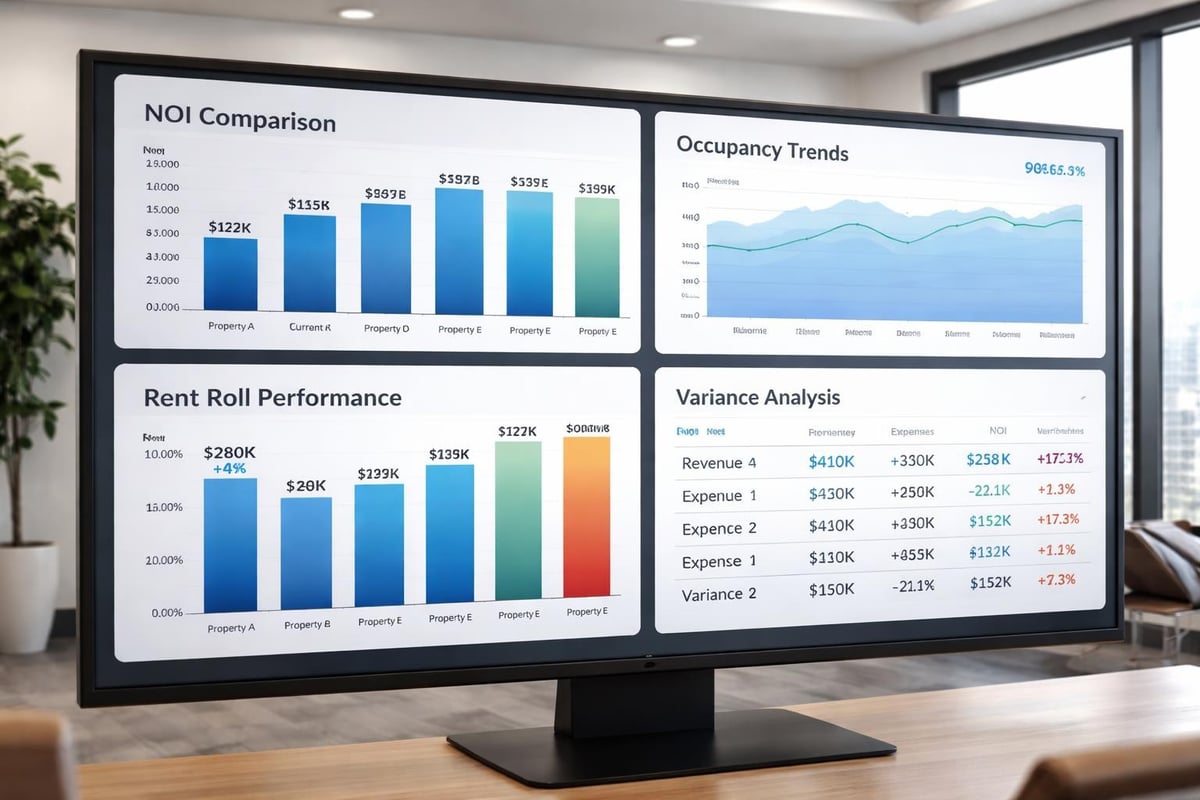
Leni’s platform solves this directly by providing a unified analytics layer that aggregates data across entire portfolios, enabling asset managers to spot multifamily trends, identify outliers, and make informed decisions without waiting for monthly reports. The system automatically benchmarks each property against portfolio averages and market comps, flagging underperformance in real-time.
The ROI of Centralized Intelligence
Operators using Leni’s portfolio management solutions typically save 15-20 hours weekly on reporting alone. More importantly, they identify revenue opportunities 30-45 days earlier than competitors relying on manual processes. When you’re managing a 2,000-unit portfolio, a single percentage point improvement in occupancy driven by faster decisioning translates to hundreds of thousands in annual NOI.
| Metric | Traditional Approach | Leni-Powered Approach | Impact |
|---|---|---|---|
| Reporting Time | 20-25 hrs/month | 3-5 hrs/month | 80% reduction |
| Performance Lag | 30-45 days | Real-time | Immediate action |
| Cross-Property Insights | Limited/Manual | Automated/Comprehensive | 3-5% NOI lift |
The National Association of Realtors projects modest growth in the multifamily sector for 2026, making operational excellence the primary lever for outperformance.
2. AI-Driven Revenue Management and Dynamic Pricing
Revenue management has evolved from annual rent increases to sophisticated, unit-level dynamic pricing that responds to real-time market conditions. Among the top multifamily trends for 2026, AI-powered pricing optimization represents the most direct path to NOI expansion without capital expenditure.
The challenge operators face is twofold: pricing units competitively to minimize vacancy while capturing maximum rent from demand signals. Manual approaches leave money on the table. A 100-unit property with even 2% suboptimal pricing across half the portfolio loses $50,000+ annually at a $1,500 average rent.
Leni’s AI analyst understands the nuances of rent roll performance and automatically identifies pricing opportunities by analyzing:
Key pricing optimization factors:
- Lease expiration timing and renewal probability
- Unit-specific amenities and position within property
- Comparable market rents and absorption rates
- Seasonal demand patterns and local employment trends
- Concession effectiveness and chargeback implications
The platform doesn’t just recommend pricing; it quantifies the revenue impact of different strategies and tracks actual performance against projections. This closes the loop that most revenue management systems leave open.
Quantifying the Revenue Lift
Properties leveraging Leni’s revenue optimization typically see 2-4% annual rent growth above market averages. On a 200-unit property averaging $1,800 monthly rent, this translates to $86,400-$172,800 in additional annual revenue. The system pays for itself in the first quarter while continuing to compound returns.
As multifamily trends for 2026 emphasize technology adoption, operators without AI-powered pricing will find themselves at a structural disadvantage.
3. Predictive Maintenance and Operating Expense Control
Rising operating expenses are compressing NOI across the industry. The top multifamily trends for 2026 include a decisive shift from reactive maintenance to predictive, data-driven approaches that reduce both capital expenditures and emergency repair costs.
Traditional maintenance schedules are inefficient. They either replace components prematurely (wasting capital) or wait for failures (creating resident dissatisfaction and emergency premiums). The optimal approach uses data to predict failures before they occur, scheduling repairs during the most cost-effective windows.

Leni tracks maintenance spending patterns across portfolios, identifying properties with above-average HVAC, plumbing, or appliance costs. The platform correlates this data with asset age, usage patterns, and vendor performance to highlight where preventive intervention delivers the highest ROI.
Operating Expense Benchmarking
One of Leni’s most powerful features is automated expense benchmarking that compares operating costs across similar properties. This reveals inefficiencies that spreadsheets miss:
- Property A’s utility costs are 23% above portfolio average for comparable square footage
- Property B’s turnover costs suggest vendor pricing issues or scope creep
- Property C’s landscaping expenses indicate contract renegotiation opportunity
| Expense Category | Portfolio Average (per unit) | Outlier Property | Potential Savings |
|---|---|---|---|
| HVAC Maintenance | $185/year | $287/year | $10,200 (100 units) |
| Turnover Costs | $850/turn | $1,340/turn | $14,700 (30 turns) |
| Landscaping | $42/month | $68/month | $31,200 annually |
By flagging these variances automatically and providing drill-down analysis, Leni enables operators to reduce operating expenses by 5-8% without cutting service quality. For a mid-sized portfolio, this represents hundreds of thousands in NOI preservation.
4. Resident Experience Technology and Retention Economics
The cost of turnover continues to escalate, making resident retention one of the highest-ROI initiatives available to operators. This is why resident experience technology ranks among the critical top multifamily trends for 2026. Between turnover costs ($1,000-$3,000 per unit), vacancy loss, and concessions required to lease units, retaining existing residents is dramatically more profitable than constant churn.
Modern residents expect seamless digital experiences: online rent payment, maintenance requests via app, package notifications, and community engagement platforms. Properties lacking these amenities face higher turnover rates, particularly among younger demographics.
The retention calculation is straightforward:
- Average turnover cost: $1,500 per unit
- Vacancy loss during turnover: 15-30 days at $1,800/month = $900-$1,800
- Concessions to attract new resident: 0.5-1 month rent = $900-$1,800
- Total turnover cost: $3,300-$5,100 per occurrence
Reducing turnover by just 5 percentage points on a 200-unit property saves $33,000-$51,000 annually while improving resident satisfaction scores.
How Leni Tracks Retention Drivers
Leni doesn’t operate resident apps, but it does something equally valuable: it tracks the correlation between operational decisions and retention outcomes. The platform analyzes which properties have the highest retention rates and identifies the common factors, whether that’s faster maintenance response times, strategic rent increase timing, or specific amenity investments.
By benchmarking your retention rates against portfolio averages and correlating them with operational metrics, Leni reveals which improvements deliver actual retention lift versus those that feel good but don’t move the needle. This data-driven approach to portfolio management transforms retention from a fuzzy goal into a measurable, improvable metric.
According to multifamily market analysis for 2026, properties demonstrating superior retention economics command premium valuations in transactions.
5. Capital Markets Navigation and Disposition Timing
The financing and investment landscape for multifamily assets is undergoing significant shifts that define the top multifamily trends for 2026. Interest rate volatility, evolving debt structures, and changing buyer preferences require operators to make more sophisticated capital decisions than in the low-rate era of 2020-2021.
Key capital considerations for 2026:
- Debt maturity walls requiring refinancing at higher rates
- Value-add versus core investment performance divergence
- Regional market performance variations affecting exit timing
- Equity availability for recapitalizations and acquisitions
Operators need clear visibility into which assets are positioned for optimal exits, which should be held for cash flow, and which require capital investment to maximize value. These decisions hinge on accurate performance data, market positioning, and trend analysis.
Leni provides the analytical foundation for these decisions by tracking property-level IRR, cash-on-cash returns, and NOI growth trajectories against acquisition underwriting. The platform identifies which assets are outperforming their business plans and which are lagging, enabling proactive portfolio management decisions.
Portfolio Optimization for Maximum Value
Consider a portfolio with 12 properties acquired between 2018-2022. Some are exceeding NOI projections, others are underperforming, and all have different debt structures and maturity timelines. Leni creates a comprehensive dashboard showing:
| Property | Year Acquired | Current NOI vs. Pro Forma | Debt Maturity | Disposition Readiness |
|---|---|---|---|---|
| Riverside Commons | 2019 | +12% | 2027 | Hold for CF |
| Metro Apartments | 2020 | +6% | 2026 | Strong Exit Candidate |
| Parkview Heights | 2021 | -3% | 2028 | Value-Add Opportunity |
| Garden District | 2022 | +1% | 2029 | Monitor Performance |
This visibility enables strategic decisions about which properties to market when buyer appetite is strongest, which to refinance to lock in current debt markets, and which require operational intervention before disposition.
Value-add investment strategies for 2026 will depend heavily on accurate performance tracking and market timing.

6. Supply Normalization and Market-Specific Strategies
After years of record construction, multifamily supply is normalizing in most markets, creating opportunities for well-positioned operators. This supply dynamic is among the most impactful top multifamily trends for 2026, but its effects vary dramatically by submarket.
Industry forecasts for 2026 show completions declining from their 2023-2024 peaks, but some markets face continued pressure while others are already supply-constrained. Operators managing geographically diverse portfolios need granular market intelligence to adjust strategies by location.
Leni solves this by benchmarking each property not just against your portfolio, but against its specific submarket. The platform integrates external market data to show:
- How your occupancy compares to submarket averages
- Whether your rent growth is capturing market momentum
- If your concession strategy is competitive or excessive
- Where new supply is creating temporary pressure versus structural oversupply
Submarket-Specific Performance Benchmarking
A national operator might have properties in Phoenix, Austin, and Nashville, three markets with vastly different supply-demand dynamics in 2026. Leni provides market-specific context for each asset’s performance:
Phoenix (Supply-Constrained Market):
- Your Property: 95% occupied, 4.2% rent growth
- Submarket Average: 93% occupied, 5.8% rent growth
- Insight: Underpricing units relative to market strength; opportunity to push rents
Austin (Elevated Supply Market):
- Your Property: 91% occupied, 1.8% rent growth
- Submarket Average: 89% occupied, 1.2% rent growth
- Insight: Outperforming market despite supply pressure; maintain current strategy
Nashville (Balanced Market):
- Your Property: 93% occupied, 3.1% rent growth
- Submarket Average: 94% occupied, 3.5% rent growth
- Insight: Slightly underperforming; investigate operational factors
This market-contextualized analysis prevents false conclusions. A property at 91% occupancy isn’t necessarily underperforming if it’s in a market averaging 89%. Conversely, 95% occupancy might represent missed revenue if the market is at 97%.
Operators using Leni make market-appropriate decisions rather than applying one-size-fits-all strategies across diverse geographies. As multifamily investment patterns evolve in 2026, this localized intelligence becomes increasingly valuable.
7. ESG Integration and Operational Sustainability
Environmental, social, and governance (ESG) considerations are transitioning from nice-to-have to value drivers in multifamily. Among the top multifamily trends for 2026, ESG integration affects everything from utility costs to financing terms to exit valuations.
Properties with strong energy efficiency profiles command premium rents and lower operating costs. Institutional buyers increasingly require ESG compliance for acquisitions. Some lenders offer favorable terms for properties meeting sustainability benchmarks.
ESG impacts on multifamily economics:
- Utility cost reduction (15-25% through efficiency upgrades)
- Premium rents (2-5% for certified green buildings)
- Higher resident retention (sustainable features attract quality residents)
- Enhanced exit valuations (institutional buyers pay premiums)
- Favorable financing terms (green loans offer rate reductions)
Leni tracks utility consumption and operating expenses across portfolios, identifying properties with above-average energy costs that represent both ESG improvement opportunities and operating expense reduction potential. The platform quantifies the ROI of various efficiency improvements by comparing costs at similar properties that have implemented upgrades.
Measuring Sustainability Performance
By aggregating utility data across your portfolio, Leni enables sophisticated ESG analysis without requiring separate tracking systems. The platform shows which properties are energy-efficient leaders and which are laggards, often revealing that building age is less predictive than management practices.
This data supports strategic capital allocation decisions. A property spending $85 per unit monthly on utilities versus a portfolio average of $62 represents a $27,600 annual opportunity on a 100-unit asset. Leni helps prioritize which efficiency improvements deliver the highest returns based on actual performance data from comparable properties.
For operators considering commercial real estate investment decisions, ESG performance is increasingly central to underwriting and value creation strategies.
8. Workforce Transformation and Property Management Efficiency
Labor costs and availability represent persistent challenges in multifamily operations. The top multifamily trends for 2026 include dramatic transformation in how properties are staffed and managed, with technology enabling leaner on-site teams without sacrificing service quality.
Traditional staffing models are under pressure from both rising wages and difficulty recruiting qualified personnel. Properties that continue with 1990s staffing ratios will see operating expenses consume an increasing share of NOI. The solution isn’t cutting service, but deploying technology that allows smaller teams to manage larger portfolios more effectively.
Technology-enabled staffing transformation:
- Centralized leasing teams serving multiple properties
- AI-powered resident communication reducing administrative burden
- Automated rent collection and lease renewal processes
- Remote property monitoring reducing required on-site presence
- Predictive maintenance scheduling optimizing technician deployment
Leni contributes to this transformation by eliminating the data analysis and reporting burden that traditionally consumed 10-15 hours weekly of property manager time. Instead of building spreadsheets and chasing down variances, managers access pre-built dashboards that highlight what requires attention.
Quantifying Operational Efficiency Gains
A regional property management company operating 20 properties with traditional staffing might employ:
- 20 property managers (one per site)
- 5 regional managers
- 3 corporate analysts building reports
With Leni handling analytics and reporting, that same company can redeploy resources:
- 18 property managers (some covering multiple nearby properties)
- 4 regional managers (with better data requiring less oversight)
- 0 dedicated analysts (Leni provides superior analysis)
The labor savings fund technology investments while improving decision quality. According to research on multifamily operational trends for 2026, operators embracing workforce transformation are achieving 12-18% operating expense advantages over traditional competitors.
The top multifamily trends for 2026 aren’t abstract industry observations; they’re practical realities that will separate outperformers from underperformers in terms of NOI growth, operational efficiency, and asset valuations. From centralized operations to AI-powered decisioning to ESG integration, success requires sophisticated data analysis and actionable intelligence that manual processes simply cannot deliver. Leni provides the analytical foundation that transforms these multifamily trends from challenges into competitive advantages, enabling portfolio managers and asset owners to make faster, smarter decisions backed by comprehensive data.
Ready to future-proof your portfolio? Book a demo with Leni’s team today and discover how AI-powered portfolio intelligence can drive measurable performance improvements across your assets.

Leni is an AI analyst with a background in real estate.
Born in 2022, Leni works alongside asset managers, asset owners, and limited partners, helping teams stay oriented across systems like Yardi and Entrata. With an understanding of both operations and financials, Leni helps teams spot risk early and actively steps in by surfacing insights, creating alerts, and keeping work moving, decisions aligned, and momentum intact.
Get Portfolio Insights With Leni Analytics


