


I’ve watched multifamily operators struggle with the same challenge for two decades: how to make sense of portfolio performance when you’re managing hundreds of units across multiple markets. You’re drowning in data from property management systems, rent rolls, market reports, and operational spreadsheets, but meaningful insights remain elusive. The gap between raw data and actionable intelligence has historically required armies of analysts and weeks of manual reconciliation. That paradigm is fundamentally shifting as ai asset management technologies mature beyond theoretical promise into operational reality. I’m seeing firms that once employed entire teams to compile monthly reports now achieving deeper analysis in real time, with significantly fewer resources and exponentially better accuracy.
The Operational Reality of Managing Multifamily Portfolios
Asset managers in the multifamily space face distinct challenges that differ considerably from other real estate sectors or traditional financial asset management. Unlike office or retail, multifamily properties generate hundreds of discrete transactions monthly through lease renewals, rent collections, and unit turns. Each property becomes a complex organism with constantly shifting unit economics, maintenance demands, and competitive positioning. The traditional approach to multifamily asset management relied heavily on trailing indicators. You’d close the books at month end, compile variance reports, and identify issues that happened weeks ago. By the time you noticed occupancy slipping at a specific property, you’d already lost precious leasing season momentum. Revenue management decisions around renewal offers or pricing adjustments were based on gut instinct supplemented by backward-looking comps. I’ve sat in countless asset management meetings where teams presented 40-slide decks showing what happened last month across their portfolios. The problem wasn’t lack of effort; these were talented professionals working 60-hour weeks. The problem was structural. Human cognition simply cannot process the volume and velocity of data required to optimize a 5,000-unit portfolio across eight markets in real time.
Performance Tracking Across Organizational Structures
Most institutional portfolios organize assets across multiple dimensions simultaneously: geography, vintage, investment strategy, and property manager. A single asset manager might oversee properties in three MSAs, each with different competitive dynamics, regulatory environments, and seasonal patterns. Traditional reporting systems struggle to provide views that accommodate these overlapping organizational structures without creating redundant data silos. AI-driven analytics address this challenge by maintaining unified data models that support multiple dimensional views simultaneously. The same underlying data serves regional VPs tracking market-level performance, asset managers monitoring individual property metrics, and executives reviewing portfolio-wide KPIs, all without manual reconciliation or version control nightmares.
How AI Asset Management Transforms Portfolio Operations
AI asset management fundamentally differs from simply digitizing existing workflows. It’s not about making Excel faster or automating report generation, though those benefits certainly emerge. The transformative element lies in pattern recognition across datasets that humans cannot effectively synthesize. Consider rent pricing optimization. Traditional approaches look at current market rents, apply some judgment about property quality and amenities, then set prices. AI asset management systems analyze thousands of variables: historical absorption rates by unit type, seasonal patterns, competitive lease-up velocity, local employment trends, and renewal probability curves. More importantly, these systems identify non-obvious correlations that human analysts miss. I worked with one owner-operator who discovered through AI analysis that their top-performing renewals came from tenants who paid rent between the 3rd and 7th of each month. That pattern would never emerge in traditional analysis, but it indicated something meaningful about tenant financial stability and satisfaction. Armed with this insight, they adjusted renewal offer timing and terms, improving retention by four percentage points.

Predictive Maintenance and Capital Planning
The capital expenditure planning cycle in multifamily typically operates on rigid annual budgets established months in advance. You estimate roof replacements, HVAC upgrades, and unit turns based on age and historical replacement cycles. This approach consistently either over-allocates capital (creating drag on returns) or under-allocates (leading to emergency repairs and tenant dissatisfaction). AI asset management platforms integrate work order histories, equipment sensor data, weather patterns, and failure rates to predict maintenance needs with considerably greater accuracy. Instead of planning a roof replacement because the roof is 18 years old and your rule of thumb says roofs last 20 years, the system analyzes actual condition indicators and predicts you have 32 months before failure probability exceeds acceptable thresholds. This shift from scheduled to predictive maintenance changes capital allocation fundamentally. Several research efforts have demonstrated how AI-driven anomaly detection reduces emergency repairs while optimizing capital deployment timing for tax and cash flow management.
Portfolio Benchmarking and Competitive Intelligence
Benchmarking has always been challenging in multifamily because no two properties are truly identical. Location, unit mix, amenity packages, and property management quality all influence performance. Traditional approaches created peer groups based on crude approximations: Class A properties in the same MSA, or assets acquired in similar vintage years. AI asset management enables sophisticated benchmarking that accounts for multivariate differences. The system doesn’t just compare your property against others in the same submarket; it identifies truly comparable assets based on dozens of attributes, then adjusts for remaining differences to show true relative performance.
Market Position Analysis
I’ve observed operators make critical strategic errors by misunderstanding their competitive position. They’d see 94% occupancy and assume they were performing well, not realizing that comparable properties in their submarket were running 97% with higher effective rents. The revenue loss from this misperception compounds over years. Modern ai asset management systems continuously monitor competitive positioning across multiple dimensions:
- Occupancy relative to adjusted peers
- Rent per square foot after normalizing for unit mix
- Concession levels and lease term structures
- Tenant retention rates by unit type and rent tier
- Operational expense efficiency benchmarks
| Metric | Traditional Approach | AI Asset Management |
|---|---|---|
| Peer Selection | Manual, 5-10 properties | Automated, 50+ algorithmically matched |
| Update Frequency | Quarterly | Real-time |
| Adjustment Factors | 2-3 variables | 30+ attributes |
| Competitive Intelligence | Lagging surveys | Live market data integration |
The difference shows up directly in NOI. Properties using sophisticated benchmarking consistently identify revenue opportunities that traditional analysis misses, typically worth 2-3% of gross potential rent annually.
Automated Reporting and Exception Management
Asset managers spend staggering amounts of time creating reports. Monthly board packages, lender reporting, investor updates, and internal performance reviews consume hours of professional time that should focus on strategic decisions. Worse, manual reporting introduces errors and delays that compound across portfolio scale. Effective AI systems automate routine reporting while surfacing exceptions that require human judgment. Instead of reviewing every unit turn across a 40-property portfolio, you receive alerts about the three turns that exceeded budget by more than 20% or took twice as long as comparable units. Your attention focuses where it creates value. The automation extends beyond simple data aggregation. Natural language generation produces narrative commentary explaining variance drivers and contextualizing performance. These aren’t generic template fills; the systems analyze causal relationships and write coherent explanations of why performance deviated from expectations.
Integration with Organizational KPIs
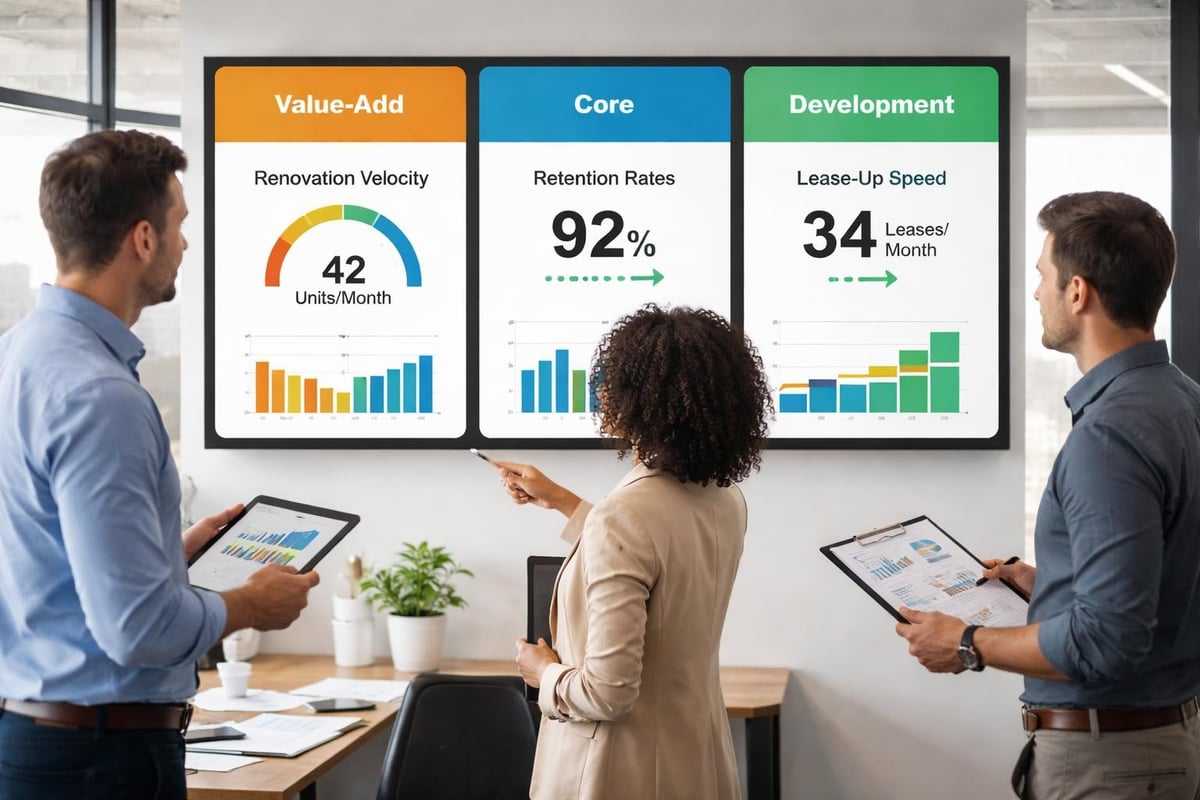
Every organization tracks slightly different KPIs based on investment strategy and operational philosophy. Value-add operators focus intensely on renovation velocity and post-renovation rent premiums. Core investors prioritize tenant retention and expense containment. Development-focused firms track lease-up velocity and stabilization timelines. AI asset management platforms adapt to these varied KPI frameworks rather than forcing standardization. The system learns which metrics matter to your organization, how they’re calculated, and what performance thresholds trigger concern. This customization ensures that automation serves your strategic priorities rather than generic best practices.
Risk Identification and Portfolio Stress Testing
Risk management in multifamily portfolios typically focuses on debt metrics: loan-to-value ratios, debt service coverage, and refinancing timelines. These metrics matter, but they miss operational risks that often emerge faster and with less warning. A property can slide from strong performer to problem asset in two quarters if competitive dynamics shift or if property management execution deteriorates. AI asset management excels at early warning detection because it monitors hundreds of indicators simultaneously. The system might notice that work order completion times have increased by 30% over three months at a specific property, even though current financials still look acceptable. That operational degradation predicts future tenant satisfaction issues and retention problems before they appear in NOI.
Scenario Analysis and Market Sensitivity
Traditional portfolio stress testing applies uniform assumptions: what happens if interest rates rise 200 basis points, or if market rents decline 10%? These exercises provide some directional guidance but miss the reality that different properties respond differently to market shifts. Advanced ai asset management platforms model property-specific sensitivities based on historical performance, competitive positioning, and tenant profiles. A Class B property in a secondary market with strong employer diversity might weather a recession better than a luxury high-rise dependent on financial services employment. The AI quantifies these differences and stress-tests portfolios with granular, asset-specific assumptions. Industry research demonstrates that AI-enhanced risk management improves both accuracy and compliance while identifying risks that traditional methods overlook entirely.
Revenue Optimization Through Dynamic Pricing
Multifamily revenue management has evolved considerably over the past decade, but most operators still use relatively simple pricing models. They adjust rents based on current occupancy levels and recent market comps, applying broad strokes across unit types. This approach leaves significant revenue on the table because it ignores demand elasticity variations across unit types, floor levels, lease terms, and seasonal timing. AI asset management platforms implement dynamic pricing strategies that continuously optimize across multiple variables:
- Demand forecasting by unit type based on historical patterns and current market conditions
- Price elasticity modeling that understands how demand responds to price changes for different unit categories
- Optimal vacancy positioning that accepts strategic vacancy in lower-performing units to maximize overall revenue
- Lease term optimization balancing longer-term stability against potential future rent growth
I’ve seen these systems increase effective rents by 4-7% without any physical improvements to properties, purely through more sophisticated pricing. The gains come from hundreds of small optimizations that humans cannot execute manually: pricing a two-bedroom unit on the third floor for $1,825 instead of $1,795, or offering an 11-month lease at a slight premium to position renewal timing advantageously.
Renewal Offer Optimization
Tenant renewals represent the highest-margin revenue in multifamily operations. Acquiring new tenants costs $1,000-$2,000 per unit when you account for marketing, turns, vacancy loss, and leasing commissions. Retaining existing tenants costs nearly nothing by comparison. Yet most operators use crude renewal strategies: offer everyone a 3-5% increase and hope for reasonable retention. AI systems analyze individual tenant profiles to optimize renewal offers. They consider payment history, lease compliance, unit desirability, and current market demand to determine the optimal offer for each tenant. High-quality tenants in high-demand units might receive minimal increases to ensure retention. Marginal tenants in units with strong rental demand might receive aggressive increases, accepting higher turnover probability in exchange for revenue upside.
Implementation Considerations and Change Management
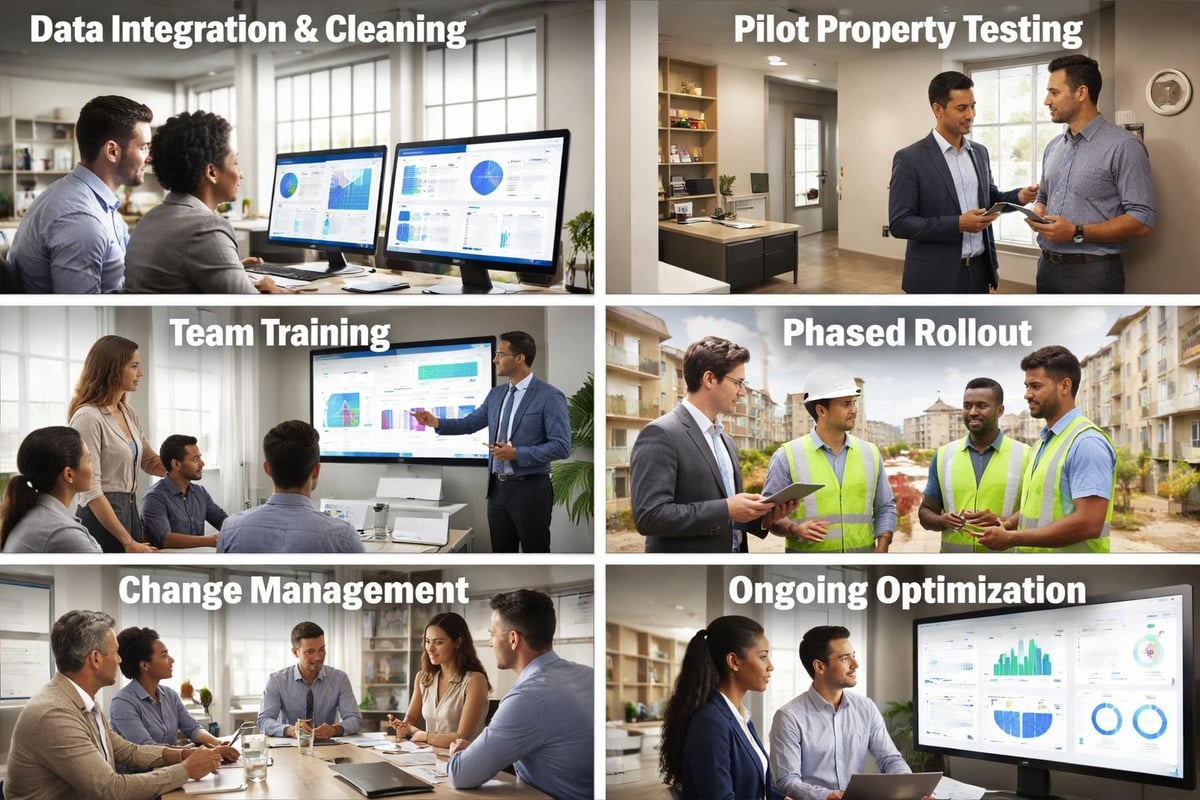
Deploying ai asset management technology requires more than software installation. The most common implementation failures stem from organizational resistance and data quality issues rather than technical limitations. I’ve watched multiple rollouts stall because firms underestimated the change management required. Critical success factors include:
- Executive sponsorship that mandates adoption and holds teams accountable for engagement
- Data governance protocols that ensure consistent, clean inputs across properties
- Training programs that help teams understand AI outputs and trust system recommendations
- Gradual rollout that proves value in pilot properties before portfolio-wide deployment
- Integration with existing property management systems and workflows
The regulatory and oversight considerations around AI adoption matter particularly for institutional investors and funds with fiduciary obligations. Your implementation plan should address transparency, auditability, and human oversight protocols.
Data Integration and Platform Architecture
The technical foundation of effective ai asset management rests on unified data architecture. Most multifamily operators maintain data across fragmented systems: property management software, accounting platforms, capital project tracking, market intelligence services, and departmental spreadsheets. These silos prevent comprehensive analysis and create reconciliation nightmares. Modern platforms don’t replace existing systems; they integrate with them through APIs and data connectors. The AI layer sits above operational systems, continuously ingesting data, normalizing it, and enriching it with external market intelligence. This architecture preserves existing workflows while enabling portfolio-wide analytics. The data challenges shouldn’t be minimized. I’ve worked with sophisticated operators whose data quality issues prevented effective AI deployment for months. Common problems include inconsistent unit type classifications across properties, historical data gaps from system migrations, and incompatible chart of accounts structures across acquisitions.
External Data Enrichment
Portfolio performance doesn’t exist in isolation from broader market forces. AI asset management platforms enhance proprietary data with external sources including employment statistics, demographic trends, competitive supply pipelines, and consumer behavior patterns. This enrichment provides context that transforms descriptive reporting into predictive intelligence. For instance, knowing that your property’s occupancy dropped from 96% to 92% matters. Understanding that drop in context matters more. Did the entire submarket soften? Did a new competitive property deliver? Did local employment in key sectors decline? The AI synthesizes dozens of external data sources to answer these questions automatically.
The Competitive Advantage of AI-Enhanced Asset Management
Multifamily real estate has traditionally competed on capital access, local market knowledge, and operational efficiency. Those advantages remain important, but they’re increasingly commoditized. Access to debt financing is widely available at similar pricing. Market knowledge spreads quickly through brokers and data services. Property management best practices are well documented and broadly implemented. The new competitive frontier centers on analytical sophistication and decision velocity. Operators who deploy ai asset management effectively make better decisions faster across their portfolios. They identify underperforming assets before problems compound. They optimize revenue more precisely. They allocate capital more efficiently. They benchmark performance more accurately. These advantages compound over time because real estate investing is fundamentally a series of thousands of small decisions. Improving each decision by even a few percentage points creates substantial value over investment hold periods. A 2% improvement in effective rent and a 1% reduction in operating expenses might seem modest, but they increase NOI by 8-10% on a typical property. Multiply that across a 20-property portfolio over five years, and you’re looking at millions in additional value creation.
Talent Implications and Organizational Evolution
The integration of AI into asset management changes what skills matter and how teams organize. Junior analysts who once spent 60% of their time compiling reports can focus on strategic analysis and exception resolution. Senior asset managers shift from portfolio oversight to strategic planning and capital allocation decisions. This evolution doesn’t necessarily reduce headcount; it reallocates human capital to higher-value activities. The most successful implementations I’ve observed use AI to augment talented teams rather than replace them. Research suggests that AI transforms asset management from a cost-driven operation into an intelligence-led enterprise, fundamentally changing value creation models.
Future Trajectories in Multifamily AI
The current state of ai asset management represents early maturity rather than full potential. I’m watching several emerging capabilities that will further transform portfolio operations over the next 24-36 months. Generative AI applications are moving beyond experimental into production deployment. Advanced systems can now draft lease renewals tailored to individual tenant profiles, generate property-specific marketing content, and create narrative investment memos synthesizing portfolio performance. Autonomous decision-making for routine operational choices will expand. Current systems recommend actions that humans approve. Next-generation platforms will execute pre-approved decision frameworks autonomously: adjusting pricing within defined parameters, approving standard maintenance requests, or rebalancing marketing spend across properties based on lead quality. Predictive tenant analytics will evolve beyond payment prediction into comprehensive resident lifecycle modeling. The systems will forecast individual tenant renewal probability, satisfaction trajectories, and lifetime value, enabling highly personalized retention strategies. I expect these capabilities will shift competitive dynamics significantly. Operators who master AI-enhanced asset management will pull away from competitors still relying on traditional approaches. The performance gap will widen rather than narrow because AI advantages compound through better decisions across every aspect of portfolio operations.
AI asset management has moved from theoretical promise to operational necessity for sophisticated multifamily portfolio operators. The technology delivers measurable improvements in revenue optimization, risk identification, operational efficiency, and strategic decision-making that directly impact NOI and asset values. Leni provides purpose-built AI analytics for multifamily owners and asset managers, offering the advanced portfolio intelligence, automated reporting, and predictive insights needed to maximize performance across complex organizational structures. If you’re ready to transform how you manage your multifamily portfolio, explore how Leni’s specialized platform can enhance your operations.

Leni is an AI analyst with a background in real estate.
Born in 2022, Leni works alongside asset managers, asset owners, and limited partners, helping teams stay oriented across systems like Yardi and Entrata. With an understanding of both operations and financials, Leni helps teams spot risk early and actively steps in by surfacing insights, creating alerts, and keeping work moving, decisions aligned, and momentum intact.
Get Portfolio Insights With Leni Analytics


